The Clinical Information System (CIS)Brittney N.Teresa H.Greg D.Stephanie J.
Overview of CIS: slides 4-7 by Teresa H.EHR Component: slides 8-10 by Stephanie J.Clinical decision making system in a CIS: slides 11-13 by Greg D. Safety: slides 14-18 by Teresa H.Cost: slides 19-21 by Brittney N.Education: slides 22-23 by Brittney N.
Intro into CIS & EHRThe Clinical Information System (CIS) and Electronic Health Record (EHR) are key components to giving quality care to clients. It allows health care professionals to come together and deliver care, and without the organization of such software, information could possibly get lost in translation.
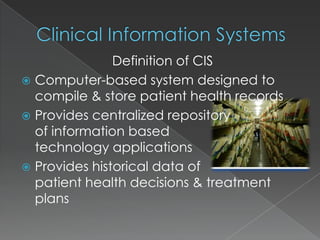
Clinical Information SystemsDefinition of CIS   Computer-based system designed to compile & store patient health records Provides centralized repository                                       of information based                                      technology applicationsProvides historical data of                             patient health decisions & treatment plans
Allows navigation and integration of information from different entities (billing,                                     compliance,wellness activities)	Encodes knowledge to drive                              clinical decision making processCaptures clinical data to support                       more efficient & effective                                                   decision making that is evidenced based           Provides for interdisciplinary exchange of information to streamline workflow
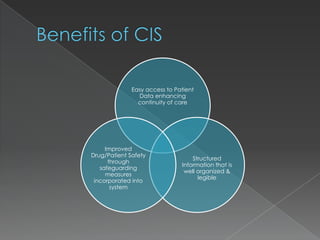
Benefits of CIS
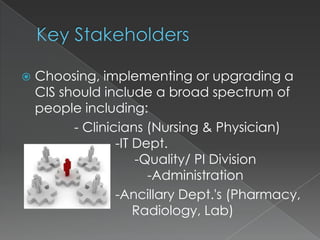
Key StakeholdersChoosing, implementing or upgrading a CIS should include a broad spectrum of people including:              - Clinicians (Nursing & Physician) 			-IT Dept.						              -Quality/ PI Division					-Administration			-Ancillary Dept.'s (Pharmacy,	                      Radiology, Lab)
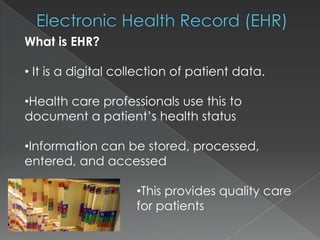
Electronic Health Record (EHR)What is EHR? It is a digital collection of patient data.
Health care professionals use this to document a patient’s health status
Information can be stored, processed, entered, and accessed
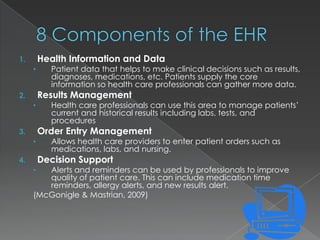
This provides quality care for patients8 Components of the EHRHealth Information and DataPatient data that helps to make clinical decisions such as results, diagnoses, medications, etc. Patients supply the core information so health care professionals can gather more data. Results ManagementHealth care professionals can use this area to manage patients’ current and historical results including labs, tests, and procedures Order Entry ManagementAllows health care providers to enter patient orders such as medications, labs, and nursing. Decision SupportAlerts and reminders can be used by professionals to improve quality of patient care. This can include medication time reminders, allergy alerts, and new results alert.(McGonigle & Mastrian, 2009)
Electronic Communication and ConnectivityCommunication between health care personnel through e-mail and recording digital messages. Patient SupportPrograms for patient education and monitoring tools. This is for patients to access and become more knowledgeable over health topics.Administrative ProcessesThis is for health facilities and insurance companies for filing claims, scheduling appointments, and billing clients. Reporting and Population Health ManagementThis component is a part of data collection tools that help to create support for public and private reporting requirements. (McGonigle & Mastrian, 2009)8 Components Cont’d.
Decision Making SystemStructureDecisions : Diagnosis, alternative diagnosisIe. – red sore throat+white patches on throat+fever= Strep throat    may be = pharyngitis, tonsillitis Actions: Interventions or care to be administeredStrep throat = antibiotics, Tylenol, contact precautions Process: Hierchial approach to delineate the importance of each step of care and what order they should be in.1) 10 day antibiotics immediately 2) contact precautions/Tylenol
Decision Making SystemImplementing EBP“If clinical research is to improve clinical care, it must be relevant, of high quality, and accessible” (Sim, Gorman, Greenes, Haynes, & Kaplan, 2001)The goal of researchers is to “Develop shareable, machine-readable repositories of executable guidelines that are linked to up-to-date evidence repositories” (Sim, Gorman, Greenes, Haynes, & Kaplan, 2001)A good decision making system for a CIS is continually evolving and updating
Decision Making SystemsCompaniesCompanies that are involved in developing decision making systems are: HBOC, IBM, Siemens Medical Systems, and Health VISIONSiemens Medical Systems - http://www.medical.siemens.com/siemens/en_GLOBAL/gg_diag_FBAs/files/Informatics/Protis/0701021-Protis_Mappe_LO_38456275_1.pdfDifferent decision making systems make different decisions!!!Example – Siemens Medical Systems Protis system :Delivers a comprehensive overview of results for each patient Integrates test data from multiple instruments into one report Supports a broad range of assessment modules: iron and anemia, nutrition, cardiac risk, kidney, and CSF Provides doctors with an easy-to-review graphical readout Simplifies organization of test data, saving time (Siemens Medical Systems, 2011)
Safety ConsiderationsBackup/Storage of DataData Warehouses act as repositories for an organization’s data; allows its later retrieval (Often located off-site)By digitizing & centralizing information, it becomes more accessibleMinimizing downtime                                             increases functionality of                                      system
Safety cont.Protection of Files (viruses, hacker, & worms)Safeguards: Develop a System Map to identify                             all computers connected to internal                 network, virus scanning software,                   intrusion detection systemsDevelop a Security Policy defining authorized users, password policy & accessibility	    Harden the Software by checking for updates & patches
Safety cont.Reduce the number of access points		Install a gateway or firewall to shield your internal network from the Internet; install anti-virus software    Require data encryption for                                              information sent over unsecured                                     networks or on portable devices                     	Conduct periodic security audits
Safety cont.Health Insurance Portability & Accountability Act became law in1996; established to provide privacy, confidentiality, & security to patientsHealth care entities must insure all coworkers have received HIPAA educationCollaboration with external sites & entities to insure knowledge of policiesEstablish disciplinary action for violationsEnsure protocol to identify, authenticate, & properly respond to individual request for records.
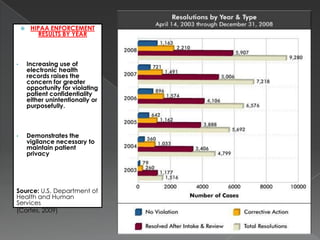
HIPAAHIPAA ENFORCEMENT RESULTS BY YEARIncreasing use of electronic health records raises the concern for greater opportunity for violating patient confidentiality either unintentionally or purposefully.
Demonstrates the vigilance necessary to maintain patient privacySource: U.S. Department of Health and Human Services(Cortes, 2009)
CO$TSeveral things should be considered in the total cost of implementing an EHR/EMR: purchase price, IT personnel, maintenance, system capable of handling the software, staff education, & more.Purchase Price
Depends on size of facility, implementation process, & current legacy (operating) system.
Health Information Technology Act of 2007 and the Wired for Health Care Quality Act of 2007 help provide financial support and incentives to implement and EHR/EMR.It is estimated that the purchasing cost is $33,000 for each physician, with an additional $1,500 per doctor per month for maintenance.
IT Personnel
With the additional technology, additional support staff is needed.

CIS Project

  • 1.
    The Clinical InformationSystem (CIS)Brittney N.Teresa H.Greg D.Stephanie J.
  • 2.
    Overview of CIS:slides 4-7 by Teresa H.EHR Component: slides 8-10 by Stephanie J.Clinical decision making system in a CIS: slides 11-13 by Greg D. Safety: slides 14-18 by Teresa H.Cost: slides 19-21 by Brittney N.Education: slides 22-23 by Brittney N.
  • 3.
    Intro into CIS& EHRThe Clinical Information System (CIS) and Electronic Health Record (EHR) are key components to giving quality care to clients. It allows health care professionals to come together and deliver care, and without the organization of such software, information could possibly get lost in translation.
  • 4.
    Clinical Information SystemsDefinitionof CIS Computer-based system designed to compile & store patient health records Provides centralized repository of information based technology applicationsProvides historical data of patient health decisions & treatment plans
  • 5.
    Allows navigation andintegration of information from different entities (billing, compliance,wellness activities) Encodes knowledge to drive clinical decision making processCaptures clinical data to support more efficient & effective decision making that is evidenced based Provides for interdisciplinary exchange of information to streamline workflow
  • 6.
  • 7.
    Key StakeholdersChoosing, implementingor upgrading a CIS should include a broad spectrum of people including: - Clinicians (Nursing & Physician) -IT Dept. -Quality/ PI Division -Administration -Ancillary Dept.'s (Pharmacy, Radiology, Lab)
  • 8.
    Electronic Health Record(EHR)What is EHR? It is a digital collection of patient data.
  • 9.
    Health care professionalsuse this to document a patient’s health status
  • 10.
    Information can bestored, processed, entered, and accessed
  • 11.
    This provides qualitycare for patients8 Components of the EHRHealth Information and DataPatient data that helps to make clinical decisions such as results, diagnoses, medications, etc. Patients supply the core information so health care professionals can gather more data. Results ManagementHealth care professionals can use this area to manage patients’ current and historical results including labs, tests, and procedures Order Entry ManagementAllows health care providers to enter patient orders such as medications, labs, and nursing. Decision SupportAlerts and reminders can be used by professionals to improve quality of patient care. This can include medication time reminders, allergy alerts, and new results alert.(McGonigle & Mastrian, 2009)
  • 12.
    Electronic Communication andConnectivityCommunication between health care personnel through e-mail and recording digital messages. Patient SupportPrograms for patient education and monitoring tools. This is for patients to access and become more knowledgeable over health topics.Administrative ProcessesThis is for health facilities and insurance companies for filing claims, scheduling appointments, and billing clients. Reporting and Population Health ManagementThis component is a part of data collection tools that help to create support for public and private reporting requirements. (McGonigle & Mastrian, 2009)8 Components Cont’d.
  • 13.
    Decision Making SystemStructureDecisions: Diagnosis, alternative diagnosisIe. – red sore throat+white patches on throat+fever= Strep throat may be = pharyngitis, tonsillitis Actions: Interventions or care to be administeredStrep throat = antibiotics, Tylenol, contact precautions Process: Hierchial approach to delineate the importance of each step of care and what order they should be in.1) 10 day antibiotics immediately 2) contact precautions/Tylenol
  • 14.
    Decision Making SystemImplementingEBP“If clinical research is to improve clinical care, it must be relevant, of high quality, and accessible” (Sim, Gorman, Greenes, Haynes, & Kaplan, 2001)The goal of researchers is to “Develop shareable, machine-readable repositories of executable guidelines that are linked to up-to-date evidence repositories” (Sim, Gorman, Greenes, Haynes, & Kaplan, 2001)A good decision making system for a CIS is continually evolving and updating
  • 15.
    Decision Making SystemsCompaniesCompaniesthat are involved in developing decision making systems are: HBOC, IBM, Siemens Medical Systems, and Health VISIONSiemens Medical Systems - http://www.medical.siemens.com/siemens/en_GLOBAL/gg_diag_FBAs/files/Informatics/Protis/0701021-Protis_Mappe_LO_38456275_1.pdfDifferent decision making systems make different decisions!!!Example – Siemens Medical Systems Protis system :Delivers a comprehensive overview of results for each patient Integrates test data from multiple instruments into one report Supports a broad range of assessment modules: iron and anemia, nutrition, cardiac risk, kidney, and CSF Provides doctors with an easy-to-review graphical readout Simplifies organization of test data, saving time (Siemens Medical Systems, 2011)
  • 16.
    Safety ConsiderationsBackup/Storage ofDataData Warehouses act as repositories for an organization’s data; allows its later retrieval (Often located off-site)By digitizing & centralizing information, it becomes more accessibleMinimizing downtime increases functionality of system
  • 17.
    Safety cont.Protection ofFiles (viruses, hacker, & worms)Safeguards: Develop a System Map to identify all computers connected to internal network, virus scanning software, intrusion detection systemsDevelop a Security Policy defining authorized users, password policy & accessibility Harden the Software by checking for updates & patches
  • 18.
    Safety cont.Reduce thenumber of access points Install a gateway or firewall to shield your internal network from the Internet; install anti-virus software Require data encryption for information sent over unsecured networks or on portable devices Conduct periodic security audits
  • 19.
    Safety cont.Health InsurancePortability & Accountability Act became law in1996; established to provide privacy, confidentiality, & security to patientsHealth care entities must insure all coworkers have received HIPAA educationCollaboration with external sites & entities to insure knowledge of policiesEstablish disciplinary action for violationsEnsure protocol to identify, authenticate, & properly respond to individual request for records.
  • 20.
    HIPAAHIPAA ENFORCEMENT RESULTSBY YEARIncreasing use of electronic health records raises the concern for greater opportunity for violating patient confidentiality either unintentionally or purposefully.
  • 21.
    Demonstrates the vigilancenecessary to maintain patient privacySource: U.S. Department of Health and Human Services(Cortes, 2009)
  • 22.
    CO$TSeveral things shouldbe considered in the total cost of implementing an EHR/EMR: purchase price, IT personnel, maintenance, system capable of handling the software, staff education, & more.Purchase Price
  • 23.
    Depends on sizeof facility, implementation process, & current legacy (operating) system.
  • 24.
    Health Information TechnologyAct of 2007 and the Wired for Health Care Quality Act of 2007 help provide financial support and incentives to implement and EHR/EMR.It is estimated that the purchasing cost is $33,000 for each physician, with an additional $1,500 per doctor per month for maintenance.
  • 25.
  • 26.
    With the additionaltechnology, additional support staff is needed.