CIRCULATORY SYSTEM
Johnel Villanueva Esponilla
Let’s Warm Up!!!
WHAT WE WILL LEARN?
1. Identify parts of the circulatory system.
2. Describe the function of the parts of the
circulatory system.
3. Explain ways to take care of the circulatory
system.
Let’s Warm Up!!!
Explain three ways how the circulatory
system is like a transportation system.
Trucks, Buses, and Cars!
This should be one paragraph or more!
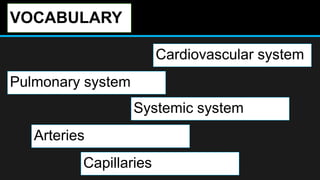
VOCABULARY
Cardiovascular system
Pulmonary system
Systemic system
Arteries
Capillaries
VOCABULARY
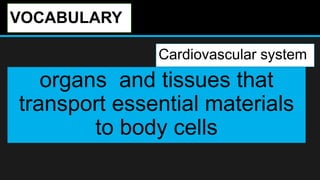
Cardiovascular system
organs and tissues that
transport essential materials
to body cells
VOCABULARY
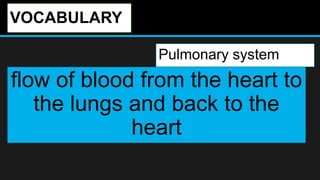
Pulmonary system
flow of blood from the heart to
the lungs and back to the
heart
VOCABULARY
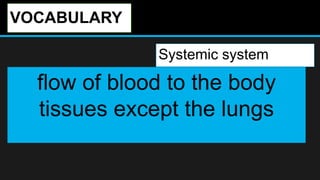
Systemic system
flow of blood to the body
tissues except the lungs
VOCABULARY
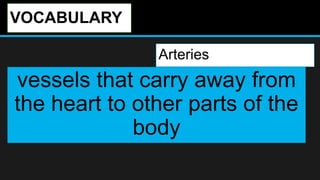
Arteries
vessels that carry away from
the heart to other parts of the
body
VOCABULARY
Veins
vessels that carry blood from
the body back to the heart
VOCABULARY
Capillaries
tiny tubes that carry blood
from the arteries to the cells,
and back to the veins
Introduction!!!
Humans and other vertebrates have a
closed circulatory system!!!
Circulatory System
The Truth About
Your Heart
Heart
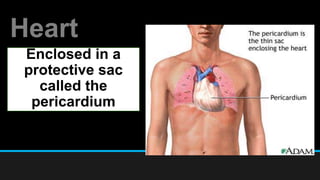
Enclosed in a
protective sac
called the
pericardium
Heart
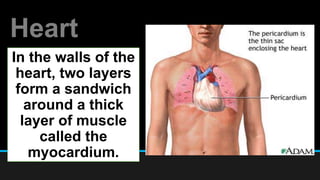
In the walls of the
heart, two layers
form a sandwich
around a thick
layer of muscle
called the
myocardium.
Heart
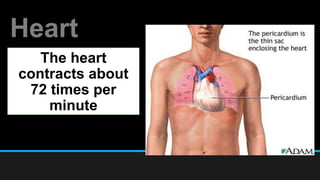
The heart
contracts about
72 times per
minute
Heart
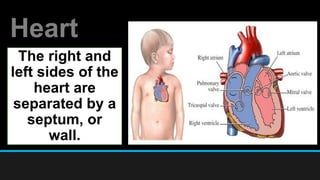
The right and
left sides of the
heart are
separated by a
septum, or
wall.
Heart
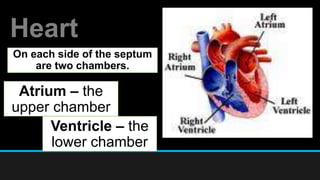
On each side of the septum
are two chambers.
Atrium – the
upper chamber
Ventricle – the
lower chamber
Blood
Blood
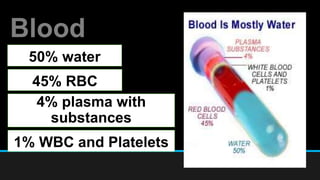
50% water
45% RBC
4% plasma with
substances
1% WBC and Platelets
Erythrocytes
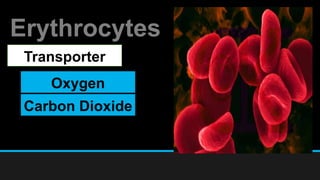
Transporter
Oxygen
Carbon Dioxide
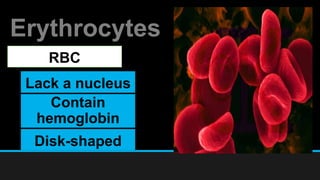
Erythrocytes
RBC
Lack a nucleus
Contain
hemoglobin
Disk-shaped
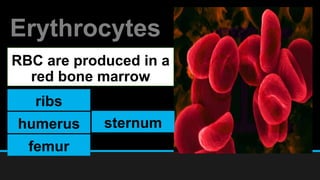
Erythrocytes
RBC are produced in a
red bone marrow
ribs
humerus
femur
sternum
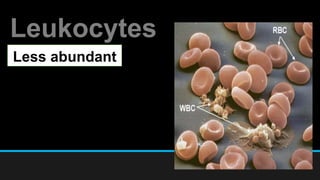
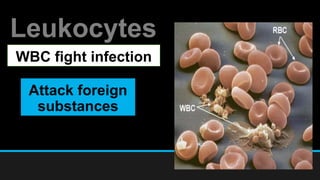
Leukocytes
Less abundant
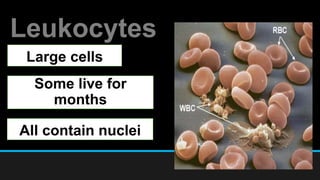
Leukocytes
Large cells
Some live for
months
All contain nuclei
Leukocytes
WBC fight infection
Attack foreign
substances
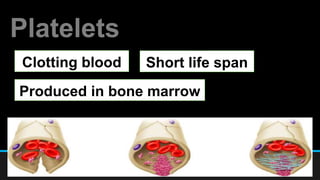
Platelets
Clotting blood
Produced in bone marrow
Short life span
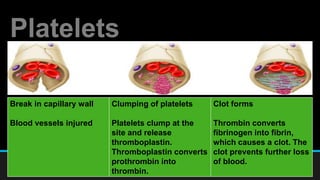
Platelets
Break in capillary wall
Blood vessels injured
Clumping of platelets
Platelets clump at the
site and release
thromboplastin.
Thromboplastin converts
prothrombin into
thrombin.
Clot forms
Thrombin converts
fibrinogen into fibrin,
which causes a clot. The
clot prevents further loss
of blood.
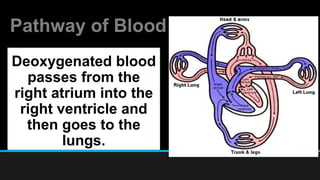
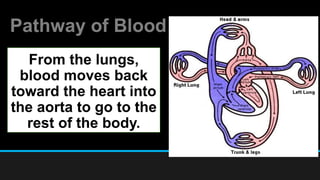
Pathway of Blood
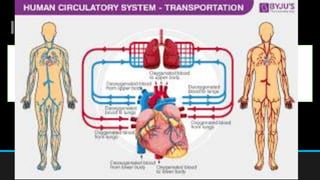
Deoxygenated blood
passes from the
right atrium into the
right ventricle and
then goes to the
lungs.
Pathway of Blood
From the lungs,
blood moves back
toward the heart into
the aorta to go to the
rest of the body.
Blood Types
There are four blood
types. A, B, AB, and
O.
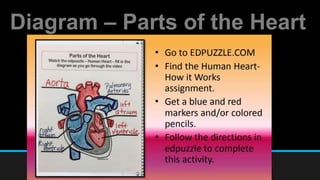
Diagram – Parts of the Heart
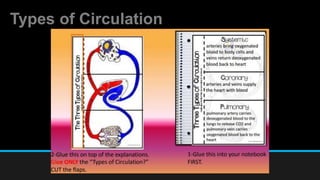
Types of Circulation
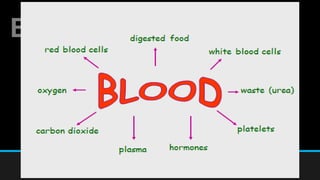
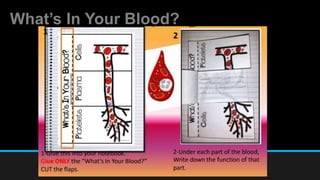
What’s In Your Blood?
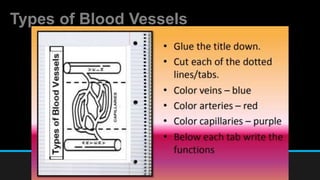
Types of Blood Vessels
What is the
importance of
circulatory system?

Circulatory system

Editor's Notes

  • #3 This is the question that your experiment answers
  • #5 This is the question that your experiment answers
  • #13 This is the question that your experiment answers
  • #14 This is the question that your experiment answers
  • #15 This is the question that your experiment answers
  • #16 This is the question that your experiment answers
  • #17 This is the question that your experiment answers
  • #18 This is the question that your experiment answers
  • #19 This is the question that your experiment answers
  • #20 This is the question that your experiment answers
  • #21 This is the question that your experiment answers
  • #22 This is the question that your experiment answers
  • #23 This is the question that your experiment answers
  • #24 This is the question that your experiment answers
  • #25 This is the question that your experiment answers
  • #26 This is the question that your experiment answers
  • #27 This is the question that your experiment answers
  • #28 This is the question that your experiment answers
  • #29 This is the question that your experiment answers
  • #30 This is the question that your experiment answers
  • #31 This is the question that your experiment answers
  • #32 This is the question that your experiment answers
  • #33 This is the question that your experiment answers
  • #34 This is the question that your experiment answers
  • #35 This is the question that your experiment answers
  • #36 This is the question that your experiment answers
  • #37 This is the question that your experiment answers