CIRCLES 
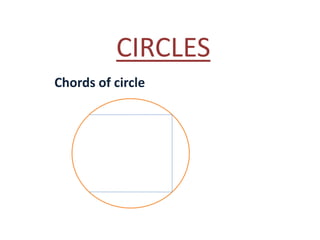
Chords of circle
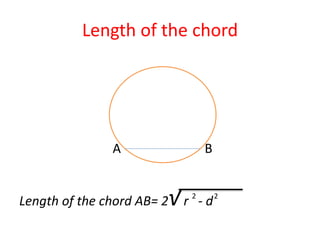
Length of the chord 
A B 
Length of the chord AB= 2√ r 2 - d2
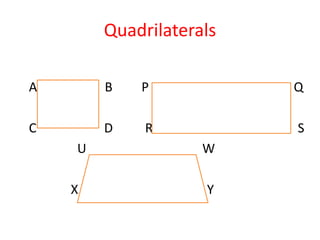
Quadrilaterals 
A B P Q 
C D R S 
U W 
X Y
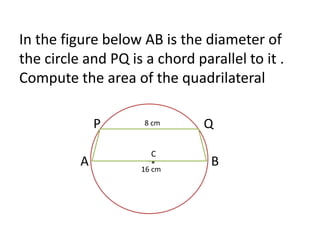
In the figure below AB is the diameter of 
the circle and PQ is a chord parallel to it . 
Compute the area of the quadrilateral 
P 8 cm 
Q 
C 
* 
A B 
1 
1 
16 cm
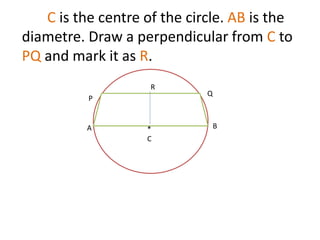
C is the centre of the circle. AB is the 
diametre. Draw a perpendicular from C to 
PQ and mark it as R. 
* 
C 
P 
R 
A 
Q 
B
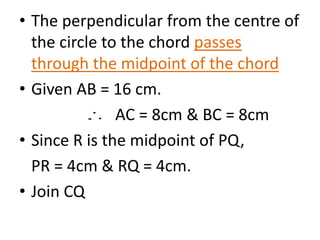
• The perpendicular from the centre of 
the circle to the chord passes 
through the midpoint of the chord 
• Given AB = 16 cm. 
AC = 8cm & BC = 8cm 
• Since R is the midpoint of PQ, 
PR = 4cm & RQ = 4cm. 
• Join CQ
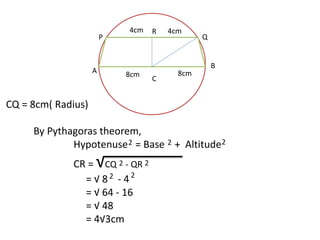
CQ = 8cm( Radius) 
4cm 4cm 
P Q 
By Pythagoras theorem, 
Hypotenuse = Base + Altitude 
CR = √CQ - QR 
= √ 8 - 4 
= √ 64 - 16 
= √ 48 
= 4√3cm 
R 
C 
A 
B 
8cm 8cm 
2 2 2 
2 
2 
2 
2
Area of trapezium ABQP = ½ CR[PQ + AB] 
= ½ 4 √3[8 + 16] 
= 2 √3 × 24 
= 48 √3 sq.cm

Circles

  • 1.
  • 2.
    Length of thechord A B Length of the chord AB= 2√ r 2 - d2
  • 3.
    Quadrilaterals A BP Q C D R S U W X Y
  • 4.
    In the figurebelow AB is the diameter of the circle and PQ is a chord parallel to it . Compute the area of the quadrilateral P 8 cm Q C * A B 1 1 16 cm
  • 5.
    C is thecentre of the circle. AB is the diametre. Draw a perpendicular from C to PQ and mark it as R. * C P R A Q B
  • 6.
    • The perpendicularfrom the centre of the circle to the chord passes through the midpoint of the chord • Given AB = 16 cm. AC = 8cm & BC = 8cm • Since R is the midpoint of PQ, PR = 4cm & RQ = 4cm. • Join CQ
  • 7.
    CQ = 8cm(Radius) 4cm 4cm P Q By Pythagoras theorem, Hypotenuse = Base + Altitude CR = √CQ - QR = √ 8 - 4 = √ 64 - 16 = √ 48 = 4√3cm R C A B 8cm 8cm 2 2 2 2 2 2 2
  • 8.
    Area of trapeziumABQP = ½ CR[PQ + AB] = ½ 4 √3[8 + 16] = 2 √3 × 24 = 48 √3 sq.cm