Presented by
Nayma Nazia-014586
Farzana Islam-014589
Sirajum Masuda-014587
Farjana Boby-014585
 CIDA is a lead agency for development
assistance of the Government of Canada.
 It is one of UNICEF Bangladesh’s top five
donors
Full name: Canadian International Development
Agency
Country of origin/Head quarter: Gatineau,
Quebec, Canada
Year of establishment: 1968
Formed by: Canadian govt. under Pierre
Trudeau
The conservative govt. announced that, CIDA
would be folded into the “ Department of
Foreign Affairs”
and, the organization renamed as
the
“Department of Foreign Affairs, Trade and
Development”
 To reduce poverty
 To promote human rights
 To support sustainable development
 To contribute in making a more secure,
equitable and prosperous world
 create opportunities for children,
 equality between men and women
 Asia region
 Eastern Europe
 America
 North Africa and Middle East
 Sub-Saharan Africa
1. Asia region:
 Afghanistan, Bangladesh, Bhutan, Burma(
Myanmar), Cambodia, China, Cook Islands, Fiji,
India, Indonesia, Islamic Republic of Afghanistan,
Kazakhstan, Kiribati, Korea, Kyrgyzstan, Laos,
Malaysia, Maldives, Marshal Islands, Micronesia,
Mongolia, Nauru, Nepal, Niue, North Korea,
Pakistan, Palau, Papua New Guinea, Philippines,
Samoa, Solomon Islands, Sri Lanka, Tajikistan,
Thailand, Timor-Leste, Tokelau, Tonga,
Turkmenistan, Tuvalu, Uzbekistan, Vanuatu,
Vietnam, Wallis and Futuna.
Albania, Armenia, Azerbaijan, Belarus, Bosnia
and Herzegovina, Bulgaria, Croatia, Czech
Republic, Estonia, Georgia, Hungary, Kosovo,
Latvia, Lithuania, Macedonia, Moldavia,
Moldova, Montenegro, Poland, Romania,
Russia, Serbia, Slovakia, Slovenia, Turkey,
Ukraine.
 Anguilla, Antigua and Barbuda, Argentina,
Bahamas, Barbados, Belize, Bolivia, Brazil, British
Virgin Islands, Canada, Chile, Colombia, Costa
 Rica, Cuba, Dominican Republic, Dominica,
Ecuador, El Salvador, Grenada, Guatemala,
Guyana, Haiti, Honduras, Jamaica, Mexico,
Montserrat, Nicaragua, Panama, Paraguay, Peru,
Saint Kitts and Nevis, Saint Lucia, Saint Vincent
and the Grenadines, Suriname, Trinidad Tobago,
Turks and Caicos Islands, Uruguay, Venezuela.
 Algeria, Egypt, Iran, Iraq, Jordan, Lebanon,
Libya, Mauritania, Morocco, Syria, Tunisia,
United Arab Emirates, West Bank and Gaza,
Western Sahara and Yemen.
 Angola, Burkina-Faso, Burundi, Cabot Verde,
Cameroon, Cape Verde, Central African Republic,
Chad, Comoros, Congo, Cote d’Ivoire,
Democratic Republic of Congo, Djibouti,
Equatorial Guinea, Eritrea, Ethiopia, Gabon,
Gambia, Ghana, Guinea-Bissau, Guinea, Kenya,
Lesotho, Liberia, Madagascar, Malawi, Mali,
Mauritius, Mozambique, Namibia, Nigeria, Niger,
Rwanda, Saint Helena, Sao Tome and Principe,
Senegal, Seychelles, Sierra Leone, Somalia, South
Africa, South Sudan, Sudan, Swaziland, Tanzania,
Togo, Uganda, Zambia and Zimbabwe.
• Basic education
• Capacity development
• Child protection
• Climate change
• Gender equality
• Health and nutrition
• HIV/AIDS
• Human rights, Democratization and Good
Government
• Millennium development goals
• Peace building
• Private sector development
Work for continent's most pressing challenges:
• Quality Education
• Reducing poverty;
• Consolidating economic gains;
• Strengthening governance and political
inclusion;
• Social development; and
• The environment and Health
Bangladesh was chosen based on..
 its level of need,
 its ability to use aid dollars wisely and
 Bangladesh has been one of Canada’s largest
aid recipients for the past three decades.
CIDA’s priorities in Bangladesh strongly align
with UNICEF’s work.
CIDA focuses on:
 improving the quality and delivery of
education
 increasing access and retention rates in
primary school
 reducing gaps between girls and boys.
1.Primary Education Development Program - Phase
III (2013-09-10 to 2017-03-31)
2. Basic Education for Hard-to-Reach Urban
Working Children (BEHTRUWC) project (2013-03-
27 — 2018-09-30)
3. Access to Health and Education for all Children
and Youth with Disabilities(2012-12-19 —
2018-03-31)
4.BRAC Primary Education Program II (2010-10-12
— 2015-03-31)
5. Basic Education for Working Children - Phase II
(2006-03-29 — 2011-11-24)
(2006-03-29 — 2011-11-24)
Outcomes:
(1) 6,646 learning centers were established in
Bangladesh's six main divisional cities
(2) all teachers and supervisors of the centers
received one foundation training and four
refresher training courses on interactive
teaching methodology
 child-friendly, basic education curriculum
and materials were developed emphasizing
knowledge and life skills useful for poor,
urban children
 150,573 learners completed the 40-month
basic education course with functional
literacy, numeracy and enhanced life skills
(the equivalent of grades 1 to 3); and
 7,255 students completed livelihood training.
Outcomes:
Results as of March 2011 include: The
achievements in the 2011 grade 10 Secondary
School Certificate (SSC) examination show an
increase in pass rates from 52.5% at the start of
the project in 2005 to 67.4 % in 2009, and
between 2009 and 2011 the SSC pass rate
increased to 82.1%. The increase in pass rates in
SSC indicates the positive impact of the training
of teachers in improving the quality of secondary
education in Bangladesh.
CIDA has been working with UNICEF
 arsenic-safe water to Bangladeshi people
through the deployment
 disaster recovery
 Chittagong Hill Tracts,
 poverty reduction,
 gender equality and environmental
sustainability.
1. Support to the Afghanistan Reconstruction Trust
Fund – Education (EQUIP)
2. Afghanistan School Feeding Program
3. Community-Based Girls' Education Project
4. BEACON: Increasing Access to Quality Basic
Education
5. Teacher Certification and Accreditation of Teacher
Education Programs
6. Afghanistan - Knowledge Fund 2011-2014
7. Fanoos Safe Light: Teacher Training in
Afghanistan
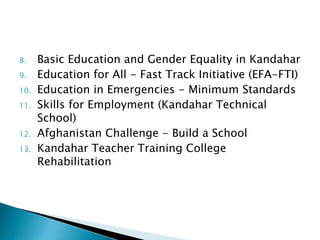
8. Basic Education and Gender Equality in Kandahar
9. Education for All - Fast Track Initiative (EFA-FTI)
10. Education in Emergencies - Minimum Standards
11. Skills for Employment (Kandahar Technical
School)
12. Afghanistan Challenge - Build a School
13. Kandahar Teacher Training College
Rehabilitation
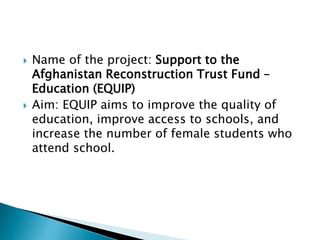
 Name of the project: Support to the
Afghanistan Reconstruction Trust Fund –
Education (EQUIP)
 Aim: EQUIP aims to improve the quality of
education, improve access to schools, and
increase the number of female students who
attend school.
 Strengthening basic education
 Primary education
 Teacher training
 Education facilities and training
 Education policy and administrative
management
 Early childhood education
 Outcomes
The expected intermediate outcome for this project is
increased basic education level for boys and girls.
 Name of the Project: Education in
Emergencies - Minimum Standards
 Aim: The aim of this project is to improve
access to quality education for school
children affected by conflict or disaster in
south-eastern, central, and northern
Afghanistan.
Activities
It supports the implementation of standards for
delivering education in emergency situations, as
set by the global Inter-Agency Network for
Education in Emergencies (INEE).
This project provides training on how to apply
the INEE Minimum Standards and give INEE trainers
and key education stakeholders an opportunity to
share challenges and good practices. The project
also includes translating the INEE Minimum
Standards into the Dari and Pashto languages.
Results
As a result of this project, education
stakeholders have a better of understanding
of how to integrate education in an
emergency setting.
 Similarities
Bangladesh Afghanistan
Primary
education
Primary
education
Quality of
education
Quality of
education
Basic education Basic education
Teacher training Teacher
training
Increasing of
access in school
Increasing of
access in school
 Dissimilarities
Bangladesh Afghanistan
No project of
maintaining of standard
of education in
emergency situation
Maintaining of standard
of education in
emergency situation
 CIDA gives lot of focus on girl’s education
 It is working to improve the quality of
education worldwide.
 It also gives emphasis on basic education
 From the project “Education in Emergencies -
Minimum Standards” we can learn that we can
have programme or project to improve access
to quality education for school children
affected by natural disasters in different
times of the year in different regions of
Bangladesh.
Thank you
Globalizing Education:
Ends And Means
1. Globalization
 Globalization Education and development
 Enticement to western education
 Challenges to be contended
2. Nationalism vs Internationalism
 Sustainable development
- Knowledge –based economy
- Development based education
- People who will work for this
3. Globalization and industrialized countries
 According to UNDP’s Human Development Report , 2003,
human condition is not so good in last 10 years. They are
suffering not more than they already have.
 Industrialized countries are busy to capture natural
resources only for their own purpose.
 Rich countries claim them as leaders of world. But they
spend more dollars for weapons for military rather than
helping poor countries.
 Globally interconnected information technology can’t
reduce hunger, disease, joblessness and superstitions.
4. Spreading of English language through globalization
 Though education has become a commodity for sale ,
developed countries have much more educational
commodity to export rather than developing countries.
 Spreading of English language is an adjunct to this
educational exports campaign.
 Little children even in the remotest rural and tribal areas
are learning English nursery rhymes and western tales
of adventure.
 English is needed for trade and commerce.
 But school children are not engaged in trade and
commerce.
 Development requires education and training of the
people in multiple skills and an open
administration at all levels.
 Networks of “ Information Kiosks” are already being
experimented to take globally available knowledge
to the people.
 It is not English but the languages of the
information targeted groups that would lay the
foundations of sustainable rural development
directed by science and technology.
 Little children must not be oppressed with learning
which is unusable at their age and in their home
environment.
 We need self-confidence for facing the threat of
economic and cultural imperialism.
 Tagore was a proponent of the kind of “ one world”
in which no nation would stand in fear of another.
 Gandhiji”s strong and reasoned perception of
freedom could also shape our response to
globalization.
 According to Gandhiji, we don’t deserve freedom if
we exploit other race or single individual , if we
don’t cherish and treasure the equal right of every
other race, weak or strong.
 The fundamental principle of globalization is said
to be freedom: freedom to trade, to govern, to give
and receive education and to work anywhere.
Thank you

Cida

  • 1.
    Presented by Nayma Nazia-014586 FarzanaIslam-014589 Sirajum Masuda-014587 Farjana Boby-014585
  • 2.
     CIDA isa lead agency for development assistance of the Government of Canada.  It is one of UNICEF Bangladesh’s top five donors
  • 3.
    Full name: CanadianInternational Development Agency Country of origin/Head quarter: Gatineau, Quebec, Canada Year of establishment: 1968 Formed by: Canadian govt. under Pierre Trudeau
  • 4.
    The conservative govt.announced that, CIDA would be folded into the “ Department of Foreign Affairs” and, the organization renamed as the “Department of Foreign Affairs, Trade and Development”
  • 5.
     To reducepoverty  To promote human rights  To support sustainable development  To contribute in making a more secure, equitable and prosperous world  create opportunities for children,  equality between men and women
  • 7.
     Asia region Eastern Europe  America  North Africa and Middle East  Sub-Saharan Africa
  • 8.
    1. Asia region: Afghanistan, Bangladesh, Bhutan, Burma( Myanmar), Cambodia, China, Cook Islands, Fiji, India, Indonesia, Islamic Republic of Afghanistan, Kazakhstan, Kiribati, Korea, Kyrgyzstan, Laos, Malaysia, Maldives, Marshal Islands, Micronesia, Mongolia, Nauru, Nepal, Niue, North Korea, Pakistan, Palau, Papua New Guinea, Philippines, Samoa, Solomon Islands, Sri Lanka, Tajikistan, Thailand, Timor-Leste, Tokelau, Tonga, Turkmenistan, Tuvalu, Uzbekistan, Vanuatu, Vietnam, Wallis and Futuna.
  • 9.
    Albania, Armenia, Azerbaijan,Belarus, Bosnia and Herzegovina, Bulgaria, Croatia, Czech Republic, Estonia, Georgia, Hungary, Kosovo, Latvia, Lithuania, Macedonia, Moldavia, Moldova, Montenegro, Poland, Romania, Russia, Serbia, Slovakia, Slovenia, Turkey, Ukraine.
  • 10.
     Anguilla, Antiguaand Barbuda, Argentina, Bahamas, Barbados, Belize, Bolivia, Brazil, British Virgin Islands, Canada, Chile, Colombia, Costa  Rica, Cuba, Dominican Republic, Dominica, Ecuador, El Salvador, Grenada, Guatemala, Guyana, Haiti, Honduras, Jamaica, Mexico, Montserrat, Nicaragua, Panama, Paraguay, Peru, Saint Kitts and Nevis, Saint Lucia, Saint Vincent and the Grenadines, Suriname, Trinidad Tobago, Turks and Caicos Islands, Uruguay, Venezuela.
  • 11.
     Algeria, Egypt,Iran, Iraq, Jordan, Lebanon, Libya, Mauritania, Morocco, Syria, Tunisia, United Arab Emirates, West Bank and Gaza, Western Sahara and Yemen.
  • 12.
     Angola, Burkina-Faso,Burundi, Cabot Verde, Cameroon, Cape Verde, Central African Republic, Chad, Comoros, Congo, Cote d’Ivoire, Democratic Republic of Congo, Djibouti, Equatorial Guinea, Eritrea, Ethiopia, Gabon, Gambia, Ghana, Guinea-Bissau, Guinea, Kenya, Lesotho, Liberia, Madagascar, Malawi, Mali, Mauritius, Mozambique, Namibia, Nigeria, Niger, Rwanda, Saint Helena, Sao Tome and Principe, Senegal, Seychelles, Sierra Leone, Somalia, South Africa, South Sudan, Sudan, Swaziland, Tanzania, Togo, Uganda, Zambia and Zimbabwe.
  • 13.
    • Basic education •Capacity development • Child protection • Climate change • Gender equality • Health and nutrition • HIV/AIDS • Human rights, Democratization and Good Government • Millennium development goals • Peace building • Private sector development
  • 14.
    Work for continent'smost pressing challenges: • Quality Education • Reducing poverty; • Consolidating economic gains; • Strengthening governance and political inclusion; • Social development; and • The environment and Health
  • 15.
    Bangladesh was chosenbased on..  its level of need,  its ability to use aid dollars wisely and  Bangladesh has been one of Canada’s largest aid recipients for the past three decades. CIDA’s priorities in Bangladesh strongly align with UNICEF’s work.
  • 16.
    CIDA focuses on: improving the quality and delivery of education  increasing access and retention rates in primary school  reducing gaps between girls and boys.
  • 17.
    1.Primary Education DevelopmentProgram - Phase III (2013-09-10 to 2017-03-31) 2. Basic Education for Hard-to-Reach Urban Working Children (BEHTRUWC) project (2013-03- 27 — 2018-09-30) 3. Access to Health and Education for all Children and Youth with Disabilities(2012-12-19 — 2018-03-31) 4.BRAC Primary Education Program II (2010-10-12 — 2015-03-31) 5. Basic Education for Working Children - Phase II (2006-03-29 — 2011-11-24)
  • 18.
    (2006-03-29 — 2011-11-24) Outcomes: (1)6,646 learning centers were established in Bangladesh's six main divisional cities (2) all teachers and supervisors of the centers received one foundation training and four refresher training courses on interactive teaching methodology
  • 19.
     child-friendly, basiceducation curriculum and materials were developed emphasizing knowledge and life skills useful for poor, urban children  150,573 learners completed the 40-month basic education course with functional literacy, numeracy and enhanced life skills (the equivalent of grades 1 to 3); and  7,255 students completed livelihood training.
  • 20.
    Outcomes: Results as ofMarch 2011 include: The achievements in the 2011 grade 10 Secondary School Certificate (SSC) examination show an increase in pass rates from 52.5% at the start of the project in 2005 to 67.4 % in 2009, and between 2009 and 2011 the SSC pass rate increased to 82.1%. The increase in pass rates in SSC indicates the positive impact of the training of teachers in improving the quality of secondary education in Bangladesh.
  • 21.
    CIDA has beenworking with UNICEF  arsenic-safe water to Bangladeshi people through the deployment  disaster recovery  Chittagong Hill Tracts,  poverty reduction,  gender equality and environmental sustainability.
  • 22.
    1. Support tothe Afghanistan Reconstruction Trust Fund – Education (EQUIP) 2. Afghanistan School Feeding Program 3. Community-Based Girls' Education Project 4. BEACON: Increasing Access to Quality Basic Education 5. Teacher Certification and Accreditation of Teacher Education Programs 6. Afghanistan - Knowledge Fund 2011-2014 7. Fanoos Safe Light: Teacher Training in Afghanistan
  • 23.
    8. Basic Educationand Gender Equality in Kandahar 9. Education for All - Fast Track Initiative (EFA-FTI) 10. Education in Emergencies - Minimum Standards 11. Skills for Employment (Kandahar Technical School) 12. Afghanistan Challenge - Build a School 13. Kandahar Teacher Training College Rehabilitation
  • 24.
     Name ofthe project: Support to the Afghanistan Reconstruction Trust Fund – Education (EQUIP)  Aim: EQUIP aims to improve the quality of education, improve access to schools, and increase the number of female students who attend school.
  • 25.
     Strengthening basiceducation  Primary education  Teacher training  Education facilities and training  Education policy and administrative management  Early childhood education
  • 26.
     Outcomes The expectedintermediate outcome for this project is increased basic education level for boys and girls.
  • 27.
     Name ofthe Project: Education in Emergencies - Minimum Standards  Aim: The aim of this project is to improve access to quality education for school children affected by conflict or disaster in south-eastern, central, and northern Afghanistan.
  • 28.
    Activities It supports theimplementation of standards for delivering education in emergency situations, as set by the global Inter-Agency Network for Education in Emergencies (INEE). This project provides training on how to apply the INEE Minimum Standards and give INEE trainers and key education stakeholders an opportunity to share challenges and good practices. The project also includes translating the INEE Minimum Standards into the Dari and Pashto languages.
  • 29.
    Results As a resultof this project, education stakeholders have a better of understanding of how to integrate education in an emergency setting.
  • 30.
     Similarities Bangladesh Afghanistan Primary education Primary education Qualityof education Quality of education Basic education Basic education Teacher training Teacher training Increasing of access in school Increasing of access in school
  • 31.
     Dissimilarities Bangladesh Afghanistan Noproject of maintaining of standard of education in emergency situation Maintaining of standard of education in emergency situation
  • 32.
     CIDA giveslot of focus on girl’s education  It is working to improve the quality of education worldwide.  It also gives emphasis on basic education
  • 33.
     From theproject “Education in Emergencies - Minimum Standards” we can learn that we can have programme or project to improve access to quality education for school children affected by natural disasters in different times of the year in different regions of Bangladesh.
  • 34.
  • 35.
  • 36.
    1. Globalization  GlobalizationEducation and development  Enticement to western education  Challenges to be contended
  • 37.
    2. Nationalism vsInternationalism  Sustainable development - Knowledge –based economy - Development based education - People who will work for this
  • 38.
    3. Globalization andindustrialized countries  According to UNDP’s Human Development Report , 2003, human condition is not so good in last 10 years. They are suffering not more than they already have.  Industrialized countries are busy to capture natural resources only for their own purpose.  Rich countries claim them as leaders of world. But they spend more dollars for weapons for military rather than helping poor countries.  Globally interconnected information technology can’t reduce hunger, disease, joblessness and superstitions.
  • 39.
    4. Spreading ofEnglish language through globalization  Though education has become a commodity for sale , developed countries have much more educational commodity to export rather than developing countries.  Spreading of English language is an adjunct to this educational exports campaign.  Little children even in the remotest rural and tribal areas are learning English nursery rhymes and western tales of adventure.  English is needed for trade and commerce.  But school children are not engaged in trade and commerce.
  • 40.
     Development requireseducation and training of the people in multiple skills and an open administration at all levels.  Networks of “ Information Kiosks” are already being experimented to take globally available knowledge to the people.  It is not English but the languages of the information targeted groups that would lay the foundations of sustainable rural development directed by science and technology.  Little children must not be oppressed with learning which is unusable at their age and in their home environment.  We need self-confidence for facing the threat of economic and cultural imperialism.
  • 41.
     Tagore wasa proponent of the kind of “ one world” in which no nation would stand in fear of another.  Gandhiji”s strong and reasoned perception of freedom could also shape our response to globalization.  According to Gandhiji, we don’t deserve freedom if we exploit other race or single individual , if we don’t cherish and treasure the equal right of every other race, weak or strong.  The fundamental principle of globalization is said to be freedom: freedom to trade, to govern, to give and receive education and to work anywhere.
  • 42.