By,
Dr-Ebtessam Nada,
Associate professor of audio-vistibular
medicine, Zagazig university, Egypt
Fortunately regardless the software used there
are fixed tools to be used to manipulate
patients’ complaint
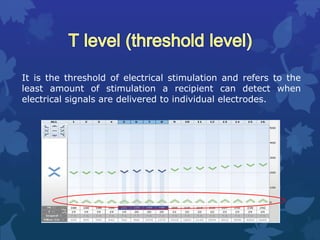
It is the threshold of electrical stimulation and refers to the
least amount of stimulation a recipient can detect when
electrical signals are delivered to individual electrodes.
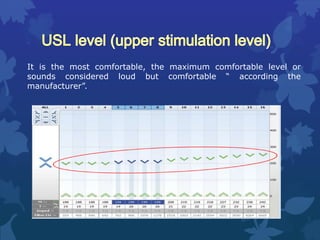
It is the most comfortable, the maximum comfortable level or
sounds considered loud but comfortable “ according the
manufacturer”.
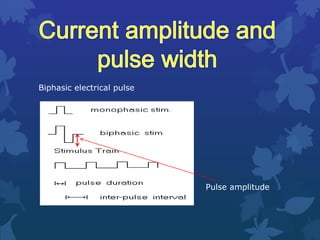
Biphasic electrical pulse
Pulse amplitude
 This parameter determines the range of acoustic signals
that are mapped into the recipient's electric dynamic
range.
 The lower edge of the dynamic range determines the
acoustic input level that is mapped near the threshold of
electrical stimulation while the upper limit of the IDR
determines the acoustic signals that are mapped near
the maximum electrical stimulation.
 Low frequency components of the signal is usually
delivered to electrode contacts that are higher than that
of the input signal. As a result, the pitch of the human
voice is much higher than what the recipient was
accustomed.
 Furthermore, despite the sophisticated nature of the
speech coding strategies used with CI still the signal is
markedly different from the normal peripheral auditory
system in response to acoustic stimulation.
 The auditory system has not received stimulation for
certain sounds (high frequencies) so, reducing the ability
to processing these sounds again.
 Less stimulation sites (electrode contacts ) in CI relative
to 3500 IHCs in normal cochlea.
Different signal type than
that of a hearing aid
 A period of acclimatization
is necessary for the
auditory system to adjust
to the new signal.
 Young children who didn’t
experience sounds before
require extensive exposure
to speech and
environmental sounds
(auditory verbal therapy).
 Before we judge a complaint of patient a
period of acclimatization should be
considered first after the initial activation.
 Sound quality and speech recognition
always improve over the first few months
after activation, so, re-programing during
the early stages of implant use may not
result in better sound quality.
 Global reduction of the upper stimulation level but without
resulting in soft sounds.
 Loudness balances across electrode array.
 Reduction of the stimulation rate.
 Or reduction of gain for the LF or HF channels (for CIS
strategies).
 Sweep to identify the electrode with the ringing character.
 Disable the most basal electrodes.
 Increasing IDR.
 Increase microphone sensitivity.
 Increase threshold levels.
 Increased loudness growth function (maplaw).
 Sweep at USL to ensure pitch percepts in expected
tonotopic pattern
 different stimulation rate, or another speech coding
strategy
• Echo or boomy
sound quality.
• Ringing
pinging or
tinny sound
quality.
• Sound is
muffled fuzzy
or not clear.
• Overall poor
sound quality
performance.
 Ensure loudness balance across USL in electrode array
 Global decrease of USL if speech of the others become
too soft, increase sensitivity, T levels or loudness growth
for low level inputs.
Too loud own voice but speech from others is comfortable
 After considering the acclimatization
issue, reduce microphone sensitivity
and/or IDR.
 Adjust T levels to balance loudness at
50% of DR
 Global decrease of T levels.
 Ensure loudness balance across
electrode array at USL.
 Global decrease of USL
 Decrease the USL in the LF channels.
 Reduce stimulation levels at LF
channels and increase Stimulation
levels at MF and HF channels.
• Buzzing, frying or
humming sounds.
• Roaring.
• Hollow sound.
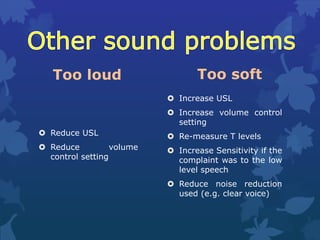
Too loud
 Reduce USL
 Reduce volume
control setting
Too soft
 Increase USL
 Increase volume control
setting
 Re-measure T levels
 Increase Sensitivity if the
complaint was to the low
level speech
 Reduce noise reduction
used (e.g. clear voice)
 Reassess volume control setting
 Increase T levels and/or increase IDR, increase T
levels, or increase maplaw setting.
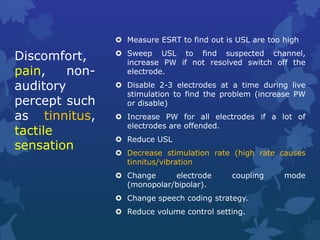
Discomfort,
pain, non-
auditory
percept such
as tinnitus,
tactile
sensation
 Measure ESRT to find out is USL are too high
 Sweep USL to find suspected channel,
increase PW if not resolved switch off the
electrode.
 Disable 2-3 electrodes at a time during live
stimulation to find the problem (increase PW
or disable)
 Increase PW for all electrodes if a lot of
electrodes are offended.
 Reduce USL
 Decrease stimulation rate (high rate causes
tinnitus/vibration
 Change electrode coupling mode
(monopolar/bipolar).
 Change speech coding strategy.
 Reduce volume control setting.
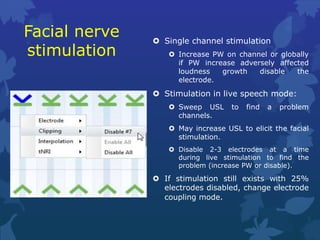
Facial nerve
stimulation
 Single channel stimulation
 Increase PW on channel or globally
if PW increase adversely affected
loudness growth disable the
electrode.
 Stimulation in live speech mode:
 Sweep USL to find a problem
channels.
 May increase USL to elicit the facial
stimulation.
 Disable 2-3 electrodes at a time
during live stimulation to find the
problem (increase PW or disable).
 If stimulation still exists with 25%
electrodes disabled, change electrode
coupling mode.
 In contrast to hard failure in which a cochlear implant shows more
than a sudden loss of function, such as no communication between
the internal and external devices.
 A “soft failure” is a term used by the cochlear implant industry to
describe a situation where a patient’s hearing performance has
noticeably decreased but the implant integrity testing shows that
the implant is functioning as normal. In other words, the implant
testing does not show a problem with the internal device, but the
patient is not hearing as well as they used to.
 The Consensus Statement from 10th Symposium
on Cochlear Implantation in Children assessed
that soft failure:
• Is an uncommon occurrence
• Is a working diagnosis
• Only confirmed by removal, examination and identification
of failure mode.
• Diagnosis begins with awareness of common
presentations
• Declining performance, aversive symptoms or
intermittent function
• Diagnosis can only be made with complete otological
examination, CT scan, expert re-programming,
exchange of all external hardware, and integrity testing
by the manufacturer.
CI mapping troubleshooting and problem solving

CI mapping troubleshooting and problem solving

  • 1.
    By, Dr-Ebtessam Nada, Associate professorof audio-vistibular medicine, Zagazig university, Egypt
  • 2.
    Fortunately regardless thesoftware used there are fixed tools to be used to manipulate patients’ complaint
  • 3.
    It is thethreshold of electrical stimulation and refers to the least amount of stimulation a recipient can detect when electrical signals are delivered to individual electrodes.
  • 4.
    It is themost comfortable, the maximum comfortable level or sounds considered loud but comfortable “ according the manufacturer”.
  • 5.
  • 6.
     This parameterdetermines the range of acoustic signals that are mapped into the recipient's electric dynamic range.  The lower edge of the dynamic range determines the acoustic input level that is mapped near the threshold of electrical stimulation while the upper limit of the IDR determines the acoustic signals that are mapped near the maximum electrical stimulation.
  • 9.
     Low frequencycomponents of the signal is usually delivered to electrode contacts that are higher than that of the input signal. As a result, the pitch of the human voice is much higher than what the recipient was accustomed.  Furthermore, despite the sophisticated nature of the speech coding strategies used with CI still the signal is markedly different from the normal peripheral auditory system in response to acoustic stimulation.  The auditory system has not received stimulation for certain sounds (high frequencies) so, reducing the ability to processing these sounds again.  Less stimulation sites (electrode contacts ) in CI relative to 3500 IHCs in normal cochlea. Different signal type than that of a hearing aid
  • 10.
     A periodof acclimatization is necessary for the auditory system to adjust to the new signal.  Young children who didn’t experience sounds before require extensive exposure to speech and environmental sounds (auditory verbal therapy).
  • 12.
     Before wejudge a complaint of patient a period of acclimatization should be considered first after the initial activation.  Sound quality and speech recognition always improve over the first few months after activation, so, re-programing during the early stages of implant use may not result in better sound quality.
  • 13.
     Global reductionof the upper stimulation level but without resulting in soft sounds.  Loudness balances across electrode array.  Reduction of the stimulation rate.  Or reduction of gain for the LF or HF channels (for CIS strategies).  Sweep to identify the electrode with the ringing character.  Disable the most basal electrodes.  Increasing IDR.  Increase microphone sensitivity.  Increase threshold levels.  Increased loudness growth function (maplaw).  Sweep at USL to ensure pitch percepts in expected tonotopic pattern  different stimulation rate, or another speech coding strategy • Echo or boomy sound quality. • Ringing pinging or tinny sound quality. • Sound is muffled fuzzy or not clear. • Overall poor sound quality performance.
  • 14.
     Ensure loudnessbalance across USL in electrode array  Global decrease of USL if speech of the others become too soft, increase sensitivity, T levels or loudness growth for low level inputs. Too loud own voice but speech from others is comfortable
  • 15.
     After consideringthe acclimatization issue, reduce microphone sensitivity and/or IDR.  Adjust T levels to balance loudness at 50% of DR  Global decrease of T levels.  Ensure loudness balance across electrode array at USL.  Global decrease of USL  Decrease the USL in the LF channels.  Reduce stimulation levels at LF channels and increase Stimulation levels at MF and HF channels. • Buzzing, frying or humming sounds. • Roaring. • Hollow sound.
  • 16.
    Too loud  ReduceUSL  Reduce volume control setting Too soft  Increase USL  Increase volume control setting  Re-measure T levels  Increase Sensitivity if the complaint was to the low level speech  Reduce noise reduction used (e.g. clear voice)
  • 17.
     Reassess volumecontrol setting  Increase T levels and/or increase IDR, increase T levels, or increase maplaw setting.
  • 19.
    Discomfort, pain, non- auditory percept such astinnitus, tactile sensation  Measure ESRT to find out is USL are too high  Sweep USL to find suspected channel, increase PW if not resolved switch off the electrode.  Disable 2-3 electrodes at a time during live stimulation to find the problem (increase PW or disable)  Increase PW for all electrodes if a lot of electrodes are offended.  Reduce USL  Decrease stimulation rate (high rate causes tinnitus/vibration  Change electrode coupling mode (monopolar/bipolar).  Change speech coding strategy.  Reduce volume control setting.
  • 20.
    Facial nerve stimulation  Singlechannel stimulation  Increase PW on channel or globally if PW increase adversely affected loudness growth disable the electrode.  Stimulation in live speech mode:  Sweep USL to find a problem channels.  May increase USL to elicit the facial stimulation.  Disable 2-3 electrodes at a time during live stimulation to find the problem (increase PW or disable).  If stimulation still exists with 25% electrodes disabled, change electrode coupling mode.
  • 21.
     In contrastto hard failure in which a cochlear implant shows more than a sudden loss of function, such as no communication between the internal and external devices.  A “soft failure” is a term used by the cochlear implant industry to describe a situation where a patient’s hearing performance has noticeably decreased but the implant integrity testing shows that the implant is functioning as normal. In other words, the implant testing does not show a problem with the internal device, but the patient is not hearing as well as they used to.
  • 22.
     The ConsensusStatement from 10th Symposium on Cochlear Implantation in Children assessed that soft failure: • Is an uncommon occurrence • Is a working diagnosis • Only confirmed by removal, examination and identification of failure mode. • Diagnosis begins with awareness of common presentations • Declining performance, aversive symptoms or intermittent function • Diagnosis can only be made with complete otological examination, CT scan, expert re-programming, exchange of all external hardware, and integrity testing by the manufacturer.