


An Introduction to
Common Assessment Framework (CAF)
for Quality Management in the Public Sector
Seta A. Wicaksana
Founder and CEO
www.humanikaconsulting.com
Introduction
• Common Assessment Framework (CAF)
• Self Assessment
• CAF and Criterions
• Assessment Panels (Score)
• The Journey
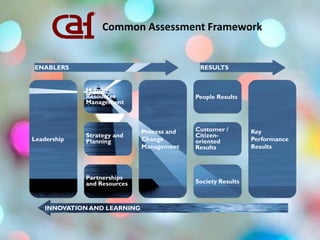
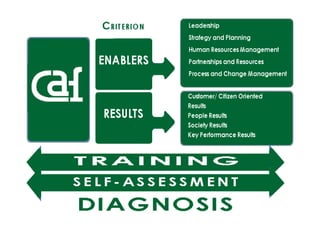
Common Assessment Framework
Leadership
Human
Resources
Management
Strategy and
Planning
Partnerships
and Resources
Process and
Change
Management
People Results
Customer /
Citizen-
oriented
Results
Society Results
Key
Performance
Results
ENABLERS RESULTS
INNOVATION AND LEARNING
CAF, What is it?
• The CAF is an easy-to-use, free tool to assist public-sector
organizations across Europe in using quality management
techniques to improve their performance.
• The CAF is a total quality management (TQM) tool
• It is inspired by the major Total Quality models in general, and
by the Excellence Model of the European Foundation for
Quality Management (EFQM) in particular.
• It is especially designed for public-sector organizations, taking
into account their characteristics.
• To be compatible with the commonest models used by the
Public and private organizations.
CAF purposes
• To introduce public administrations to the
principles of TQM and
• gradually guide them, through the use and
understanding of self-assessment, from the
current “Plan-Do” sequence of activities to a
full fledged “Plan-Do-Check-Act (PCDA)”
cycle;
• To facilitate the self-assessment of a public
organization in order to arrive at a diagnosis
and improvement actions;
• To act as a bridge across the various models
used in quality management;
• To facilitate bench learning between public-
sector organizations.
• To be available, free of charge
CAF Provides
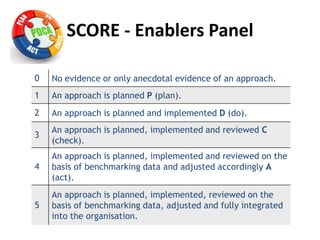
Enablers
– The features of an organisation which determine how
it performs
– Criteria 1-5 deal with the Enabler features of an
organisation; these determine how it performs. The
assessment of actions relating to the Enablers should
be based on the Enablers Panel.
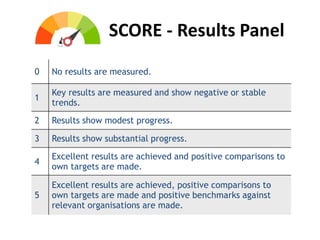
Results
– The results or outputs which the organisation
achieves
– The assessment of results requires a different set of
responses, so the responses from this point are based
on the Results Assessment Panel.
Why CAF good for us
• Effective identification of
the strengths of the
organization and the areas
where improvement is
needed
• Identification of relevant
improvement actions
• Increased level of awareness
and communication
throughout the organization
• to make your people
become aware and
interested in quality issues
Total Quality in the organization
• Quality of results =
Quality of organization
• Two management models
– ISO 9000 (housekeeping -
employees) “DO THINGS
RIGHT”
– TQM (continuous
improvement - top
management) “DO THE
RIGHT THING”
PDCA
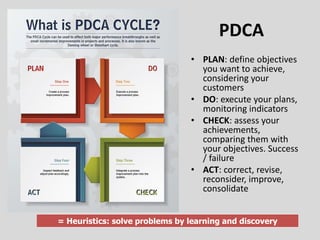
• PLAN: define objectives
you want to achieve,
considering your
customers
• DO: execute your plans,
monitoring indicators
• CHECK: assess your
achievements,
comparing them with
your objectives. Success
/ failure
• ACT: correct, revise,
reconsider, improve,
consolidate
= Heuristics: solve problems by learning and discovery
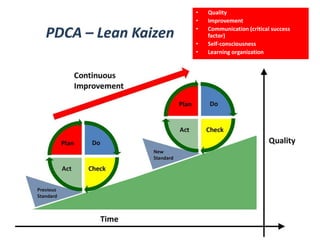
• Quality
• Improvement
• Communication (critical success
factor)
• Self-consciousness
• Learning organization
Self-Assessment
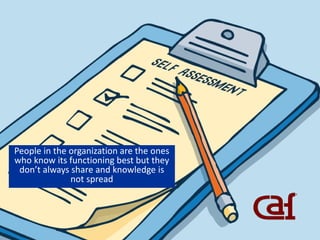
People in the organization are the ones
who know its functioning best but they
don’t always share and knowledge is
not spread
Self-Assessment
– It Integrates initiatives of quality
improvement in the current management of
the organization
– It works as a diagnostic tool
– It a dynamic process, allowing the additional
motivation of people to change management
– It is a structured and rigorous way to manage
improvement processes
– It is based on facts and not on individual
subjective feelings
– It allows the recognition of progresses
achieved
– It allows internal and external benchmarking
– It recognizes performance levels
– Identifies strengths and improvement areas
– Is based on facts
– Develops a common language and promotes
a new culture
– Involves all people at all levels
– Must aim at continuous improvement
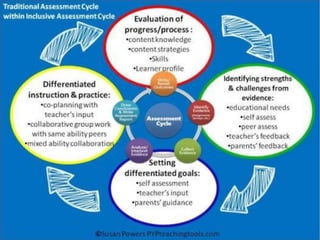
Self-Assessment Cycle
STRENGTHS &
AREAS FOR
IMPROVEMENT
IMPLEMENTING
IMPROVEMENT
ACTIONS
IMPROVED
RESULTS
SELF-
ASSESSMENT
The Criterions
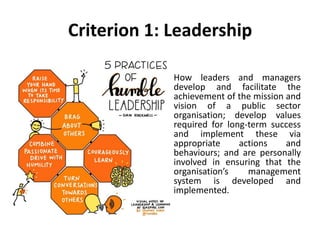
Criterion 1: Leadership
How leaders and managers
develop and facilitate the
achievement of the mission and
vision of a public sector
organisation; develop values
required for long-term success
and implement these via
appropriate actions and
behaviours; and are personally
involved in ensuring that the
organisation’s management
system is developed and
implemented.
Criterion 1: Leadership
• Sub-Criterion
– 1.1. Give a direction to the organisation:
develop and communicate vision, mission
and values
– 1.2. Develop and implement a system for
managing the organisation
– 1.3. Motivate and support the people in the
organisation and act as a role model
– 1.4. Manage the relations with politicians
and other stakeholders
Criterion 2: Strategy and Planning
How the organisation
implements its mission
and vision via a clear
stakeholder-focused
strategy, supported by
relevant policies, plans,
objectives, targets and
processes.
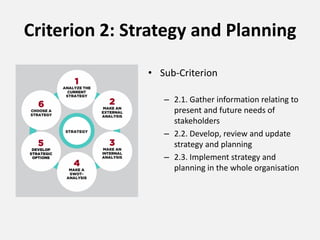
Criterion 2: Strategy and Planning
• Sub-Criterion
– 2.1. Gather information relating to
present and future needs of
stakeholders
– 2.2. Develop, review and update
strategy and planning
– 2.3. Implement strategy and
planning in the whole organisation
Criterion 3: Human Resources Management
How the organisation manages,
develops and releases the
knowledge and full potential of its
people at individual, team-based
and organisation wide levels; and
plans these activities in order to
support its policy and strategy and
the effective operation of its people.
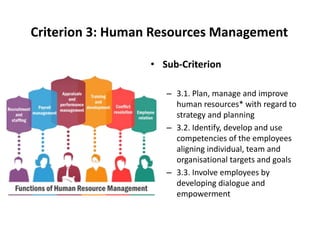
Criterion 3: Human Resources Management
• Sub-Criterion
– 3.1. Plan, manage and improve
human resources* with regard to
strategy and planning
– 3.2. Identify, develop and use
competencies of the employees
aligning individual, team and
organisational targets and goals
– 3.3. Involve employees by
developing dialogue and
empowerment
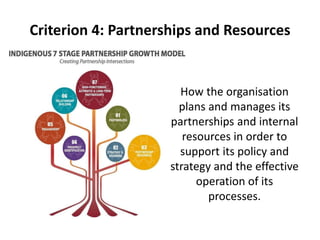
Criterion 4: Partnerships and Resources
How the organisation
plans and manages its
partnerships and internal
resources in order to
support its policy and
strategy and the effective
operation of its
processes.
Criterion 4: Partnerships
and Resources
• Sub-Criterion
– 4.1. Develops and implements key
partnership relations
– 4.2. Develops and implements
partnerships with the
customers/citizens
– 4.3. Manages knowledge
– 4.4. Manages finances
– 4.5. Manages technology
– 4.6. Manages buildings and assets
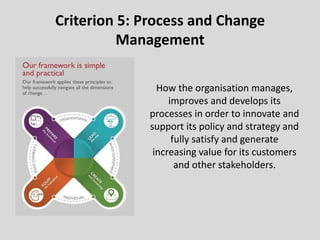
Criterion 5: Process and Change
Management
How the organisation manages,
improves and develops its
processes in order to innovate and
support its policy and strategy and
fully satisfy and generate
increasing value for its customers
and other stakeholders.
Criterion 5: Process and Change Management
• Sub-Criterion
– 5.1. Identifies, designs,
manages and improves
processes
– 5.2. Develops and delivers
services and products by
involving the
customers/citizens
– 5.3. Plans and manages
modernisation and
innovation
Criterion 6: Customer/Citizen oriented Results
What results the organisation is achieving
in relation to the satisfaction of its internal and external
customers.
Sub-Criterion
6.1. Results of customer/citizen satisfaction measurements
6.2. Indicators of customer/citizen-oriented measurements
Criterion 7: People Results
The results the organisation is achieving in relation to the
satisfaction of its people.
SubCriterion
7.1. Results of people satisfaction and motivation measurements
7.2. Indicators of people results
Criterion 8: Society Results
What the organisation is achieving in satisfying the needs and the expectations of the local,
national and international community at large (as appropriate). This includes the perception of
the organisation’s approach to quality of life, the environment and the preservation of global
resources, and the organisation’s own internal measures of effectiveness. It will include its
relations with authorities and bodies, which affect and regulate its business.
Sub-Criterion
8.1. Results of societal performance
8.2. Results of environmental performance
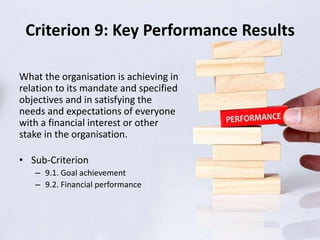
Criterion 9: Key Performance Results
What the organisation is achieving in
relation to its mandate and specified
objectives and in satisfying the
needs and expectations of everyone
with a financial interest or other
stake in the organisation.
• Sub-Criterion
– 9.1. Goal achievement
– 9.2. Financial performance
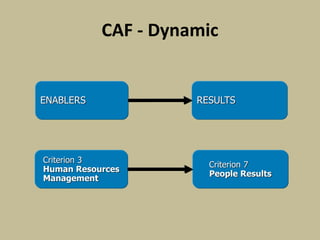
CAF - Dynamic
ENABLERS RESULTS
Criterion 3
Human Resources
Management
Criterion 7
People Results
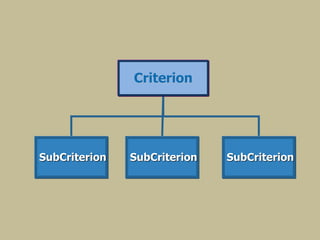
Criterion
SubCriterionSubCriterion SubCriterion
Assessment panels
Score
SCORE - Enablers Panel
0 No evidence or only anecdotal evidence of an approach.
1 An approach is planned P (plan).
2 An approach is planned and implemented D (do).
3
An approach is planned, implemented and reviewed C
(check).
4
An approach is planned, implemented and reviewed on the
basis of benchmarking data and adjusted accordingly A
(act).
5
An approach is planned, implemented, reviewed on the
basis of benchmarking data, adjusted and fully integrated
into the organisation.
SCORE - Results Panel
0 No results are measured.
1
Key results are measured and show negative or stable
trends.
2 Results show modest progress.
3 Results show substantial progress.
4
Excellent results are achieved and positive comparisons to
own targets are made.
5
Excellent results are achieved, positive comparisons to
own targets are made and positive benchmarks against
relevant organisations are made.
The Journey
Guidelines for the use of the CAF
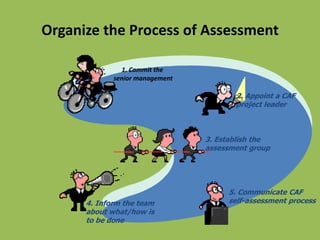
Organize the Process of Assessment
1. Commit the
senior management
2. Appoint a CAF
project leader
3. Establish the
assessment group
4. Inform the team
about what/how is
to be done
5. Communicate CAF
self-assessment process
 Undertake consensus
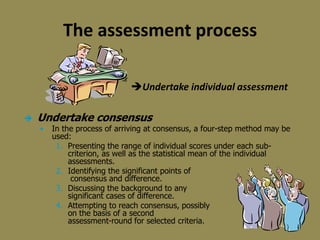
• In the process of arriving at consensus, a four-step method may be
used:
1. Presenting the range of individual scores under each sub-
criterion, as well as the statistical mean of the individual
assessments.
2. Identifying the significant points of
consensus and difference.
3. Discussing the background to any
significant cases of difference.
4. Attempting to reach consensus, possibly
on the basis of a second
assessment-round for selected criteria.
The assessment process
Undertake individual assessment
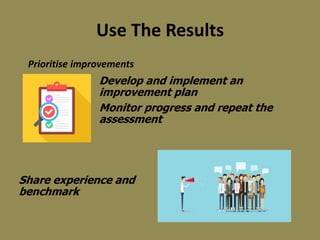
Use The Results
Prioritise improvements
Develop and implement an
improvement plan
Monitor progress and repeat the
assessment
Share experience and
benchmark
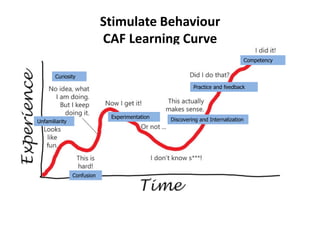
Stimulate Behaviour
CAF Learning Curve
Unfamiliarity
Confusion
Curiosity
Experimentation Discovering and Internalization
Practice and feedback
Competency
Learning and Giving for
Better Indonesia

Common Assessment Framework

  • 1.
    An Introduction to CommonAssessment Framework (CAF) for Quality Management in the Public Sector Seta A. Wicaksana Founder and CEO www.humanikaconsulting.com
  • 2.
    Introduction • Common AssessmentFramework (CAF) • Self Assessment • CAF and Criterions • Assessment Panels (Score) • The Journey
  • 4.
    Common Assessment Framework Leadership Human Resources Management Strategyand Planning Partnerships and Resources Process and Change Management People Results Customer / Citizen- oriented Results Society Results Key Performance Results ENABLERS RESULTS INNOVATION AND LEARNING
  • 5.
    CAF, What isit? • The CAF is an easy-to-use, free tool to assist public-sector organizations across Europe in using quality management techniques to improve their performance. • The CAF is a total quality management (TQM) tool • It is inspired by the major Total Quality models in general, and by the Excellence Model of the European Foundation for Quality Management (EFQM) in particular. • It is especially designed for public-sector organizations, taking into account their characteristics. • To be compatible with the commonest models used by the Public and private organizations.
  • 6.
    CAF purposes • Tointroduce public administrations to the principles of TQM and • gradually guide them, through the use and understanding of self-assessment, from the current “Plan-Do” sequence of activities to a full fledged “Plan-Do-Check-Act (PCDA)” cycle; • To facilitate the self-assessment of a public organization in order to arrive at a diagnosis and improvement actions; • To act as a bridge across the various models used in quality management; • To facilitate bench learning between public- sector organizations. • To be available, free of charge
  • 7.
    CAF Provides Enablers – Thefeatures of an organisation which determine how it performs – Criteria 1-5 deal with the Enabler features of an organisation; these determine how it performs. The assessment of actions relating to the Enablers should be based on the Enablers Panel. Results – The results or outputs which the organisation achieves – The assessment of results requires a different set of responses, so the responses from this point are based on the Results Assessment Panel.
  • 8.
    Why CAF goodfor us • Effective identification of the strengths of the organization and the areas where improvement is needed • Identification of relevant improvement actions • Increased level of awareness and communication throughout the organization • to make your people become aware and interested in quality issues
  • 9.
    Total Quality inthe organization • Quality of results = Quality of organization • Two management models – ISO 9000 (housekeeping - employees) “DO THINGS RIGHT” – TQM (continuous improvement - top management) “DO THE RIGHT THING”
  • 10.
    PDCA • PLAN: defineobjectives you want to achieve, considering your customers • DO: execute your plans, monitoring indicators • CHECK: assess your achievements, comparing them with your objectives. Success / failure • ACT: correct, revise, reconsider, improve, consolidate = Heuristics: solve problems by learning and discovery
  • 11.
    • Quality • Improvement •Communication (critical success factor) • Self-consciousness • Learning organization
  • 12.
    Self-Assessment People in theorganization are the ones who know its functioning best but they don’t always share and knowledge is not spread
  • 13.
    Self-Assessment – It Integratesinitiatives of quality improvement in the current management of the organization – It works as a diagnostic tool – It a dynamic process, allowing the additional motivation of people to change management – It is a structured and rigorous way to manage improvement processes – It is based on facts and not on individual subjective feelings – It allows the recognition of progresses achieved – It allows internal and external benchmarking – It recognizes performance levels – Identifies strengths and improvement areas – Is based on facts – Develops a common language and promotes a new culture – Involves all people at all levels – Must aim at continuous improvement
  • 14.
    Self-Assessment Cycle STRENGTHS & AREASFOR IMPROVEMENT IMPLEMENTING IMPROVEMENT ACTIONS IMPROVED RESULTS SELF- ASSESSMENT
  • 15.
  • 16.
    Criterion 1: Leadership Howleaders and managers develop and facilitate the achievement of the mission and vision of a public sector organisation; develop values required for long-term success and implement these via appropriate actions and behaviours; and are personally involved in ensuring that the organisation’s management system is developed and implemented.
  • 17.
    Criterion 1: Leadership •Sub-Criterion – 1.1. Give a direction to the organisation: develop and communicate vision, mission and values – 1.2. Develop and implement a system for managing the organisation – 1.3. Motivate and support the people in the organisation and act as a role model – 1.4. Manage the relations with politicians and other stakeholders
  • 19.
    Criterion 2: Strategyand Planning How the organisation implements its mission and vision via a clear stakeholder-focused strategy, supported by relevant policies, plans, objectives, targets and processes.
  • 20.
    Criterion 2: Strategyand Planning • Sub-Criterion – 2.1. Gather information relating to present and future needs of stakeholders – 2.2. Develop, review and update strategy and planning – 2.3. Implement strategy and planning in the whole organisation
  • 22.
    Criterion 3: HumanResources Management How the organisation manages, develops and releases the knowledge and full potential of its people at individual, team-based and organisation wide levels; and plans these activities in order to support its policy and strategy and the effective operation of its people.
  • 23.
    Criterion 3: HumanResources Management • Sub-Criterion – 3.1. Plan, manage and improve human resources* with regard to strategy and planning – 3.2. Identify, develop and use competencies of the employees aligning individual, team and organisational targets and goals – 3.3. Involve employees by developing dialogue and empowerment
  • 25.
    Criterion 4: Partnershipsand Resources How the organisation plans and manages its partnerships and internal resources in order to support its policy and strategy and the effective operation of its processes.
  • 26.
    Criterion 4: Partnerships andResources • Sub-Criterion – 4.1. Develops and implements key partnership relations – 4.2. Develops and implements partnerships with the customers/citizens – 4.3. Manages knowledge – 4.4. Manages finances – 4.5. Manages technology – 4.6. Manages buildings and assets
  • 28.
    Criterion 5: Processand Change Management How the organisation manages, improves and develops its processes in order to innovate and support its policy and strategy and fully satisfy and generate increasing value for its customers and other stakeholders.
  • 29.
    Criterion 5: Processand Change Management • Sub-Criterion – 5.1. Identifies, designs, manages and improves processes – 5.2. Develops and delivers services and products by involving the customers/citizens – 5.3. Plans and manages modernisation and innovation
  • 31.
    Criterion 6: Customer/Citizenoriented Results What results the organisation is achieving in relation to the satisfaction of its internal and external customers. Sub-Criterion 6.1. Results of customer/citizen satisfaction measurements 6.2. Indicators of customer/citizen-oriented measurements
  • 32.
    Criterion 7: PeopleResults The results the organisation is achieving in relation to the satisfaction of its people. SubCriterion 7.1. Results of people satisfaction and motivation measurements 7.2. Indicators of people results
  • 33.
    Criterion 8: SocietyResults What the organisation is achieving in satisfying the needs and the expectations of the local, national and international community at large (as appropriate). This includes the perception of the organisation’s approach to quality of life, the environment and the preservation of global resources, and the organisation’s own internal measures of effectiveness. It will include its relations with authorities and bodies, which affect and regulate its business. Sub-Criterion 8.1. Results of societal performance 8.2. Results of environmental performance
  • 34.
    Criterion 9: KeyPerformance Results What the organisation is achieving in relation to its mandate and specified objectives and in satisfying the needs and expectations of everyone with a financial interest or other stake in the organisation. • Sub-Criterion – 9.1. Goal achievement – 9.2. Financial performance
  • 36.
    CAF - Dynamic ENABLERSRESULTS Criterion 3 Human Resources Management Criterion 7 People Results
  • 37.
  • 38.
  • 39.
    SCORE - EnablersPanel 0 No evidence or only anecdotal evidence of an approach. 1 An approach is planned P (plan). 2 An approach is planned and implemented D (do). 3 An approach is planned, implemented and reviewed C (check). 4 An approach is planned, implemented and reviewed on the basis of benchmarking data and adjusted accordingly A (act). 5 An approach is planned, implemented, reviewed on the basis of benchmarking data, adjusted and fully integrated into the organisation.
  • 40.
    SCORE - ResultsPanel 0 No results are measured. 1 Key results are measured and show negative or stable trends. 2 Results show modest progress. 3 Results show substantial progress. 4 Excellent results are achieved and positive comparisons to own targets are made. 5 Excellent results are achieved, positive comparisons to own targets are made and positive benchmarks against relevant organisations are made.
  • 41.
    The Journey Guidelines forthe use of the CAF
  • 43.
    Organize the Processof Assessment 1. Commit the senior management 2. Appoint a CAF project leader 3. Establish the assessment group 4. Inform the team about what/how is to be done 5. Communicate CAF self-assessment process
  • 44.
     Undertake consensus •In the process of arriving at consensus, a four-step method may be used: 1. Presenting the range of individual scores under each sub- criterion, as well as the statistical mean of the individual assessments. 2. Identifying the significant points of consensus and difference. 3. Discussing the background to any significant cases of difference. 4. Attempting to reach consensus, possibly on the basis of a second assessment-round for selected criteria. The assessment process Undertake individual assessment
  • 45.
    Use The Results Prioritiseimprovements Develop and implement an improvement plan Monitor progress and repeat the assessment Share experience and benchmark
  • 46.
    Stimulate Behaviour CAF LearningCurve Unfamiliarity Confusion Curiosity Experimentation Discovering and Internalization Practice and feedback Competency
  • 48.
    Learning and Givingfor Better Indonesia