MeerKAT outline
Lindsay
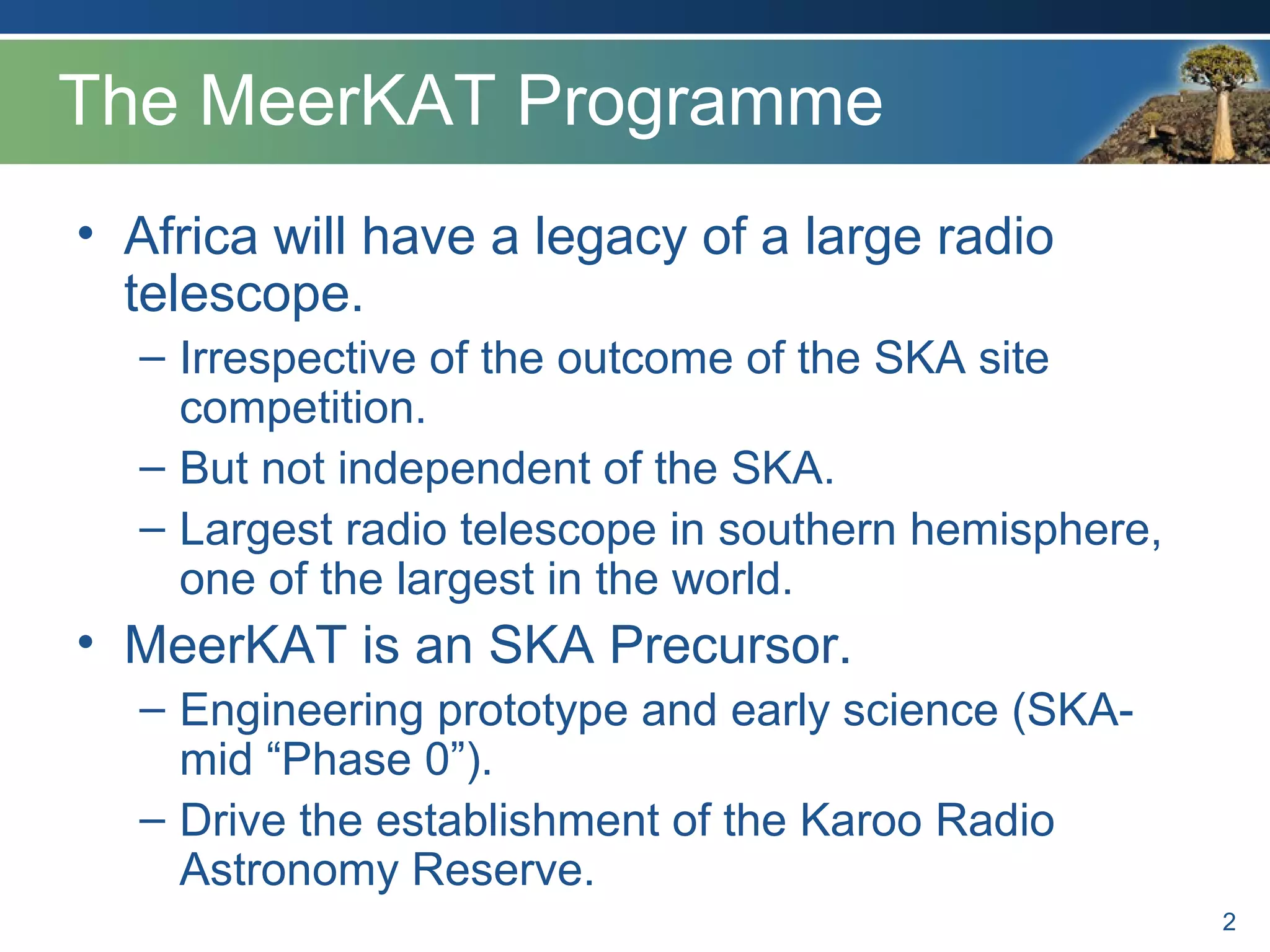
The MeerKAT Programme
• Africa will have a legacy of a large radio
telescope.
– Irrespective of the outcome of the SKA site
competition.
– But not independent of the SKA.
– Largest radio telescope in southern hemisphere,
one of the largest in the world.
• MeerKAT is an SKA Precursor.
– Engineering prototype and early science (SKA-
mid “Phase 0”).
– Drive the establishment of the Karoo Radio
Astronomy Reserve.
2
3
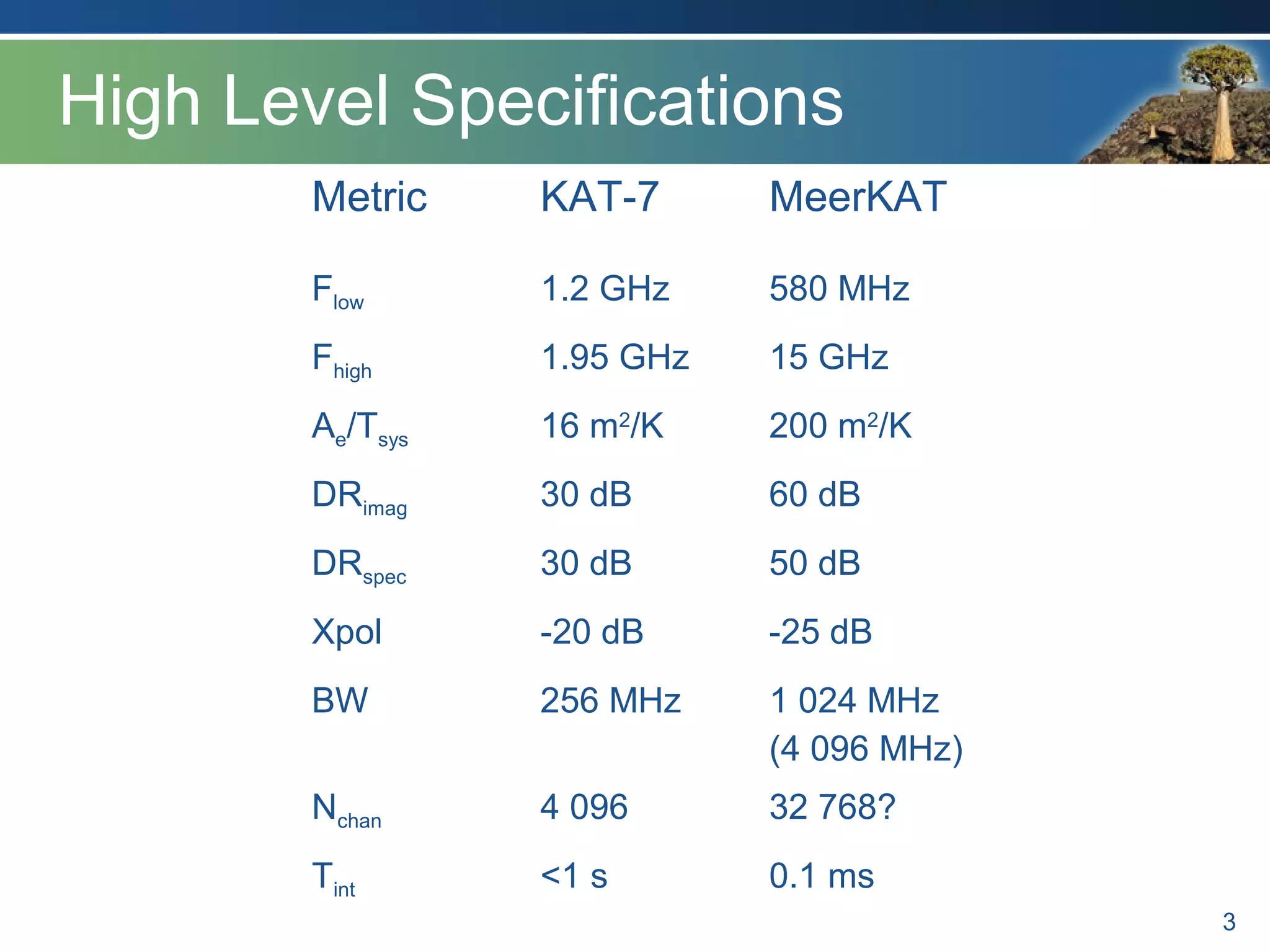
High Level Specifications
Metric KAT-7 MeerKAT
Flow 1.2 GHz 580 MHz
Fhigh 1.95 GHz 15 GHz
Ae/Tsys 16 m2
/K 200 m2
/K
DRimag 30 dB 60 dB
DRspec 30 dB 50 dB
Xpol -20 dB -25 dB
BW 256 MHz 1 024 MHz
(4 096 MHz)
Nchan 4 096 32 768?
Tint <1 s 0.1 ms
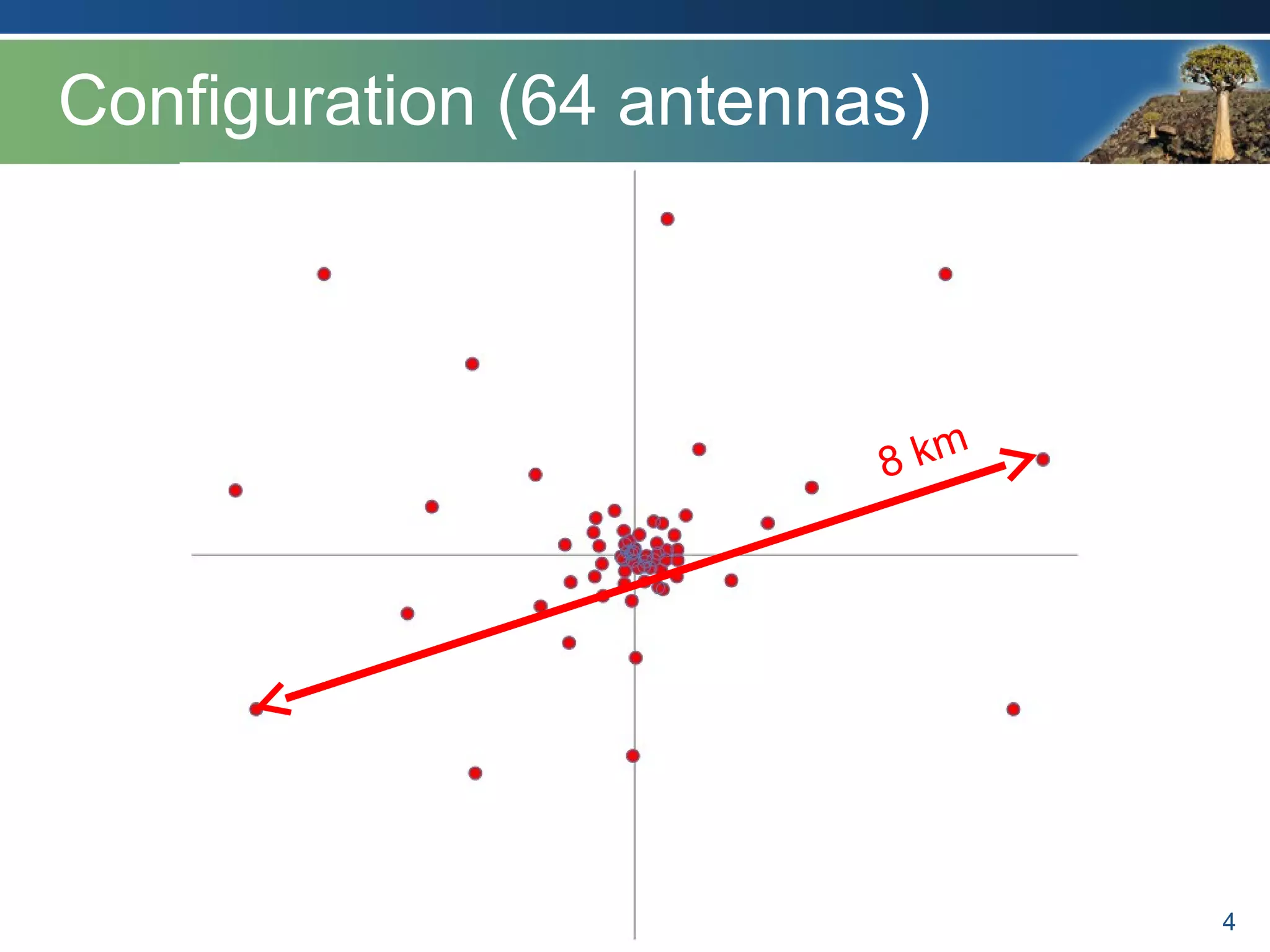
Configuration (64 antennas)
4
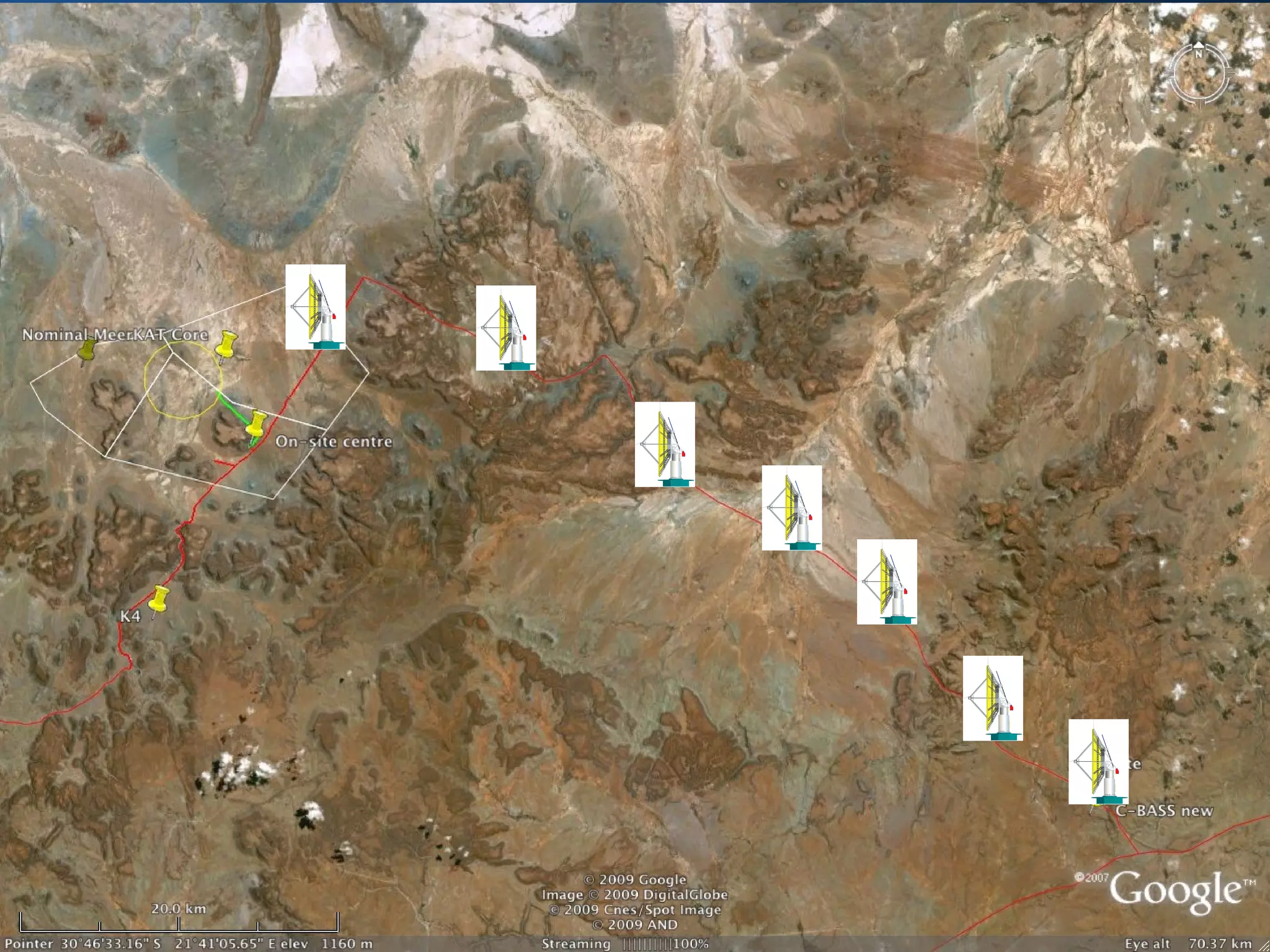
8 km
5
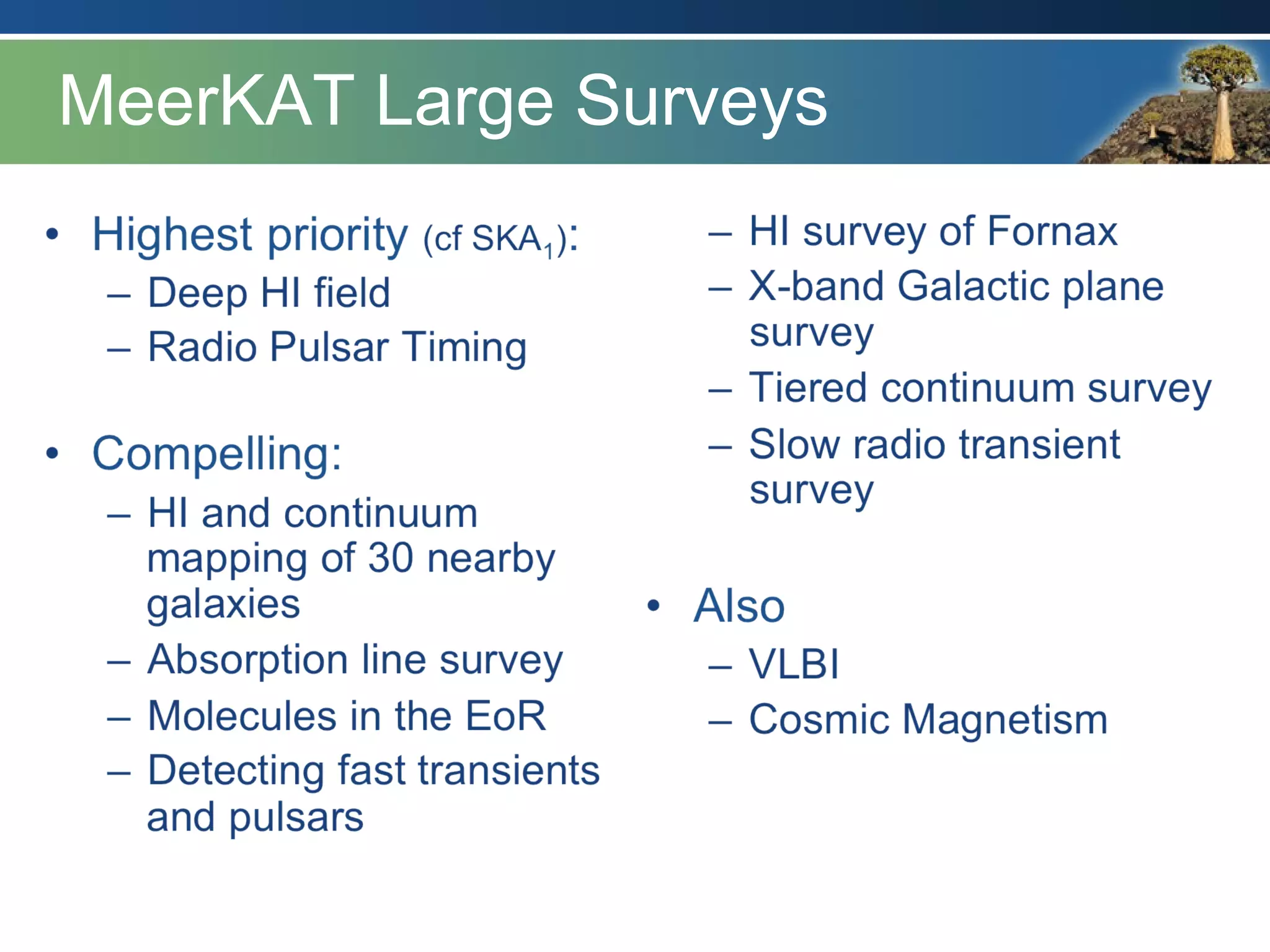
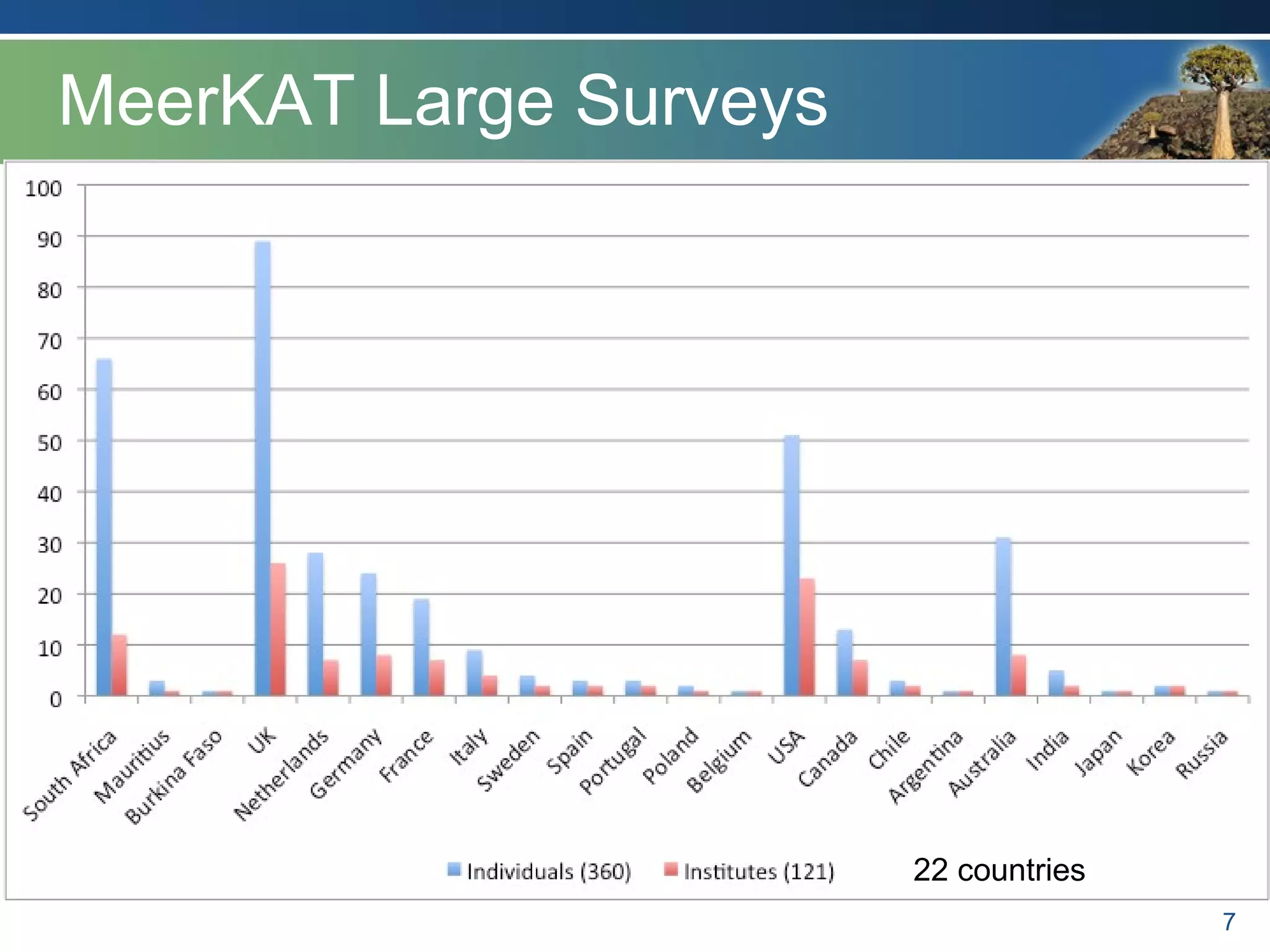
MeerKAT Large Surveys
7
22 countries
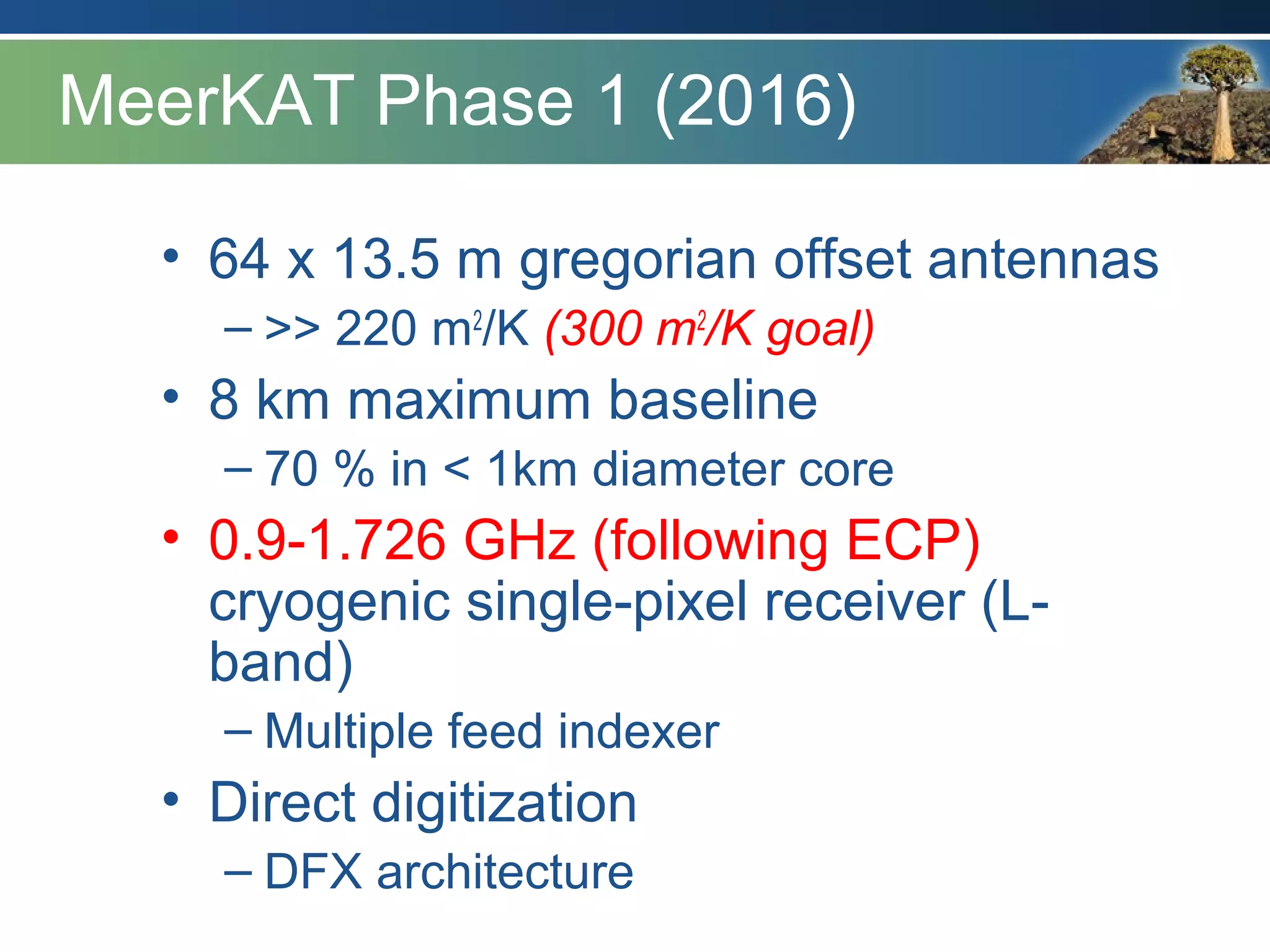
MeerKAT Phase 1 (2016)
• 64 x 13.5 m gregorian offset antennas
– >> 220 m2
/K (300 m2
/K goal)
• 8 km maximum baseline
– 70 % in < 1km diameter core
• 0.9-1.726 GHz (following ECP)
cryogenic single-pixel receiver (L-
band)
– Multiple feed indexer
• Direct digitization
– DFX architecture
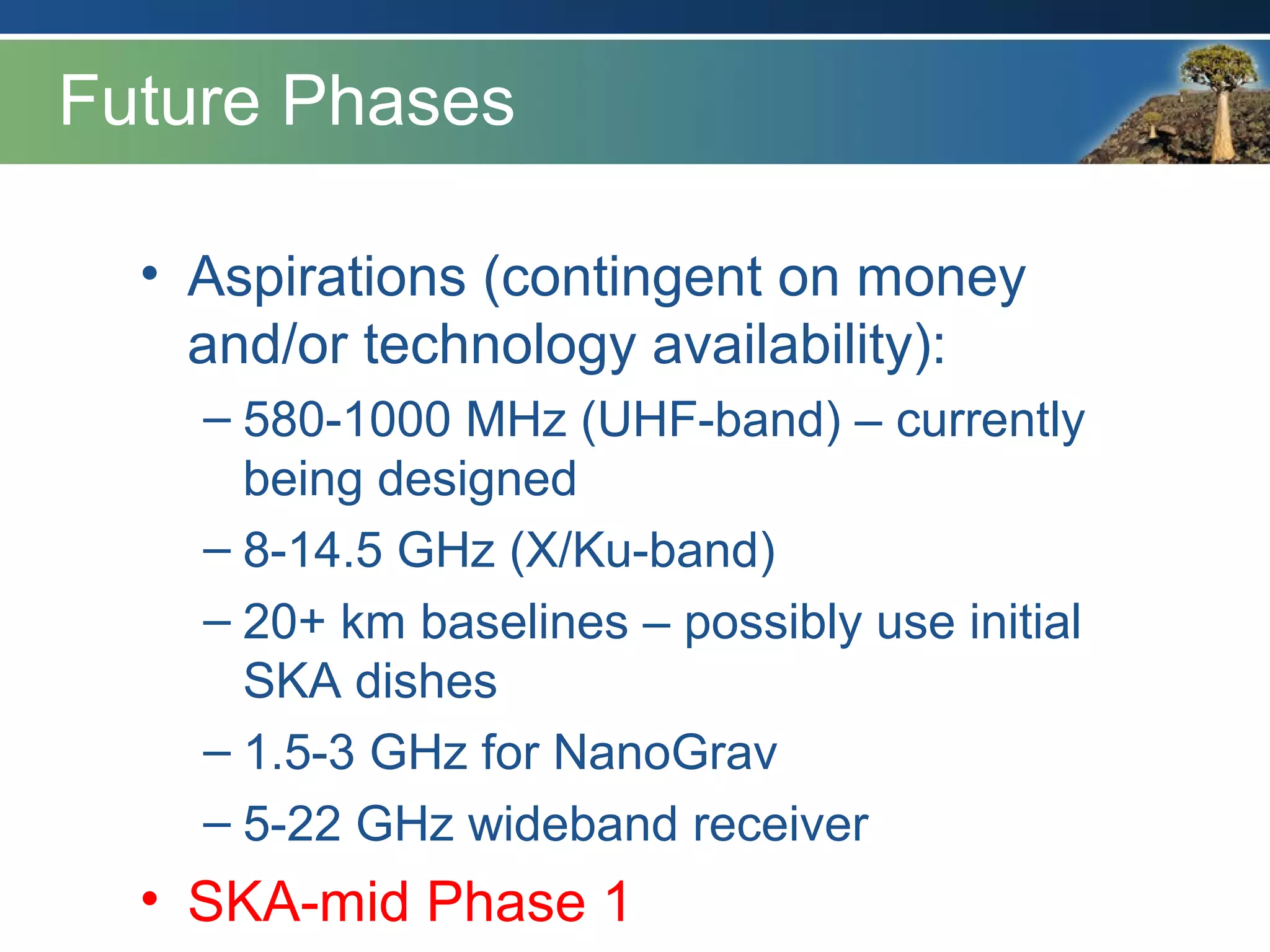
Future Phases
• Aspirations (contingent on money
and/or technology availability):
– 580-1000 MHz (UHF-band) – currently
being designed
– 8-14.5 GHz (X/Ku-band)
– 20+ km baselines – possibly use initial
SKA dishes
– 1.5-3 GHz for NanoGrav
– 5-22 GHz wideband receiver
• SKA-mid Phase 1
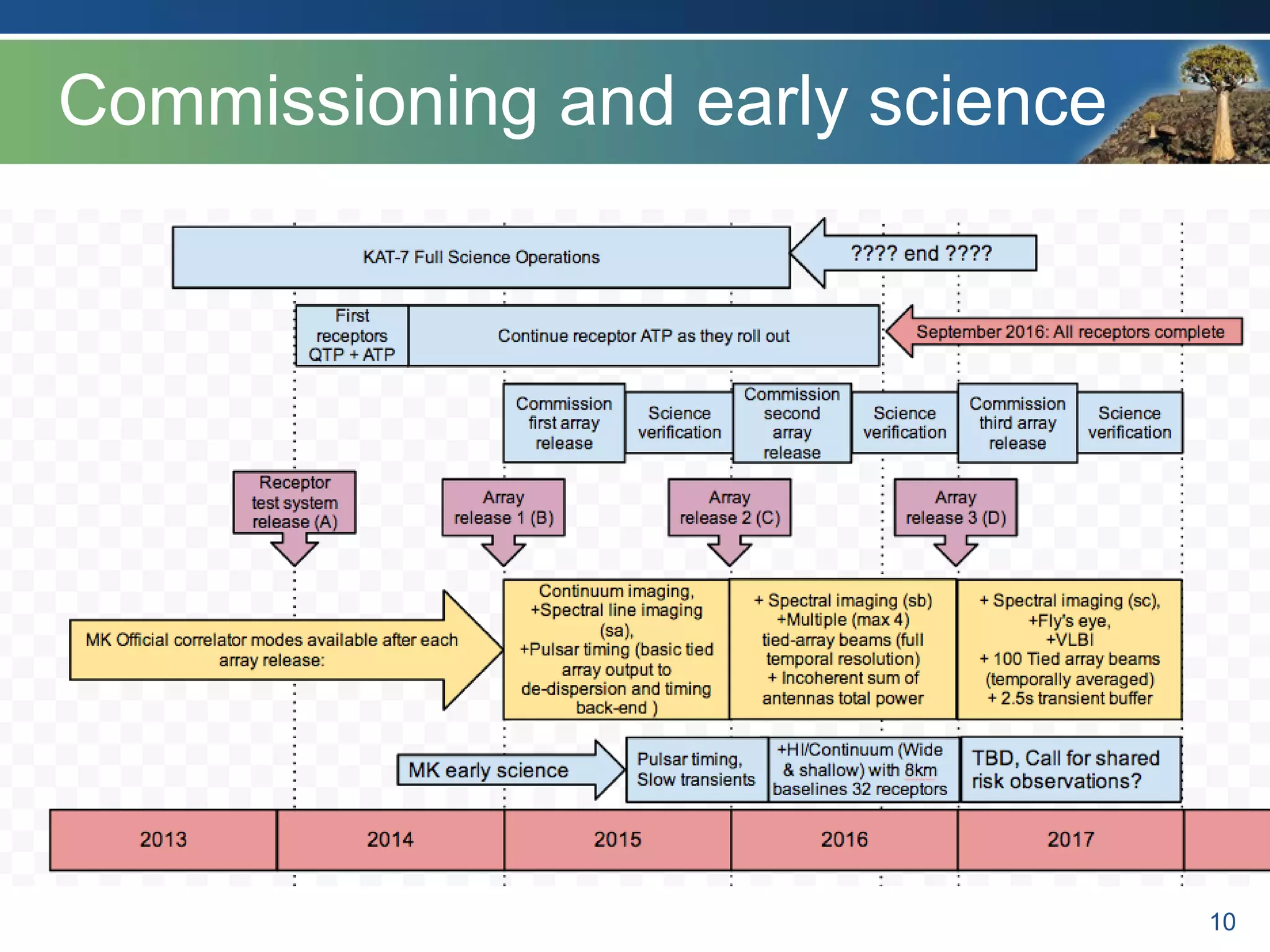
Commissioning and early science
10
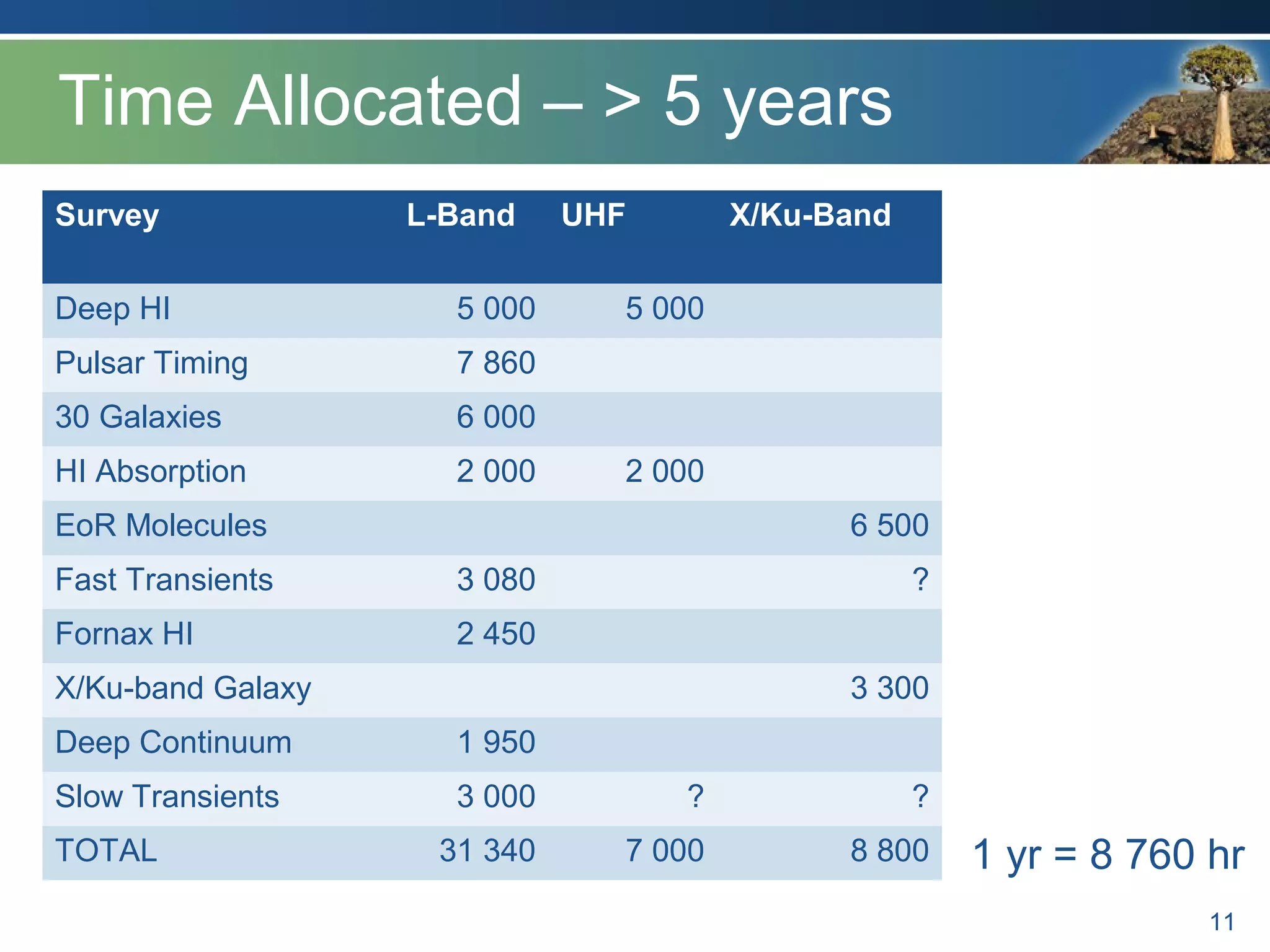
Time Allocated – > 5 years
11
Survey L-Band UHF X/Ku-Band
Deep HI 5 000 5 000
Pulsar Timing 7 860
30 Galaxies 6 000
HI Absorption 2 000 2 000
EoR Molecules 6 500
Fast Transients 3 080 ?
Fornax HI 2 450
X/Ku-band Galaxy 3 300
Deep Continuum 1 950
Slow Transients 3 000 ? ?
TOTAL 31 340 7 000 8 800 1 yr = 8 760 hr
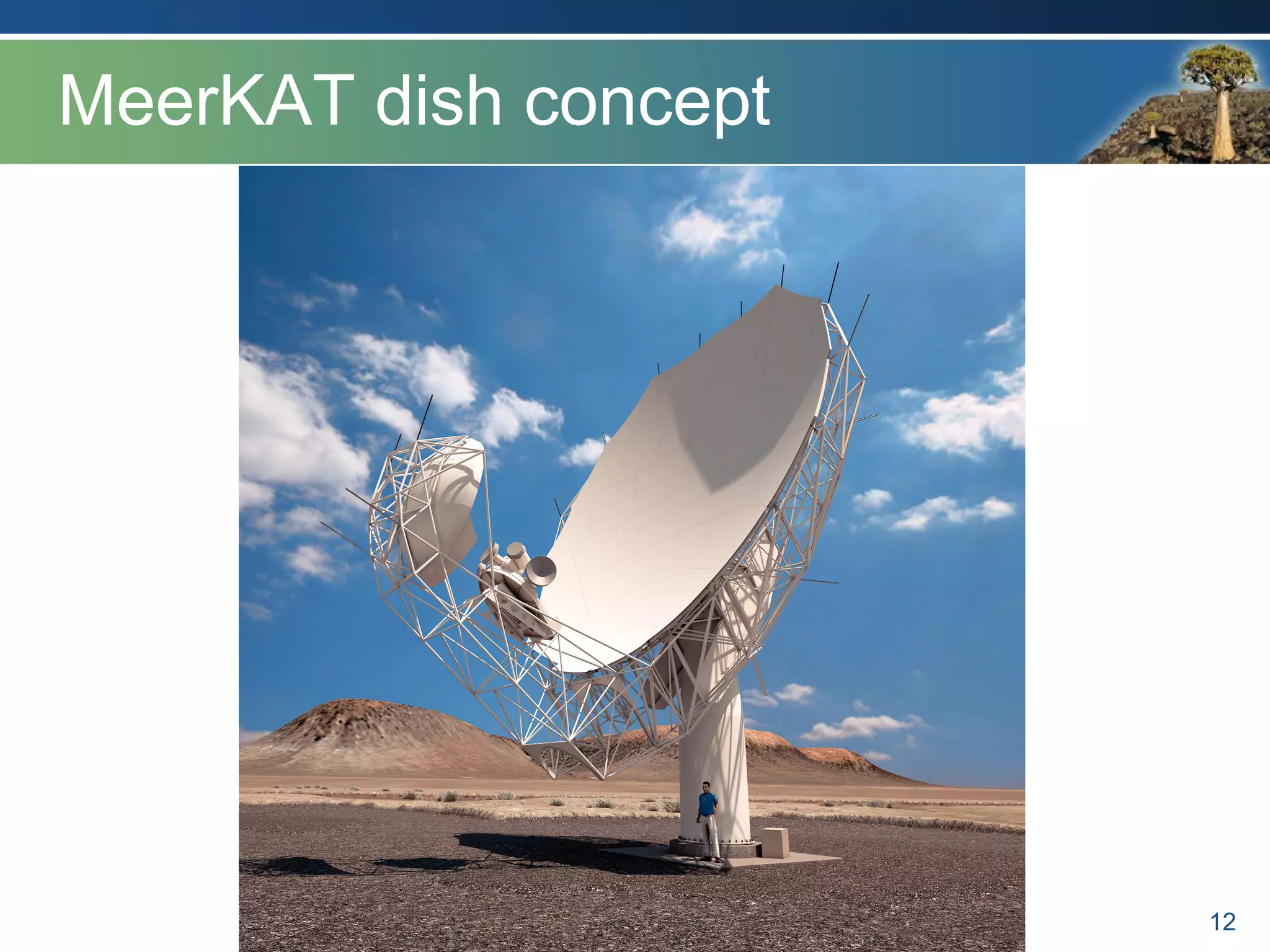
MeerKAT dish concept
12
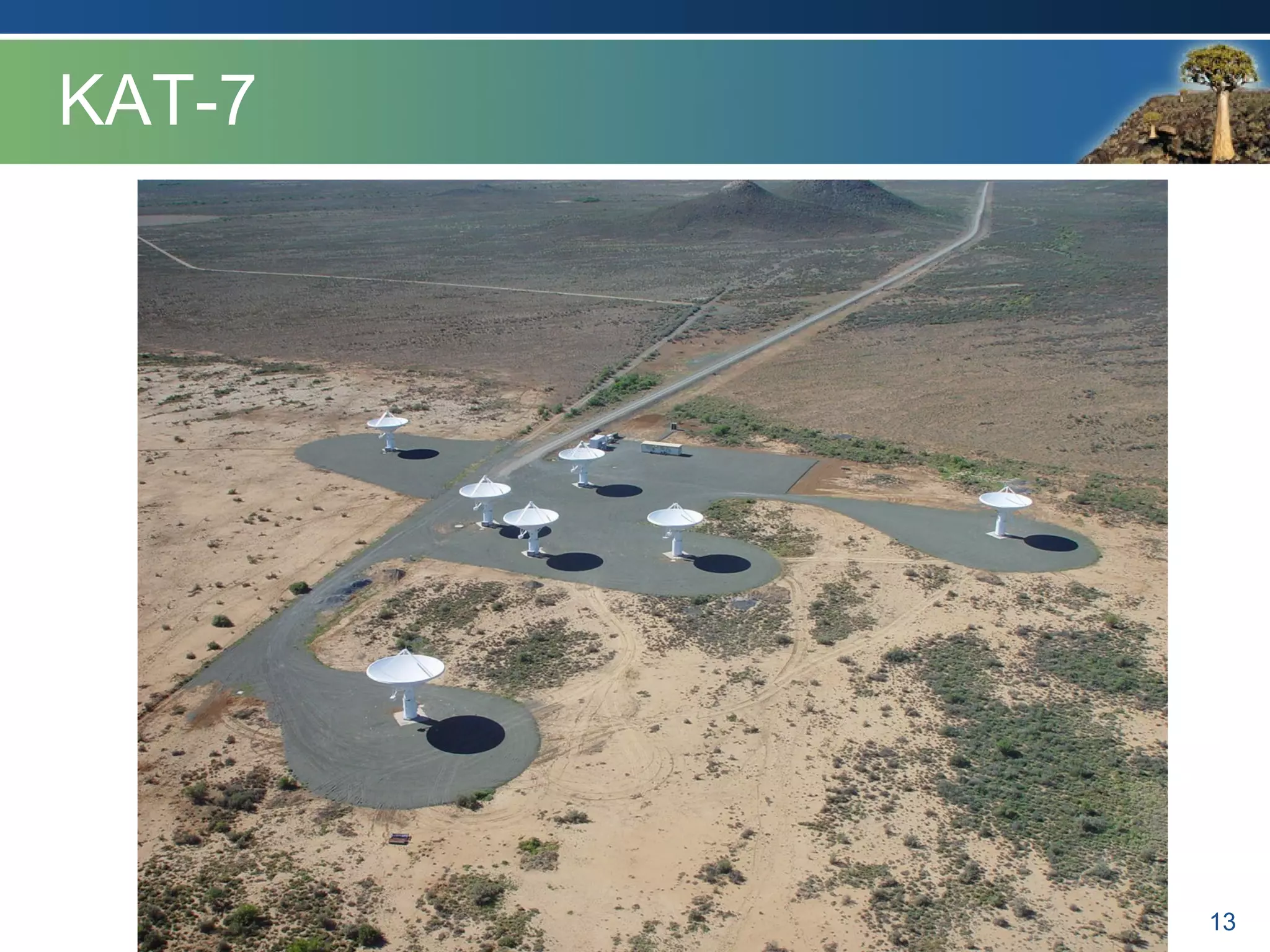
KAT-7
13
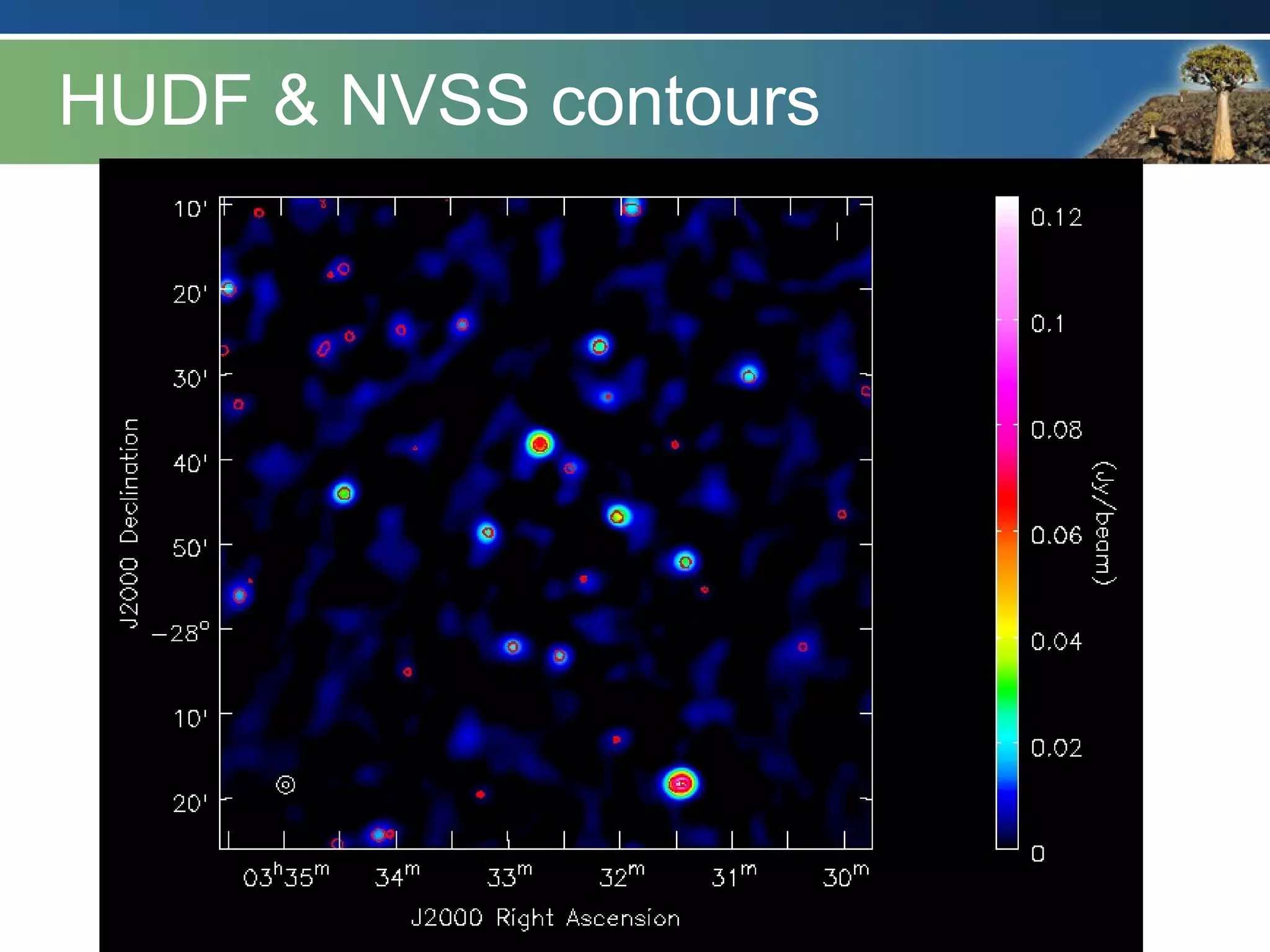
HUDF & NVSS contours
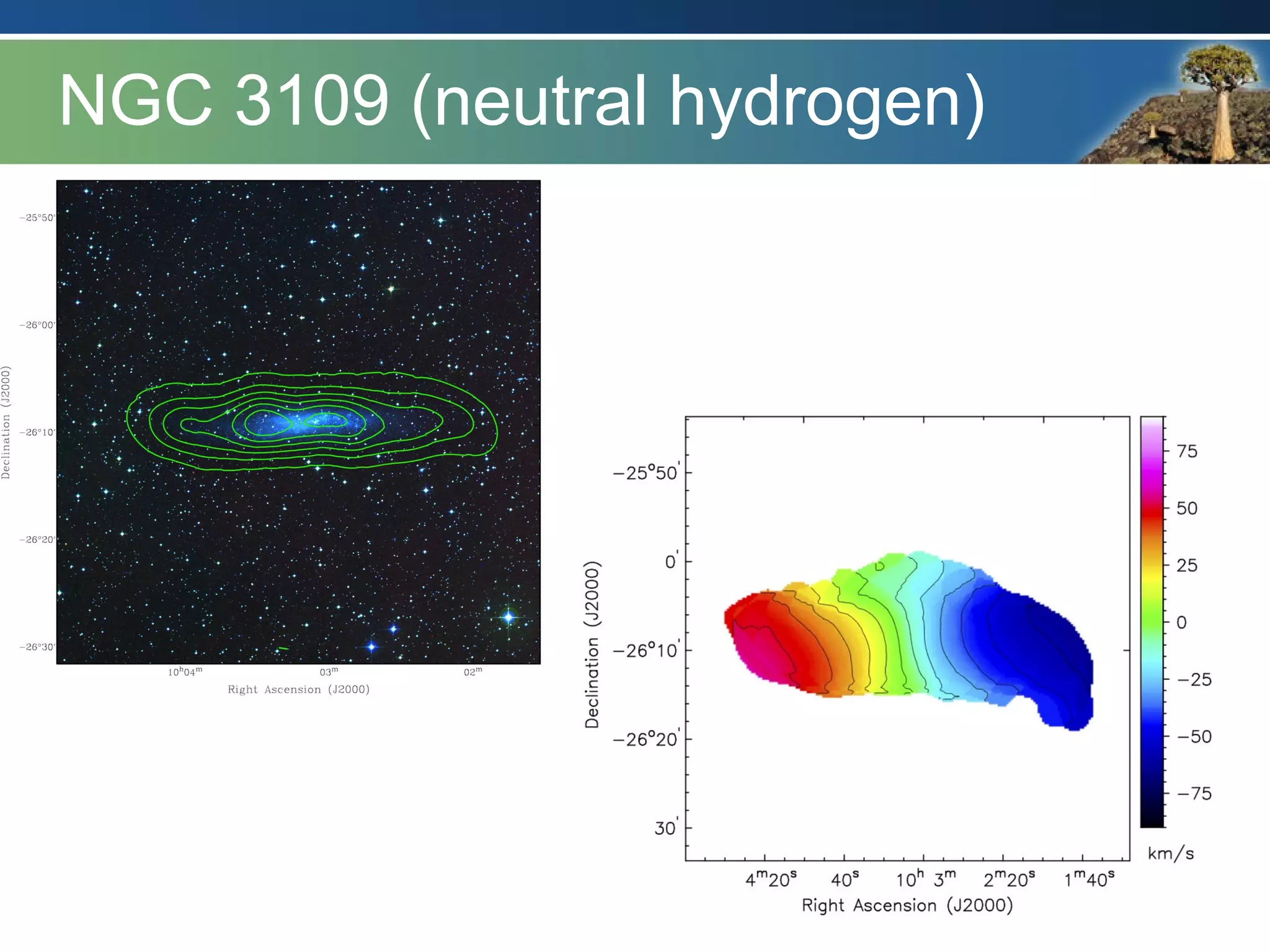
NGC 3109 (neutral hydrogen)
15
16
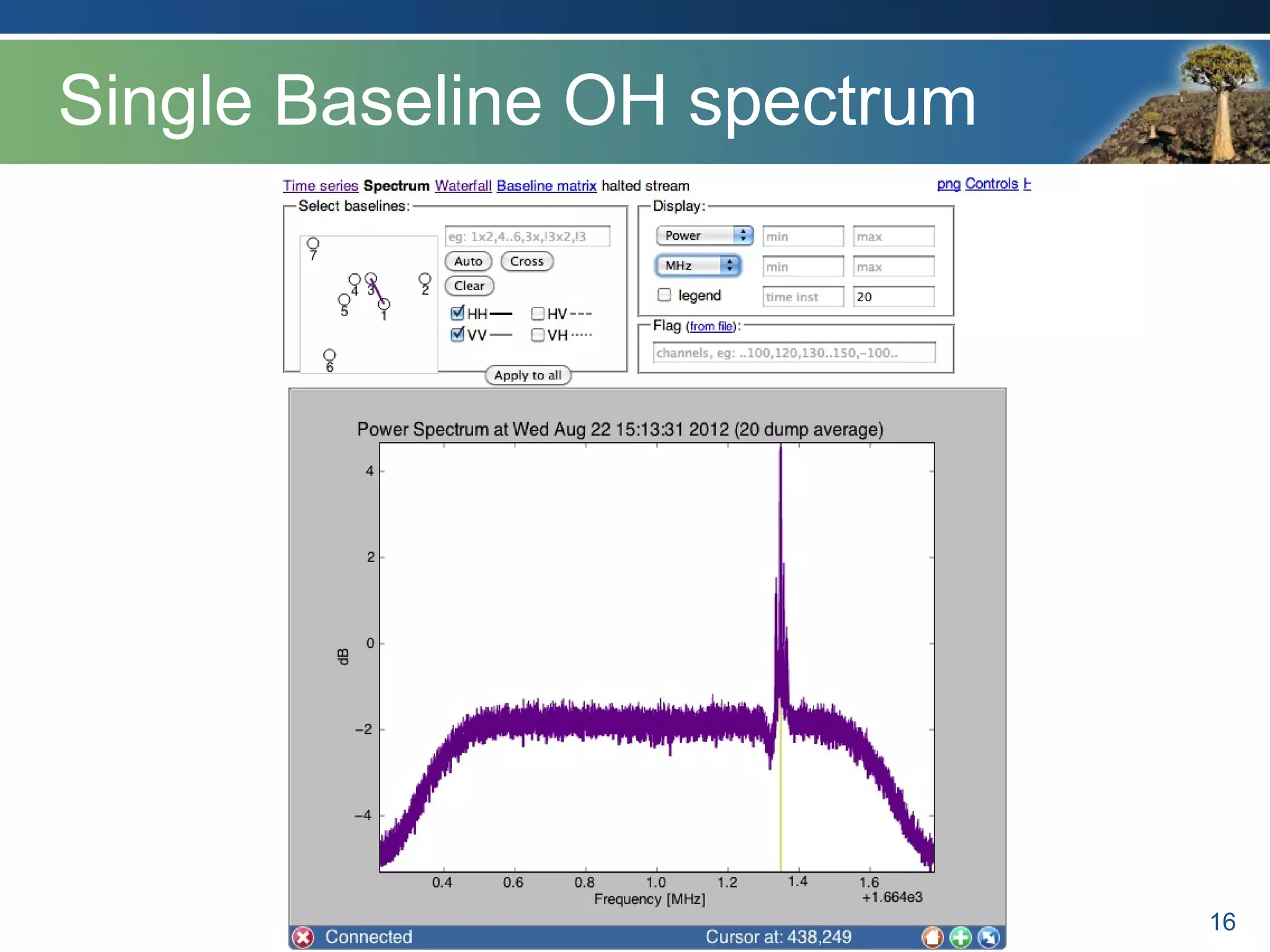
Single Baseline OH spectrum
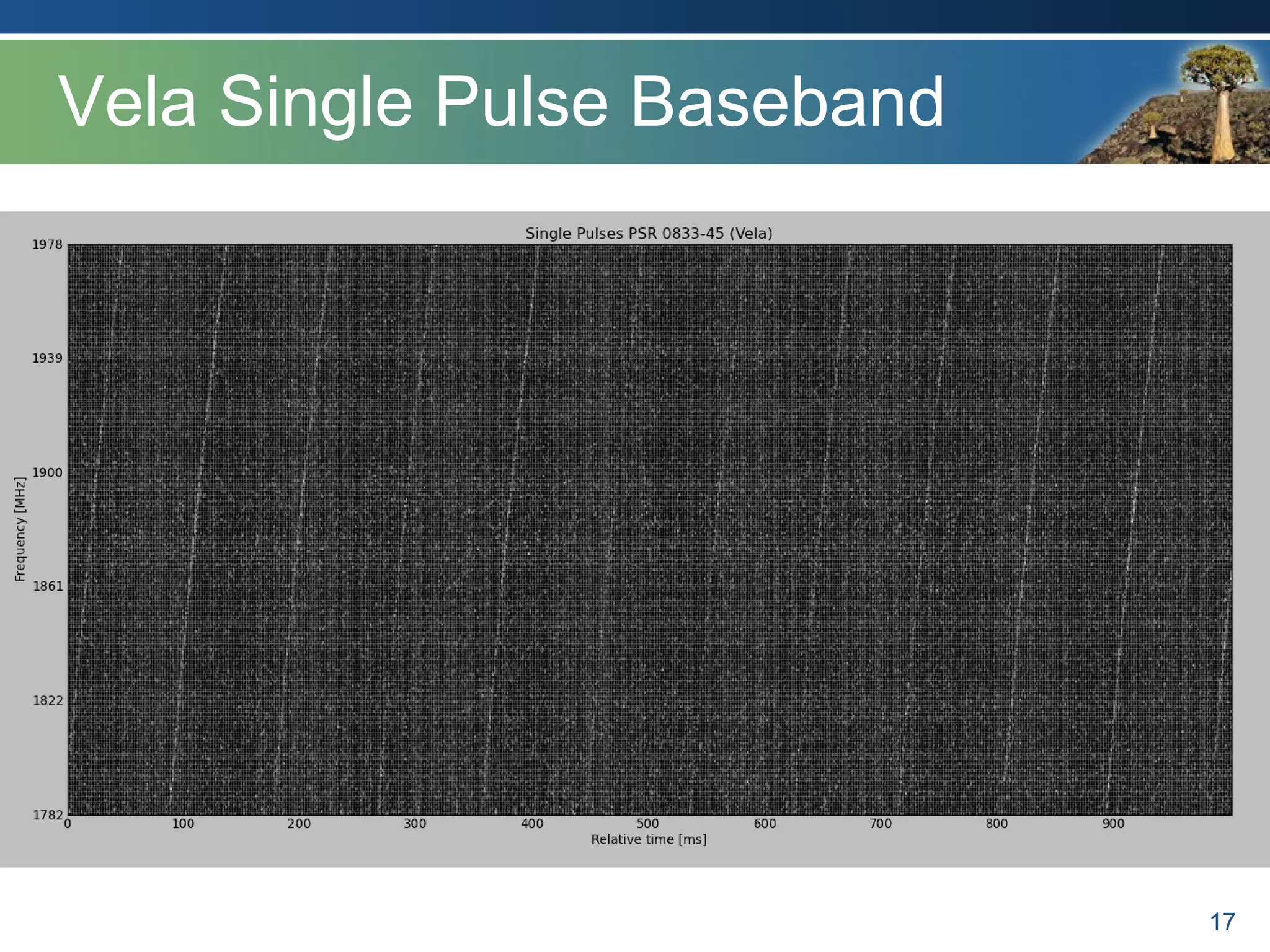
Vela Single Pulse Baseband
17
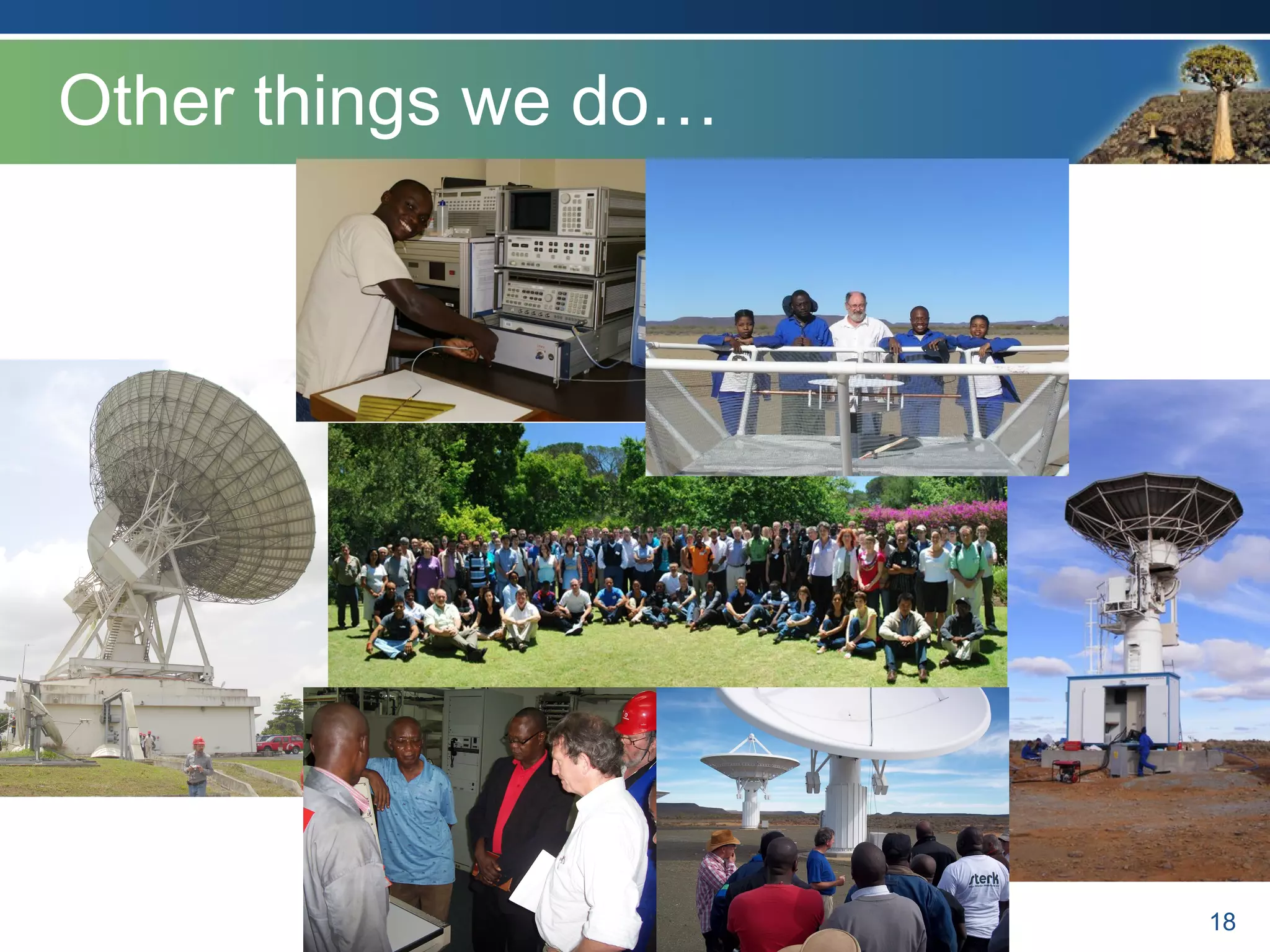
Other things we do…
18
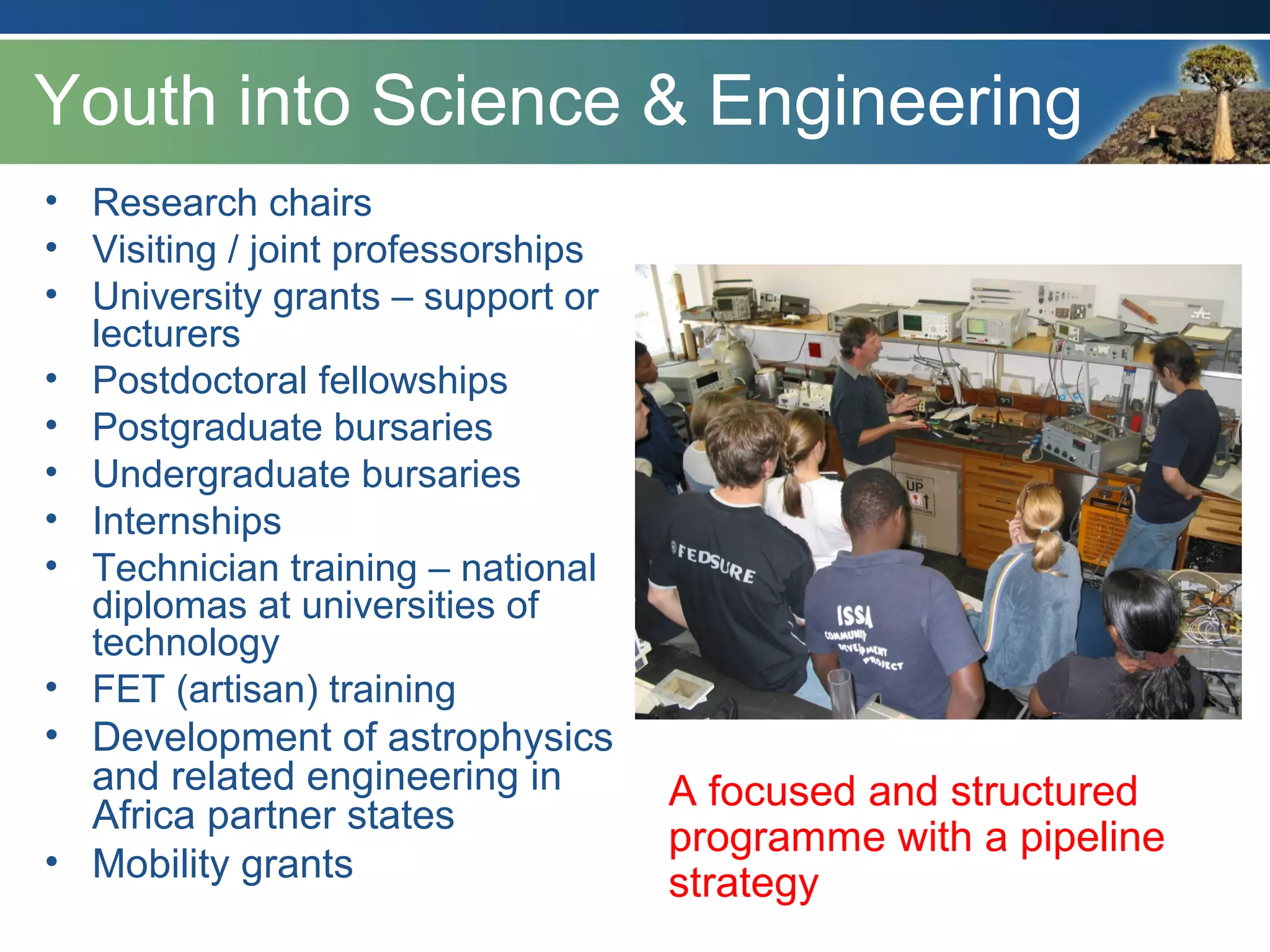
Youth into Science & Engineering
• Research chairs
• Visiting / joint professorships
• University grants – support or
lecturers
• Postdoctoral fellowships
• Postgraduate bursaries
• Undergraduate bursaries
• Internships
• Technician training – national
diplomas at universities of
technology
• FET (artisan) training
• Development of astrophysics
and related engineering in
Africa partner states
• Mobility grants
A focused and structured
programme with a pipeline
strategy
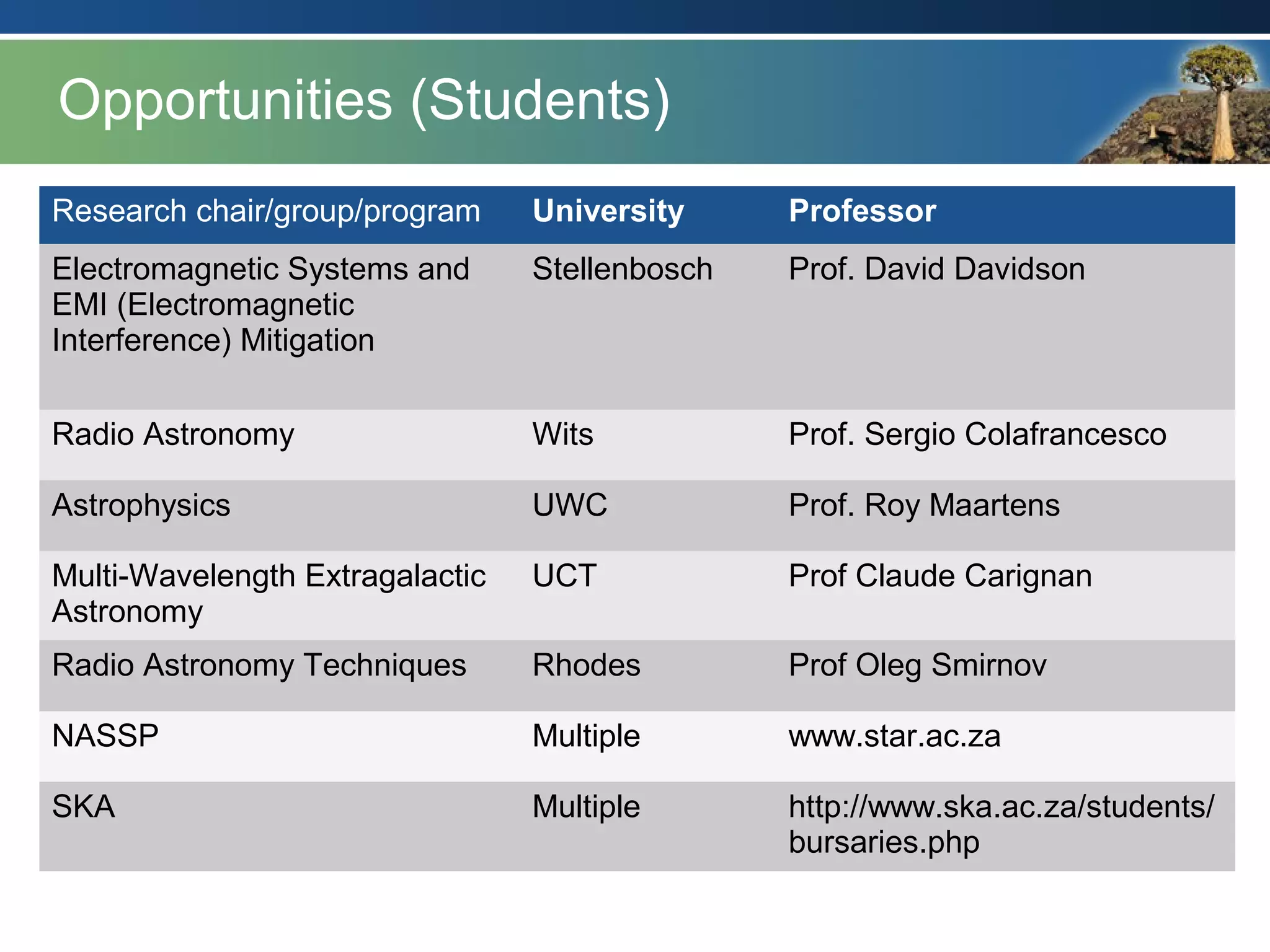
Opportunities (Students)
Research chair/group/program University Professor
Electromagnetic Systems and
EMI (Electromagnetic
Interference) Mitigation
Stellenbosch Prof. David Davidson
Radio Astronomy Wits Prof. Sergio Colafrancesco
Astrophysics UWC Prof. Roy Maartens
Multi-Wavelength Extragalactic
Astronomy
UCT Prof Claude Carignan
Radio Astronomy Techniques Rhodes Prof Oleg Smirnov
NASSP Multiple www.star.ac.za
SKA Multiple http://www.ska.ac.za/students/
bursaries.php
Opportunities (Faculty)
• Science Data Processing
– Developer MeerKAT
• Archiving, Pipelining, Calibration, HPC
– Developer SKA PEP
• Work on developing specifications for SKA
• Commissioning
– Senior scientist
• Can lead commissioning teams with a good knowledge
of the system from hardware through to publishable
science
– Junior/intermediate scientist
• Has worked on radio telescope hardware and data
21

MeerKAT: an overview

  • 1.
  • 2.
    The MeerKAT Programme •Africa will have a legacy of a large radio telescope. – Irrespective of the outcome of the SKA site competition. – But not independent of the SKA. – Largest radio telescope in southern hemisphere, one of the largest in the world. • MeerKAT is an SKA Precursor. – Engineering prototype and early science (SKA- mid “Phase 0”). – Drive the establishment of the Karoo Radio Astronomy Reserve. 2
  • 3.
    3 High Level Specifications MetricKAT-7 MeerKAT Flow 1.2 GHz 580 MHz Fhigh 1.95 GHz 15 GHz Ae/Tsys 16 m2 /K 200 m2 /K DRimag 30 dB 60 dB DRspec 30 dB 50 dB Xpol -20 dB -25 dB BW 256 MHz 1 024 MHz (4 096 MHz) Nchan 4 096 32 768? Tint <1 s 0.1 ms
  • 4.
  • 5.
  • 6.
  • 7.
  • 8.
    MeerKAT Phase 1(2016) • 64 x 13.5 m gregorian offset antennas – >> 220 m2 /K (300 m2 /K goal) • 8 km maximum baseline – 70 % in < 1km diameter core • 0.9-1.726 GHz (following ECP) cryogenic single-pixel receiver (L- band) – Multiple feed indexer • Direct digitization – DFX architecture
  • 9.
    Future Phases • Aspirations(contingent on money and/or technology availability): – 580-1000 MHz (UHF-band) – currently being designed – 8-14.5 GHz (X/Ku-band) – 20+ km baselines – possibly use initial SKA dishes – 1.5-3 GHz for NanoGrav – 5-22 GHz wideband receiver • SKA-mid Phase 1
  • 10.
  • 11.
    Time Allocated –> 5 years 11 Survey L-Band UHF X/Ku-Band Deep HI 5 000 5 000 Pulsar Timing 7 860 30 Galaxies 6 000 HI Absorption 2 000 2 000 EoR Molecules 6 500 Fast Transients 3 080 ? Fornax HI 2 450 X/Ku-band Galaxy 3 300 Deep Continuum 1 950 Slow Transients 3 000 ? ? TOTAL 31 340 7 000 8 800 1 yr = 8 760 hr
  • 12.
  • 13.
  • 14.
    HUDF & NVSScontours
  • 15.
    NGC 3109 (neutralhydrogen) 15
  • 16.
  • 17.
    Vela Single PulseBaseband 17
  • 18.
  • 19.
    Youth into Science& Engineering • Research chairs • Visiting / joint professorships • University grants – support or lecturers • Postdoctoral fellowships • Postgraduate bursaries • Undergraduate bursaries • Internships • Technician training – national diplomas at universities of technology • FET (artisan) training • Development of astrophysics and related engineering in Africa partner states • Mobility grants A focused and structured programme with a pipeline strategy
  • 20.
    Opportunities (Students) Research chair/group/programUniversity Professor Electromagnetic Systems and EMI (Electromagnetic Interference) Mitigation Stellenbosch Prof. David Davidson Radio Astronomy Wits Prof. Sergio Colafrancesco Astrophysics UWC Prof. Roy Maartens Multi-Wavelength Extragalactic Astronomy UCT Prof Claude Carignan Radio Astronomy Techniques Rhodes Prof Oleg Smirnov NASSP Multiple www.star.ac.za SKA Multiple http://www.ska.ac.za/students/ bursaries.php
  • 21.
    Opportunities (Faculty) • ScienceData Processing – Developer MeerKAT • Archiving, Pipelining, Calibration, HPC – Developer SKA PEP • Work on developing specifications for SKA • Commissioning – Senior scientist • Can lead commissioning teams with a good knowledge of the system from hardware through to publishable science – Junior/intermediate scientist • Has worked on radio telescope hardware and data 21