TIME AND SALES
TERRITORY
MANAGEMENT
S. M. Habibur Rahman Tipu | Sales
Professional
Present By:
ESTABLISHING SALES
TERRITORY
 A sales territory is usually thought of as a
geographic area that contains customer
accounts (present and potential).
 The major emphasis should be on the
customers and prospects because a market is
made up of people and customers, not
geographic areas.
ESTABLISHING SALES
TERRITORY
Reasons for establishing sales territories
 To facilitate the planning and controlling of the selling
function.
 To enhance market coverage.
 To keep selling costs at a minimum.
 To strengthen customer relations.
 To build a more effective SF.
 To evaluate the SF better.
 To coordinate selling with other marketing functions.
ESTABLISHING SALES
TERRITORY
Reasons for not establishing sales territories
 Small companies with only a few people selling in a local
market.
 The available sales coverage is far below the sales
potential of the market.
 Companies introducing new product or with products that
everyone needs.
 Sales are made primarily on the basis of social contacts or
personal friendships.
SETTING UP SALES
TERRITORY
1. Selecting a geographic control unit
 States, counties (region), zip code areas, cities,
metropolitan areas, trading areas.
SETTING UP SALES
TERRITORY
2. Making an account analysis
 To identify accounts by name.
 To estimate the total sales potential for all accounts in
each geographic control unit.
 To classify each accounts according to its annual buying
potential.
SETTING UP SALES
TERRITORY
3. Developing a salesperson workload analysis
A salesperson workload analysis is an estimate of the time
and effort required to cover each geographic control
unit.
 Numbers of account to be called on.
 The length of each call.
 The travel time required.
 The non-selling time.
SETTING UP SALES
TERRITORY
4. Combine geographic control units into sales
territories
 To group adjacent control units into territories of
roughly equal sales potential.
SETTING UP SALES
TERRITORY
5. Assigning sales personnel to territories
 Relative ability (product and industry knowledge,
persuasiveness and verbal ability).
 Potential sales effectiveness within the territory
(salesperson’s physical, social and cultural
characteristics).
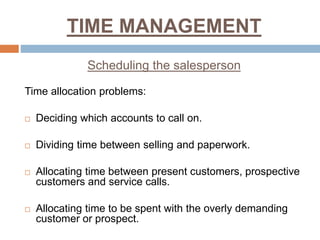
TIME MANAGEMENT
Scheduling the salesperson
Time allocation problems:
 Deciding which accounts to call on.
 Dividing time between selling and paperwork.
 Allocating time between present customers, prospective
customers and service calls.
 Allocating time to be spent with the overly demanding
customer or prospect.
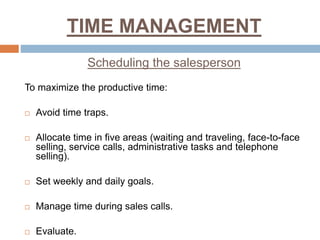
TIME MANAGEMENT
Scheduling the salesperson
To maximize the productive time:
 Avoid time traps.
 Allocate time in five areas (waiting and traveling, face-to-face
selling, service calls, administrative tasks and telephone
selling).
 Set weekly and daily goals.
 Manage time during sales calls.
 Evaluate.
Thank You !

TIME AND SALES TERRITORY

  • 1.
    TIME AND SALES TERRITORY MANAGEMENT S.M. Habibur Rahman Tipu | Sales Professional Present By:
  • 2.
    ESTABLISHING SALES TERRITORY  Asales territory is usually thought of as a geographic area that contains customer accounts (present and potential).  The major emphasis should be on the customers and prospects because a market is made up of people and customers, not geographic areas.
  • 3.
    ESTABLISHING SALES TERRITORY Reasons forestablishing sales territories  To facilitate the planning and controlling of the selling function.  To enhance market coverage.  To keep selling costs at a minimum.  To strengthen customer relations.  To build a more effective SF.  To evaluate the SF better.  To coordinate selling with other marketing functions.
  • 4.
    ESTABLISHING SALES TERRITORY Reasons fornot establishing sales territories  Small companies with only a few people selling in a local market.  The available sales coverage is far below the sales potential of the market.  Companies introducing new product or with products that everyone needs.  Sales are made primarily on the basis of social contacts or personal friendships.
  • 5.
    SETTING UP SALES TERRITORY 1.Selecting a geographic control unit  States, counties (region), zip code areas, cities, metropolitan areas, trading areas.
  • 6.
    SETTING UP SALES TERRITORY 2.Making an account analysis  To identify accounts by name.  To estimate the total sales potential for all accounts in each geographic control unit.  To classify each accounts according to its annual buying potential.
  • 7.
    SETTING UP SALES TERRITORY 3.Developing a salesperson workload analysis A salesperson workload analysis is an estimate of the time and effort required to cover each geographic control unit.  Numbers of account to be called on.  The length of each call.  The travel time required.  The non-selling time.
  • 8.
    SETTING UP SALES TERRITORY 4.Combine geographic control units into sales territories  To group adjacent control units into territories of roughly equal sales potential.
  • 9.
    SETTING UP SALES TERRITORY 5.Assigning sales personnel to territories  Relative ability (product and industry knowledge, persuasiveness and verbal ability).  Potential sales effectiveness within the territory (salesperson’s physical, social and cultural characteristics).
  • 10.
    TIME MANAGEMENT Scheduling thesalesperson Time allocation problems:  Deciding which accounts to call on.  Dividing time between selling and paperwork.  Allocating time between present customers, prospective customers and service calls.  Allocating time to be spent with the overly demanding customer or prospect.
  • 11.
    TIME MANAGEMENT Scheduling thesalesperson To maximize the productive time:  Avoid time traps.  Allocate time in five areas (waiting and traveling, face-to-face selling, service calls, administrative tasks and telephone selling).  Set weekly and daily goals.  Manage time during sales calls.  Evaluate.
  • 12.