

CSE340 - Principles of
Programming Languages
Lecture 16:
Grammars III
Javier Gonzalez-Sanchez
javiergs@asu.edu
BYENG M1-38
Office Hours: By appointment
Javier Gonzalez-Sanchez | CSE340 | Summer 2015 | 2
Chomsky Hierarchy
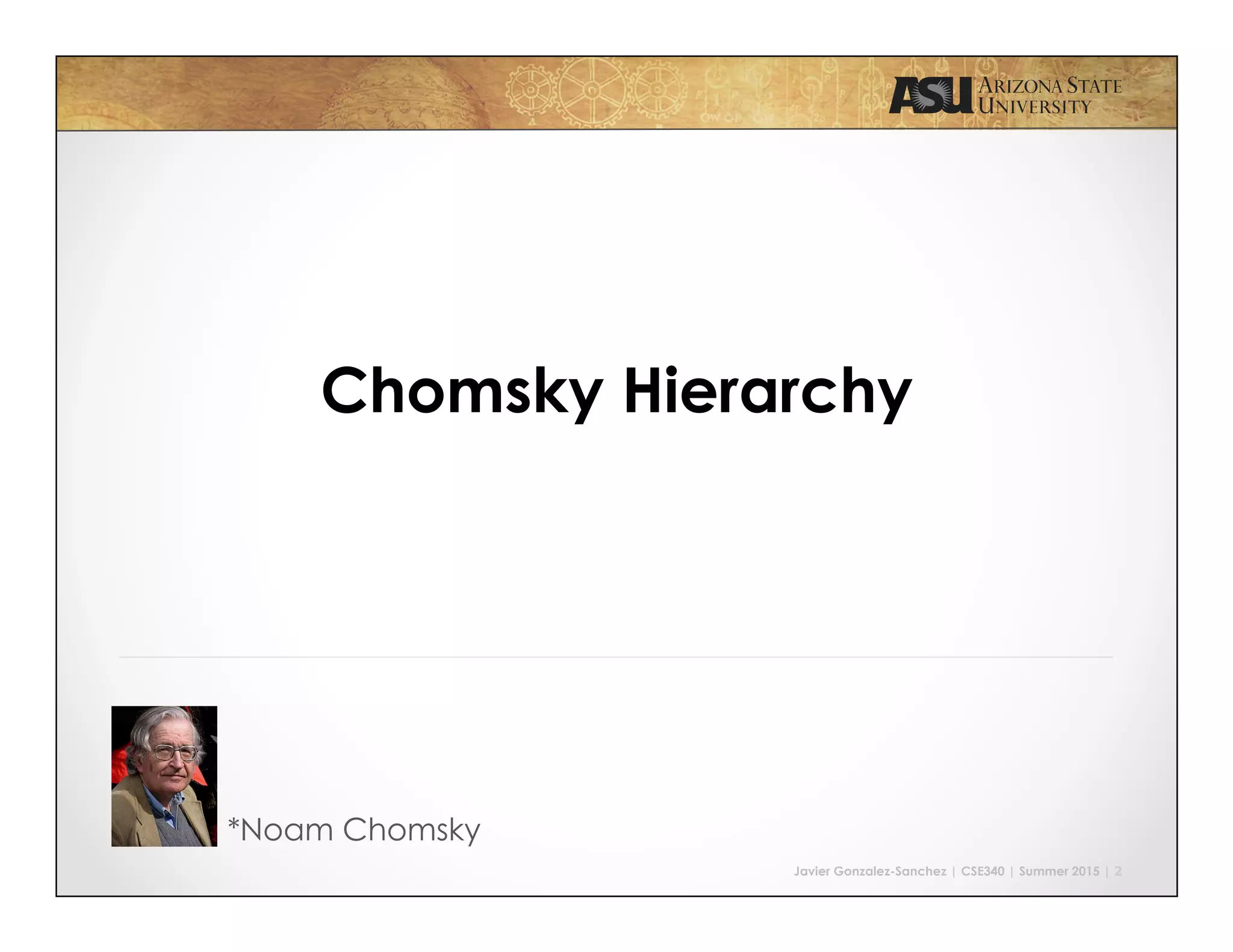
*Noam Chomsky
Javier Gonzalez-Sanchez | CSE340 | Summer 2015 | 3
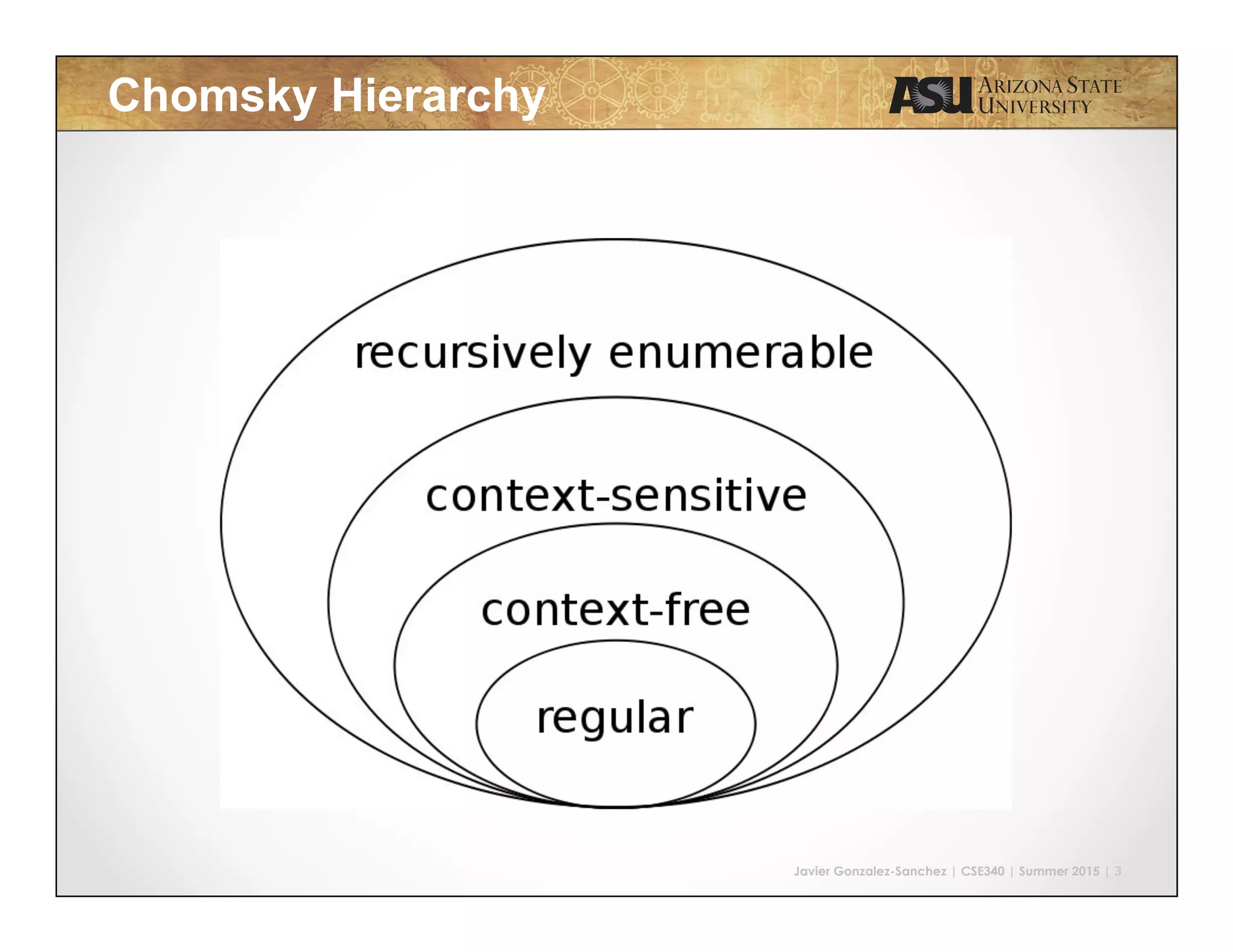
Chomsky Hierarchy
Javier Gonzalez-Sanchez | CSE340 | Summer 2015 | 4
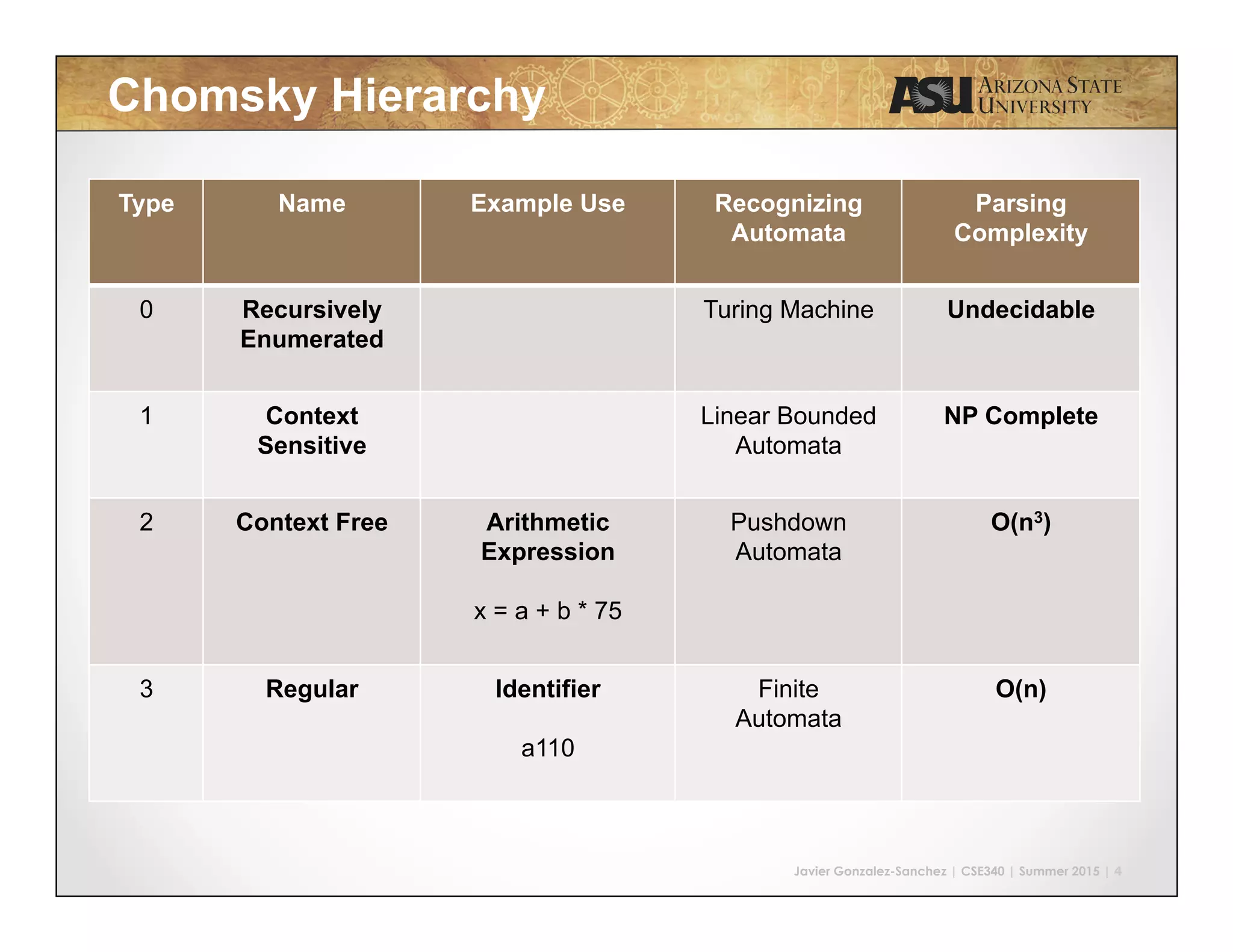
Chomsky Hierarchy
Type Name Example Use Recognizing
Automata
Parsing
Complexity
0 Recursively
Enumerated
Turing Machine Undecidable
1 Context
Sensitive
Linear Bounded
Automata
NP Complete
2 Context Free Arithmetic
Expression
x = a + b * 75
Pushdown
Automata
O(n3)
3 Regular Identifier
a110
Finite
Automata
O(n)
Javier Gonzalez-Sanchez | CSE340 | Summer 2015 | 5
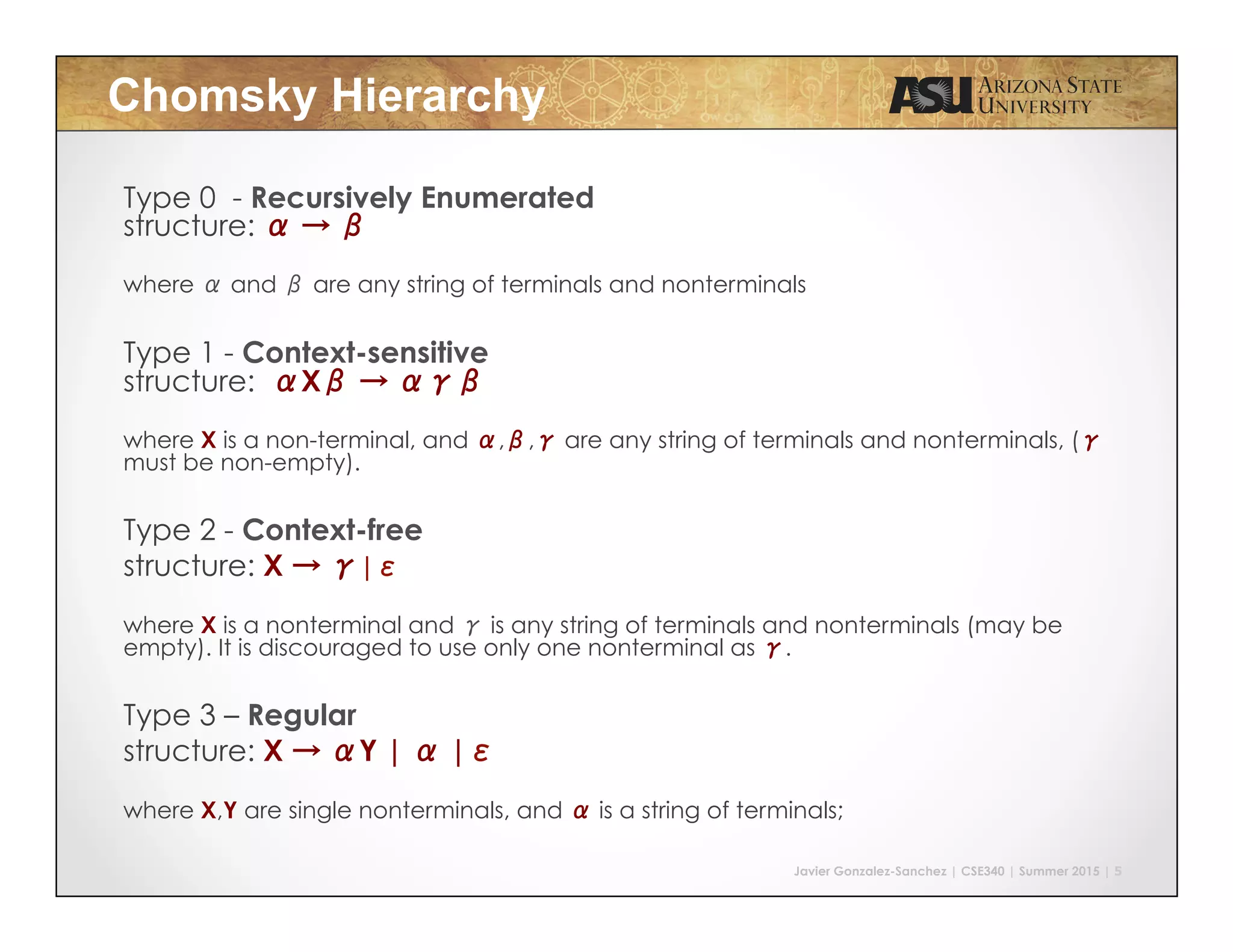
Chomsky Hierarchy
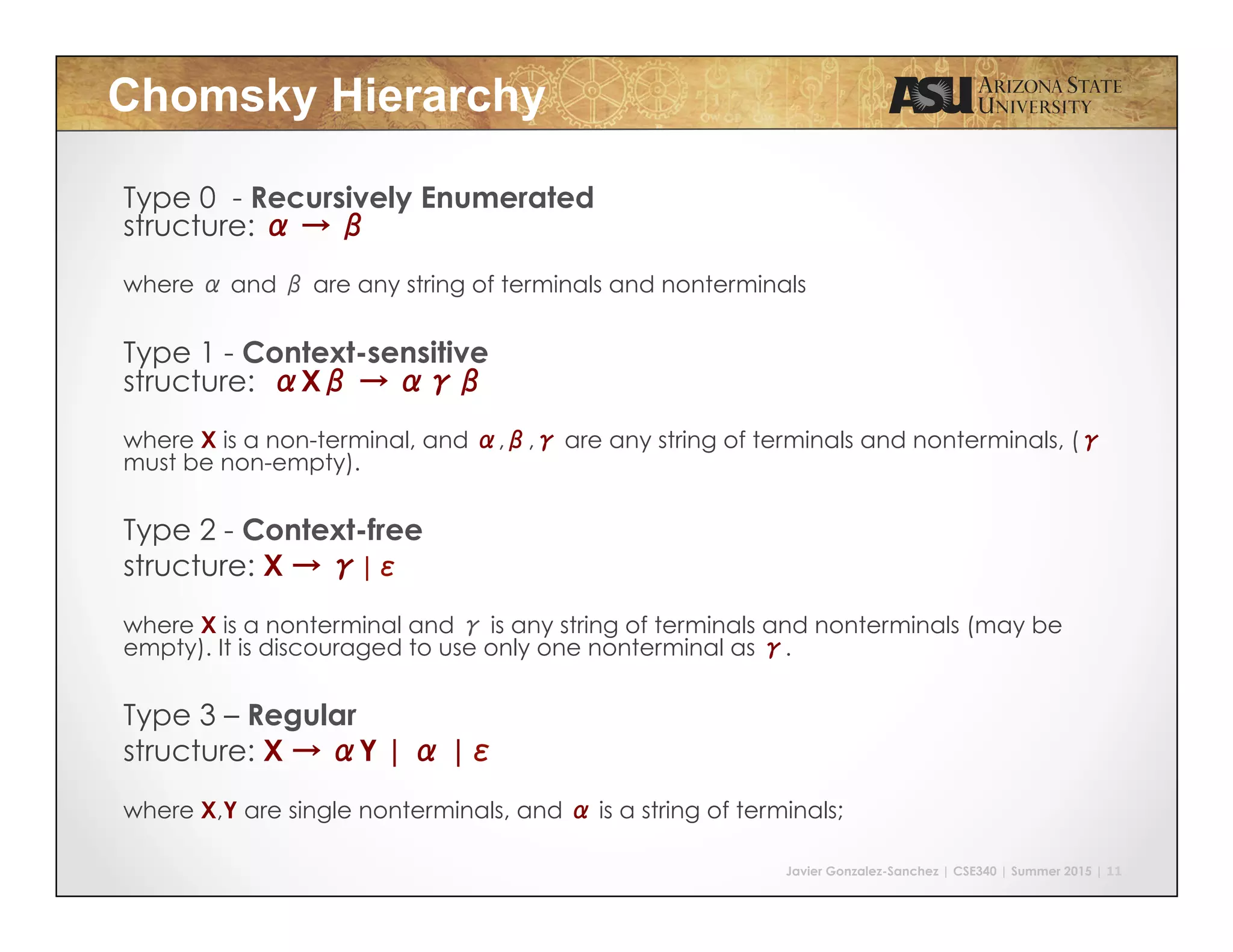
Type 0 - Recursively Enumerated
structure: α → β
where α and β are any string of terminals and nonterminals
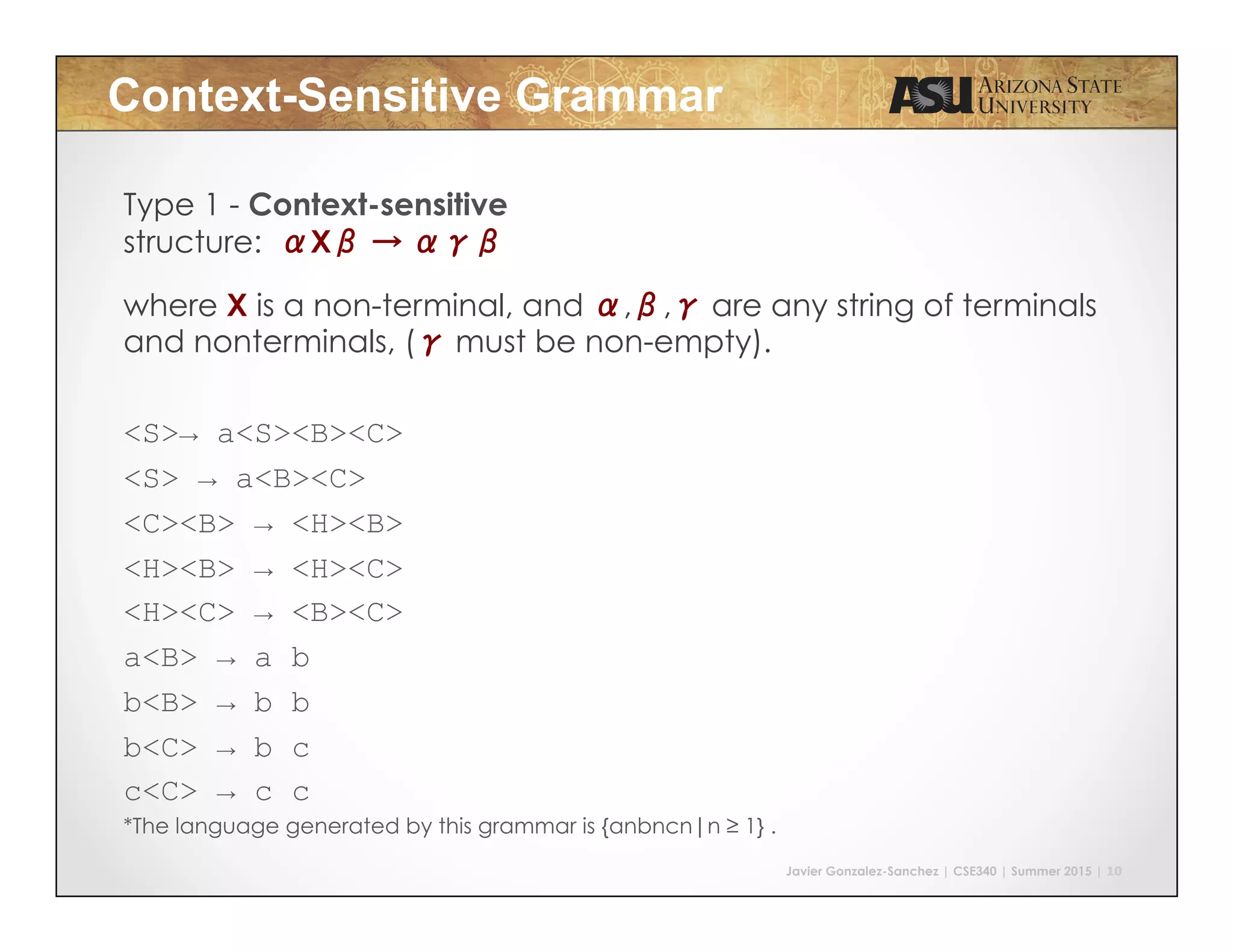
Type 1 - Context-sensitive
structure: αXβ → αγβ
where X is a non-terminal, and α,β,γ are any string of terminals and nonterminals, (γ
must be non-empty).
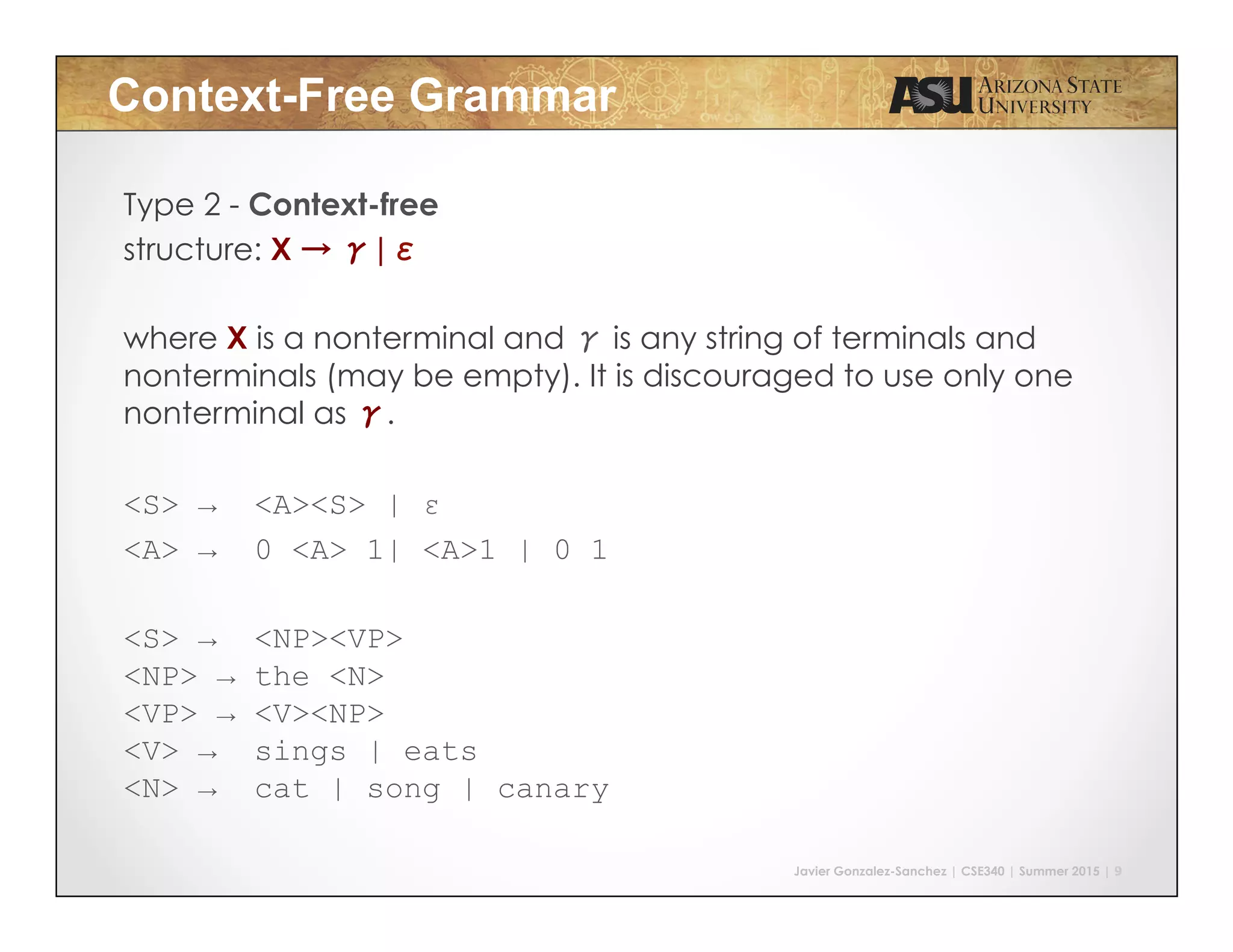
Type 2 - Context-free
structure: X → γ|ε
where X is a nonterminal and γ is any string of terminals and nonterminals (may be
empty). It is discouraged to use only one nonterminal as γ.
Type 3 – Regular
structure: X → αY | α |ε
where X,Y are single nonterminals, and α is a string of terminals;
Javier Gonzalez-Sanchez | CSE340 | Summer 2015 | 6
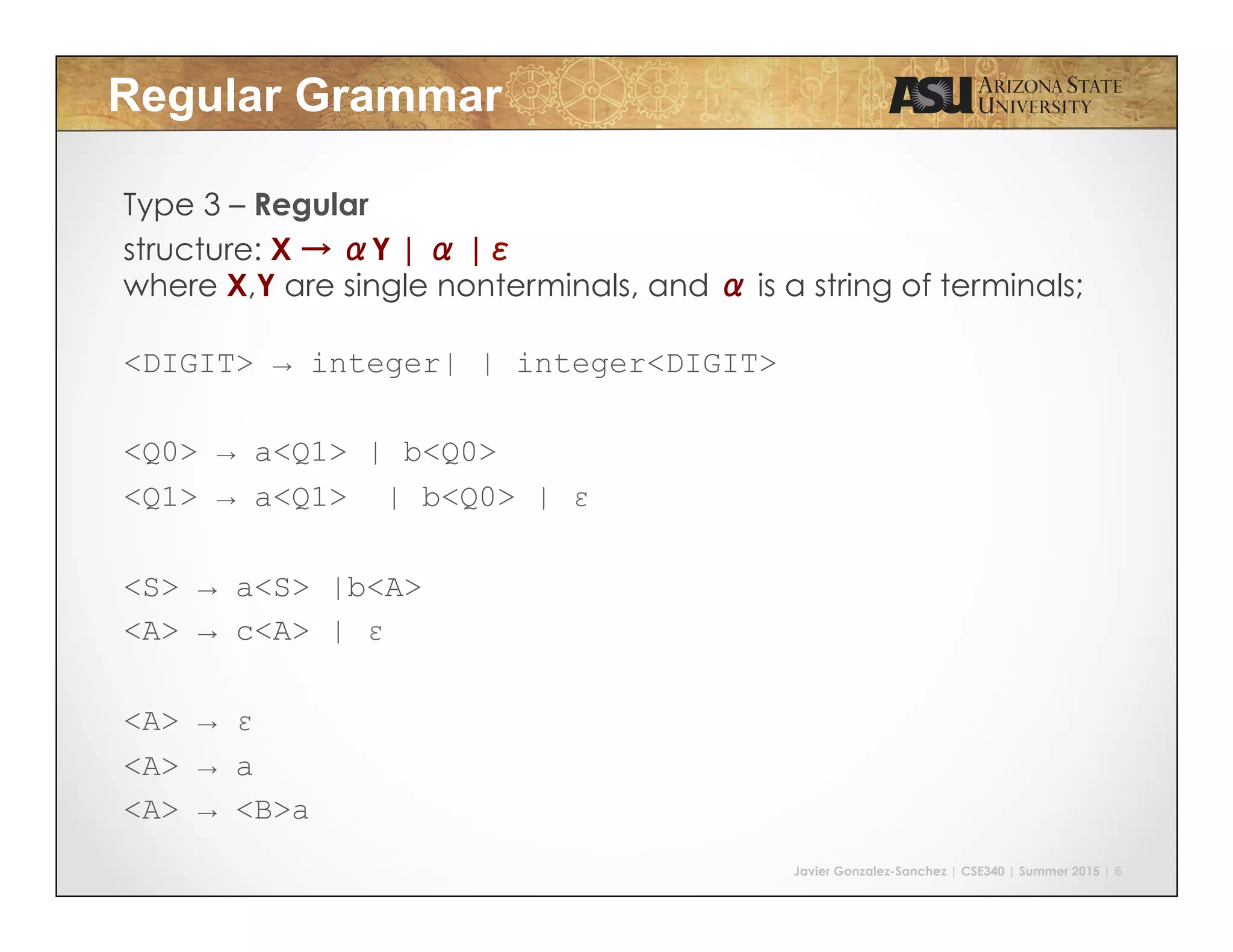
Regular Grammar
Type 3 – Regular
structure: X → αY | α |ε
where X,Y are single nonterminals, and α is a string of terminals;
<DIGIT> → integer| | integer<DIGIT>
<Q0> → a<Q1> | b<Q0>
<Q1> → a<Q1> | b<Q0> | ε
<S> → a<S> |b<A>
<A> → c<A> | ε
<A> → ε
<A> → a
<A> → <B>a
	
  
Javier Gonzalez-Sanchez | CSE340 | Summer 2015 | 7
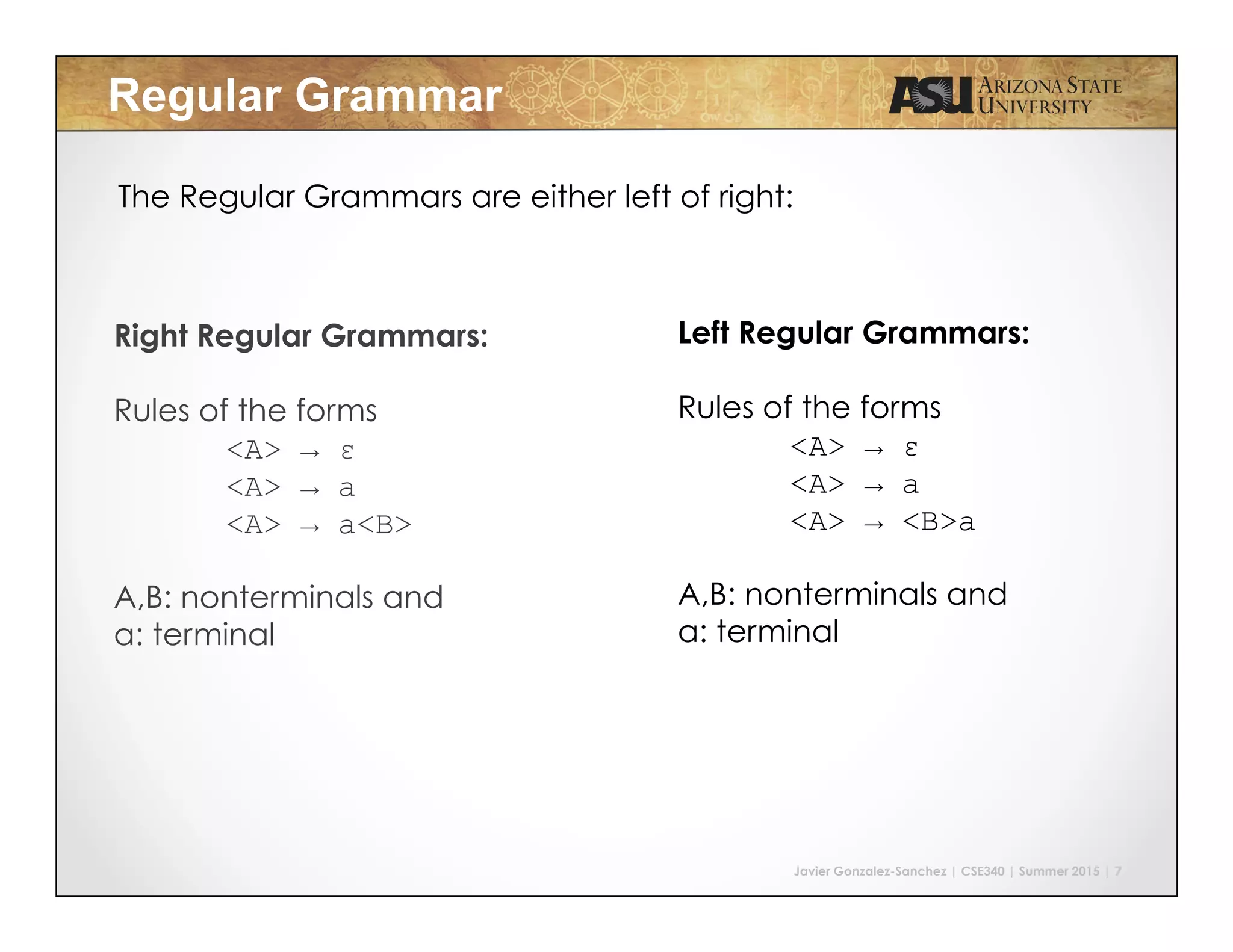
Regular Grammar	
  
Right Regular Grammars:
Rules of the forms
<A> → ε
<A> → a
<A> → a<B>
A,B: nonterminals and
a: terminal
The Regular Grammars are either left of right:
Left Regular Grammars:
Rules of the forms
<A> → ε
<A> → a
<A> → <B>a
A,B: nonterminals and
a: terminal
Javier Gonzalez-Sanchez | CSE340 | Summer 2015 | 8
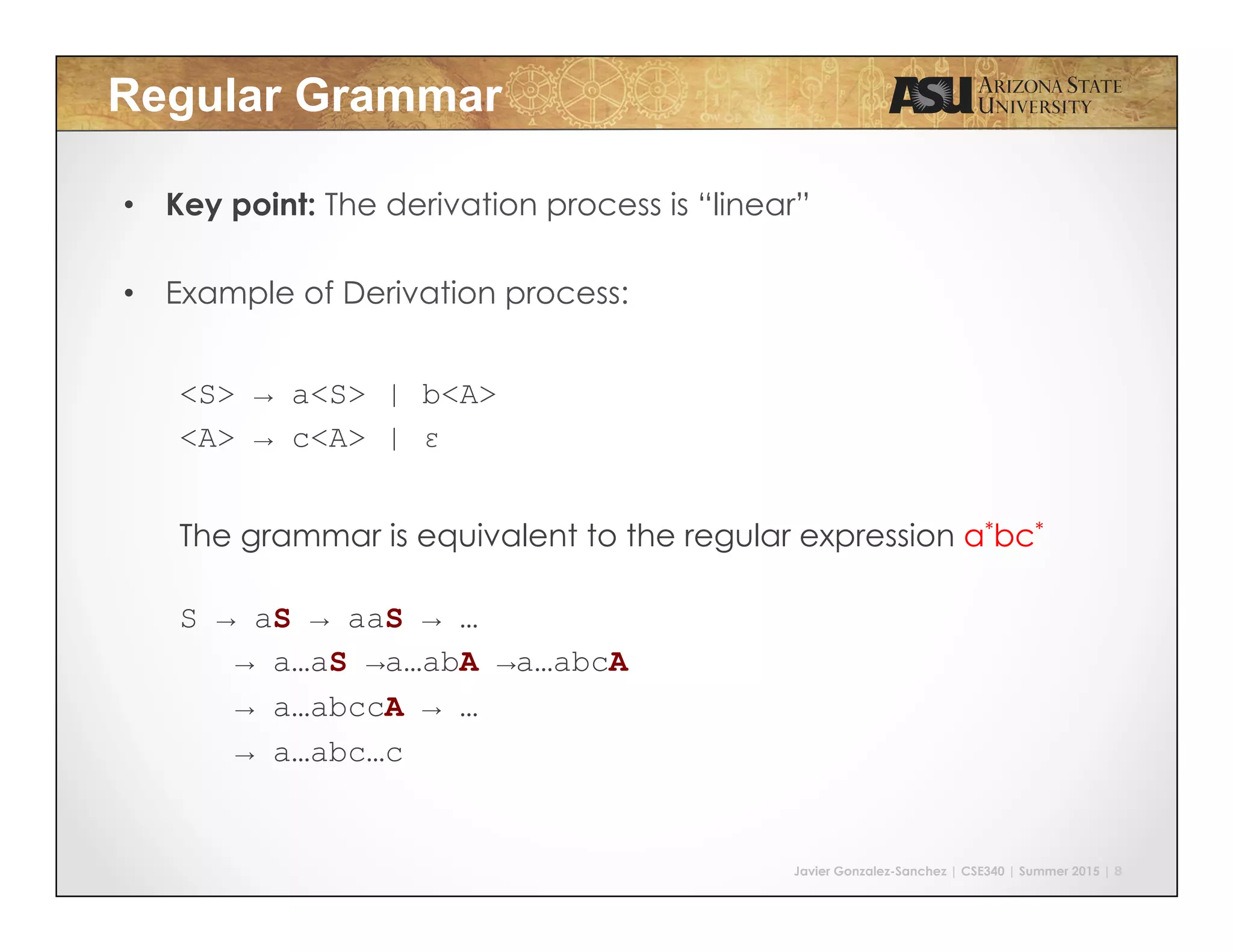
Regular Grammar
•  Key point: The derivation process is “linear”
•  Example of Derivation process:
<S> → a<S> | b<A>
<A> → c<A> | ε
	
  
The grammar is equivalent to the regular expression a*bc*
S → aS → aaS → …
→ a…aS →a…abA →a…abcA
→ a…abccA → …
→ a…abc…c
Javier Gonzalez-Sanchez | CSE340 | Summer 2015 | 9
Context-Free Grammar
Type 2 - Context-free
structure: X → γ|ε
where X is a nonterminal and γ is any string of terminals and
nonterminals (may be empty). It is discouraged to use only one
nonterminal as γ.
<S> → <A><S> | ε
<A> → 0 <A> 1| <A>1 | 0 1
<S> → <NP><VP>
<NP> → the <N>
<VP> → <V><NP>
<V> → sings | eats
<N> → cat | song | canary	
  
Javier Gonzalez-Sanchez | CSE340 | Summer 2015 | 10
Context-Sensitive Grammar
Type 1 - Context-sensitive
structure: αXβ → αγβ
where X is a non-terminal, and α,β,γ are any string of terminals
and nonterminals, (γ must be non-empty).
<S>→ a<S><B><C>
<S> → a<B><C>
<C><B> → <H><B>
<H><B> → <H><C>
<H><C> → <B><C>
a<B> → a b
b<B> → b b
b<C> → b c
c<C> → c c
*The language generated by this grammar is {anbncn|n ≥ 1} .
Javier Gonzalez-Sanchez | CSE340 | Summer 2015 | 11
Chomsky Hierarchy
Type 0 - Recursively Enumerated
structure: α → β
where α and β are any string of terminals and nonterminals
Type 1 - Context-sensitive
structure: αXβ → αγβ
where X is a non-terminal, and α,β,γ are any string of terminals and nonterminals, (γ
must be non-empty).
Type 2 - Context-free
structure: X → γ|ε
where X is a nonterminal and γ is any string of terminals and nonterminals (may be
empty). It is discouraged to use only one nonterminal as γ.
Type 3 – Regular
structure: X → αY | α |ε
where X,Y are single nonterminals, and α is a string of terminals;
Javier Gonzalez-Sanchez | CSE340 | Summer 2015 | 12
Exercise
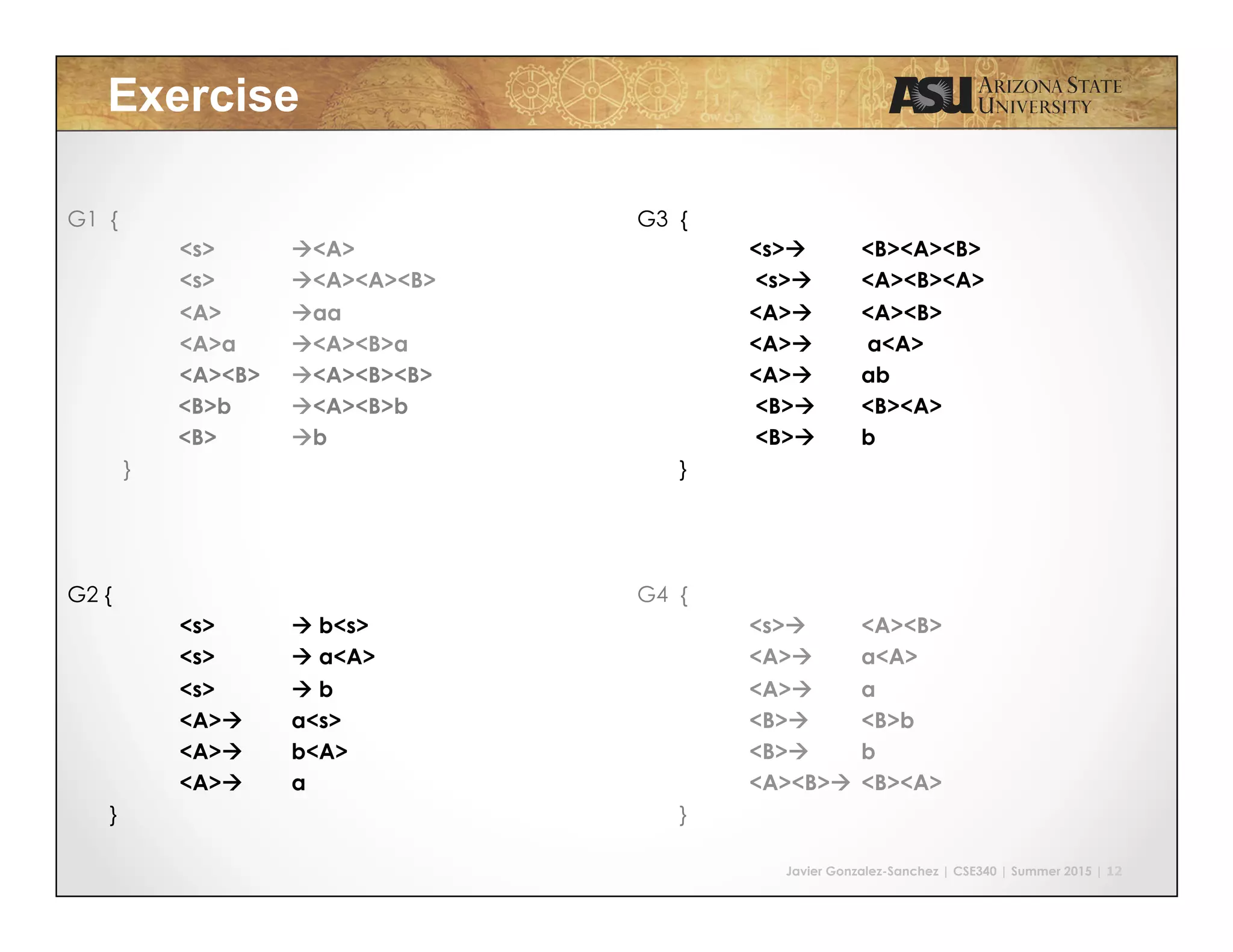
G3 {
<s>à <B><A><B>
<s>à <A><B><A>
<A>à <A><B>
<A>à a<A>
<A>à ab
<B>à <B><A>
<B>à b
}
G4 {
<s>à <A><B>
<A>à a<A>
<A>à a
<B>à <B>b
<B>à b
<A><B>à <B><A>
}
G1 {
<s> à<A>
<s> à<A><A><B>
<A> àaa
<A>a à<A><B>a
<A><B> à<A><B><B>
<B>b à<A><B>b
<B> àb
}
G2 {
<s> à b<s>
<s> à a<A>
<s> à b
<A>à a<s>
<A>à b<A>
<A>à a
}
Javier Gonzalez-Sanchez | CSE340 | Summer 2015 | 13
Examples
Javier Gonzalez-Sanchez | CSE340 | Summer 2015 | 14
Types of Grammars
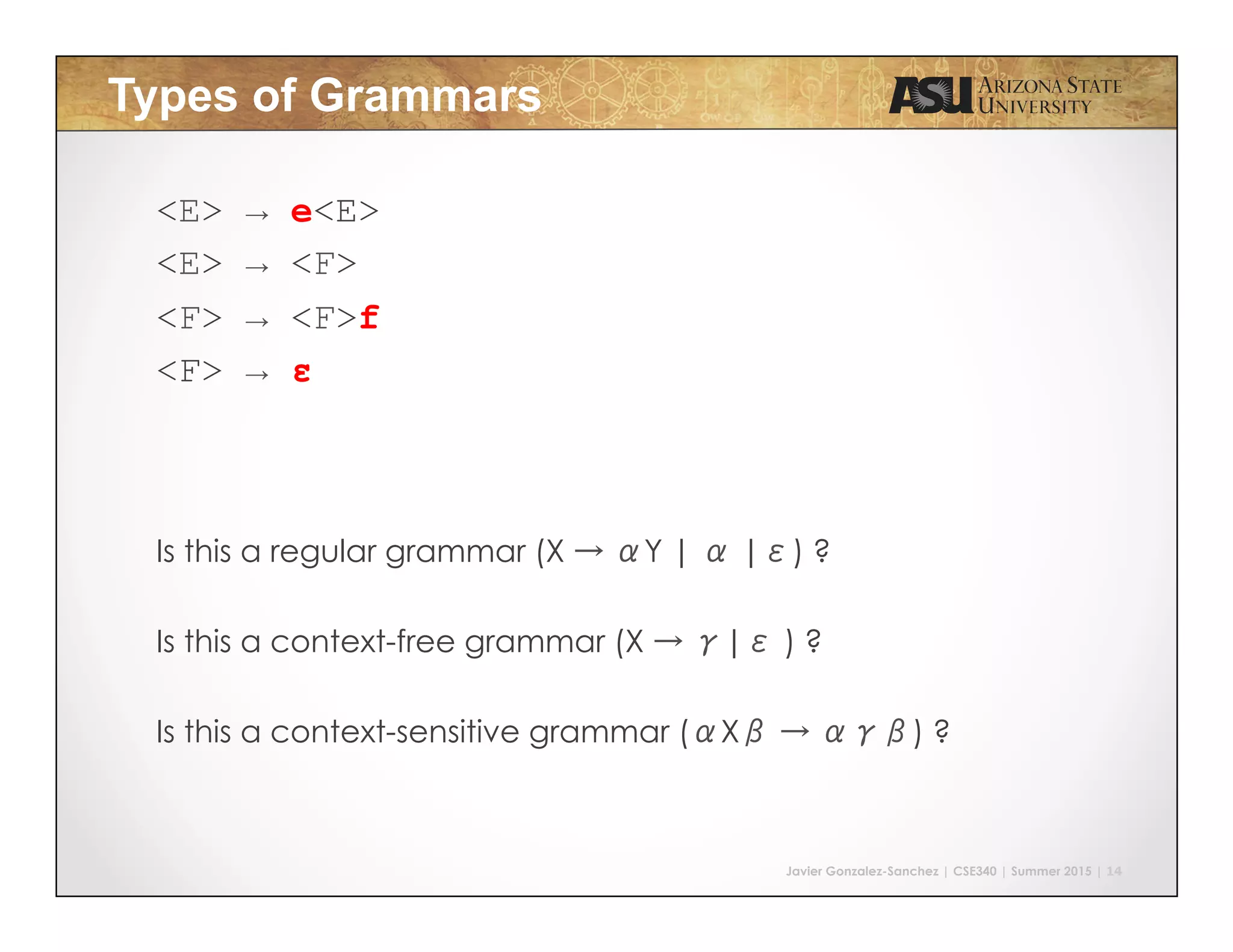
<E> → e<E>
<E> → <F>
<F> → <F>f
<F> → ε
Is this a regular grammar (X → αY | α |ε) ?
Is this a context-free grammar (X → γ|ε ) ?
Is this a context-sensitive grammar (αXβ → αγβ) ?
Javier Gonzalez-Sanchez | CSE340 | Summer 2015 | 15
Types of Grammars
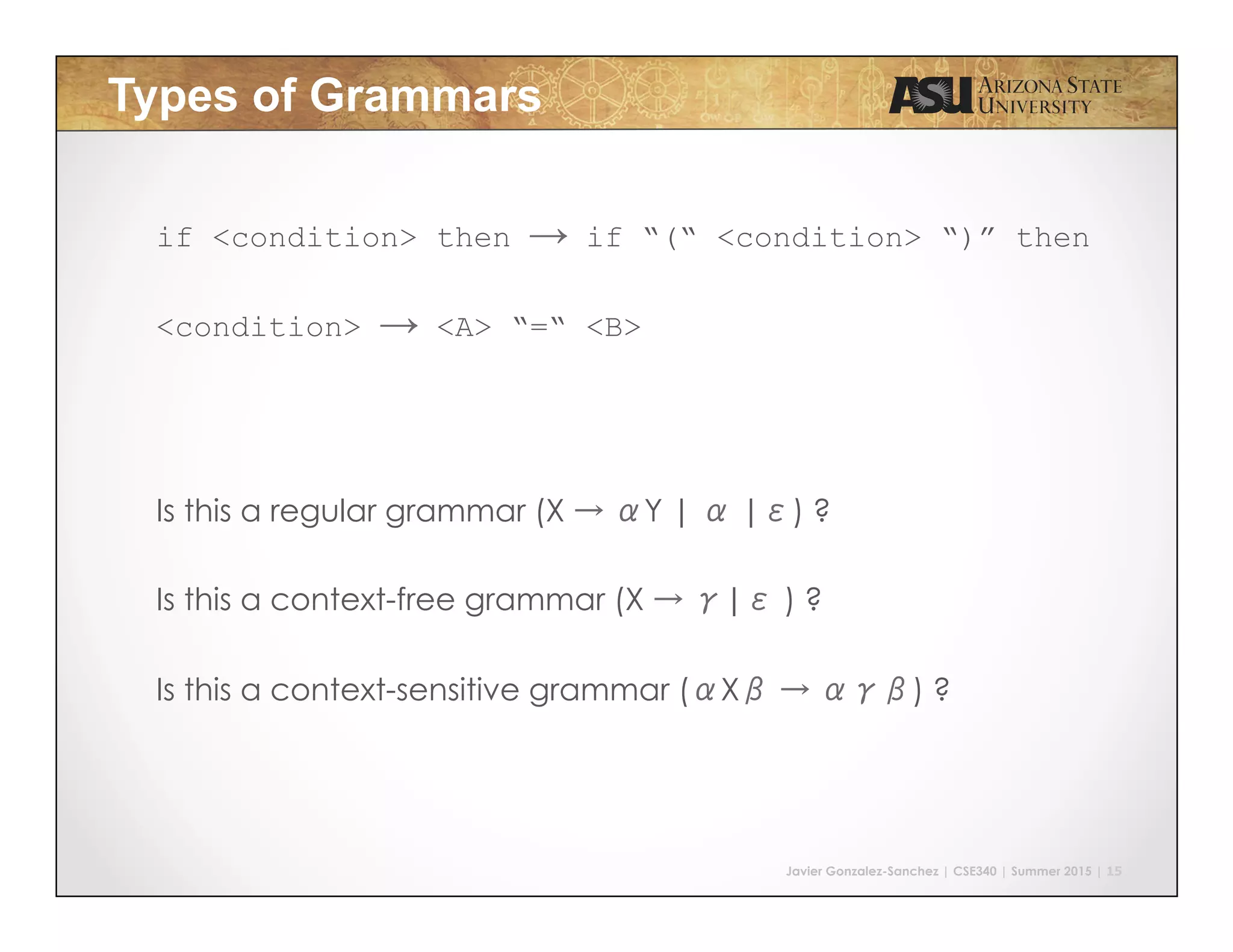
if <condition> then → if “(“ <condition> “)” then
<condition> → <A> “=“ <B>
Is this a regular grammar (X → αY | α |ε) ?
Is this a context-free grammar (X → γ|ε ) ?
Is this a context-sensitive grammar (αXβ → αγβ) ?
Javier Gonzalez-Sanchez | CSE340 | Summer 2015 | 16
Types of Grammars
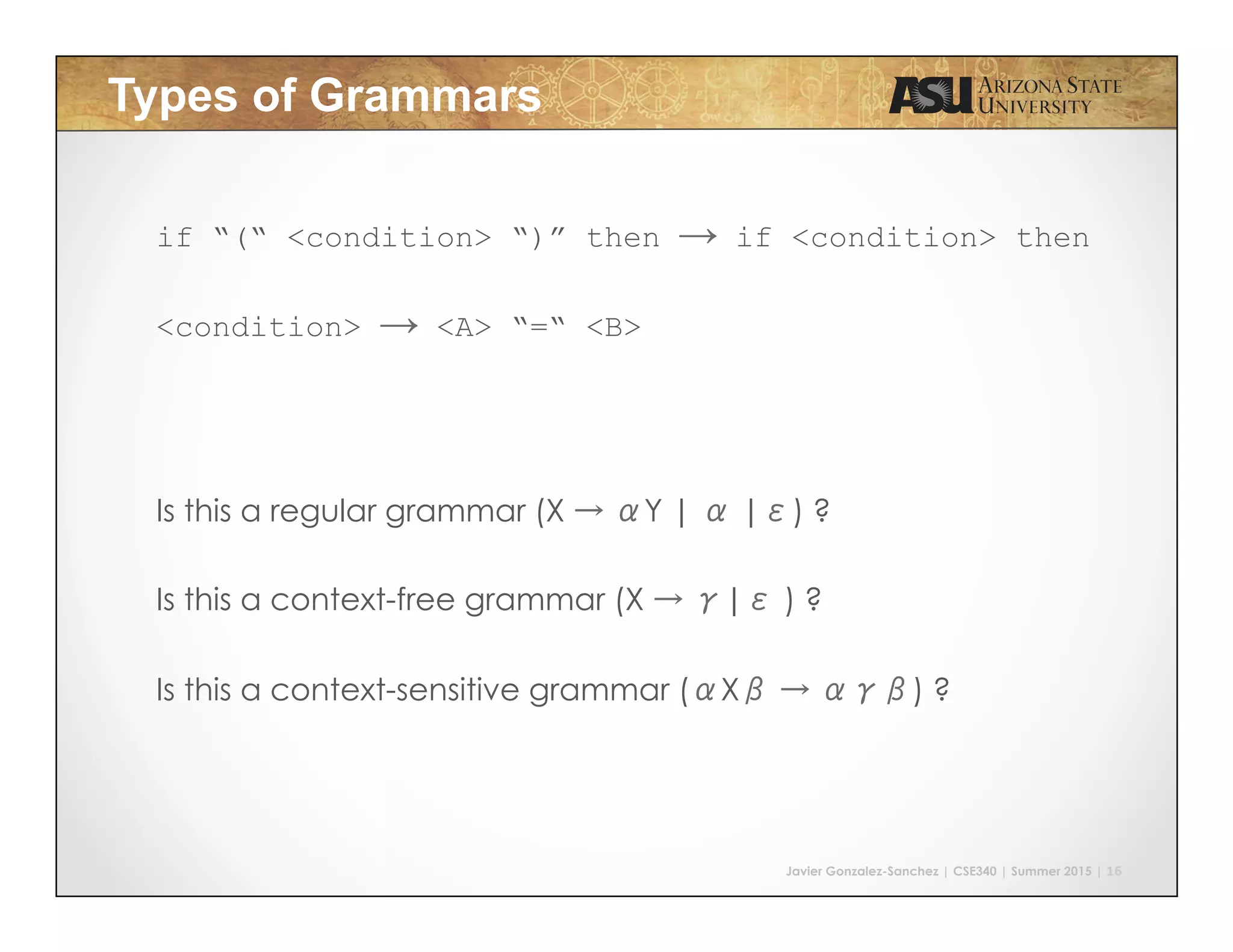
if “(“ <condition> “)” then → if <condition> then
<condition> → <A> “=“ <B>
Is this a regular grammar (X → αY | α |ε) ?
Is this a context-free grammar (X → γ|ε ) ?
Is this a context-sensitive grammar (αXβ → αγβ) ?
Javier Gonzalez-Sanchez | CSE340 | Summer 2015 | 17
Types of Grammars
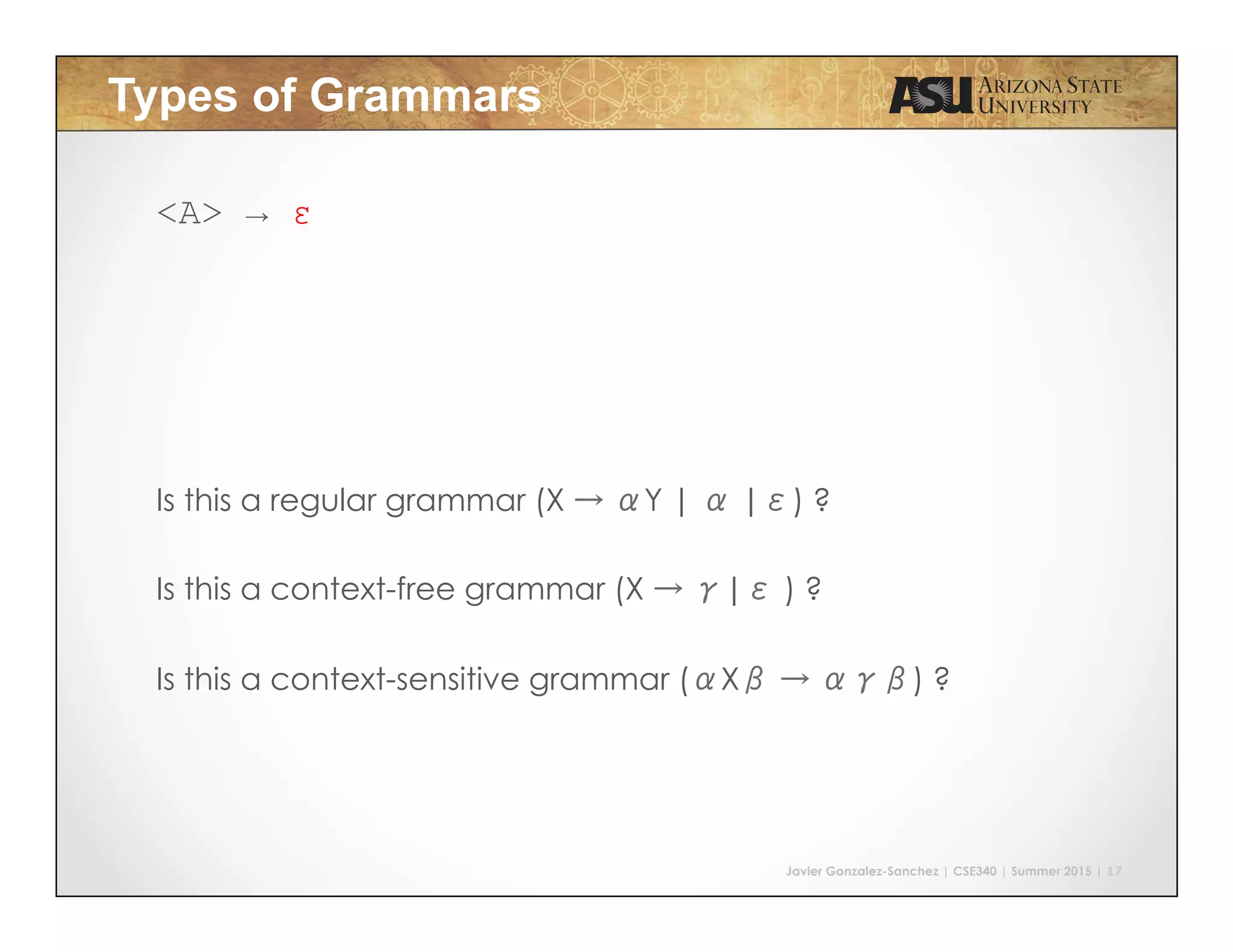
<A> → ε
Is this a regular grammar (X → αY | α |ε) ?
Is this a context-free grammar (X → γ|ε ) ?
Is this a context-sensitive grammar (αXβ → αγβ) ?
Javier Gonzalez-Sanchez | CSE340 | Summer 2015 | 18
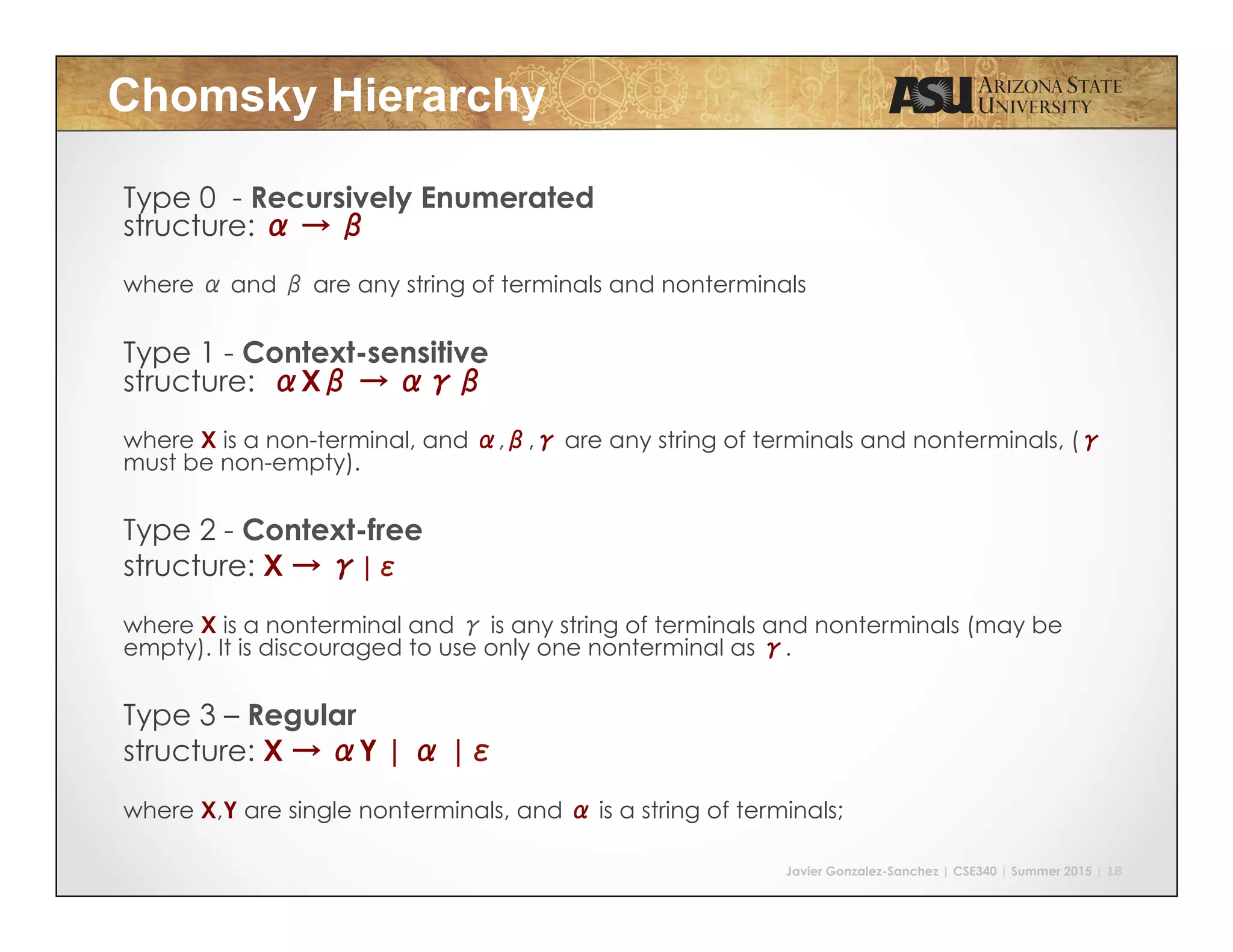
Chomsky Hierarchy
Type 0 - Recursively Enumerated
structure: α → β
where α and β are any string of terminals and nonterminals
Type 1 - Context-sensitive
structure: αXβ → αγβ
where X is a non-terminal, and α,β,γ are any string of terminals and nonterminals, (γ
must be non-empty).
Type 2 - Context-free
structure: X → γ|ε
where X is a nonterminal and γ is any string of terminals and nonterminals (may be
empty). It is discouraged to use only one nonterminal as γ.
Type 3 – Regular
structure: X → αY | α |ε
where X,Y are single nonterminals, and α is a string of terminals;
CSE340 - Principles of Programming Languages
Javier Gonzalez-Sanchez
javiergs@asu.edu
Summer 2015
Disclaimer. These slides can only be used as study material for the class CSE340 at ASU. They cannot be distributed or used for another purpose.

201506 CSE340 Lecture 16

  • 1.
    CSE340 - Principlesof Programming Languages Lecture 16: Grammars III Javier Gonzalez-Sanchez javiergs@asu.edu BYENG M1-38 Office Hours: By appointment
  • 2.
    Javier Gonzalez-Sanchez |CSE340 | Summer 2015 | 2 Chomsky Hierarchy *Noam Chomsky
  • 3.
    Javier Gonzalez-Sanchez |CSE340 | Summer 2015 | 3 Chomsky Hierarchy
  • 4.
    Javier Gonzalez-Sanchez |CSE340 | Summer 2015 | 4 Chomsky Hierarchy Type Name Example Use Recognizing Automata Parsing Complexity 0 Recursively Enumerated Turing Machine Undecidable 1 Context Sensitive Linear Bounded Automata NP Complete 2 Context Free Arithmetic Expression x = a + b * 75 Pushdown Automata O(n3) 3 Regular Identifier a110 Finite Automata O(n)
  • 5.
    Javier Gonzalez-Sanchez |CSE340 | Summer 2015 | 5 Chomsky Hierarchy Type 0 - Recursively Enumerated structure: α → β where α and β are any string of terminals and nonterminals Type 1 - Context-sensitive structure: αXβ → αγβ where X is a non-terminal, and α,β,γ are any string of terminals and nonterminals, (γ must be non-empty). Type 2 - Context-free structure: X → γ|ε where X is a nonterminal and γ is any string of terminals and nonterminals (may be empty). It is discouraged to use only one nonterminal as γ. Type 3 – Regular structure: X → αY | α |ε where X,Y are single nonterminals, and α is a string of terminals;
  • 6.
    Javier Gonzalez-Sanchez |CSE340 | Summer 2015 | 6 Regular Grammar Type 3 – Regular structure: X → αY | α |ε where X,Y are single nonterminals, and α is a string of terminals; <DIGIT> → integer| | integer<DIGIT> <Q0> → a<Q1> | b<Q0> <Q1> → a<Q1> | b<Q0> | ε <S> → a<S> |b<A> <A> → c<A> | ε <A> → ε <A> → a <A> → <B>a  
  • 7.
    Javier Gonzalez-Sanchez |CSE340 | Summer 2015 | 7 Regular Grammar   Right Regular Grammars: Rules of the forms <A> → ε <A> → a <A> → a<B> A,B: nonterminals and a: terminal The Regular Grammars are either left of right: Left Regular Grammars: Rules of the forms <A> → ε <A> → a <A> → <B>a A,B: nonterminals and a: terminal
  • 8.
    Javier Gonzalez-Sanchez |CSE340 | Summer 2015 | 8 Regular Grammar •  Key point: The derivation process is “linear” •  Example of Derivation process: <S> → a<S> | b<A> <A> → c<A> | ε   The grammar is equivalent to the regular expression a*bc* S → aS → aaS → … → a…aS →a…abA →a…abcA → a…abccA → … → a…abc…c
  • 9.
    Javier Gonzalez-Sanchez |CSE340 | Summer 2015 | 9 Context-Free Grammar Type 2 - Context-free structure: X → γ|ε where X is a nonterminal and γ is any string of terminals and nonterminals (may be empty). It is discouraged to use only one nonterminal as γ. <S> → <A><S> | ε <A> → 0 <A> 1| <A>1 | 0 1 <S> → <NP><VP> <NP> → the <N> <VP> → <V><NP> <V> → sings | eats <N> → cat | song | canary  
  • 10.
    Javier Gonzalez-Sanchez |CSE340 | Summer 2015 | 10 Context-Sensitive Grammar Type 1 - Context-sensitive structure: αXβ → αγβ where X is a non-terminal, and α,β,γ are any string of terminals and nonterminals, (γ must be non-empty). <S>→ a<S><B><C> <S> → a<B><C> <C><B> → <H><B> <H><B> → <H><C> <H><C> → <B><C> a<B> → a b b<B> → b b b<C> → b c c<C> → c c *The language generated by this grammar is {anbncn|n ≥ 1} .
  • 11.
    Javier Gonzalez-Sanchez |CSE340 | Summer 2015 | 11 Chomsky Hierarchy Type 0 - Recursively Enumerated structure: α → β where α and β are any string of terminals and nonterminals Type 1 - Context-sensitive structure: αXβ → αγβ where X is a non-terminal, and α,β,γ are any string of terminals and nonterminals, (γ must be non-empty). Type 2 - Context-free structure: X → γ|ε where X is a nonterminal and γ is any string of terminals and nonterminals (may be empty). It is discouraged to use only one nonterminal as γ. Type 3 – Regular structure: X → αY | α |ε where X,Y are single nonterminals, and α is a string of terminals;
  • 12.
    Javier Gonzalez-Sanchez |CSE340 | Summer 2015 | 12 Exercise G3 { <s>à <B><A><B> <s>à <A><B><A> <A>à <A><B> <A>à a<A> <A>à ab <B>à <B><A> <B>à b } G4 { <s>à <A><B> <A>à a<A> <A>à a <B>à <B>b <B>à b <A><B>à <B><A> } G1 { <s> à<A> <s> à<A><A><B> <A> àaa <A>a à<A><B>a <A><B> à<A><B><B> <B>b à<A><B>b <B> àb } G2 { <s> à b<s> <s> à a<A> <s> à b <A>à a<s> <A>à b<A> <A>à a }
  • 13.
    Javier Gonzalez-Sanchez |CSE340 | Summer 2015 | 13 Examples
  • 14.
    Javier Gonzalez-Sanchez |CSE340 | Summer 2015 | 14 Types of Grammars <E> → e<E> <E> → <F> <F> → <F>f <F> → ε Is this a regular grammar (X → αY | α |ε) ? Is this a context-free grammar (X → γ|ε ) ? Is this a context-sensitive grammar (αXβ → αγβ) ?
  • 15.
    Javier Gonzalez-Sanchez |CSE340 | Summer 2015 | 15 Types of Grammars if <condition> then → if “(“ <condition> “)” then <condition> → <A> “=“ <B> Is this a regular grammar (X → αY | α |ε) ? Is this a context-free grammar (X → γ|ε ) ? Is this a context-sensitive grammar (αXβ → αγβ) ?
  • 16.
    Javier Gonzalez-Sanchez |CSE340 | Summer 2015 | 16 Types of Grammars if “(“ <condition> “)” then → if <condition> then <condition> → <A> “=“ <B> Is this a regular grammar (X → αY | α |ε) ? Is this a context-free grammar (X → γ|ε ) ? Is this a context-sensitive grammar (αXβ → αγβ) ?
  • 17.
    Javier Gonzalez-Sanchez |CSE340 | Summer 2015 | 17 Types of Grammars <A> → ε Is this a regular grammar (X → αY | α |ε) ? Is this a context-free grammar (X → γ|ε ) ? Is this a context-sensitive grammar (αXβ → αγβ) ?
  • 18.
    Javier Gonzalez-Sanchez |CSE340 | Summer 2015 | 18 Chomsky Hierarchy Type 0 - Recursively Enumerated structure: α → β where α and β are any string of terminals and nonterminals Type 1 - Context-sensitive structure: αXβ → αγβ where X is a non-terminal, and α,β,γ are any string of terminals and nonterminals, (γ must be non-empty). Type 2 - Context-free structure: X → γ|ε where X is a nonterminal and γ is any string of terminals and nonterminals (may be empty). It is discouraged to use only one nonterminal as γ. Type 3 – Regular structure: X → αY | α |ε where X,Y are single nonterminals, and α is a string of terminals;
  • 19.
    CSE340 - Principlesof Programming Languages Javier Gonzalez-Sanchez javiergs@asu.edu Summer 2015 Disclaimer. These slides can only be used as study material for the class CSE340 at ASU. They cannot be distributed or used for another purpose.