Chapter 11
A HIERARCHY OF
FORMAL LANGUAGES
AND AUTOMATA
Learning Objectives
At the conclusion of the chapter, the student will be able to:
• Explain the difference between recursive and recursively
enumerable languages
• Describe the type of productions in an unrestricted grammar
• Identify the types of languages generated by unrestricted grammars
• Describe the type of productions in a context sensitive grammar
• Give a sequence of derivations to generate a string using the
productions in a context sensitive grammar
• Identify the types of languages generated by context-sensitive
grammars
• Construct a context-sensitive grammar to generate a particular
language
• Describe the structure and components of the Chomsky hierarchy
Recursive and Recursively
Enumerable Languages
• A language L is recursively enumerable if there exists
a Turing machine that accepts it (as we have
previously stated, rejected strings cause the
machine to either not halt or halt in a nonfinal state)
• A language L is recursive if there exists a Turing
machine that accepts it and is guaranteed to halt on
every valid input string
• In other words, a language is recursive if and only if
there exists a membership algorithm for it
Languages That Are Not Recursively
Enumerable
• Theorem 11.1 states that, for any nonempty alphabet,
there exist languages not recursively enumerable
• One proof involves a technique called diagonalization,
which can be used to show that, in a sense, there are
fewer Turing Machines than there are languages
• More explicitly, Theorem 11.3 describes the existence
of a recursively enumerable language whose
complement is not recursively enumerable
• Furthermore, Theorem 11.5 concludes that the family
of recursive languages is a proper subset of the family
of recursively enumerable languages
Unrestricted Grammars
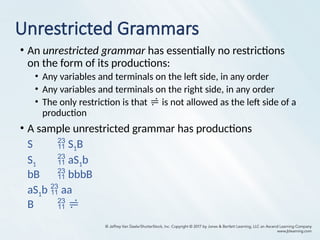
• An unrestricted grammar has essentially no restrictions
on the form of its productions:
• Any variables and terminals on the left side, in any order
• Any variables and terminals on the right side, in any order
• The only restriction is that  is not allowed as the left side of a
production
• A sample unrestricted grammar has productions
S  S1B
S1  aS1b
bB  bbbB
aS1b  aa
B  
Unrestricted Grammars and
Recursively Enumerable Languages
• Theorem 11.6: Any language generated by an
unrestricted grammar is recursively enumerable
• Theorem 11.7: For every recursively enumerable
language L, there exists an unrestricted grammar G
that generates L
• These two theorems establish the result that
unrestricted grammars generate exactly the family
of recursively enumerable languages, the largest
family of languages that can be generated or
recognized algorithmically
Context-Sensitive Grammars
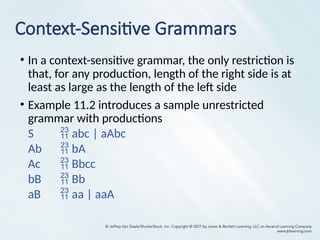
• In a context-sensitive grammar, the only restriction is
that, for any production, length of the right side is at
least as large as the length of the left side
• Example 11.2 introduces a sample unrestricted
grammar with productions
S  abc | aAbc
Ab  bA
Ac  Bbcc
bB  Bb
aB  aa | aaA
Characteristics of Context-Sensitive
Grammars
• An important characteristic of context-sensitive
grammars is that they are noncontracting, in the
sense that in any derivation, the length of
successive sentential forms can never decrease
• These grammars are called context-sensitive
because it is possible to specify that variables may
only be replaced in certain contexts
• For instance, in the grammar of Example 11.2,
variable A can only be replaced if it is followed by
either b or c
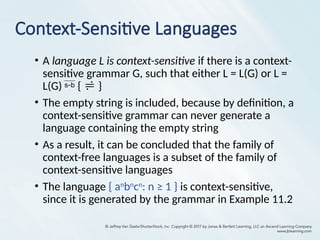
Context-Sensitive Languages
• A language L is context-sensitive if there is a context-
sensitive grammar G, such that either L = L(G) or L =
L(G)  {  }
• The empty string is included, because by definition, a
context-sensitive grammar can never generate a
language containing the empty string
• As a result, it can be concluded that the family of
context-free languages is a subset of the family of
context-sensitive languages
• The language { an
bn
cn
: n ≥ 1 } is context-sensitive,
since it is generated by the grammar in Example 11.2
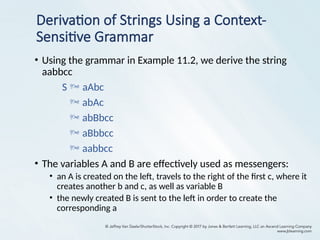
Derivation of Strings Using a Context-
Sensitive Grammar
• Using the grammar in Example 11.2, we derive the string
aabbcc
S  aAbc
 abAc
 abBbcc
 aBbbcc
 aabbcc
• The variables A and B are effectively used as messengers:
• an A is created on the left, travels to the right of the first c, where it
creates another b and c, as well as variable B
• the newly created B is sent to the left in order to create the
corresponding a
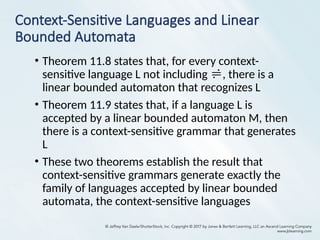
Context-Sensitive Languages and Linear
Bounded Automata
• Theorem 11.8 states that, for every context-
sensitive language L not including , there is a
linear bounded automaton that recognizes L
• Theorem 11.9 states that, if a language L is
accepted by a linear bounded automaton M, then
there is a context-sensitive grammar that generates
L
• These two theorems establish the result that
context-sensitive grammars generate exactly the
family of languages accepted by linear bounded
automata, the context-sensitive languages
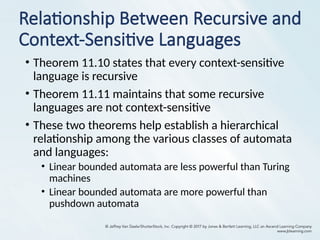
Relationship Between Recursive and
Context-Sensitive Languages
• Theorem 11.10 states that every context-sensitive
language is recursive
• Theorem 11.11 maintains that some recursive
languages are not context-sensitive
• These two theorems help establish a hierarchical
relationship among the various classes of automata
and languages:
• Linear bounded automata are less powerful than Turing
machines
• Linear bounded automata are more powerful than
pushdown automata
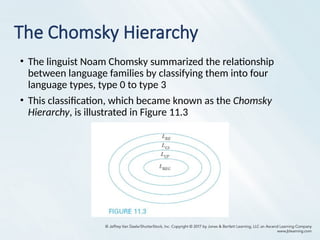
The Chomsky Hierarchy
• The linguist Noam Chomsky summarized the relationship
between language families by classifying them into four
language types, type 0 to type 3
• This classification, which became known as the Chomsky
Hierarchy, is illustrated in Figure 11.3
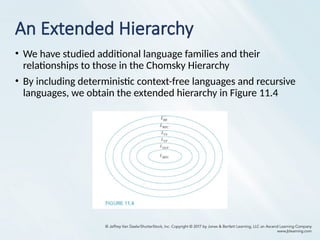
An Extended Hierarchy
• We have studied additional language families and their
relationships to those in the Chomsky Hierarchy
• By including deterministic context-free languages and recursive
languages, we obtain the extended hierarchy in Figure 11.4
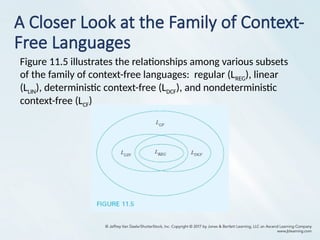
A Closer Look at the Family of Context-
Free Languages
Figure 11.5 illustrates the relationships among various subsets
of the family of context-free languages: regular (LREG), linear
(LLIN), deterministic context-free (LDCF), and nondeterministic
context-free (LCF)

slides for Automata theory chapter no 11

  • 1.
    Chapter 11 A HIERARCHYOF FORMAL LANGUAGES AND AUTOMATA
  • 2.
    Learning Objectives At theconclusion of the chapter, the student will be able to: • Explain the difference between recursive and recursively enumerable languages • Describe the type of productions in an unrestricted grammar • Identify the types of languages generated by unrestricted grammars • Describe the type of productions in a context sensitive grammar • Give a sequence of derivations to generate a string using the productions in a context sensitive grammar • Identify the types of languages generated by context-sensitive grammars • Construct a context-sensitive grammar to generate a particular language • Describe the structure and components of the Chomsky hierarchy
  • 3.
    Recursive and Recursively EnumerableLanguages • A language L is recursively enumerable if there exists a Turing machine that accepts it (as we have previously stated, rejected strings cause the machine to either not halt or halt in a nonfinal state) • A language L is recursive if there exists a Turing machine that accepts it and is guaranteed to halt on every valid input string • In other words, a language is recursive if and only if there exists a membership algorithm for it
  • 4.
    Languages That AreNot Recursively Enumerable • Theorem 11.1 states that, for any nonempty alphabet, there exist languages not recursively enumerable • One proof involves a technique called diagonalization, which can be used to show that, in a sense, there are fewer Turing Machines than there are languages • More explicitly, Theorem 11.3 describes the existence of a recursively enumerable language whose complement is not recursively enumerable • Furthermore, Theorem 11.5 concludes that the family of recursive languages is a proper subset of the family of recursively enumerable languages
  • 5.
    Unrestricted Grammars • Anunrestricted grammar has essentially no restrictions on the form of its productions: • Any variables and terminals on the left side, in any order • Any variables and terminals on the right side, in any order • The only restriction is that  is not allowed as the left side of a production • A sample unrestricted grammar has productions S  S1B S1  aS1b bB  bbbB aS1b  aa B  
  • 6.
    Unrestricted Grammars and RecursivelyEnumerable Languages • Theorem 11.6: Any language generated by an unrestricted grammar is recursively enumerable • Theorem 11.7: For every recursively enumerable language L, there exists an unrestricted grammar G that generates L • These two theorems establish the result that unrestricted grammars generate exactly the family of recursively enumerable languages, the largest family of languages that can be generated or recognized algorithmically
  • 7.
    Context-Sensitive Grammars • Ina context-sensitive grammar, the only restriction is that, for any production, length of the right side is at least as large as the length of the left side • Example 11.2 introduces a sample unrestricted grammar with productions S  abc | aAbc Ab  bA Ac  Bbcc bB  Bb aB  aa | aaA
  • 8.
    Characteristics of Context-Sensitive Grammars •An important characteristic of context-sensitive grammars is that they are noncontracting, in the sense that in any derivation, the length of successive sentential forms can never decrease • These grammars are called context-sensitive because it is possible to specify that variables may only be replaced in certain contexts • For instance, in the grammar of Example 11.2, variable A can only be replaced if it is followed by either b or c
  • 9.
    Context-Sensitive Languages • Alanguage L is context-sensitive if there is a context- sensitive grammar G, such that either L = L(G) or L = L(G)  {  } • The empty string is included, because by definition, a context-sensitive grammar can never generate a language containing the empty string • As a result, it can be concluded that the family of context-free languages is a subset of the family of context-sensitive languages • The language { an bn cn : n ≥ 1 } is context-sensitive, since it is generated by the grammar in Example 11.2
  • 10.
    Derivation of StringsUsing a Context- Sensitive Grammar • Using the grammar in Example 11.2, we derive the string aabbcc S  aAbc  abAc  abBbcc  aBbbcc  aabbcc • The variables A and B are effectively used as messengers: • an A is created on the left, travels to the right of the first c, where it creates another b and c, as well as variable B • the newly created B is sent to the left in order to create the corresponding a
  • 11.
    Context-Sensitive Languages andLinear Bounded Automata • Theorem 11.8 states that, for every context- sensitive language L not including , there is a linear bounded automaton that recognizes L • Theorem 11.9 states that, if a language L is accepted by a linear bounded automaton M, then there is a context-sensitive grammar that generates L • These two theorems establish the result that context-sensitive grammars generate exactly the family of languages accepted by linear bounded automata, the context-sensitive languages
  • 12.
    Relationship Between Recursiveand Context-Sensitive Languages • Theorem 11.10 states that every context-sensitive language is recursive • Theorem 11.11 maintains that some recursive languages are not context-sensitive • These two theorems help establish a hierarchical relationship among the various classes of automata and languages: • Linear bounded automata are less powerful than Turing machines • Linear bounded automata are more powerful than pushdown automata
  • 13.
    The Chomsky Hierarchy •The linguist Noam Chomsky summarized the relationship between language families by classifying them into four language types, type 0 to type 3 • This classification, which became known as the Chomsky Hierarchy, is illustrated in Figure 11.3
  • 14.
    An Extended Hierarchy •We have studied additional language families and their relationships to those in the Chomsky Hierarchy • By including deterministic context-free languages and recursive languages, we obtain the extended hierarchy in Figure 11.4
  • 15.
    A Closer Lookat the Family of Context- Free Languages Figure 11.5 illustrates the relationships among various subsets of the family of context-free languages: regular (LREG), linear (LLIN), deterministic context-free (LDCF), and nondeterministic context-free (LCF)