Designed By:-
Qasim Javed
 Chlorination may be reffered as :-
 Chlorination reaction:-
It is halogenation reaction
by using chlorine.
 Water chlorination:-
It is a method of water
treatment by adding chlorine to water.
Qasim Javed 24/19/2017
 Reaction with Methane (CH4).
 Reaction with Benzene(C6H6).
 Reaction with Alkenes and Alkynes.
Qasim Javed 34/19/2017
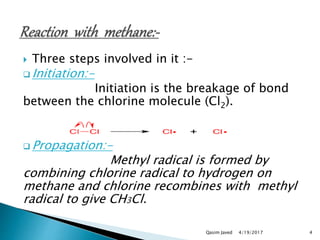
 Three steps involved in it :-
 Initiation:-
Initiation is the breakage of bond
between the chlorine molecule (Cl2).
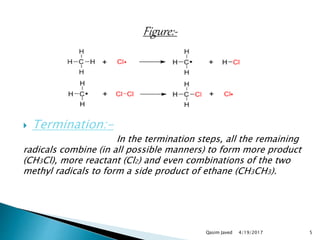
 Propagation:-
Methyl radical is formed by
combining chlorine radical to hydrogen on
methane and chlorine recombines with methyl
radical to give CH3Cl.
Qasim Javed 44/19/2017
 Termination:-
In the termination steps, all the remaining
radicals combine (in all possible manners) to form more product
(CH3Cl), more reactant (Cl2) and even combinations of the two
methyl radicals to form a side product of ethane (CH3CH3).
Qasim Javed 54/19/2017
Qasim Javed 64/19/2017
 It involves substitution and also addition
reactions.
 The catalyst used is either aluminum
chloride(AlCl3) or iron chloride(FeCl3) .
 This reaction occurs at room tamperature and
in the presence of ultraviolet radiations.
 Thus reaction of benzene with chlorine gives
Chlorobenzene (C6H5Cl).
Qasim Javed 74/19/2017
Or
Qasim Javed 84/19/2017
 It occurs in the presence of ultraviolet
radiation or in the presence of sunlight.
 Breakage of delocalized Pi bonds.
 Chlorine is added to each carbon atom.
 Hexachlorocyclohexane is formed.
Qasim Javed 94/19/2017
 They contain double bond.
 The reaction is exothermic and
The products are more stable then
Alkenes.
4/19/2017Qasim Javed 10
–C = C – – C – C–
4/19/2017Qasim Javed 11
CH2Cl2
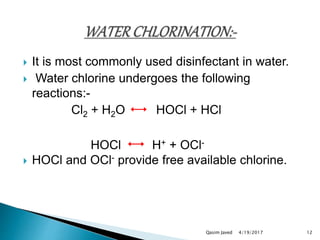
 It is most commonly used disinfectant in water.
 Water chlorine undergoes the following
reactions:-
Cl2 + H2O HOCl + HCl
 HOCl and OCl- provide free available chlorine.
4/19/2017Qasim Javed 12
HOCl H+ + OCl-

Chlorination

  • 1.
  • 2.
     Chlorination maybe reffered as :-  Chlorination reaction:- It is halogenation reaction by using chlorine.  Water chlorination:- It is a method of water treatment by adding chlorine to water. Qasim Javed 24/19/2017
  • 3.
     Reaction withMethane (CH4).  Reaction with Benzene(C6H6).  Reaction with Alkenes and Alkynes. Qasim Javed 34/19/2017
  • 4.
     Three stepsinvolved in it :-  Initiation:- Initiation is the breakage of bond between the chlorine molecule (Cl2).  Propagation:- Methyl radical is formed by combining chlorine radical to hydrogen on methane and chlorine recombines with methyl radical to give CH3Cl. Qasim Javed 44/19/2017
  • 5.
     Termination:- In thetermination steps, all the remaining radicals combine (in all possible manners) to form more product (CH3Cl), more reactant (Cl2) and even combinations of the two methyl radicals to form a side product of ethane (CH3CH3). Qasim Javed 54/19/2017
  • 6.
  • 7.
     It involvessubstitution and also addition reactions.  The catalyst used is either aluminum chloride(AlCl3) or iron chloride(FeCl3) .  This reaction occurs at room tamperature and in the presence of ultraviolet radiations.  Thus reaction of benzene with chlorine gives Chlorobenzene (C6H5Cl). Qasim Javed 74/19/2017
  • 8.
  • 9.
     It occursin the presence of ultraviolet radiation or in the presence of sunlight.  Breakage of delocalized Pi bonds.  Chlorine is added to each carbon atom.  Hexachlorocyclohexane is formed. Qasim Javed 94/19/2017
  • 10.
     They containdouble bond.  The reaction is exothermic and The products are more stable then Alkenes. 4/19/2017Qasim Javed 10 –C = C – – C – C–
  • 11.
  • 12.
     It ismost commonly used disinfectant in water.  Water chlorine undergoes the following reactions:- Cl2 + H2O HOCl + HCl  HOCl and OCl- provide free available chlorine. 4/19/2017Qasim Javed 12 HOCl H+ + OCl-