CHLORINE MEASUREMENT
Praful Hanmante
 Most commonly used for
disinfection of water.
CHLORINE AS DISINFECT
Cl2 when applied to water  forms hypochlorous acid and
hydrochloric acid
Cl2 + H2O ↔ HOCl + H+ +Cl- [pH dependent reaction]
Ca(OCl)2 + 2H2O ↔ 2HOCl + Ca(OH)2
NaOCl + H2O ↔ HOCl+NaOH
HOCl = Hypochlorous Acid
Ca(OCl)2 = Calcium hypochlorite
Ca(OH)2 = Calcium Hydroxide
NaOCl = Sodium hypochlorite
HOCl ↔ H+ + OCl- [pH dependent reaction]
 Killing effiency of HOCl is 40 -80 times larger than OCl - .
Lower pH favors HOCl.
 HOCl = Hypochlorous acid
 OCl - = Hypochloride ion
 Free chlorine = HOCl + OCl-
FREE CHLORINE
 HOCl + NH3 ↔ NH2Cl (monochloramine) + H2O
 HOCl + NH2Cl ↔ NHCl2 (dichloramine) + H2O
 HOCl + NHCl2 ↔ NCl3 (trichloramine) + H2O
 Combined chlorine=monochloramine+dichloramine+
trichloramine
 Total chlorine = combined chlorine + free chlorine
COMBINED CHLORINE
BREAKPOINT
MEASUREMENT TECHNIQUES
 DPD Colorimetric Method
Amperometric Method
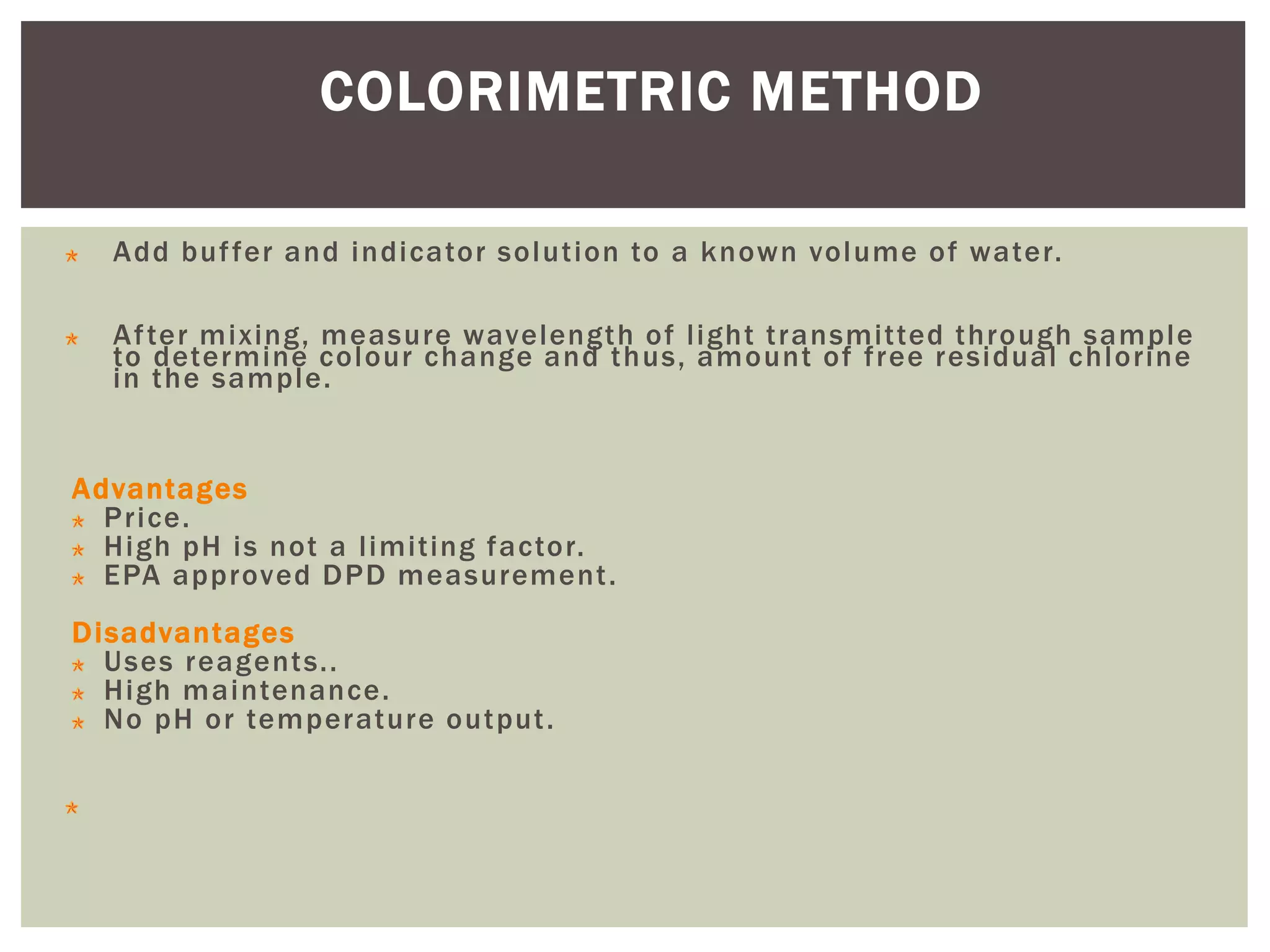
Add buffer and indicator solution to a known volume of water.
After mixing, measure wavelength of light transmitted through sample
to determine colour change and thus, amount of free residual chlorine
in the sample.
Advantages
Price.
High pH is not a limiting factor.
EPA approved DPD measurement.
Disadvantages
Uses reagents..
High maintenance.
No pH or temperature output.
COLORIMETRIC METHOD
COLORIMETRIC METHOD
 Free Residual Chlorine— (DPD), The reaction takes place at a
buffered pH of 6.3 to 6.6.
 Total Residual Chlorine— By adding potassium iodide to the
sample, chloramines in the sample oxidize iodide to iodine,
which then oxidizes the DPD indicator to the magenta color at
a buffered pH of 5.1.
A sensor consisting of a membrane (which allows HOCL to
migrate through it), two dissimilar metal electrodes, and an
electrolyte are submersed into the water sample.
A free residual chlorine reading is derived based on mV
changes experienced by the sensor.
Advantages
Ease of use
No reagents or buffers added
Disadvantages
pH dependence
AMPEROMETRIC METHOD
How does the chlorine sensor work
 Current is proportional to
diffusion rate, which is
proportional to concentration
cathode
membrane
anode
(Ag/AgCl)
electrolyte
(KCl)
electrons
HOCL
HOCL + H+ + 2e- Cl- + H2O
2Ag + 2Cl - AgCl + 2e-
Amperometric sensor measures
only HOCL
PH DEPEDENACE
FREE CHLORINE AND THE PH PROBLEM
 Three ways to solve the
problem...
 Restrict applications to
only those having
constant pH
 Use acid to adjust the
pH of the sample
 Measure pH continuously
and perform automatic
correction
350
400
450
500
550
600
650
7.0 7.5 8.0 8.5 9.0 9.5
sensitivity,nA/ppm
pH at 25 C
15
The reagent solution...
 Add an acid to the sample to lower
pH to about 6.
 Acid converts OCl to HOCl, which
the sensor measures.
 Disadvantages
– requires sample conditioning
system
– requires reagents acid
reagent
bottle
reagent
pump
sensor
HOCl + OCl HOCl
INTERNAL PH CORRECTION
The Rosemount Analytical approach
Use continuous pH correction
Good between pH 6.0 and 9.5.
– Below pH 6.0, don’t need correction.
– Above pH 9.5, usually there is too little
HOCl available to measure.
If pH varies less than 0.2 peak-to-peak,
don’t need continuous pH correction.
If pH varies more than 0.2 peak-to-peak,
use continuous pH correction.
free chlorine
sensor
pH
sensor
Free chlorine sensor - 499ACL-01
 Easy to replace membrane - no tools
required
 Range: 0 - 20 ppm
 Linear range: 0 - 6 ppm
 Linearity: 2% (typical). Following calibration
in the linear range, the measured
concentration of any point in the linear range
is within about ±0.1 ppm of the expected
value.
 Electrolyte life: about three months
 Variopol quick disconnect option makes
replacing the sensor easy.
cable
cable grip
machined
plug,
receives
cable grip
O-rings
MNPT
threads,
pipe tape
not shown
19
Determination of total chlorine
 No single sensor can be used to determine all the different forms
of total chlorine.
 The only way to measure total chlorine is to convert it into a form
the sensor can measure.
 Requires a sample conditioning system. Most manufacturers use
an off-line system.
acetic acid buffer
with potassium iodide
total chlorine iodine
iodine sensor
to waste
The concentration of iodine produced by the reaction between total chlorine
and potassium iodide is directly proportional to the concentra-tion of total
chlorine in the sample.
 Can be used as disinfectant
 Chloramines: effective vs. bacteria but NOT viruses.
 Chloramines not powerful enough to form THMs.
 Last a lot longer in the mains than free chlorine,
20
CHLORAMINES
Activated carbon
 C + 2Cl2 + 2H2O → 4HCl + CO2
 When dissolved in water, sodium bisulfite (SBS) is formed
from SMBS (Sodium metabisulfite) :
Na2S2O5 + H2O → 2 NaHSO3
2NaHSO3 + 2HOCl → H2SO4 + 2HCl + Na2SO4
DECHLORINATION
22
Dechlorination
Remember: You’re measuring the absence of chlorine, not chlorine.
chlorine
sensor
dechlorination
chemicals
chlorinated water
chlorinated water sample
(for calibrating and checking
sensor response)
dechlorinated
water sample
Installation
Linear velocity in basin is
typically not high enough
for a good measurement.
Basins and tanks:
Rarely is there enough flow
through a tank to provide
adequate stirring.
better
sample point
Best practice is to use an
extracted sample and the
FCL arrangement for flow
control
 FLOW
 Loss of flow
 Air bubbles
 Membrane fouling
FACTOR AFFECTING
Maintenance
Current depends on diffusion rate through
the membrane.
chlorine
membrane
cathode
clean
surface
fouled
surface
A dirty or fouled membrane blocks the passage of chlorine. The result is low
readings and sluggish response to concentration changes.
26
Sample flow
 Diffusion rate (ie sensor current) depends on the concentration of
chlorine at the surface of the membrane.
 As the sensor operates, it depletes the chlorine at the membrane
surface.
 Diffusion from bulk liquid is not adequate to replace loss, so
current drops.
cathode
membrane
sample
cathode
membrane
sample
cathode
membrane
sample
NO FLOW
27
Sample flow (cont’d)…
 Flowing sample keeps the concentration of chlorine at the
surface equal to the bulk concentration.
 Sensor current is proportional to the concentration of chlorine in
the bulk solution.
cathode
membrane
sample
FLOW
cathode
membrane
sample
28
Sample flow is important
 Normally, sensor current is a non-linear function of flow.
 There is a minimum flow above which the sensor current is more or
less independent of flow.
 Each type of sensor has an optimum flow.
sensor
current
flow
minimum flow rate
29
Automatic cleaning systems
wastewater
aeration basin
oxygen
sensor sensor
sensor cable
spray nozzle
membrane
water or air line
normal operation
spray cleaner activated
recovery period
normal operation
Commonly used with oxygen sensors.
30
3 ELECTRODE
CAMPARISION
33
Drinking water filter plant
T
OZ
ozone
generator
screens
raw water
flocculant
ozone destruct
T
ozone contact
chamber
settling basin
backwash
pump
to screens
backwash reclaim pond
NaOH
NaOCl
pHCl
T PC
mixer
contact
tank
T
34
Distribution system
filter plant
NaOCl
Cl
Cl
35
Groundwater source
NaOCl
Cl
Cl
well
36
Desalination/wastewater reclamation plant
NaOCl
media filter
T
C
C
C
Cl
RO modules
calcite
filter
dCl
NaHSO3
membrane filter
pH Cl T
reject
*SCS921A
**FCL
*
**
PC
37
Waste treatment plant
raw
waste
grit chamber
primary sedimentation
tank
screens
to sludge system
to sludge
system
aeration basin
secondary
sedimentation
tank
dechlorination
tank
blower
NaOCl
activated
sludge
to sludge
system
to
aeration
basin
chlorine contact
chamber
DODO
CldCl
T
Cl typically total chlorine

Chlorination & measurement

  • 1.
  • 2.
     Most commonlyused for disinfection of water. CHLORINE AS DISINFECT
  • 3.
    Cl2 when appliedto water  forms hypochlorous acid and hydrochloric acid Cl2 + H2O ↔ HOCl + H+ +Cl- [pH dependent reaction] Ca(OCl)2 + 2H2O ↔ 2HOCl + Ca(OH)2 NaOCl + H2O ↔ HOCl+NaOH HOCl = Hypochlorous Acid Ca(OCl)2 = Calcium hypochlorite Ca(OH)2 = Calcium Hydroxide NaOCl = Sodium hypochlorite
  • 4.
    HOCl ↔ H++ OCl- [pH dependent reaction]  Killing effiency of HOCl is 40 -80 times larger than OCl - . Lower pH favors HOCl.  HOCl = Hypochlorous acid  OCl - = Hypochloride ion  Free chlorine = HOCl + OCl- FREE CHLORINE
  • 5.
     HOCl +NH3 ↔ NH2Cl (monochloramine) + H2O  HOCl + NH2Cl ↔ NHCl2 (dichloramine) + H2O  HOCl + NHCl2 ↔ NCl3 (trichloramine) + H2O  Combined chlorine=monochloramine+dichloramine+ trichloramine  Total chlorine = combined chlorine + free chlorine COMBINED CHLORINE
  • 6.
  • 7.
    MEASUREMENT TECHNIQUES  DPDColorimetric Method Amperometric Method
  • 8.
    Add buffer andindicator solution to a known volume of water. After mixing, measure wavelength of light transmitted through sample to determine colour change and thus, amount of free residual chlorine in the sample. Advantages Price. High pH is not a limiting factor. EPA approved DPD measurement. Disadvantages Uses reagents.. High maintenance. No pH or temperature output. COLORIMETRIC METHOD
  • 9.
  • 10.
     Free ResidualChlorine— (DPD), The reaction takes place at a buffered pH of 6.3 to 6.6.  Total Residual Chlorine— By adding potassium iodide to the sample, chloramines in the sample oxidize iodide to iodine, which then oxidizes the DPD indicator to the magenta color at a buffered pH of 5.1.
  • 11.
    A sensor consistingof a membrane (which allows HOCL to migrate through it), two dissimilar metal electrodes, and an electrolyte are submersed into the water sample. A free residual chlorine reading is derived based on mV changes experienced by the sensor. Advantages Ease of use No reagents or buffers added Disadvantages pH dependence AMPEROMETRIC METHOD
  • 12.
    How does thechlorine sensor work  Current is proportional to diffusion rate, which is proportional to concentration cathode membrane anode (Ag/AgCl) electrolyte (KCl) electrons HOCL HOCL + H+ + 2e- Cl- + H2O 2Ag + 2Cl - AgCl + 2e- Amperometric sensor measures only HOCL
  • 13.
  • 14.
    FREE CHLORINE ANDTHE PH PROBLEM  Three ways to solve the problem...  Restrict applications to only those having constant pH  Use acid to adjust the pH of the sample  Measure pH continuously and perform automatic correction 350 400 450 500 550 600 650 7.0 7.5 8.0 8.5 9.0 9.5 sensitivity,nA/ppm pH at 25 C
  • 15.
    15 The reagent solution... Add an acid to the sample to lower pH to about 6.  Acid converts OCl to HOCl, which the sensor measures.  Disadvantages – requires sample conditioning system – requires reagents acid reagent bottle reagent pump sensor HOCl + OCl HOCl
  • 16.
  • 17.
    The Rosemount Analyticalapproach Use continuous pH correction Good between pH 6.0 and 9.5. – Below pH 6.0, don’t need correction. – Above pH 9.5, usually there is too little HOCl available to measure. If pH varies less than 0.2 peak-to-peak, don’t need continuous pH correction. If pH varies more than 0.2 peak-to-peak, use continuous pH correction. free chlorine sensor pH sensor
  • 18.
    Free chlorine sensor- 499ACL-01  Easy to replace membrane - no tools required  Range: 0 - 20 ppm  Linear range: 0 - 6 ppm  Linearity: 2% (typical). Following calibration in the linear range, the measured concentration of any point in the linear range is within about ±0.1 ppm of the expected value.  Electrolyte life: about three months  Variopol quick disconnect option makes replacing the sensor easy. cable cable grip machined plug, receives cable grip O-rings MNPT threads, pipe tape not shown
  • 19.
    19 Determination of totalchlorine  No single sensor can be used to determine all the different forms of total chlorine.  The only way to measure total chlorine is to convert it into a form the sensor can measure.  Requires a sample conditioning system. Most manufacturers use an off-line system. acetic acid buffer with potassium iodide total chlorine iodine iodine sensor to waste The concentration of iodine produced by the reaction between total chlorine and potassium iodide is directly proportional to the concentra-tion of total chlorine in the sample.
  • 20.
     Can beused as disinfectant  Chloramines: effective vs. bacteria but NOT viruses.  Chloramines not powerful enough to form THMs.  Last a lot longer in the mains than free chlorine, 20 CHLORAMINES
  • 21.
    Activated carbon  C+ 2Cl2 + 2H2O → 4HCl + CO2  When dissolved in water, sodium bisulfite (SBS) is formed from SMBS (Sodium metabisulfite) : Na2S2O5 + H2O → 2 NaHSO3 2NaHSO3 + 2HOCl → H2SO4 + 2HCl + Na2SO4 DECHLORINATION
  • 22.
    22 Dechlorination Remember: You’re measuringthe absence of chlorine, not chlorine. chlorine sensor dechlorination chemicals chlorinated water chlorinated water sample (for calibrating and checking sensor response) dechlorinated water sample
  • 23.
    Installation Linear velocity inbasin is typically not high enough for a good measurement. Basins and tanks: Rarely is there enough flow through a tank to provide adequate stirring. better sample point Best practice is to use an extracted sample and the FCL arrangement for flow control
  • 24.
     FLOW  Lossof flow  Air bubbles  Membrane fouling FACTOR AFFECTING
  • 25.
    Maintenance Current depends ondiffusion rate through the membrane. chlorine membrane cathode clean surface fouled surface A dirty or fouled membrane blocks the passage of chlorine. The result is low readings and sluggish response to concentration changes.
  • 26.
    26 Sample flow  Diffusionrate (ie sensor current) depends on the concentration of chlorine at the surface of the membrane.  As the sensor operates, it depletes the chlorine at the membrane surface.  Diffusion from bulk liquid is not adequate to replace loss, so current drops. cathode membrane sample cathode membrane sample cathode membrane sample NO FLOW
  • 27.
    27 Sample flow (cont’d)… Flowing sample keeps the concentration of chlorine at the surface equal to the bulk concentration.  Sensor current is proportional to the concentration of chlorine in the bulk solution. cathode membrane sample FLOW cathode membrane sample
  • 28.
    28 Sample flow isimportant  Normally, sensor current is a non-linear function of flow.  There is a minimum flow above which the sensor current is more or less independent of flow.  Each type of sensor has an optimum flow. sensor current flow minimum flow rate
  • 29.
    29 Automatic cleaning systems wastewater aerationbasin oxygen sensor sensor sensor cable spray nozzle membrane water or air line normal operation spray cleaner activated recovery period normal operation Commonly used with oxygen sensors.
  • 30.
  • 31.
  • 33.
    33 Drinking water filterplant T OZ ozone generator screens raw water flocculant ozone destruct T ozone contact chamber settling basin backwash pump to screens backwash reclaim pond NaOH NaOCl pHCl T PC mixer contact tank T
  • 34.
  • 35.
  • 36.
    36 Desalination/wastewater reclamation plant NaOCl mediafilter T C C C Cl RO modules calcite filter dCl NaHSO3 membrane filter pH Cl T reject *SCS921A **FCL * ** PC
  • 37.
    37 Waste treatment plant raw waste gritchamber primary sedimentation tank screens to sludge system to sludge system aeration basin secondary sedimentation tank dechlorination tank blower NaOCl activated sludge to sludge system to aeration basin chlorine contact chamber DODO CldCl T Cl typically total chlorine