Chinese Thinking Patterns or ErrorsDr. Foo, KoongHeanJames Cook University, Singapore CAMPUS28 August 2009
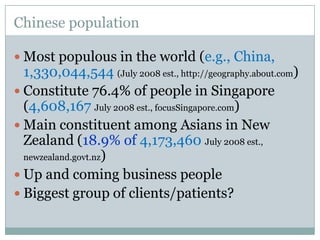
Chinese populationMost populous in the world (e.g., China, 1,330,044,544 (July 2008 est., http://geography.about.com)Constitute 76.4% of people in Singapore (4,608,167 July 2008 est., focusSingapore.com)Main constituent among Asians in New Zealand (18.9% of 4,173,460July 2008 est., newzealand.govt.nz)Up and coming business peopleBiggest group of clients/patients?
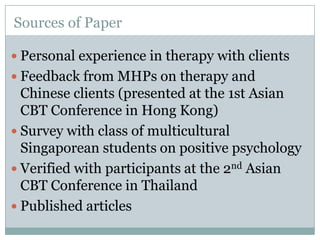
Sources of PaperPersonal experience in therapy with clients Feedback from MHPs on therapy and Chinese clients (presented at the 1st Asian CBT Conference in Hong Kong)Survey with class of multicultural Singaporean students on positive psychologyVerified with participants at the 2nd Asian CBT Conference in ThailandPublished articles
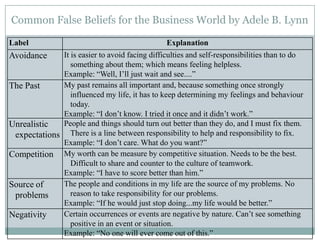
Sources of PaperBasing on Automatic (Negative)Thoughts by Aaron T. Beck and Common False Beliefs by Adele B. LynnCombining and Modifying the said Thoughts and BeliefsProposed new definitions and labels
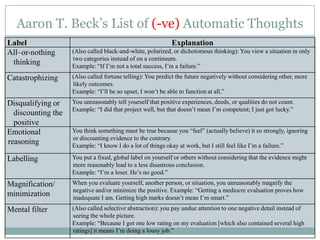
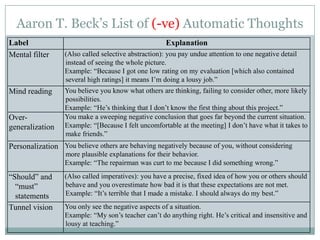
Aaron T. Beck’s List of (-ve) Automatic Thoughts
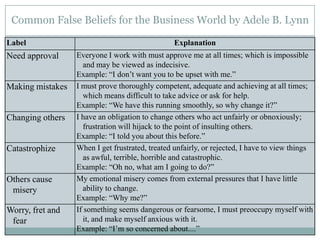
Common False Beliefs for the Business World by Adele B. Lynn
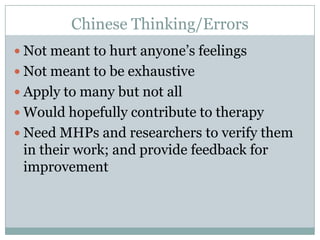
Chinese Thinking/ErrorsNot meant to hurt anyone’s feelingsNot meant to be exhaustiveApply to many but not all Would hopefully contribute to therapyNeed MHPs and researchers to verify them in their work; and provide feedback for improvement
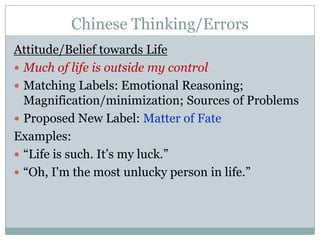
Chinese Thinking/ErrorsAttitude/Belief towards LifeMuch of life is outside my control Matching Labels: Emotional Reasoning; Magnification/minimization; Sources of ProblemsProposed New Label: Matter of FateExamples:“Life is such. It’s my luck.” “Oh, I'm the most unlucky person in life.”
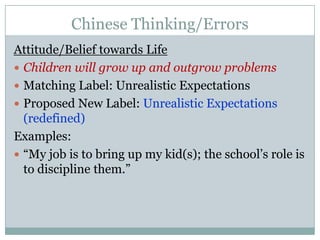
Chinese Thinking/ErrorsAttitude/Belief towards LifeChildren will grow up and outgrow problemsMatching Label: Unrealistic ExpectationsProposed New Label: Unrealistic Expectations (redefined)Examples:“My job is to bring up my kid(s); the school’s role is to discipline them.”
Chinese Thinking/ErrorsAttitude/Belief towards LifeEducation is the ticket to career and life, happiness and prosperityMatching Labels: All-or-Nothing; Emotional Reasoning; Should & Must; CompetitionProposed New Label: Unrealistic Expectations (redefined)Examples:“Education come first, play or sports or rest come later.”
Chinese Thinking/ErrorsAttitude/Belief towards LifeOlder folks are always like this. They are beyond changeMatching Labels: Labelling; Others cause MiseryNew Label: Beyond ChangeExamples:“The older folks never shed their spots. Always grumpy, nagging, nothing to do, while their time away at void decks, etc.”
Chinese Thinking/ErrorsAttitude/Belief towards LifeFamily problems stay within the homeMatching Labels: Personalisation; Others cause Misery; AvoidanceNew Label: Keeping Secrets  Examples:“Never say or spread your family problems outside the home. That’ll be bad for reputation of the family.”
Chinese Thinking/ErrorsAttitude/Belief towards EnvironmentLack of awareness of surrounding. Self-centred thinking/viewpointMatching Label: Mind Reading; Tunnel Vision; Unrealistic ExpectationsNew Label: Self-centrednessExamples:“Yes, you can get it from that shop.”“Oh yes, it good for you.”
Chinese Thinking/ErrorsAttitude/Belief towards EnvironmentExpensive stuff is good. Anything discounted or free is good. Take first and complain laterMatching Labels: All-or-Nothing; Should & Must; Mental FilterNew Label: All-or-Nothing (redefined)Examples:“Don’t have never mind, if I have it, it is fine.”“Better to have it than lose it or let others have it.”
Chinese Thinking/ErrorsAttitude/Belief towards EnvironmentAvoid difficult situationsMatching Labels: Tunnel Vision; Avoidance; Others cause Misery; NegativityNew Label: Face-savingExamples:“It’s all because of them, why do they do such things, so reckless.”
Chinese Thinking/ErrorsAttitude/Belief towards Health and IllnessWestern illness Western medicine; Eastern illness Eastern medicineMatching Labels: Should & Must; The PastNew Label: The PastExamples:“My parents believed in Chinese medicine for its gentle effect and its ability to eradicate the roots of the disease. I was more inclined to use Western medicine for its immediate effect in treating signs and symptoms.”
Chinese Thinking/ErrorsAttitude/Belief towards Health and IllnessQuick fix is the preferred treatment mode for any illnessMatching Label: Emotional Reasoning; Personalisation; Should & MustNew Label: PragmaticExamples:“Can I get well with just this session?” “How much?”
Chinese Thinking/ErrorsAttitude/Belief towards Health and IllnessSomatisation of illnessMatching Label: Worry, Fret and FearNew Label: Face-savingExamples:“Oh, I’ve got this backache. Must have overworked myself.”
Chinese Thinking/ErrorsAttitude/Belief towards Health and IllnessTraditional healing system is still goodMatching Label: Should & Must; The PastNew Label: The PastExamples:“The shaman or bomoh can help relieve my problems if the doctor cannot.”
Chinese Thinking/ErrorsAttitude/Belief towards Health and IllnessMental illness is stigmatized and equated with crazinessMatching Labels: All-or-Nothing; Emotional Reasoning; Labelling; Overgeneralization; Avoidance; NegativityNew Label: All-or-Nothing Examples:“Don’t go near someone with this illness. Mental illness could be contagious.”
Chinese Thinking/ErrorsAttitude/Belief towards Health and IllnessThe sick usually plays up the sick roleMatching Labels: Disqualifying or Discounting the Positive; Over-generalization; Need approval; Unrealistic Expectations; CatastrophizeNew Label: My TurnExamples:“I’ve been looking after all of you, now that I’m sick, it’s your turn to look after me.”
Chinese Thinking/ErrorsAttitude/Belief towards Health and IllnessChinese coping skills are problem- or emotion-focusedMatching Label: Emotional Reasoning; Mental Filter; Should & Must; Source of ProblemsNew Label: PragmaticExamples:“Go for the problem or the solution.”
Chinese Thinking/ErrorsAttitude/Belief towards Religion/SpiritualityMany Chinese Singaporeans are brought up under Confucianism, Taoism, or Buddhism. However, a good many are now Christian convertsMatching Label: Emotional Reasoning; Over-generalization; Personalisation; Changing Others; The Past; Unrealistic ExpectationsNew Label: Matter of FaithExamples:“My faith is in Christianity or Buddhism or Taoism; therefore, I’ll do/not do this and that because of my faith/religion/belief.
Chinese Thinking/ErrorsAttitude/Belief towards RelationshipsAuthority is always rightMatching Labels: Labelling; Mental Filter; Overgeneralization; Mental FilterNew Label: The AuthorityExamples:“Because they are trained or in charge, they must know how and have answers to my problems.”
Chinese Thinking/ErrorsAttitude/Belief towards RelationshipsHave to compare with others—from objects to pay to children to houses to jobsBe competent or cannot lose to others. Matching Label: Mind Reading; Personalisation; CompetitionNew Label: Competition (existing)Examples:“I must show them I can do it. I cannot let myself down.”
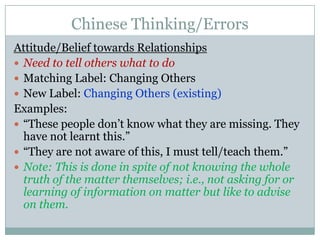
Chinese Thinking/ErrorsAttitude/Belief towards RelationshipsNeed to tell others what to doMatching Label: Changing OthersNew Label: Changing Others (existing)Examples:“These people don’t know what they are missing. They have not learnt this.” “They are not aware of this, I must tell/teach them.” Note: This is done in spite of not knowing the whole truth of the matter themselves; i.e., not asking for or learning of information on matter but like to advise on them.
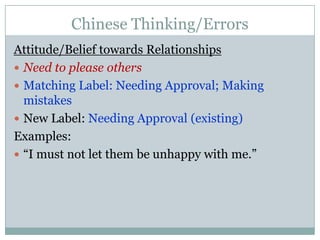
Chinese Thinking/ErrorsAttitude/Belief towards RelationshipsNeed to please othersMatching Label: Needing Approval; Making mistakesNew Label: Needing Approval (existing)Examples:“I must not let them be unhappy with me.”
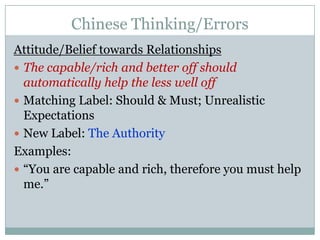
Chinese Thinking/ErrorsAttitude/Belief towards RelationshipsThe capable/rich and better off should automatically help the less well offMatching Label: Should & Must; Unrealistic ExpectationsNew Label: The AuthorityExamples:“You are capable and rich, therefore you must help me.”
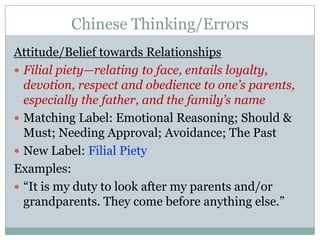
Chinese Thinking/ErrorsAttitude/Belief towards RelationshipsFilial piety—relating to face, entails loyalty, devotion, respect and obedience to one’s parents, especially the father, and the family’s nameMatching Label: Emotional Reasoning; Should & Must; Needing Approval; Avoidance; The PastNew Label: Filial PietyExamples:“It is my duty to look after my parents and/or grandparents. They come before anything else.”
Chinese Thinking Patternsor ErrorsThank you for your attention.Questions?
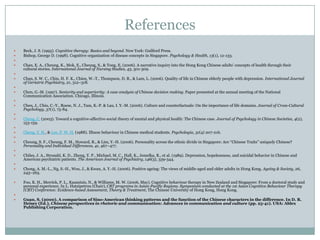
ReferencesBeck, J. S. (1995). Cognitive therapy: Basics and beyond. New York: Guilford Press. Bishop, George D. (1998). Cognitive organization of disease concepts in Singapore. Psychology & Health, 13(1), 12-133. Chan, E. A., Cheung, K., Mok, E., Cheung, S., & Tong, E. (2006). A narrative inquiry into the Hong Kong Chinese adults’ concepts of health through their cultural stories. International Journal of Nursing Studies, 43, 301-309. Chan, S. W. C., Chiu, H. F. K., Chien, W.-T., Thompson, D. R., & Lam, L. (2006). Quality of life in Chinese elderly people with depression. International Journal of Geriatric Psychiatry, 21, 312–318. Chen, G.-M. (1997). Seniority and superiority: A case analysis of Chinese decision making. Paper presented at the annual meeting of the National Communication Association. Chicago, Illinois. Chen, J., Chiu, C.-Y., Roese, N. J., Tam, K.-P. & Lau, I. Y.-M. (2006). Culture and counterfactuals: On the importance of life domains. Journal of Cross-Cultural Psychology, 37(1), 75-84. Cheng, C. (2003). Toward a cognitive-affective-social theory of mental and physical health: The Chinese case. Journal of Psychology in Chinese Societies, 4(2), 153-159. Cheng, Y. H., & Lee, P. W. H. (1988). Illness behaviour in Chinese medical students. Psychologia, 31(4) 207-216.  Cheung, S. F., Cheung, F. M., Howard, R., & Lim, Y.-H. (2006). Personality across the ethnic divide in Singapore: Are ‘‘Chinese Traits’’ uniquely Chinese? Personality and Individual Differences, 41, 467–477. Chiles, J. A., Strosahl, K. D., Zheng, Y. P., Michael, M. C., Hall, K., Jemelka, R., et al. (1989). Depression, hopelessness, and suicidal behavior in Chinese and American psychiatric patients. The American Journal of Psychiatry, 146(3), 339-344. Chong, A. M.-L., Ng, S.-H., Woo, J., & Kwan, A. Y.-H. (2006). Positive ageing: The views of middle-aged and older adults in Hong Kong. Ageing & Society, 26, 243–265. Foo, K. H., Merrick, P. L., Kazantzis, N., & Williams, M. W. (2006, May). Cognitive behaviour therapy in New Zealand and Singapore: From a doctoral study and personal experience. In L. Hatzipetrou (Chair), CBT programs in Asian-Pacific Regions. Symposium conducted at the 1st Asian Cognitive Behaviour Therapy (CBT) Conference: Evidence-based Assessment, Theory & Treatment, The Chinese University of Hong Kong, Hong Kong. Guan, S. (2000). A comparison of Sino-American thinking patterns and the function of the Chinese characters in the difference. In D. R. Heisey (Ed.), Chinese perspectives in rhetoric and communication: Advances in communication and culture (pp. 25-41). USA: Ablex Publishing Corporation.
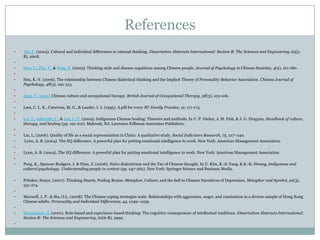
References Ho, C. (2004). Cultural and individual differences in rational thinking. Dissertation Abstracts International: Section B: The Sciences and Engineering, 65(5-B), 2608. Hou, Y., Zhu, Y., & Peng, K. (2003). Thinking style and disease cognitions among Chinese people. Journal of Psychology in Chinese Societies, 4(2), 161-180. Hsu, K.-Y. (2006). The relationship between Chinese dialectical thinking and the Implicit Theory of Personality-Behavior Association. Chinese Journal of Psychology, 48(3), 291-313.   Jang, Y. (1995). Chinese culture and occupational therapy. British Journal of Occupational Therapy, 58(3), 103-106. Lam, C. L. K., Catarivas, M. G., & Lauder, I. J. (1995). A pill for every ill? Family Practice, 12, 171-175. Lei, T., Askeroth, C., & Lee, C.-T. (2004). Indigenous Chinese healing: Theories and methods. In U. P. Gielen, J. M. Fish, & J. G. Draguns, Handbook of culture, therapy, and healing (pp. 191-212). Mahwah, NJ: Lawrence Erlbaum Associates Publishers. Liu, L. (2006). Quality of life as a social representation in China: A qualitative study. Social Indicators Research, 75, 217–240. Lynn, A. B. (2004). The EQ difference: A powerful plan for putting emotional intelligence to work. New York: American Management Association. Lynn, A. B. (2004). The EQ difference: A powerful plan for putting emotional intelligence to work. New York: American Management Association. Peng, K., Spencer-Rodgers, J. & Nian, Z. (2006). Naïve dialecticism and the Tao of Chinese thought. In U. Kim, K.-S. Yang, & K.-K. Hwang, Indigenous and cultural psychology: Understanding people in context (pp. 247-262). New York: Springer Science and Business Media.Pritzker, Sonya. (2007) .Thinking Hearts, Feeling Brains: Metaphor, Culture, and the Self in Chinese Narratives of Depression, Metaphor and Symbol, 22(3), 251-274. Maxwell, J. P., & Siu, O.L. (2008). The Chinese coping strategies scale: Relationships with aggression, anger, and rumination in a diverse sample of Hong Kong Chinese adults. Personality and Individual Differences, 44, 1049–1059. Norenzayan, A. (2001). Rule-based and experience-based thinking: The cognitive consequences of intellectual traditions. Dissertation Abstracts International: Section B: The Sciences and Engineering, 62(6-B), 2992. 
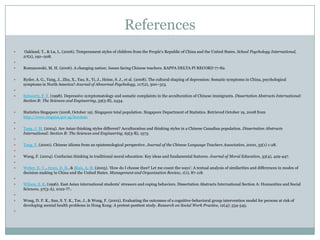
References Oakland, T., & Lu, L. (2006). Temperament styles of children from the People’s Republic of China and the United States. School Psychology International, 27(2), 192–208. Romanowski, M. H. (2006). A changing nation: Issues facing Chinese teachers. KAPPA DELTA PI RECORD 77-82. Ryder, A. G., Yang, J., Zhu, X., Yao, S., Yi, J., Heine, S. J., et al. (2008). The cultural shaping of depression: Somatic symptoms in China, psychological symptoms in North America? Journal of Abnormal Psychology, 117(2), 300–313. Schwartz, P. Y. (1998). Depressive symptomatology and somatic complaints in the acculturation of Chinese immigrants. Dissertation Abstracts International: Section B: The Sciences and Engineering, 59(5-B), 2434. Statistics Singapore (2008, October 19). Singapore total population. Singapore Department of Statistics. Retrieved October 19, 2008 from http://www.singstat.gov.sg/keystats Tang, J. M. (2004). Are Asian thinking styles different? Acculturation and thinking styles in a Chinese Canadian population. Dissertation Abstracts International: Section B: The Sciences and Engineering, 65(3-B), 1573. Tang, Y. (2000). Chinese idioms from an epistemological perspective. Journal of the Chinese Language Teachers Association, 2000, 35(1) 1-28. Wang, F. (2004). Confucian thinking in traditional moral education: Key ideas and fundamental features. Journal of Moral Education, 33(4), 429-447. Weber, E. U., Ames, D. R., & Blais, A.-R. (2005). ‘How do I choose thee? Let me count the ways’: A textual analysis of similarities and differences in modes of decision-making in China and the United States. Management and Organization Review, 1(1), 87-118. Wilson, S. R. (1996). East Asian international students' stressors and coping behaviors. Dissertation Abstracts International Section A: Humanities and Social Sciences, 57(3-A), 1022-??.. Wong, D. F. K., Sun, S. Y. K., Tse, J., & Wong, F. (2002). Evaluating the outcomes of a cognitive-behavioral group intervention model for persons at risk of developing mental health problems in Hong Kong: A pretest-posttest study. Research on Social Work Practice, 12(4); 534-545. 
ReferencesWong, O.-N., C., & Piran, N. (1995). Western biases and assumptions as impediments in counselling traditional Chinese clients. Canadian Journal of Counselling, 29(2), 107-119. Wong, V. & Chiu, S. (2005). Towards a Confucian notion of youth development in Hong Kong. The International Journal of Sociology and Social Policy, 25(10-11), 14-36. Yang, K., & Victor, C. R. (2008). The prevalence of and risk factors for loneliness among older people in China. Ageing & Society, 28, 305–327. Zhang, J., & Jin, S. (1998). Interpersonal relations and suicide ideation in China. Genetic, Social, and General Psychology Monographs.  124.n1 (Feb 1998): 79(16).  

Chinese Thinking Patterns or Errors

  • 1.
    Chinese Thinking Patternsor ErrorsDr. Foo, KoongHeanJames Cook University, Singapore CAMPUS28 August 2009
  • 2.
    Chinese populationMost populousin the world (e.g., China, 1,330,044,544 (July 2008 est., http://geography.about.com)Constitute 76.4% of people in Singapore (4,608,167 July 2008 est., focusSingapore.com)Main constituent among Asians in New Zealand (18.9% of 4,173,460July 2008 est., newzealand.govt.nz)Up and coming business peopleBiggest group of clients/patients?
  • 3.
    Sources of PaperPersonalexperience in therapy with clients Feedback from MHPs on therapy and Chinese clients (presented at the 1st Asian CBT Conference in Hong Kong)Survey with class of multicultural Singaporean students on positive psychologyVerified with participants at the 2nd Asian CBT Conference in ThailandPublished articles
  • 4.
    Sources of PaperBasingon Automatic (Negative)Thoughts by Aaron T. Beck and Common False Beliefs by Adele B. LynnCombining and Modifying the said Thoughts and BeliefsProposed new definitions and labels
  • 5.
    Aaron T. Beck’sList of (-ve) Automatic Thoughts
  • 6.
    Aaron T. Beck’sList of (-ve) Automatic Thoughts
  • 7.
    Common False Beliefsfor the Business World by Adele B. Lynn
  • 8.
    Common False Beliefsfor the Business World by Adele B. Lynn
  • 9.
    Chinese Thinking/ErrorsNot meantto hurt anyone’s feelingsNot meant to be exhaustiveApply to many but not all Would hopefully contribute to therapyNeed MHPs and researchers to verify them in their work; and provide feedback for improvement
  • 10.
    Chinese Thinking/ErrorsAttitude/Belief towardsLifeMuch of life is outside my control Matching Labels: Emotional Reasoning; Magnification/minimization; Sources of ProblemsProposed New Label: Matter of FateExamples:“Life is such. It’s my luck.” “Oh, I'm the most unlucky person in life.”
  • 11.
    Chinese Thinking/ErrorsAttitude/Belief towardsLifeChildren will grow up and outgrow problemsMatching Label: Unrealistic ExpectationsProposed New Label: Unrealistic Expectations (redefined)Examples:“My job is to bring up my kid(s); the school’s role is to discipline them.”
  • 12.
    Chinese Thinking/ErrorsAttitude/Belief towardsLifeEducation is the ticket to career and life, happiness and prosperityMatching Labels: All-or-Nothing; Emotional Reasoning; Should & Must; CompetitionProposed New Label: Unrealistic Expectations (redefined)Examples:“Education come first, play or sports or rest come later.”
  • 13.
    Chinese Thinking/ErrorsAttitude/Belief towardsLifeOlder folks are always like this. They are beyond changeMatching Labels: Labelling; Others cause MiseryNew Label: Beyond ChangeExamples:“The older folks never shed their spots. Always grumpy, nagging, nothing to do, while their time away at void decks, etc.”
  • 14.
    Chinese Thinking/ErrorsAttitude/Belief towardsLifeFamily problems stay within the homeMatching Labels: Personalisation; Others cause Misery; AvoidanceNew Label: Keeping Secrets Examples:“Never say or spread your family problems outside the home. That’ll be bad for reputation of the family.”
  • 15.
    Chinese Thinking/ErrorsAttitude/Belief towardsEnvironmentLack of awareness of surrounding. Self-centred thinking/viewpointMatching Label: Mind Reading; Tunnel Vision; Unrealistic ExpectationsNew Label: Self-centrednessExamples:“Yes, you can get it from that shop.”“Oh yes, it good for you.”
  • 16.
    Chinese Thinking/ErrorsAttitude/Belief towardsEnvironmentExpensive stuff is good. Anything discounted or free is good. Take first and complain laterMatching Labels: All-or-Nothing; Should & Must; Mental FilterNew Label: All-or-Nothing (redefined)Examples:“Don’t have never mind, if I have it, it is fine.”“Better to have it than lose it or let others have it.”
  • 17.
    Chinese Thinking/ErrorsAttitude/Belief towardsEnvironmentAvoid difficult situationsMatching Labels: Tunnel Vision; Avoidance; Others cause Misery; NegativityNew Label: Face-savingExamples:“It’s all because of them, why do they do such things, so reckless.”
  • 18.
    Chinese Thinking/ErrorsAttitude/Belief towardsHealth and IllnessWestern illness Western medicine; Eastern illness Eastern medicineMatching Labels: Should & Must; The PastNew Label: The PastExamples:“My parents believed in Chinese medicine for its gentle effect and its ability to eradicate the roots of the disease. I was more inclined to use Western medicine for its immediate effect in treating signs and symptoms.”
  • 19.
    Chinese Thinking/ErrorsAttitude/Belief towardsHealth and IllnessQuick fix is the preferred treatment mode for any illnessMatching Label: Emotional Reasoning; Personalisation; Should & MustNew Label: PragmaticExamples:“Can I get well with just this session?” “How much?”
  • 20.
    Chinese Thinking/ErrorsAttitude/Belief towardsHealth and IllnessSomatisation of illnessMatching Label: Worry, Fret and FearNew Label: Face-savingExamples:“Oh, I’ve got this backache. Must have overworked myself.”
  • 21.
    Chinese Thinking/ErrorsAttitude/Belief towardsHealth and IllnessTraditional healing system is still goodMatching Label: Should & Must; The PastNew Label: The PastExamples:“The shaman or bomoh can help relieve my problems if the doctor cannot.”
  • 22.
    Chinese Thinking/ErrorsAttitude/Belief towardsHealth and IllnessMental illness is stigmatized and equated with crazinessMatching Labels: All-or-Nothing; Emotional Reasoning; Labelling; Overgeneralization; Avoidance; NegativityNew Label: All-or-Nothing Examples:“Don’t go near someone with this illness. Mental illness could be contagious.”
  • 23.
    Chinese Thinking/ErrorsAttitude/Belief towardsHealth and IllnessThe sick usually plays up the sick roleMatching Labels: Disqualifying or Discounting the Positive; Over-generalization; Need approval; Unrealistic Expectations; CatastrophizeNew Label: My TurnExamples:“I’ve been looking after all of you, now that I’m sick, it’s your turn to look after me.”
  • 24.
    Chinese Thinking/ErrorsAttitude/Belief towardsHealth and IllnessChinese coping skills are problem- or emotion-focusedMatching Label: Emotional Reasoning; Mental Filter; Should & Must; Source of ProblemsNew Label: PragmaticExamples:“Go for the problem or the solution.”
  • 25.
    Chinese Thinking/ErrorsAttitude/Belief towardsReligion/SpiritualityMany Chinese Singaporeans are brought up under Confucianism, Taoism, or Buddhism. However, a good many are now Christian convertsMatching Label: Emotional Reasoning; Over-generalization; Personalisation; Changing Others; The Past; Unrealistic ExpectationsNew Label: Matter of FaithExamples:“My faith is in Christianity or Buddhism or Taoism; therefore, I’ll do/not do this and that because of my faith/religion/belief.
  • 26.
    Chinese Thinking/ErrorsAttitude/Belief towardsRelationshipsAuthority is always rightMatching Labels: Labelling; Mental Filter; Overgeneralization; Mental FilterNew Label: The AuthorityExamples:“Because they are trained or in charge, they must know how and have answers to my problems.”
  • 27.
    Chinese Thinking/ErrorsAttitude/Belief towardsRelationshipsHave to compare with others—from objects to pay to children to houses to jobsBe competent or cannot lose to others. Matching Label: Mind Reading; Personalisation; CompetitionNew Label: Competition (existing)Examples:“I must show them I can do it. I cannot let myself down.”
  • 28.
    Chinese Thinking/ErrorsAttitude/Belief towardsRelationshipsNeed to tell others what to doMatching Label: Changing OthersNew Label: Changing Others (existing)Examples:“These people don’t know what they are missing. They have not learnt this.” “They are not aware of this, I must tell/teach them.” Note: This is done in spite of not knowing the whole truth of the matter themselves; i.e., not asking for or learning of information on matter but like to advise on them.
  • 29.
    Chinese Thinking/ErrorsAttitude/Belief towardsRelationshipsNeed to please othersMatching Label: Needing Approval; Making mistakesNew Label: Needing Approval (existing)Examples:“I must not let them be unhappy with me.”
  • 30.
    Chinese Thinking/ErrorsAttitude/Belief towardsRelationshipsThe capable/rich and better off should automatically help the less well offMatching Label: Should & Must; Unrealistic ExpectationsNew Label: The AuthorityExamples:“You are capable and rich, therefore you must help me.”
  • 31.
    Chinese Thinking/ErrorsAttitude/Belief towardsRelationshipsFilial piety—relating to face, entails loyalty, devotion, respect and obedience to one’s parents, especially the father, and the family’s nameMatching Label: Emotional Reasoning; Should & Must; Needing Approval; Avoidance; The PastNew Label: Filial PietyExamples:“It is my duty to look after my parents and/or grandparents. They come before anything else.”
  • 32.
    Chinese Thinking PatternsorErrorsThank you for your attention.Questions?
  • 33.
    ReferencesBeck, J. S.(1995). Cognitive therapy: Basics and beyond. New York: Guilford Press. Bishop, George D. (1998). Cognitive organization of disease concepts in Singapore. Psychology & Health, 13(1), 12-133. Chan, E. A., Cheung, K., Mok, E., Cheung, S., & Tong, E. (2006). A narrative inquiry into the Hong Kong Chinese adults’ concepts of health through their cultural stories. International Journal of Nursing Studies, 43, 301-309. Chan, S. W. C., Chiu, H. F. K., Chien, W.-T., Thompson, D. R., & Lam, L. (2006). Quality of life in Chinese elderly people with depression. International Journal of Geriatric Psychiatry, 21, 312–318. Chen, G.-M. (1997). Seniority and superiority: A case analysis of Chinese decision making. Paper presented at the annual meeting of the National Communication Association. Chicago, Illinois. Chen, J., Chiu, C.-Y., Roese, N. J., Tam, K.-P. & Lau, I. Y.-M. (2006). Culture and counterfactuals: On the importance of life domains. Journal of Cross-Cultural Psychology, 37(1), 75-84. Cheng, C. (2003). Toward a cognitive-affective-social theory of mental and physical health: The Chinese case. Journal of Psychology in Chinese Societies, 4(2), 153-159. Cheng, Y. H., & Lee, P. W. H. (1988). Illness behaviour in Chinese medical students. Psychologia, 31(4) 207-216.  Cheung, S. F., Cheung, F. M., Howard, R., & Lim, Y.-H. (2006). Personality across the ethnic divide in Singapore: Are ‘‘Chinese Traits’’ uniquely Chinese? Personality and Individual Differences, 41, 467–477. Chiles, J. A., Strosahl, K. D., Zheng, Y. P., Michael, M. C., Hall, K., Jemelka, R., et al. (1989). Depression, hopelessness, and suicidal behavior in Chinese and American psychiatric patients. The American Journal of Psychiatry, 146(3), 339-344. Chong, A. M.-L., Ng, S.-H., Woo, J., & Kwan, A. Y.-H. (2006). Positive ageing: The views of middle-aged and older adults in Hong Kong. Ageing & Society, 26, 243–265. Foo, K. H., Merrick, P. L., Kazantzis, N., & Williams, M. W. (2006, May). Cognitive behaviour therapy in New Zealand and Singapore: From a doctoral study and personal experience. In L. Hatzipetrou (Chair), CBT programs in Asian-Pacific Regions. Symposium conducted at the 1st Asian Cognitive Behaviour Therapy (CBT) Conference: Evidence-based Assessment, Theory & Treatment, The Chinese University of Hong Kong, Hong Kong. Guan, S. (2000). A comparison of Sino-American thinking patterns and the function of the Chinese characters in the difference. In D. R. Heisey (Ed.), Chinese perspectives in rhetoric and communication: Advances in communication and culture (pp. 25-41). USA: Ablex Publishing Corporation.
  • 34.
    References Ho, C. (2004).Cultural and individual differences in rational thinking. Dissertation Abstracts International: Section B: The Sciences and Engineering, 65(5-B), 2608. Hou, Y., Zhu, Y., & Peng, K. (2003). Thinking style and disease cognitions among Chinese people. Journal of Psychology in Chinese Societies, 4(2), 161-180. Hsu, K.-Y. (2006). The relationship between Chinese dialectical thinking and the Implicit Theory of Personality-Behavior Association. Chinese Journal of Psychology, 48(3), 291-313.  Jang, Y. (1995). Chinese culture and occupational therapy. British Journal of Occupational Therapy, 58(3), 103-106. Lam, C. L. K., Catarivas, M. G., & Lauder, I. J. (1995). A pill for every ill? Family Practice, 12, 171-175. Lei, T., Askeroth, C., & Lee, C.-T. (2004). Indigenous Chinese healing: Theories and methods. In U. P. Gielen, J. M. Fish, & J. G. Draguns, Handbook of culture, therapy, and healing (pp. 191-212). Mahwah, NJ: Lawrence Erlbaum Associates Publishers. Liu, L. (2006). Quality of life as a social representation in China: A qualitative study. Social Indicators Research, 75, 217–240. Lynn, A. B. (2004). The EQ difference: A powerful plan for putting emotional intelligence to work. New York: American Management Association. Lynn, A. B. (2004). The EQ difference: A powerful plan for putting emotional intelligence to work. New York: American Management Association. Peng, K., Spencer-Rodgers, J. & Nian, Z. (2006). Naïve dialecticism and the Tao of Chinese thought. In U. Kim, K.-S. Yang, & K.-K. Hwang, Indigenous and cultural psychology: Understanding people in context (pp. 247-262). New York: Springer Science and Business Media.Pritzker, Sonya. (2007) .Thinking Hearts, Feeling Brains: Metaphor, Culture, and the Self in Chinese Narratives of Depression, Metaphor and Symbol, 22(3), 251-274. Maxwell, J. P., & Siu, O.L. (2008). The Chinese coping strategies scale: Relationships with aggression, anger, and rumination in a diverse sample of Hong Kong Chinese adults. Personality and Individual Differences, 44, 1049–1059. Norenzayan, A. (2001). Rule-based and experience-based thinking: The cognitive consequences of intellectual traditions. Dissertation Abstracts International: Section B: The Sciences and Engineering, 62(6-B), 2992. 
  • 35.
    References Oakland, T., &Lu, L. (2006). Temperament styles of children from the People’s Republic of China and the United States. School Psychology International, 27(2), 192–208. Romanowski, M. H. (2006). A changing nation: Issues facing Chinese teachers. KAPPA DELTA PI RECORD 77-82. Ryder, A. G., Yang, J., Zhu, X., Yao, S., Yi, J., Heine, S. J., et al. (2008). The cultural shaping of depression: Somatic symptoms in China, psychological symptoms in North America? Journal of Abnormal Psychology, 117(2), 300–313. Schwartz, P. Y. (1998). Depressive symptomatology and somatic complaints in the acculturation of Chinese immigrants. Dissertation Abstracts International: Section B: The Sciences and Engineering, 59(5-B), 2434. Statistics Singapore (2008, October 19). Singapore total population. Singapore Department of Statistics. Retrieved October 19, 2008 from http://www.singstat.gov.sg/keystats Tang, J. M. (2004). Are Asian thinking styles different? Acculturation and thinking styles in a Chinese Canadian population. Dissertation Abstracts International: Section B: The Sciences and Engineering, 65(3-B), 1573. Tang, Y. (2000). Chinese idioms from an epistemological perspective. Journal of the Chinese Language Teachers Association, 2000, 35(1) 1-28. Wang, F. (2004). Confucian thinking in traditional moral education: Key ideas and fundamental features. Journal of Moral Education, 33(4), 429-447. Weber, E. U., Ames, D. R., & Blais, A.-R. (2005). ‘How do I choose thee? Let me count the ways’: A textual analysis of similarities and differences in modes of decision-making in China and the United States. Management and Organization Review, 1(1), 87-118. Wilson, S. R. (1996). East Asian international students' stressors and coping behaviors. Dissertation Abstracts International Section A: Humanities and Social Sciences, 57(3-A), 1022-??.. Wong, D. F. K., Sun, S. Y. K., Tse, J., & Wong, F. (2002). Evaluating the outcomes of a cognitive-behavioral group intervention model for persons at risk of developing mental health problems in Hong Kong: A pretest-posttest study. Research on Social Work Practice, 12(4); 534-545. 
  • 36.
    ReferencesWong, O.-N., C.,& Piran, N. (1995). Western biases and assumptions as impediments in counselling traditional Chinese clients. Canadian Journal of Counselling, 29(2), 107-119. Wong, V. & Chiu, S. (2005). Towards a Confucian notion of youth development in Hong Kong. The International Journal of Sociology and Social Policy, 25(10-11), 14-36. Yang, K., & Victor, C. R. (2008). The prevalence of and risk factors for loneliness among older people in China. Ageing & Society, 28, 305–327. Zhang, J., & Jin, S. (1998). Interpersonal relations and suicide ideation in China. Genetic, Social, and General Psychology Monographs.  124.n1 (Feb 1998): 79(16).