Discussion Points
Introduction
Research Questions
Background
Explanation of Some most influential
institutions and organizations
Ten Trends
Two Truisms
Findings
Conclusion
Introduction
 China is now a global actor of significant and
growing importance. It is involved in regions
and on issues that were once only peripheral to
its interests and it is effectively using tools
previously unavailable.
 China’s relationship with international
organizations has experienced a process from
denial to admitting, from playing common
roles to striving for important positions, from
highlighting domestic necessities to more
concern about international image.
Research Questions
The study covers a number of issues and
questions surrounding China’s participation
in international and regional institutions
and forums. These issues and questions
address the following broad themes:
What is China’s posture, objectives and
strategies within key international
institutions, and in the context of its
economic partnerships?
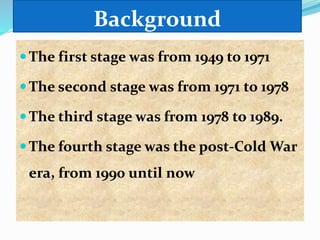
Background
The first stage was from 1949 to 1971
The second stage was from 1971 to 1978
The third stage was from 1978 to 1989.
The fourth stage was the post-Cold War
era, from 1990 until now
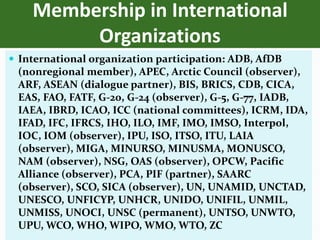
Membership in International
Organizations
 International organization participation: ADB, AfDB
(nonregional member), APEC, Arctic Council (observer),
ARF, ASEAN (dialogue partner), BIS, BRICS, CDB, CICA,
EAS, FAO, FATF, G-20, G-24 (observer), G-5, G-77, IADB,
IAEA, IBRD, ICAO, ICC (national committees), ICRM, IDA,
IFAD, IFC, IFRCS, IHO, ILO, IMF, IMO, IMSO, Interpol,
IOC, IOM (observer), IPU, ISO, ITSO, ITU, LAIA
(observer), MIGA, MINURSO, MINUSMA, MONUSCO,
NAM (observer), NSG, OAS (observer), OPCW, Pacific
Alliance (observer), PCA, PIF (partner), SAARC
(observer), SCO, SICA (observer), UN, UNAMID, UNCTAD,
UNESCO, UNFICYP, UNHCR, UNIDO, UNIFIL, UNMIL,
UNMISS, UNOCI, UNSC (permanent), UNTSO, UNWTO,
UPU, WCO, WHO, WIPO, WMO, WTO, ZC
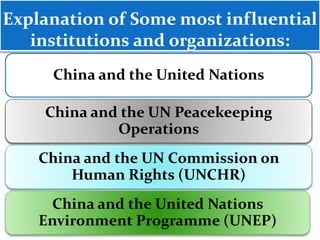
Explanation of Some most influential
institutions and organizations:
China and the United Nations
China and the UN Peacekeeping
Operations
China and the UN Commission on
Human Rights (UNCHR)
China and the United Nations
Environment Programme (UNEP)
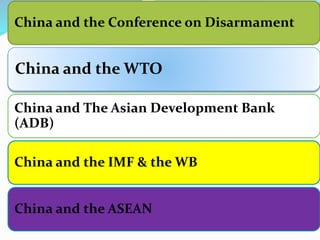
China and the Conference on Disarmament
China and the WTO
China and The Asian Development Bank
(ADB)
China and the IMF & the WB
China and the ASEAN
Ten Trends
 Greater Assertiveness, Greater Maturity
 Expanding Influence
 Broadening Sphere of Engagement
 Extreme Effectiveness
 Content to Play a “Defensive Game” (in Some
Organizations)
 Greater Engagement: a Two-Way Street
 An Impressive Ability to Learn
 An Increasingly Valuable and Constructive Participant –
in at Least Some Respects
 Ambivalence
 The Primacy of Taiwan
Two Truisms
 China’s Greatest Objective is STABILITY.
 International Organizations Do Not
Create the Prevailing World Economic or
Strategic Order – They Reflect the
Prevailing World Order.
Conclusion and Findings
 This term paper analyzed Chinese international
organizational behavior in major international
organizations and came to the conclusion that currently,
China’s behavior often appears more substantive than
symbolic.
 However, the main findings that importantly complement
this conclusion are three. First, even though the number of
global issues and international organizations was adjusted
to the limited space, the nature of China’s behavior even in
this framework is extremely complex.
Continue…….
 Second, despite being applicable only to some aspects of
China’s international organization behavior, Johnston’s
theory presents an important tool for analysis of Beijing’s
foreign policy. It reveals how participation in an
international institution might contribute to the
internalization of its norms and compliance with its values.
 Third, China’s international organization behavior does not
appear to follow one stable pattern.
 China is doing what great powers do: using hard and soft
power to further solidify its positions.
Thank You

China and international institutions

  • 2.
    Discussion Points Introduction Research Questions Background Explanationof Some most influential institutions and organizations Ten Trends Two Truisms Findings Conclusion
  • 3.
    Introduction  China isnow a global actor of significant and growing importance. It is involved in regions and on issues that were once only peripheral to its interests and it is effectively using tools previously unavailable.  China’s relationship with international organizations has experienced a process from denial to admitting, from playing common roles to striving for important positions, from highlighting domestic necessities to more concern about international image.
  • 4.
    Research Questions The studycovers a number of issues and questions surrounding China’s participation in international and regional institutions and forums. These issues and questions address the following broad themes: What is China’s posture, objectives and strategies within key international institutions, and in the context of its economic partnerships?
  • 5.
    Background The first stagewas from 1949 to 1971 The second stage was from 1971 to 1978 The third stage was from 1978 to 1989. The fourth stage was the post-Cold War era, from 1990 until now
  • 6.
    Membership in International Organizations International organization participation: ADB, AfDB (nonregional member), APEC, Arctic Council (observer), ARF, ASEAN (dialogue partner), BIS, BRICS, CDB, CICA, EAS, FAO, FATF, G-20, G-24 (observer), G-5, G-77, IADB, IAEA, IBRD, ICAO, ICC (national committees), ICRM, IDA, IFAD, IFC, IFRCS, IHO, ILO, IMF, IMO, IMSO, Interpol, IOC, IOM (observer), IPU, ISO, ITSO, ITU, LAIA (observer), MIGA, MINURSO, MINUSMA, MONUSCO, NAM (observer), NSG, OAS (observer), OPCW, Pacific Alliance (observer), PCA, PIF (partner), SAARC (observer), SCO, SICA (observer), UN, UNAMID, UNCTAD, UNESCO, UNFICYP, UNHCR, UNIDO, UNIFIL, UNMIL, UNMISS, UNOCI, UNSC (permanent), UNTSO, UNWTO, UPU, WCO, WHO, WIPO, WMO, WTO, ZC
  • 7.
    Explanation of Somemost influential institutions and organizations: China and the United Nations China and the UN Peacekeeping Operations China and the UN Commission on Human Rights (UNCHR) China and the United Nations Environment Programme (UNEP)
  • 8.
    China and theConference on Disarmament China and the WTO China and The Asian Development Bank (ADB) China and the IMF & the WB China and the ASEAN
  • 9.
    Ten Trends  GreaterAssertiveness, Greater Maturity  Expanding Influence  Broadening Sphere of Engagement  Extreme Effectiveness  Content to Play a “Defensive Game” (in Some Organizations)  Greater Engagement: a Two-Way Street  An Impressive Ability to Learn  An Increasingly Valuable and Constructive Participant – in at Least Some Respects  Ambivalence  The Primacy of Taiwan
  • 10.
    Two Truisms  China’sGreatest Objective is STABILITY.  International Organizations Do Not Create the Prevailing World Economic or Strategic Order – They Reflect the Prevailing World Order.
  • 11.
    Conclusion and Findings This term paper analyzed Chinese international organizational behavior in major international organizations and came to the conclusion that currently, China’s behavior often appears more substantive than symbolic.  However, the main findings that importantly complement this conclusion are three. First, even though the number of global issues and international organizations was adjusted to the limited space, the nature of China’s behavior even in this framework is extremely complex.
  • 12.
    Continue…….  Second, despitebeing applicable only to some aspects of China’s international organization behavior, Johnston’s theory presents an important tool for analysis of Beijing’s foreign policy. It reveals how participation in an international institution might contribute to the internalization of its norms and compliance with its values.  Third, China’s international organization behavior does not appear to follow one stable pattern.  China is doing what great powers do: using hard and soft power to further solidify its positions.
  • 13.