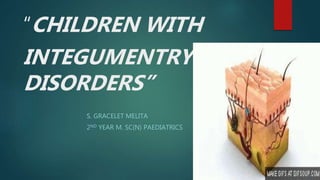
“CHILDREN WITH
INTEGUMENTRY
DISORDERS”
S. GRACELET MELITA
2ND YEAR M. SC(N) PAEDIATRICS
OVERALL OBJECTIVE:
 At the end of the class students will be able to learn
about impetigo, scabies, seborrheic dermatitis and
apply those nursing management, principles and
develop protocols in the clinical area as well.
SPECIFIC OBJECTIVE:
 Students will be able to;
 Define impetigo, scabies and seborrheic dermatitis
 Enumerate the etiology of impetigo, scabies and SD
 Describe the pathophysiology of impetigo, scabies and SD
 List the clinical features of impetigo, scabies and SD
 Discuss the nursing management of impetigo, scabies and SD
 Explain the treatment of impetigo, scabies and SD
INTRODUCTION:
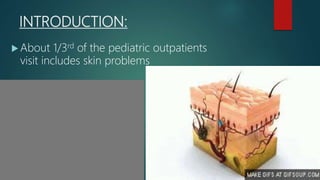
 About 1/3rd of the pediatric outpatients
visit includes skin problems
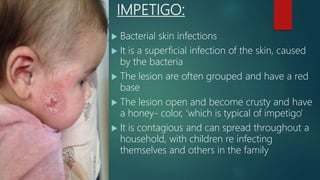
IMPETIGO:
 Bacterial skin infections
 It is a superficial infection of the skin, caused
by the bacteria
 The lesion are often grouped and have a red
base
 The lesion open and become crusty and have
a honey- color, ‘which is typical of impetigo’
 It is contagious and can spread throughout a
household, with children re infecting
themselves and others in the family
EPIDEMIOLOGY:
 Low income countries located in the tropical
regions
 162 million children globally (2017)
ETIOLOGY
 Group A beta hemolytic
streptococcus
 Staphylococcus aureus
 More common in children
 Worse by poor hygiene
 Warm temperatures
PATHOPHYSIOLOGY
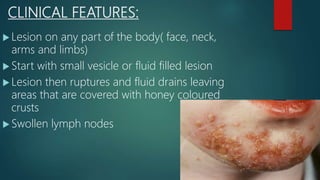
CLINICAL FEATURES:
 Lesion on any part of the body( face, neck,
arms and limbs)
 Start with small vesicle or fluid filled lesion
 Lesion then ruptures and fluid drains leaving
areas that are covered with honey coloured
crusts
 Swollen lymph nodes
DIAGNOSTIC EVALUATION:
 Complete medical history
 Physical examination
 Culture of the lesion( to confirm the
diagnosis and the type of bacteria)
MANAGEMENT:
 Children with;
many lesions- oral antibiotics
few lesion- topical antibiotics
 Bathe the child with antibacterial soap daily
 Proper handwashing technique by everyone in the
house
 Short fingernails
 Avoid sharing the garments, towels and other
household items
SCABIES:
 It is an infestation of mites
characterized by small red bumps and
intense itching
 Highly contagious infection while they
are sleeping together in the same bed
or have close personal contact
 “SARCOPTES SCABIEI”
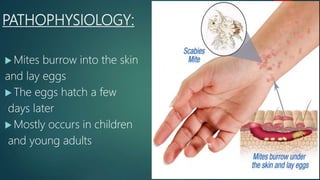
PATHOPHYSIOLOGY:
 Mites burrow into the skin
and lay eggs
 The eggs hatch a few
days later
 Mostly occurs in children
and young adults
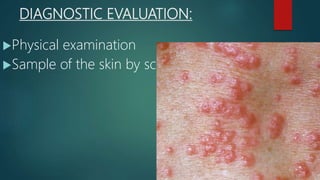
CLINICAL FEATURES:
 4 – 6 weeks to develop symptoms
 Lesion on the head, neck, palms and soles(
young children)
 Lesion on the hands, between the fingers,
wrists, belt line, thighs, belly button, groin area,
around the breasts, armpits( older children)
 Severe Itching
 red bumps
 Scaly or crusty skin
DIAGNOSTIC EVALUATION:
Physical examination
Sample of the skin by scarping
MANAGEMENT:
 TREATABLE
 Application of creams, lotions( permethrin
and lindane solutions)
 Oral antihistamines
 Topical ointments
 Wash all clothes, bedding and dry in hot
dryer.
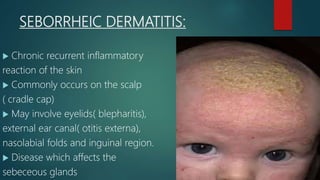
SEBORRHEIC DERMATITIS:
 Chronic recurrent inflammatory
reaction of the skin
 Commonly occurs on the scalp
( cradle cap)
 May involve eyelids( blepharitis),
external ear canal( otitis externa),
nasolabial folds and inguinal region.
 Disease which affects the
sebeceous glands
ETIOLOGY:
Unknown
Common in early infancy
Neural disease
Neuroleptic medications
Emotional stress
EPIDEMIOLOGY:
 Infants after 2 weeks
 Male> female
PATHOPHYSIOLOGY:
 Seborrheic dermatitis is associated with normal levels
of Malassezia but an abnormal immune response. Helper T cells,
phytohemagglutinin and concanavalin stimulation, and antibody
titers are depressed compared with those of control subjects.
 Zani et al report that even with antifungal treatments, there was no
reduction in levels of Malassezia. The contribution
of Malassezia species to seborrheic dermatitis may come from its
lipase activity—releasing inflammatory free fatty acids—and from its
ability to activate the alternative complement pathway.
CLINICAL FEATURES:
 Lesion( thick adherent, yellowish, scaly, oily patches,
mild pruritic)
 Dryness( sensation of tightness)
MANAGEMENT:
 Scalp hygiene
 Shampoo use
- education on demonstration
- shampoo containing sulfur and salicylic
acid
- a fine tooth comb
THEORY:
JOURNAL INFORMATION:
NURSING DIAGNOSIS
ACUTE PAIN RELATED TO INJURY TO BIOLOGICAL
AGENTS:
 analgesic administration
 Pain management( non pharmacological)
 Positioning
 Comfort measures
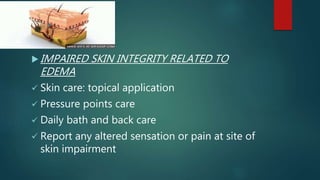
 IMPAIRED SKIN INTEGRITY RELATED TO
EDEMA
 Skin care: topical application
 Pressure points care
 Daily bath and back care
 Report any altered sensation or pain at site of
skin impairment
ACTUAL INFECTION RELATED TO ANTIGEN ANTIBODY
REACTION UNDER EPIDERMIS:
 Monitor vital signs
 Follow aseptic techniques
 Keep the Environment clean
 Change the clothing daily
DISTURBED SLEEP PATTERN RELATED TO PAIN:
 Assess the child sleep pattern
 Bed time rituals
 Provide pain relief
 Keep environment quite
DISTURBED BODY IMAGE RELATED TO
CHANGES IN THE SKIN
 Body image enhancement
 Observe the coping mechanism
 Avoid frequent history collection
 Encourage them to ventilate their
feelings
ANXIETY RELATED TO CHANGES IN HEALTH STATUS
 Allow them to ventilate their feelings
 Emotional support
 Changes in the environment and routine
 Activities
RISK FOR INFECTION RELATED TO TISSUE DAMAGE AND
INVASIVE PROCEDURES
 Monitor vital signs
 Follow proper hand washing techniques
 Keep the unit clean
 Personal hygiene
SOCIAL ISOLATION RELATED TO
CONTANGIOUS DISEASE
 Allow then to ventilate their feelings
 Play therapy
 Fine motor skills
 Parental involvement
KNOWLEDGE DEFICIT REGARDING THE
DISEASE CONDITION AND THE
PROGNOSIS
 Assess their knowledge level
 Allow them to clarify their doubts
 Simple and own language
 demonstration of the procedures
 Risk for complications related to skin
infections secondary to invasion of the
bacteria, immunogenic response
 Observe the signs of anaphylaxis, aso titres
 Throat swab
 SELF CARE DEFICT RELATED TO IGNORANCE, MATURATION PROCESS
 BATH
 Hair wash
 Scrub bath
 Topical application
 RISK FOR ALTERATION IN NUTRITION
RELATED TO IGNORANCE LACK OF DIETARY
INTAKE
 High protein with vitamins
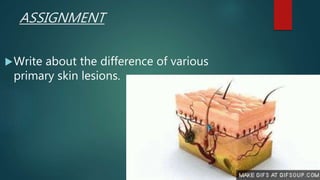
ASSIGNMENT
Write about the difference of various
primary skin lesions.
Children with integumentry disorders

Children with integumentry disorders

  • 1.
    “CHILDREN WITH INTEGUMENTRY DISORDERS” S. GRACELETMELITA 2ND YEAR M. SC(N) PAEDIATRICS
  • 2.
    OVERALL OBJECTIVE:  Atthe end of the class students will be able to learn about impetigo, scabies, seborrheic dermatitis and apply those nursing management, principles and develop protocols in the clinical area as well.
  • 3.
    SPECIFIC OBJECTIVE:  Studentswill be able to;  Define impetigo, scabies and seborrheic dermatitis  Enumerate the etiology of impetigo, scabies and SD  Describe the pathophysiology of impetigo, scabies and SD  List the clinical features of impetigo, scabies and SD  Discuss the nursing management of impetigo, scabies and SD  Explain the treatment of impetigo, scabies and SD
  • 5.
    INTRODUCTION:  About 1/3rdof the pediatric outpatients visit includes skin problems
  • 6.
    IMPETIGO:  Bacterial skininfections  It is a superficial infection of the skin, caused by the bacteria  The lesion are often grouped and have a red base  The lesion open and become crusty and have a honey- color, ‘which is typical of impetigo’  It is contagious and can spread throughout a household, with children re infecting themselves and others in the family
  • 7.
    EPIDEMIOLOGY:  Low incomecountries located in the tropical regions  162 million children globally (2017)
  • 8.
    ETIOLOGY  Group Abeta hemolytic streptococcus  Staphylococcus aureus  More common in children  Worse by poor hygiene  Warm temperatures
  • 9.
  • 10.
    CLINICAL FEATURES:  Lesionon any part of the body( face, neck, arms and limbs)  Start with small vesicle or fluid filled lesion  Lesion then ruptures and fluid drains leaving areas that are covered with honey coloured crusts  Swollen lymph nodes
  • 11.
    DIAGNOSTIC EVALUATION:  Completemedical history  Physical examination  Culture of the lesion( to confirm the diagnosis and the type of bacteria)
  • 12.
    MANAGEMENT:  Children with; manylesions- oral antibiotics few lesion- topical antibiotics  Bathe the child with antibacterial soap daily  Proper handwashing technique by everyone in the house  Short fingernails  Avoid sharing the garments, towels and other household items
  • 13.
    SCABIES:  It isan infestation of mites characterized by small red bumps and intense itching  Highly contagious infection while they are sleeping together in the same bed or have close personal contact  “SARCOPTES SCABIEI”
  • 14.
    PATHOPHYSIOLOGY:  Mites burrowinto the skin and lay eggs  The eggs hatch a few days later  Mostly occurs in children and young adults
  • 15.
    CLINICAL FEATURES:  4– 6 weeks to develop symptoms  Lesion on the head, neck, palms and soles( young children)  Lesion on the hands, between the fingers, wrists, belt line, thighs, belly button, groin area, around the breasts, armpits( older children)  Severe Itching  red bumps  Scaly or crusty skin
  • 16.
  • 17.
    MANAGEMENT:  TREATABLE  Applicationof creams, lotions( permethrin and lindane solutions)  Oral antihistamines  Topical ointments  Wash all clothes, bedding and dry in hot dryer.
  • 18.
    SEBORRHEIC DERMATITIS:  Chronicrecurrent inflammatory reaction of the skin  Commonly occurs on the scalp ( cradle cap)  May involve eyelids( blepharitis), external ear canal( otitis externa), nasolabial folds and inguinal region.  Disease which affects the sebeceous glands
  • 19.
    ETIOLOGY: Unknown Common in earlyinfancy Neural disease Neuroleptic medications Emotional stress
  • 20.
    EPIDEMIOLOGY:  Infants after2 weeks  Male> female
  • 21.
    PATHOPHYSIOLOGY:  Seborrheic dermatitisis associated with normal levels of Malassezia but an abnormal immune response. Helper T cells, phytohemagglutinin and concanavalin stimulation, and antibody titers are depressed compared with those of control subjects.  Zani et al report that even with antifungal treatments, there was no reduction in levels of Malassezia. The contribution of Malassezia species to seborrheic dermatitis may come from its lipase activity—releasing inflammatory free fatty acids—and from its ability to activate the alternative complement pathway.
  • 23.
    CLINICAL FEATURES:  Lesion(thick adherent, yellowish, scaly, oily patches, mild pruritic)  Dryness( sensation of tightness)
  • 24.
    MANAGEMENT:  Scalp hygiene Shampoo use - education on demonstration - shampoo containing sulfur and salicylic acid - a fine tooth comb
  • 25.
  • 29.
  • 30.
    NURSING DIAGNOSIS ACUTE PAINRELATED TO INJURY TO BIOLOGICAL AGENTS:  analgesic administration  Pain management( non pharmacological)  Positioning  Comfort measures
  • 31.
     IMPAIRED SKININTEGRITY RELATED TO EDEMA  Skin care: topical application  Pressure points care  Daily bath and back care  Report any altered sensation or pain at site of skin impairment
  • 32.
    ACTUAL INFECTION RELATEDTO ANTIGEN ANTIBODY REACTION UNDER EPIDERMIS:  Monitor vital signs  Follow aseptic techniques  Keep the Environment clean  Change the clothing daily
  • 33.
    DISTURBED SLEEP PATTERNRELATED TO PAIN:  Assess the child sleep pattern  Bed time rituals  Provide pain relief  Keep environment quite
  • 34.
    DISTURBED BODY IMAGERELATED TO CHANGES IN THE SKIN  Body image enhancement  Observe the coping mechanism  Avoid frequent history collection  Encourage them to ventilate their feelings
  • 35.
    ANXIETY RELATED TOCHANGES IN HEALTH STATUS  Allow them to ventilate their feelings  Emotional support  Changes in the environment and routine  Activities
  • 36.
    RISK FOR INFECTIONRELATED TO TISSUE DAMAGE AND INVASIVE PROCEDURES  Monitor vital signs  Follow proper hand washing techniques  Keep the unit clean  Personal hygiene
  • 37.
    SOCIAL ISOLATION RELATEDTO CONTANGIOUS DISEASE  Allow then to ventilate their feelings  Play therapy  Fine motor skills  Parental involvement
  • 38.
    KNOWLEDGE DEFICIT REGARDINGTHE DISEASE CONDITION AND THE PROGNOSIS  Assess their knowledge level  Allow them to clarify their doubts  Simple and own language  demonstration of the procedures
  • 39.
     Risk forcomplications related to skin infections secondary to invasion of the bacteria, immunogenic response  Observe the signs of anaphylaxis, aso titres  Throat swab
  • 40.
     SELF CAREDEFICT RELATED TO IGNORANCE, MATURATION PROCESS  BATH  Hair wash  Scrub bath  Topical application
  • 41.
     RISK FORALTERATION IN NUTRITION RELATED TO IGNORANCE LACK OF DIETARY INTAKE  High protein with vitamins
  • 42.
    ASSIGNMENT Write about thedifference of various primary skin lesions.