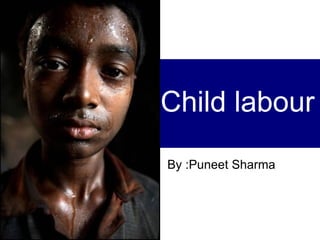
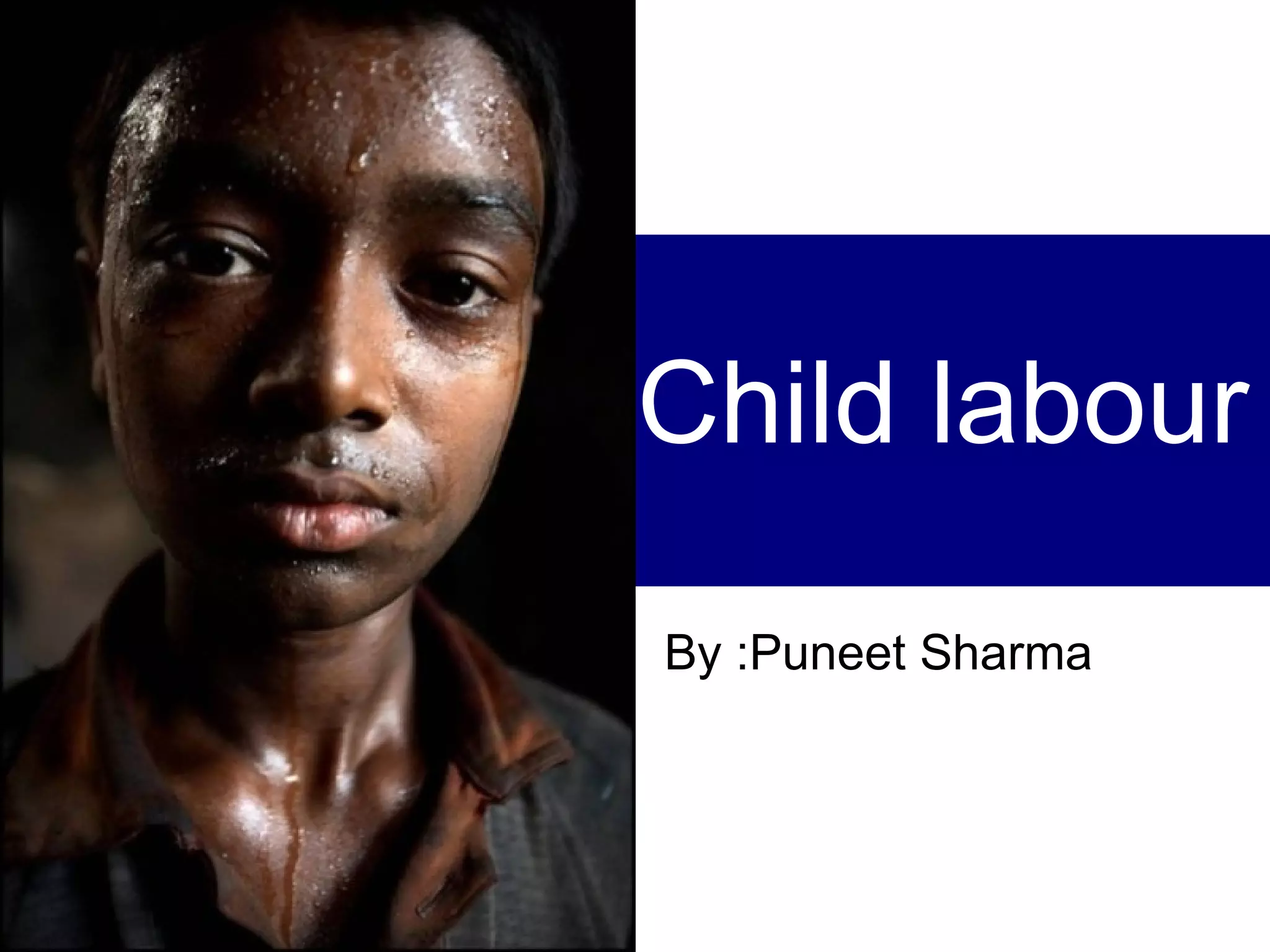




Child labour
By :Puneet Sharma
Child labour
 Child labour is not only a social
  problem but also an economic one
 A child work for fourteen hours a-day
  is what is termed as child labor.
 Child labour has a predominant feature
  in Indian society
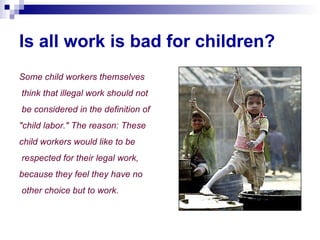
Is all work is bad for children?
Some child workers themselves
think that illegal work should not
be considered in the definition of
"child labor." The reason: These
child workers would like to be
respected for their legal work,
because they feel they have no
other choice but to work.
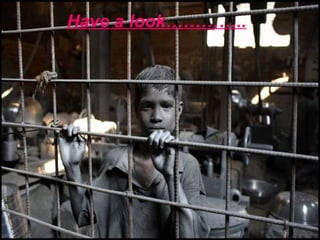
Have a look…………..
Do you really think that our
Future is safe….
A young Indian boy climbs on top of

                                        piles of teak wood in a government-run
                                         lumberyard in UP. The boy's job
                                         is to label the teak wood. The wood is
                                        common in Myanmar and is in high
                                        demand
                                         in Japan and most of Asia.


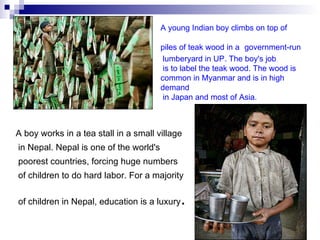
A boy works in a tea stall in a small village
in Nepal. Nepal is one of the world's
poorest countries, forcing huge numbers
of children to do hard labor. For a majority

of children in Nepal, education is a luxury   .
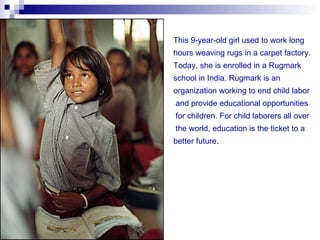
This 9-year-old girl used to work long
hours weaving rugs in a carpet factory.
Today, she is enrolled in a Rugmark
school in India. Rugmark is an
organization working to end child labor
and provide educational opportunities
for children. For child laborers all over
the world, education is the ticket to a
better future.
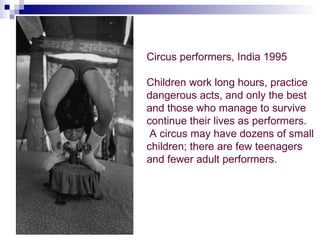
Circus performers, India 1995

Children work long hours, practice
dangerous acts, and only the best
and those who manage to survive
continue their lives as performers.
 A circus may have dozens of small
children; there are few teenagers
and fewer adult performers.
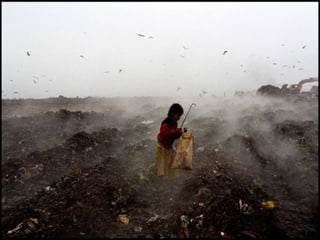
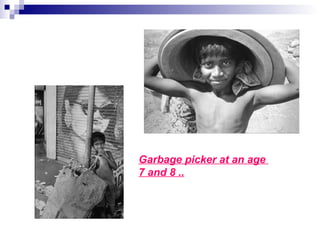
Garbage picker at an age
7 and 8 ..
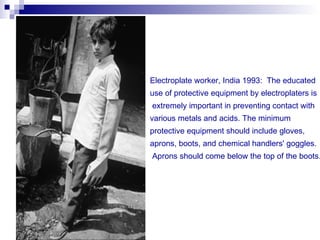
Electroplate worker, India 1993: The educated
use of protective equipment by electroplaters is
extremely important in preventing contact with
various metals and acids. The minimum
protective equipment should include gloves,
aprons, boots, and chemical handlers' goggles.
Aprons should come below the top of the boots.
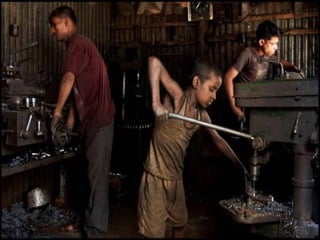
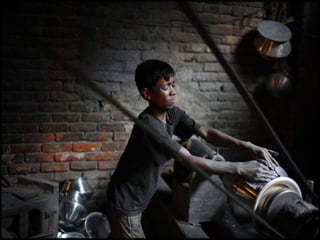
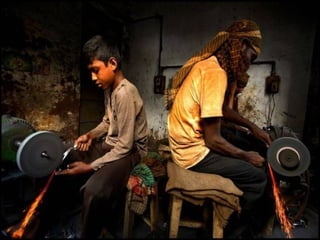
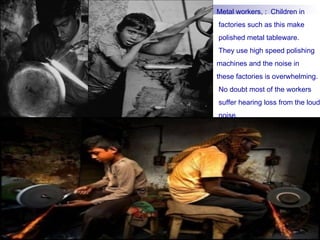
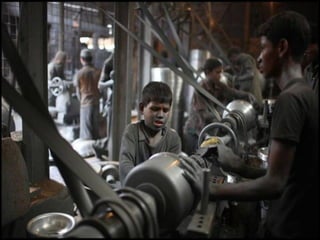
Metal workers, : Children in
factories such as this make
polished metal tableware.
They use high speed polishing
machines and the noise in
these factories is overwhelming.
No doubt most of the workers
suffer hearing loss from the loud
noise.
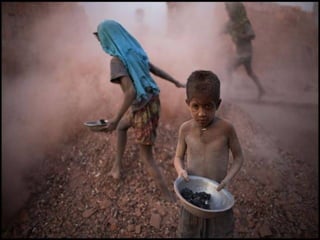
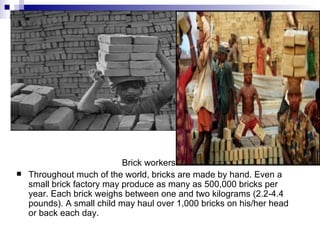
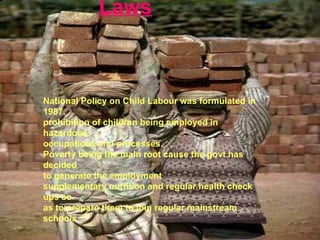
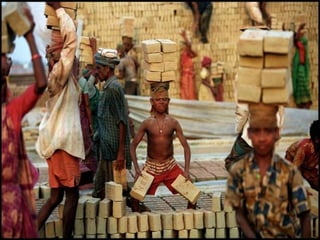
Brick workers
   Throughout much of the world, bricks are made by hand. Even a
    small brick factory may produce as many as 500,000 bricks per
    year. Each brick weighs between one and two kilograms (2.2-4.4
    pounds). A small child may haul over 1,000 bricks on his/her head
    or back each day.
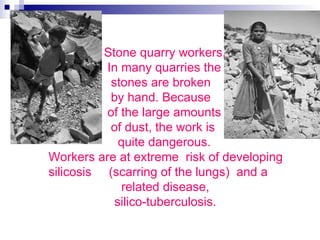
Stone quarry workers,
          In many quarries the
           stones are broken
           by hand. Because
          of the large amounts
           of dust, the work is
             quite dangerous.
Workers are at extreme risk of developing
silicosis (scarring of the lungs) and a
              related disease,
            silico-tuberculosis.
   .
.


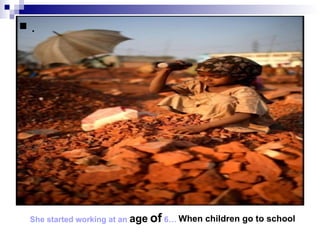
    She started working at an age of 6… When children go to school
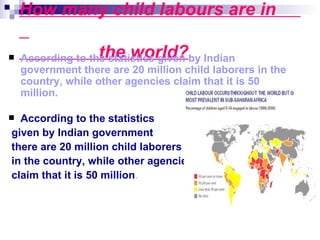
How many child labours are in

                  the world?
    According to the statistics given by Indian
    government there are 20 million child laborers in the
    country, while other agencies claim that it is 50
    million.

 According to the statistics
given by Indian government
there are 20 million child laborers
in the country, while other agencies
claim that it is 50 million.
Causes of child labour

 Poverty
 Over population
 Illiteracy
 Urbanization
 Orphans
 Unemployment of elders


                    Cont…………..
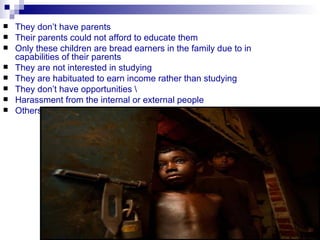
   They don’t have parents
   Their parents could not afford to educate them
   Only these children are bread earners in the family due to in
    capabilities of their parents
   They are not interested in studying
   They are habituated to earn income rather than studying
   They don’t have opportunities 
   Harassment from the internal or external people
   Others
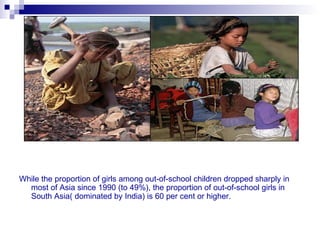
While the proportion of girls among out-of-school children dropped sharply in
  most of Asia since 1990 (to 49%), the proportion of out-of-school girls in
  South Asia( dominated by India) is 60 per cent or higher.
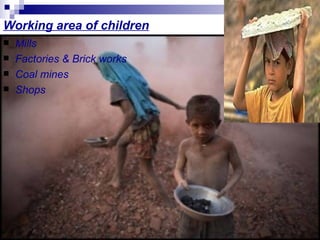
Working area of children
   Mills
   Factories & Brick works
   Coal mines
   Shops
Laws


National Policy on Child Labour was formulated in
1987.
prohibition of children being employed in
hazardous
occupations and processes.
Poverty being the main root cause the govt has
decided
to generate the employment
supplementary nutrition and regular health check
ups so
as to prepare them to join regular mainstream
schools
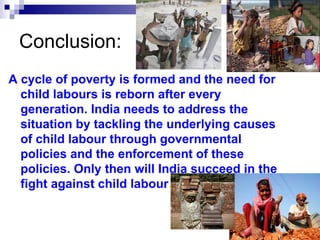
Conclusion:
A cycle of poverty is formed and the need for
  child labours is reborn after every
  generation. India needs to address the
  situation by tackling the underlying causes
  of child labour through governmental
  policies and the enforcement of these
  policies. Only then will India succeed in the
  fight against child labour.
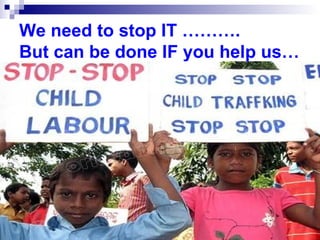
We need to stop IT ……….
But can be done IF you help us…
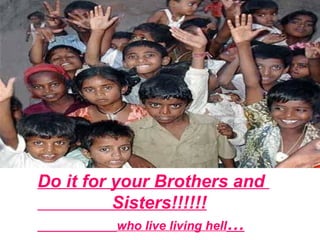
Do it for your Brothers and
          Sisters!!!!!!
           who live living hell…
m
Child labour
Child labour
Child labour
Child labour

Child labour

  • 1.
  • 2.
    Child labour  Childlabour is not only a social problem but also an economic one  A child work for fourteen hours a-day is what is termed as child labor.  Child labour has a predominant feature in Indian society
  • 3.
    Is all workis bad for children? Some child workers themselves think that illegal work should not be considered in the definition of "child labor." The reason: These child workers would like to be respected for their legal work, because they feel they have no other choice but to work.
  • 4.
  • 11.
    Do you reallythink that our Future is safe….
  • 12.
    A young Indianboy climbs on top of piles of teak wood in a government-run lumberyard in UP. The boy's job is to label the teak wood. The wood is common in Myanmar and is in high demand in Japan and most of Asia. A boy works in a tea stall in a small village in Nepal. Nepal is one of the world's poorest countries, forcing huge numbers of children to do hard labor. For a majority of children in Nepal, education is a luxury .
  • 13.
    This 9-year-old girlused to work long hours weaving rugs in a carpet factory. Today, she is enrolled in a Rugmark school in India. Rugmark is an organization working to end child labor and provide educational opportunities for children. For child laborers all over the world, education is the ticket to a better future.
  • 14.
    Circus performers, India1995 Children work long hours, practice dangerous acts, and only the best and those who manage to survive continue their lives as performers. A circus may have dozens of small children; there are few teenagers and fewer adult performers.
  • 15.
    Garbage picker atan age 7 and 8 ..
  • 16.
    Electroplate worker, India1993: The educated use of protective equipment by electroplaters is extremely important in preventing contact with various metals and acids. The minimum protective equipment should include gloves, aprons, boots, and chemical handlers' goggles. Aprons should come below the top of the boots.
  • 17.
    Metal workers, :Children in factories such as this make polished metal tableware. They use high speed polishing machines and the noise in these factories is overwhelming. No doubt most of the workers suffer hearing loss from the loud noise.
  • 18.
    Brick workers  Throughout much of the world, bricks are made by hand. Even a small brick factory may produce as many as 500,000 bricks per year. Each brick weighs between one and two kilograms (2.2-4.4 pounds). A small child may haul over 1,000 bricks on his/her head or back each day.
  • 19.
    Stone quarry workers, In many quarries the stones are broken by hand. Because of the large amounts of dust, the work is quite dangerous. Workers are at extreme risk of developing silicosis (scarring of the lungs) and a related disease, silico-tuberculosis.
  • 20.
    . . She started working at an age of 6… When children go to school
  • 21.
    How many childlabours are in  the world? According to the statistics given by Indian government there are 20 million child laborers in the country, while other agencies claim that it is 50 million.  According to the statistics given by Indian government there are 20 million child laborers in the country, while other agencies claim that it is 50 million.
  • 22.
    Causes of childlabour  Poverty  Over population  Illiteracy  Urbanization  Orphans  Unemployment of elders Cont…………..
  • 23.
    They don’t have parents  Their parents could not afford to educate them  Only these children are bread earners in the family due to in capabilities of their parents  They are not interested in studying  They are habituated to earn income rather than studying  They don’t have opportunities  Harassment from the internal or external people  Others
  • 24.
    While the proportionof girls among out-of-school children dropped sharply in most of Asia since 1990 (to 49%), the proportion of out-of-school girls in South Asia( dominated by India) is 60 per cent or higher.
  • 25.
    Working area ofchildren  Mills  Factories & Brick works  Coal mines  Shops
  • 26.
    Laws National Policy onChild Labour was formulated in 1987. prohibition of children being employed in hazardous occupations and processes. Poverty being the main root cause the govt has decided to generate the employment supplementary nutrition and regular health check ups so as to prepare them to join regular mainstream schools
  • 27.
    Conclusion: A cycle ofpoverty is formed and the need for child labours is reborn after every generation. India needs to address the situation by tackling the underlying causes of child labour through governmental policies and the enforcement of these policies. Only then will India succeed in the fight against child labour.
  • 28.
    We need tostop IT ………. But can be done IF you help us…
  • 29.
    Do it foryour Brothers and Sisters!!!!!! who live living hell…
  • 30.