CHILD LABOUR IN INDIA
CHILD LABOUR
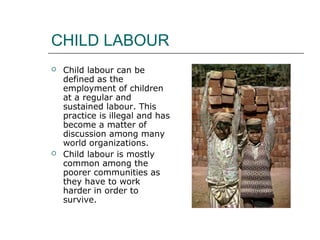
 Child labour can be
defined as the
employment of children
at a regular and
sustained labour. This
practice is illegal and has
become a matter of
discussion among many
world organizations.
 Child labour is mostly
common among the
poorer communities as
they have to work
harder in order to
survive.
CAUSES CHILD LABOUR IN
INDIA
 Poverty and high unemployment.
 Free education is limited forcing
children to work at an early age.
 Over population.
 Urbanization: movement of people
from rural areas to big cities.
 Illiteracy
Poverty and High Unemployment
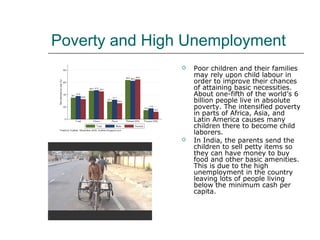
 Poor children and their families
may rely upon child labour in
order to improve their chances
of attaining basic necessities.
About one-fifth of the world’s 6
billion people live in absolute
poverty. The intensified poverty
in parts of Africa, Asia, and
Latin America causes many
children there to become child
laborers.
 In India, the parents send the
children to sell petty items so
they can have money to buy
food and other basic amenities.
This is due to the high
unemployment in the country
leaving lots of people living
below the minimum cash per
capita.
Limited Education
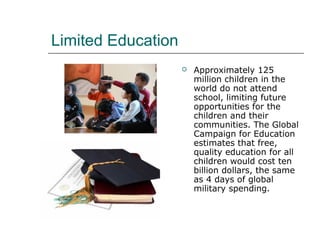
 Approximately 125
million children in the
world do not attend
school, limiting future
opportunities for the
children and their
communities. The Global
Campaign for Education
estimates that free,
quality education for all
children would cost ten
billion dollars, the same
as 4 days of global
military spending.
Over Population
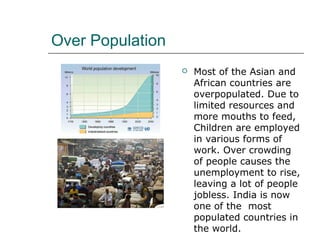
 Most of the Asian and
African countries are
overpopulated. Due to
limited resources and
more mouths to feed,
Children are employed
in various forms of
work. Over crowding
of people causes the
unemployment to rise,
leaving a lot of people
jobless. India is now
one of the most
populated countries in
the world.
Urbanization
 The Industrial
Revolution has its own
negative side. Many a
time companies and
export industries in
the developing world
employ child workers,
particularly in the
garment industry.
They move from the
rural areas to the
urban cities
illiteracy
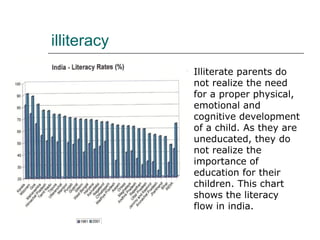
 Illiterate parents do
not realize the need
for a proper physical,
emotional and
cognitive development
of a child. As they are
uneducated, they do
not realize the
importance of
education for their
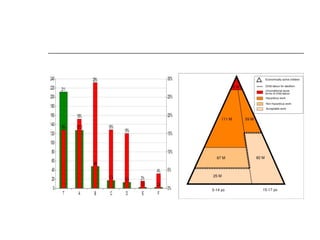
children. This chart
shows the literacy
flow in india.
EFFECTS
 Child labour directly
affects the future of the
country,destroying the
capabilities of the
youths in
india,depriving them on
pursueing thier dreams
of being professionals
such as
architects,doctors and
even professional
cricket players as it is
known cricket is very
important in india.
 Child labour also
exposes children to
physical and mental
hazards endangering
their lives. This in turn
affects thier life
morally.it makes the
child develop mentally
fast which is a
dangerous sign for
youths. This can lead
them to becoming
gangsters and bad
people of the society.
EFFECTS
 Child labour also
creates and
perpetuate poverty
because the
earnings are not
substantial to
sustain or be used
as capital for other
business
oppotunities.
 It condemns a child of
a good
childhood.depriving
him many services in
the society as well as
depriving him from
being
educated.instead,waste
s valuable time being
unskilled and badly
paid attimes tortured
too.
REACTIONS
 Child labor is recognised world wide
and alot of world organisations have
stuck their necks out to stop this
bad practice. Some papers have
labelled it the slavery of the modern
age. Such organisations are
 UNICEF
 ILO
 NCRC
 WFCLC
CONCLUSION
 The social malady of child labor can be
brought under control, if each individual
takes responsibility of reporting about
anyone employing a child below the age
of 14years.
 Thus, instead of ignoring on should find
out about reporting child labor and how
such children can actually be saved.
 Child labor can be controlled if the
government functions effectively with
the support of the public.
Child labour

Child labour

  • 1.
  • 2.
    CHILD LABOUR  Childlabour can be defined as the employment of children at a regular and sustained labour. This practice is illegal and has become a matter of discussion among many world organizations.  Child labour is mostly common among the poorer communities as they have to work harder in order to survive.
  • 3.
    CAUSES CHILD LABOURIN INDIA  Poverty and high unemployment.  Free education is limited forcing children to work at an early age.  Over population.  Urbanization: movement of people from rural areas to big cities.  Illiteracy
  • 5.
    Poverty and HighUnemployment  Poor children and their families may rely upon child labour in order to improve their chances of attaining basic necessities. About one-fifth of the world’s 6 billion people live in absolute poverty. The intensified poverty in parts of Africa, Asia, and Latin America causes many children there to become child laborers.  In India, the parents send the children to sell petty items so they can have money to buy food and other basic amenities. This is due to the high unemployment in the country leaving lots of people living below the minimum cash per capita.
  • 6.
    Limited Education  Approximately125 million children in the world do not attend school, limiting future opportunities for the children and their communities. The Global Campaign for Education estimates that free, quality education for all children would cost ten billion dollars, the same as 4 days of global military spending.
  • 7.
    Over Population  Mostof the Asian and African countries are overpopulated. Due to limited resources and more mouths to feed, Children are employed in various forms of work. Over crowding of people causes the unemployment to rise, leaving a lot of people jobless. India is now one of the most populated countries in the world.
  • 8.
    Urbanization  The Industrial Revolutionhas its own negative side. Many a time companies and export industries in the developing world employ child workers, particularly in the garment industry. They move from the rural areas to the urban cities
  • 9.
    illiteracy  Illiterate parentsdo not realize the need for a proper physical, emotional and cognitive development of a child. As they are uneducated, they do not realize the importance of education for their children. This chart shows the literacy flow in india.
  • 10.
    EFFECTS  Child labourdirectly affects the future of the country,destroying the capabilities of the youths in india,depriving them on pursueing thier dreams of being professionals such as architects,doctors and even professional cricket players as it is known cricket is very important in india.  Child labour also exposes children to physical and mental hazards endangering their lives. This in turn affects thier life morally.it makes the child develop mentally fast which is a dangerous sign for youths. This can lead them to becoming gangsters and bad people of the society.
  • 11.
    EFFECTS  Child labouralso creates and perpetuate poverty because the earnings are not substantial to sustain or be used as capital for other business oppotunities.  It condemns a child of a good childhood.depriving him many services in the society as well as depriving him from being educated.instead,waste s valuable time being unskilled and badly paid attimes tortured too.
  • 12.
    REACTIONS  Child laboris recognised world wide and alot of world organisations have stuck their necks out to stop this bad practice. Some papers have labelled it the slavery of the modern age. Such organisations are  UNICEF  ILO  NCRC  WFCLC
  • 13.
    CONCLUSION  The socialmalady of child labor can be brought under control, if each individual takes responsibility of reporting about anyone employing a child below the age of 14years.  Thus, instead of ignoring on should find out about reporting child labor and how such children can actually be saved.  Child labor can be controlled if the government functions effectively with the support of the public.