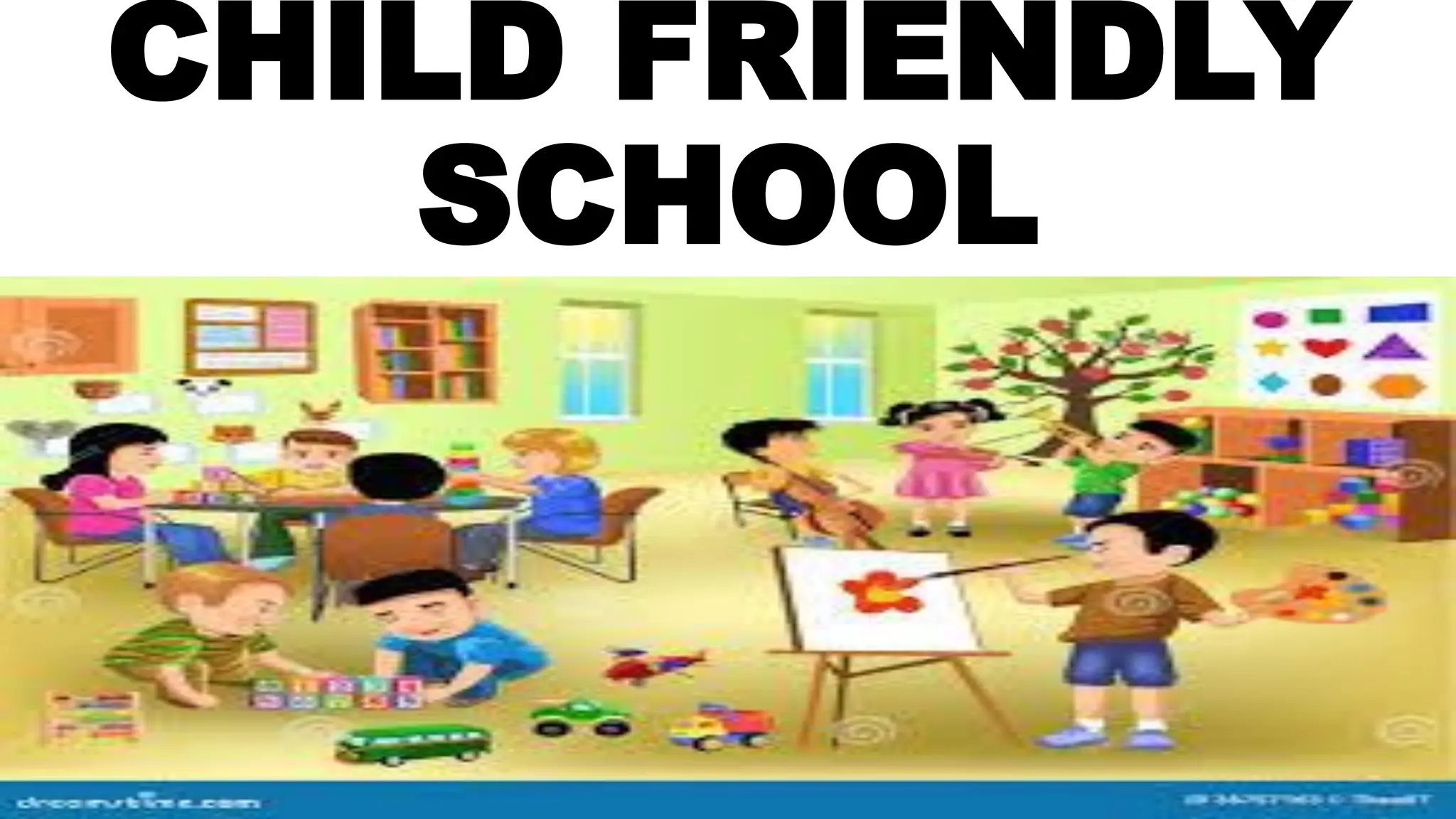
CHILD FRIENDLY
SCHOOL
MEET THE FACILITATOR
RASHEED, Oluwasegun Kazeem Ph.D
(+234)-8051700164, (+234)-7066867887
kazeemrasheed1440@gmail.com
MNAEAP, EMPM, MNIM, MTRCN, MACSN, CT, Dip. Digital Mkt., CEAF,
CME, W10FE, CMIE, FMIE, MAPROCON, AMIBRN, MCIEMA (USA)
Lead Principal Facilitator at HEED – A - DINK CONSULT
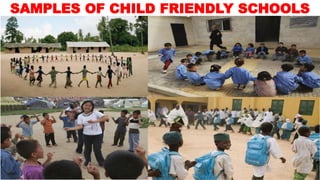
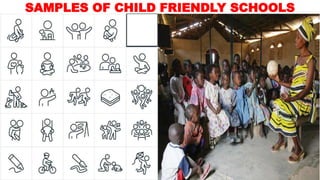
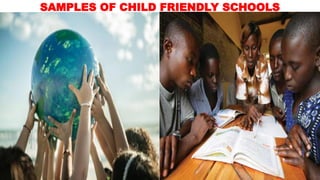
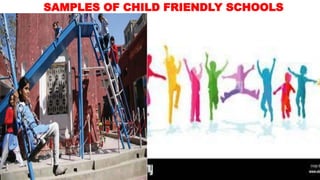
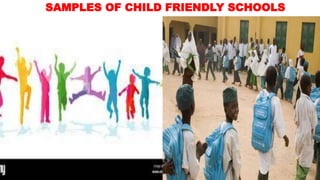
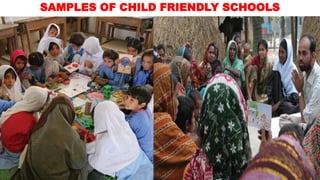
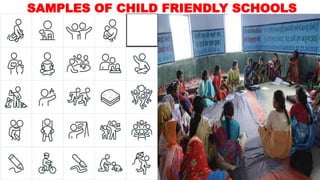
SAMPLES OF CHILD FRIENDLY SCHOOLS
INTRODUCTION
Childhood is an exclusionary status, in that, children are under the jurisdiction of
their parents. Their subordinate position is also evident in their interaction with
adults. A child is expected to be deferential and obedient by nature. In an
attempt to teach children, there is need to know them and know much about
how they behave especially in this fast growing century.
CHILDREN ARE LIKE
 PLANT
BUILDING
COMPUTER
BOOK AND PEN
VEHICLE
WHAT DO YOU KNOW ABOUT CHILDREN?
Here are some tips on how to know them better;
•Children learn through tears and drama
•Teaching children is best taught through mother’s tongue. It is only in developing
countries like ours that children learn through foreign languages
•The school should be made a house of joy for children
•Children need to be guided on how to use their reasoning in making decisions
•Play meaningfully with them to get them involved
•Reward and punishment is necessary when raising children (using stick and carrot
approach)
•Curiosity is natural with children hence; teachers should not discourage the children
while asking questions
•Children should never be taken as adult hence; they should be treated as they are
WHAT DO YOU KNOW ABOUT CHILDREN?
•Children education is based on interest and needs. Hence, teacher should make
teaching friendly
•Each child is a unique individual with his own needs, interest and background.
Therefore, respect children.
•Children love drama and emulation. Therefore, teacher should teach by example
•Children should not be exposed to hard task beyond their capacity, rather start
with the simplest
•Complete education of children must combine the hands (crafting) the brain
(quantitative reasoning) and the heart (reflection)
•Help children to unfold their hidden talent
•Involve children in teaching and learning process to enhance quick assimilation
•Teacher should not be statue where children learn rather, teacher should be
dynamic
WHAT IS A SCHOOL?
School is an institution devoted primarily to imparting
knowledge or developing certain skills.
It is a place where instructions are given.
It is a place where mutual interactions and understanding
is achieved.
The Child-Friendly School Initiative was launched in
Nigeria in 2002, with the goal of creating 600 child
friendly schools by 2007 all over the country being the
first phase after which the second would be launched
WHAT LEARNERS WANT IN A SCHOOL
Where there are learners, there should also be teachers who care for children,
provide for their learning needs, and nurture their interests.
The physical school – the school building and its facilities – classrooms, gymnasium
or activity area, grounds for young children to thrill and play, toilet facilities,
drinking fountains, and the like.
The learning environment more than just the sum total of all things – people
(learners and teachers) around them.
A healthy learning environment not only enhances the child’s academic
achievement but also ensures his or her physical, psychological, social, and
emotional growth.
WHO SHOULD PROVIDE THE LEARNING ENVIRONMENT?
SCHOOL HEADS
TEACHERS
PARENTS AND FAMILIES
COMMUNITY INSTITUTIONS
OTHER COMMUNITY MEMBERS AND
THE LEARNERS THEMSELVES SUPPORTING EACH OTHER
WHEN CAN A SCHOOL BE CALLED A CHILD-FRIENDLY SCHOOL?
A child-friendly school is more than just a place for formal learning. Foremost, it
is an institution that recognizes and respects the rights of children, and not just
their right to be educated but rights to be healthy, to be given opportunities for
play and leisure, to be protected from harm and abuse, to express their views
freely, and to participate in decision-making according to their evolving
capacities.
HOW CAN OUR SCHOOL BECOME A CHILD FRIENDLY SCHOOL
THE TRAITS OF CHILD FRIENDLY SCHOOL
1. A child-friendly school is inclusive, gender-
sensitive, and non- discriminating.
• It is said to be inclusive, gender-sensitive, and
non- discriminating
•Gives boys and girls equal learning
opportunities
• Treats all children equally, regardless of gender,
social status, cultural origin or religious belief.
HOW CAN OUR SCHOOL BECOME A CHILD FRIENDLY SCHOOL
THE TRAITS OF CHILD FRIENDLY SCHOOL
2. It is child-centered
• Has the best interest of the child in mind in all its learning activities
• Has a curriculum that addresses the child’s learning needs
• Employs teaching methods that are suited to the child’s age,
abilities, and ways of learning
• Encourages children to think and decide for themselves, ask
questions, and express their opinions
• Makes sure that children master the basic skills of writing, reading,
speaking (and listening), mathematics, and the necessary skills that
they can use.
HOW CAN OUR SCHOOL BECOME A CHILD FRIENDLY SCHOOL
THE TRAITS OF CHILD FRIENDLY SCHOOL
3. It is healthy for children. . .
• Promotes children’s health
• Guarantees that school buildings, grounds, and facilities are safe,
clean, healthy, and with adequate water and sanitary facilities
• Has written policies and regular practices that promote good
health
• Integrates health education and life skill development in its
curriculum
• Hosts regular health services for children
HOW CAN OUR SCHOOL BECOME A CHILD FRIENDLY SCHOOL
THE TRAITS OF CHILD FRIENDLY SCHOOL
4. Caring and protective of all children
• Safeguards and provides security for children
• Helps defend and protect children from harm and
abuse
• Encourages children to care for each other
• Does not tolerate physical punishment on children
• Has clear guidelines for conduct between students and
•Does not allow bullying for the students.
HOW CAN OUR SCHOOL BECOME A CHILD FRIENDLY SCHOOL
THE TRAITS OF CHILD FRIENDLY SCHOOL
5. Involves children’s families on issues concerning them
• Works closely with children’s families
• Consults parents and invites their opinions regarding school policies and
activities
• Holds regular dialogues with parents regarding their children’s learning
progress
• Collaborates with parents to encourage their children to practice at home what
they are learning in school
• Cares as much as parents that children get enough nutrition and are in good
health
• Cares about the children’s safety not only within the school premises but also
on their way to and from school
HOW OUR SCHOOL CAN ACHIEVE CFS?
ENCOURAGE CHILDREN’S PARTICIPATION IN CLASS WORK
PROMOTING CHILDREN’S HEALTH AND WELL-BEING
GUARANTEE SAFE AND PROTECTIVE SPACES FOR CHILDREN
ENCOURAGE CHILDREN’S COMPLETION OF TASK
ENSURE CHILDREN’S HIGH ACADEMIC ACHIEVEMENT AND SUCCESS
RAISE TEACHERS’ MORALE AND MOTIVATION TO TRAIN STUDENTS
MOBILIZE COMMUNITY SUPPORT FOR CHILDREN’S EDUCATION
United Nations Convention on the Rights of the Child
ratification and accession by General Assembly
1. Each child within jurisdiction has without discrimination of any kind,
irrespective of the child's or his or her parent's or legal guardian's race, colour,
sex, language, religion, political or other opinion, national, ethnic or social origin,
property, disability, birth or other status;
2. Child is protected against all forms of discrimination or punishment on the
basis of the status;
3. In all actions concerning children, whether undertaken by public or private
social welfare institutions, courts of law, administrative authorities or legislative
bodies, the best interests of the child shall be a primary consideration;
4. It should be ensured that the institutions, services and facilities responsible for
the care or protection of children shall conform with the standards established
by competent authorities, particularly in the areas of safety, health, in the
number and suitability of their staff, as well as competent supervision;
5. Possible measure for the survival and development of the child;
6. The child shall be registered immediately after birth and shall have the right
from birth to a name, the right to acquire a nationality and. as far as possible, the
right to know and be cared for by his or her parents;
7. Respect the right of the child to preserve his or her identity, including
nationality, name and family relations as recognized by law without unlawful
interference;
8. A child shall not be separated from his or her parents against their will, except when
competent authorities subject to judicial review determine, in accordance with
applicable law and procedures, that such separation is necessary for the best interests
of the child;
9. Honour is to be given to a child who is capable of forming his or her own views the
right to express those views freely in all matters affecting the child, the views of the
child being given due weight in accordance with the age and maturity of the child;
10. A child shall has the right to freedom of expression; this right shall include freedom
to seek, receive and impart information and ideas of all kinds, regardless of frontiers,
either orally, in writing or in print, in the form of art, or through any other media of the
child's choice;
11. Respect the right of the child to freedom of thought, conscience and religion,
freedom of association and to freedom of peaceful assembly;
12. A child has access to information and material from a diversity of national
and international sources, especially those aimed at the promotion of his or her
social, spiritual and moral well-being and physical and mental health;
13. It is encouraged to produce of children's books attractively and pursuant of
good image to enhance their sight;
14. Right of a child to be protected from all forms of physical or mental violence,
injury or abuse, neglect or negligent treatment, maltreatment or exploitation,
including sexual abuse;
15. A child is entitled to special protection , assistance, recognize and/or permit
the system of adoption shall ensure that the best interests of the child shall be
the paramount consideration;
16. A child who is seeking refugee status or who is considered a refugee in
accordance with applicable international or domestic law and procedures shall,
receive appropriate protection and humanitarian assistance in the enjoyment of
applicable rights;
17. A mentally or physically disabled child should enjoy a full and decent life, in
conditions which ensure dignity, promote self-reliance and facilitate the child's
active participation in the community;
18. Recognize the right of the child to the enjoyment of the highest attainable
standard of health and to facilities for the treatment of illness and rehabilitation of
health. Ensure that no child is deprived of his or her right of access to such health
care services;
19. Periodic review of the treatment provided to the child and all other
circumstances relevant to his or her placement;
20. Recognize the right of the child to education, and with a view to achieving this right
progressively and on the basis of equal opportunity, they shall, in particular:
• Make primary education compulsory and available free to all;
• Encourage the development of different forms of secondary education, including general and
vocational education, make them available and accessible to every child, and take appropriate
measures such as the introduction of free education and offering financial assistance in case of
need;
• Make higher education accessible to all on the basis of capacity by every appropriate means;
• Make educational and vocational information and guidance available and accessible to all
children;
• Take measures to encourage regular attendance at schools and the reduction of drop-out rates.
21. The development of the child's personality, talents and mental and physical abilities
to their fullest Potential;
22. Recognize the right of the child to rest and leisure, to engage in play and
recreational activities appropriate to the age of the child and to participate freely in
cultural life and the arts;
23. Recognize the right of the child to be protected from economic exploitation and
from performing any work that is likely to be hazardous or to interfere with the child's
education, or to be harmful to the child's health or physical, mental, spiritual, moral or
social development;
24. Right to protect children from the illicit use of narcotic drugs and psychotropic
substances as defined in the relevant international treaties, and to prevent the use of
children in the illicit production and trafficking of such substances;
25. Prevent the abduction of, the sale of or traffic in children for any purpose or in any
form;
26. No child shall be subjected to torture or other cruel, inhuman or degrading
treatment or punishment. Neither capital punishment nor life imprisonment without
possibility of release shall be imposed for offences committed by persons below
eighteen years of age;
27. No child shall be deprived of his or her liberty unlawfully or
arbitrarily;
28. Every child deprived of his or her liberty shall have the right to
prompt access to legal and other appropriate assistance, as well as the
right to challenge the legality of the deprivation of his or her liberty
before a court or other competent, independent and impartial
authority, and to a prompt decision on any such action;
29. No child is to be compelled to give testimony or to confess or guilt
innocent until proven guilty according to law;
30. A child is to have his or her privacy fully respected at all levels.
Question and Answer

CHILD FRIENDLY SCHOOL for school growths

  • 1.
  • 2.
    MEET THE FACILITATOR RASHEED,Oluwasegun Kazeem Ph.D (+234)-8051700164, (+234)-7066867887 kazeemrasheed1440@gmail.com MNAEAP, EMPM, MNIM, MTRCN, MACSN, CT, Dip. Digital Mkt., CEAF, CME, W10FE, CMIE, FMIE, MAPROCON, AMIBRN, MCIEMA (USA) Lead Principal Facilitator at HEED – A - DINK CONSULT
  • 3.
    SAMPLES OF CHILDFRIENDLY SCHOOLS
  • 4.
    SAMPLES OF CHILDFRIENDLY SCHOOLS
  • 5.
    SAMPLES OF CHILDFRIENDLY SCHOOLS
  • 6.
    SAMPLES OF CHILDFRIENDLY SCHOOLS
  • 7.
    SAMPLES OF CHILDFRIENDLY SCHOOLS
  • 8.
    SAMPLES OF CHILDFRIENDLY SCHOOLS
  • 9.
    SAMPLES OF CHILDFRIENDLY SCHOOLS
  • 10.
    INTRODUCTION Childhood is anexclusionary status, in that, children are under the jurisdiction of their parents. Their subordinate position is also evident in their interaction with adults. A child is expected to be deferential and obedient by nature. In an attempt to teach children, there is need to know them and know much about how they behave especially in this fast growing century. CHILDREN ARE LIKE  PLANT BUILDING COMPUTER BOOK AND PEN VEHICLE
  • 11.
    WHAT DO YOUKNOW ABOUT CHILDREN? Here are some tips on how to know them better; •Children learn through tears and drama •Teaching children is best taught through mother’s tongue. It is only in developing countries like ours that children learn through foreign languages •The school should be made a house of joy for children •Children need to be guided on how to use their reasoning in making decisions •Play meaningfully with them to get them involved •Reward and punishment is necessary when raising children (using stick and carrot approach) •Curiosity is natural with children hence; teachers should not discourage the children while asking questions •Children should never be taken as adult hence; they should be treated as they are
  • 12.
    WHAT DO YOUKNOW ABOUT CHILDREN? •Children education is based on interest and needs. Hence, teacher should make teaching friendly •Each child is a unique individual with his own needs, interest and background. Therefore, respect children. •Children love drama and emulation. Therefore, teacher should teach by example •Children should not be exposed to hard task beyond their capacity, rather start with the simplest •Complete education of children must combine the hands (crafting) the brain (quantitative reasoning) and the heart (reflection) •Help children to unfold their hidden talent •Involve children in teaching and learning process to enhance quick assimilation •Teacher should not be statue where children learn rather, teacher should be dynamic
  • 13.
    WHAT IS ASCHOOL? School is an institution devoted primarily to imparting knowledge or developing certain skills. It is a place where instructions are given. It is a place where mutual interactions and understanding is achieved. The Child-Friendly School Initiative was launched in Nigeria in 2002, with the goal of creating 600 child friendly schools by 2007 all over the country being the first phase after which the second would be launched
  • 14.
    WHAT LEARNERS WANTIN A SCHOOL Where there are learners, there should also be teachers who care for children, provide for their learning needs, and nurture their interests. The physical school – the school building and its facilities – classrooms, gymnasium or activity area, grounds for young children to thrill and play, toilet facilities, drinking fountains, and the like. The learning environment more than just the sum total of all things – people (learners and teachers) around them. A healthy learning environment not only enhances the child’s academic achievement but also ensures his or her physical, psychological, social, and emotional growth.
  • 15.
    WHO SHOULD PROVIDETHE LEARNING ENVIRONMENT? SCHOOL HEADS TEACHERS PARENTS AND FAMILIES COMMUNITY INSTITUTIONS OTHER COMMUNITY MEMBERS AND THE LEARNERS THEMSELVES SUPPORTING EACH OTHER
  • 16.
    WHEN CAN ASCHOOL BE CALLED A CHILD-FRIENDLY SCHOOL? A child-friendly school is more than just a place for formal learning. Foremost, it is an institution that recognizes and respects the rights of children, and not just their right to be educated but rights to be healthy, to be given opportunities for play and leisure, to be protected from harm and abuse, to express their views freely, and to participate in decision-making according to their evolving capacities.
  • 17.
    HOW CAN OURSCHOOL BECOME A CHILD FRIENDLY SCHOOL THE TRAITS OF CHILD FRIENDLY SCHOOL 1. A child-friendly school is inclusive, gender- sensitive, and non- discriminating. • It is said to be inclusive, gender-sensitive, and non- discriminating •Gives boys and girls equal learning opportunities • Treats all children equally, regardless of gender, social status, cultural origin or religious belief.
  • 18.
    HOW CAN OURSCHOOL BECOME A CHILD FRIENDLY SCHOOL THE TRAITS OF CHILD FRIENDLY SCHOOL 2. It is child-centered • Has the best interest of the child in mind in all its learning activities • Has a curriculum that addresses the child’s learning needs • Employs teaching methods that are suited to the child’s age, abilities, and ways of learning • Encourages children to think and decide for themselves, ask questions, and express their opinions • Makes sure that children master the basic skills of writing, reading, speaking (and listening), mathematics, and the necessary skills that they can use.
  • 19.
    HOW CAN OURSCHOOL BECOME A CHILD FRIENDLY SCHOOL THE TRAITS OF CHILD FRIENDLY SCHOOL 3. It is healthy for children. . . • Promotes children’s health • Guarantees that school buildings, grounds, and facilities are safe, clean, healthy, and with adequate water and sanitary facilities • Has written policies and regular practices that promote good health • Integrates health education and life skill development in its curriculum • Hosts regular health services for children
  • 20.
    HOW CAN OURSCHOOL BECOME A CHILD FRIENDLY SCHOOL THE TRAITS OF CHILD FRIENDLY SCHOOL 4. Caring and protective of all children • Safeguards and provides security for children • Helps defend and protect children from harm and abuse • Encourages children to care for each other • Does not tolerate physical punishment on children • Has clear guidelines for conduct between students and •Does not allow bullying for the students.
  • 21.
    HOW CAN OURSCHOOL BECOME A CHILD FRIENDLY SCHOOL THE TRAITS OF CHILD FRIENDLY SCHOOL 5. Involves children’s families on issues concerning them • Works closely with children’s families • Consults parents and invites their opinions regarding school policies and activities • Holds regular dialogues with parents regarding their children’s learning progress • Collaborates with parents to encourage their children to practice at home what they are learning in school • Cares as much as parents that children get enough nutrition and are in good health • Cares about the children’s safety not only within the school premises but also on their way to and from school
  • 22.
    HOW OUR SCHOOLCAN ACHIEVE CFS? ENCOURAGE CHILDREN’S PARTICIPATION IN CLASS WORK PROMOTING CHILDREN’S HEALTH AND WELL-BEING GUARANTEE SAFE AND PROTECTIVE SPACES FOR CHILDREN ENCOURAGE CHILDREN’S COMPLETION OF TASK ENSURE CHILDREN’S HIGH ACADEMIC ACHIEVEMENT AND SUCCESS RAISE TEACHERS’ MORALE AND MOTIVATION TO TRAIN STUDENTS MOBILIZE COMMUNITY SUPPORT FOR CHILDREN’S EDUCATION
  • 23.
    United Nations Conventionon the Rights of the Child ratification and accession by General Assembly 1. Each child within jurisdiction has without discrimination of any kind, irrespective of the child's or his or her parent's or legal guardian's race, colour, sex, language, religion, political or other opinion, national, ethnic or social origin, property, disability, birth or other status; 2. Child is protected against all forms of discrimination or punishment on the basis of the status; 3. In all actions concerning children, whether undertaken by public or private social welfare institutions, courts of law, administrative authorities or legislative bodies, the best interests of the child shall be a primary consideration;
  • 24.
    4. It shouldbe ensured that the institutions, services and facilities responsible for the care or protection of children shall conform with the standards established by competent authorities, particularly in the areas of safety, health, in the number and suitability of their staff, as well as competent supervision; 5. Possible measure for the survival and development of the child; 6. The child shall be registered immediately after birth and shall have the right from birth to a name, the right to acquire a nationality and. as far as possible, the right to know and be cared for by his or her parents; 7. Respect the right of the child to preserve his or her identity, including nationality, name and family relations as recognized by law without unlawful interference;
  • 25.
    8. A childshall not be separated from his or her parents against their will, except when competent authorities subject to judicial review determine, in accordance with applicable law and procedures, that such separation is necessary for the best interests of the child; 9. Honour is to be given to a child who is capable of forming his or her own views the right to express those views freely in all matters affecting the child, the views of the child being given due weight in accordance with the age and maturity of the child; 10. A child shall has the right to freedom of expression; this right shall include freedom to seek, receive and impart information and ideas of all kinds, regardless of frontiers, either orally, in writing or in print, in the form of art, or through any other media of the child's choice; 11. Respect the right of the child to freedom of thought, conscience and religion, freedom of association and to freedom of peaceful assembly;
  • 26.
    12. A childhas access to information and material from a diversity of national and international sources, especially those aimed at the promotion of his or her social, spiritual and moral well-being and physical and mental health; 13. It is encouraged to produce of children's books attractively and pursuant of good image to enhance their sight; 14. Right of a child to be protected from all forms of physical or mental violence, injury or abuse, neglect or negligent treatment, maltreatment or exploitation, including sexual abuse; 15. A child is entitled to special protection , assistance, recognize and/or permit the system of adoption shall ensure that the best interests of the child shall be the paramount consideration;
  • 27.
    16. A childwho is seeking refugee status or who is considered a refugee in accordance with applicable international or domestic law and procedures shall, receive appropriate protection and humanitarian assistance in the enjoyment of applicable rights; 17. A mentally or physically disabled child should enjoy a full and decent life, in conditions which ensure dignity, promote self-reliance and facilitate the child's active participation in the community; 18. Recognize the right of the child to the enjoyment of the highest attainable standard of health and to facilities for the treatment of illness and rehabilitation of health. Ensure that no child is deprived of his or her right of access to such health care services; 19. Periodic review of the treatment provided to the child and all other circumstances relevant to his or her placement;
  • 28.
    20. Recognize theright of the child to education, and with a view to achieving this right progressively and on the basis of equal opportunity, they shall, in particular: • Make primary education compulsory and available free to all; • Encourage the development of different forms of secondary education, including general and vocational education, make them available and accessible to every child, and take appropriate measures such as the introduction of free education and offering financial assistance in case of need; • Make higher education accessible to all on the basis of capacity by every appropriate means; • Make educational and vocational information and guidance available and accessible to all children; • Take measures to encourage regular attendance at schools and the reduction of drop-out rates. 21. The development of the child's personality, talents and mental and physical abilities to their fullest Potential; 22. Recognize the right of the child to rest and leisure, to engage in play and recreational activities appropriate to the age of the child and to participate freely in cultural life and the arts;
  • 29.
    23. Recognize theright of the child to be protected from economic exploitation and from performing any work that is likely to be hazardous or to interfere with the child's education, or to be harmful to the child's health or physical, mental, spiritual, moral or social development; 24. Right to protect children from the illicit use of narcotic drugs and psychotropic substances as defined in the relevant international treaties, and to prevent the use of children in the illicit production and trafficking of such substances; 25. Prevent the abduction of, the sale of or traffic in children for any purpose or in any form; 26. No child shall be subjected to torture or other cruel, inhuman or degrading treatment or punishment. Neither capital punishment nor life imprisonment without possibility of release shall be imposed for offences committed by persons below eighteen years of age;
  • 30.
    27. No childshall be deprived of his or her liberty unlawfully or arbitrarily; 28. Every child deprived of his or her liberty shall have the right to prompt access to legal and other appropriate assistance, as well as the right to challenge the legality of the deprivation of his or her liberty before a court or other competent, independent and impartial authority, and to a prompt decision on any such action; 29. No child is to be compelled to give testimony or to confess or guilt innocent until proven guilty according to law; 30. A child is to have his or her privacy fully respected at all levels.
  • 31.