Kırşehir Ahi Evran Üniversitesi
Sağlık Bilimleri Enstitüsü
CHILD NEGLECT & ABUSE
Prepared by :
 Alı Falh abdlhasan
201217154
Supervised by :
Dr. Öğr. Üyesi HİLAL SEKİ ÖZ
What is Child Abuse ?
 Child Abuse is something or failing to do
something that results in harm to a child or
puts a child at risk of harm.
Definition
 The World Health Organization (WHO) defines child
abuse and child maltreatment as
"all forms of physical and/or emotional ill-treatment,
sexual abuse, neglect or negligent treatment or
commercial or other exploitation, resulting in actual or
potential harm to the child's health, survival,
development or dignity in the context of a relationship
of responsibility, trust or power’’.
Definition
 The United States federal Child Abuse Prevention
and Treatment Act defines child abuse and
neglect as, at minimum
"any recent act or failure to act on the part of a
parent or caretaker which results in death serious
physical or emotional harm, sexual abuse or
exploitation" and/or "an act or failure to act which
presents an imminent risk of serious harm’’.
Statistic
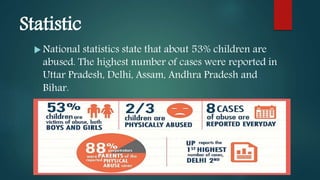
 National statistics state that about 53% children are
abused. The highest number of cases were reported in
Uttar Pradesh, Delhi, Assam, Andhra Pradesh and
Bihar.
Types of Child abuse
• Physical Abuse
• Sexual Abuse
• Emotional/Psychological Abuse
• Neglect
Physical Abuse
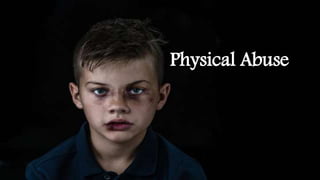
Physical Abuse
 Physical abuse is the injury by other than accidental
means of a child under 18 years of age which is the
result of actions by a parent, guardian, or other
designated (temporary or permanent) caretaker.
 The injuries inflicted are intentional and not
accidental.
• Some result from punishment that is inappropriate
for the child’s age ,condition, or level of
development.
• Some result from a parent’s frustration and lack of
control in acting out anger.
Battered Child Syndrome
• A severe form of physical abuse.
• First described by Kempe in 1962.
• Battered child syndrome is the collection of injuries
sustained by a child as a result of repeated
mistreatment or beating.
• Bruises, lacerations , burns and fractures are
commonly inflicted injuries.
• The major trait of the caretakers is either a lack of an
explanation for critical injuries or explanations that
does not account for the severity of injuries.
Munchausen syndrome
• MUNCHAUSEN SYNDROME is a psychological disorder in
which the person fabricates the symptoms or injury in
order to undergo medical tests, hospitalization or even
medical or surgical treatment , when she/he is not really
sick.
Munchausen syndrome
• Described by Dr. Richard Asher in 1951.
• In cases of Munchausen syndrome by proxy , a parent or
caretaker attempts to bring medical attention to
themselves by injuring or inducing illness in their
children.
• It describes children who are victims of parentally
fabricated or induced illness.
• The term was coined by Dr. Roy Meadow.
Shaken baby syndrome
First reported by Guthkelch in 1971.
• Seen primarily in children 18 months of age or younger.
• The infant’s head is shaken vigorously forward and
backward hitting the chest and shoulders.
• Symptoms are:
Retinal hemorrhage, Subdural or subarachnoid
hematomas , Breathing difficulties
,Seizures/Unconsciousness.
SEXUAL ABUSE
Child sexual abuse
Sexual abuse is the misuse of a child for sexual
pleasure or gratification
• It is of two types.
1) Out -of-house abuse
2) In-house abuse(Incest)
• Sexual abuse has the potential to interfere with
child’s normal healthy development, both
emotionally and physically.
Effects of sexual assault
• Guilt
• Flashbacks/nightmares/Insomnia
• Fear of things associated with the abuse (including objects, smells,
places, doctor's visits, etc.),
• Low self-esteem
Effects of sexual assault
• Sexual dysfunction,
• Self-injury
• Suicidal tendency
• Depression, anxiety , bulimia nervosa
• Increased risk of sexually transmitted infections
EMOTIONAL ABUSE
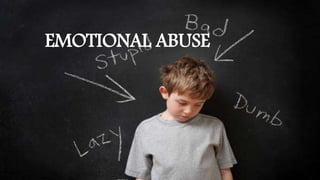
Types of emotional abuse
• Rejection
• Ignoring
• Terrorization
• Isolating
• Blaming(scapegoating)
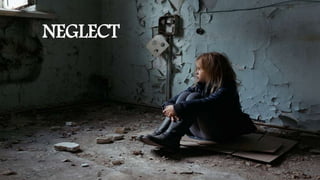
NEGLECT
Neglect
 It is the failure or lack of prudent care for a child's
wellbeing through lack of adequate supervision, food,
clothing, shelter, education or medical care.
 It may not produce visible signs, and it usually occurs
over a period of time.
 Physical abuse tends to be episodic, neglect tends to be
chronic. ABUSE IS AN ACT OF COMMISSION,NEGLECT
IS AN ACT OF OMISSION.
Neglect types
• Neglecting nutrition
• Neglecting health care
• Neglected teeth
• Neglecting safety
• Emotional neglect
• Physical neglect
Nutritional Neglect
 Failure to thrive refers to an underweight,
malnourished condition in a child has a weight that is
below the 3rd or 5th percentile for their age and/or
whose growth has fallen off precipitously and crossed
two major growth percentiles.
Nutritional Neglect
 Failure to thrive:
• The infants have gaunt faces, prominent ribs, wasted
buttocks, and spindly extremities and is expressed in first
two years of life.
• The causes of failure to thrive are estimated as 30%
organic, 20% underfeeding due to understandable error
and 50% underfeeding from parental neglect.
Neglecting health care
 When a child with a treatable chronic disease has
serious deterioration of the condition because the
parents or caretakers repeatedly ignore healthcare
recommendations, healthcare neglect occurs.
 It occurs in situations where an emergency exists and
the parents/caretakers will not acknowledge it much.
 Refusals because of religious beliefs also lead to
healthcare neglect.
Neglected teeth
 Dental neglect, as defined by the American Academy of
Pediatric Dentistry(2003), is the “ failure of parent or
guardian to seek and follow through with treatment
necessary to ensure a level of oral health essential for
adequate function and freedom from pain and
infection.”
Neglected teeth
 Dental caries, periodontal diseases, and other oral
conditions, if left untreated, can lead to pain, infection,
and loss of function.
 These undesirable outcomes can adversely affect
learning, communication, nutrition, and other activities
necessary for normal growth and development.
Neglecting safety
 Safety neglect occurs when injury results from
lack of supervision. These situations usually
involves children younger than 4 years of age,
when it is important that parents directly
supervise them. This leads to injuries like burns,
poisonings, falls because children are not being
watched.
Emotional neglect
 Emotional neglect is a failure to notice, attend to,
or respond appropriately to a child's feelings.
 It is ,in some ways, the opposite of mistreatment
and abuse. Whereas mistreatment and abuse are
parental acts, emotional neglect is a parent's
failure to act.
Physical neglect
 Failure to care for children according to
accepted or appreciated standard.
 This is usually coaxial with physical abuse and
involves presentation of child with unkempt
hair, dirty or insufficient clothing, incomplete
immunization, unsanitary home environment
and inadequate after-school supervision.
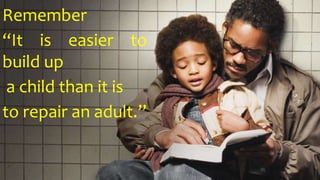
Remember
“It is easier to
build up
a child than it is
to repair an adult.”
Thankyouforlistening
Dinlediğiniziçinteşekkürler

Child neglect & abuse

  • 1.
    Kırşehir Ahi EvranÜniversitesi Sağlık Bilimleri Enstitüsü CHILD NEGLECT & ABUSE Prepared by :  Alı Falh abdlhasan 201217154 Supervised by : Dr. Öğr. Üyesi HİLAL SEKİ ÖZ
  • 2.
    What is ChildAbuse ?  Child Abuse is something or failing to do something that results in harm to a child or puts a child at risk of harm.
  • 3.
    Definition  The WorldHealth Organization (WHO) defines child abuse and child maltreatment as "all forms of physical and/or emotional ill-treatment, sexual abuse, neglect or negligent treatment or commercial or other exploitation, resulting in actual or potential harm to the child's health, survival, development or dignity in the context of a relationship of responsibility, trust or power’’.
  • 4.
    Definition  The UnitedStates federal Child Abuse Prevention and Treatment Act defines child abuse and neglect as, at minimum "any recent act or failure to act on the part of a parent or caretaker which results in death serious physical or emotional harm, sexual abuse or exploitation" and/or "an act or failure to act which presents an imminent risk of serious harm’’.
  • 5.
    Statistic  National statisticsstate that about 53% children are abused. The highest number of cases were reported in Uttar Pradesh, Delhi, Assam, Andhra Pradesh and Bihar.
  • 6.
    Types of Childabuse • Physical Abuse • Sexual Abuse • Emotional/Psychological Abuse • Neglect
  • 7.
  • 8.
    Physical Abuse  Physicalabuse is the injury by other than accidental means of a child under 18 years of age which is the result of actions by a parent, guardian, or other designated (temporary or permanent) caretaker.  The injuries inflicted are intentional and not accidental. • Some result from punishment that is inappropriate for the child’s age ,condition, or level of development. • Some result from a parent’s frustration and lack of control in acting out anger.
  • 9.
    Battered Child Syndrome •A severe form of physical abuse. • First described by Kempe in 1962. • Battered child syndrome is the collection of injuries sustained by a child as a result of repeated mistreatment or beating. • Bruises, lacerations , burns and fractures are commonly inflicted injuries. • The major trait of the caretakers is either a lack of an explanation for critical injuries or explanations that does not account for the severity of injuries.
  • 10.
    Munchausen syndrome • MUNCHAUSENSYNDROME is a psychological disorder in which the person fabricates the symptoms or injury in order to undergo medical tests, hospitalization or even medical or surgical treatment , when she/he is not really sick.
  • 11.
    Munchausen syndrome • Describedby Dr. Richard Asher in 1951. • In cases of Munchausen syndrome by proxy , a parent or caretaker attempts to bring medical attention to themselves by injuring or inducing illness in their children. • It describes children who are victims of parentally fabricated or induced illness. • The term was coined by Dr. Roy Meadow.
  • 12.
    Shaken baby syndrome Firstreported by Guthkelch in 1971. • Seen primarily in children 18 months of age or younger. • The infant’s head is shaken vigorously forward and backward hitting the chest and shoulders. • Symptoms are: Retinal hemorrhage, Subdural or subarachnoid hematomas , Breathing difficulties ,Seizures/Unconsciousness.
  • 13.
  • 14.
    Child sexual abuse Sexualabuse is the misuse of a child for sexual pleasure or gratification • It is of two types. 1) Out -of-house abuse 2) In-house abuse(Incest) • Sexual abuse has the potential to interfere with child’s normal healthy development, both emotionally and physically.
  • 15.
    Effects of sexualassault • Guilt • Flashbacks/nightmares/Insomnia • Fear of things associated with the abuse (including objects, smells, places, doctor's visits, etc.), • Low self-esteem
  • 16.
    Effects of sexualassault • Sexual dysfunction, • Self-injury • Suicidal tendency • Depression, anxiety , bulimia nervosa • Increased risk of sexually transmitted infections
  • 17.
  • 18.
    Types of emotionalabuse • Rejection • Ignoring • Terrorization • Isolating • Blaming(scapegoating)
  • 19.
  • 20.
    Neglect  It isthe failure or lack of prudent care for a child's wellbeing through lack of adequate supervision, food, clothing, shelter, education or medical care.  It may not produce visible signs, and it usually occurs over a period of time.  Physical abuse tends to be episodic, neglect tends to be chronic. ABUSE IS AN ACT OF COMMISSION,NEGLECT IS AN ACT OF OMISSION.
  • 21.
    Neglect types • Neglectingnutrition • Neglecting health care • Neglected teeth • Neglecting safety • Emotional neglect • Physical neglect
  • 22.
    Nutritional Neglect  Failureto thrive refers to an underweight, malnourished condition in a child has a weight that is below the 3rd or 5th percentile for their age and/or whose growth has fallen off precipitously and crossed two major growth percentiles.
  • 23.
    Nutritional Neglect  Failureto thrive: • The infants have gaunt faces, prominent ribs, wasted buttocks, and spindly extremities and is expressed in first two years of life. • The causes of failure to thrive are estimated as 30% organic, 20% underfeeding due to understandable error and 50% underfeeding from parental neglect.
  • 24.
    Neglecting health care When a child with a treatable chronic disease has serious deterioration of the condition because the parents or caretakers repeatedly ignore healthcare recommendations, healthcare neglect occurs.  It occurs in situations where an emergency exists and the parents/caretakers will not acknowledge it much.  Refusals because of religious beliefs also lead to healthcare neglect.
  • 25.
    Neglected teeth  Dentalneglect, as defined by the American Academy of Pediatric Dentistry(2003), is the “ failure of parent or guardian to seek and follow through with treatment necessary to ensure a level of oral health essential for adequate function and freedom from pain and infection.”
  • 26.
    Neglected teeth  Dentalcaries, periodontal diseases, and other oral conditions, if left untreated, can lead to pain, infection, and loss of function.  These undesirable outcomes can adversely affect learning, communication, nutrition, and other activities necessary for normal growth and development.
  • 27.
    Neglecting safety  Safetyneglect occurs when injury results from lack of supervision. These situations usually involves children younger than 4 years of age, when it is important that parents directly supervise them. This leads to injuries like burns, poisonings, falls because children are not being watched.
  • 28.
    Emotional neglect  Emotionalneglect is a failure to notice, attend to, or respond appropriately to a child's feelings.  It is ,in some ways, the opposite of mistreatment and abuse. Whereas mistreatment and abuse are parental acts, emotional neglect is a parent's failure to act.
  • 29.
    Physical neglect  Failureto care for children according to accepted or appreciated standard.  This is usually coaxial with physical abuse and involves presentation of child with unkempt hair, dirty or insufficient clothing, incomplete immunization, unsanitary home environment and inadequate after-school supervision.
  • 30.
    Remember “It is easierto build up a child than it is to repair an adult.”
  • 31.