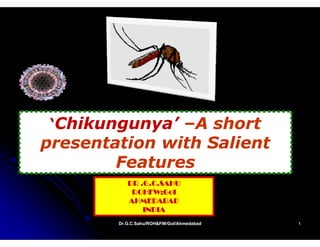
‘Chikungunya –A short
  Chikungunya’
presentation with Salient
        Features


        Dr.G.C.Sahu/ROH&FW/GoI/Ahmedabad
        Dr.G.C.Sahu/ROH&FW/GoI/Ahmedabad   1
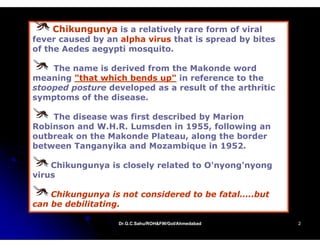
Chikungunya is a relatively rare form of viral
fever caused b an alpha virus that i spread b bi
f          d by     l h  i     h is       d by bites
of the Aedes aegypti mosquito.

    The name i derived from the M k d word
    Th        is d i d f      h Makonde         d
meaning "that which bends up" in reference to the
stooped posture developed as a result of the arthritic
symptoms of the di
           f h disease.

     The disease was first described by Marion
R bi
Robinson and W H R L
            d W.H.R. Lumsden i 1955, following an
                           d   in 1955 f ll   i
outbreak on the Makonde Plateau, along the border
between Tanganyika and Mozambique in 1952.

    Chikungunya is closely related to O'nyong'nyong
virus

    Chikungunya is not considered to be fatal…..but
can be debilitating.

                   Dr.G.C.Sahu/ROH&FW/GoI/Ahmedabad
                   Dr.G.C.Sahu/ROH&FW/GoI/Ahmedabad      2
Synonyms
CHIKV Fever
Buggy Creek virus infection
Knuckle fever
Me Tri virus infection
Semliki Forest virus infection


         Dr.G.C.Sahu/ROH&FW/GoI/Ahmedabad
         Dr.G.C.Sahu/ROH&FW/GoI/Ahmedabad   3
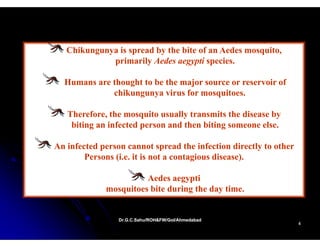
Chikungunya is spread by the bite of an Aedes mosquito,
             p
             primarily Aedes aegypti species.
                       y         gyp p

  Humans are thought to be the major source or reservoir of
             chikungunya virus for mosquitoes.

   Therefore, the mosquito usually transmits the disease by
    biting an infected person and then biting someone else.
                                                      else

An infected person cannot spread the infection directly to other
        Persons (i.e. it is not a contagious disease).

                       Aedes aegypti
                                gyp
             mosquitoes bite during the day time.


                 Dr.G.C.Sahu/ROH&FW/GoI/Ahmedabad
                 Dr.G.C.Sahu/ROH&FW/GoI/Ahmedabad
                                                                   4
Chikungunya occurs mainly in Africa, India, and Southeast
   Asia.
   Asia There have been a number of outbreaks (epidemics) in
   the Philippines and on islands throughout the Indian Ocean.

           Humans act as very efficient reservoirs for the virus.
   chikungunya is most prevalent in urban areas. Currently the
      d sease s being epo ted o
      disease is be g reported from rural a eas a so due to t e
                                        u a areas also          the
  proliferation of this vector as a result of life style change among
rural population. Epidemics are sustained by the human-mosquito-
                                                       human-mosquito-
                      human transmission cycle.
                                             cycle

          Anyone who is bitten by an infected mosquito can get
                          chikungunya.
                           hik

       Widespread poverty, year-round tropical climate, environ-
                                  year-                   environ-
   mental disturbance due to war or natural disaster and lack of
 public health infrastructure are some of the factors that promote
        uncontrolled mosquito breeding and is condusive to
                     outbreaks of chikungunya,
                      Dr.G.C.Sahu/ROH&FW/GoI/Ahmedabad
                      Dr.G.C.Sahu/ROH&FW/GoI/Ahmedabad                   5
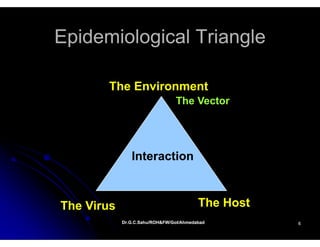
Epidemiological Triangle

       The Environment
                                The Vector


               Interaction
               I t    ti


The Virus                                The Host
            Dr.G.C.Sahu/ROH&FW/GoI/Ahmedabad
            Dr.G.C.Sahu/ROH&FW/GoI/Ahmedabad        6
Dr.G.C.Sahu/ROH&FW/GoI/Ahmedabad
Dr.G.C.Sahu/ROH&FW/GoI/Ahmedabad   7
The Indian Epidemic
The last Indian epidemic started in Nov 2005.
Andhra Pradesh, Karnataka, Maharashtra,
Madhya Pradesh, Odisha, Gujarat, Tamilnadu,
                             j
Rajasthan, Kerala came under its onslaught.
The epidemic spread far and wide at a rapid
rate but northern states like Delhi, Haryana,
  t b t     th     t t   lik D lhi H
Punjab remained mostly unaffected.
There was not much cry from U.P. and Bihar
                               UP
either.


             Dr.G.C.Sahu/ROH&FW/GoI/Ahmedabad
                                                8
Symptoms
                  S   t

The symptoms of chikungunya include:

•Fever which can reach 39 °C,
                           C

•A petechial or maculopapular rash
usually involving the limbs and trunk,

•Arthralgia or arthritis affecting multiple
        g                        g      p
joints which can be debilitating.

•There can also be headache,
                   headache
conjunctival suffusion and slight
photophobia.

             Dr.G.C.Sahu/ROH&FW/GoI/Ahmedabad
             Dr.G.C.Sahu/ROH&FW/GoI/Ahmedabad   9
Clinical Features
Incubation period is 2-12 days; usually 3-7
                      2-                  3-
days.
Viremia last for 5 days (infective period).
Silent CHIKV – inapparent infections in children
Flu-
Flu-like symptoms, Severe headache and chills.
High grade fever (40°C or 104°F).
                  (40°       104°
Arthralgia or arthritis – lasting several weeks.
        g                       g
Conjunctival suffusion and mild photophobia.
Nausea, vomiting, abdominal pain, severe
weakness.


              Dr.G.C.Sahu/ROH&FW/GoI/Ahmedabad
              Dr.G.C.Sahu/ROH&FW/GoI/Ahmedabad   10
The Arthralgia
The small joints of the lower and upper limbs.
Migratory poly arthralgia – not much effusions.
Larger joints may also be affected (knee,
ankle).
Pain worse in the morning – less by evening.
Joints may be swollen & painful to the touch.
Some patients have incapacitating joint pains.
Arthritis may last for weeks or months.


              Dr.G.C.Sahu/ROH&FW/GoI/Ahmedabad
              Dr.G.C.Sahu/ROH&FW/GoI/Ahmedabad   11
Course of illness
Fever typically lasts for 2 - 3 days and comes down.
Fever may reoccur after 3 days – ‘saddle back’ fever.
Some rare cases - fever lasts up to a couple of weeks.
                                                weeks
Patients do have prolonged fatigue for several weeks.
High fever & crippling joint pain marked the last Indian
epidemic.
Joint pain, intense headache, insomnia and an extreme
deg ee of prostration ay as o
degree o p os a o may last for 5 to 7 days.
                                    o days
Life long immunity, once one suffers this infection.


                   Dr.G.C.Sahu/ROH&FW/GoI/Ahmedabad
                   Dr.G.C.Sahu/ROH&FW/GoI/Ahmedabad        12
Who are at greater risk ?
Pregnant women
P        t
Elderly people
Newborns
Women in general
Diabetics
Immuno-
Immuno-compromised patients
Patients with severe chronic
illnesses
ill

          Dr.G.C.Sahu/ROH&FW/GoI/Ahmedabad   13
Differential Diagnosis
Dengue fever, DHF, DSS.
O nyong
O’nyong-nyong viral fever
O’nyong-             fever.
Sindbis viral fever.
Other non specific viral fevers.
Any other acute fever like
malaria, UTI etc.


          Dr.G.C.Sahu/ROH&FW/GoI/Ahmedabad
          Dr.G.C.Sahu/ROH&FW/GoI/Ahmedabad   14
DIAGNOSIS

    Chikungunya is diagnosed by blood tests.

    Since the clinical appearance of both
    Si    th   li i l              f b th
chikungunya and dengue are similar, laboratory
confirmation is important, especially in areas where
                   p          p     y
dengue is present.

Key Diagnostic Tests.

  Detection of antigens or antibody to the agent in
the blood (serology)

  ELISA is available

  An IgM capture ELISA is necessary to distinguish
the disease from dengue fever.
                    g
                                                       15
Treatment….
                Treatment
There is no specific treatment for CHIK VV.
Symptomatic treatment only.
No vaccine or preventive pill is available .
The illness is usually self-limiting.
                       self-
It will resolve with time over a week to 10
days.
No relapses occur – no second attacks.
Convalescence may take longer.
Infected persons should be isolated from mosquitoes in as
much as possible in order to avoid transmission of infection to
other people.


                    Dr.G.C.Sahu/ROH&FW/GoI/Ahmedabad
                    Dr.G.C.Sahu/ROH&FW/GoI/Ahmedabad
                                                                  16
Treatment….
               Treatment
Rest to the patient and mild movements of joints.
Cold compresses to inflamed joints.
Liberal fluid intake or IV fluids.
Analgesics and NSAIDS:
   Paraetamol ± Ibuprofen or aceclofenac or diclofenac .
   Naproxen sodium (Naprasyn, Xenobid).
   Aspirin should be avoided
Hydroxy chloroquine sulphate (HCQS) 200 mg/OD or
chloroquine p
       q     phosphate 250 mg/OD may supplement
                  p            g/       y   pp
alleviating the acute symptoms.
The role of steroidal preparations in easing the acute
symptoms is still debatable.
 y p


                      Dr.G.C.Sahu/ROH&FW/GoI/Ahmedabad
                      Dr.G.C.Sahu/ROH&FW/GoI/Ahmedabad
                                                           17
What not to give ?
No indication for antibiotics.
Never use costly, large spectrum
drugs.
No indication for long acting steroids
No indication for short term steroids
also in the acute phase of illness.
Rarely, if the joint swelling persists –
we may consider use of steroids in
short burst.

             Dr.G.C.Sahu/ROH&FW/GoI/Ahmedabad
             Dr.G.C.Sahu/ROH&FW/GoI/Ahmedabad   18
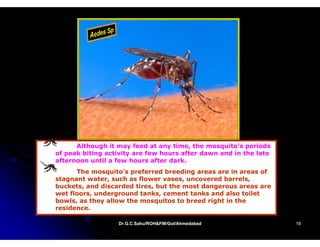
Although it may feed at any time, the mosquito's periods
of peak biting activity are few hours after dawn and in the late
afternoon until a few hours after dark.
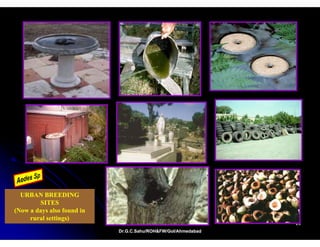
      The mosquito's preferred breeding areas are in areas of
stagnant water, such as flower vases, uncovered barrels,
   g           ,                      ,                  ,
buckets, and discarded tires, but the most dangerous areas are
wet floors, underground tanks, cement tanks and also toilet
bowls, as they allow the mosquitos to breed right in the
residence.

                  Dr.G.C.Sahu/ROH&FW/GoI/Ahmedabad
                  Dr.G.C.Sahu/ROH&FW/GoI/Ahmedabad                 19
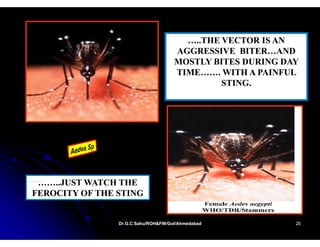
…..THE VECTOR IS AN
                                     AGGRESSIVE BITER…AND
                                     MOSTLY BITES DURING DAY
                                     TIME……. WITH A PAINFUL
                                              STING.


 ……..JUST WATCH THE
     JUST
FEROCITY OF THE STING


                Dr.G.C.Sahu/ROH&FW/GoI/Ahmedabad
                Dr.G.C.Sahu/ROH&FW/GoI/Ahmedabad           20
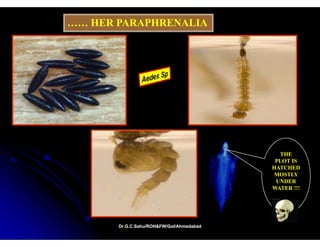
…… HER PARAPHRENALIA


                                            THE
                                           PLOT IS
                                          HATCHED
                                          MOSTLY
                                           UNDER
                                          WATER !!!


       Dr.G.C.Sahu/ROH&FW/GoI/Ahmedabad
       Dr.G.C.Sahu/ROH&FW/GoI/Ahmedabad
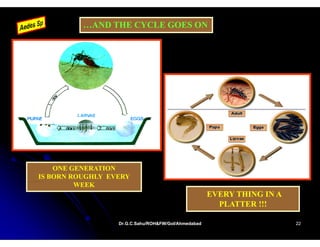
…AND THE CYCLE GOES ON


    ONE GENERATION
IS BORN ROUGHLY EVERY
         WEEK
                                                     EVERY THING IN A
                                                       PLATTER !!!

                  Dr.G.C.Sahu/ROH&FW/GoI/Ahmedabad
                  Dr.G.C.Sahu/ROH&FW/GoI/Ahmedabad                      22
URBAN BREEDING
        SITES
(Now a days also found in
     rural settings)
                                                               23
                            Dr.G.C.Sahu/ROH&FW/GoI/Ahmedabad
PERSONAL PROPHYLACTIC MEASURES-
                             MEASURES-
         PREVENTION OF MOSQUITO BITES

   WEAR FULL SLEEVED CLOTHS, LONG DRESSES THAT COVER THE
                     CLOTHS
ARMS AND LEGS DURING THE OUTBREAKS.

   USE INSECT REPELLENTS WHILE SLEEPING AT NIGHT
                                           NIGHT.

   TAKE ADDITIONAL CARE OF CHILDREN AND ELDERLY.

   USE MOSQUITO COILS/ELECTRIC VAPOUR MATS.

   USE MOSQUITO NETS ESPECIALLY TO PROTECT BABIES AND OLD
PEOPLE.

   KEEP PATIENTS PROTECTED FROM MOSQUITO BITES IN ACUTE
PHASE WHICH WILL REDUCE NO.OF INFECTIVE MOSQUITO
POPULATION.

                    Dr.G.C.Sahu/ROH&FW/GoI/Ahmedabad
                    Dr.G.C.Sahu/ROH&FW/GoI/Ahmedabad   24
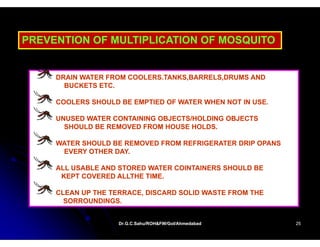
PREVENTION OF MULTIPLICATION OF MOSQUITO


     DRAIN WATER FROM COOLERS.TANKS,BARRELS,DRUMS AND
       BUCKETS ETC.

     COOLERS SHOULD BE EMPTIED OF WATER WHEN NOT IN USE.

     UNUSED WATER CONTAINING OBJECTS/HOLDING OBJECTS
       SHOULD BE REMOVED FROM HOUSE HOLDS.

     WATER SHOULD BE REMOVED FROM REFRIGERATER DRIP OPANS
      EVERY OTHER DAY
                  DAY.

     ALL USABLE AND STORED WATER COINTAINERS SHOULD BE
      KEPT COVERED ALLTHE TIME.

     CLEAN UP THE TERRACE, DISCARD SOLID WASTE FROM THE
       SORROUNDINGS.


                    Dr.G.C.Sahu/ROH&FW/GoI/Ahmedabad
                    Dr.G.C.Sahu/ROH&FW/GoI/Ahmedabad        25
TAKE LONG TERM MEASURES


     INITIATE RECOMMENDED VECTOR CONTROL
MEASURES.

     IDENTIFY AND MAP OUT THE HIGH RISK AREAS FOR
     PRIORITISATION OF AREA SPECIFIC STRATEGIES.

     PATIENTS SHOULD BE TREATED IN NEARBY HEALTH
    /HOSPITALS.

    EFFECTIVE HEALTH EDUCATION CAMPAIGNS AND
    FIELD SUPERVISION
          SUPERVISION.


                 Dr.G.C.Sahu/ROH&FW/GoI/Ahmedabad
                 Dr.G.C.Sahu/ROH&FW/GoI/Ahmedabad   26
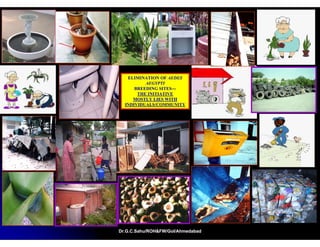
ELIMINATION OF AEDES
          AEGYPTI
      BREEDING SITES---
                SITES---
       THE INITIATIVE
     MOSTLY LIES WITH
  INDIVIDUALS/COMMUNITY


Dr.G.C.Sahu/ROH&FW/GoI/Ahmedabad
Is Bangalore in the grip of chikungunya?
   [ Saturday, A il 08 2006 12 33 46 am TIMES NEWS
     S t d April 08,          12:33:46
                       NETWORK ]

BANGALORE: The Aedes aegypti mosquito that causes chikungunya now seems to
have bitten Bangaloreans. At least 15 persons, suspected to be suffering from the viral
infection, have been admitted to the Epidemic Diseases (ED) Hospital ………. At least
80,000 people in Gulbarga, Tumkur, Bidar, Raichur, Bellary, Chitradurga,
Davanagere, Kolar and Bijapur are affected since December 2005.


Back after 32 yrs, dengue-like fever: chikungunya
Toufiq Rashid
Indian Express.. Thursday, April 27, 2006 at 0000 hrs
Mosquito carrier, not known to be fatal, cases sweep Andhra, Karnataka
NEW DELHI, APRIL 26: Thirty two years after its last outbreak in India, chikungunya is back. A relatively rare viral fever with dengue-like
symptoms, chikungunya has been sweeping Andhra Pradesh, Karnataka and Maharashtra.
In the last three months, the official count of the affected has climbed to a staggering 1.5 lakh people and Health officials concede that
figures on the ground may be higher.
Caused by an alphavirus spread through bites from the Aedes Aegypti mosquito—the same mosquito behind dengue—chikungunya is not
considered fatal. But 77 deaths since 2005 on the Indian Ocean island of Reunion have been linked to chikungunya.
Health officials in Delhi said the last outbreak in the country was reported in 1974. “The
virus must have been silent but it has made a comeback,”

                                                                                                                                              28
                                                 Dr.G.C.Sahu/ROH&FW/GoI/Ahmedabad
                                                 Dr.G.C.Sahu/ROH&FW/GoI/Ahmedabad
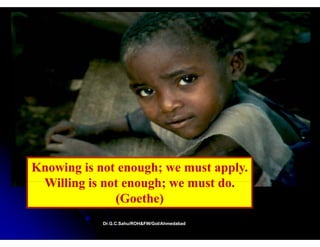
Knowing is not enough; we must apply.
 Willing is not enough; we must do
                                do.
              (Goethe)
            Dr.G.C.Sahu/ROH&FW/GoI/Ahmedabad
            Dr.G.C.Sahu/ROH&FW/GoI/Ahmedabad
GOVT EFFORTS
 COUPLED WITH
  THE PUBLIC
PARTICIPATION….
PARTICIPATION….
   IS THE KEY.
          KEY.


           Acknowledgements:
           Acknowledgements:
                    g
          • WHO
          • CDC
          • NVBDCP
          • NCDC
          • JD(NVBDCP),Gandhinagar.
              (       ),       g
          • Dy.Director(Epidemic),Gandhinagar
          • Dr. R.V.S.N.Sarma. (Canada)


             Dr.G.C.Sahu/ROH&FW/GoI/Ahmedabad
             Dr.G.C.Sahu/ROH&FW/GoI/Ahmedabad
                                                …….. THANKS

Chickungunya - dr

  • 1.
    ‘Chikungunya –A short Chikungunya’ presentation with Salient Features Dr.G.C.Sahu/ROH&FW/GoI/Ahmedabad Dr.G.C.Sahu/ROH&FW/GoI/Ahmedabad 1
  • 2.
    Chikungunya is arelatively rare form of viral fever caused b an alpha virus that i spread b bi f d by l h i h is d by bites of the Aedes aegypti mosquito. The name i derived from the M k d word Th is d i d f h Makonde d meaning "that which bends up" in reference to the stooped posture developed as a result of the arthritic symptoms of the di f h disease. The disease was first described by Marion R bi Robinson and W H R L d W.H.R. Lumsden i 1955, following an d in 1955 f ll i outbreak on the Makonde Plateau, along the border between Tanganyika and Mozambique in 1952. Chikungunya is closely related to O'nyong'nyong virus Chikungunya is not considered to be fatal…..but can be debilitating. Dr.G.C.Sahu/ROH&FW/GoI/Ahmedabad Dr.G.C.Sahu/ROH&FW/GoI/Ahmedabad 2
  • 3.
    Synonyms CHIKV Fever Buggy Creekvirus infection Knuckle fever Me Tri virus infection Semliki Forest virus infection Dr.G.C.Sahu/ROH&FW/GoI/Ahmedabad Dr.G.C.Sahu/ROH&FW/GoI/Ahmedabad 3
  • 4.
    Chikungunya is spreadby the bite of an Aedes mosquito, p primarily Aedes aegypti species. y gyp p Humans are thought to be the major source or reservoir of chikungunya virus for mosquitoes. Therefore, the mosquito usually transmits the disease by biting an infected person and then biting someone else. else An infected person cannot spread the infection directly to other Persons (i.e. it is not a contagious disease). Aedes aegypti gyp mosquitoes bite during the day time. Dr.G.C.Sahu/ROH&FW/GoI/Ahmedabad Dr.G.C.Sahu/ROH&FW/GoI/Ahmedabad 4
  • 5.
    Chikungunya occurs mainlyin Africa, India, and Southeast Asia. Asia There have been a number of outbreaks (epidemics) in the Philippines and on islands throughout the Indian Ocean. Humans act as very efficient reservoirs for the virus. chikungunya is most prevalent in urban areas. Currently the d sease s being epo ted o disease is be g reported from rural a eas a so due to t e u a areas also the proliferation of this vector as a result of life style change among rural population. Epidemics are sustained by the human-mosquito- human-mosquito- human transmission cycle. cycle Anyone who is bitten by an infected mosquito can get chikungunya. hik Widespread poverty, year-round tropical climate, environ- year- environ- mental disturbance due to war or natural disaster and lack of public health infrastructure are some of the factors that promote uncontrolled mosquito breeding and is condusive to outbreaks of chikungunya, Dr.G.C.Sahu/ROH&FW/GoI/Ahmedabad Dr.G.C.Sahu/ROH&FW/GoI/Ahmedabad 5
  • 6.
    Epidemiological Triangle The Environment The Vector Interaction I t ti The Virus The Host Dr.G.C.Sahu/ROH&FW/GoI/Ahmedabad Dr.G.C.Sahu/ROH&FW/GoI/Ahmedabad 6
  • 7.
  • 8.
    The Indian Epidemic Thelast Indian epidemic started in Nov 2005. Andhra Pradesh, Karnataka, Maharashtra, Madhya Pradesh, Odisha, Gujarat, Tamilnadu, j Rajasthan, Kerala came under its onslaught. The epidemic spread far and wide at a rapid rate but northern states like Delhi, Haryana, t b t th t t lik D lhi H Punjab remained mostly unaffected. There was not much cry from U.P. and Bihar UP either. Dr.G.C.Sahu/ROH&FW/GoI/Ahmedabad 8
  • 9.
    Symptoms S t The symptoms of chikungunya include: •Fever which can reach 39 °C, C •A petechial or maculopapular rash usually involving the limbs and trunk, •Arthralgia or arthritis affecting multiple g g p joints which can be debilitating. •There can also be headache, headache conjunctival suffusion and slight photophobia. Dr.G.C.Sahu/ROH&FW/GoI/Ahmedabad Dr.G.C.Sahu/ROH&FW/GoI/Ahmedabad 9
  • 10.
    Clinical Features Incubation periodis 2-12 days; usually 3-7 2- 3- days. Viremia last for 5 days (infective period). Silent CHIKV – inapparent infections in children Flu- Flu-like symptoms, Severe headache and chills. High grade fever (40°C or 104°F). (40° 104° Arthralgia or arthritis – lasting several weeks. g g Conjunctival suffusion and mild photophobia. Nausea, vomiting, abdominal pain, severe weakness. Dr.G.C.Sahu/ROH&FW/GoI/Ahmedabad Dr.G.C.Sahu/ROH&FW/GoI/Ahmedabad 10
  • 11.
    The Arthralgia The smalljoints of the lower and upper limbs. Migratory poly arthralgia – not much effusions. Larger joints may also be affected (knee, ankle). Pain worse in the morning – less by evening. Joints may be swollen & painful to the touch. Some patients have incapacitating joint pains. Arthritis may last for weeks or months. Dr.G.C.Sahu/ROH&FW/GoI/Ahmedabad Dr.G.C.Sahu/ROH&FW/GoI/Ahmedabad 11
  • 12.
    Course of illness Fevertypically lasts for 2 - 3 days and comes down. Fever may reoccur after 3 days – ‘saddle back’ fever. Some rare cases - fever lasts up to a couple of weeks. weeks Patients do have prolonged fatigue for several weeks. High fever & crippling joint pain marked the last Indian epidemic. Joint pain, intense headache, insomnia and an extreme deg ee of prostration ay as o degree o p os a o may last for 5 to 7 days. o days Life long immunity, once one suffers this infection. Dr.G.C.Sahu/ROH&FW/GoI/Ahmedabad Dr.G.C.Sahu/ROH&FW/GoI/Ahmedabad 12
  • 13.
    Who are atgreater risk ? Pregnant women P t Elderly people Newborns Women in general Diabetics Immuno- Immuno-compromised patients Patients with severe chronic illnesses ill Dr.G.C.Sahu/ROH&FW/GoI/Ahmedabad 13
  • 14.
    Differential Diagnosis Dengue fever,DHF, DSS. O nyong O’nyong-nyong viral fever O’nyong- fever. Sindbis viral fever. Other non specific viral fevers. Any other acute fever like malaria, UTI etc. Dr.G.C.Sahu/ROH&FW/GoI/Ahmedabad Dr.G.C.Sahu/ROH&FW/GoI/Ahmedabad 14
  • 15.
    DIAGNOSIS Chikungunya is diagnosed by blood tests. Since the clinical appearance of both Si th li i l f b th chikungunya and dengue are similar, laboratory confirmation is important, especially in areas where p p y dengue is present. Key Diagnostic Tests. Detection of antigens or antibody to the agent in the blood (serology) ELISA is available An IgM capture ELISA is necessary to distinguish the disease from dengue fever. g 15
  • 16.
    Treatment…. Treatment There is no specific treatment for CHIK VV. Symptomatic treatment only. No vaccine or preventive pill is available . The illness is usually self-limiting. self- It will resolve with time over a week to 10 days. No relapses occur – no second attacks. Convalescence may take longer. Infected persons should be isolated from mosquitoes in as much as possible in order to avoid transmission of infection to other people. Dr.G.C.Sahu/ROH&FW/GoI/Ahmedabad Dr.G.C.Sahu/ROH&FW/GoI/Ahmedabad 16
  • 17.
    Treatment…. Treatment Rest to the patient and mild movements of joints. Cold compresses to inflamed joints. Liberal fluid intake or IV fluids. Analgesics and NSAIDS: Paraetamol ± Ibuprofen or aceclofenac or diclofenac . Naproxen sodium (Naprasyn, Xenobid). Aspirin should be avoided Hydroxy chloroquine sulphate (HCQS) 200 mg/OD or chloroquine p q phosphate 250 mg/OD may supplement p g/ y pp alleviating the acute symptoms. The role of steroidal preparations in easing the acute symptoms is still debatable. y p Dr.G.C.Sahu/ROH&FW/GoI/Ahmedabad Dr.G.C.Sahu/ROH&FW/GoI/Ahmedabad 17
  • 18.
    What not togive ? No indication for antibiotics. Never use costly, large spectrum drugs. No indication for long acting steroids No indication for short term steroids also in the acute phase of illness. Rarely, if the joint swelling persists – we may consider use of steroids in short burst. Dr.G.C.Sahu/ROH&FW/GoI/Ahmedabad Dr.G.C.Sahu/ROH&FW/GoI/Ahmedabad 18
  • 19.
    Although it mayfeed at any time, the mosquito's periods of peak biting activity are few hours after dawn and in the late afternoon until a few hours after dark. The mosquito's preferred breeding areas are in areas of stagnant water, such as flower vases, uncovered barrels, g , , , buckets, and discarded tires, but the most dangerous areas are wet floors, underground tanks, cement tanks and also toilet bowls, as they allow the mosquitos to breed right in the residence. Dr.G.C.Sahu/ROH&FW/GoI/Ahmedabad Dr.G.C.Sahu/ROH&FW/GoI/Ahmedabad 19
  • 20.
    …..THE VECTOR ISAN AGGRESSIVE BITER…AND MOSTLY BITES DURING DAY TIME……. WITH A PAINFUL STING. ……..JUST WATCH THE JUST FEROCITY OF THE STING Dr.G.C.Sahu/ROH&FW/GoI/Ahmedabad Dr.G.C.Sahu/ROH&FW/GoI/Ahmedabad 20
  • 21.
    …… HER PARAPHRENALIA THE PLOT IS HATCHED MOSTLY UNDER WATER !!! Dr.G.C.Sahu/ROH&FW/GoI/Ahmedabad Dr.G.C.Sahu/ROH&FW/GoI/Ahmedabad
  • 22.
    …AND THE CYCLEGOES ON ONE GENERATION IS BORN ROUGHLY EVERY WEEK EVERY THING IN A PLATTER !!! Dr.G.C.Sahu/ROH&FW/GoI/Ahmedabad Dr.G.C.Sahu/ROH&FW/GoI/Ahmedabad 22
  • 23.
    URBAN BREEDING SITES (Now a days also found in rural settings) 23 Dr.G.C.Sahu/ROH&FW/GoI/Ahmedabad
  • 24.
    PERSONAL PROPHYLACTIC MEASURES- MEASURES- PREVENTION OF MOSQUITO BITES WEAR FULL SLEEVED CLOTHS, LONG DRESSES THAT COVER THE CLOTHS ARMS AND LEGS DURING THE OUTBREAKS. USE INSECT REPELLENTS WHILE SLEEPING AT NIGHT NIGHT. TAKE ADDITIONAL CARE OF CHILDREN AND ELDERLY. USE MOSQUITO COILS/ELECTRIC VAPOUR MATS. USE MOSQUITO NETS ESPECIALLY TO PROTECT BABIES AND OLD PEOPLE. KEEP PATIENTS PROTECTED FROM MOSQUITO BITES IN ACUTE PHASE WHICH WILL REDUCE NO.OF INFECTIVE MOSQUITO POPULATION. Dr.G.C.Sahu/ROH&FW/GoI/Ahmedabad Dr.G.C.Sahu/ROH&FW/GoI/Ahmedabad 24
  • 25.
    PREVENTION OF MULTIPLICATIONOF MOSQUITO DRAIN WATER FROM COOLERS.TANKS,BARRELS,DRUMS AND BUCKETS ETC. COOLERS SHOULD BE EMPTIED OF WATER WHEN NOT IN USE. UNUSED WATER CONTAINING OBJECTS/HOLDING OBJECTS SHOULD BE REMOVED FROM HOUSE HOLDS. WATER SHOULD BE REMOVED FROM REFRIGERATER DRIP OPANS EVERY OTHER DAY DAY. ALL USABLE AND STORED WATER COINTAINERS SHOULD BE KEPT COVERED ALLTHE TIME. CLEAN UP THE TERRACE, DISCARD SOLID WASTE FROM THE SORROUNDINGS. Dr.G.C.Sahu/ROH&FW/GoI/Ahmedabad Dr.G.C.Sahu/ROH&FW/GoI/Ahmedabad 25
  • 26.
    TAKE LONG TERMMEASURES INITIATE RECOMMENDED VECTOR CONTROL MEASURES. IDENTIFY AND MAP OUT THE HIGH RISK AREAS FOR PRIORITISATION OF AREA SPECIFIC STRATEGIES. PATIENTS SHOULD BE TREATED IN NEARBY HEALTH /HOSPITALS. EFFECTIVE HEALTH EDUCATION CAMPAIGNS AND FIELD SUPERVISION SUPERVISION. Dr.G.C.Sahu/ROH&FW/GoI/Ahmedabad Dr.G.C.Sahu/ROH&FW/GoI/Ahmedabad 26
  • 27.
    ELIMINATION OF AEDES AEGYPTI BREEDING SITES--- SITES--- THE INITIATIVE MOSTLY LIES WITH INDIVIDUALS/COMMUNITY Dr.G.C.Sahu/ROH&FW/GoI/Ahmedabad Dr.G.C.Sahu/ROH&FW/GoI/Ahmedabad
  • 28.
    Is Bangalore inthe grip of chikungunya? [ Saturday, A il 08 2006 12 33 46 am TIMES NEWS S t d April 08, 12:33:46 NETWORK ] BANGALORE: The Aedes aegypti mosquito that causes chikungunya now seems to have bitten Bangaloreans. At least 15 persons, suspected to be suffering from the viral infection, have been admitted to the Epidemic Diseases (ED) Hospital ………. At least 80,000 people in Gulbarga, Tumkur, Bidar, Raichur, Bellary, Chitradurga, Davanagere, Kolar and Bijapur are affected since December 2005. Back after 32 yrs, dengue-like fever: chikungunya Toufiq Rashid Indian Express.. Thursday, April 27, 2006 at 0000 hrs Mosquito carrier, not known to be fatal, cases sweep Andhra, Karnataka NEW DELHI, APRIL 26: Thirty two years after its last outbreak in India, chikungunya is back. A relatively rare viral fever with dengue-like symptoms, chikungunya has been sweeping Andhra Pradesh, Karnataka and Maharashtra. In the last three months, the official count of the affected has climbed to a staggering 1.5 lakh people and Health officials concede that figures on the ground may be higher. Caused by an alphavirus spread through bites from the Aedes Aegypti mosquito—the same mosquito behind dengue—chikungunya is not considered fatal. But 77 deaths since 2005 on the Indian Ocean island of Reunion have been linked to chikungunya. Health officials in Delhi said the last outbreak in the country was reported in 1974. “The virus must have been silent but it has made a comeback,” 28 Dr.G.C.Sahu/ROH&FW/GoI/Ahmedabad Dr.G.C.Sahu/ROH&FW/GoI/Ahmedabad
  • 29.
    Knowing is notenough; we must apply. Willing is not enough; we must do do. (Goethe) Dr.G.C.Sahu/ROH&FW/GoI/Ahmedabad Dr.G.C.Sahu/ROH&FW/GoI/Ahmedabad
  • 30.
    GOVT EFFORTS COUPLEDWITH THE PUBLIC PARTICIPATION…. PARTICIPATION…. IS THE KEY. KEY. Acknowledgements: Acknowledgements: g • WHO • CDC • NVBDCP • NCDC • JD(NVBDCP),Gandhinagar. ( ), g • Dy.Director(Epidemic),Gandhinagar • Dr. R.V.S.N.Sarma. (Canada) Dr.G.C.Sahu/ROH&FW/GoI/Ahmedabad Dr.G.C.Sahu/ROH&FW/GoI/Ahmedabad …….. THANKS