
Jawaharnavodayavidyalaya,pune
Chemistryinvestigatoryprojecton
“STERILIZATION OF
WATER USING
BLEACHING POWDER”
By
Suyash jagtap
“STERILIZATION OF
WATER USING
BLEACHING POWDER”
Madeby: suyashsuniljagtap
Class: 12th
“A”
Roll no : 4644187
Guidedby: Mr.D.V.Bade(PGT.Chemistry)
INDEX
 CertificateofAuthenticity
 Acknowledgement
 Introduction
 -NeedofWater
 -PurificationofWater
 -Needforastablepurificationtechnique
 Experiment
 -Aim
 -Pre-RequisiteKnowledge
 -Requirements
 -Procedure
 Result
CERTIFICATE OF AUTHENTICITY
This is to certify that SACHIN BIBHISHAN SHERKHANE
, a student of class XII has successfully
completed the research project on the topic
“Sterilization of Water by usingBleaching Powder”
under the guidance of Mr. D.V.BADE (PGT CHEMISTRY).
This project is absolutely genuine and does not indulge in
plagiarism of any kind.
The references taken in making this project have been
declared at the end of this
report.
Signature ( Subject Teacher) Signature ( Examiner)
ACKNOWLEDGEMENT
I feel proud topresent my Investigatory project in Biologyonthe topic“Fecal
Transplantsforthetreatmentofdigestivedisease”whichaimsatusing Bleaching powder
as a disinfectantand purifier tomake water fitfordrinking.
This project wouldn’thavebeen feasiblewithouttheproper and rigorousguidance of my
Chemistryteacher Mr. D.V.BADE whoguided methroughoutthis project in every
possibleway.An investigatoryproject involvesvariousdifficultlab experiments which
havetobe carried out bythe student to obtaintheobservationsandconclude the report
on a meaningfulnote. These experiments are very criticaland in thecase of failure,may
result in disastrousconsequences. Thereby, I would liketothank both Mr.D.V.BADE and
LabAsst. Mr.B.R.SHINDE forguidingmeon a step by step basisand ensuring thatI
completed allmy experiments withease.
Rigoroushard work has been put in thisproject toensure thatit proves tobethe best. I
hopethatthis project willproveto bea breeding ground forthe next generation of
students and willguidethem in every possibleway.
INTRODUCTION
Needofwater
Water is an importantand essential ingredient in our quest for survivalonthis planet. It
is very essential forcarrying outvariousmetabolicprocesses in our bodyand alsoto carry
out Hemoglobinthroughoutthebody. A dailyaverageof 1gallonper man is sufficientfor
drinking and cooking purposes. A horse, bullock,or muledrinks about11 gallonsat a
time. standing up, an average allowanceof5 gallonsshouldbegiven for a man,and 10
gallonsfora horse or a camel. An elephant drinks 25 gallons,each mule or ox drinks 6 to
8 gallons,each sheep or pig 6 to8 pints.These areminimum quantities. One cubic footof
water = 6 gallons(a gallon= 10 lbs.). In order tofulfillsuch ahuge demand ofwater, it
needs to be purified and supplied in a orderly and systematic way. But withthe
increasing world population,thedemand fordrinking water has also increased
dramaticallyandtherefore itis very essentialto identify resources of water fromwhich we
can use water fordrinking purposes. Many availableresources ofwater do not haveit in
drinkableform.Either the watercontains excess ofCalciumor Magnesium saltsor any
other organic impurityorit simplycontains foreign particles which makeit unfitand
unsafeforDrinking.
PurificationofWater
There aremany methods forthe purificationofwater.Someof them are
1. Boiling
2. Filtration
3. Bleaching powder treatment
4. SODIS (SolarWater Disinfection)
And thelistgoes on….
Boilingisperhaps the most commonlyused water purificationtechniquein use today.
Whilein normalhouseholdsit is an efficient technique; it cannot beused forindustrial
and largescalepurposes. It is because in normalhouseholds,thewater to bepurified is
very smallin quantity and hence thewater lossdue to evaporationisalmostnegligible.
But in Industrialor largescalepurificationofwaterthe water lossdue toevaporation will
bequite highand theamountofpurified water obtainedwillbevery less. Filtrationisalso
used forremoving foreign particlesfromwater. One majordrawback ofthis purification
process is that itcannot beused forremoving foreign chemicals and impuritiesthatare
misciblewith water.SODISorSolarWaterDisinfectionisrecommendedby theUnited
Nationsfordisinfectionofwaterusingsoftdrinkbottles,sunlight,andablacksurface--at
leastin hotnationswithregularlyintensesunlight.
Water-filledtransparent bottlesplaced in a horizontalpositionatopaflatsurfacein
strong sunlightfor around fivehours willkillmicrobes in thewater. Theprocess is made
even moresafeand effectiveifthe bottomhalfofthebottleor thesurfaceit's lying on is
blackened, and/orthe flatsurfaceismade ofplasticor metal.It's the combinationofheat
and ultravioletlightwhichkills theorganisms.
Themajor drawback ofthispurificationtechnique is thatit cannot beused in countries
withcold weather. Also, thetimeconsumed forPurificationprocessis moreand it also
needs a ‘blackened’ surface, much likesolarcookers.
Needforastablepurificationtechnique
Thereforewe need a purificationtechnique whichcan beused anytimeand anywhere,
does not require the use ofany third party content and which isalsoeconomically
feasibleon bothnormalscaleand largescale.
Hence welook atthemethod of purificationofwaterusing thetechnique oftreatment
by bleachingpowder commonly known as “Chlorination”.
EXPERIMENT
Aim:Sterilization ofwaterusingbleachingpowder
Requirements:
 Burette,
 titrationflask,
 100mlgraduated cylinder,
 250mlmeasuring
 flask,
 weight box,
 glazed tile,
 glasswool.
 Bleaching Powder,
 Glasswool,
o N Na2S2O3solution,
o 10% KI solution,
o different samples
 ofwater,
 starch solution.
Procedure:
1. Preparationofbleaching powder solution.Weighaccurately 2.5g ofthegiven sample of
bleaching powder and transfer it toa 250mlconical flask.Add about100-150ml of
distilledwater. Stopper the flaskand shake itvigorously.Thesuspension thus
obtainedis filtered throughglass wooland thefiltrateisdiluted with water (in a
measuring flask)to makethevolume250ml.The solutionobtainedis1% bleaching
powder solution.
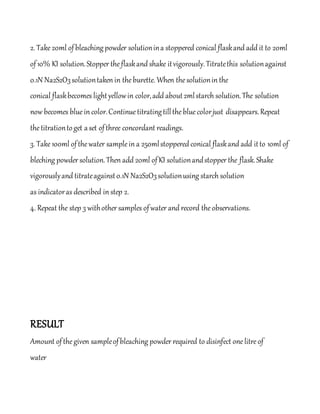
2. Take20ml ofbleachingpowder solutionina stoppered conical flaskand add it to 20ml
of10% KI solution.Stopper theflaskand shake itvigorously.Titratethis solutionagainst
0.1N Na2S2O3solutiontaken in theburette. When thesolutionin the
conical flaskbecomes lightyellowin color,add about2mlstarch solution.The solution
now becomes bluein color.Continuetitratingtillthebluecolorjust disappears.Repeat
thetitrationtoget aset ofthree concordant readings.
3. Take100ml ofthewater samplein a 250mlstoppered conical flaskand add itto 10ml of
bleching powder solution.Then add 20ml ofKI solutionandstopper the flask.Shake
vigorouslyand titrateagainst0.1N Na2S2O3solutionusing starch solution
as indicatoras described in step 2.
4. Repeat the step 3 withother samples ofwater and record theobservations.
RESULT
Amount ofthegiven sampleofbleaching powder required to disinfect onelitreof
water
SampleI = ………g
SampleII= ………g
SampleIII= ………g

chemistry investigatory project

  • 1.
  • 2.
    “STERILIZATION OF WATER USING BLEACHINGPOWDER” Madeby: suyashsuniljagtap Class: 12th “A” Roll no : 4644187 Guidedby: Mr.D.V.Bade(PGT.Chemistry)
  • 3.
    INDEX  CertificateofAuthenticity  Acknowledgement Introduction  -NeedofWater  -PurificationofWater  -Needforastablepurificationtechnique  Experiment  -Aim  -Pre-RequisiteKnowledge  -Requirements  -Procedure
  • 4.
     Result CERTIFICATE OFAUTHENTICITY This is to certify that SACHIN BIBHISHAN SHERKHANE , a student of class XII has successfully completed the research project on the topic “Sterilization of Water by usingBleaching Powder” under the guidance of Mr. D.V.BADE (PGT CHEMISTRY). This project is absolutely genuine and does not indulge in plagiarism of any kind. The references taken in making this project have been declared at the end of this report.
  • 5.
    Signature ( SubjectTeacher) Signature ( Examiner) ACKNOWLEDGEMENT I feel proud topresent my Investigatory project in Biologyonthe topic“Fecal Transplantsforthetreatmentofdigestivedisease”whichaimsatusing Bleaching powder as a disinfectantand purifier tomake water fitfordrinking. This project wouldn’thavebeen feasiblewithouttheproper and rigorousguidance of my Chemistryteacher Mr. D.V.BADE whoguided methroughoutthis project in every possibleway.An investigatoryproject involvesvariousdifficultlab experiments which havetobe carried out bythe student to obtaintheobservationsandconclude the report on a meaningfulnote. These experiments are very criticaland in thecase of failure,may result in disastrousconsequences. Thereby, I would liketothank both Mr.D.V.BADE and
  • 6.
    LabAsst. Mr.B.R.SHINDE forguidingmeona step by step basisand ensuring thatI completed allmy experiments withease. Rigoroushard work has been put in thisproject toensure thatit proves tobethe best. I hopethatthis project willproveto bea breeding ground forthe next generation of students and willguidethem in every possibleway. INTRODUCTION Needofwater Water is an importantand essential ingredient in our quest for survivalonthis planet. It is very essential forcarrying outvariousmetabolicprocesses in our bodyand alsoto carry out Hemoglobinthroughoutthebody. A dailyaverageof 1gallonper man is sufficientfor drinking and cooking purposes. A horse, bullock,or muledrinks about11 gallonsat a time. standing up, an average allowanceof5 gallonsshouldbegiven for a man,and 10
  • 7.
    gallonsfora horse ora camel. An elephant drinks 25 gallons,each mule or ox drinks 6 to 8 gallons,each sheep or pig 6 to8 pints.These areminimum quantities. One cubic footof water = 6 gallons(a gallon= 10 lbs.). In order tofulfillsuch ahuge demand ofwater, it needs to be purified and supplied in a orderly and systematic way. But withthe increasing world population,thedemand fordrinking water has also increased dramaticallyandtherefore itis very essentialto identify resources of water fromwhich we can use water fordrinking purposes. Many availableresources ofwater do not haveit in drinkableform.Either the watercontains excess ofCalciumor Magnesium saltsor any other organic impurityorit simplycontains foreign particles which makeit unfitand unsafeforDrinking. PurificationofWater There aremany methods forthe purificationofwater.Someof them are 1. Boiling 2. Filtration
  • 8.
    3. Bleaching powdertreatment 4. SODIS (SolarWater Disinfection) And thelistgoes on…. Boilingisperhaps the most commonlyused water purificationtechniquein use today. Whilein normalhouseholdsit is an efficient technique; it cannot beused forindustrial and largescalepurposes. It is because in normalhouseholds,thewater to bepurified is very smallin quantity and hence thewater lossdue to evaporationisalmostnegligible. But in Industrialor largescalepurificationofwaterthe water lossdue toevaporation will bequite highand theamountofpurified water obtainedwillbevery less. Filtrationisalso used forremoving foreign particlesfromwater. One majordrawback ofthis purification process is that itcannot beused forremoving foreign chemicals and impuritiesthatare misciblewith water.SODISorSolarWaterDisinfectionisrecommendedby theUnited Nationsfordisinfectionofwaterusingsoftdrinkbottles,sunlight,andablacksurface--at leastin hotnationswithregularlyintensesunlight. Water-filledtransparent bottlesplaced in a horizontalpositionatopaflatsurfacein strong sunlightfor around fivehours willkillmicrobes in thewater. Theprocess is made even moresafeand effectiveifthe bottomhalfofthebottleor thesurfaceit's lying on is blackened, and/orthe flatsurfaceismade ofplasticor metal.It's the combinationofheat and ultravioletlightwhichkills theorganisms.
  • 9.
    Themajor drawback ofthispurificationtechniqueis thatit cannot beused in countries withcold weather. Also, thetimeconsumed forPurificationprocessis moreand it also needs a ‘blackened’ surface, much likesolarcookers. Needforastablepurificationtechnique Thereforewe need a purificationtechnique whichcan beused anytimeand anywhere, does not require the use ofany third party content and which isalsoeconomically feasibleon bothnormalscaleand largescale. Hence welook atthemethod of purificationofwaterusing thetechnique oftreatment by bleachingpowder commonly known as “Chlorination”.
  • 10.
    EXPERIMENT Aim:Sterilization ofwaterusingbleachingpowder Requirements:  Burette, titrationflask,  100mlgraduated cylinder,  250mlmeasuring  flask,  weight box,  glazed tile,  glasswool.  Bleaching Powder,  Glasswool, o N Na2S2O3solution,
  • 11.
    o 10% KIsolution, o different samples  ofwater,  starch solution. Procedure: 1. Preparationofbleaching powder solution.Weighaccurately 2.5g ofthegiven sample of bleaching powder and transfer it toa 250mlconical flask.Add about100-150ml of distilledwater. Stopper the flaskand shake itvigorously.Thesuspension thus obtainedis filtered throughglass wooland thefiltrateisdiluted with water (in a measuring flask)to makethevolume250ml.The solutionobtainedis1% bleaching powder solution.
  • 12.
    2. Take20ml ofbleachingpowdersolutionina stoppered conical flaskand add it to 20ml of10% KI solution.Stopper theflaskand shake itvigorously.Titratethis solutionagainst 0.1N Na2S2O3solutiontaken in theburette. When thesolutionin the conical flaskbecomes lightyellowin color,add about2mlstarch solution.The solution now becomes bluein color.Continuetitratingtillthebluecolorjust disappears.Repeat thetitrationtoget aset ofthree concordant readings. 3. Take100ml ofthewater samplein a 250mlstoppered conical flaskand add itto 10ml of bleching powder solution.Then add 20ml ofKI solutionandstopper the flask.Shake vigorouslyand titrateagainst0.1N Na2S2O3solutionusing starch solution as indicatoras described in step 2. 4. Repeat the step 3 withother samples ofwater and record theobservations. RESULT Amount ofthegiven sampleofbleaching powder required to disinfect onelitreof water
  • 13.
    SampleI = ………g SampleII=………g SampleIII= ………g