Presentation By:
Shahzad Jehangir
Danyal Zaffer
Mustafa Khan
Faraz Ahmed Khan
By:
Mustafa Khan
Pharmacological Action Of Aspirin:
• ->Aspirin is NSAID (Non-Steroidal Anti-Inflammatory Drug).
• ->It has anti-inflammatory, analgesic, anti-pyretic and antithrombotic
activity.
• NSAID= are a drug class that groups together drugs that
provide analgesic (pain-killing) and antipyretic (fever-reducing)
effects, and, in higher doses, anti-inflammatory effects.
• Anti-Inflammatory: The reduction of swelling effect of a substance.
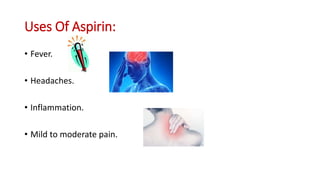
Uses Of Aspirin:
• Fever.
• Headaches.
• Inflammation.
• Mild to moderate pain.
Side Effects Of Aspirin:
• Coughing up blood.
• Severe nausea.
• Fever lasting longer than 3 days.
• Vomiting.
• Swelling.
• Hearing problems, ringing in your ears.
• Difficulty breathing. Etc.
High Risk Groups:
• This drug should not be given to the following group of people:
• ->Pregnant Mothers.
• ->Kidney Dysfunction Patients.
• ->Neonates. (Newborn baby)
Mechanism of Action:
• Prohibits the synthesis of prostaglandins (a group of compounds with
varying hormone-like effects) by cyclooxygenase (is an enzyme that is
responsible for formation of proteinoids).
• Proteinoids: A protein like polypeptide formed abiotically from amino
acid mixture in the presence of heat.
Half Life Of Aspirin:
• The half—life is approximately 15 to 20 min for aspirin. Elimination
follows zero-order kinetics. Renal elimination of unchanged drug
depends on urine pH. A pH of more than 6.5 increases renal Cl of free
salicylate from less than 5% to more than 80%.
Brands Of Aspirin:
• ->Ascard.
• ->Erocid.
• ->Disprin.
• ->Meriprin.
• ->Pauarin.
The End!
LOWPLAT
(Clopidogrel)
By:
Danyal Zaffer
Pharmacological Action Of Clopidogrel :
• ->Anti-Platelet.
• ->It acts by decreasing adenosine diphosphate-medicated platelet
aggregation.
• Platelet Aggregation: The clumping together of platelets in the blood.
Platelet aggregation is part of the sequence of events leading to the
formation of a thrombus (clot).
Uses Of Clopidogrel:
• ->Atherosclerosis. (Atherosclerosis is a specific form of
arteriosclerosis in which an artery-wall thickens as a result of invasion
and accumulation of white blood cells).
• ->Myocardial Infarction. (Heart Attack).
• ->Angina. (Chest Pain).
Side Effects Of Clopidogrel:
• ->Upper Respiratory Tract Infection.
• ->Chest Pain.
• ->Headache.
• ->Dizziness.
• ->Rash.
• ->Depression.
High Risk Groups:
• This drug should not be given to the following group of people:
• ->Pregnant Mothers.
• ->Kidney Dysfunction Patients.
• ->Neonates. (Newborn baby)
Mechanism of Action:
• Prohibitor of adenosine diphosphate (ADP) induced pathway for
platelet aggregation.
• Platelet Aggregation: The clumping together of platelets in the blood.
Platelet aggregation is part of the sequence of events leading to the
formation of a thrombus (clot).
Half Life Of Clopidogrel:
• In the only published study, the standard dosing regimen for
Clopidogrel (75 mg day−1 for 14 days) caused 46% inhibition of ADP-
induced platelet aggregation 24 h after the last dose but no
significant inhibition of platelet aggregation was observed 4
days after the last dose.
Brands:
• ->Pailet.
• ->Pidogrel.
• ->Clotinil.
• ->Seaclop.
• ->Flexiflow.
The End!
Rast
(Rosuvastatin)
By:
Shahzad Jehangir
Pharmacological Action Of Rosuvastatin:
• It is a lipid regulating drug.
• It is responsible for maintaining a certain amount of lipids in our
blood/body.
Uses Of Rosuvastatin:
• ->Hypercholesterolemia.(an excess of cholesterol in the bloodstream)
• ->Hyperlipidemia.(Hyperlipidemia is abnormally elevated levels of
any or all lipids and/or lipoproteins in the blood)
• ->Hypertriglyceridemia.(Hypertriglyceridemia, a condition in which
triglyceride levels are elevated)
• A triglyceride is an ester derived from glycerol and three fatty acids.
Side Effects Of Rosuvastatin:
• ->Headache.
• ->Dizziness.
• ->Nausea.
• ->Abdominal Pain.
• ->Constipation.
High Risk Groups:
• This drug should not be given to the following group of people:
• ->Pregnant Mothers.
• ->Kidney Dysfunction Patients.
• ->Neonates. (Newborn baby)
• ->Old People.
Mechanism of Action:
• ->Prohibits the rate-limiting step in cholesterol biosynthesis by
competitively inhibiting HMG-CoA reductase.
• HMG-CoA: Rate-Controlling enzyme of cholesterol.
Half Life Of Rosuvastatin:
• The elimination half-life (t½) of Rosuvastatin is approximately 19
hours. After an intravenous dose, approximately 28% of total body
clearance was via the renal route, and 72% by the hepatic route.
Brands:
• ->Rosuliva.
• ->Vaptor.
• ->Rovista.
• ->Rosuva.
• ->Rosutrol.
The End!

Chemistry

  • 1.
    Presentation By: Shahzad Jehangir DanyalZaffer Mustafa Khan Faraz Ahmed Khan
  • 2.
  • 3.
    Pharmacological Action OfAspirin: • ->Aspirin is NSAID (Non-Steroidal Anti-Inflammatory Drug). • ->It has anti-inflammatory, analgesic, anti-pyretic and antithrombotic activity. • NSAID= are a drug class that groups together drugs that provide analgesic (pain-killing) and antipyretic (fever-reducing) effects, and, in higher doses, anti-inflammatory effects. • Anti-Inflammatory: The reduction of swelling effect of a substance.
  • 4.
    Uses Of Aspirin: •Fever. • Headaches. • Inflammation. • Mild to moderate pain.
  • 5.
    Side Effects OfAspirin: • Coughing up blood. • Severe nausea. • Fever lasting longer than 3 days. • Vomiting. • Swelling. • Hearing problems, ringing in your ears. • Difficulty breathing. Etc.
  • 6.
    High Risk Groups: •This drug should not be given to the following group of people: • ->Pregnant Mothers. • ->Kidney Dysfunction Patients. • ->Neonates. (Newborn baby)
  • 7.
    Mechanism of Action: •Prohibits the synthesis of prostaglandins (a group of compounds with varying hormone-like effects) by cyclooxygenase (is an enzyme that is responsible for formation of proteinoids). • Proteinoids: A protein like polypeptide formed abiotically from amino acid mixture in the presence of heat.
  • 8.
    Half Life OfAspirin: • The half—life is approximately 15 to 20 min for aspirin. Elimination follows zero-order kinetics. Renal elimination of unchanged drug depends on urine pH. A pH of more than 6.5 increases renal Cl of free salicylate from less than 5% to more than 80%.
  • 9.
    Brands Of Aspirin: •->Ascard. • ->Erocid. • ->Disprin. • ->Meriprin. • ->Pauarin.
  • 10.
  • 11.
  • 12.
    Pharmacological Action OfClopidogrel : • ->Anti-Platelet. • ->It acts by decreasing adenosine diphosphate-medicated platelet aggregation. • Platelet Aggregation: The clumping together of platelets in the blood. Platelet aggregation is part of the sequence of events leading to the formation of a thrombus (clot).
  • 13.
    Uses Of Clopidogrel: •->Atherosclerosis. (Atherosclerosis is a specific form of arteriosclerosis in which an artery-wall thickens as a result of invasion and accumulation of white blood cells). • ->Myocardial Infarction. (Heart Attack). • ->Angina. (Chest Pain).
  • 14.
    Side Effects OfClopidogrel: • ->Upper Respiratory Tract Infection. • ->Chest Pain. • ->Headache. • ->Dizziness. • ->Rash. • ->Depression.
  • 15.
    High Risk Groups: •This drug should not be given to the following group of people: • ->Pregnant Mothers. • ->Kidney Dysfunction Patients. • ->Neonates. (Newborn baby)
  • 16.
    Mechanism of Action: •Prohibitor of adenosine diphosphate (ADP) induced pathway for platelet aggregation. • Platelet Aggregation: The clumping together of platelets in the blood. Platelet aggregation is part of the sequence of events leading to the formation of a thrombus (clot).
  • 17.
    Half Life OfClopidogrel: • In the only published study, the standard dosing regimen for Clopidogrel (75 mg day−1 for 14 days) caused 46% inhibition of ADP- induced platelet aggregation 24 h after the last dose but no significant inhibition of platelet aggregation was observed 4 days after the last dose.
  • 18.
    Brands: • ->Pailet. • ->Pidogrel. •->Clotinil. • ->Seaclop. • ->Flexiflow.
  • 19.
  • 20.
  • 21.
    Pharmacological Action OfRosuvastatin: • It is a lipid regulating drug. • It is responsible for maintaining a certain amount of lipids in our blood/body.
  • 22.
    Uses Of Rosuvastatin: •->Hypercholesterolemia.(an excess of cholesterol in the bloodstream) • ->Hyperlipidemia.(Hyperlipidemia is abnormally elevated levels of any or all lipids and/or lipoproteins in the blood) • ->Hypertriglyceridemia.(Hypertriglyceridemia, a condition in which triglyceride levels are elevated) • A triglyceride is an ester derived from glycerol and three fatty acids.
  • 23.
    Side Effects OfRosuvastatin: • ->Headache. • ->Dizziness. • ->Nausea. • ->Abdominal Pain. • ->Constipation.
  • 24.
    High Risk Groups: •This drug should not be given to the following group of people: • ->Pregnant Mothers. • ->Kidney Dysfunction Patients. • ->Neonates. (Newborn baby) • ->Old People.
  • 25.
    Mechanism of Action: •->Prohibits the rate-limiting step in cholesterol biosynthesis by competitively inhibiting HMG-CoA reductase. • HMG-CoA: Rate-Controlling enzyme of cholesterol.
  • 26.
    Half Life OfRosuvastatin: • The elimination half-life (t½) of Rosuvastatin is approximately 19 hours. After an intravenous dose, approximately 28% of total body clearance was via the renal route, and 72% by the hepatic route.
  • 27.
    Brands: • ->Rosuliva. • ->Vaptor. •->Rovista. • ->Rosuva. • ->Rosutrol.
  • 28.