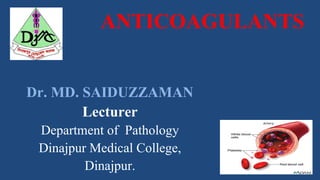
ANTICOAGULANTS
Dr. MD. SAIDUZZAMAN
Lecturer
Department of Pathology
Dinajpur Medical College,
Dinajpur.
• From ancient times, blood was called
“living force” of the body.
• Greeks and romans committed suicide
by letting out blood
• Early times, man recognised that loss
of blood is associated with weakness
and disease
Give me
Give meblood..
blood..Ha ha ha
Ha ha ha
Albert Hustin and Luis Agote
discover that
adding sodium citrate to blood
will prevent it from Clotting
ANTI COAGULATION!!!
Francis Peyton Rous and J R Turner
added glucose to sodium citrate;
allowed blood to be STORED for
sometime before transfusing
BLOOD PRESERVATION!!!
Why anticoagulants ?
Anticoalants are the drugs which are used to
prevent unwanted coagulation
Blood clots – Thrombus
Arterial Thrombosis:
Adherence of platelets to arterial walls – “White” in
color - Often associated with MI, stroke and ischemia
Why anticoagulants ?
Venous Thrombosis:
Develops in areas of stagnated blood flow (deep vein
thrombosis), “Red” in color- Associated with Congestive
Heart Failure, Cancer, Surgery
Thrombus dislodge from arteries and veins and
become an embolus
Venous emboli can block arterioles in the lung and
pulmonary circulation
Thromboembolism
Available Anticoagulants
1. Used in vitro (Outside the body): Citrate, oxalate,
EDTA , Heparin, dextran sulphate etc.
2. Used in vivo (inside the body):
Dicoumarol,Warfarin, Phenindione.
3. Both in Vitro & in Vivo: Heparin, dextran sulphate
etc.
Paul-Heller double salt mixture
Used in:
Haematological investigations
Biochemical investigations
3.8% Na-citrate
Used in:
ESR (Westergren method)
Coagulation test
EDTA (Ethylene diamine tetraacetic acid)
Used in:
Platelet count
Heparin
Used in:
Blood biochemistry
Gas analysis
Emergency test
Osmotic fragility
Immunophenotyping
Potassium oxalate
Used in:
Biochemical investigations
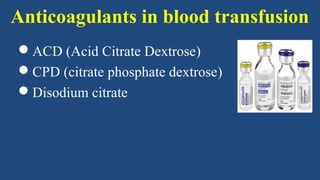
Anticoagulants in blood transfusion
ACD (Acid Citrate Dextrose)
CPD (citrate phosphate dextrose)
Disodium citrate
Anticoagulants in Pregnancy
Heparin due to it has no
teratogenicity
Chronology of Anticoagulants
YEAR PERSON ANTICOAGULANT REMARKS
1916 Rous and Turner Citrate dextrose RT soln 12 days
1943 Loutit and Mollison Acid citrate dextrose pH 5
1957 Gibson Citrate phosphate dextrose Prevents PO4
loss
1957 Gabrio Added nucleotides RBC metabolism
1968 Sheilds CPDA-1
1970 Beutler Additive solutions
1979 Hogman SAG 5 weeks storage
1980 Lovric CP2D (1 bag) + SAG (additive)⁰

Anticoagulants

  • 1.
    ANTICOAGULANTS Dr. MD. SAIDUZZAMAN Lecturer Departmentof Pathology Dinajpur Medical College, Dinajpur.
  • 2.
    • From ancienttimes, blood was called “living force” of the body. • Greeks and romans committed suicide by letting out blood • Early times, man recognised that loss of blood is associated with weakness and disease Give me Give meblood.. blood..Ha ha ha Ha ha ha
  • 3.
    Albert Hustin andLuis Agote discover that adding sodium citrate to blood will prevent it from Clotting ANTI COAGULATION!!!
  • 4.
    Francis Peyton Rousand J R Turner added glucose to sodium citrate; allowed blood to be STORED for sometime before transfusing BLOOD PRESERVATION!!!
  • 5.
    Why anticoagulants ? Anticoalantsare the drugs which are used to prevent unwanted coagulation Blood clots – Thrombus Arterial Thrombosis: Adherence of platelets to arterial walls – “White” in color - Often associated with MI, stroke and ischemia
  • 6.
    Why anticoagulants ? VenousThrombosis: Develops in areas of stagnated blood flow (deep vein thrombosis), “Red” in color- Associated with Congestive Heart Failure, Cancer, Surgery Thrombus dislodge from arteries and veins and become an embolus Venous emboli can block arterioles in the lung and pulmonary circulation Thromboembolism
  • 8.
    Available Anticoagulants 1. Usedin vitro (Outside the body): Citrate, oxalate, EDTA , Heparin, dextran sulphate etc. 2. Used in vivo (inside the body): Dicoumarol,Warfarin, Phenindione. 3. Both in Vitro & in Vivo: Heparin, dextran sulphate etc.
  • 10.
    Paul-Heller double saltmixture Used in: Haematological investigations Biochemical investigations
  • 11.
    3.8% Na-citrate Used in: ESR(Westergren method) Coagulation test
  • 12.
    EDTA (Ethylene diaminetetraacetic acid) Used in: Platelet count
  • 13.
    Heparin Used in: Blood biochemistry Gasanalysis Emergency test Osmotic fragility Immunophenotyping
  • 15.
  • 16.
    Anticoagulants in bloodtransfusion ACD (Acid Citrate Dextrose) CPD (citrate phosphate dextrose) Disodium citrate
  • 17.
    Anticoagulants in Pregnancy Heparindue to it has no teratogenicity
  • 18.
    Chronology of Anticoagulants YEARPERSON ANTICOAGULANT REMARKS 1916 Rous and Turner Citrate dextrose RT soln 12 days 1943 Loutit and Mollison Acid citrate dextrose pH 5 1957 Gibson Citrate phosphate dextrose Prevents PO4 loss 1957 Gabrio Added nucleotides RBC metabolism 1968 Sheilds CPDA-1 1970 Beutler Additive solutions 1979 Hogman SAG 5 weeks storage 1980 Lovric CP2D (1 bag) + SAG (additive)⁰