RAJIV GANDHI SCHEME
FOR EMPOWERMENT OF
 ADOLESCENT GIRLS
  (RGSEAG) ‘SABLA’
        – THE SCHEME

                       1
DEFINITION OF
            ADOLESCENT

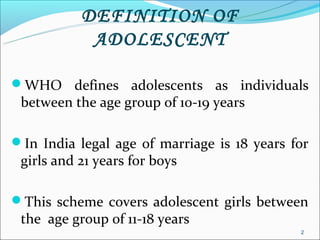
WHO defines adolescents as individuals
 between the age group of 10-19 years

In India legal age of marriage is 18 years for
 girls and 21 years for boys

This scheme covers adolescent girls between
 the age group of 11-18 years
                                             2
DEMOGRAPHIC PROFILE OF
   ADOLESCENT IN INDIA
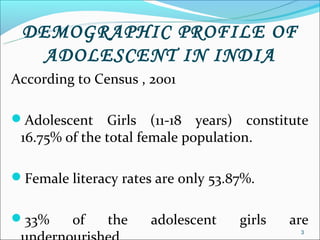
According to Census , 2001

Adolescent    Girls (11-18 years) constitute
 16.75% of the total female population.

Female literacy rates are only 53.87%.


33%     of    the    adolescent    girls   are
                                             3
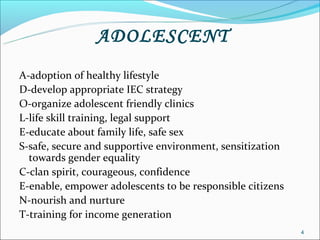
ADOLESCENT
A-adoption of healthy lifestyle
D-develop appropriate IEC strategy
O-organize adolescent friendly clinics
L-life skill training, legal support
E-educate about family life, safe sex
S-safe, secure and supportive environment, sensitization
  towards gender equality
C-clan spirit, courageous, confidence
E-enable, empower adolescents to be responsible citizens
N-nourish and nurture
T-training for income generation
                                                           4
WHY IS ADOLESCENCE A
 PERIOD OF SIGNIFICANCE
It is a significant period for physical, mental,
 emotional and psychological growth

During     this period, nutritional problems
 originating earlier can be partially corrected

It is a period to shape and consolidate healthy
 eating and lifestyle behaviour:        preventing
 nutrition related diseases in future
                                                     5
EARLIER INITIATIVES BY
      GOVERNMENT
KISHORI SHAKTI YOJANA, 2000 aimed to improve
 the nutritional and health status of adolescent girls
 and to equip them to improve and upgrade their
 home-based and vocational skills

NUTRITION      PROGRAMME FOR ADOLESCENT
 GIRLS (NPAG), 2002-03 identified 51 districts across
 the country to address the programme. Under this
 programme 6 kgs of free food grains per beneficiary
 per month are given to adolescent girls
                                                         6
OBJECTIVES OF SABLA
             SCHEME
1. Enable self-development and empowerment of AGs
2. Improve their nutrition and health status
3. Spread awareness among them about health, hygiene,
   nutrition, ARSH (Adolescent Reproductive and Sexual
   Health) and family and child care
4. Upgrade their home-based skills, life skills and
   vocational skills
5. Mainstream out of school AGs into formal/non formal
   education
6. Provide information/guidance about public services
   such as PHC, Post Office, Bank, Police Station


                                                     7
TARGET GROUP
The scheme covers all adolescent girls in the age group of
   11-18 years under all ICDS projects under two categories:
1. 11-14 years
2. 14-18 years


All out of school girls would assemble six days a week at
  AWC. Others school going girls would meet at the AWC
  at least twice a month and during vacation/holidays
  they will receive life skill education, nutrition and
  health education, awareness about other social-legal
  issues
                                                           8
SERVICES

1.   Nutrition Provision
2.   IFA supplementation
3.   Health check-up and Referral Services
4.   Nutrition & Health Education
5.   Counselling/Guidance on Family Welfare, ARSH,
     Child Care Practices and Home Management
6.   Life Skill Education and accessing public services
7.   Vocational training (for girls aged 16 and above) and
     skill development

                                                         9
NUTRITION
Each adolescent will be given 600 calories, 18-20
 grams of protein and micronutrients (approx. 1/3
 of RDA) per day for 300 days in year

Supplementary Nutrition will be provided in the
 form of hot cooked meal or Take Home Ration (as
 feasible)

COST: Cost will be Rs. 5/- per beneficiary per day

                                                     10
IFA SUPPLEMENTATION

IFA tablets will be distributed to adolescent girls on
 Kishori Diwas

The state can procure these supplements if Health
 Department is unable to do it under the scheme

Adolescent girls will be given information on food
 fortification, dietary diversification and advantages
 of weekly supplementation for combating IFA
 deficiency by ANM/AWW                               11
HEALTH CHECK-UP AND
     REFERRAL SERVICES
Kishori Diwas will be celebrated once in three
 months. On this day, a general health check-up will
 be done for all adolescent girls

Medical officer/ANM will provide de-worming
 tablets
Height and weight of the girls will be taken
Kishori cards will be prepared and maintained by
 marking major milestone

                                                  12
NUTRITION AND HEALTH EDUCATION
Nutrition and health education will be given in AWC jointly
 by ICDS, health functionaries and resource persons/ field
 trainers from NGO’s

Objectives :
Better health status of the girl
Leading to an overall improvement in the family health
Breaking the vicious integrated cycle of malnutrition

Education will include: safe drinking water, personal hygiene
  and sanitation, physical exercise, first-aid, balanced diet,
  increasing the nutrition value of locally available food,
  healthy cooking and eating habits, nutrition during various
  stages of life etc.
                                                           13
GUIDANCE ON FAMILY WELFARE,
ARSH, CHILDCARE PRACTICES AND
      HOME MANAGEMENT
This training will be provided at the AWC by the resource
 person from NGOs/CBO’s with the help of AWW,
 ASHA, ANM, and supervisor.

Age appropriate knowledge for 2 age groups of 11-14 and
 14-18 years with respect to reproductive cycle,
 HIV/AID’s, contraception. Right age of marriage and
 pregnancy, child care and feeding practices will be
 imparted

                                                      14
AND ACCESSING PUBLIC
           SERVICES
Life Skill Education- deals effectively with the demands
  and challenges of everyday life. The AGs will acquire
  knowledge and develop attitudes and skills which
  support and promote the adoption of healthy and
  positive behaviour in them

It will also include awareness talks and visits to public
  services and gathering information on the usage of it.
  The talks and visits will be arranged in collaboration
  with PRI members, NGOs, police personal, bank/post
  officials/health functionaries etc
                                                      15
VOCATIONAL TRAINING
It will be imparted to out of school girls above 16 years
  of age which will focus on non-hazardous income
  generating skills. Trades may include: book binding,
  health care, beauty culture, soft toys, mushroom
  cultivation, bio-fertilizers, repair and maintenance of
  watch, radio, TV etc.

The training will be given by Vocational Training
 Providers (VTPs) under various modules of National
 Skill Development programme (NSDP )
                                                      16
MODALITIES FOR
            IMPLEMENTATION

1.   Kishori Samooh: A group of 15-25 AGs will be formed
     at AWC headed by Sakhi and assisted by 2 Sahelis.
     Sakhi & Sahelis will be imparted training as per
     module to serve as peer educator for others

2. Training Kit: It will be provided at every AWC to assist
     AGs to understand various health, nutrition, social,
     legal issues by conducting activities. This kit will have
     games and activities so that girls enjoy while learning
                                                            17
3. Kishori Diwas: Kishori Diwas will be celebrated once in three
   months on this day a general health check-up will be done
   for all adolescent girls

4. Kishori Cards: This will be maintained at AWC which will
   contain information about weight, height, BMI, IFA
   supplementation, de-worming, immunization etc.

5. Personnel: CDPO will be in-charge of the implementation of
   scheme at the project level. At village level AWW will act as
   the facilitator of the scheme and would be assisted by AWH,
   Sakhi-Saheli and partnering NGOs/Community Base
   Organization(CBO)

6. Role of NGOs/CBOs: These institutes will be identified for
   imparting Nutrition and Health Education, Life Skill
   Education, Vocational Training etc.                     18
PATTERN AND FUNCTIONAL
       RESPONSIBLITY
RGSEAG will be a centrally sponsored scheme
MWCD will be responsible for budgetary control and
 administration of the scheme
At state level, the Secretary of Department of Women
 and Child Development/Social Welfare dealing with
 ICDS will be responsible for overall direction and
 implementation of the scheme
The scheme will be implemented through AWC which
 will be the focal point for the delivery of services. AWW
 will survey and register all adolescent girls and will
 advise them to come to AWC
The CDPO will be responsible for implementing the
 scheme at field level
                                                       19
COST OF THE PROJECT

Rs. 3.8 lakh per project per annum will be
 provided by Government of India to States/UTs
 that will include maintaining ARC, training kit,
 NHE, Life Skill Education, vocational training,
 IEC, Health Cards and Referral slips


                                                20
MONITORING, SUPERVISION
, RECORDS and EVALUATION
Monitoring & Supervision: will be set up under ICDS at
 national, state and community level

Records to be maintained: register has to be maintained
 at AWC by AWW with assistance of Sakhi/Saheli. The
 supervisor will randomly check records of girls for
 accuracy. Project wise physical and financial progress
 report on quarterly/annual basis will be consolidated by
 CDPO

Evaluation: may be carried out by states periodically to
 access the impact and take corrective measures
                                                      21
TRAINING
Capacity building of ICDS functionaries (CDPOs,
 Supervisors & AWWs ) for all round development
 of AGs will be carried out

Separate   training modules for ToTs, ICDS
 functionaries and identified AGs (Sakhi/Saheli)

NGOs may be involved in training of Sakhi/
 Sahelis

                                               22
COMMUNITY INVOLVEMENT
    AND AWARNESS
     GENERATION
Sensitization programmes for parents and
  adolescents (boys & girls), community may be
  taken up under IEC by involving NGOs/ Civil
  Society Organizations. This may be taken on
  Kishori Diwas

To achieve this, involvement of panchayats in
 improving the awareness level of the community
 would be desirable

                                              23
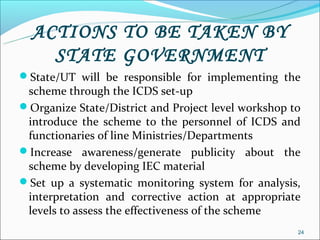
ACTIONS TO BE TAKEN BY
    STATE GOVERNMENT
State/UT will be responsible for implementing the
 scheme through the ICDS set-up
Organize State/District and Project level workshop to
 introduce the scheme to the personnel of ICDS and
 functionaries of line Ministries/Departments
Increase awareness/generate publicity about the
 scheme by developing IEC material
Set up a systematic monitoring system for analysis,
 interpretation and corrective action at appropriate
 levels to assess the effectiveness of the scheme
                                                     24
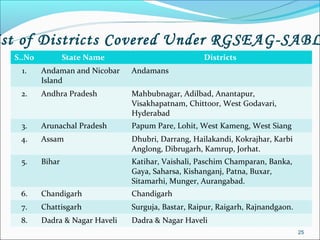
st of Districts Covered Under RGSEAG-SABL
 S..No           State Name                         Districts
  1.     Andaman and Nicobar    Andamans
         Island
  2.     Andhra Pradesh         Mahbubnagar, Adilbad, Anantapur,
                                Visakhapatnam, Chittoor, West Godavari,
                                Hyderabad
  3.     Arunachal Pradesh      Papum Pare, Lohit, West Kameng, West Siang
  4.     Assam                  Dhubri, Darrang, Hailakandi, Kokrajhar, Karbi
                                Anglong, Dibrugarh, Kamrup, Jorhat.
  5.     Bihar                  Katihar, Vaishali, Paschim Champaran, Banka,
                                Gaya, Saharsa, Kishanganj, Patna, Buxar,
                                Sitamarhi, Munger, Aurangabad.
  6.     Chandigarh             Chandigarh
  7.     Chattisgarh            Surguja, Bastar, Raipur, Raigarh, Rajnandgaon.
  8.     Dadra & Nagar Haveli   Dadra & Nagar Haveli
                                                                                 25
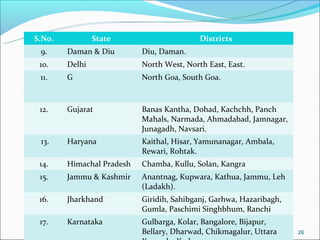
S.No.           State                      Districts
 9.     Daman & Diu        Diu, Daman.
 10.    Delhi              North West, North East, East.
 11.    G                  North Goa, South Goa.


 12.    Gujarat            Banas Kantha, Dohad, Kachchh, Panch
                           Mahals, Narmada, Ahmadabad, Jamnagar,
                           Junagadh, Navsari.
 13.    Haryana            Kaithal, Hisar, Yamunanagar, Ambala,
                           Rewari, Rohtak.
 14.    Himachal Pradesh   Chamba, Kullu, Solan, Kangra
 15.    Jammu & Kashmir    Anantnag, Kupwara, Kathua, Jammu, Leh
                           (Ladakh).
 16.    Jharkhand          Giridih, Sahibganj, Garhwa, Hazaribagh,
                           Gumla, Paschimi Singhbhum, Ranchi
 17.    Karnataka          Gulbarga, Kolar, Bangalore, Bijapur,
                           Bellary, Dharwad, Chikmagalur, Uttara     26
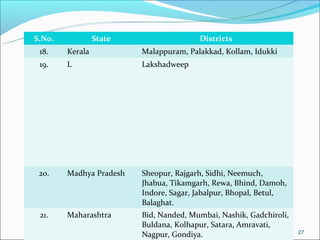
S.No.            State                  Districts
 18.    Kerala           Malappuram, Palakkad, Kollam, Idukki
 19.    L                Lakshadweep


 20.    Madhya Pradesh   Sheopur, Rajgarh, Sidhi, Neemuch,
                         Jhabua, Tikamgarh, Rewa, Bhind, Damoh,
                         Indore, Sagar, Jabalpur, Bhopal, Betul,
                         Balaghat.
 21.    Maharashtra      Bid, Nanded, Mumbai, Nashik, Gadchiroli,
                         Buldana, Kolhapur, Satara, Amravati,
                                                                    27
                         Nagpur, Gondiya.
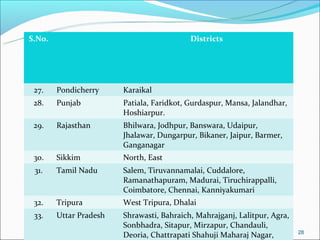
S.No.                                      Districts


 27.    Pondicherry     Karaikal
 28.    Punjab          Patiala, Faridkot, Gurdaspur, Mansa, Jalandhar,
                        Hoshiarpur.
 29.    Rajasthan       Bhilwara, Jodhpur, Banswara, Udaipur,
                        Jhalawar, Dungarpur, Bikaner, Jaipur, Barmer,
                        Ganganagar
 30.    Sikkim          North, East
 31.    Tamil Nadu      Salem, Tiruvannamalai, Cuddalore,
                        Ramanathapuram, Madurai, Tiruchirappalli,
                        Coimbatore, Chennai, Kanniyakumari
 32.    Tripura         West Tripura, Dhalai
 33.    Uttar Pradesh   Shrawasti, Bahraich, Mahrajganj, Lalitpur, Agra,
                        Sonbhadra, Sitapur, Mirzapur, Chandauli,
                                                                           28
                        Deoria, Chattrapati Shahuji Maharaj Nagar,
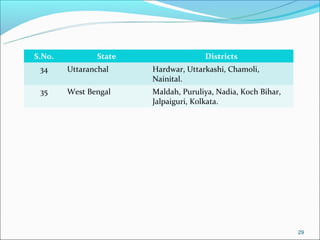
S.No.          State                 Districts
 34     Uttaranchal    Hardwar, Uttarkashi, Chamoli,
                       Nainital.
 35     West Bengal    Maldah, Puruliya, Nadia, Koch Bihar,
                       Jalpaiguri, Kolkata.


                                                              29
INDIRA GANDHI
 MATRITVA SAHyOG
 yOJANA (IGMSy) -A
CONDITIONAL MATERNITy BENEFIT (CMB)
             SCHEME
                                      30
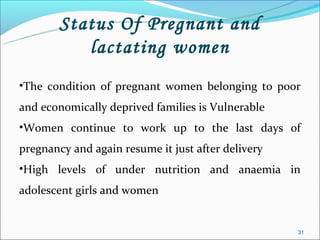
Status Of Pregnant and
           lactating women
•The condition of pregnant women belonging to poor
and economically deprived families is Vulnerable
•Women continue to work up to the last days of
pregnancy and again resume it just after delivery
•High levels of under nutrition and anaemia in
adolescent girls and women


                                                    31
• Under nutrition adolescent girls and women results in
 increased susceptibility to infections, slow recovery
 from illnesses, cumulative growth and development
 deficits   leading to   reduced productivity and     a
 heightened risk of adverse pregnancy outcomes for
 women


• Woman’s nutritional status has important implications
 for her health as well as the health and development of
 her children
                                                      32
• The pregnant and lactating mothers require greater
 nutritional support, access to health care services,
 enhanced food and nutrient intake, family care, skilled
 counselling support and a hygienic environment


• Therefore,   it   requires   multi-sectoral,   concerted,
 convergent and supportive actions


                                                         33
OBJECTIVES
To improve the health and nutrition status of pregnant,
lactating women and infants by:
•Promoting appropriate practices, care and service
utilization during pregnancy, safe delivery and lactation;
•Encouraging women to follow (optimal) IYCF practices
including early and exclusive breastfeeding for the first six
months;
•Contributing   to   better   enabling    environment        by
providing cash incentives for improved health and
nutrition to pregnant and nursing mothers                    34
TARGET GROUP

Pregnant Women of 19 years of age and above for first two
live births (benefit for still births will be as per the norms of
scheme)
All Government/PSUs (Central & State) employees will be
excluded from the scheme as they are entitled for paid
maternity leave.


                                                                35
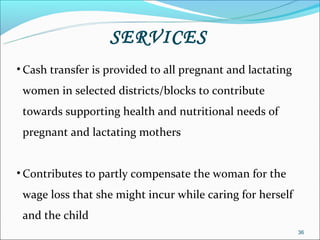
SERVICES
• Cash transfer is provided to all pregnant and lactating
 women in selected districts/blocks to contribute
 towards supporting health and nutritional needs of
 pregnant and lactating mothers


• Contributes to partly compensate the woman for the
 wage loss that she might incur while caring for herself
 and the child
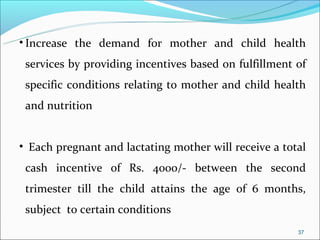
                                                            36
• Increase the demand for mother and child health
 services by providing incentives based on fulfillment of
 specific conditions relating to mother and child health
 and nutrition


• Each pregnant and lactating mother will receive a total
 cash incentive of Rs. 4000/- between the second
 trimester till the child attains the age of 6 months,
 subject to certain conditions
                                                       37
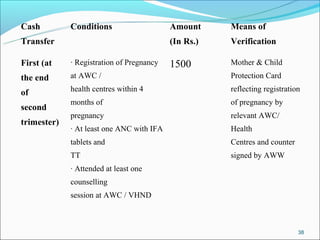
Cash         Conditions                    Amount     Means of
Transfer                                   (In Rs.)   Verification

First (at    · Registration of Pregnancy   1500       Mother & Child
the end      at AWC /                                 Protection Card

of           health centres within 4                  reflecting registration
             months of                                of pregnancy by
second
             pregnancy                                relevant AWC/
trimester)
             · At least one ANC with IFA              Health
             tablets and                              Centres and counter
             TT                                       signed by AWW
             · Attended at least one
             counselling
             session at AWC / VHND


                                                                            38
Cash        Conditions                      Amount     Means of
Transfer                                    (In Rs.)   Verification
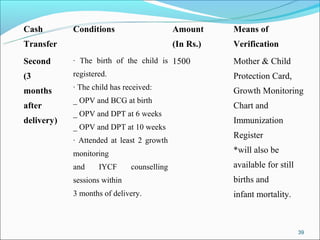
Second      · The birth of the child is 1500           Mother & Child
(3          registered.                                Protection Card,
months      · The child has received:                  Growth Monitoring
            _ OPV and BCG at birth
after                                                  Chart and
            _ OPV and DPT at 6 weeks
delivery)                                              Immunization
            _ OPV and DPT at 10 weeks
                                                       Register
            · Attended at least 2 growth
            monitoring                                 *will also be
            and     IYCF      counselling              available for still
            sessions within                            births and
            3 months of delivery.                      infant mortality.


                                                                             39
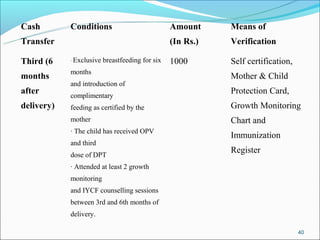
Cash        Conditions                            Amount     Means of
Transfer                                          (In Rs.)   Verification

Third (6    · Exclusive   breastfeeding for six   1000       Self certification,
            months
months                                                       Mother & Child
            and introduction of
after       complimentary
                                                             Protection Card,
delivery)   feeding as certified by the                      Growth Monitoring
            mother                                           Chart and
            · The child has received OPV
                                                             Immunization
            and third
            dose of DPT
                                                             Register
            · Attended at least 2 growth
            monitoring
            and IYCF counselling sessions
            between 3rd and 6th months of
            delivery.

                                                                                   40
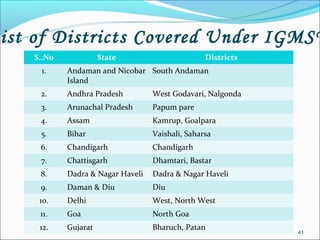
ist of Districts Covered Under IGMSY
   S..No             State                       Districts
    1.     Andaman and Nicobar South Andaman
           Island
    2.     Andhra Pradesh         West Godavari, Nalgonda
    3.     Arunachal Pradesh      Papum pare
    4.     Assam                  Kamrup, Goalpara
    5.     Bihar                  Vaishali, Saharsa
    6.     Chandigarh             Chandigarh
    7.     Chattisgarh            Dhamtari, Bastar
    8.     Dadra & Nagar Haveli   Dadra & Nagar Haveli
    9.     Daman & Diu            Diu
    10.    Delhi                  West, North West
    11.    Goa                    North Goa
    12.    Gujarat                Bharuch, Patan
                                                             41
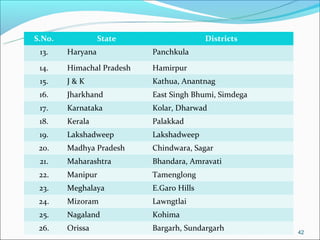
S.No.             State                   Districts
 13.    Haryana            Panchkula

 14.    Himachal Pradesh   Hamirpur
 15.    J&K                Kathua, Anantnag
 16.    Jharkhand          East Singh Bhumi, Simdega
 17.    Karnataka          Kolar, Dharwad
 18.    Kerala             Palakkad
 19.    Lakshadweep        Lakshadweep
 20.    Madhya Pradesh     Chindwara, Sagar
 21.    Maharashtra        Bhandara, Amravati
 22.    Manipur            Tamenglong
 23.    Meghalaya          E.Garo Hills
 24.    Mizoram            Lawngtlai
 25.    Nagaland           Kohima
 26.    Orissa             Bargarh, Sundargarh         42
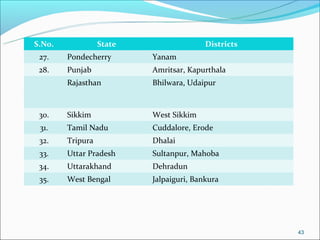
S.No.             State                  Districts
 27.    Pondecherry       Yanam
 28.    Punjab            Amritsar, Kapurthala
        Rajasthan         Bhilwara, Udaipur


 30.    Sikkim            West Sikkim
 31.    Tamil Nadu        Cuddalore, Erode
 32.    Tripura           Dhalai
 33.    Uttar Pradesh     Sultanpur, Mahoba
 34.    Uttarakhand       Dehradun
 35.    West Bengal       Jalpaiguri, Bankura


                                                     43
THANK YOU

            44

Sabla and igmsy

  • 1.
    RAJIV GANDHI SCHEME FOREMPOWERMENT OF ADOLESCENT GIRLS (RGSEAG) ‘SABLA’ – THE SCHEME 1
  • 2.
    DEFINITION OF ADOLESCENT WHO defines adolescents as individuals between the age group of 10-19 years In India legal age of marriage is 18 years for girls and 21 years for boys This scheme covers adolescent girls between the age group of 11-18 years 2
  • 3.
    DEMOGRAPHIC PROFILE OF ADOLESCENT IN INDIA According to Census , 2001 Adolescent Girls (11-18 years) constitute 16.75% of the total female population. Female literacy rates are only 53.87%. 33% of the adolescent girls are 3
  • 4.
    ADOLESCENT A-adoption of healthylifestyle D-develop appropriate IEC strategy O-organize adolescent friendly clinics L-life skill training, legal support E-educate about family life, safe sex S-safe, secure and supportive environment, sensitization towards gender equality C-clan spirit, courageous, confidence E-enable, empower adolescents to be responsible citizens N-nourish and nurture T-training for income generation 4
  • 5.
    WHY IS ADOLESCENCEA PERIOD OF SIGNIFICANCE It is a significant period for physical, mental, emotional and psychological growth During this period, nutritional problems originating earlier can be partially corrected It is a period to shape and consolidate healthy eating and lifestyle behaviour: preventing nutrition related diseases in future 5
  • 6.
    EARLIER INITIATIVES BY GOVERNMENT KISHORI SHAKTI YOJANA, 2000 aimed to improve the nutritional and health status of adolescent girls and to equip them to improve and upgrade their home-based and vocational skills NUTRITION PROGRAMME FOR ADOLESCENT GIRLS (NPAG), 2002-03 identified 51 districts across the country to address the programme. Under this programme 6 kgs of free food grains per beneficiary per month are given to adolescent girls 6
  • 7.
    OBJECTIVES OF SABLA SCHEME 1. Enable self-development and empowerment of AGs 2. Improve their nutrition and health status 3. Spread awareness among them about health, hygiene, nutrition, ARSH (Adolescent Reproductive and Sexual Health) and family and child care 4. Upgrade their home-based skills, life skills and vocational skills 5. Mainstream out of school AGs into formal/non formal education 6. Provide information/guidance about public services such as PHC, Post Office, Bank, Police Station 7
  • 8.
    TARGET GROUP The schemecovers all adolescent girls in the age group of 11-18 years under all ICDS projects under two categories: 1. 11-14 years 2. 14-18 years All out of school girls would assemble six days a week at AWC. Others school going girls would meet at the AWC at least twice a month and during vacation/holidays they will receive life skill education, nutrition and health education, awareness about other social-legal issues 8
  • 9.
    SERVICES 1. Nutrition Provision 2. IFA supplementation 3. Health check-up and Referral Services 4. Nutrition & Health Education 5. Counselling/Guidance on Family Welfare, ARSH, Child Care Practices and Home Management 6. Life Skill Education and accessing public services 7. Vocational training (for girls aged 16 and above) and skill development 9
  • 10.
    NUTRITION Each adolescent willbe given 600 calories, 18-20 grams of protein and micronutrients (approx. 1/3 of RDA) per day for 300 days in year Supplementary Nutrition will be provided in the form of hot cooked meal or Take Home Ration (as feasible) COST: Cost will be Rs. 5/- per beneficiary per day 10
  • 11.
    IFA SUPPLEMENTATION IFA tabletswill be distributed to adolescent girls on Kishori Diwas The state can procure these supplements if Health Department is unable to do it under the scheme Adolescent girls will be given information on food fortification, dietary diversification and advantages of weekly supplementation for combating IFA deficiency by ANM/AWW 11
  • 12.
    HEALTH CHECK-UP AND REFERRAL SERVICES Kishori Diwas will be celebrated once in three months. On this day, a general health check-up will be done for all adolescent girls Medical officer/ANM will provide de-worming tablets Height and weight of the girls will be taken Kishori cards will be prepared and maintained by marking major milestone 12
  • 13.
    NUTRITION AND HEALTHEDUCATION Nutrition and health education will be given in AWC jointly by ICDS, health functionaries and resource persons/ field trainers from NGO’s Objectives : Better health status of the girl Leading to an overall improvement in the family health Breaking the vicious integrated cycle of malnutrition Education will include: safe drinking water, personal hygiene and sanitation, physical exercise, first-aid, balanced diet, increasing the nutrition value of locally available food, healthy cooking and eating habits, nutrition during various stages of life etc. 13
  • 14.
    GUIDANCE ON FAMILYWELFARE, ARSH, CHILDCARE PRACTICES AND HOME MANAGEMENT This training will be provided at the AWC by the resource person from NGOs/CBO’s with the help of AWW, ASHA, ANM, and supervisor. Age appropriate knowledge for 2 age groups of 11-14 and 14-18 years with respect to reproductive cycle, HIV/AID’s, contraception. Right age of marriage and pregnancy, child care and feeding practices will be imparted 14
  • 15.
    AND ACCESSING PUBLIC SERVICES Life Skill Education- deals effectively with the demands and challenges of everyday life. The AGs will acquire knowledge and develop attitudes and skills which support and promote the adoption of healthy and positive behaviour in them It will also include awareness talks and visits to public services and gathering information on the usage of it. The talks and visits will be arranged in collaboration with PRI members, NGOs, police personal, bank/post officials/health functionaries etc 15
  • 16.
    VOCATIONAL TRAINING It willbe imparted to out of school girls above 16 years of age which will focus on non-hazardous income generating skills. Trades may include: book binding, health care, beauty culture, soft toys, mushroom cultivation, bio-fertilizers, repair and maintenance of watch, radio, TV etc. The training will be given by Vocational Training Providers (VTPs) under various modules of National Skill Development programme (NSDP ) 16
  • 17.
    MODALITIES FOR IMPLEMENTATION 1. Kishori Samooh: A group of 15-25 AGs will be formed at AWC headed by Sakhi and assisted by 2 Sahelis. Sakhi & Sahelis will be imparted training as per module to serve as peer educator for others 2. Training Kit: It will be provided at every AWC to assist AGs to understand various health, nutrition, social, legal issues by conducting activities. This kit will have games and activities so that girls enjoy while learning 17
  • 18.
    3. Kishori Diwas:Kishori Diwas will be celebrated once in three months on this day a general health check-up will be done for all adolescent girls 4. Kishori Cards: This will be maintained at AWC which will contain information about weight, height, BMI, IFA supplementation, de-worming, immunization etc. 5. Personnel: CDPO will be in-charge of the implementation of scheme at the project level. At village level AWW will act as the facilitator of the scheme and would be assisted by AWH, Sakhi-Saheli and partnering NGOs/Community Base Organization(CBO) 6. Role of NGOs/CBOs: These institutes will be identified for imparting Nutrition and Health Education, Life Skill Education, Vocational Training etc. 18
  • 19.
    PATTERN AND FUNCTIONAL RESPONSIBLITY RGSEAG will be a centrally sponsored scheme MWCD will be responsible for budgetary control and administration of the scheme At state level, the Secretary of Department of Women and Child Development/Social Welfare dealing with ICDS will be responsible for overall direction and implementation of the scheme The scheme will be implemented through AWC which will be the focal point for the delivery of services. AWW will survey and register all adolescent girls and will advise them to come to AWC The CDPO will be responsible for implementing the scheme at field level 19
  • 20.
    COST OF THEPROJECT Rs. 3.8 lakh per project per annum will be provided by Government of India to States/UTs that will include maintaining ARC, training kit, NHE, Life Skill Education, vocational training, IEC, Health Cards and Referral slips 20
  • 21.
    MONITORING, SUPERVISION , RECORDSand EVALUATION Monitoring & Supervision: will be set up under ICDS at national, state and community level Records to be maintained: register has to be maintained at AWC by AWW with assistance of Sakhi/Saheli. The supervisor will randomly check records of girls for accuracy. Project wise physical and financial progress report on quarterly/annual basis will be consolidated by CDPO Evaluation: may be carried out by states periodically to access the impact and take corrective measures 21
  • 22.
    TRAINING Capacity building ofICDS functionaries (CDPOs, Supervisors & AWWs ) for all round development of AGs will be carried out Separate training modules for ToTs, ICDS functionaries and identified AGs (Sakhi/Saheli) NGOs may be involved in training of Sakhi/ Sahelis 22
  • 23.
    COMMUNITY INVOLVEMENT AND AWARNESS GENERATION Sensitization programmes for parents and adolescents (boys & girls), community may be taken up under IEC by involving NGOs/ Civil Society Organizations. This may be taken on Kishori Diwas To achieve this, involvement of panchayats in improving the awareness level of the community would be desirable 23
  • 24.
    ACTIONS TO BETAKEN BY STATE GOVERNMENT State/UT will be responsible for implementing the scheme through the ICDS set-up Organize State/District and Project level workshop to introduce the scheme to the personnel of ICDS and functionaries of line Ministries/Departments Increase awareness/generate publicity about the scheme by developing IEC material Set up a systematic monitoring system for analysis, interpretation and corrective action at appropriate levels to assess the effectiveness of the scheme 24
  • 25.
    st of DistrictsCovered Under RGSEAG-SABL S..No State Name Districts 1. Andaman and Nicobar Andamans Island 2. Andhra Pradesh Mahbubnagar, Adilbad, Anantapur, Visakhapatnam, Chittoor, West Godavari, Hyderabad 3. Arunachal Pradesh Papum Pare, Lohit, West Kameng, West Siang 4. Assam Dhubri, Darrang, Hailakandi, Kokrajhar, Karbi Anglong, Dibrugarh, Kamrup, Jorhat. 5. Bihar Katihar, Vaishali, Paschim Champaran, Banka, Gaya, Saharsa, Kishanganj, Patna, Buxar, Sitamarhi, Munger, Aurangabad. 6. Chandigarh Chandigarh 7. Chattisgarh Surguja, Bastar, Raipur, Raigarh, Rajnandgaon. 8. Dadra & Nagar Haveli Dadra & Nagar Haveli 25
  • 26.
    S.No. State Districts 9. Daman & Diu Diu, Daman. 10. Delhi North West, North East, East. 11. G North Goa, South Goa. 12. Gujarat Banas Kantha, Dohad, Kachchh, Panch Mahals, Narmada, Ahmadabad, Jamnagar, Junagadh, Navsari. 13. Haryana Kaithal, Hisar, Yamunanagar, Ambala, Rewari, Rohtak. 14. Himachal Pradesh Chamba, Kullu, Solan, Kangra 15. Jammu & Kashmir Anantnag, Kupwara, Kathua, Jammu, Leh (Ladakh). 16. Jharkhand Giridih, Sahibganj, Garhwa, Hazaribagh, Gumla, Paschimi Singhbhum, Ranchi 17. Karnataka Gulbarga, Kolar, Bangalore, Bijapur, Bellary, Dharwad, Chikmagalur, Uttara 26
  • 27.
    S.No. State Districts 18. Kerala Malappuram, Palakkad, Kollam, Idukki 19. L Lakshadweep 20. Madhya Pradesh Sheopur, Rajgarh, Sidhi, Neemuch, Jhabua, Tikamgarh, Rewa, Bhind, Damoh, Indore, Sagar, Jabalpur, Bhopal, Betul, Balaghat. 21. Maharashtra Bid, Nanded, Mumbai, Nashik, Gadchiroli, Buldana, Kolhapur, Satara, Amravati, 27 Nagpur, Gondiya.
  • 28.
    S.No. Districts 27. Pondicherry Karaikal 28. Punjab Patiala, Faridkot, Gurdaspur, Mansa, Jalandhar, Hoshiarpur. 29. Rajasthan Bhilwara, Jodhpur, Banswara, Udaipur, Jhalawar, Dungarpur, Bikaner, Jaipur, Barmer, Ganganagar 30. Sikkim North, East 31. Tamil Nadu Salem, Tiruvannamalai, Cuddalore, Ramanathapuram, Madurai, Tiruchirappalli, Coimbatore, Chennai, Kanniyakumari 32. Tripura West Tripura, Dhalai 33. Uttar Pradesh Shrawasti, Bahraich, Mahrajganj, Lalitpur, Agra, Sonbhadra, Sitapur, Mirzapur, Chandauli, 28 Deoria, Chattrapati Shahuji Maharaj Nagar,
  • 29.
    S.No. State Districts 34 Uttaranchal Hardwar, Uttarkashi, Chamoli, Nainital. 35 West Bengal Maldah, Puruliya, Nadia, Koch Bihar, Jalpaiguri, Kolkata. 29
  • 30.
    INDIRA GANDHI MATRITVASAHyOG yOJANA (IGMSy) -A CONDITIONAL MATERNITy BENEFIT (CMB) SCHEME 30
  • 31.
    Status Of Pregnantand lactating women •The condition of pregnant women belonging to poor and economically deprived families is Vulnerable •Women continue to work up to the last days of pregnancy and again resume it just after delivery •High levels of under nutrition and anaemia in adolescent girls and women 31
  • 32.
    • Under nutritionadolescent girls and women results in increased susceptibility to infections, slow recovery from illnesses, cumulative growth and development deficits leading to reduced productivity and a heightened risk of adverse pregnancy outcomes for women • Woman’s nutritional status has important implications for her health as well as the health and development of her children 32
  • 33.
    • The pregnantand lactating mothers require greater nutritional support, access to health care services, enhanced food and nutrient intake, family care, skilled counselling support and a hygienic environment • Therefore, it requires multi-sectoral, concerted, convergent and supportive actions 33
  • 34.
    OBJECTIVES To improve thehealth and nutrition status of pregnant, lactating women and infants by: •Promoting appropriate practices, care and service utilization during pregnancy, safe delivery and lactation; •Encouraging women to follow (optimal) IYCF practices including early and exclusive breastfeeding for the first six months; •Contributing to better enabling environment by providing cash incentives for improved health and nutrition to pregnant and nursing mothers 34
  • 35.
    TARGET GROUP Pregnant Womenof 19 years of age and above for first two live births (benefit for still births will be as per the norms of scheme) All Government/PSUs (Central & State) employees will be excluded from the scheme as they are entitled for paid maternity leave. 35
  • 36.
    SERVICES • Cash transferis provided to all pregnant and lactating women in selected districts/blocks to contribute towards supporting health and nutritional needs of pregnant and lactating mothers • Contributes to partly compensate the woman for the wage loss that she might incur while caring for herself and the child 36
  • 37.
    • Increase thedemand for mother and child health services by providing incentives based on fulfillment of specific conditions relating to mother and child health and nutrition • Each pregnant and lactating mother will receive a total cash incentive of Rs. 4000/- between the second trimester till the child attains the age of 6 months, subject to certain conditions 37
  • 38.
    Cash Conditions Amount Means of Transfer (In Rs.) Verification First (at · Registration of Pregnancy 1500 Mother & Child the end at AWC / Protection Card of health centres within 4 reflecting registration months of of pregnancy by second pregnancy relevant AWC/ trimester) · At least one ANC with IFA Health tablets and Centres and counter TT signed by AWW · Attended at least one counselling session at AWC / VHND 38
  • 39.
    Cash Conditions Amount Means of Transfer (In Rs.) Verification Second · The birth of the child is 1500 Mother & Child (3 registered. Protection Card, months · The child has received: Growth Monitoring _ OPV and BCG at birth after Chart and _ OPV and DPT at 6 weeks delivery) Immunization _ OPV and DPT at 10 weeks Register · Attended at least 2 growth monitoring *will also be and IYCF counselling available for still sessions within births and 3 months of delivery. infant mortality. 39
  • 40.
    Cash Conditions Amount Means of Transfer (In Rs.) Verification Third (6 · Exclusive breastfeeding for six 1000 Self certification, months months Mother & Child and introduction of after complimentary Protection Card, delivery) feeding as certified by the Growth Monitoring mother Chart and · The child has received OPV Immunization and third dose of DPT Register · Attended at least 2 growth monitoring and IYCF counselling sessions between 3rd and 6th months of delivery. 40
  • 41.
    ist of DistrictsCovered Under IGMSY S..No State Districts 1. Andaman and Nicobar South Andaman Island 2. Andhra Pradesh West Godavari, Nalgonda 3. Arunachal Pradesh Papum pare 4. Assam Kamrup, Goalpara 5. Bihar Vaishali, Saharsa 6. Chandigarh Chandigarh 7. Chattisgarh Dhamtari, Bastar 8. Dadra & Nagar Haveli Dadra & Nagar Haveli 9. Daman & Diu Diu 10. Delhi West, North West 11. Goa North Goa 12. Gujarat Bharuch, Patan 41
  • 42.
    S.No. State Districts 13. Haryana Panchkula 14. Himachal Pradesh Hamirpur 15. J&K Kathua, Anantnag 16. Jharkhand East Singh Bhumi, Simdega 17. Karnataka Kolar, Dharwad 18. Kerala Palakkad 19. Lakshadweep Lakshadweep 20. Madhya Pradesh Chindwara, Sagar 21. Maharashtra Bhandara, Amravati 22. Manipur Tamenglong 23. Meghalaya E.Garo Hills 24. Mizoram Lawngtlai 25. Nagaland Kohima 26. Orissa Bargarh, Sundargarh 42
  • 43.
    S.No. State Districts 27. Pondecherry Yanam 28. Punjab Amritsar, Kapurthala Rajasthan Bhilwara, Udaipur 30. Sikkim West Sikkim 31. Tamil Nadu Cuddalore, Erode 32. Tripura Dhalai 33. Uttar Pradesh Sultanpur, Mahoba 34. Uttarakhand Dehradun 35. West Bengal Jalpaiguri, Bankura 43
  • 44.