Q.1
Ans. (A) List of Important Banking Terminology.
ATM (Automatic Teller Machines):
They are machines that dispense cash, receive cash, accept cheques,and give balance
detailsand mini statements to the customers through Computer network
Banc assurance:
It is the distribution of insurance productsand the insurance policies of insurance
companiesby banksas corporate agentsthrough their branches. Banks charge a fee
for this service from insurance companies
Bouncing of a cheque:
When an account has insufficient funds the cheque is not payable and is returned by
the bank with a reason “Exceeds arrangement” or “funds insufficient”.
Bank Account:
It is account of nominal interest which can only be used for personal purpose and which
Has some restrictionson withdrawal
Bank Rate:
It is the rate of interest charged by a central bank to commercial banks on the advances
and the loansit extends.
Base rate:
It is the rate of interest on which banksbase their lending rates. Usually loans are given
At a rate higherthan the base rates and saving rate is below the base rate
Basis Point:
One-hundredth of 1% point normally used for indicating cost of finance
Call Money:
It is a loan that is made for a very short period of a few days only with a low rate of
Interest
Cheque:
It is written by an individual to transfer amount between two accounts of the same bank
or a different bank and the money is withdrawn from the account.
Core Banking:
It is a general term used to describe the services provided by a group of networked
bank branches
Core Banking Solutions (CBS):
In this all the branchesof the bank are connected together and the customer can
Access his/herfunds or transactionsfrom any other branch.
CRR (Cash Reverse Ratio):
the amount of funds that a bank keep with the RBI. If the percentage of CRR increases
then the amount with the bank comes down.
Current Account:
It is an account that can be opened generally for business purposes with no restrictions
on withdrawalsand no interest paid
Debit Card:
It is a card issued by the bank so the customers can withdraw their money from their
account electronically.
Demat Account:
The way in which a bank keepsmoney in a deposit account in the same way the
Depository Company converts share certificates into electronic form and keep them in a
Demat account.
Dishonour of Cheque:
Non-payment of a cheque by the paying banker with a return memo giving reasons for
the non-payment
E-Banking:
It is a type of banking in which we can conduct financial transactions electronically.
RTGS, Credit cards, Debit cards etc come under this category.
EFT – (Electronic Fund Transfer):
In this we use Automatic teller machine, wire transfer and computers to move funds
between different accountsin different or same bank.
Fiscal Deficit:
It is the amount of Funds borrowed by the government to meet the expenditures.
Inflation:
It is an increase in the quantity of money in circulation without any corresponding
increase in goodsthus leading to an abnormal rise in the price level
Initial Public Offering (IPO):
It is the time when a company makesthe first offering of the shares to the public.
Kiosk Banking:
Doing banking from a cubicle from which food, newspapers,tickets,etc are also sold
Leverage Ratio:
It is a financial ratio which gives us an idea or a measure of a company’s ability to meet
its financial losses.
Liquidity:
It is the ability of converting an investment quickly into cash with no loss in value.
Market Capitalization:
The product of the share price and number of the company’s outstanding ordinary
shares.
Mortgage:
It is a kind of security which one offers for taking an advance or loan from someone.
Mutual Fund:
These are investment schemes. It poolsmoney from various investors in order to
purchase securities.
Monetary Policy:
it refers to the Central Government policy with respect to the quantity of money in the
economy, the rate of interest and the exchange rate
Non-bank ATM / White labeled ATM:
An ATM or cash machine that does not prominently display a bank’s name or logo.A
fee will be charged for cash withdrawalsin these ATMs and they don’t accept deposits
Non-performing Assets (NPAs):
NPA or non-performing loansare loansgiven by a bank on which repayments or
interest payments are not being made on time
Permanent Account Number (PAN):
PAN is a number issued by the Income Tax Department to their tax payers.
Plastic Money:
Plastic money is a name given to Credit cards, Debit cards, ATM cards anf International
Cards issued by banks
Point of Sale (PoS):
PoS refers to a location at which a payment of a card transaction occurs
Prime Lending Rate (PLR):
Rate of interest at which a bank givesloan to its most reliable customer i.e., customer
with ‘zero risk’
Pass Book:
It is a book where all the bank transactionsare recorded.They are mainly issued to
Current or SavingsBank account holders.
Repo Rate:
Commercial banksborrow funds by the RBI if there is any shortage in the form of
rupees. If thisrate increases it becomes expensive to borrow money from RBI and vice
versa.
Reverse Repo Rate:
It is the exact opposite of repo rate. It is the rate at which RBI borrows money from
bankswhen it feels there is too much money floating in the banking system
Special Drawing Rights (SDR):
It is a reserve asset (Paper Gold) created within the framework of the International
Monetary Fund in an attempt to increase international liquidity
SLR (Statutory Liquidity Ratio):
It is amount that a commercial bank should have before giving credits to its customers
which should be eitherin the form of gold,money or bonds.
Teller:
He/she is a staff member of the bank who cashes cheques, accepts deposits and
perform different banking servicesfor the general mass.
Universal Banking:
When financial institutionsand banksundertake activities related to banking like
investment, issue of debit and credit card etc then it is known as universal banking.
Virtual Banking:
Internet banking issometimes known asvirtual banking.It is called so because it has no
bricksand boundaries.It is controlled by the World Wide Web.
Wholesale Banking:
It is similar to retail banking with a slight difference that it mainly focuses on the financial
needs of the institutional clientsand the industry.
Zero Coupon Bond:
It is a bond that is sold at good discount as it has no coupon.
(B) Difference in mobile banking and IMPS.
BASIS FOR
COMPARISON
MOBILE BANKING INTERNET BANKING
Meaning Mobile banking refers to an internet
based facility provided by banks that
enables the customers to execute bank
transactions, via cellular devices.
Internet banking implies a service that
allows the customers to conduct the
financial transactions electronically,
with the use of internet.
Device Mobilesor Tablets Computers or Laptops
Uses Short message service, mobile
applicationorwebsite
Bank's website
Fund transfer Through NEFT or RTGS Through NEFT, RTGS or IMPS
Functions Limited Comparatively more
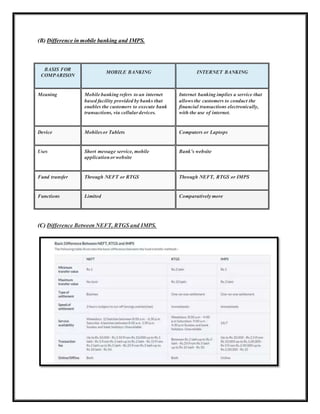
(C) Difference Between NEFT, RTGS and IMPS.

Important words for banking terminology

  • 1.
    Q.1 Ans. (A) Listof Important Banking Terminology. ATM (Automatic Teller Machines): They are machines that dispense cash, receive cash, accept cheques,and give balance detailsand mini statements to the customers through Computer network Banc assurance: It is the distribution of insurance productsand the insurance policies of insurance companiesby banksas corporate agentsthrough their branches. Banks charge a fee for this service from insurance companies Bouncing of a cheque: When an account has insufficient funds the cheque is not payable and is returned by the bank with a reason “Exceeds arrangement” or “funds insufficient”. Bank Account: It is account of nominal interest which can only be used for personal purpose and which Has some restrictionson withdrawal Bank Rate: It is the rate of interest charged by a central bank to commercial banks on the advances and the loansit extends.
  • 2.
    Base rate: It isthe rate of interest on which banksbase their lending rates. Usually loans are given At a rate higherthan the base rates and saving rate is below the base rate Basis Point: One-hundredth of 1% point normally used for indicating cost of finance Call Money: It is a loan that is made for a very short period of a few days only with a low rate of Interest Cheque: It is written by an individual to transfer amount between two accounts of the same bank or a different bank and the money is withdrawn from the account. Core Banking: It is a general term used to describe the services provided by a group of networked bank branches Core Banking Solutions (CBS): In this all the branchesof the bank are connected together and the customer can Access his/herfunds or transactionsfrom any other branch. CRR (Cash Reverse Ratio): the amount of funds that a bank keep with the RBI. If the percentage of CRR increases then the amount with the bank comes down. Current Account: It is an account that can be opened generally for business purposes with no restrictions on withdrawalsand no interest paid Debit Card: It is a card issued by the bank so the customers can withdraw their money from their account electronically. Demat Account: The way in which a bank keepsmoney in a deposit account in the same way the
  • 3.
    Depository Company convertsshare certificates into electronic form and keep them in a Demat account. Dishonour of Cheque: Non-payment of a cheque by the paying banker with a return memo giving reasons for the non-payment E-Banking: It is a type of banking in which we can conduct financial transactions electronically. RTGS, Credit cards, Debit cards etc come under this category. EFT – (Electronic Fund Transfer): In this we use Automatic teller machine, wire transfer and computers to move funds between different accountsin different or same bank. Fiscal Deficit: It is the amount of Funds borrowed by the government to meet the expenditures. Inflation: It is an increase in the quantity of money in circulation without any corresponding increase in goodsthus leading to an abnormal rise in the price level Initial Public Offering (IPO): It is the time when a company makesthe first offering of the shares to the public. Kiosk Banking: Doing banking from a cubicle from which food, newspapers,tickets,etc are also sold Leverage Ratio: It is a financial ratio which gives us an idea or a measure of a company’s ability to meet its financial losses. Liquidity: It is the ability of converting an investment quickly into cash with no loss in value. Market Capitalization: The product of the share price and number of the company’s outstanding ordinary shares.
  • 4.
    Mortgage: It is akind of security which one offers for taking an advance or loan from someone. Mutual Fund: These are investment schemes. It poolsmoney from various investors in order to purchase securities. Monetary Policy: it refers to the Central Government policy with respect to the quantity of money in the economy, the rate of interest and the exchange rate Non-bank ATM / White labeled ATM: An ATM or cash machine that does not prominently display a bank’s name or logo.A fee will be charged for cash withdrawalsin these ATMs and they don’t accept deposits Non-performing Assets (NPAs): NPA or non-performing loansare loansgiven by a bank on which repayments or interest payments are not being made on time Permanent Account Number (PAN): PAN is a number issued by the Income Tax Department to their tax payers. Plastic Money: Plastic money is a name given to Credit cards, Debit cards, ATM cards anf International Cards issued by banks Point of Sale (PoS): PoS refers to a location at which a payment of a card transaction occurs Prime Lending Rate (PLR): Rate of interest at which a bank givesloan to its most reliable customer i.e., customer with ‘zero risk’ Pass Book: It is a book where all the bank transactionsare recorded.They are mainly issued to Current or SavingsBank account holders. Repo Rate:
  • 5.
    Commercial banksborrow fundsby the RBI if there is any shortage in the form of rupees. If thisrate increases it becomes expensive to borrow money from RBI and vice versa. Reverse Repo Rate: It is the exact opposite of repo rate. It is the rate at which RBI borrows money from bankswhen it feels there is too much money floating in the banking system Special Drawing Rights (SDR): It is a reserve asset (Paper Gold) created within the framework of the International Monetary Fund in an attempt to increase international liquidity SLR (Statutory Liquidity Ratio): It is amount that a commercial bank should have before giving credits to its customers which should be eitherin the form of gold,money or bonds. Teller: He/she is a staff member of the bank who cashes cheques, accepts deposits and perform different banking servicesfor the general mass. Universal Banking: When financial institutionsand banksundertake activities related to banking like investment, issue of debit and credit card etc then it is known as universal banking. Virtual Banking: Internet banking issometimes known asvirtual banking.It is called so because it has no bricksand boundaries.It is controlled by the World Wide Web. Wholesale Banking: It is similar to retail banking with a slight difference that it mainly focuses on the financial needs of the institutional clientsand the industry. Zero Coupon Bond: It is a bond that is sold at good discount as it has no coupon.
  • 6.
    (B) Difference inmobile banking and IMPS. BASIS FOR COMPARISON MOBILE BANKING INTERNET BANKING Meaning Mobile banking refers to an internet based facility provided by banks that enables the customers to execute bank transactions, via cellular devices. Internet banking implies a service that allows the customers to conduct the financial transactions electronically, with the use of internet. Device Mobilesor Tablets Computers or Laptops Uses Short message service, mobile applicationorwebsite Bank's website Fund transfer Through NEFT or RTGS Through NEFT, RTGS or IMPS Functions Limited Comparatively more (C) Difference Between NEFT, RTGS and IMPS.