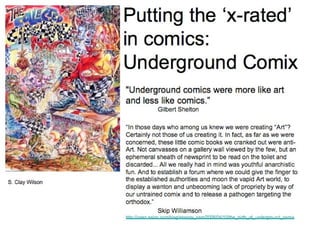
Putting the ‘x-rated’ in comics: Underground Comix "Underground comics were more like art and less like comics.”   Gilbert Shelton  “ In those days who among us knew we were creating “Art”? Certainly not those of us creating it. In fact, as far as we were concerned, these little comic books we cranked out were anti-Art. Not canvasses on a gallery wall viewed by the few, but an ephemeral sheath of newsprint to be read on the toilet and discarded... All we really had in mind was youthful anarchistic fun. And to establish a forum where we could give the finger to the established authorities and moon the vapid Art world, to display a wanton and unbecoming lack of propriety by way of our untrained comix and to release a pathogen targeting the orthodox.” Skip Williamson  http://open.salon.com/blog/snappy_sam/2009/04/10/the_birth_of_underground_comix S. Clay Wilson
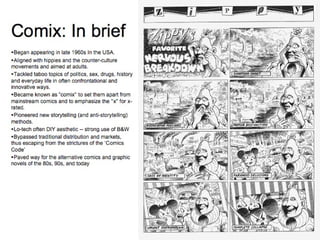
Comix: In brief Began appearing in late 1960s In the USA. Aligned with hippies and the counter-culture movements and aimed at adults. Tackled taboo topics of politics, sex, drugs, history and everyday life in often confrontational and innovative ways. Became known as "comix" to set them apart from mainstream comics and to emphasize the "x" for x-rated. Pioneered new storytelling (and anti-storytelling) methods. Lo-tech often DIY aesthetic -- strong use of B&W Bypassed traditional distribution and markets, thus escaping from the strictures of the ‘Comics Code’ Paved way for the alternative comics and graphic novels of the 80s, 90s, and today
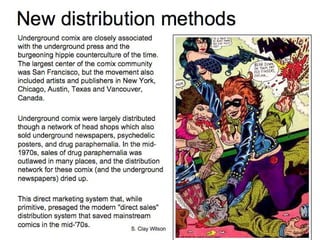
New distribution methods Underground comix are closely associated with the underground press and the burgeoning hippie counterculture of the time. The largest center of the comix community was San Francisco, but the movement also included artists and publishers in New York, Chicago, Austin, Texas and Vancouver, Canada. Underground comix were largely distributed though a network of head shops which also sold underground newspapers, psychedelic posters, and drug paraphernalia. In the mid-1970s, sales of drug paraphernalia was outlawed in many places, and the distribution network for these comix (and the underground newspapers) dried up.  This direct marketing system that, while primitive, presaged the modern "direct sales" distribution system that saved mainstream comics in the mid-'70s.  S. Clay Wilson
New production methods In the USA, comics were traditionally produced industrially; i.e each element (writing, penciling, inking, lettering, etc) was handled by a separate individual.  Underground comix, by contrast, were often completely produced (and often published and distributed) by one artist. In an era when very few mainstream artists or writers were granted ownership of their material, this meant the men and women who created the undergrounds usually retained ownership of their characters.  Without them, the face of the "independent comics movement" of the late 1970s and early '80s -- as well as the "adult" comics scene that blossomed in Europe at roughly the same time -- would have been far different. Vaughn Bodé
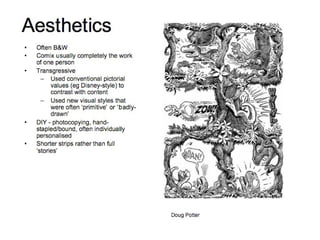
Aesthetics Often B&W Comix usually completely the work of one person Transgressive Used conventional pictorial values (eg Disney-style) to contrast with content Used new visual styles that were often ‘primitive’ or ‘badly-drawn’ DIY - photocopying, hand-stapled/bound, often individually personalised Shorter strips rather than full ‘stories’ Doug Potter
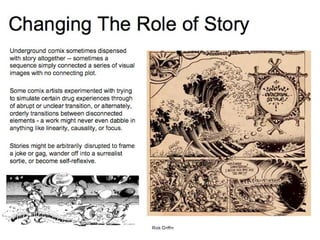
Changing The Role of Story Underground comix sometimes dispensed with story altogether -- sometimes a sequence simply connected a series of visual images with no connecting plot. Some comix artists experimented with trying to simulate certain drug experiences through of abrupt or unclear transition, or alternately, orderly transitions between disconnected elements - a work might never even dabble in anything like linearity, causality, or focus. Stories might be arbitrarily disrupted to frame a joke or gag, wander off into a surrealist sortie, or become self-reflexive. Rick Griffin
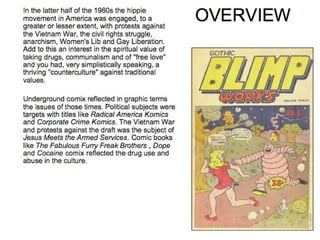
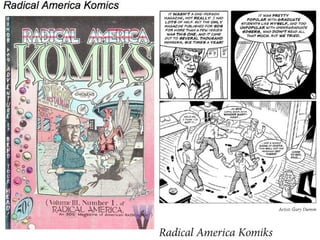
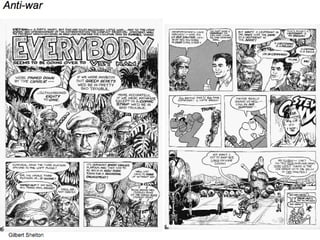
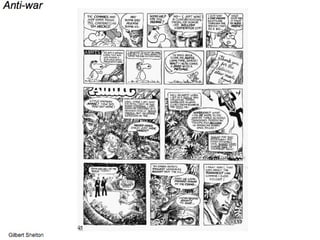
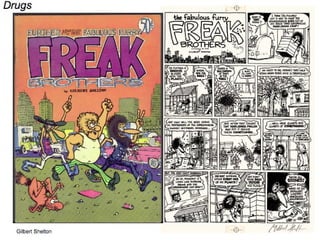
In the latter half of the 1960s the hippie movement in America was engaged, to a greater or lesser extent, with protests against the Vietnam War, the civil rights struggle, anarchism, Women's Lib and Gay Liberation. Add to this an interest in the spiritual value of taking drugs, communalism and of "free love" and you had, very simplistically speaking, a thriving "counterculture" against traditional values. Underground comix reflected in graphic terms the issues of those times. Political subjects were targets with titles like  Radical America Komics  and  Corporate Crime Komics . The Vietnam War and protests against the draft was the subject of  Jesus Meets the Armed Services . Comic books like  The Fabulous Furry Freak Brothers  ,  Dope  and  Cocaine  comix reflected the drug use and abuse in the culture.  OVERVIEW
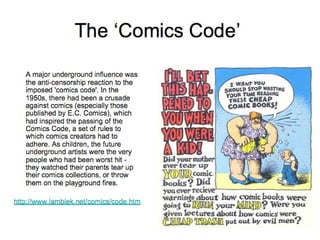
The ‘Comics Code’ A major underground influence was the anti-censorship reaction to the imposed 'comics code'. In the 1950s, there had been a crusade against comics (especially those published by E.C. Comics), which had inspired the passing of the Comics Code, a set of rules to which comics creators had to adhere. As children, the future underground artists were the very people who had been worst hit - they watched their parents tear up their comics collections, or throw them on the playground fires.  http://www.lambiek.net/comics/code.htm
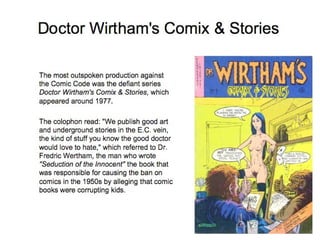
Doctor Wirtham's Comix & Stories The most outspoken production against the Comic Code was the defiant series  Doctor Wirtham's Comix & Stories , which appeared around 1977.  The colophon read: "We publish good art and underground stories in the E.C. vein, the kind of stuff you know the good doctor would love to hate," which referred to Dr. Fredric Wertham, the man who wrote  "Seduction of the Innocent"  the book that was responsible for causing the ban on comics in the 1950s by alleging that comic books were corrupting kids.
Mad Magazine One of the most important precursors and influences on underground comix was  Mad  which was EC’s response to the its targeting by the Comics Code. EC Comics had been a specific target during the moral pogrom against comics. Inarguably filled to the brim with graphic gore, suggestive story lines, violence, drugs and sadism, EC could not get its books distributed after the Comics Code was enacted. Aside from the lurid gore – perhaps partially because of it – EC Comics also published some of the best artists and writers in the history of comics. Mad  was the brainchild of writer/editor Harvey Kurtzman, who used the superior EC stable of artists to write and edit a comic book that satirized American culture.  Mad  (first the comic book, then the magazine) would be the one idea that would keep EC Comics afloat.  For awhile Mad survived as a comic book, spoofing comics characters, TV shows, movies, the human race and life in the USA. In 1953, in order to escape the censor’s knife, Mad switched to a magazine format and out of the purview of the Comics Code. Kurtzman liberated comedy in comics and inspired a new generation of cartoonists to push the boundaries of satire even further. More directly, in his post- Mad  magazine,  Help!,  Kurtzman provided pages devoted to "amateur talent," where many future undergrounders, like Robert Crumb and Gilbert Shelton, got their first break. http://www.toonopedia.com/mad.htm
Underground media In the late-60s underground newspapers such as  The East Village Other  (which featured articles, music reviews and hippie news), started to publish comix and attracted work by artists such as Vaughn Bodé, Spain Rodriguez and Willy Murphy. As these comix gained popularity,  The East Village Other  started its own monthly comix magazine,  Gothic Blimp Works.
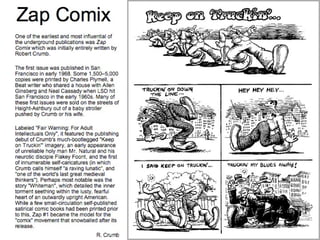
Zap Comix One of the earliest and most influential of the underground publications was  Zap Comix  which was initially entirely written by Robert Crumb. The first issue was published in San Francisco in early 1968. Some 1,500–5,000 copies were printed by Charles Plymell, a Beat writer who shared a house with Allen Ginsberg and Neal Cassady when LSD hit San Francisco in the early 1960s. Many of these first issues were sold on the streets of Haight-Ashbury out of a baby stroller pushed by Crumb or his wife. Labeled "Fair Warning: For Adult Intellectuals Only", it featured the publishing debut of Crumb's much-bootlegged "Keep on Truckin'" imagery, an early appearance of unreliable holy man Mr. Natural and his neurotic disciple Flakey Foont, and the first of innumerable self-caricatures (in which Crumb calls himself "a raving lunatic", and "one of the world's last great medieval thinkers"). Perhaps most notable was the story "Whiteman", which detailed the inner torment seething within the lusty, fearful heart of an outwardly upright American. While a few small-circulation self-published satirical comic books had been printed prior to this, Zap #1 became the model for the "comix" movement that snowballed after its release.  R. Crumb
Zap Comix After the success of the first issue, Crumb opened the pages of Zap to several other artists, including S. Clay Wilson, Robert Williams, "Spain" Rodriguez, and two artists with reputations as psychedelic poster designers, Victor Moscoso and Rick Griffin. This stable of artists, along with Crumb, remained mostly constant throughout the history of Zap, which published sporadically. It was typical for several years to pass between new issues; the most recent Zap (#15) appeared in 2005.  Zap  was also one of the books that put the "underground" in comics:  Zap  #4, in particular, was the subject of numerous "community standards" obscenity busts and court cases. That issue was most notorious for Crumb's satirical story  Joe Blow , depicting an incestuous all-American nuclear family whose motto was "the family that lays together, stays together." San Francisco's City Lights Bookstore was raided by police, and the fourth issue of Zap was eventually prohibited from selling over the counter in New York.  The attention created a bump in Zap sales and elevated its reputation among counterculture types; it certainly cannot be argued that succeeding issues of Zap were any tamer in content. Victor Moscoso
Zap Comix R. Crumb R. Crumb
Zap Comix
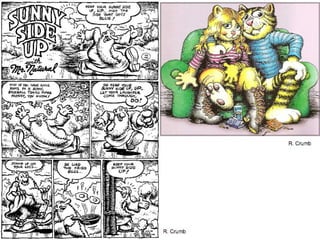
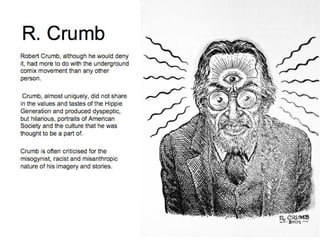
R. Crumb Robert Crumb, although he would deny it, had more to do with the underground comix movement than any other person.    Crumb, almost uniquely, did not share in the values and tastes of the Hippie Generation and produced dyspeptic, but hilarious, portraits of American Society and the culture that he was thought to be a part of.  Crumb is often criticised for the misogynist, racist and misanthropic nature of his imagery and stories.
Radical America Komics
Anti-war Gilbert Shelton
Drugs Gilbert Shelton
Sex 'Amputee Love' (1975), a liberating comic about a female amputee and her lovers. Written by the double amputee Rene, and drawn by her husband Rich. The cover is by Brent Boates.
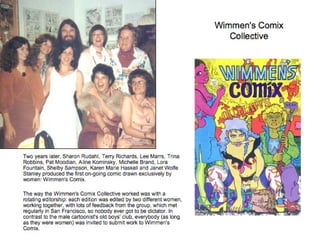
Women’s Comix  Finding that the comix underground scene was often much like a boy's club, women comic artists got together in the early 1970s and produced the first all-woman comic book, 'It Ain't Me, Babe'. This was followed by a plethora of titles including Wimmen's Comix, Tits 'n Clits and Twisted Sisters.
Wimmen's Comix Collective Two years later, Sharon Rudahl, Terry Richards, Lee Marrs, Trina Robbins, Pat Moodian, Aline Kominsky, Michelle Brand, Lora Fountain, Shelby Sampson, Karen Marie Haskell and Janet Wolfe Stanley produced the first on-going comic drawn exclusively by women: Wimmen's Comix. The way the Wimmen's Comix Collective worked was with a rotating editorship: each edition was edited by two different women, working together, with lots of feedback from the group, which met regularly in San Francisco, so nobody ever got to be dictator. In contrast to the male cartoonist's old boys' club, everybody (as long as they were women) was invited to submit work to Wimmen's Comix.
Small Press publishers Kitchen Sink Press   was founded by Denis Kitchen. The niche markets of Underground Comix encouraged the foundation of small press publishing. In the early 1970s, the "comic book convention" was initiated, where dealers sold rare and valuable comic books at collectors prices. Out of this atmosphere, the comic book specialty shop was born.  The underground and conventional comic book venues found common ground in the specialty shop, perhaps because both strains existed outside the accepted popular culture. As a concept, the comic shop thrived, partly because the forum allowed publishers direct contact with their readers, and as a result, many publishers experimented with different kinds of books, directed at different segments of the comic book store patronage.
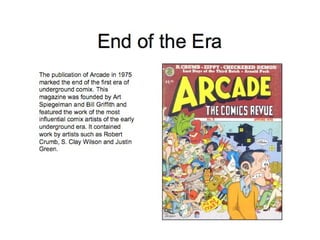
End of the Era The publication of Arcade in 1975 marked the end of the first era of underground comix. This magazine was founded by Art Spiegelman and Bill Griffith and featured the work of the most influential comix artists of the early underground era. It contained work by artists such as Robert Crumb, S. Clay Wilson and Justin Green.
Punk Comix After 1975, a second wave of underground comix came up, with more punk inspired comix such as  Anarchy Comics , founded by Jay Kinney.
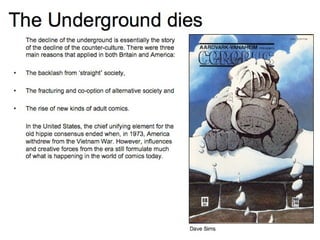
The Underground dies The decline of the underground is essentially the story of the decline of the counter-culture. There were three main reasons that applied in both Britain and America: The backlash from ‘straight ’  society, The fracturing and co-option of alternative society and The rise of new kinds of adult comics. In the United States, the chief unifying element for the old hippie consensus ended when, in 1973, America withdrew from the Vietnam War. However, influences and creative forces from the era still formulate much of what is happening in the world of comics today. Dave Sims
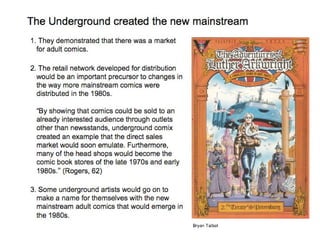
The Underground created the new mainstream 1. They demonstrated that there was a market for adult comics. 2. The retail network developed for distribution would be an important precursor to changes in the way more mainstream comics were distributed in the 1980s.  “By showing that comics could be sold to an already interested audience through outlets other than newsstands, underground comix created an example that the direct sales market would soon emulate. Furthermore, many of the head shops would become the comic book stores of the late 1970s and early 1980s. ”  (Rogers, 62) 3. Some underground artists would go on to make a name for themselves with the new mainstream adult comics that would emerge in the 1980s.  Bryan Talbot
Alternative comics In the '80s a group of artists, avoiding the mainstream publishers like Marvel and DC, began to publish comix books similar in content (super heroes) but with a fresh point of view and retaining the ownership of the characters, something not allowed by the big companies. There also sprang up a totally unique group of comix like  Love and Rockets, Raw, American Splendor, Eightball , and  Yummy Fur , which introduced adult (even intellectual) content combined with a contemporary artistic sensibility.  The superheros of the 80s were societal outcasts, burdened with complex personalities and problems. Artwork became more expressive and story lines increasingly demanding. Non-superhero comic books also grew more intricate and literate than they had been previously. Other factors were important as well. Comic book creators in the United States were utilizing cartooning methods developed by Japanese and European artists and writers, bringing new sophistication into American comics. Underground comics moved closed to the mainstream comics culture, but used accepted comic book characters to examine beliefs and attitudes previously left unexplored by more conventional comic book creators. The graphic novel, a sophisticated book length story generally contained in one volume, was created in 1978 by Will Eisner when he published  A Contract with God.  The form grew so popular that by the end of the next decade, many publishers no longer produced periodicals, but instead concentrated their efforts solely on graphic novels. It is within the graphic novel format that one encounters much of the most experimental and exciting work being done in the comics medium today. Art Spiegelman
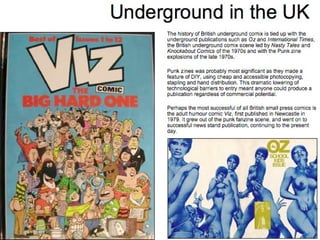
Underground in the UK The history of British underground comix is tied up with the underground publications such as  Oz  and  International Times , the British underground comix scene led by  Nasty Tales  and  Knockabout Comics  of the 1970s and with the Punk zine explosions of the late 1970s.  Punk zines was probably most significant as they made a feature of DIY, using cheap and accessible photocopying, stapling and hand distribution. This dramatic lowering of technological barriers to entry meant anyone could produce a publication regardless of commercial potential. Perhaps the most successful of all British small press comics is the adult humour comic  Viz , first published in Newcastle in 1979. It grew out of the punk fanzine scene, and went on to successful news stand publication, continuing to the present day.
viz
viz

Underground Comix

  • 1.
    Putting the ‘x-rated’in comics: Underground Comix "Underground comics were more like art and less like comics.” Gilbert Shelton “ In those days who among us knew we were creating “Art”? Certainly not those of us creating it. In fact, as far as we were concerned, these little comic books we cranked out were anti-Art. Not canvasses on a gallery wall viewed by the few, but an ephemeral sheath of newsprint to be read on the toilet and discarded... All we really had in mind was youthful anarchistic fun. And to establish a forum where we could give the finger to the established authorities and moon the vapid Art world, to display a wanton and unbecoming lack of propriety by way of our untrained comix and to release a pathogen targeting the orthodox.” Skip Williamson http://open.salon.com/blog/snappy_sam/2009/04/10/the_birth_of_underground_comix S. Clay Wilson
  • 2.
    Comix: In briefBegan appearing in late 1960s In the USA. Aligned with hippies and the counter-culture movements and aimed at adults. Tackled taboo topics of politics, sex, drugs, history and everyday life in often confrontational and innovative ways. Became known as "comix" to set them apart from mainstream comics and to emphasize the "x" for x-rated. Pioneered new storytelling (and anti-storytelling) methods. Lo-tech often DIY aesthetic -- strong use of B&W Bypassed traditional distribution and markets, thus escaping from the strictures of the ‘Comics Code’ Paved way for the alternative comics and graphic novels of the 80s, 90s, and today
  • 3.
    New distribution methodsUnderground comix are closely associated with the underground press and the burgeoning hippie counterculture of the time. The largest center of the comix community was San Francisco, but the movement also included artists and publishers in New York, Chicago, Austin, Texas and Vancouver, Canada. Underground comix were largely distributed though a network of head shops which also sold underground newspapers, psychedelic posters, and drug paraphernalia. In the mid-1970s, sales of drug paraphernalia was outlawed in many places, and the distribution network for these comix (and the underground newspapers) dried up. This direct marketing system that, while primitive, presaged the modern "direct sales" distribution system that saved mainstream comics in the mid-'70s. S. Clay Wilson
  • 4.
    New production methodsIn the USA, comics were traditionally produced industrially; i.e each element (writing, penciling, inking, lettering, etc) was handled by a separate individual. Underground comix, by contrast, were often completely produced (and often published and distributed) by one artist. In an era when very few mainstream artists or writers were granted ownership of their material, this meant the men and women who created the undergrounds usually retained ownership of their characters. Without them, the face of the "independent comics movement" of the late 1970s and early '80s -- as well as the "adult" comics scene that blossomed in Europe at roughly the same time -- would have been far different. Vaughn Bodé
  • 5.
    Aesthetics Often B&WComix usually completely the work of one person Transgressive Used conventional pictorial values (eg Disney-style) to contrast with content Used new visual styles that were often ‘primitive’ or ‘badly-drawn’ DIY - photocopying, hand-stapled/bound, often individually personalised Shorter strips rather than full ‘stories’ Doug Potter
  • 6.
    Changing The Roleof Story Underground comix sometimes dispensed with story altogether -- sometimes a sequence simply connected a series of visual images with no connecting plot. Some comix artists experimented with trying to simulate certain drug experiences through of abrupt or unclear transition, or alternately, orderly transitions between disconnected elements - a work might never even dabble in anything like linearity, causality, or focus. Stories might be arbitrarily disrupted to frame a joke or gag, wander off into a surrealist sortie, or become self-reflexive. Rick Griffin
  • 7.
    In the latterhalf of the 1960s the hippie movement in America was engaged, to a greater or lesser extent, with protests against the Vietnam War, the civil rights struggle, anarchism, Women's Lib and Gay Liberation. Add to this an interest in the spiritual value of taking drugs, communalism and of "free love" and you had, very simplistically speaking, a thriving "counterculture" against traditional values. Underground comix reflected in graphic terms the issues of those times. Political subjects were targets with titles like Radical America Komics and Corporate Crime Komics . The Vietnam War and protests against the draft was the subject of Jesus Meets the Armed Services . Comic books like The Fabulous Furry Freak Brothers , Dope and Cocaine comix reflected the drug use and abuse in the culture. OVERVIEW
  • 8.
    The ‘Comics Code’A major underground influence was the anti-censorship reaction to the imposed 'comics code'. In the 1950s, there had been a crusade against comics (especially those published by E.C. Comics), which had inspired the passing of the Comics Code, a set of rules to which comics creators had to adhere. As children, the future underground artists were the very people who had been worst hit - they watched their parents tear up their comics collections, or throw them on the playground fires. http://www.lambiek.net/comics/code.htm
  • 9.
    Doctor Wirtham's Comix& Stories The most outspoken production against the Comic Code was the defiant series Doctor Wirtham's Comix & Stories , which appeared around 1977. The colophon read: "We publish good art and underground stories in the E.C. vein, the kind of stuff you know the good doctor would love to hate," which referred to Dr. Fredric Wertham, the man who wrote "Seduction of the Innocent" the book that was responsible for causing the ban on comics in the 1950s by alleging that comic books were corrupting kids.
  • 10.
    Mad Magazine Oneof the most important precursors and influences on underground comix was Mad which was EC’s response to the its targeting by the Comics Code. EC Comics had been a specific target during the moral pogrom against comics. Inarguably filled to the brim with graphic gore, suggestive story lines, violence, drugs and sadism, EC could not get its books distributed after the Comics Code was enacted. Aside from the lurid gore – perhaps partially because of it – EC Comics also published some of the best artists and writers in the history of comics. Mad was the brainchild of writer/editor Harvey Kurtzman, who used the superior EC stable of artists to write and edit a comic book that satirized American culture. Mad (first the comic book, then the magazine) would be the one idea that would keep EC Comics afloat. For awhile Mad survived as a comic book, spoofing comics characters, TV shows, movies, the human race and life in the USA. In 1953, in order to escape the censor’s knife, Mad switched to a magazine format and out of the purview of the Comics Code. Kurtzman liberated comedy in comics and inspired a new generation of cartoonists to push the boundaries of satire even further. More directly, in his post- Mad magazine, Help!, Kurtzman provided pages devoted to "amateur talent," where many future undergrounders, like Robert Crumb and Gilbert Shelton, got their first break. http://www.toonopedia.com/mad.htm
  • 11.
    Underground media Inthe late-60s underground newspapers such as The East Village Other (which featured articles, music reviews and hippie news), started to publish comix and attracted work by artists such as Vaughn Bodé, Spain Rodriguez and Willy Murphy. As these comix gained popularity, The East Village Other started its own monthly comix magazine, Gothic Blimp Works.
  • 12.
    Zap Comix Oneof the earliest and most influential of the underground publications was Zap Comix which was initially entirely written by Robert Crumb. The first issue was published in San Francisco in early 1968. Some 1,500–5,000 copies were printed by Charles Plymell, a Beat writer who shared a house with Allen Ginsberg and Neal Cassady when LSD hit San Francisco in the early 1960s. Many of these first issues were sold on the streets of Haight-Ashbury out of a baby stroller pushed by Crumb or his wife. Labeled "Fair Warning: For Adult Intellectuals Only", it featured the publishing debut of Crumb's much-bootlegged "Keep on Truckin'" imagery, an early appearance of unreliable holy man Mr. Natural and his neurotic disciple Flakey Foont, and the first of innumerable self-caricatures (in which Crumb calls himself "a raving lunatic", and "one of the world's last great medieval thinkers"). Perhaps most notable was the story "Whiteman", which detailed the inner torment seething within the lusty, fearful heart of an outwardly upright American. While a few small-circulation self-published satirical comic books had been printed prior to this, Zap #1 became the model for the "comix" movement that snowballed after its release. R. Crumb
  • 13.
    Zap Comix Afterthe success of the first issue, Crumb opened the pages of Zap to several other artists, including S. Clay Wilson, Robert Williams, "Spain" Rodriguez, and two artists with reputations as psychedelic poster designers, Victor Moscoso and Rick Griffin. This stable of artists, along with Crumb, remained mostly constant throughout the history of Zap, which published sporadically. It was typical for several years to pass between new issues; the most recent Zap (#15) appeared in 2005. Zap was also one of the books that put the "underground" in comics: Zap #4, in particular, was the subject of numerous "community standards" obscenity busts and court cases. That issue was most notorious for Crumb's satirical story Joe Blow , depicting an incestuous all-American nuclear family whose motto was "the family that lays together, stays together." San Francisco's City Lights Bookstore was raided by police, and the fourth issue of Zap was eventually prohibited from selling over the counter in New York. The attention created a bump in Zap sales and elevated its reputation among counterculture types; it certainly cannot be argued that succeeding issues of Zap were any tamer in content. Victor Moscoso
  • 14.
    Zap Comix R.Crumb R. Crumb
  • 15.
  • 16.
    R. Crumb RobertCrumb, although he would deny it, had more to do with the underground comix movement than any other person. Crumb, almost uniquely, did not share in the values and tastes of the Hippie Generation and produced dyspeptic, but hilarious, portraits of American Society and the culture that he was thought to be a part of. Crumb is often criticised for the misogynist, racist and misanthropic nature of his imagery and stories.
  • 17.
  • 18.
  • 19.
  • 20.
  • 21.
    Sex 'Amputee Love'(1975), a liberating comic about a female amputee and her lovers. Written by the double amputee Rene, and drawn by her husband Rich. The cover is by Brent Boates.
  • 22.
    Women’s Comix Finding that the comix underground scene was often much like a boy's club, women comic artists got together in the early 1970s and produced the first all-woman comic book, 'It Ain't Me, Babe'. This was followed by a plethora of titles including Wimmen's Comix, Tits 'n Clits and Twisted Sisters.
  • 23.
    Wimmen's Comix CollectiveTwo years later, Sharon Rudahl, Terry Richards, Lee Marrs, Trina Robbins, Pat Moodian, Aline Kominsky, Michelle Brand, Lora Fountain, Shelby Sampson, Karen Marie Haskell and Janet Wolfe Stanley produced the first on-going comic drawn exclusively by women: Wimmen's Comix. The way the Wimmen's Comix Collective worked was with a rotating editorship: each edition was edited by two different women, working together, with lots of feedback from the group, which met regularly in San Francisco, so nobody ever got to be dictator. In contrast to the male cartoonist's old boys' club, everybody (as long as they were women) was invited to submit work to Wimmen's Comix.
  • 24.
    Small Press publishersKitchen Sink Press was founded by Denis Kitchen. The niche markets of Underground Comix encouraged the foundation of small press publishing. In the early 1970s, the "comic book convention" was initiated, where dealers sold rare and valuable comic books at collectors prices. Out of this atmosphere, the comic book specialty shop was born. The underground and conventional comic book venues found common ground in the specialty shop, perhaps because both strains existed outside the accepted popular culture. As a concept, the comic shop thrived, partly because the forum allowed publishers direct contact with their readers, and as a result, many publishers experimented with different kinds of books, directed at different segments of the comic book store patronage.
  • 25.
    End of theEra The publication of Arcade in 1975 marked the end of the first era of underground comix. This magazine was founded by Art Spiegelman and Bill Griffith and featured the work of the most influential comix artists of the early underground era. It contained work by artists such as Robert Crumb, S. Clay Wilson and Justin Green.
  • 26.
    Punk Comix After1975, a second wave of underground comix came up, with more punk inspired comix such as Anarchy Comics , founded by Jay Kinney.
  • 27.
    The Underground diesThe decline of the underground is essentially the story of the decline of the counter-culture. There were three main reasons that applied in both Britain and America: The backlash from ‘straight ’ society, The fracturing and co-option of alternative society and The rise of new kinds of adult comics. In the United States, the chief unifying element for the old hippie consensus ended when, in 1973, America withdrew from the Vietnam War. However, influences and creative forces from the era still formulate much of what is happening in the world of comics today. Dave Sims
  • 28.
    The Underground createdthe new mainstream 1. They demonstrated that there was a market for adult comics. 2. The retail network developed for distribution would be an important precursor to changes in the way more mainstream comics were distributed in the 1980s. “By showing that comics could be sold to an already interested audience through outlets other than newsstands, underground comix created an example that the direct sales market would soon emulate. Furthermore, many of the head shops would become the comic book stores of the late 1970s and early 1980s. ” (Rogers, 62) 3. Some underground artists would go on to make a name for themselves with the new mainstream adult comics that would emerge in the 1980s. Bryan Talbot
  • 29.
    Alternative comics Inthe '80s a group of artists, avoiding the mainstream publishers like Marvel and DC, began to publish comix books similar in content (super heroes) but with a fresh point of view and retaining the ownership of the characters, something not allowed by the big companies. There also sprang up a totally unique group of comix like Love and Rockets, Raw, American Splendor, Eightball , and Yummy Fur , which introduced adult (even intellectual) content combined with a contemporary artistic sensibility. The superheros of the 80s were societal outcasts, burdened with complex personalities and problems. Artwork became more expressive and story lines increasingly demanding. Non-superhero comic books also grew more intricate and literate than they had been previously. Other factors were important as well. Comic book creators in the United States were utilizing cartooning methods developed by Japanese and European artists and writers, bringing new sophistication into American comics. Underground comics moved closed to the mainstream comics culture, but used accepted comic book characters to examine beliefs and attitudes previously left unexplored by more conventional comic book creators. The graphic novel, a sophisticated book length story generally contained in one volume, was created in 1978 by Will Eisner when he published A Contract with God. The form grew so popular that by the end of the next decade, many publishers no longer produced periodicals, but instead concentrated their efforts solely on graphic novels. It is within the graphic novel format that one encounters much of the most experimental and exciting work being done in the comics medium today. Art Spiegelman
  • 30.
    Underground in theUK The history of British underground comix is tied up with the underground publications such as Oz and International Times , the British underground comix scene led by Nasty Tales and Knockabout Comics of the 1970s and with the Punk zine explosions of the late 1970s. Punk zines was probably most significant as they made a feature of DIY, using cheap and accessible photocopying, stapling and hand distribution. This dramatic lowering of technological barriers to entry meant anyone could produce a publication regardless of commercial potential. Perhaps the most successful of all British small press comics is the adult humour comic Viz , first published in Newcastle in 1979. It grew out of the punk fanzine scene, and went on to successful news stand publication, continuing to the present day.
  • 31.
  • 32.

Editor's Notes

  • #2 They tackled taboo topics of politics, sex, drugs, history and everyday life in ways that were even more daring than the most exalted and groundbreaking films of their time. The undergrounds were produced through tiny publishing houses by a comparative handful of folks in a far-ranging variety of styles.