Electrical and Electronic Measurement
Electronic Instruments
Parveen Malik
Assistant Professor
School of Electronics Engineering
KIIT University
parveen.malikfet@kiit.ac.in
October 30, 2019
Parveen Malik () E and EM October 30, 2019 1 / 21
Outline
1 Why we use Electronic Instruments?
2 Voltmeters
D.C.Voltmeter Circuits
A.C.Voltmeter Circuits
3 True RMS Voltmeter
4 Q-meter
5 Digital Voltmeter
Parveen Malik () E and EM October 30, 2019 2 / 21
Limitations
of
Electrical Voltmeters & Ammeters
Why we use electronic instruments ?
Limitations of electrical Voltmeters & Ammeter
The voltmeter constructed of moving coil instruments and multipliers
can not
Measure Low Voltages
Input impedance is low
These limitations are over come by use of electronic circuits that
have high input impedance.
have low output impedance.
can amplify low voltages to measurable level.
Parveen Malik () E and EM October 30, 2019 4 / 21
Electronic Voltmeters
D.C.Voltmeter
D.C.Voltmeter Transistor Circuits
(a) (b)
(c) (d)
Different Voltmeter circuits based upon Transistors
Parveen Malik () E and EM October 30, 2019 6 / 21
D.C.Voltmeter
D.C.Voltmeter Op-amp Circuits
(a) (b)
(c)
Different D.C.Voltmeter circuits based upon Transistors
Parveen Malik () E and EM October 30, 2019 7 / 21
A.C.Voltmeter
A.C.Voltmeter Op-amp Circuits
(a) (b)
(c) (d)
Different A.C. Voltmeter circuits based upon Op-Amp
Parveen Malik () E and EM October 30, 2019 8 / 21
True RMS Voltmeter
True RMS Voltmeter
The measuring circuits used in the electronic D.C. and A.C. voltmeter
are not suitable for specialized applications.
Most of them require input as pure sinusoids.
Thermocouple are used for such type of applications.
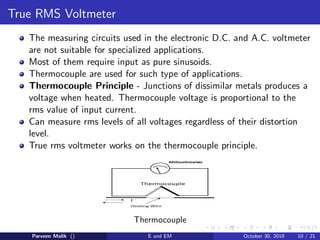
Thermocouple Principle - Junctions of dissimilar metals produces a
voltage when heated. Thermocouple voltage is proportional to the
rms value of input current.
Can measure rms levels of all voltages regardless of their distortion
level.
True rms voltmeter works on the thermocouple principle.
Thermocouple
Parveen Malik () E and EM October 30, 2019 10 / 21
True RMS Voltmeter
Thermocouple
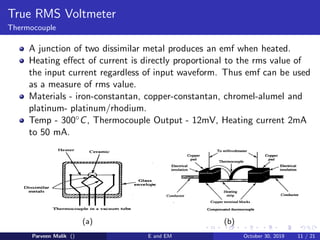
A junction of two dissimilar metal produces an emf when heated.
Heating effect of current is directly proportional to the rms value of
the input current regardless of input waveform. Thus emf can be used
as a measure of rms value.
Materials - iron-constantan, copper-constantan, chromel-alumel and
platinum- platinum/rhodium.
Temp - 300◦C, Thermocouple Output - 12mV, Heating current 2mA
to 50 mA.
(a) (b)
Parveen Malik () E and EM October 30, 2019 11 / 21
True RMS voltmeter Thermocouple type
Thermocouple
Parveen Malik () E and EM October 30, 2019 12 / 21
True RMS Voltmeter- Working
Video Amplifier Stage- The input voltage (E1) with a non-sinusoidal
waveform is amplified to Av E1 by means of video amplifier (A1). A video
amplifier operates over a wide range of frequencies (audio to very high).
The current I1 passed through resistor R1 has the same waveform as E1
and consequently the heat generated in R1 is directly proportional to the
true rms level of input voltage.
Audio Amplifier Stage- A2 works as a non-inverting d.c. amplifier which
passes direct current I2 through resistor R2. R2 is the heater for
thermocouple T2 and thermocouple voltage e2 is directly proportional to
the heating effect of I2.
Final Stage - The feedback from the output produces a voltage at the
op-amp inverting input equal to that at non-inverting input. Voltage e1 is
applied to the non-inverting input of A2 and e2 feedback to the inverting
terminal. Output voltage E2 settles at the level that makes e2 exactly
equal to e1. IF T1 and T2 are similar, heating effect of I2 is same as that
of I1. This means that I2 equals the rms value of I1. Therefore D.C. output
voltage E2 is directly proportional to rms value of a.c. input voltage E1.
Parveen Malik () E and EM October 30, 2019 13 / 21
Q meter
Q meter
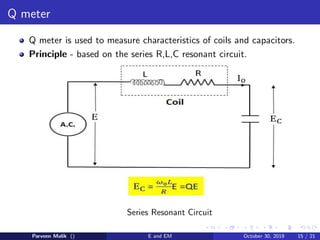
Q meter is used to measure characteristics of coils and capacitors.
Principle - based on the series R,L,C resonant circuit.
Series Resonant Circuit
Parveen Malik () E and EM October 30, 2019 15 / 21
Q meter - Practical Circuit
Practical Q meter circuit
Parveen Malik () E and EM October 30, 2019 16 / 21
Q meter - errors
Observation 1
QTrue = ω0L
R
QMeasured = ω0L
R+Rsh
QTrue = QMeasured 1 + Rsh
R
Observation 2
QTrue = 1
ω0CR
QMeasured = 1
ω0(C+Cd )R
QTrue = QMeasured 1 + Cd
C
Parveen Malik () E and EM October 30, 2019 17 / 21
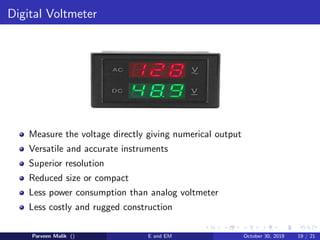
Digital Voltmeter
Digital Voltmeter
Measure the voltage directly giving numerical output
Versatile and accurate instruments
Superior resolution
Reduced size or compact
Less power consumption than analog voltmeter
Less costly and rugged construction
Parveen Malik () E and EM October 30, 2019 19 / 21
Digital Voltmeter
Block Diagram
Analog to Digital Converter
Parveen Malik () E and EM October 30, 2019 20 / 21
Digital Voltmeter
Working
Objective - Measurement of Input Voltage Vi .
When input voltage Vi is greater than ramp output voltage Vr , the
opamp output saturates to +Vsat or 1 as it is fed at the non-inverting
terminal of voltage comparator. At this moment, one input of AND gate is
1 and consequently, the clock pulses start passing through it. Once the
ramp voltage become greater than input voltage Vi at time, t1, the one
input of the AND gate becomes 0 and consequently, no clock pulses pass
through it.Thus, the decade counter counts the no. of clock pulses till Vi
is greater than Vr and the no. of pulses passed are directly proportional
the input voltage level.
Parveen Malik () E and EM October 30, 2019 21 / 21

Chapter5

  • 1.
    Electrical and ElectronicMeasurement Electronic Instruments Parveen Malik Assistant Professor School of Electronics Engineering KIIT University parveen.malikfet@kiit.ac.in October 30, 2019 Parveen Malik () E and EM October 30, 2019 1 / 21
  • 2.
    Outline 1 Why weuse Electronic Instruments? 2 Voltmeters D.C.Voltmeter Circuits A.C.Voltmeter Circuits 3 True RMS Voltmeter 4 Q-meter 5 Digital Voltmeter Parveen Malik () E and EM October 30, 2019 2 / 21
  • 3.
  • 4.
    Why we useelectronic instruments ? Limitations of electrical Voltmeters & Ammeter The voltmeter constructed of moving coil instruments and multipliers can not Measure Low Voltages Input impedance is low These limitations are over come by use of electronic circuits that have high input impedance. have low output impedance. can amplify low voltages to measurable level. Parveen Malik () E and EM October 30, 2019 4 / 21
  • 5.
  • 6.
    D.C.Voltmeter D.C.Voltmeter Transistor Circuits (a)(b) (c) (d) Different Voltmeter circuits based upon Transistors Parveen Malik () E and EM October 30, 2019 6 / 21
  • 7.
    D.C.Voltmeter D.C.Voltmeter Op-amp Circuits (a)(b) (c) Different D.C.Voltmeter circuits based upon Transistors Parveen Malik () E and EM October 30, 2019 7 / 21
  • 8.
    A.C.Voltmeter A.C.Voltmeter Op-amp Circuits (a)(b) (c) (d) Different A.C. Voltmeter circuits based upon Op-Amp Parveen Malik () E and EM October 30, 2019 8 / 21
  • 9.
  • 10.
    True RMS Voltmeter Themeasuring circuits used in the electronic D.C. and A.C. voltmeter are not suitable for specialized applications. Most of them require input as pure sinusoids. Thermocouple are used for such type of applications. Thermocouple Principle - Junctions of dissimilar metals produces a voltage when heated. Thermocouple voltage is proportional to the rms value of input current. Can measure rms levels of all voltages regardless of their distortion level. True rms voltmeter works on the thermocouple principle. Thermocouple Parveen Malik () E and EM October 30, 2019 10 / 21
  • 11.
    True RMS Voltmeter Thermocouple Ajunction of two dissimilar metal produces an emf when heated. Heating effect of current is directly proportional to the rms value of the input current regardless of input waveform. Thus emf can be used as a measure of rms value. Materials - iron-constantan, copper-constantan, chromel-alumel and platinum- platinum/rhodium. Temp - 300◦C, Thermocouple Output - 12mV, Heating current 2mA to 50 mA. (a) (b) Parveen Malik () E and EM October 30, 2019 11 / 21
  • 12.
    True RMS voltmeterThermocouple type Thermocouple Parveen Malik () E and EM October 30, 2019 12 / 21
  • 13.
    True RMS Voltmeter-Working Video Amplifier Stage- The input voltage (E1) with a non-sinusoidal waveform is amplified to Av E1 by means of video amplifier (A1). A video amplifier operates over a wide range of frequencies (audio to very high). The current I1 passed through resistor R1 has the same waveform as E1 and consequently the heat generated in R1 is directly proportional to the true rms level of input voltage. Audio Amplifier Stage- A2 works as a non-inverting d.c. amplifier which passes direct current I2 through resistor R2. R2 is the heater for thermocouple T2 and thermocouple voltage e2 is directly proportional to the heating effect of I2. Final Stage - The feedback from the output produces a voltage at the op-amp inverting input equal to that at non-inverting input. Voltage e1 is applied to the non-inverting input of A2 and e2 feedback to the inverting terminal. Output voltage E2 settles at the level that makes e2 exactly equal to e1. IF T1 and T2 are similar, heating effect of I2 is same as that of I1. This means that I2 equals the rms value of I1. Therefore D.C. output voltage E2 is directly proportional to rms value of a.c. input voltage E1. Parveen Malik () E and EM October 30, 2019 13 / 21
  • 14.
  • 15.
    Q meter Q meteris used to measure characteristics of coils and capacitors. Principle - based on the series R,L,C resonant circuit. Series Resonant Circuit Parveen Malik () E and EM October 30, 2019 15 / 21
  • 16.
    Q meter -Practical Circuit Practical Q meter circuit Parveen Malik () E and EM October 30, 2019 16 / 21
  • 17.
    Q meter -errors Observation 1 QTrue = ω0L R QMeasured = ω0L R+Rsh QTrue = QMeasured 1 + Rsh R Observation 2 QTrue = 1 ω0CR QMeasured = 1 ω0(C+Cd )R QTrue = QMeasured 1 + Cd C Parveen Malik () E and EM October 30, 2019 17 / 21
  • 18.
  • 19.
    Digital Voltmeter Measure thevoltage directly giving numerical output Versatile and accurate instruments Superior resolution Reduced size or compact Less power consumption than analog voltmeter Less costly and rugged construction Parveen Malik () E and EM October 30, 2019 19 / 21
  • 20.
    Digital Voltmeter Block Diagram Analogto Digital Converter Parveen Malik () E and EM October 30, 2019 20 / 21
  • 21.
    Digital Voltmeter Working Objective -Measurement of Input Voltage Vi . When input voltage Vi is greater than ramp output voltage Vr , the opamp output saturates to +Vsat or 1 as it is fed at the non-inverting terminal of voltage comparator. At this moment, one input of AND gate is 1 and consequently, the clock pulses start passing through it. Once the ramp voltage become greater than input voltage Vi at time, t1, the one input of the AND gate becomes 0 and consequently, no clock pulses pass through it.Thus, the decade counter counts the no. of clock pulses till Vi is greater than Vr and the no. of pulses passed are directly proportional the input voltage level. Parveen Malik () E and EM October 30, 2019 21 / 21