CLONING
VECTOR
Objectives
 After the end of the presentation we’ll know -
 What is cloning vector?
 Types of cloning vector
– Plasmid
– Bacteriophage
– Cosmid
– Bacterial Artificial Chromosome (BAC)
– Yeast Artificial Chromosome (BAC)
– Human Artificial Chromosome (HAC)
 What determines choice of vector?
Cloning vector
 A cloning vector is a small piece of DNA in which a foreignDNA
fragment can be inserted for cloning purposes.
 Most vectors are genetically engineered.
 There are many types of cloning vectors including:
- plasmids - Bacterial artificial chromosome (BAC)
- phages - Yeast artificial chromosome (YAC)
- cosmids -
cosmid
• A cosmid, first described by Collins and Hohn in 1978
• It is formed by joining ends of a linearized plasmid DNA with
cos-site of lambda DNA.
• The cosmid DNA can be packed in a capsid of lambda phage in
vitro to form recombinant phage particles.
• Cosmids have advantages of both plasmids and phage vectors
and they can be delivered to the host by the more efficient
infection procedures rather than by transformation.
cosmid contin...
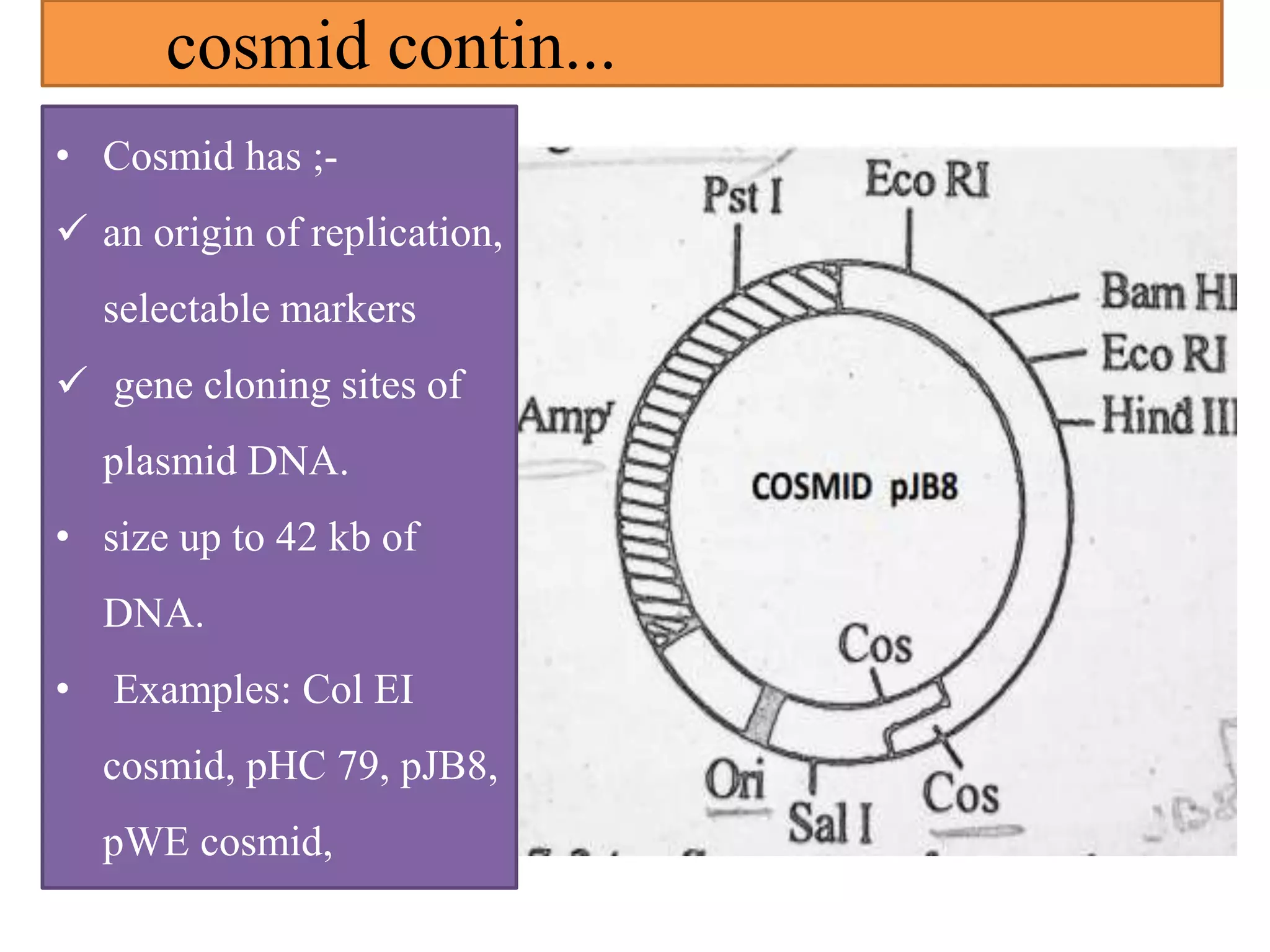
• Cosmid has ;-
 an origin of replication,
selectable markers
 gene cloning sites of
plasmid DNA.
• size up to 42 kb of
DNA.
• Examples: Col EI
cosmid, pHC 79, pJB8,
pWE cosmid,
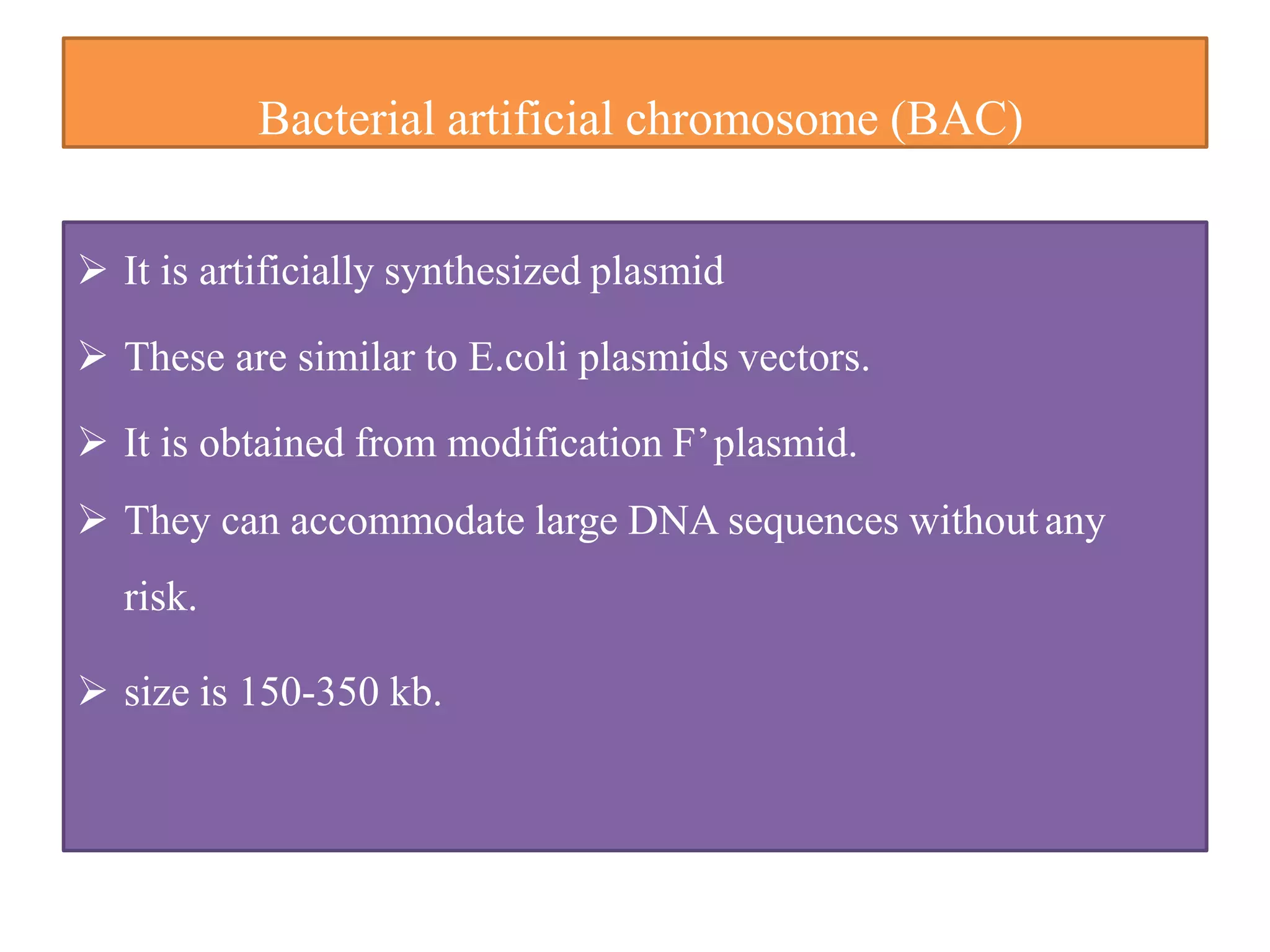
Bacterial artificial chromosome (BAC)
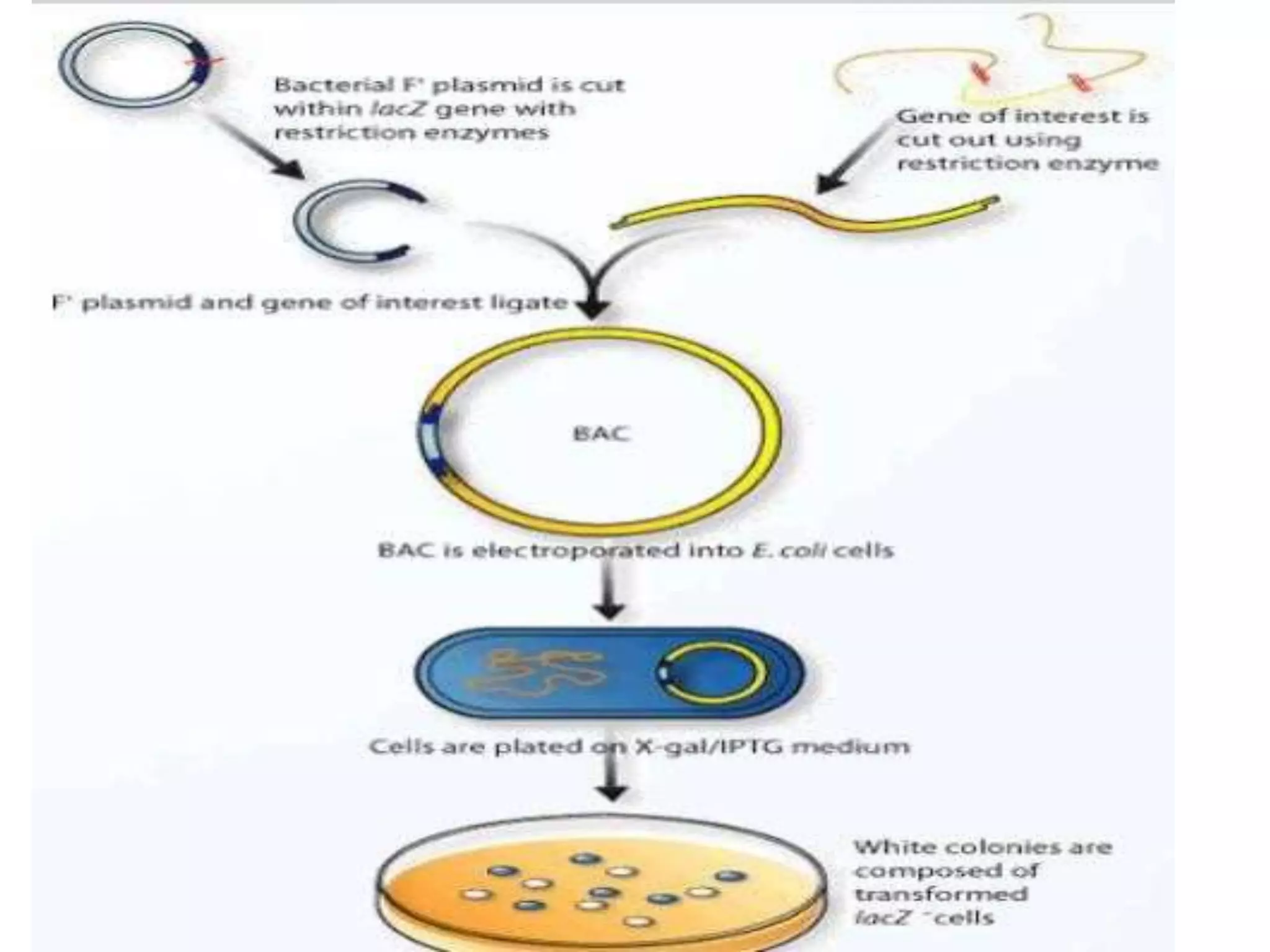
 It is artificially synthesized plasmid
 These are similar to E.coli plasmids vectors.
 It is obtained from modification F’plasmid.
 They can accommodate large DNA sequences withoutany
risk.
 size is 150-350 kb.
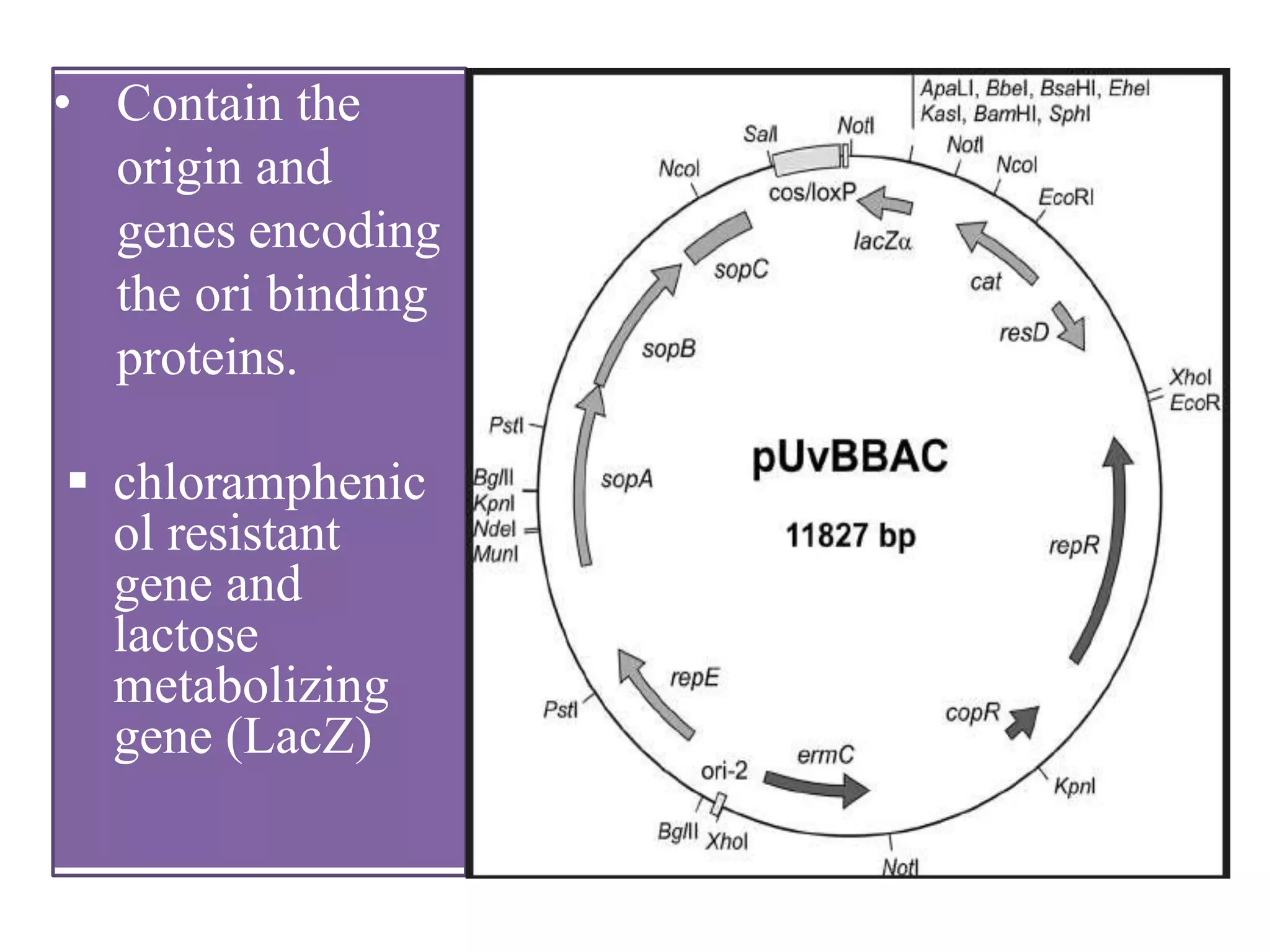
• Contain the
origin and
genes encoding
the ori binding
proteins.
 chloramphenic
ol resistant
gene and
lactose
metabolizing
gene (LacZ)
Advantages of BACs compared to
YACs
• Stable
• Ease to transformation
• Speed of growth of E. coli host
• Simpler to purify
• More user friendly
• They are helpful in the development of
vaccines

Chapter4.pptx

  • 1.
  • 2.
    Objectives  After theend of the presentation we’ll know -  What is cloning vector?  Types of cloning vector – Plasmid – Bacteriophage – Cosmid – Bacterial Artificial Chromosome (BAC) – Yeast Artificial Chromosome (BAC) – Human Artificial Chromosome (HAC)  What determines choice of vector?
  • 3.
    Cloning vector  Acloning vector is a small piece of DNA in which a foreignDNA fragment can be inserted for cloning purposes.  Most vectors are genetically engineered.  There are many types of cloning vectors including: - plasmids - Bacterial artificial chromosome (BAC) - phages - Yeast artificial chromosome (YAC) - cosmids -
  • 4.
    cosmid • A cosmid,first described by Collins and Hohn in 1978 • It is formed by joining ends of a linearized plasmid DNA with cos-site of lambda DNA. • The cosmid DNA can be packed in a capsid of lambda phage in vitro to form recombinant phage particles. • Cosmids have advantages of both plasmids and phage vectors and they can be delivered to the host by the more efficient infection procedures rather than by transformation.
  • 5.
    cosmid contin... • Cosmidhas ;-  an origin of replication, selectable markers  gene cloning sites of plasmid DNA. • size up to 42 kb of DNA. • Examples: Col EI cosmid, pHC 79, pJB8, pWE cosmid,
  • 6.
    Bacterial artificial chromosome(BAC)  It is artificially synthesized plasmid  These are similar to E.coli plasmids vectors.  It is obtained from modification F’plasmid.  They can accommodate large DNA sequences withoutany risk.  size is 150-350 kb.
  • 7.
    • Contain the originand genes encoding the ori binding proteins.  chloramphenic ol resistant gene and lactose metabolizing gene (LacZ)
  • 9.
    Advantages of BACscompared to YACs • Stable • Ease to transformation • Speed of growth of E. coli host • Simpler to purify • More user friendly • They are helpful in the development of vaccines