1Gardner’s Art Through the Ages:The Western PerspectiveChapter 3Pharaohs and the Afterlife:The Art of Ancient Egypt
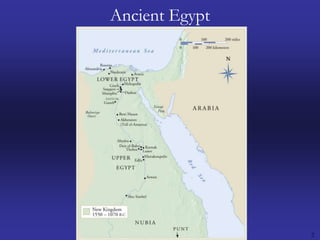
2Ancient Egypt
3GoalsUnderstand the evolution of Egyptian culture and its relationship to the Nile. Recognize stylistic conventions of Egyptian art. Describe Egyptian funerary art forms from these periods and state reasons for the development of these monuments. Understand architectural evolution from pyramid to the tomb temple and burial monuments of the Old and Middle Kingdoms. Discuss how Egyptian art changed as a result of the Hyksos’ invasions. Understand aspects of the New Kingdom as reflected in its art.
4Predynastic, Early Dynasties, and the Old KingdomUnderstand the early evolution of Egyptian culture and its relationship to the Nile.Recognize stylistic conventions of Egyptian art.Describe Egyptian funerary art forms from these periods and state reasons for the development of these monuments.
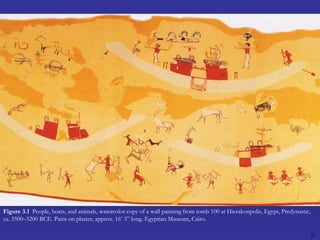
5The Nile and Egyptian UnificationExamine the early evolution of the Egyptian culture, its dependence on the Nile River, and the importance of the unification of upper and lower Egypt.
6Figure 3.1  People, boats, and animals, watercolor copy of a wall painting from tomb 100 at Hierakonpolis, Egypt, Predynastic, ca. 3500–3200 BCE. Paint on plaster, approx. 16’ 3” long. Egyptian Museum, Cairo.
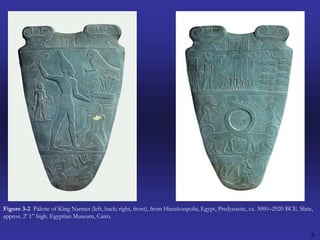
7Stylistic Conventions of Egyptian ArtExplore the importance of the Palette of Narmer as a blueprint for a formula for figure representation and other conventions seen in Egyptian art for nearly 3000 years.
8Figure 3-2  Palette of King Narmer (left, back; right, front), from Hierakonpolis, Egypt, Predynastic, ca. 3000–2920 BCE. Slate, approx. 2’ 1” high. Egyptian Museum, Cairo.
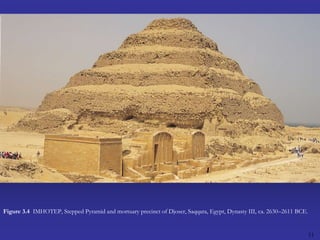
9Early Funerary Art FormsDescribe funerary art forms and practices in the Old Kingdom.Understand the importance of the Stepped Pyramid by Imhotep and the mortuary precinct at Saqqara.
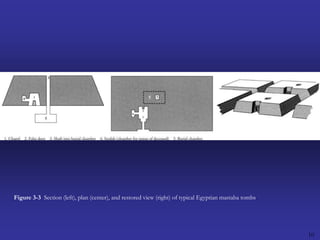
10Figure 3-3  Section (left), plan (center), and restored view (right) of typical Egyptian mastaba tombs.
11Figure 3.4  IMHOTEP, Stepped Pyramid and mortuary precinct of Djoser, Saqqara, Egypt, Dynasty III, ca. 2630–2611 BCE.
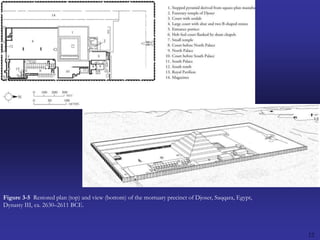
12Figure 3-5  Restored plan (top) and view (bottom) of the mortuary precinct of Djoser, Saqqara, Egypt, Dynasty III, ca. 2630–2611 BCE.
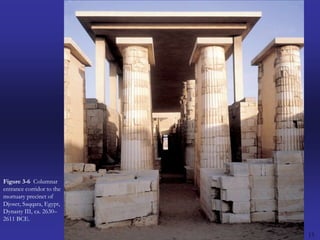
13Figure 3-6  Columnar entrance corridor to the mortuary precinct of Djoser, Saqqara, Egypt, Dynasty III, ca. 2630–2611 BCE.
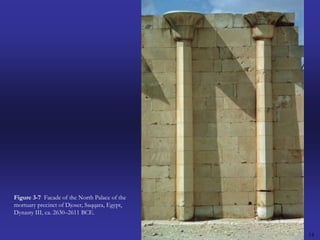
14Figure 3-7  Facade of the North Palace of the mortuary precinct of Djoser, Saqqara, Egypt, Dynasty III, ca. 2630–2611 BCE.
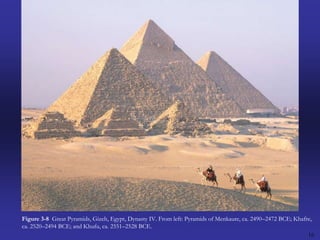
15The PyramidsUnderstand the evolution of the pyramid.Explore how and why the Great Pyramids were built.
16Figure 3-8  Great Pyramids, Gizeh, Egypt, Dynasty IV. From left: Pyramids of Menkaure, ca. 2490–2472 BCE; Khafre, ca. 2520–2494 BCE; and Khufu, ca. 2551–2528 BCE.
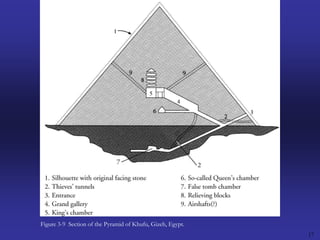
17Figure 3-9  Section of the Pyramid of Khufu, Gizeh, Egypt.
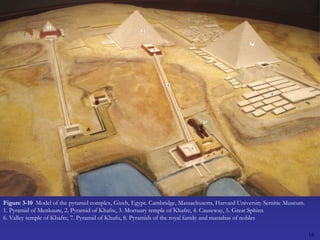
18Figure 3-10  Model of the pyramid complex, Gizeh, Egypt. Cambridge, Massachusetts, Harvard University Semitic Museum. 1. Pyramid of Menkaure, 2. Pyramid of Khafre, 3. Mortuary temple of Khafre, 4. Causeway, 5. Great Sphinx6. Valley temple of Khafre, 7. Pyramid of Khufu, 8. Pyramids of the royal family and mastabas of nobles
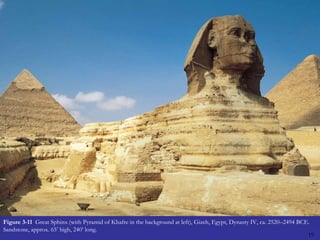
19Figure 3-11  Great Sphinx (with Pyramid of Khafre in the background at left), Gizeh, Egypt, Dynasty IV, ca. 2520–2494 BCE. Sandstone, approx. 65’ high, 240’ long.
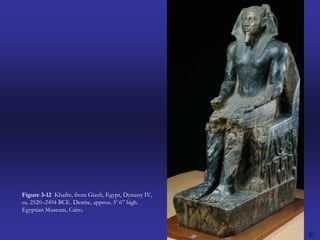
20Figure 3-12  Khafre, from Gizeh, Egypt, Dynasty IV, ca. 2520–2494 BCE. Diorite, approx. 5’ 6” high. Egyptian Museum, Cairo.
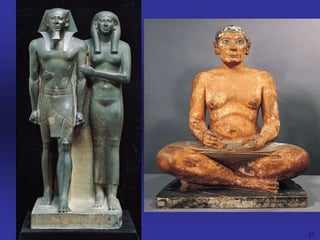
21Sculptural FormsExamine Egyptian realism and the canon seen in Old Kingdom sculptural forms of the human figure.What important differences are observed in the two objects presented here?
22
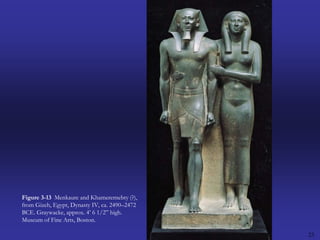
23Figure 3-13  Menkaure and Khamerernebty (?), from Gizeh, Egypt, Dynasty IV, ca. 2490–2472 BCE. Graywacke, approx. 4’ 6 1/2” high. Museum of Fine Arts, Boston.
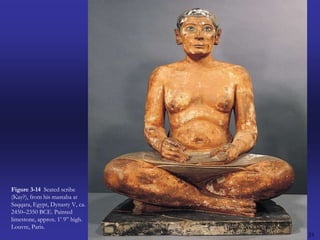
24Figure 3-14  Seated scribe (Kay?), from his mastaba at Saqqara, Egypt, Dynasty V, ca. 2450–2350 BCE. Painted limestone, approx. 1’ 9” high. Louvre, Paris.
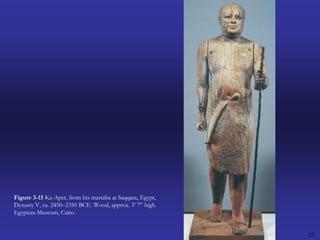
25Figure 3-15 Ka-Aper, from his mastaba at Saqqara, Egypt, Dynasty V, ca. 2450–2350 BCE. Wood, approx. 3’ 7” high. Egyptian Museum, Cairo.
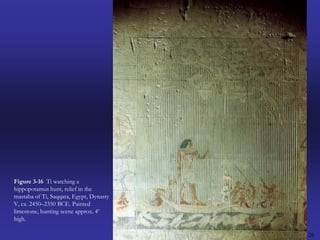
26Figure 3-16  Ti watching a hippopotamus hunt, relief in the mastaba of Ti, Saqqara, Egypt, Dynasty V, ca. 2450–2350 BCE. Painted limestone, hunting scene approx. 4’ high.
27First Intermediate and Middle KingdomDescribe Egyptian funerary art forms from these periods and state reasons for the development of these monuments.Explain possible reasons for the decline in the power of the pharaoh in the Middle Kingdom. Understand the evolution of burial monuments and why this occurred in the Middle Kingdom.
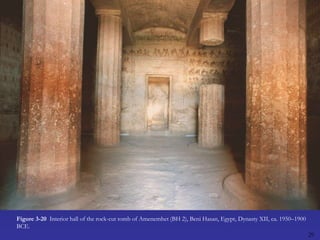
28Changes in the Middle KingdomUnderstand how and why the funerary art forms and burial monuments are changed in the Middle Kingdom.
29Figure 3-20  Interior hall of the rock-cut tomb of Amenemhet (BH 2), Beni Hasan, Egypt, Dynasty XII, ca. 1950–1900 BCE.
30Second Intermediate and New Kingdom EgyptDescribe early events in the New Kingdom which bring new influences into the art.Discuss how the Hyksos changed the culture of Egypt and show their location of origin Understand aspects of the New Kingdom as reflected in the art of ancient Egypt.
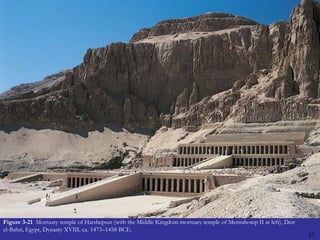
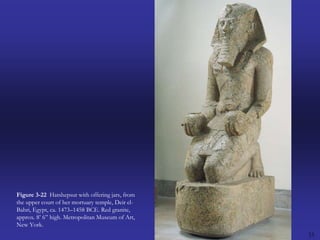
31The Grand Mortuary TemplesDescribe the grand tombs and mortuary temples of Hatshepsut and Ramses II.  What is their significance in terms of statuary and architecture?
32Figure 3-21  Mortuary temple of Hatshepsut (with the Middle Kingdom mortuary temple of Mentuhotep II at left), Deir el-Bahri, Egypt, Dynasty XVIII, ca. 1473–1458 BCE.
33Figure 3-22  Hatshepsut with offering jars, from the upper court of her mortuary temple, Deir el-Bahri, Egypt, ca. 1473–1458 BCE. Red granite, approx. 8’ 6” high. Metropolitan Museum of Art, New York.
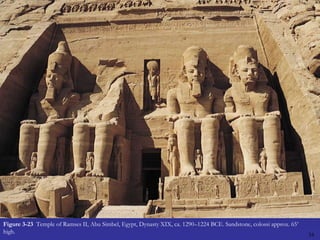
34Figure 3-23  Temple of Ramses II, Abu Simbel, Egypt, Dynasty XIX, ca. 1290–1224 BCE. Sandstone, colossi approx. 65’ high.
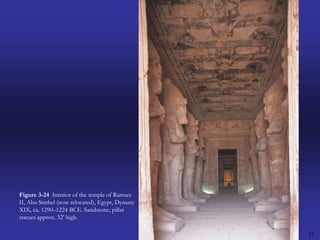
35Figure 3-24  Interior of the temple of Ramses II, Abu Simbel (now relocated), Egypt, Dynasty XIX, ca. 1290–1224 BCE. Sandstone, pillar statues approx. 32’ high.
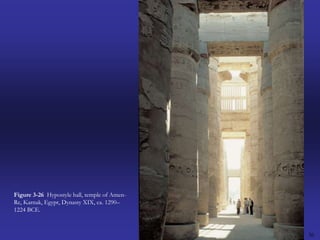
36Figure 3-26  Hypostyle hall, temple of Amen-Re, Karnak, Egypt, Dynasty XIX, ca. 1290–1224 BCE.
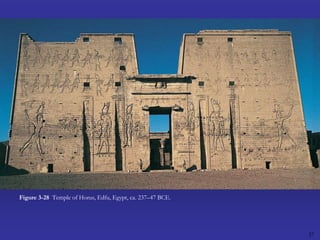
37Figure 3-28  Temple of Horus, Edfu, Egypt, ca. 237–47 BCE.
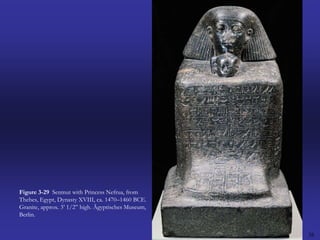
38Figure 3-29  Senmut with Princess Nefrua, from Thebes, Egypt, Dynasty XVIII, ca. 1470–1460 BCE. Granite, approx. 3’ 1/2” high. Ägyptisches Museum, Berlin.
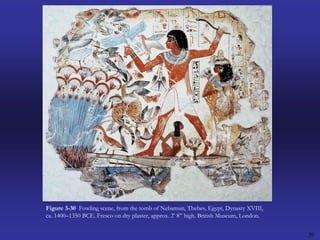
39Figure 3-30  Fowling scene, from the tomb of Nebamun, Thebes, Egypt, Dynasty XVIII, ca. 1400–1350 BCE. Fresco on dry plaster, approx. 2’ 8” high. British Museum, London.
40Painting and the Tomb of NebamunExamine materials and methods of painting in the New Kingdom.  Compare the style to the earlier Egyptian conventions.
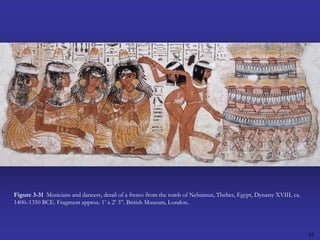
41Figure 3-31  Musicians and dancers, detail of a fresco from the tomb of Nebamun, Thebes, Egypt, Dynasty XVIII, ca. 1400–1350 BCE. Fragment approx. 1’ x 2’ 3”. British Museum, London.
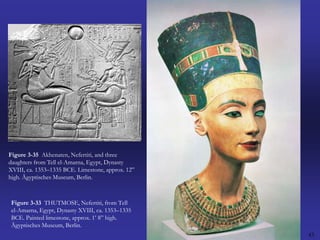
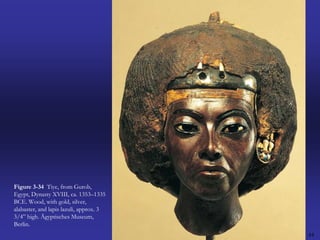
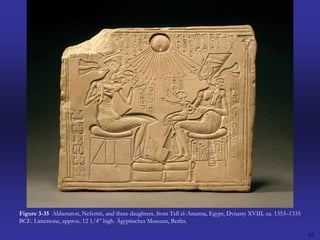
42Akhenaton and the Amarna PeriodDiscuss reasons for the artistic revolution of the Amarna Period.Examine the different artistic elements in the figures of Nefertiti and Tiye.
43Figure 3-35  Akhenaten, Nefertiti, and three daughters from Tell el-Amarna, Egypt, Dynasty XVIII, ca. 1353–1335 BCE. Limestone, approx. 12” high. Ägyptisches Museum, Berlin.Figure 3-33  THUTMOSE, Nefertiti, from Tell el-Amarna, Egypt, Dynasty XVIII, ca. 1353–1335 BCE. Painted limestone, approx. 1’ 8” high. Ägyptisches Museum, Berlin.
44Figure 3-34  Tiye, from Gurob, Egypt, Dynasty XVIII, ca. 1353–1335 BCE. Wood, with gold, silver, alabaster, and lapis lazuli, approx. 3 3/4” high. Ägyptisches Museum, Berlin.
45Figure 3-35  Akhenaton, Nefertiti, and three daughters, from Tell el-Amarna, Egypt, Dynasty XVIII, ca. 1353–1335 BCE. Limestone, approx. 12 1/4” high. Ägyptisches Museum, Berlin.
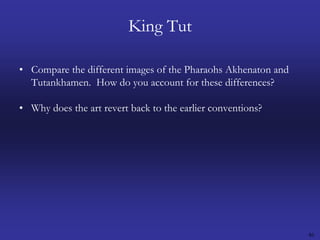
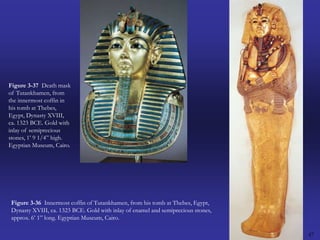
46King TutCompare the different images of the Pharaohs Akhenaton and Tutankhamen.  How do you account for these differences?Why does the art revert back to the earlier conventions?
47Figure 3-37  Death mask of Tutankhamen, from the innermost coffin in his tomb at Thebes, Egypt, Dynasty XVIII, ca. 1323 BCE. Gold with inlay of semiprecious stones, 1’ 9 1/4” high. Egyptian Museum, Cairo.Figure 3-36  Innermost coffin of Tutankhamen, from his tomb at Thebes, Egypt, Dynasty XVIII, ca. 1323 BCE. Gold with inlay of enamel and semiprecious stones, approx. 6’ 1” long. Egyptian Museum, Cairo.
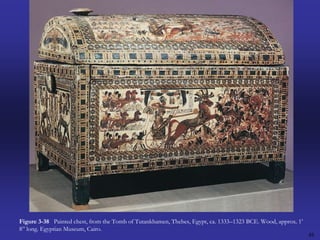
48Figure 3-38   Painted chest, from the Tomb of Tutankhamen, Thebes, Egypt, ca. 1333–1323 BCE. Wood, approx. 1’ 8” long. Egyptian Museum, Cairo.
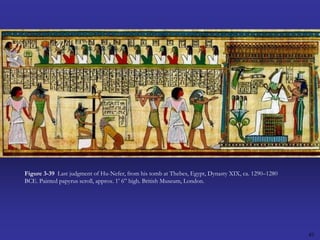
49Figure 3-39  Last judgment of Hu-Nefer, from his tomb at Thebes, Egypt, Dynasty XIX, ca. 1290–1280 BCE. Painted papyrus scroll, approx. 1’ 6” high. British Museum, London.
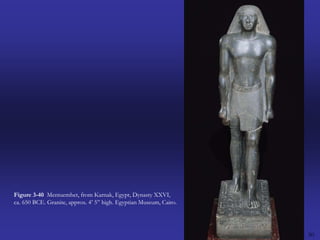
50Figure 3-40  Mentuemhet, from Karnak, Egypt, Dynasty XXVI, ca. 650 BCE. Granite, approx. 4’ 5” high. Egyptian Museum, Cairo.
51Discussion QuestionsHow do you speculate the great pyramids were built? What would have been some specific problems to consider?

Chapter3

  • 1.
    1Gardner’s Art Throughthe Ages:The Western PerspectiveChapter 3Pharaohs and the Afterlife:The Art of Ancient Egypt
  • 2.
  • 3.
    3GoalsUnderstand the evolutionof Egyptian culture and its relationship to the Nile. Recognize stylistic conventions of Egyptian art. Describe Egyptian funerary art forms from these periods and state reasons for the development of these monuments. Understand architectural evolution from pyramid to the tomb temple and burial monuments of the Old and Middle Kingdoms. Discuss how Egyptian art changed as a result of the Hyksos’ invasions. Understand aspects of the New Kingdom as reflected in its art.
  • 4.
    4Predynastic, Early Dynasties,and the Old KingdomUnderstand the early evolution of Egyptian culture and its relationship to the Nile.Recognize stylistic conventions of Egyptian art.Describe Egyptian funerary art forms from these periods and state reasons for the development of these monuments.
  • 5.
    5The Nile andEgyptian UnificationExamine the early evolution of the Egyptian culture, its dependence on the Nile River, and the importance of the unification of upper and lower Egypt.
  • 6.
    6Figure 3.1 People, boats, and animals, watercolor copy of a wall painting from tomb 100 at Hierakonpolis, Egypt, Predynastic, ca. 3500–3200 BCE. Paint on plaster, approx. 16’ 3” long. Egyptian Museum, Cairo.
  • 7.
    7Stylistic Conventions ofEgyptian ArtExplore the importance of the Palette of Narmer as a blueprint for a formula for figure representation and other conventions seen in Egyptian art for nearly 3000 years.
  • 8.
    8Figure 3-2 Palette of King Narmer (left, back; right, front), from Hierakonpolis, Egypt, Predynastic, ca. 3000–2920 BCE. Slate, approx. 2’ 1” high. Egyptian Museum, Cairo.
  • 9.
    9Early Funerary ArtFormsDescribe funerary art forms and practices in the Old Kingdom.Understand the importance of the Stepped Pyramid by Imhotep and the mortuary precinct at Saqqara.
  • 10.
    10Figure 3-3 Section (left), plan (center), and restored view (right) of typical Egyptian mastaba tombs.
  • 11.
    11Figure 3.4 IMHOTEP, Stepped Pyramid and mortuary precinct of Djoser, Saqqara, Egypt, Dynasty III, ca. 2630–2611 BCE.
  • 12.
    12Figure 3-5 Restored plan (top) and view (bottom) of the mortuary precinct of Djoser, Saqqara, Egypt, Dynasty III, ca. 2630–2611 BCE.
  • 13.
    13Figure 3-6 Columnar entrance corridor to the mortuary precinct of Djoser, Saqqara, Egypt, Dynasty III, ca. 2630–2611 BCE.
  • 14.
    14Figure 3-7 Facade of the North Palace of the mortuary precinct of Djoser, Saqqara, Egypt, Dynasty III, ca. 2630–2611 BCE.
  • 15.
    15The PyramidsUnderstand theevolution of the pyramid.Explore how and why the Great Pyramids were built.
  • 16.
    16Figure 3-8 Great Pyramids, Gizeh, Egypt, Dynasty IV. From left: Pyramids of Menkaure, ca. 2490–2472 BCE; Khafre, ca. 2520–2494 BCE; and Khufu, ca. 2551–2528 BCE.
  • 17.
    17Figure 3-9 Section of the Pyramid of Khufu, Gizeh, Egypt.
  • 18.
    18Figure 3-10 Model of the pyramid complex, Gizeh, Egypt. Cambridge, Massachusetts, Harvard University Semitic Museum. 1. Pyramid of Menkaure, 2. Pyramid of Khafre, 3. Mortuary temple of Khafre, 4. Causeway, 5. Great Sphinx6. Valley temple of Khafre, 7. Pyramid of Khufu, 8. Pyramids of the royal family and mastabas of nobles
  • 19.
    19Figure 3-11 Great Sphinx (with Pyramid of Khafre in the background at left), Gizeh, Egypt, Dynasty IV, ca. 2520–2494 BCE. Sandstone, approx. 65’ high, 240’ long.
  • 20.
    20Figure 3-12 Khafre, from Gizeh, Egypt, Dynasty IV, ca. 2520–2494 BCE. Diorite, approx. 5’ 6” high. Egyptian Museum, Cairo.
  • 21.
    21Sculptural FormsExamine Egyptianrealism and the canon seen in Old Kingdom sculptural forms of the human figure.What important differences are observed in the two objects presented here?
  • 22.
  • 23.
    23Figure 3-13 Menkaure and Khamerernebty (?), from Gizeh, Egypt, Dynasty IV, ca. 2490–2472 BCE. Graywacke, approx. 4’ 6 1/2” high. Museum of Fine Arts, Boston.
  • 24.
    24Figure 3-14 Seated scribe (Kay?), from his mastaba at Saqqara, Egypt, Dynasty V, ca. 2450–2350 BCE. Painted limestone, approx. 1’ 9” high. Louvre, Paris.
  • 25.
    25Figure 3-15 Ka-Aper,from his mastaba at Saqqara, Egypt, Dynasty V, ca. 2450–2350 BCE. Wood, approx. 3’ 7” high. Egyptian Museum, Cairo.
  • 26.
    26Figure 3-16 Ti watching a hippopotamus hunt, relief in the mastaba of Ti, Saqqara, Egypt, Dynasty V, ca. 2450–2350 BCE. Painted limestone, hunting scene approx. 4’ high.
  • 27.
    27First Intermediate andMiddle KingdomDescribe Egyptian funerary art forms from these periods and state reasons for the development of these monuments.Explain possible reasons for the decline in the power of the pharaoh in the Middle Kingdom. Understand the evolution of burial monuments and why this occurred in the Middle Kingdom.
  • 28.
    28Changes in theMiddle KingdomUnderstand how and why the funerary art forms and burial monuments are changed in the Middle Kingdom.
  • 29.
    29Figure 3-20 Interior hall of the rock-cut tomb of Amenemhet (BH 2), Beni Hasan, Egypt, Dynasty XII, ca. 1950–1900 BCE.
  • 30.
    30Second Intermediate andNew Kingdom EgyptDescribe early events in the New Kingdom which bring new influences into the art.Discuss how the Hyksos changed the culture of Egypt and show their location of origin Understand aspects of the New Kingdom as reflected in the art of ancient Egypt.
  • 31.
    31The Grand MortuaryTemplesDescribe the grand tombs and mortuary temples of Hatshepsut and Ramses II. What is their significance in terms of statuary and architecture?
  • 32.
    32Figure 3-21 Mortuary temple of Hatshepsut (with the Middle Kingdom mortuary temple of Mentuhotep II at left), Deir el-Bahri, Egypt, Dynasty XVIII, ca. 1473–1458 BCE.
  • 33.
    33Figure 3-22 Hatshepsut with offering jars, from the upper court of her mortuary temple, Deir el-Bahri, Egypt, ca. 1473–1458 BCE. Red granite, approx. 8’ 6” high. Metropolitan Museum of Art, New York.
  • 34.
    34Figure 3-23 Temple of Ramses II, Abu Simbel, Egypt, Dynasty XIX, ca. 1290–1224 BCE. Sandstone, colossi approx. 65’ high.
  • 35.
    35Figure 3-24 Interior of the temple of Ramses II, Abu Simbel (now relocated), Egypt, Dynasty XIX, ca. 1290–1224 BCE. Sandstone, pillar statues approx. 32’ high.
  • 36.
    36Figure 3-26 Hypostyle hall, temple of Amen-Re, Karnak, Egypt, Dynasty XIX, ca. 1290–1224 BCE.
  • 37.
    37Figure 3-28 Temple of Horus, Edfu, Egypt, ca. 237–47 BCE.
  • 38.
    38Figure 3-29 Senmut with Princess Nefrua, from Thebes, Egypt, Dynasty XVIII, ca. 1470–1460 BCE. Granite, approx. 3’ 1/2” high. Ägyptisches Museum, Berlin.
  • 39.
    39Figure 3-30 Fowling scene, from the tomb of Nebamun, Thebes, Egypt, Dynasty XVIII, ca. 1400–1350 BCE. Fresco on dry plaster, approx. 2’ 8” high. British Museum, London.
  • 40.
    40Painting and theTomb of NebamunExamine materials and methods of painting in the New Kingdom. Compare the style to the earlier Egyptian conventions.
  • 41.
    41Figure 3-31 Musicians and dancers, detail of a fresco from the tomb of Nebamun, Thebes, Egypt, Dynasty XVIII, ca. 1400–1350 BCE. Fragment approx. 1’ x 2’ 3”. British Museum, London.
  • 42.
    42Akhenaton and theAmarna PeriodDiscuss reasons for the artistic revolution of the Amarna Period.Examine the different artistic elements in the figures of Nefertiti and Tiye.
  • 43.
    43Figure 3-35 Akhenaten, Nefertiti, and three daughters from Tell el-Amarna, Egypt, Dynasty XVIII, ca. 1353–1335 BCE. Limestone, approx. 12” high. Ägyptisches Museum, Berlin.Figure 3-33 THUTMOSE, Nefertiti, from Tell el-Amarna, Egypt, Dynasty XVIII, ca. 1353–1335 BCE. Painted limestone, approx. 1’ 8” high. Ägyptisches Museum, Berlin.
  • 44.
    44Figure 3-34 Tiye, from Gurob, Egypt, Dynasty XVIII, ca. 1353–1335 BCE. Wood, with gold, silver, alabaster, and lapis lazuli, approx. 3 3/4” high. Ägyptisches Museum, Berlin.
  • 45.
    45Figure 3-35 Akhenaton, Nefertiti, and three daughters, from Tell el-Amarna, Egypt, Dynasty XVIII, ca. 1353–1335 BCE. Limestone, approx. 12 1/4” high. Ägyptisches Museum, Berlin.
  • 46.
    46King TutCompare thedifferent images of the Pharaohs Akhenaton and Tutankhamen. How do you account for these differences?Why does the art revert back to the earlier conventions?
  • 47.
    47Figure 3-37 Death mask of Tutankhamen, from the innermost coffin in his tomb at Thebes, Egypt, Dynasty XVIII, ca. 1323 BCE. Gold with inlay of semiprecious stones, 1’ 9 1/4” high. Egyptian Museum, Cairo.Figure 3-36 Innermost coffin of Tutankhamen, from his tomb at Thebes, Egypt, Dynasty XVIII, ca. 1323 BCE. Gold with inlay of enamel and semiprecious stones, approx. 6’ 1” long. Egyptian Museum, Cairo.
  • 48.
    48Figure 3-38 Painted chest, from the Tomb of Tutankhamen, Thebes, Egypt, ca. 1333–1323 BCE. Wood, approx. 1’ 8” long. Egyptian Museum, Cairo.
  • 49.
    49Figure 3-39 Last judgment of Hu-Nefer, from his tomb at Thebes, Egypt, Dynasty XIX, ca. 1290–1280 BCE. Painted papyrus scroll, approx. 1’ 6” high. British Museum, London.
  • 50.
    50Figure 3-40 Mentuemhet, from Karnak, Egypt, Dynasty XXVI, ca. 650 BCE. Granite, approx. 4’ 5” high. Egyptian Museum, Cairo.
  • 51.
    51Discussion QuestionsHow doyou speculate the great pyramids were built? What would have been some specific problems to consider?
  • 52.
    Is Egyptian artsimilar stylistically to any Mesopotamian culture from that time? Which culture and how are they similar or different in style and cultural context?
  • 53.
    What would besome reasons for the modification of pyramid scale and institution of rock-cut tombs as seen at Beni Hasan?
  • 54.
    Why does achange in religion bring about a change in art in ancient Egypt? Describe some specific changes in the presentation of the human figure.