SI Unites
SI Unites
Mass and Density


What is the deference between mass and weight ?
Density (d) is the ratio of mass to volume of a substance
and one of its characteristic physical properties.
Temperature and Heat








Temperature (T) is a measure of the relative hotness of an object.
Heat is energy that flows from an object at higher temperature to one
at lower temperature.
Temperature scales differ in the size of the degree unit and/or the zero
point.
The temperature scales are the Celsius (C), the Kelvin (K), and the
Fahrenheit (F) scales.
The SI base unit of temperature is the kelvin (K).
Note that the kelvin has no degree sign and preferred in all scientific
work.
Water freezes at 32°F and boils at 212°F, 180 °F = 100 C° (or 100
kelvins).
So, 1 Celsius degree = ........... °Fahrenheit degrees
Temperature Scales
Temperature Scales
ATOMIC STRUCTURE
ATOMIC STRUCTURE
Atomic Structure
Atomic Structure
All matter is composed of atoms.
Understanding the structure of
atoms is critical to understanding
the properties of matter
HISTORY OF THE ATOM
HISTORY OF THE ATOM
1808 John Dalton
suggested that all matter was made up of tiny
spheres that were able to bounce around with
perfect elasticity and called them
ATOMS
ATOMS
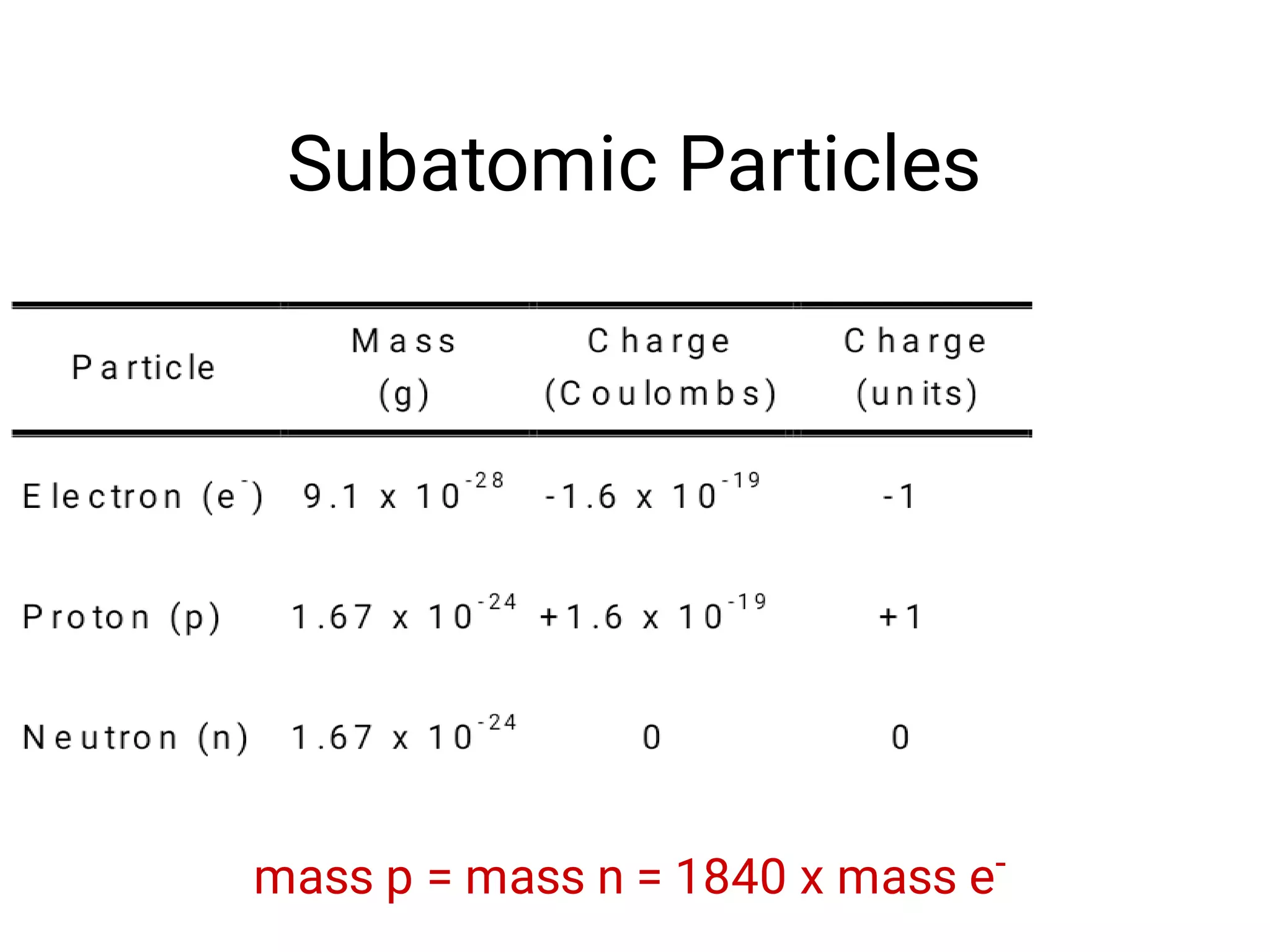
Subatomic Particles
mass p = mass n = 1840 x mass e-
Atomic Structure
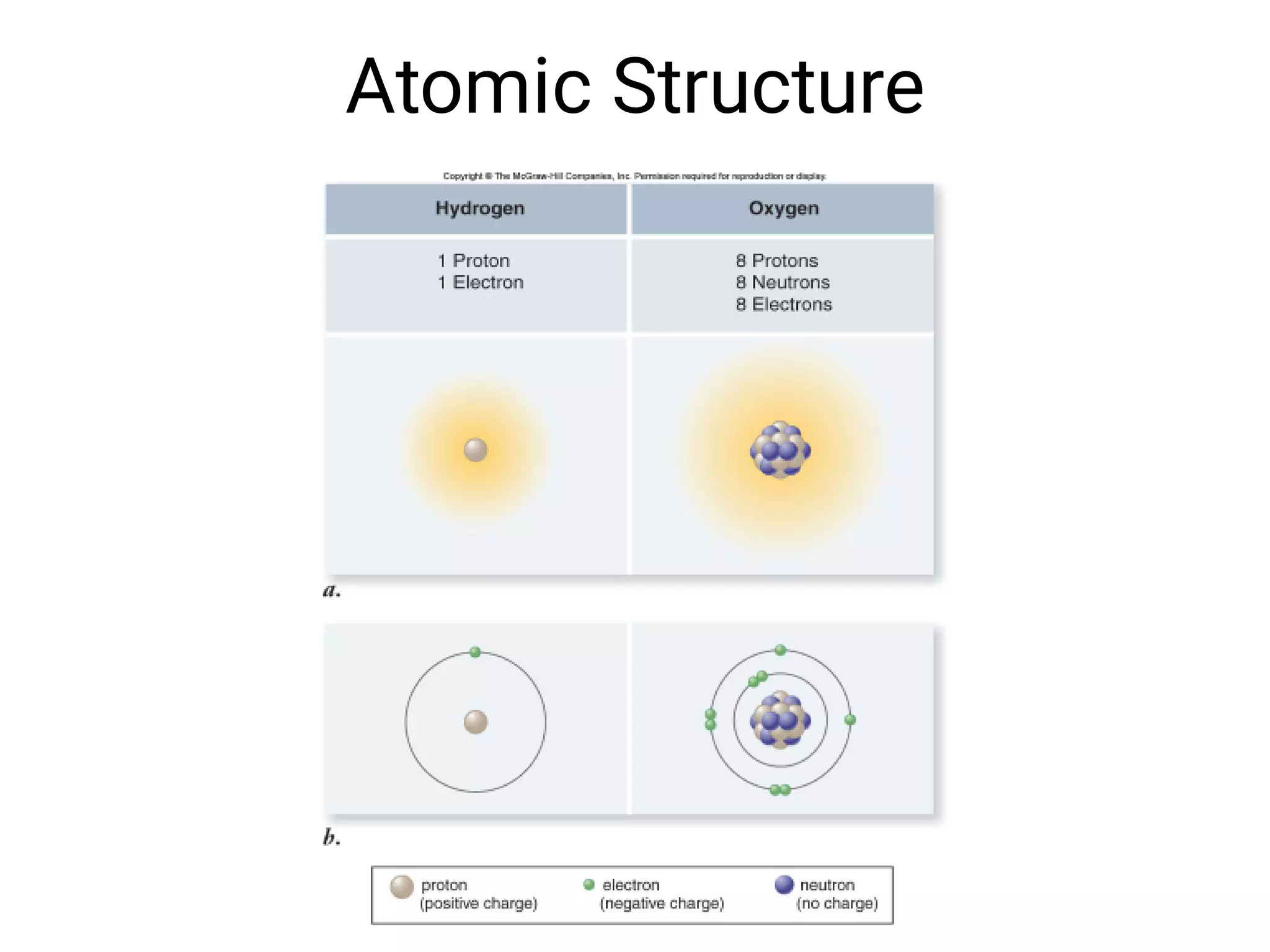
Atoms are composed of
-protons – positively charged particles
-neutrons – neutral particles
-electrons – negatively charged particles
Protons and neutrons are located in the nucleus.
Electrons are found in orbitals surrounding the
nucleus.
Atomic Structure
Atomic Structure
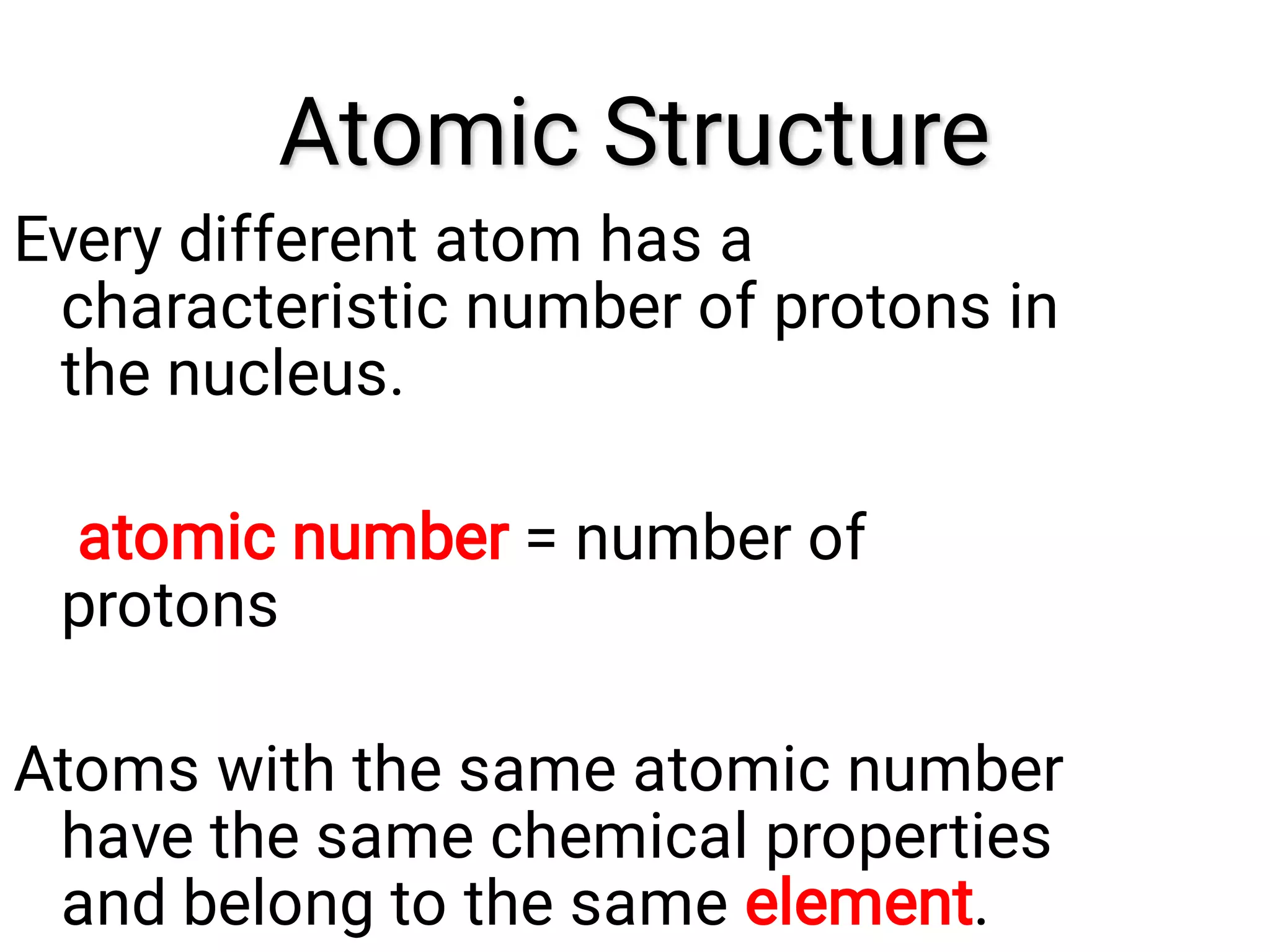
Every different atom has a
characteristic number of protons in
the nucleus.
atomic number = number of
protons
Atoms with the same atomic number
have the same chemical properties
and belong to the same element.
HELIUM ATOM
+
N
N
+
-
-
proton
electron neutron
Shell
Atomic Structure
Atomic Structure
Every different atom has a
characteristic number of protons in
the nucleus.
atomic number = number of
protons
Atoms with the same atomic number
have the same chemical properties
and belong to the same element.
Atomic Structure
Atomic Structure
Each proton and neutron has a mass of
approximately 1 dalton.
The sum of protons and neutrons is the
atom’s atomic mass.
Isotopes – atoms of the same element
that have different atomic mass
numbers due to different numbers of
neutrons.
ATOMIC STRUCTURE
ATOMIC STRUCTURE
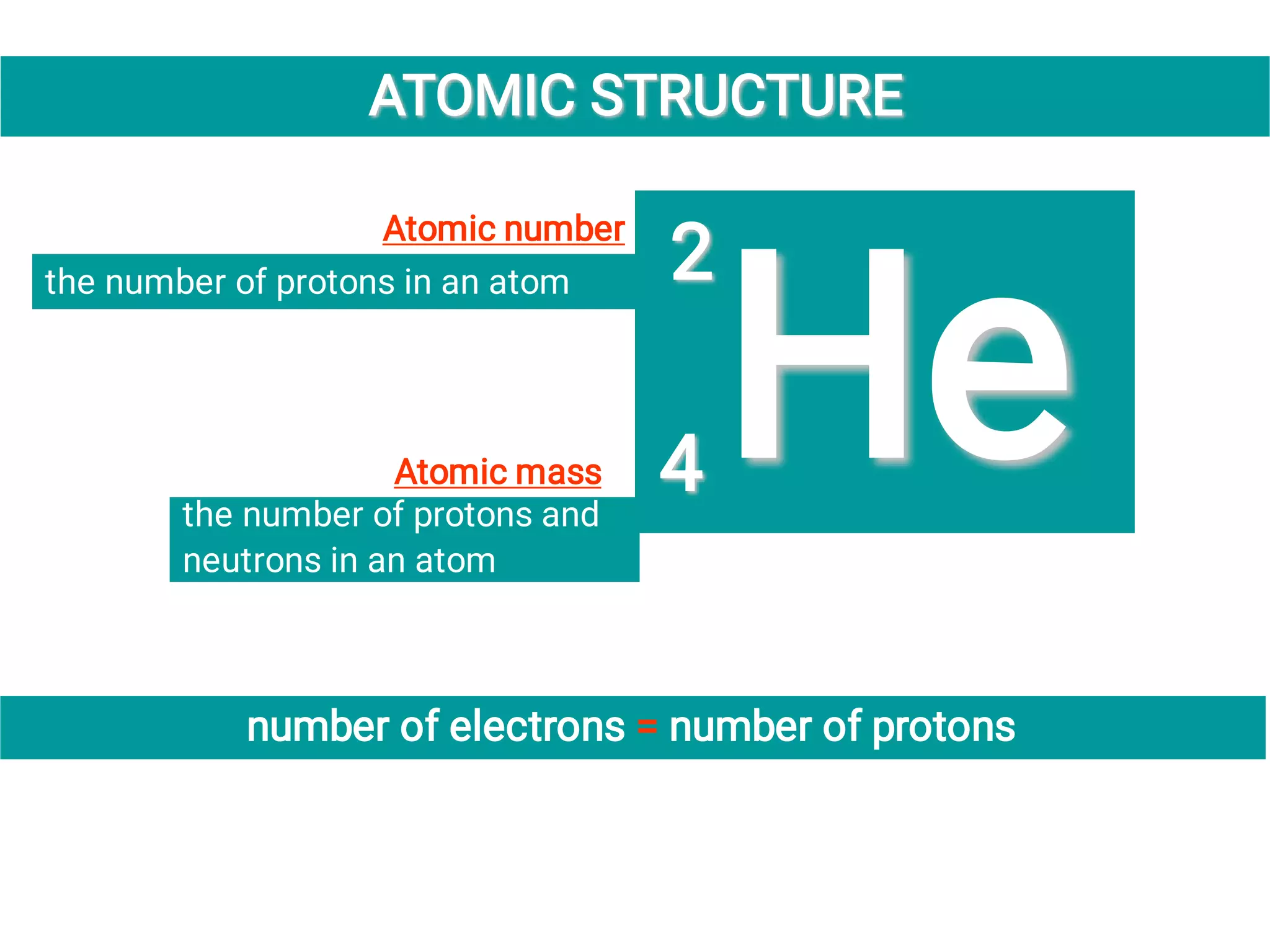
the number of protons in an atom
the number of protons and
neutrons in an atom
He
He
2
2
4
4
Atomic mass
Atomic number
number of electrons = number of protons
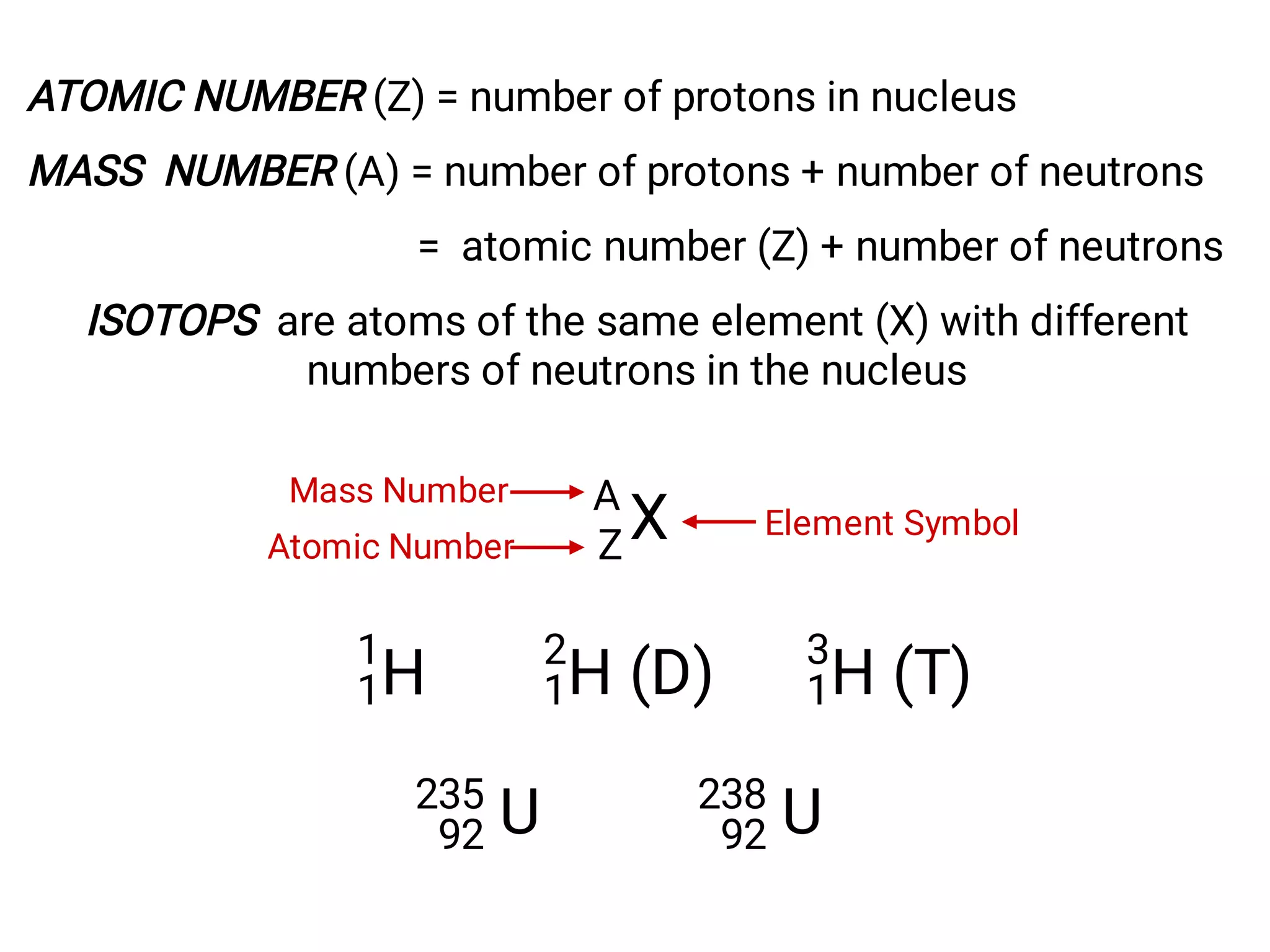
ATOMIC NUMBER (Z) = number of protons in nucleus
MASS NUMBER (A) = number of protons + number of neutrons
= atomic number (Z) + number of neutrons
ISOTOPS are atoms of the same element (X) with different
numbers of neutrons in the nucleus
X
A
Z
H
1
1 H (D)
2
1 H (T)
3
1
U
235
92 U
238
92
Mass Number
Atomic Number
Element Symbol
Atomic Structure
Atomic Structure
Atomic Structure
HISTORY OF THE ATOM
HISTORY OF THE ATOM
1913 Niels Bohr
studied under Rutherford at the Victoria
University in Manchester.
Bohr refined Rutherford's idea by adding that
the electrons were in orbits. Rather like
planets orbiting the sun. With each orbit only
able to contain a set number of electrons.
MULTIELECTRON ATOMS
MULTIELECTRON ATOMS
Atomic Structure
Atomic Structure
Neutral atoms have the same
number of protons and electrons.
Ions are charged atoms.
-cations – have more protons than
electrons and are positively
charged
-anions – have more electrons than
protons and are negatively charged
An ion is formed when an atom, or group of atoms,
has a net positive or negative charge (why?).
If a neutral atom looses one or more electrons
it becomes a cation.
If a neutral atom gains one or more electrons
it becomes an anion.
Na
11 protons
11 electrons Na+ 11 protons
10 electrons
Cl
17 protons
17 electrons Cl- 17 protons
18 electrons
Elements, Atoms & Ions
25
Elements
26
•
–
•
–
–
•
•
–
Over 112 known, of which 88 are found in
nature
others are man-made
Abundance is the percentage found in nature
oxygen most abundant element (by mass) on earth
and in the human body
the abundance and form of an element varies in
different parts of the environment
Each element has a unique symbol
The symbol of an element may be one letter or
two
if two letters, the second is lower case
27
28
29
Dalton’s Atomic Theory
30
Ê
–
Ë
–
Ì
–
Elements are composed of atoms
tiny, hard, unbreakable, spheres
All atoms of a given element are identical
all carbon atoms have the same chemical and physical
properties
Atoms of a given element are different from those
of any other element
carbon atoms have different chemical and physical
properties than sulfur atoms
Dalton’s Atomic Theory
31
Í
–
•
–
Atoms of one element
combine with atoms of
other elements to form
compounds.
Law of Constant
Composition
all samples of a
compound contain the
same proportions (by
mass) of the elements
Chemical Formulas
Dalton’s Atomic Theory
32
Î
–
–
–
•
Atoms are indivisible in a chemical process.
all atoms present at beginning are present at
the end
atoms are not created or destroyed, just
rearranged
atoms of one element cannot change into
atoms of another element
cannot turn Lead into Gold by a chemical reaction
Formulas Describe Compounds
33
•
•
–
•
•
–
•
–
a compound is a distinct substance that is
composed of atoms of two or more elements
describe the compound by describing the
number and type of each atom in the simplest
unit of the compound
molecules or ions
each element represented by its letter symbol
the number of atoms of each element is written
to the right of the element as a subscript
if there is only one atom, the 1 subscript is not written
polyatomic groups are placed in parentheses
if more than one
Are Atoms Really Unbreakable?
34
•
•
•
•
•
•
J.J. Thomson investigated a beam called a
cathode ray
he determined that the ray was made of tiny
negatively charged particles we call electrons
his measurements led him to conclude that these
electrons were smaller than a hydrogen atom
if electrons are smaller than atoms, they must be
pieces of atoms
if atoms have pieces, they must be breakable
Thomson also found that atoms of different
elements all produced these same electrons
The Electron
35
•
•
–
•
Tiny, negatively charged particle
Very light compared to mass of atom
1/1836th the mass of a H atom
Move very rapidly within the atom
Thomson’s Plum Pudding
Model
36
Ê
Ë
Ì
–
Í
Î
–
Atom breakable!!
Atom has structure
Electrons suspended in a positively charged electric
field
must have positive charge to balance negative
charge of electrons and make the atom neutral
mass of atom due to electrons
atom mostly “empty” space
compared size of electron to size of atom
Rutherford’s Gold Foil Expt
37
•
•
–
•
–
•
•
–
–
How can you prove something is empty?
put something through it
use large target atoms
use very thin sheets of target so do not absorb “bullet”
use very small particle as bullet with very high
energy
but not so small that electrons will affect it
bullet = alpha particles, target atoms = gold foil
particles have a mass of 4 amu & charge of +2 c.
u.
gold has a mass of 197 amu & is very malleable
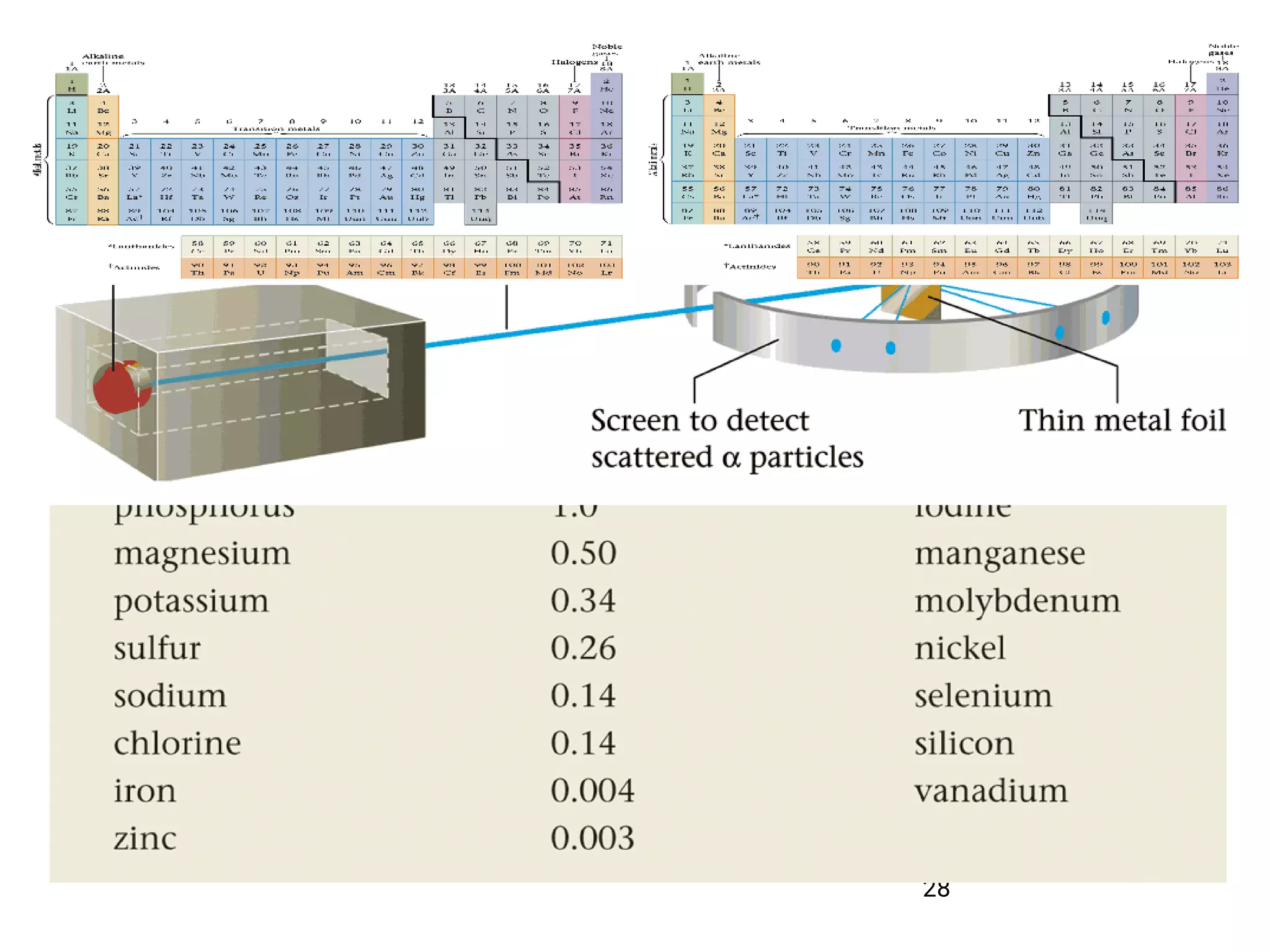
Figure 4.5: Rutherford’s experiment
on
-particle bombardment of metal foil.
38
Rutherford’s Results
39
•
•
•
Over 98% of the particles went straight
through
About 2% of the particles went through but
were deflected by large angles
About 0.01% of the particles bounced off
the gold foil
Rutherford’s Nuclear Model
40
Ê
–
Ë
Ì
–
Í
The atom contains a tiny dense center called
the nucleus
the volume is about 1/10 trillionth the
volume of the atom
The nucleus is essentially the entire mass of
the atom
The nucleus is positively charged
the amount of positive charge of the
nucleus balances the negative charge of
the electrons
The electrons move around in the empty
space of the atom surrounding the nucleus
Structure of the Nucleus
41
•
•
–
–
•
•
–
–
The nucleus was found to be composed of two
kinds of particles
Some of these particles are called protons
charge = +1
mass is about the same as a hydrogen atom
Since protons and electrons have the same
amount of charge, for the atom to be neutral there
must be equal numbers of protons and electrons
The other particle is called a neutron
has no charge
has a mass slightly more than a proton
The Modern Atom
42
•
•
•
•
–
We know atoms are composed of three
main pieces - protons, neutrons and
electrons
The nucleus contains protons and
neutrons
The nucleus is only about 10-13 cm in
diameter
The electrons move outside the nucleus
with an average distance of about 10-8 cm
therefore the radius of the atom is about 105
times larger than the radius of the nucleus
Isotopes
43
•
•
–
•
•
–
•
•
–
All atoms of an element have the same number of
protons
The number of protons in an atom of a given
element is the same as the atomic number
found on the Periodic Table
Atoms of an element with different numbers of
neutrons are called isotopes
All isotopes of an element are chemically identical
undergo the exact same chemical reactions
Isotopes of an element have different masses
Isotopes are identified by their mass numbers
mass number = protons + neutrons
Elements
44
•
•
•
–
–
•
–
•
–
–
Arranged in a pattern called the Periodic Table
Position on the table allows us to predict
properties of the element
Metals
about 75% of all the elements
lustrous, malleable, ductile, conduct heat and
electricity
Nonmetals
dull, brittle, insulators
Metalloids
also know as semi-metals
some properties of both metals & nonmetals
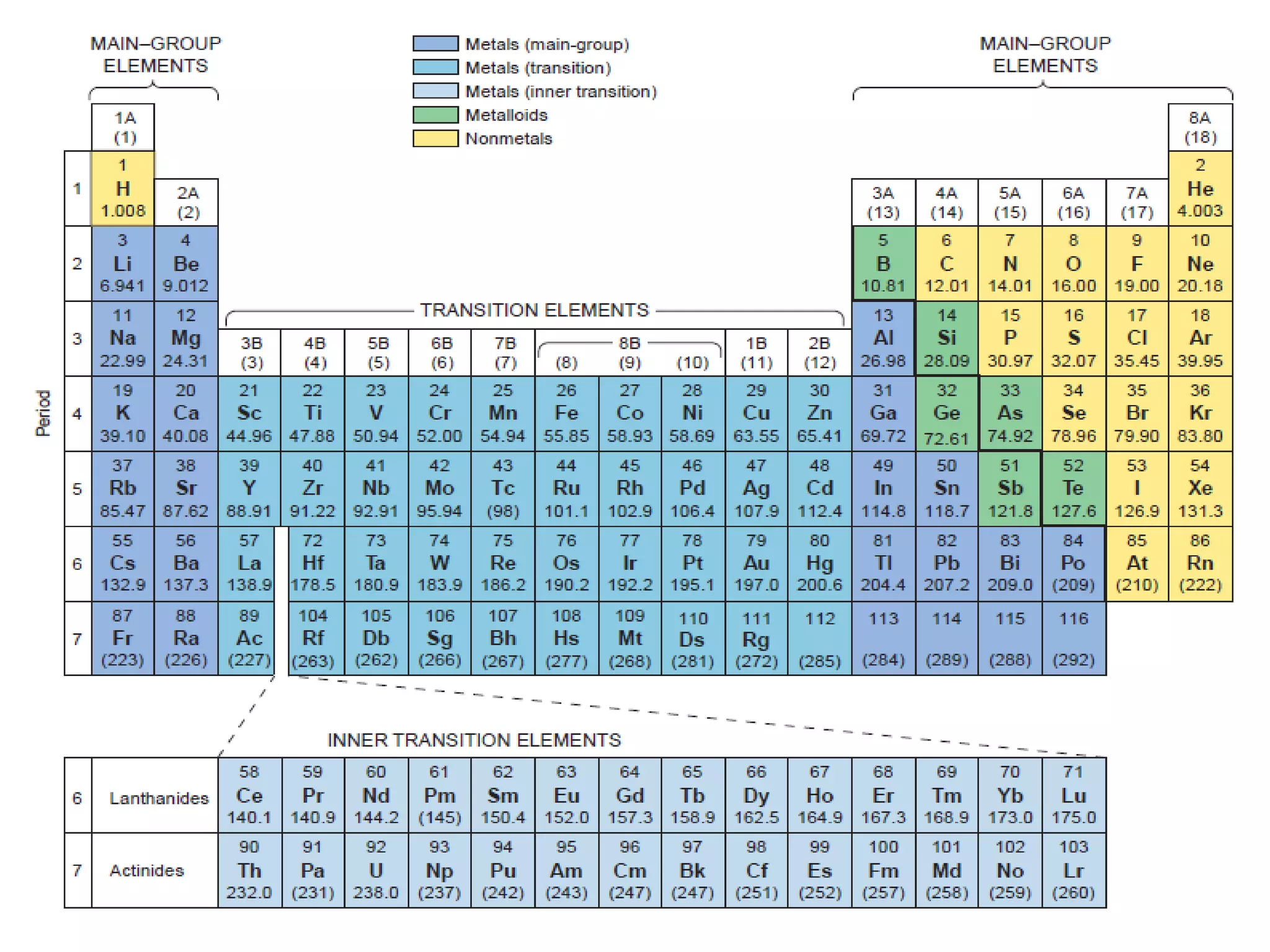
The Modern Periodic Table
45
•
•
•
•
Elements with similar chemical and
physical properties are in the same
column
Columns are called Groups or Families
Rows are called Periods
Each period shows the pattern of
properties repeated in the next period
Figure 4.11: The periodic table.
46
The Modern Periodic Table
47
•
–
•
–
•
–
–
Main Group = Representative Elements
“A” columns
Transition Elements
all metals
Bottom rows = Inner Transition Elements =
Rare Earth Elements
metals
really belong in Period 6 & 7
Important Groups
48
•
•
•
•
•
Group 8 = Noble Gases
He, Ne, Ar, Kr, Xe, Rn
all colorless gases at
room temperature
very non-reactive,
practically inert
found in nature as a
collection of separate
atoms uncombined with
other atoms
•
•
•
•
•
Noble Metals
Ag, Au, Pt
all solids at room
temperature
least reactive
metals
found in nature
uncombined with
other atoms
Important Groups - Halogens
49
•
•
•
•
Group 7A =
Halogens
very reactive
nonmetals
react with metals
to form ionic
compounds
HX all acids
•
–
•
–
•
–
–
•
–
Fluorine = F2
pale yellow gas
Chlorine = Cl2
pale green gas
Bromine = Br2
brown liquid that has lots
of brown vapor over it
Only other liquid element
at room conditions is the
metal Hg
Iodine = I2
lustrous, purple solid
Allotropes
50
•
•
•
–
–
–
Many solid nonmetallic elements can
exist in different forms with different
physical properties, these are called
allotropes
the different physical properties arise
from the different arrangements of the
atoms in the solid
Allotropes of Carbon include
diamond
graphite
buckminsterfullerene
Electrical Nature of Matter
51
•
–
–
•
•
–
Most common pure substances are very poor
conductors of electricity
with the exception of metals and graphite
Water is a very poor electrical conductor
Some substances dissolve in water to form a
solution that conducts well - these are called
electrolytes
When dissolved in water, electrolyte compounds
break up into component ions
ions are atoms or groups of atoms that have an electrical
charge
Ions
52
•
–
•
–
•
–
•
•
ions that have a positive charge are called cations
form when an atom loses electrons
ions that have a negative charge are called anions
form when an atom gains electrons
ions with opposite charges attract
therefore cations and anions attract each other
moving ions conduct electricity
compound must have no total charge, therefore we
must balance the numbers of cations and anions in a
compound to get 0 total charge
Atomic Structures of Ions
53
•
•
–
–
•
•
–
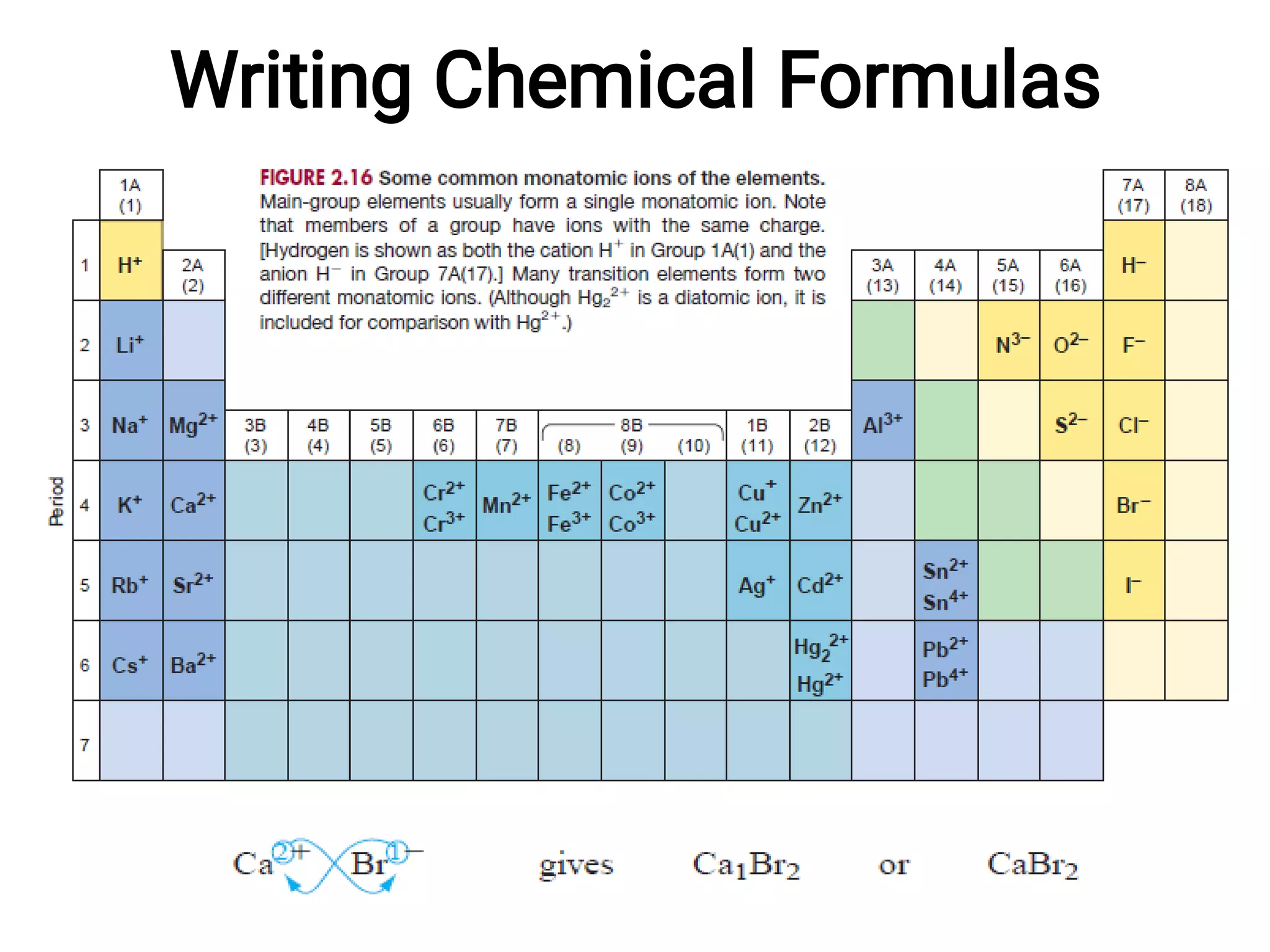
Metals form cations
For each positive charge the ion has 1 less
electron than the neutral atom
Na = 11 e-, Na+ = 10 e-
Ca = 20 e-, Ca+2 = 18 e-
Cations are named the same as the metal
sodium Na Na+ + 1e- sodium ion
calciumCa Ca+2 + 2e- calcium ion
The charge on a cation can be determined from
the Group number on the Periodic Table for Groups
IA, IIA, IIIA
Group 1A +1, Group 2A +2, (Al, Ga, In) +3
Atomic Structures of Ions
54
•
•
–
–
•
•
–
Nonmetals form anions
For each negative charge the ion has 1 more
electron than the neutral atom
F = 9 e-, F- = 10 e-
P = 15 e-, P3- = 18 e-
Anions are named by changing the ending of the
name to -ide
fluorine F + 1e- F- fluoride ion
oxygen O + 2e- O2- oxide ion
The charge on an anion can be determined from
the Group number on the Periodic Table
Group 7A -1, Group 6A -2
The Components of Matter






Any matter exists as elements, compounds, or mixtures.
Elements and compounds are referred to as substances because their
compositions are fixed.
An element consists of only one type of atom.
A compound contains two or more elements in chemical Combination
and exhibits different properties from its component elements.
The elements of a compound occur in fixed parts by mass because
each unit of the compound has fixed numbers of each type of atom.
A mixture consists of two or more substances mixed together, not
chemically combined.
Mass Laws



The law of mass conservation: Matter cannot be created or
destroyed. The total mass remains constant during chemical
reaction.
The law of definite composition: any sample of a given compound
has the same elements present in the same parts by mass
The law of multiple proportions: for different compounds of same
elements, the masses of one element that combine with a fixed
mass of the other can be expressed as a ratio of small whole
numbers.
Atomic Models Theories





Dalton 1808: All matter consists of tiny particles called atoms,
cannot be created or destroyed. Atoms of one element cannot be
converted into atoms of another element. Atoms of an element are
identical and are different from atoms of any other element.
Compounds result from the chemical combination of a specific ratio
of atoms of different elements.
But, why atoms bond as they do? What about the charged particles
that were being observed in experiments ?
J. Thomson 1897 : Cathode rays consist of negative particles
(electrons) that exist in all matter, much smaller and lighter than
atoms.
R. Millikan 1909: Determined the charge and the mass of the
electron (-1.602 x 10⁻¹⁹ C , 9.109x10⁻³¹ kg).
E. Rutherford 1910: atoms consist of a tiny, massive, positive
nucleus surrounded by electrons.
Final Model …





An atom has central nucleus, contains +p and ±n and is surrounded by
-e. An atom is neutral because -e = +p •
The atomic number: number of protons, The mass number ( ± n + +p )
.
Isotopes: atoms with the same number of protons but different
number of neutrons. Each isotope has a mass relative to the 12C
mass standard.
The atomic mass of an element is the average of the masses of its
isotopes weights according to their natural abundances and is
determined by mass spectrometry.
Carbon Z=6 , has 8 isotopes, 3 natural 12C ( 98.89%), 13C (1.11%), 14C
(0.01%), 5 made in the lab, 9C, 10C, 11C, 15C, 16C .
Final Model …
Calculating Atomic Mass of Element
Periodic Table






In the periodic table, the elements are arranged by ………….. into
horizontal periods and vertical groups.
Elements within a group have similar behavior … Why ? whereas
elements in a period have dissimilar behavior… why ?
Nonmetals appear in the upper-right portion of the table, metalloids lie
along a staircase line, and metals fill the rest of the table.
118 elements including, metals (91), non-metals (20), metalloids (7),
Alkali metals (6); Alkaline earth metals (6), Transition metals (38) ;
Post-transition metals (11), Lanthanides (15) ; Actinides-15 ; Halogens
(6) ; Noble gases (7) .
98 elements are natural and rest are synthetic.
11 elements occur as gases and 2 elements occur as liquids.Who ?
Compounds and Bonding






Few elements occur uncombined in nature, the great majority exist in
compounds.
Ionic compounds form when a metal transfers electrons to a
nonmetal, and the resulting positive and negative ions attract each
other (NaCl ? )
Covalent compounds form when elements, usually nonmetals, share
electrons. Each covalent bond is an electron pair mutually attracted
by two atomic nuclei (N2, H2O, CH4 ?)
Monatomic ions are derived from single atoms.
Polyatomic ions consist of two or more covalently bonded atoms that
have a net positive or negative charge due to a deficit or excess of
electrons (ex. CaCO3).
Some elements exist as di, tetra and even octatomic molecules ?
Elements Properties Direction
COMPOUNDS: FORMULAS,
NAMES, and MASSES


Chemical formulas: describe the simplest atom ratio (empirical
formula), actual atom number (molecular formula), and atom
arrangement (structural formula) of one unit of a compound. (ex;
H2O2 ,….., ….., …….)
Naming binary ionic compounds: Generally cation first and anion
second…. cation end in –ium then add –ide to the anion root name.
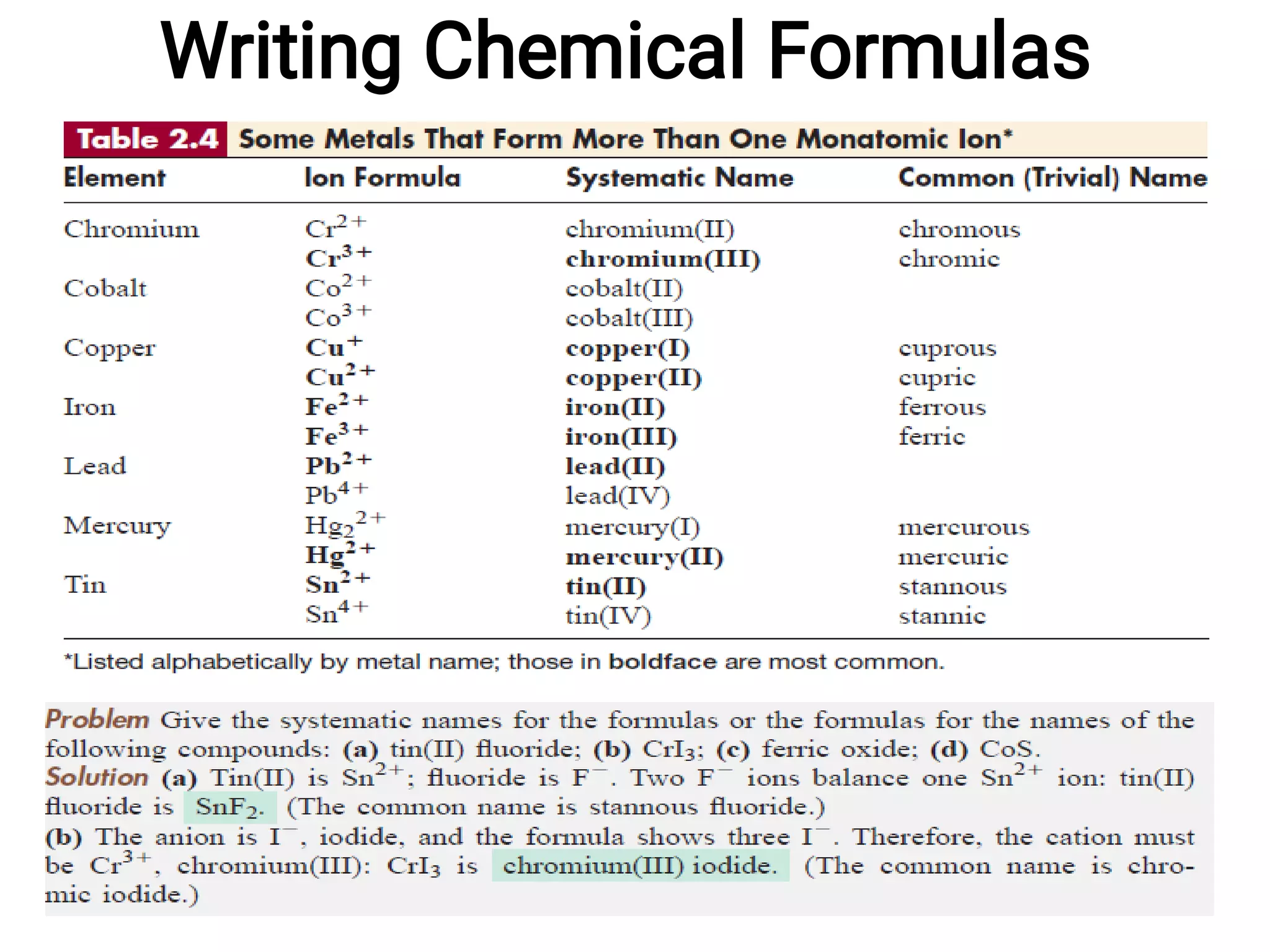
Writing Chemical Formulas
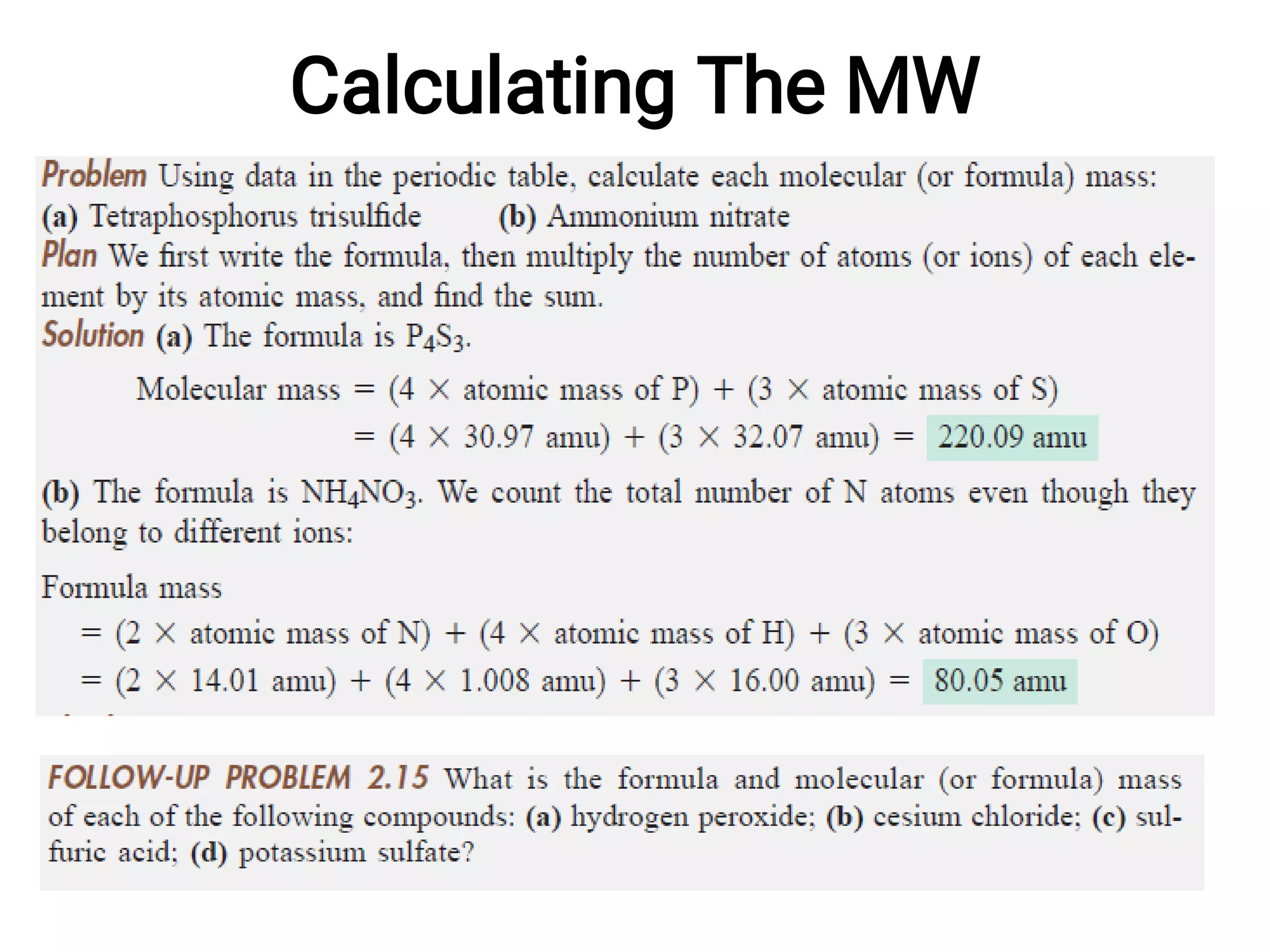
Calculating The MW
Abstract
Abstract
Problems
Quantum Theory and Atomic Structure
The Nature of Light






Electromagnetic radiation travels in waves of specific wavelength (λ)
and frequency (ν).
Frequency (nu, ν) is the number of cycles the wave undergoes per
second, expressed in 1/second [s-1; also called hertz (Hz)].
Wavelength (lambda, λ) is the distance between any point on a wave
and the corresponding point on the next crest, expressed in
nanometers (nm, 10-9 m).
Amplitude, the height of the crest (or depth of the trough) of each
wave.
All electromagnetic waves travel through a vacuum at the speed of
light, c (3.00X10⁸ m/s).
Radiation with a high frequency has a short wavelength, and vice
versa.
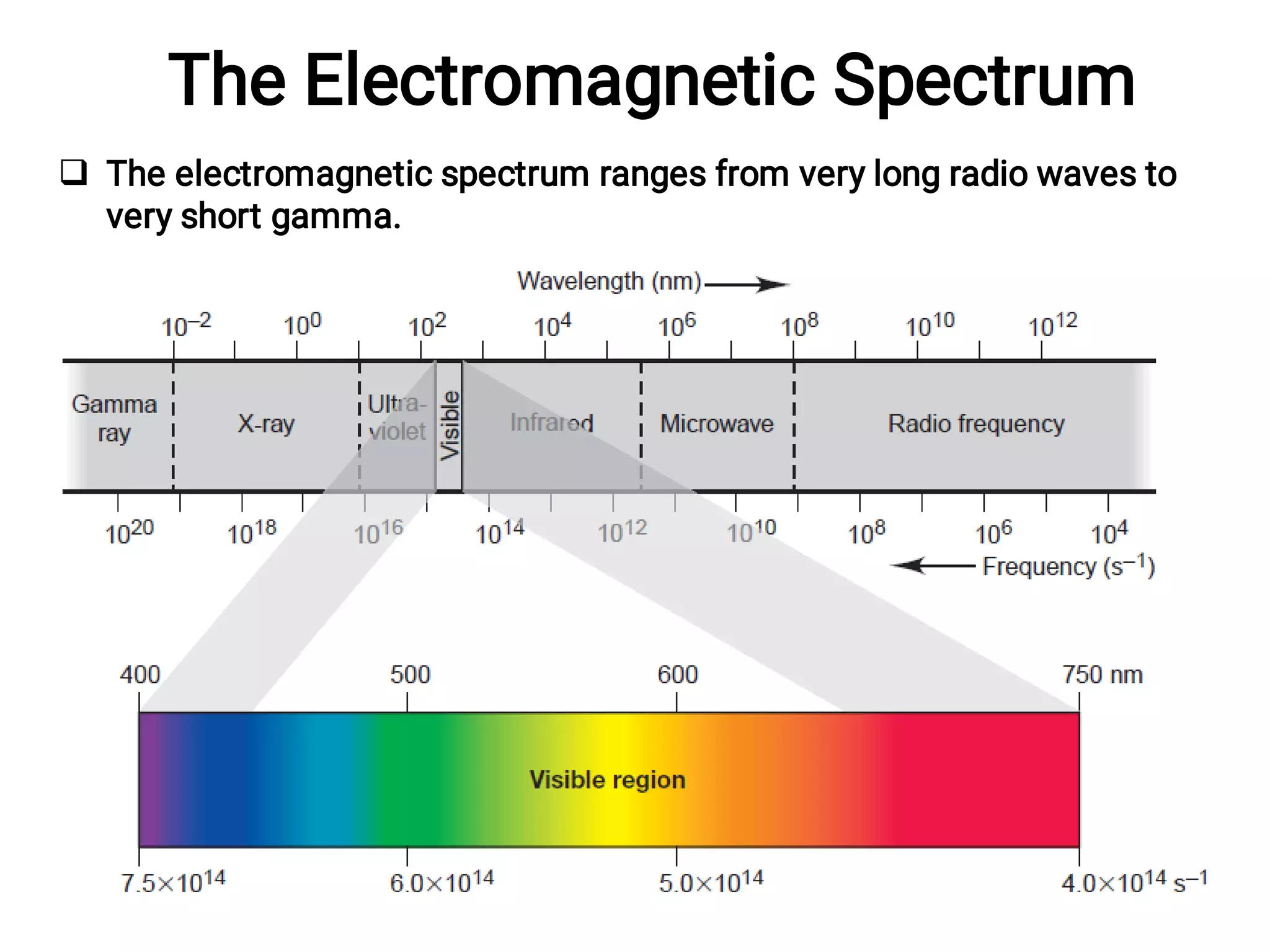
The Electromagnetic Spectrum
 The electromagnetic spectrum ranges from very long radio waves to
very short gamma.
The Electromagnetic Spectrum
Wave or Particle ?





Refraction and diffraction indicate that electromagnetic radiation is
wavelike, but blackbody radiation and the photoelectric effect indicate
that it is particle-like.
Blackbody is an idealized object that absorbs all the radiation incident
on it. A hollow cube with a small hole in one wall approximates a
blackbody.
Light exists as photons (quanta) that have an energy proportional to
the frequency. •
According to quantum theory, an atom has only certain quantities of
energy (E = nhν), which it can change only by absorbing or emitting a
photon.
E = Energy,h = Plank constant 6.626X10⁻³⁴ J.s ,ν = frequency, n =
matter quantity.
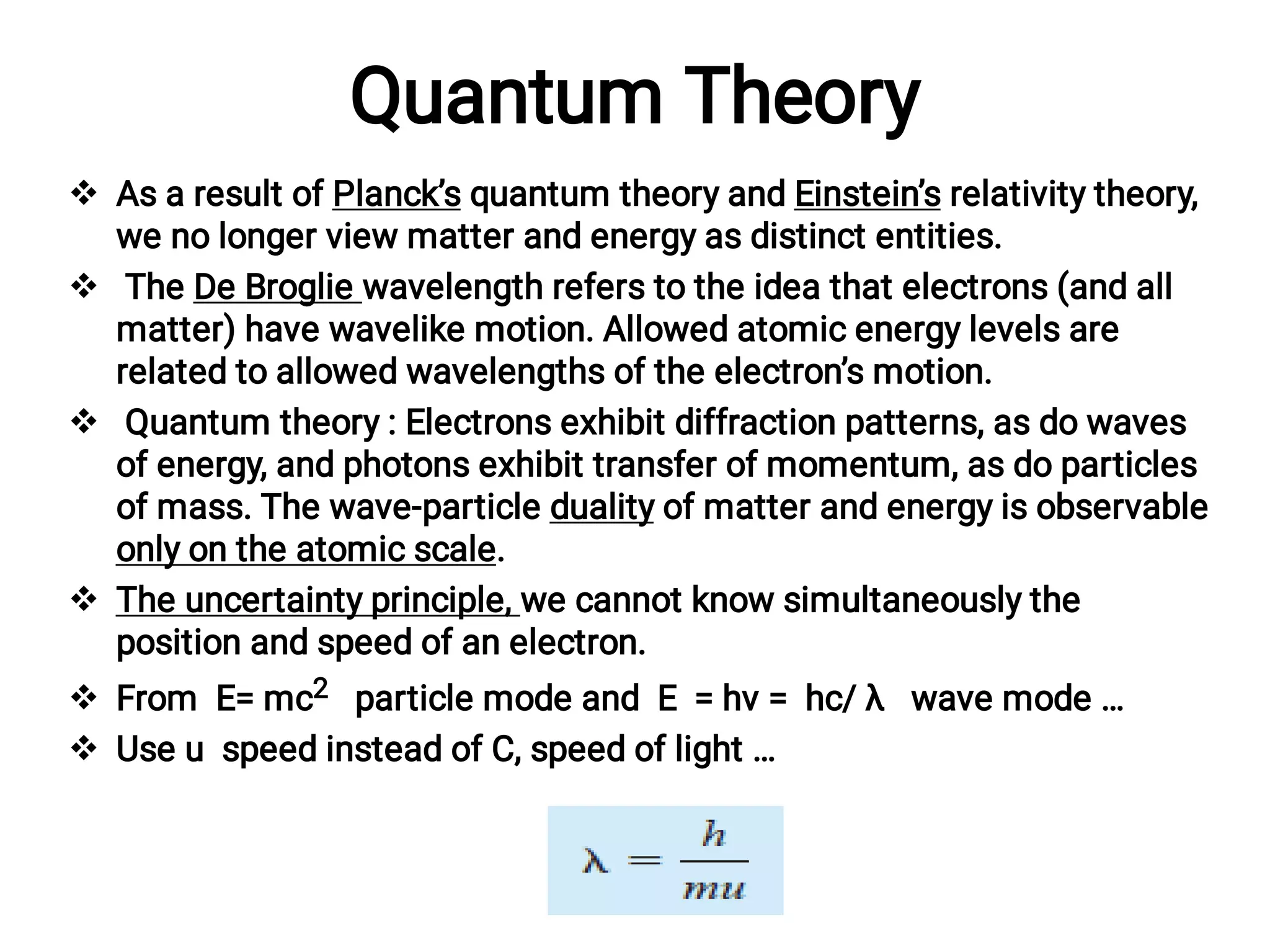
Quantum Theory






As a result of Planck’s quantum theory and Einstein’s relativity theory,
we no longer view matter and energy as distinct entities.
The De Broglie wavelength refers to the idea that electrons (and all
matter) have wavelike motion. Allowed atomic energy levels are
related to allowed wavelengths of the electron’s motion.
Quantum theory : Electrons exhibit diffraction patterns, as do waves
of energy, and photons exhibit transfer of momentum, as do particles
of mass. The wave-particle duality of matter and energy is observable
only on the atomic scale.
The uncertainty principle, we cannot know simultaneously the
position and speed of an electron.
From E= mc2 particle mode and E = hν = hc/ λ wave mode …
Use u speed instead of C, speed of light …
Problems
Electronic Configuration



The aufbau method : in the ground state of an atom, the orbital with
a lower energy is filled up first before filling of orbital with higher
energy
Pauli’s exclusion principle : No two electrons can have the same set
of quantum numbers.
Hund’s rule : Orbitals of equal energy become half-filled, with
electron spins parallel, before any pairing occurs.
Electronic Configuration
TRENDS IN ATOMIC PROPERTIES





All physical and chemical behavior of the elements is based on the
electron configurations.
Atomic size increases down a group and decreases across a period.
Across a transition series, size remains relatively constant.
Ionization energy (the energy required to remove the outermost
electron from a mole of gaseous atoms) is inversely related to
atomic size.
Electron affinity (the energy involved in adding an electron to a mole
of gaseous atoms) shows many variations from expected trends.
Based on the relative sizes of IEs and EAs, in their ionic compounds,
the Group 1A(1) and 2A(2) elements tend to form cations, and the
Group 6A(16) and 7A(17) elements tend to form anions.
TRENDS IN ATOMIC PROPERTIES
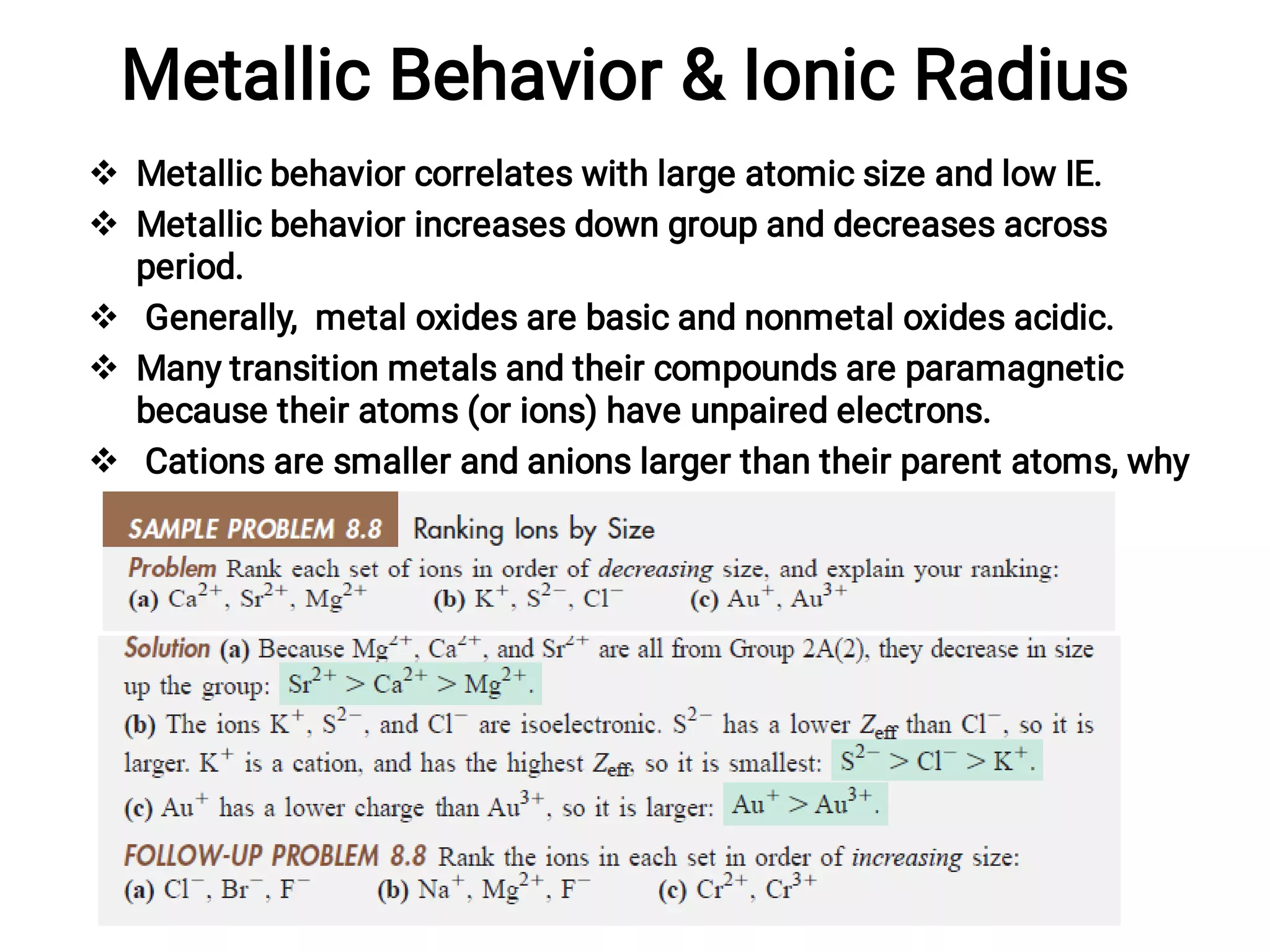
Metallic Behavior & Ionic Radius





Metallic behavior correlates with large atomic size and low IE.
Metallic behavior increases down group and decreases across
period.
Generally, metal oxides are basic and nonmetal oxides acidic.
Many transition metals and their compounds are paramagnetic
because their atoms (or ions) have unpaired electrons.
Cations are smaller and anions larger than their parent atoms, why
and in which direction ?
Chemical Bonding





Ionic bonding occurs when metal atoms transfer electrons to
nonmetal atoms, the resulting ions attract each other and form an
ionic solid.
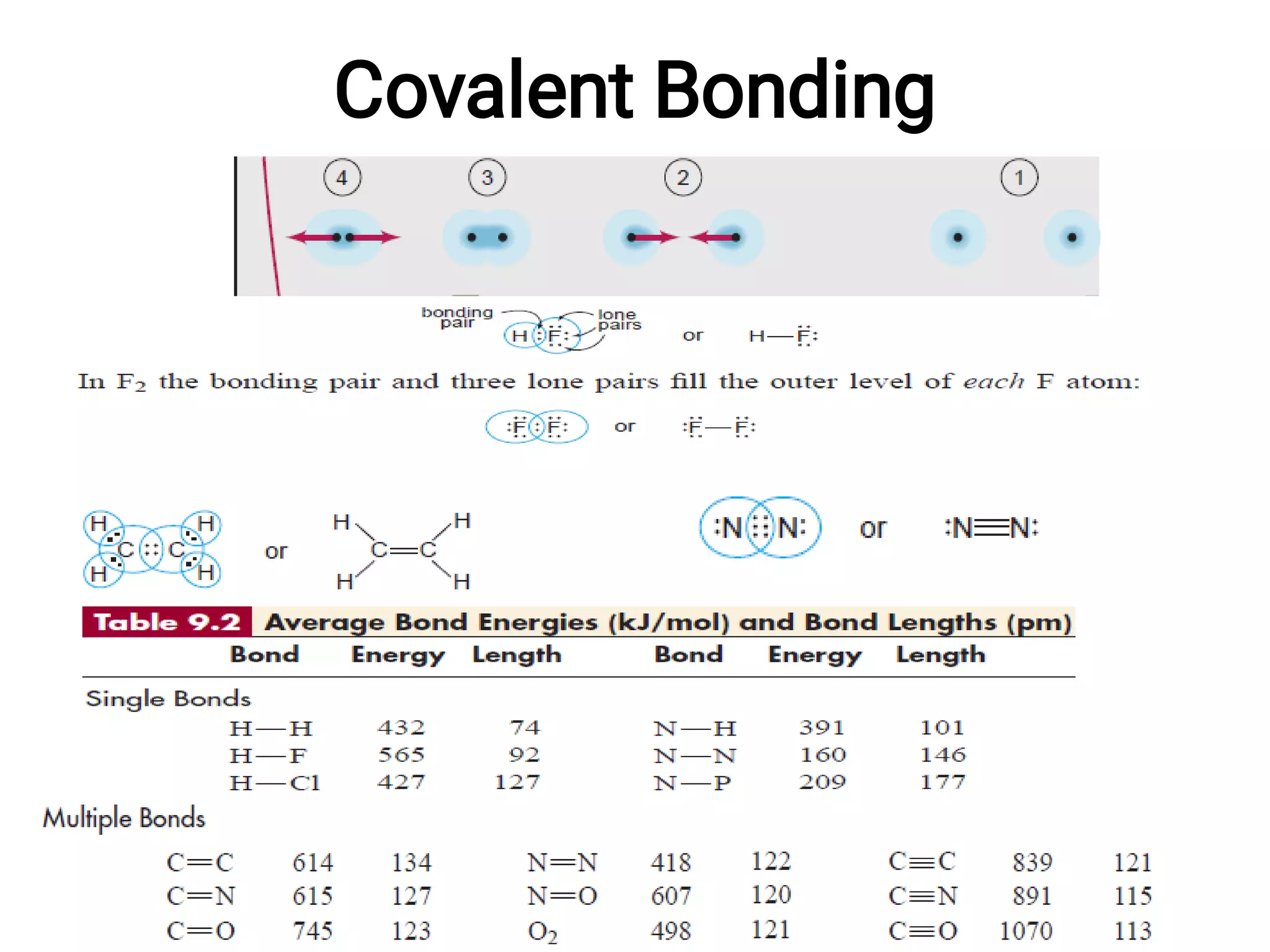
Covalent bonding occurs between nonmetal atoms results in
molecules, the bonded atoms share a pair of electrons, which remain
localized between them.
Metallic bonding occurs when many metal atoms pool their valence
electrons in a delocalized electron “sea” that holds all the atoms
together.
Octet rule: in bonding, atoms lose, gain, or share electrons to attain a
filled outer level of eight electrons (or 2).
The Lewis electron-dot symbol: Depicts the number of valence
electrons for elements separately or in molecules.
Ionic Bonding
Covalent Bonding
Bond Length & Strength
Electronegativity & Polar Bonds



Electronegativity (EN): Ability of an atom to pull bonded electrons
toward it, which generates partial charges at the ends of the bond.
EN reverse of the trends in atomic size.
Greater ΔEN between two atoms, more polar character.
Problems
Solutions



Solutions are homogeneous mixtures consisting of solute dissolved in
solvent.
The solubility of a solute: the maximum amount that can dissolve in
given amount of solvent at specified temperature.
The concentration of a solution is independent of the amount of
solution.
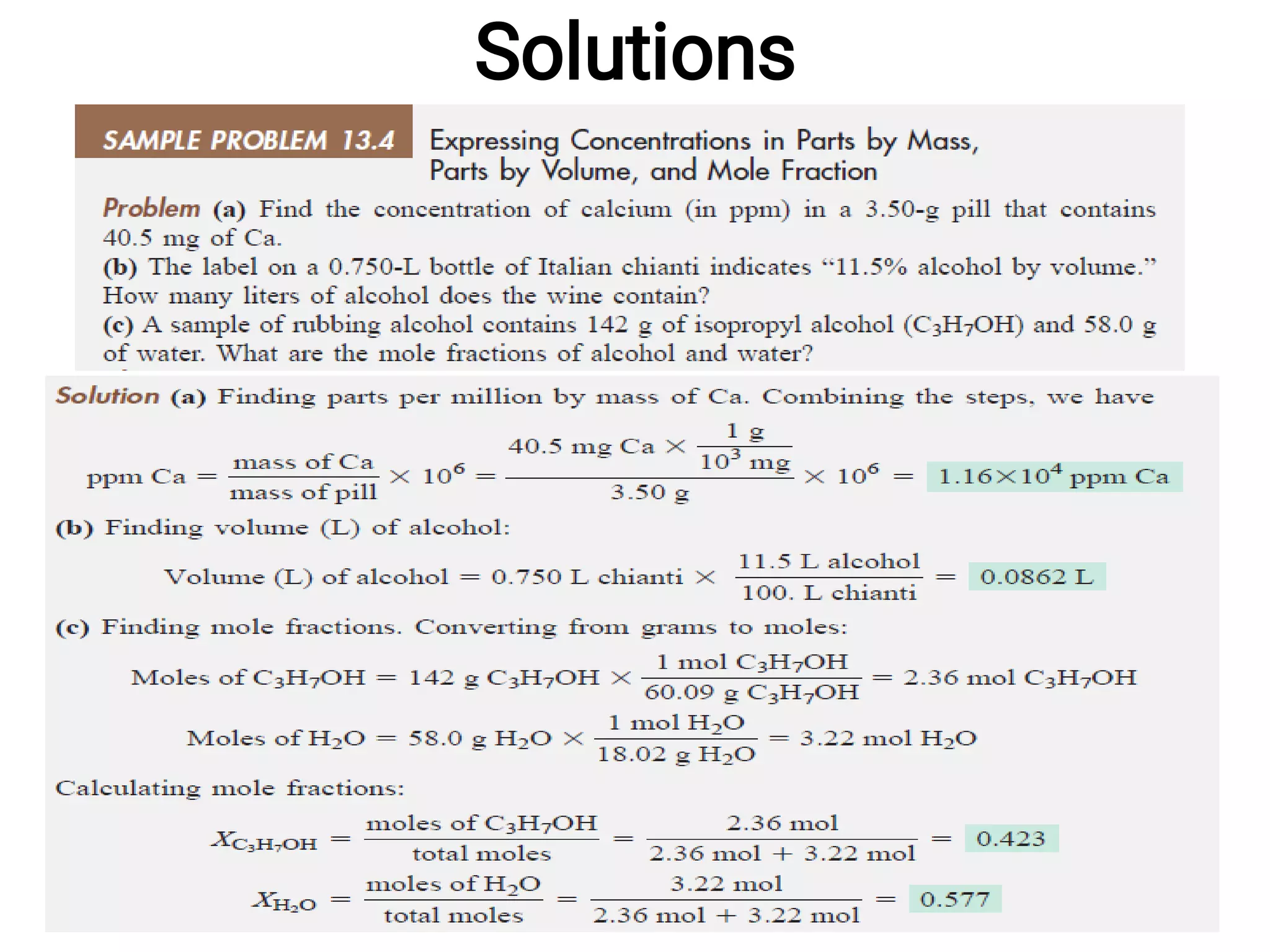
Solutions


A mole of substance is the amount that contains Avogadro’s
number (6.022 x10²³) of chemical entities (atoms, molecules, or
formula units).
Mass of one mole (g) of any element or molecule is equal to its
molecular weight (g).
Solutions
Solutions
Solutions
Acid-Base Equilibria





In aqueous solution, water binds the proton released from an acid to
form H3O+ (aq).
Arrhenius definition: Acids contain H and yield H3O+ in water, bases
contain OH and yield OH- in water.
Strong acids dissociate completely and weak acids slightly.
The extent of dissociation is expressed by the acid dissociation
constant, Ka Weak acids have Ka values from about 10-1 to 10-12.
Many acids and bases can be classified qualitatively as strong or
weak based on their formulas.
pH Scale




Pure water has low conductivity because it autoionizes to small
extent.
Ionization constant for water, Kw (1.0 x10⁻¹⁴ at 25°C).
in acidic solution, [H3O+] is greater than [OH]; the reverse is true in
basic solution; and the two are equal in neutral solution.
Simply, we use the pH scale (pH = -log [H3O+]).
pH Scale
pH Scale
Gaseous State



Gases flow more freely and have lower densities than liquids and
solids, and gases volumes can be altered significantly by changing
the applied external force or the temperature (why ?)
A barometer measures atmospheric pressure in terms of the height
of the mercury column that the atmosphere can support (760
mmHg at sea level and 0C).
Chemists measure pressure in units of atmospheres (atm), torrs
(equivalent to mmHg), and pascals (Pa, the SI unit).
THE GAS LAWS





Four variables define the physical behavior of an ideal gas:
volume (V), pressure (P), temperature (T ), and amount (number
of moles, n).
Most simple gases display nearly ideal behavior at ordinary
temperatures and pressures.
Boyle’s, Charles’s, and Avogadro’s laws relate volume to pressure,
to temperature, and to amount of gas, respectively.
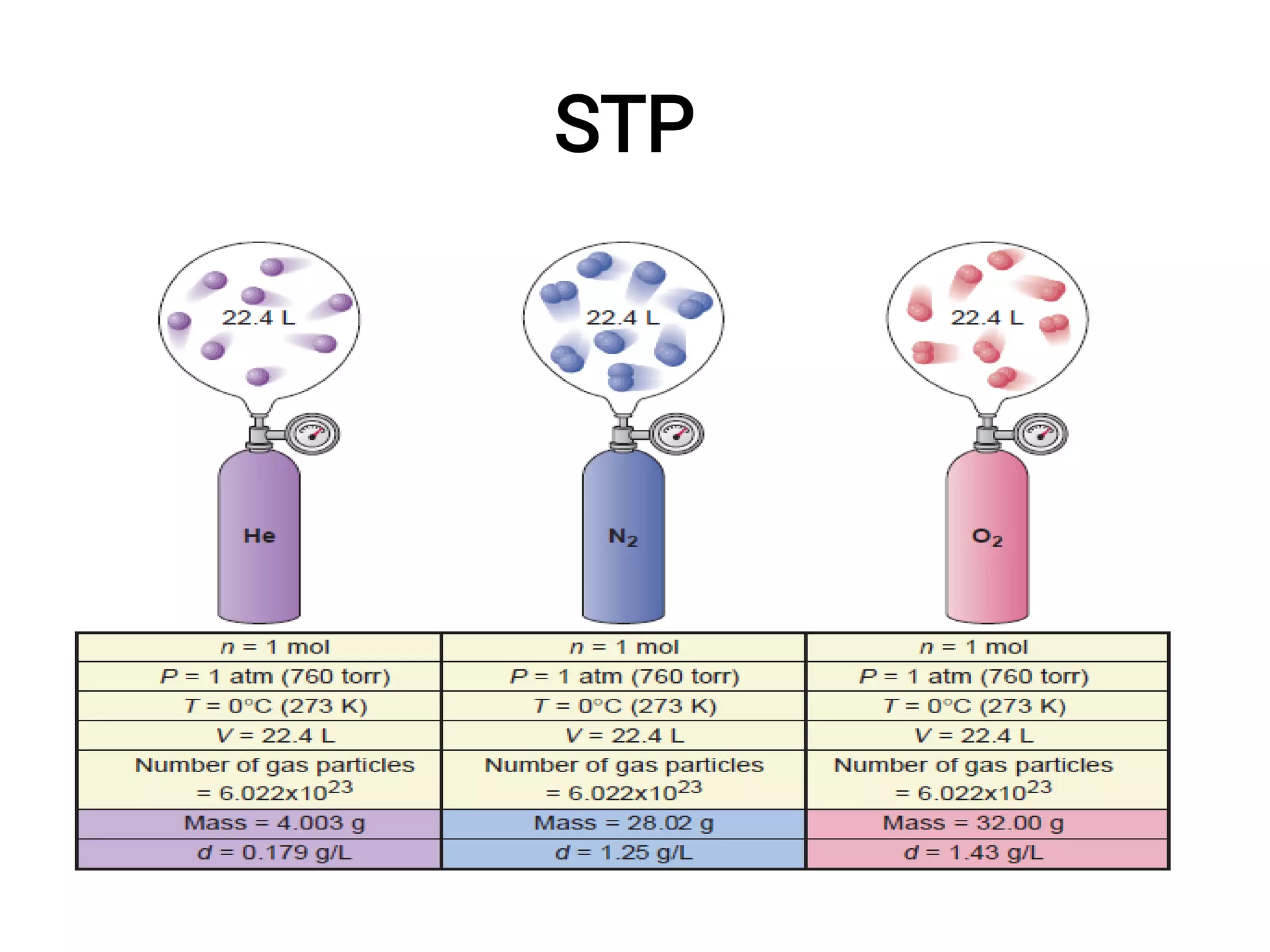
At STP (0C and 1 atm), 1 mol of an ideal gas occupies 22.4 L.
The ideal gas law incorporates the individual gas laws into one
equation: PV = nRT, where R is the universal gas constant.
STP
THE GAS LAWS
THE GAS LAWS




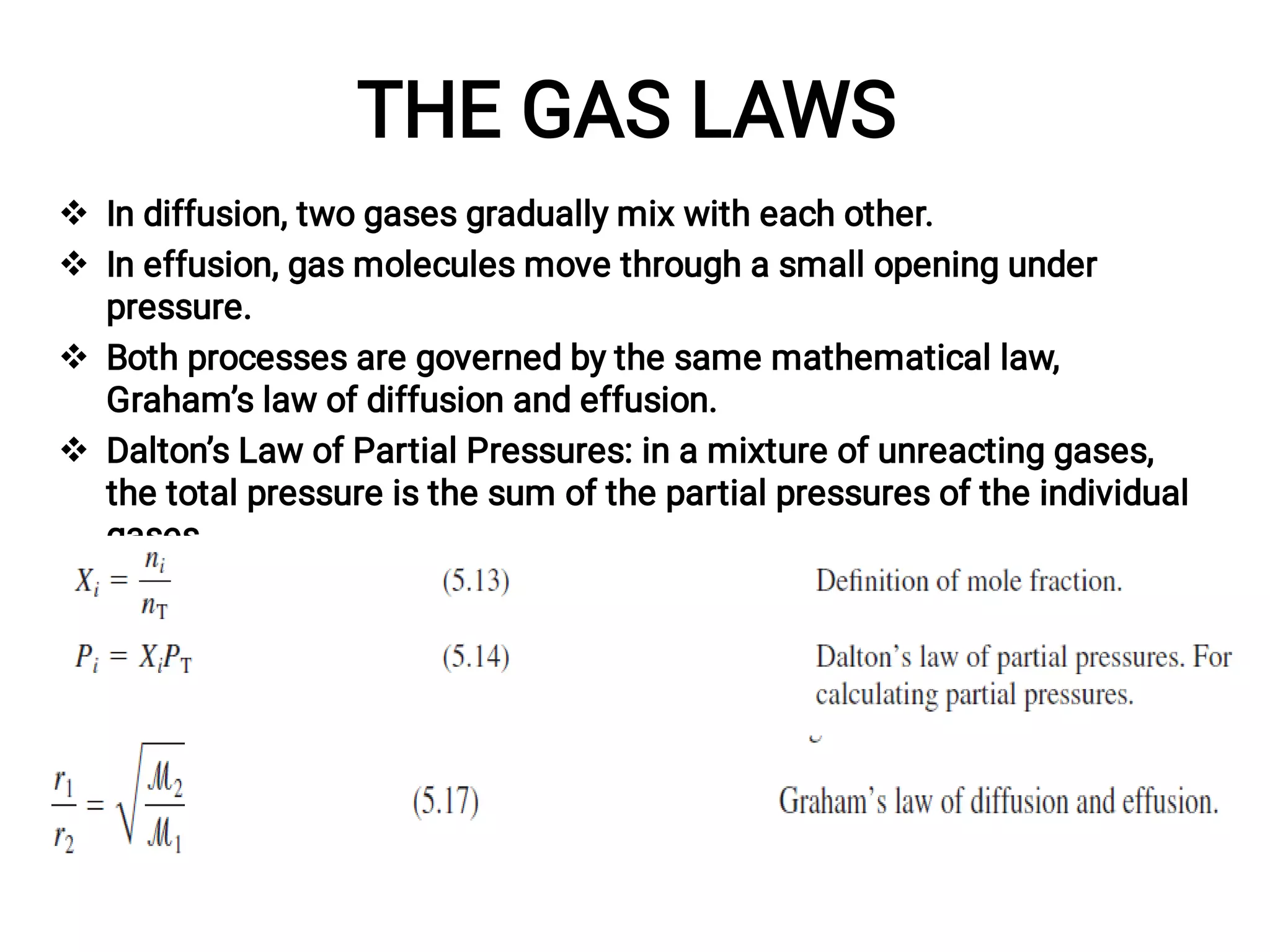
In diffusion, two gases gradually mix with each other.
In effusion, gas molecules move through a small opening under
pressure.
Both processes are governed by the same mathematical law,
Graham’s law of diffusion and effusion.
Dalton’s Law of Partial Pressures: in a mixture of unreacting gases,
the total pressure is the sum of the partial pressures of the individual
gases.
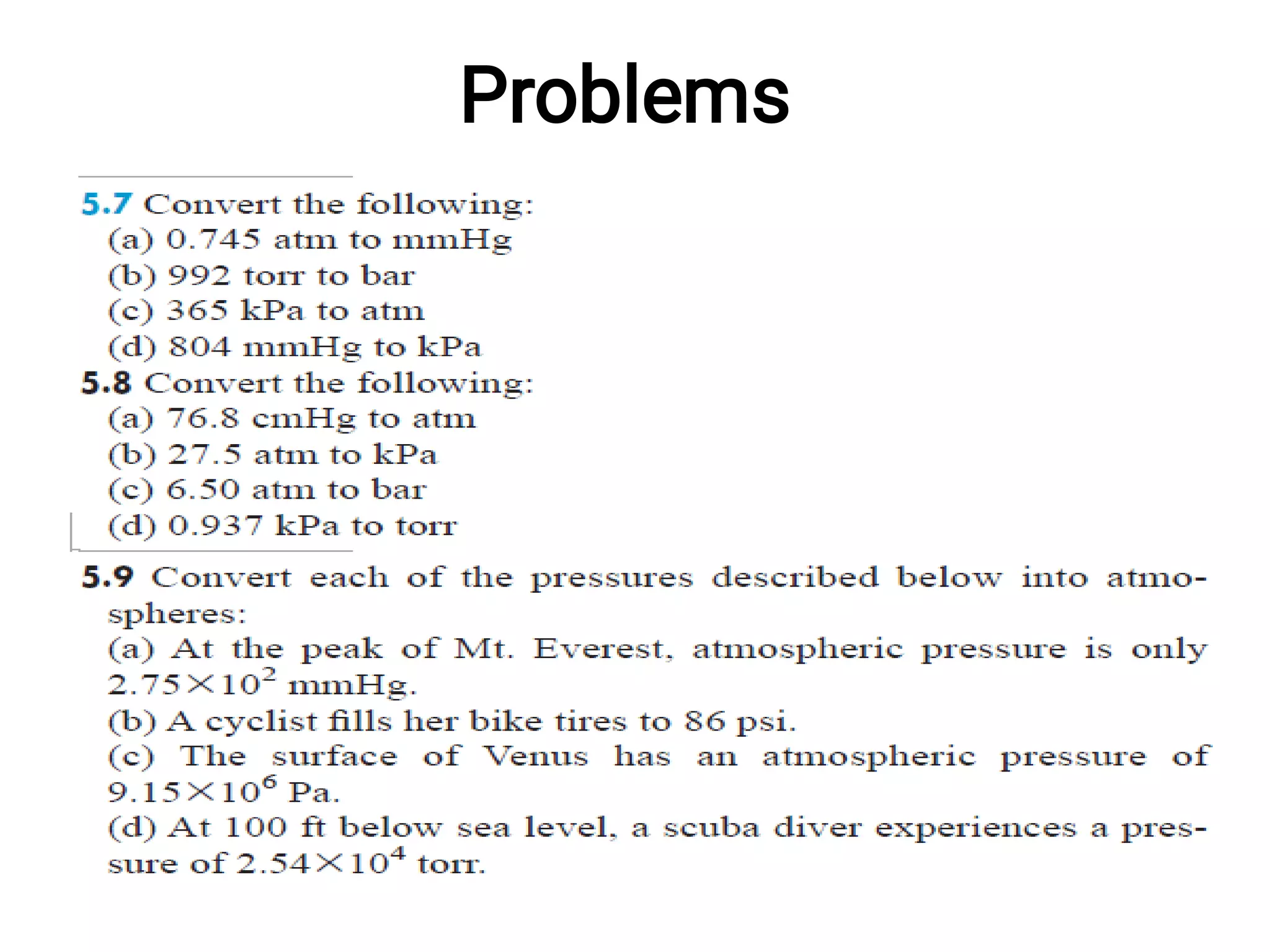
Problems
Problems

Basis for chemistry

  • 1.
  • 2.
  • 3.
    Mass and Density   Whatis the deference between mass and weight ? Density (d) is the ratio of mass to volume of a substance and one of its characteristic physical properties.
  • 4.
    Temperature and Heat         Temperature(T) is a measure of the relative hotness of an object. Heat is energy that flows from an object at higher temperature to one at lower temperature. Temperature scales differ in the size of the degree unit and/or the zero point. The temperature scales are the Celsius (C), the Kelvin (K), and the Fahrenheit (F) scales. The SI base unit of temperature is the kelvin (K). Note that the kelvin has no degree sign and preferred in all scientific work. Water freezes at 32°F and boils at 212°F, 180 °F = 100 C° (or 100 kelvins). So, 1 Celsius degree = ........... °Fahrenheit degrees
  • 5.
  • 6.
  • 7.
  • 8.
    Atomic Structure Atomic Structure Allmatter is composed of atoms. Understanding the structure of atoms is critical to understanding the properties of matter
  • 9.
    HISTORY OF THEATOM HISTORY OF THE ATOM 1808 John Dalton suggested that all matter was made up of tiny spheres that were able to bounce around with perfect elasticity and called them ATOMS ATOMS
  • 10.
    Subatomic Particles mass p= mass n = 1840 x mass e-
  • 11.
    Atomic Structure Atoms arecomposed of -protons – positively charged particles -neutrons – neutral particles -electrons – negatively charged particles Protons and neutrons are located in the nucleus. Electrons are found in orbitals surrounding the nucleus.
  • 12.
    Atomic Structure Atomic Structure Everydifferent atom has a characteristic number of protons in the nucleus. atomic number = number of protons Atoms with the same atomic number have the same chemical properties and belong to the same element.
  • 13.
  • 14.
    Atomic Structure Atomic Structure Everydifferent atom has a characteristic number of protons in the nucleus. atomic number = number of protons Atoms with the same atomic number have the same chemical properties and belong to the same element.
  • 15.
    Atomic Structure Atomic Structure Eachproton and neutron has a mass of approximately 1 dalton. The sum of protons and neutrons is the atom’s atomic mass. Isotopes – atoms of the same element that have different atomic mass numbers due to different numbers of neutrons.
  • 16.
    ATOMIC STRUCTURE ATOMIC STRUCTURE thenumber of protons in an atom the number of protons and neutrons in an atom He He 2 2 4 4 Atomic mass Atomic number number of electrons = number of protons
  • 17.
    ATOMIC NUMBER (Z)= number of protons in nucleus MASS NUMBER (A) = number of protons + number of neutrons = atomic number (Z) + number of neutrons ISOTOPS are atoms of the same element (X) with different numbers of neutrons in the nucleus X A Z H 1 1 H (D) 2 1 H (T) 3 1 U 235 92 U 238 92 Mass Number Atomic Number Element Symbol
  • 18.
  • 19.
  • 20.
    HISTORY OF THEATOM HISTORY OF THE ATOM 1913 Niels Bohr studied under Rutherford at the Victoria University in Manchester. Bohr refined Rutherford's idea by adding that the electrons were in orbits. Rather like planets orbiting the sun. With each orbit only able to contain a set number of electrons.
  • 21.
  • 23.
    Atomic Structure Atomic Structure Neutralatoms have the same number of protons and electrons. Ions are charged atoms. -cations – have more protons than electrons and are positively charged -anions – have more electrons than protons and are negatively charged
  • 24.
    An ion isformed when an atom, or group of atoms, has a net positive or negative charge (why?). If a neutral atom looses one or more electrons it becomes a cation. If a neutral atom gains one or more electrons it becomes an anion. Na 11 protons 11 electrons Na+ 11 protons 10 electrons Cl 17 protons 17 electrons Cl- 17 protons 18 electrons
  • 25.
  • 26.
    Elements 26 • – • – – • • – Over 112 known,of which 88 are found in nature others are man-made Abundance is the percentage found in nature oxygen most abundant element (by mass) on earth and in the human body the abundance and form of an element varies in different parts of the environment Each element has a unique symbol The symbol of an element may be one letter or two if two letters, the second is lower case
  • 27.
  • 28.
  • 29.
  • 30.
    Dalton’s Atomic Theory 30 Ê – Ë – Ì – Elementsare composed of atoms tiny, hard, unbreakable, spheres All atoms of a given element are identical all carbon atoms have the same chemical and physical properties Atoms of a given element are different from those of any other element carbon atoms have different chemical and physical properties than sulfur atoms
  • 31.
    Dalton’s Atomic Theory 31 Í – • – Atomsof one element combine with atoms of other elements to form compounds. Law of Constant Composition all samples of a compound contain the same proportions (by mass) of the elements Chemical Formulas
  • 32.
    Dalton’s Atomic Theory 32 Î – – – • Atomsare indivisible in a chemical process. all atoms present at beginning are present at the end atoms are not created or destroyed, just rearranged atoms of one element cannot change into atoms of another element cannot turn Lead into Gold by a chemical reaction
  • 33.
    Formulas Describe Compounds 33 • • – • • – • – acompound is a distinct substance that is composed of atoms of two or more elements describe the compound by describing the number and type of each atom in the simplest unit of the compound molecules or ions each element represented by its letter symbol the number of atoms of each element is written to the right of the element as a subscript if there is only one atom, the 1 subscript is not written polyatomic groups are placed in parentheses if more than one
  • 34.
    Are Atoms ReallyUnbreakable? 34 • • • • • • J.J. Thomson investigated a beam called a cathode ray he determined that the ray was made of tiny negatively charged particles we call electrons his measurements led him to conclude that these electrons were smaller than a hydrogen atom if electrons are smaller than atoms, they must be pieces of atoms if atoms have pieces, they must be breakable Thomson also found that atoms of different elements all produced these same electrons
  • 35.
    The Electron 35 • • – • Tiny, negativelycharged particle Very light compared to mass of atom 1/1836th the mass of a H atom Move very rapidly within the atom
  • 36.
    Thomson’s Plum Pudding Model 36 Ê Ë Ì – Í Î – Atombreakable!! Atom has structure Electrons suspended in a positively charged electric field must have positive charge to balance negative charge of electrons and make the atom neutral mass of atom due to electrons atom mostly “empty” space compared size of electron to size of atom
  • 37.
    Rutherford’s Gold FoilExpt 37 • • – • – • • – – How can you prove something is empty? put something through it use large target atoms use very thin sheets of target so do not absorb “bullet” use very small particle as bullet with very high energy but not so small that electrons will affect it bullet = alpha particles, target atoms = gold foil particles have a mass of 4 amu & charge of +2 c. u. gold has a mass of 197 amu & is very malleable
  • 38.
    Figure 4.5: Rutherford’sexperiment on -particle bombardment of metal foil. 38
  • 39.
    Rutherford’s Results 39 • • • Over 98%of the particles went straight through About 2% of the particles went through but were deflected by large angles About 0.01% of the particles bounced off the gold foil
  • 40.
    Rutherford’s Nuclear Model 40 Ê – Ë Ì – Í Theatom contains a tiny dense center called the nucleus the volume is about 1/10 trillionth the volume of the atom The nucleus is essentially the entire mass of the atom The nucleus is positively charged the amount of positive charge of the nucleus balances the negative charge of the electrons The electrons move around in the empty space of the atom surrounding the nucleus
  • 41.
    Structure of theNucleus 41 • • – – • • – – The nucleus was found to be composed of two kinds of particles Some of these particles are called protons charge = +1 mass is about the same as a hydrogen atom Since protons and electrons have the same amount of charge, for the atom to be neutral there must be equal numbers of protons and electrons The other particle is called a neutron has no charge has a mass slightly more than a proton
  • 42.
    The Modern Atom 42 • • • • – Weknow atoms are composed of three main pieces - protons, neutrons and electrons The nucleus contains protons and neutrons The nucleus is only about 10-13 cm in diameter The electrons move outside the nucleus with an average distance of about 10-8 cm therefore the radius of the atom is about 105 times larger than the radius of the nucleus
  • 43.
    Isotopes 43 • • – • • – • • – All atoms ofan element have the same number of protons The number of protons in an atom of a given element is the same as the atomic number found on the Periodic Table Atoms of an element with different numbers of neutrons are called isotopes All isotopes of an element are chemically identical undergo the exact same chemical reactions Isotopes of an element have different masses Isotopes are identified by their mass numbers mass number = protons + neutrons
  • 44.
    Elements 44 • • • – – • – • – – Arranged in apattern called the Periodic Table Position on the table allows us to predict properties of the element Metals about 75% of all the elements lustrous, malleable, ductile, conduct heat and electricity Nonmetals dull, brittle, insulators Metalloids also know as semi-metals some properties of both metals & nonmetals
  • 45.
    The Modern PeriodicTable 45 • • • • Elements with similar chemical and physical properties are in the same column Columns are called Groups or Families Rows are called Periods Each period shows the pattern of properties repeated in the next period
  • 46.
    Figure 4.11: Theperiodic table. 46
  • 47.
    The Modern PeriodicTable 47 • – • – • – – Main Group = Representative Elements “A” columns Transition Elements all metals Bottom rows = Inner Transition Elements = Rare Earth Elements metals really belong in Period 6 & 7
  • 48.
    Important Groups 48 • • • • • Group 8= Noble Gases He, Ne, Ar, Kr, Xe, Rn all colorless gases at room temperature very non-reactive, practically inert found in nature as a collection of separate atoms uncombined with other atoms • • • • • Noble Metals Ag, Au, Pt all solids at room temperature least reactive metals found in nature uncombined with other atoms
  • 49.
    Important Groups -Halogens 49 • • • • Group 7A = Halogens very reactive nonmetals react with metals to form ionic compounds HX all acids • – • – • – – • – Fluorine = F2 pale yellow gas Chlorine = Cl2 pale green gas Bromine = Br2 brown liquid that has lots of brown vapor over it Only other liquid element at room conditions is the metal Hg Iodine = I2 lustrous, purple solid
  • 50.
    Allotropes 50 • • • – – – Many solid nonmetallicelements can exist in different forms with different physical properties, these are called allotropes the different physical properties arise from the different arrangements of the atoms in the solid Allotropes of Carbon include diamond graphite buckminsterfullerene
  • 51.
    Electrical Nature ofMatter 51 • – – • • – Most common pure substances are very poor conductors of electricity with the exception of metals and graphite Water is a very poor electrical conductor Some substances dissolve in water to form a solution that conducts well - these are called electrolytes When dissolved in water, electrolyte compounds break up into component ions ions are atoms or groups of atoms that have an electrical charge
  • 52.
    Ions 52 • – • – • – • • ions that havea positive charge are called cations form when an atom loses electrons ions that have a negative charge are called anions form when an atom gains electrons ions with opposite charges attract therefore cations and anions attract each other moving ions conduct electricity compound must have no total charge, therefore we must balance the numbers of cations and anions in a compound to get 0 total charge
  • 53.
    Atomic Structures ofIons 53 • • – – • • – Metals form cations For each positive charge the ion has 1 less electron than the neutral atom Na = 11 e-, Na+ = 10 e- Ca = 20 e-, Ca+2 = 18 e- Cations are named the same as the metal sodium Na Na+ + 1e- sodium ion calciumCa Ca+2 + 2e- calcium ion The charge on a cation can be determined from the Group number on the Periodic Table for Groups IA, IIA, IIIA Group 1A +1, Group 2A +2, (Al, Ga, In) +3
  • 54.
    Atomic Structures ofIons 54 • • – – • • – Nonmetals form anions For each negative charge the ion has 1 more electron than the neutral atom F = 9 e-, F- = 10 e- P = 15 e-, P3- = 18 e- Anions are named by changing the ending of the name to -ide fluorine F + 1e- F- fluoride ion oxygen O + 2e- O2- oxide ion The charge on an anion can be determined from the Group number on the Periodic Table Group 7A -1, Group 6A -2
  • 55.
    The Components ofMatter       Any matter exists as elements, compounds, or mixtures. Elements and compounds are referred to as substances because their compositions are fixed. An element consists of only one type of atom. A compound contains two or more elements in chemical Combination and exhibits different properties from its component elements. The elements of a compound occur in fixed parts by mass because each unit of the compound has fixed numbers of each type of atom. A mixture consists of two or more substances mixed together, not chemically combined.
  • 56.
    Mass Laws    The lawof mass conservation: Matter cannot be created or destroyed. The total mass remains constant during chemical reaction. The law of definite composition: any sample of a given compound has the same elements present in the same parts by mass The law of multiple proportions: for different compounds of same elements, the masses of one element that combine with a fixed mass of the other can be expressed as a ratio of small whole numbers.
  • 57.
    Atomic Models Theories      Dalton1808: All matter consists of tiny particles called atoms, cannot be created or destroyed. Atoms of one element cannot be converted into atoms of another element. Atoms of an element are identical and are different from atoms of any other element. Compounds result from the chemical combination of a specific ratio of atoms of different elements. But, why atoms bond as they do? What about the charged particles that were being observed in experiments ? J. Thomson 1897 : Cathode rays consist of negative particles (electrons) that exist in all matter, much smaller and lighter than atoms. R. Millikan 1909: Determined the charge and the mass of the electron (-1.602 x 10⁻¹⁹ C , 9.109x10⁻³¹ kg). E. Rutherford 1910: atoms consist of a tiny, massive, positive nucleus surrounded by electrons.
  • 58.
    Final Model …      Anatom has central nucleus, contains +p and ±n and is surrounded by -e. An atom is neutral because -e = +p • The atomic number: number of protons, The mass number ( ± n + +p ) . Isotopes: atoms with the same number of protons but different number of neutrons. Each isotope has a mass relative to the 12C mass standard. The atomic mass of an element is the average of the masses of its isotopes weights according to their natural abundances and is determined by mass spectrometry. Carbon Z=6 , has 8 isotopes, 3 natural 12C ( 98.89%), 13C (1.11%), 14C (0.01%), 5 made in the lab, 9C, 10C, 11C, 15C, 16C .
  • 59.
  • 60.
  • 61.
    Periodic Table       In theperiodic table, the elements are arranged by ………….. into horizontal periods and vertical groups. Elements within a group have similar behavior … Why ? whereas elements in a period have dissimilar behavior… why ? Nonmetals appear in the upper-right portion of the table, metalloids lie along a staircase line, and metals fill the rest of the table. 118 elements including, metals (91), non-metals (20), metalloids (7), Alkali metals (6); Alkaline earth metals (6), Transition metals (38) ; Post-transition metals (11), Lanthanides (15) ; Actinides-15 ; Halogens (6) ; Noble gases (7) . 98 elements are natural and rest are synthetic. 11 elements occur as gases and 2 elements occur as liquids.Who ?
  • 63.
    Compounds and Bonding       Fewelements occur uncombined in nature, the great majority exist in compounds. Ionic compounds form when a metal transfers electrons to a nonmetal, and the resulting positive and negative ions attract each other (NaCl ? ) Covalent compounds form when elements, usually nonmetals, share electrons. Each covalent bond is an electron pair mutually attracted by two atomic nuclei (N2, H2O, CH4 ?) Monatomic ions are derived from single atoms. Polyatomic ions consist of two or more covalently bonded atoms that have a net positive or negative charge due to a deficit or excess of electrons (ex. CaCO3). Some elements exist as di, tetra and even octatomic molecules ?
  • 64.
  • 65.
    COMPOUNDS: FORMULAS, NAMES, andMASSES   Chemical formulas: describe the simplest atom ratio (empirical formula), actual atom number (molecular formula), and atom arrangement (structural formula) of one unit of a compound. (ex; H2O2 ,….., ….., …….) Naming binary ionic compounds: Generally cation first and anion second…. cation end in –ium then add –ide to the anion root name.
  • 66.
  • 67.
  • 68.
  • 69.
  • 70.
  • 71.
  • 72.
    Quantum Theory andAtomic Structure The Nature of Light       Electromagnetic radiation travels in waves of specific wavelength (λ) and frequency (ν). Frequency (nu, ν) is the number of cycles the wave undergoes per second, expressed in 1/second [s-1; also called hertz (Hz)]. Wavelength (lambda, λ) is the distance between any point on a wave and the corresponding point on the next crest, expressed in nanometers (nm, 10-9 m). Amplitude, the height of the crest (or depth of the trough) of each wave. All electromagnetic waves travel through a vacuum at the speed of light, c (3.00X10⁸ m/s). Radiation with a high frequency has a short wavelength, and vice versa.
  • 73.
    The Electromagnetic Spectrum The electromagnetic spectrum ranges from very long radio waves to very short gamma.
  • 74.
  • 75.
    Wave or Particle?      Refraction and diffraction indicate that electromagnetic radiation is wavelike, but blackbody radiation and the photoelectric effect indicate that it is particle-like. Blackbody is an idealized object that absorbs all the radiation incident on it. A hollow cube with a small hole in one wall approximates a blackbody. Light exists as photons (quanta) that have an energy proportional to the frequency. • According to quantum theory, an atom has only certain quantities of energy (E = nhν), which it can change only by absorbing or emitting a photon. E = Energy,h = Plank constant 6.626X10⁻³⁴ J.s ,ν = frequency, n = matter quantity.
  • 76.
    Quantum Theory       As aresult of Planck’s quantum theory and Einstein’s relativity theory, we no longer view matter and energy as distinct entities. The De Broglie wavelength refers to the idea that electrons (and all matter) have wavelike motion. Allowed atomic energy levels are related to allowed wavelengths of the electron’s motion. Quantum theory : Electrons exhibit diffraction patterns, as do waves of energy, and photons exhibit transfer of momentum, as do particles of mass. The wave-particle duality of matter and energy is observable only on the atomic scale. The uncertainty principle, we cannot know simultaneously the position and speed of an electron. From E= mc2 particle mode and E = hν = hc/ λ wave mode … Use u speed instead of C, speed of light …
  • 77.
  • 78.
    Electronic Configuration    The aufbaumethod : in the ground state of an atom, the orbital with a lower energy is filled up first before filling of orbital with higher energy Pauli’s exclusion principle : No two electrons can have the same set of quantum numbers. Hund’s rule : Orbitals of equal energy become half-filled, with electron spins parallel, before any pairing occurs.
  • 79.
  • 80.
  • 81.
    TRENDS IN ATOMICPROPERTIES      All physical and chemical behavior of the elements is based on the electron configurations. Atomic size increases down a group and decreases across a period. Across a transition series, size remains relatively constant. Ionization energy (the energy required to remove the outermost electron from a mole of gaseous atoms) is inversely related to atomic size. Electron affinity (the energy involved in adding an electron to a mole of gaseous atoms) shows many variations from expected trends. Based on the relative sizes of IEs and EAs, in their ionic compounds, the Group 1A(1) and 2A(2) elements tend to form cations, and the Group 6A(16) and 7A(17) elements tend to form anions.
  • 82.
    TRENDS IN ATOMICPROPERTIES
  • 83.
    Metallic Behavior &Ionic Radius      Metallic behavior correlates with large atomic size and low IE. Metallic behavior increases down group and decreases across period. Generally, metal oxides are basic and nonmetal oxides acidic. Many transition metals and their compounds are paramagnetic because their atoms (or ions) have unpaired electrons. Cations are smaller and anions larger than their parent atoms, why and in which direction ?
  • 84.
    Chemical Bonding      Ionic bondingoccurs when metal atoms transfer electrons to nonmetal atoms, the resulting ions attract each other and form an ionic solid. Covalent bonding occurs between nonmetal atoms results in molecules, the bonded atoms share a pair of electrons, which remain localized between them. Metallic bonding occurs when many metal atoms pool their valence electrons in a delocalized electron “sea” that holds all the atoms together. Octet rule: in bonding, atoms lose, gain, or share electrons to attain a filled outer level of eight electrons (or 2). The Lewis electron-dot symbol: Depicts the number of valence electrons for elements separately or in molecules.
  • 85.
  • 86.
  • 87.
    Bond Length &Strength
  • 88.
    Electronegativity & PolarBonds    Electronegativity (EN): Ability of an atom to pull bonded electrons toward it, which generates partial charges at the ends of the bond. EN reverse of the trends in atomic size. Greater ΔEN between two atoms, more polar character.
  • 89.
  • 90.
    Solutions    Solutions are homogeneousmixtures consisting of solute dissolved in solvent. The solubility of a solute: the maximum amount that can dissolve in given amount of solvent at specified temperature. The concentration of a solution is independent of the amount of solution.
  • 91.
    Solutions   A mole ofsubstance is the amount that contains Avogadro’s number (6.022 x10²³) of chemical entities (atoms, molecules, or formula units). Mass of one mole (g) of any element or molecule is equal to its molecular weight (g).
  • 92.
  • 93.
  • 94.
  • 95.
    Acid-Base Equilibria      In aqueoussolution, water binds the proton released from an acid to form H3O+ (aq). Arrhenius definition: Acids contain H and yield H3O+ in water, bases contain OH and yield OH- in water. Strong acids dissociate completely and weak acids slightly. The extent of dissociation is expressed by the acid dissociation constant, Ka Weak acids have Ka values from about 10-1 to 10-12. Many acids and bases can be classified qualitatively as strong or weak based on their formulas.
  • 96.
    pH Scale     Pure waterhas low conductivity because it autoionizes to small extent. Ionization constant for water, Kw (1.0 x10⁻¹⁴ at 25°C). in acidic solution, [H3O+] is greater than [OH]; the reverse is true in basic solution; and the two are equal in neutral solution. Simply, we use the pH scale (pH = -log [H3O+]).
  • 97.
  • 98.
  • 99.
    Gaseous State    Gases flowmore freely and have lower densities than liquids and solids, and gases volumes can be altered significantly by changing the applied external force or the temperature (why ?) A barometer measures atmospheric pressure in terms of the height of the mercury column that the atmosphere can support (760 mmHg at sea level and 0C). Chemists measure pressure in units of atmospheres (atm), torrs (equivalent to mmHg), and pascals (Pa, the SI unit).
  • 100.
    THE GAS LAWS      Fourvariables define the physical behavior of an ideal gas: volume (V), pressure (P), temperature (T ), and amount (number of moles, n). Most simple gases display nearly ideal behavior at ordinary temperatures and pressures. Boyle’s, Charles’s, and Avogadro’s laws relate volume to pressure, to temperature, and to amount of gas, respectively. At STP (0C and 1 atm), 1 mol of an ideal gas occupies 22.4 L. The ideal gas law incorporates the individual gas laws into one equation: PV = nRT, where R is the universal gas constant.
  • 101.
  • 102.
  • 103.
    THE GAS LAWS     Indiffusion, two gases gradually mix with each other. In effusion, gas molecules move through a small opening under pressure. Both processes are governed by the same mathematical law, Graham’s law of diffusion and effusion. Dalton’s Law of Partial Pressures: in a mixture of unreacting gases, the total pressure is the sum of the partial pressures of the individual gases.
  • 104.
  • 105.