(
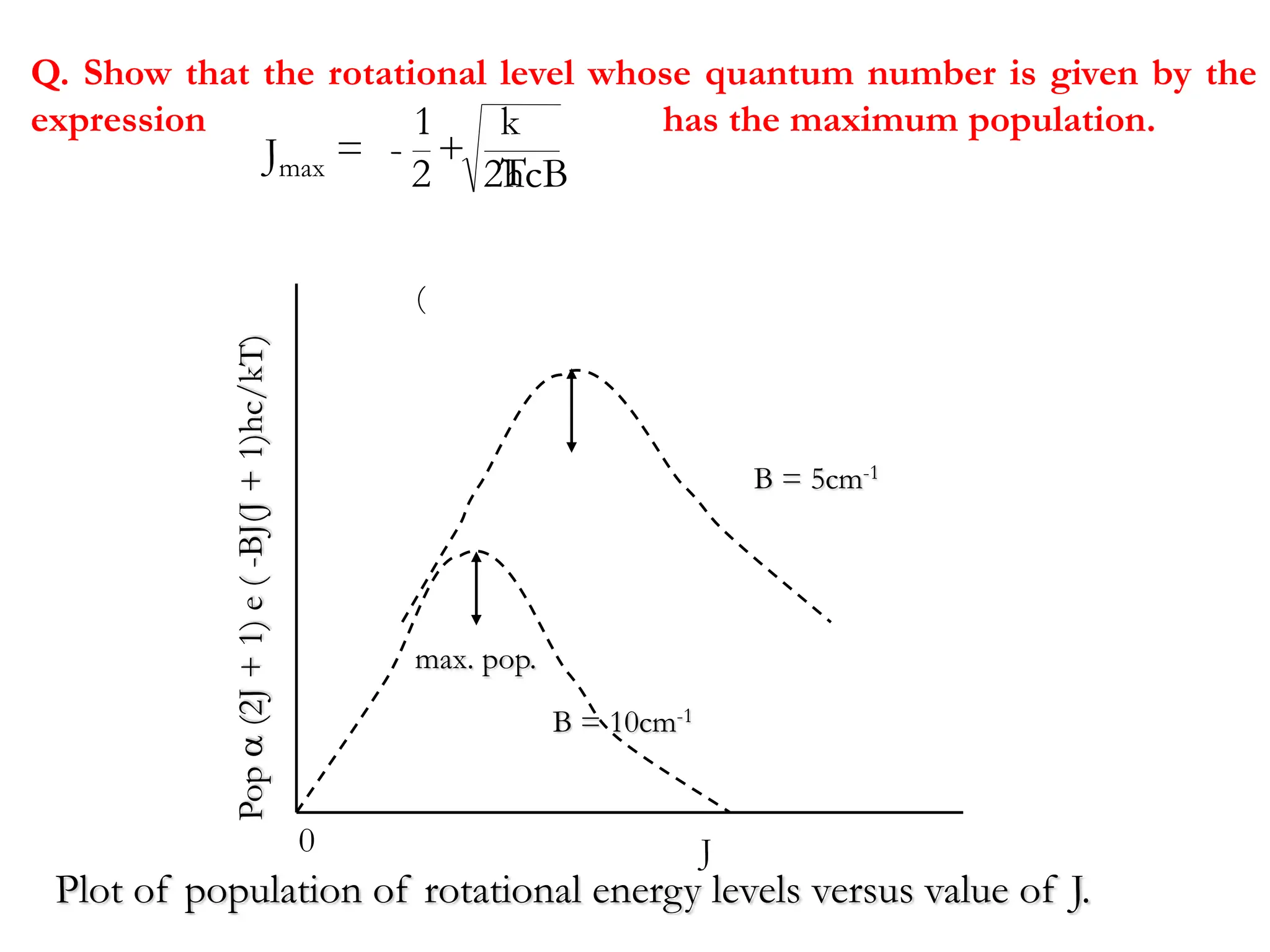
Plot of population of rotational energy levels versus value of J.
B = 5cm-1
B = 10cm-1
max. pop.
J
0
Pop

(2J
+
1)
e
(
-BJ(J
+
1)hc/kT)
Q. Show that the rotational level whose quantum number is given by the
expression has the maximum population.
2hcB
k
T
2
1
+
-
=
Jmax
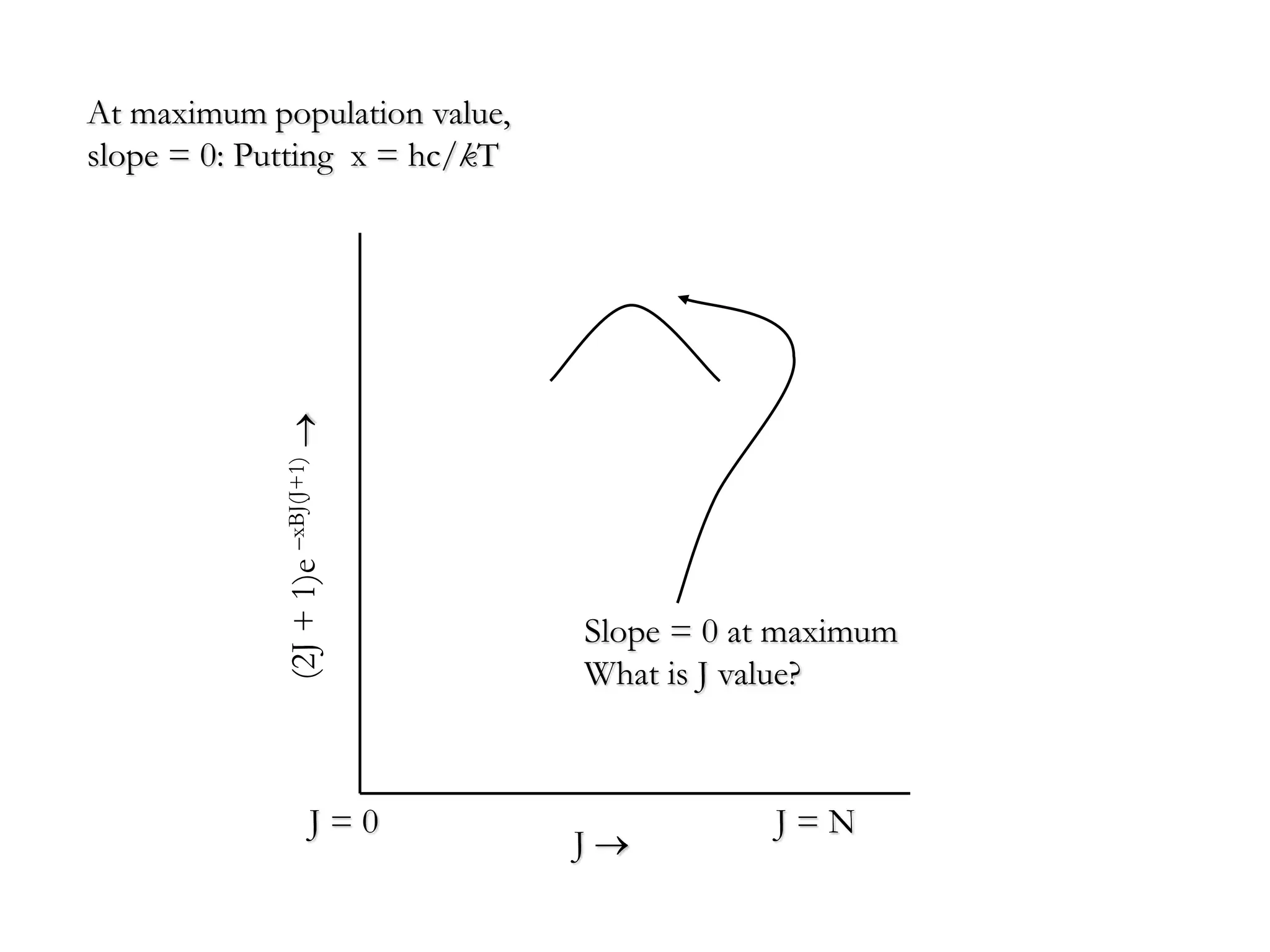
At maximum population value,
slope = 0: Putting x = hc/kT
Slope = 0 at maximum
What is J value?
J = 0 J = N
J 
(2J
+
1)e
–xBJ(J+1)

 
 
   
 
2
1)
xB(2J
e
0
2e
1)
(2J
xBe
1)
(2J
0
0
e
1
2J
dJ
d
slope
2
1)
xBJ(J
1)
xBJ(J
1)
xBJ(J
1)
xBJ(J





















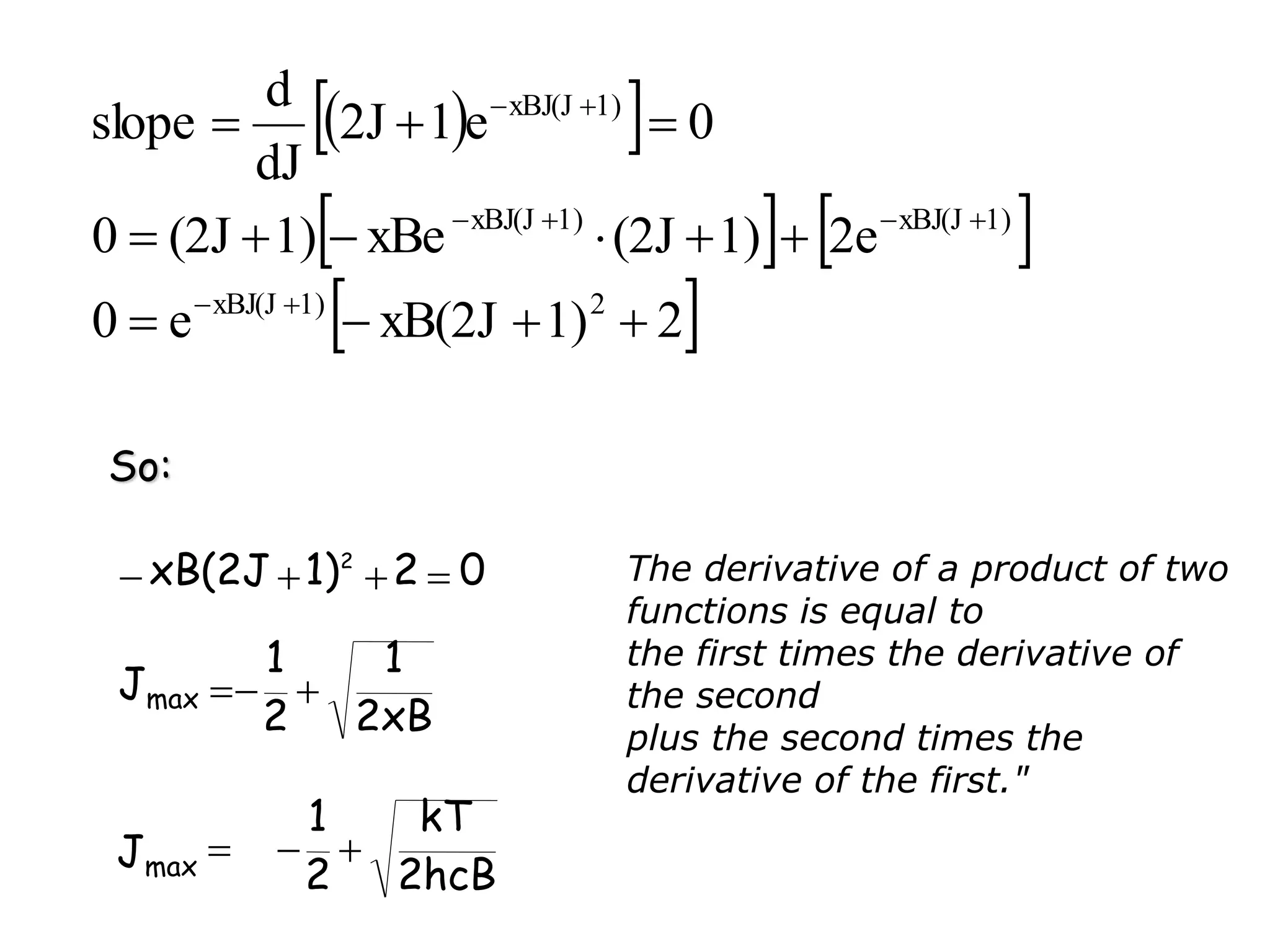
So:
2hcB
kT
2
1
2xB
1
2
1
Jmax
0
2
1)
xB(2J 2










Jmax
The derivative of a product of two
functions is equal to
the first times the derivative of
the second
plus the second times the
derivative of the first."
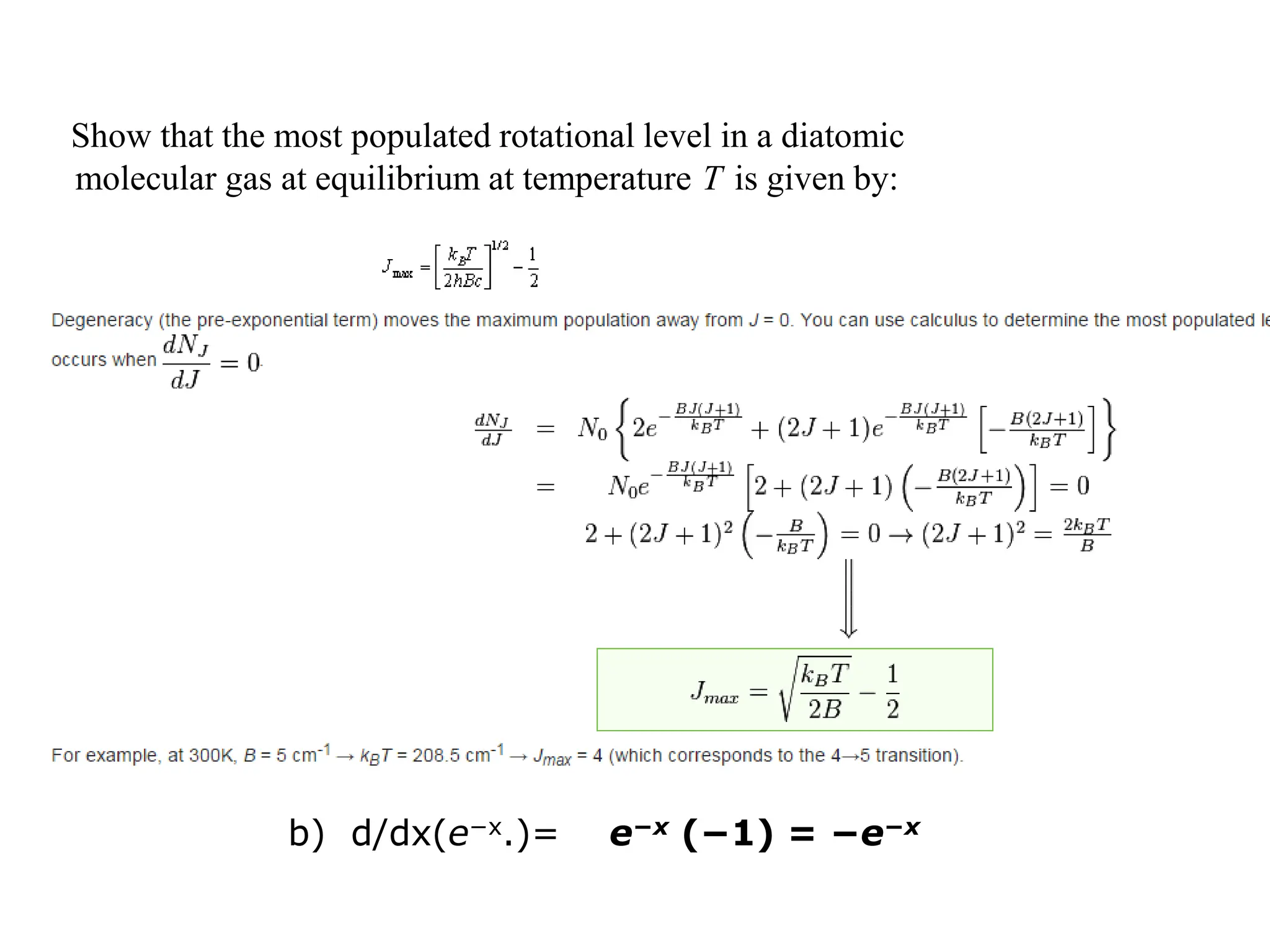
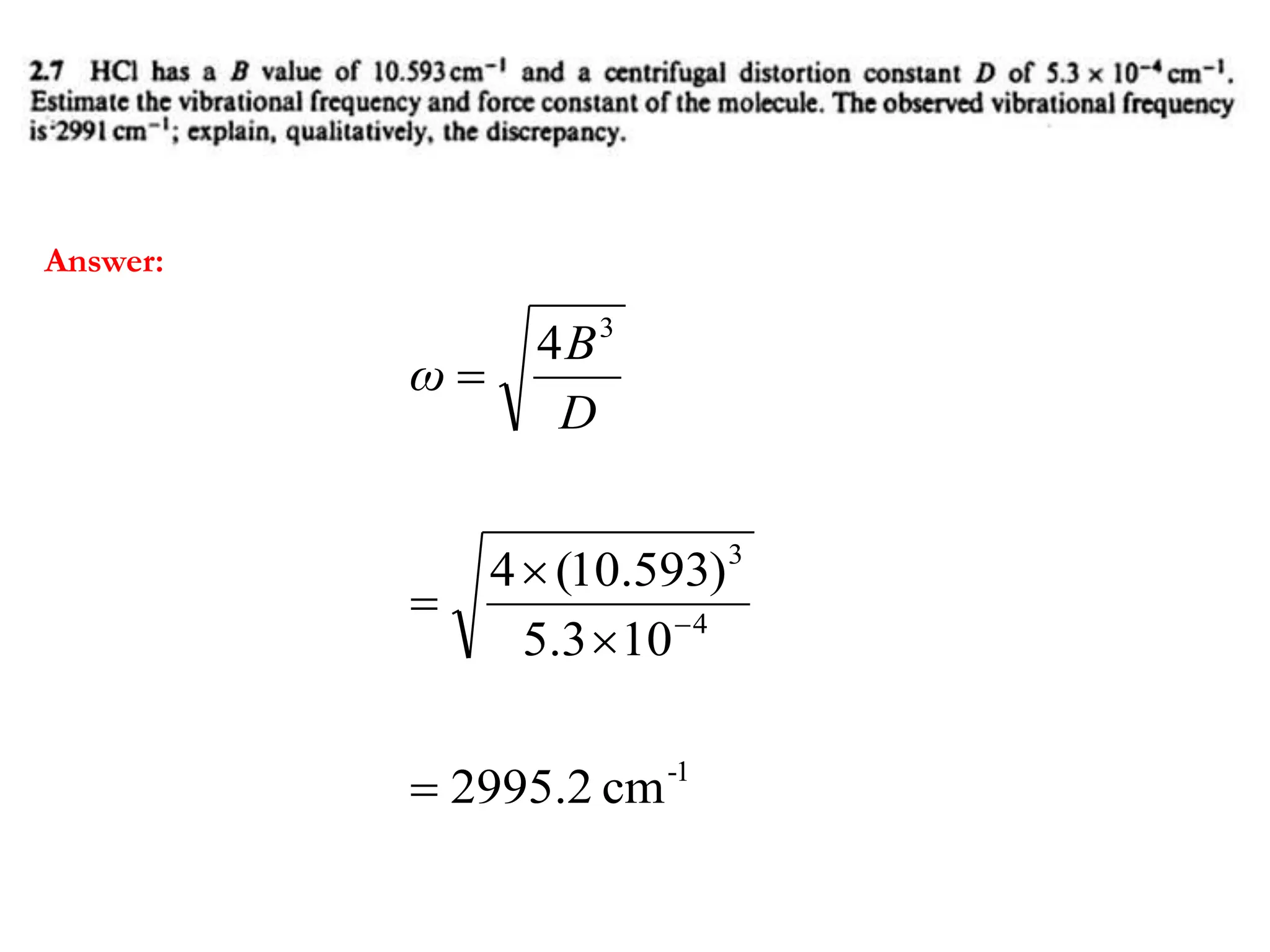
Show that the most populated rotational level in a diatomic
molecular gas at equilibrium at temperature T is given by:
b) d/dx(e−x.)= e−x (−1) = −e−x
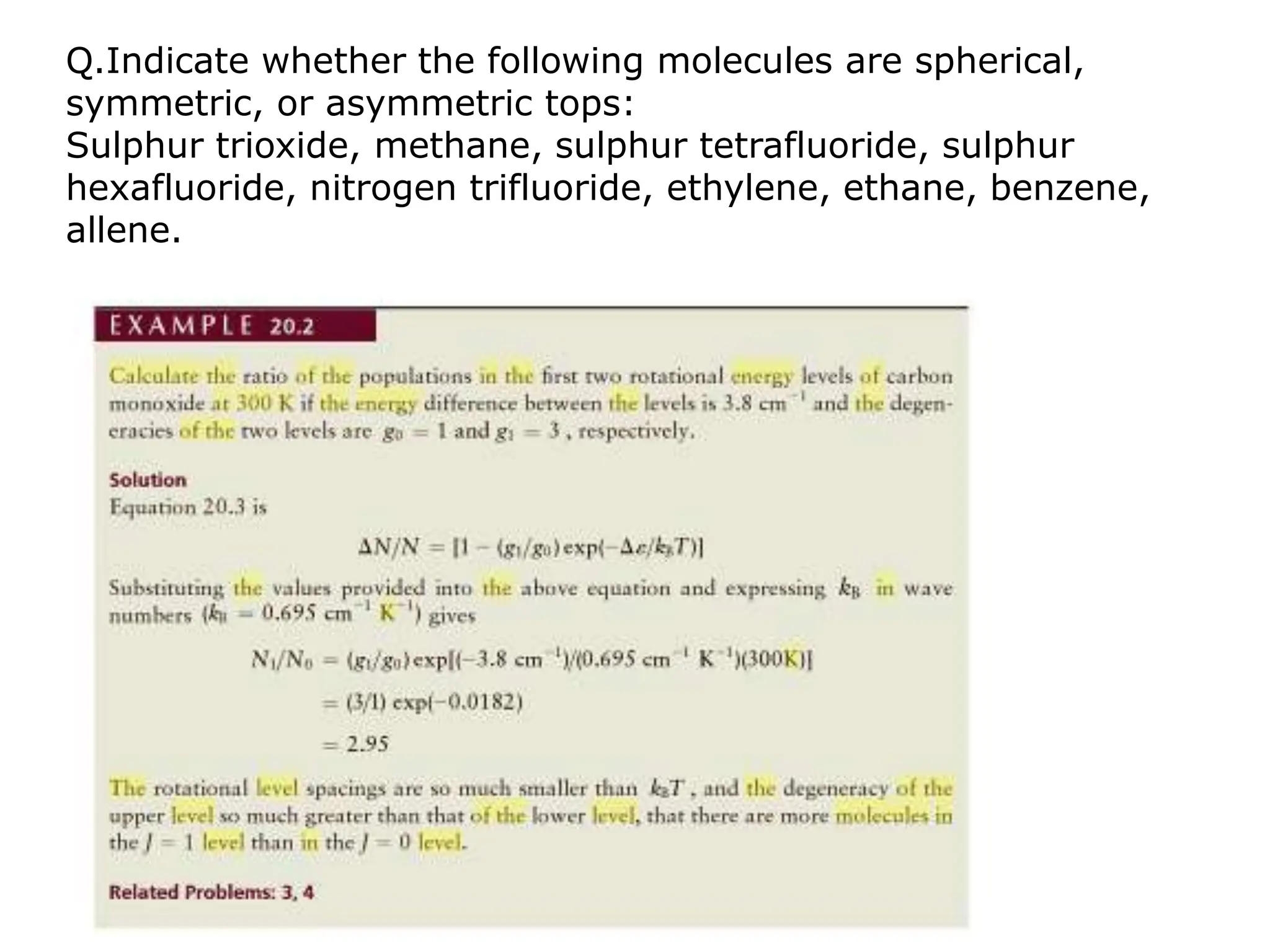
Q.Indicate whether the following molecules are spherical,
symmetric, or asymmetric tops:
Sulphur trioxide, methane, sulphur tetrafluoride, sulphur
hexafluoride, nitrogen trifluoride, ethylene, ethane, benzene,
allene.
Answer:
1
-
4
3
3
cm
2
.
2995
10
3
.
5
)
593
.
10
(
4
4






D
B
ω
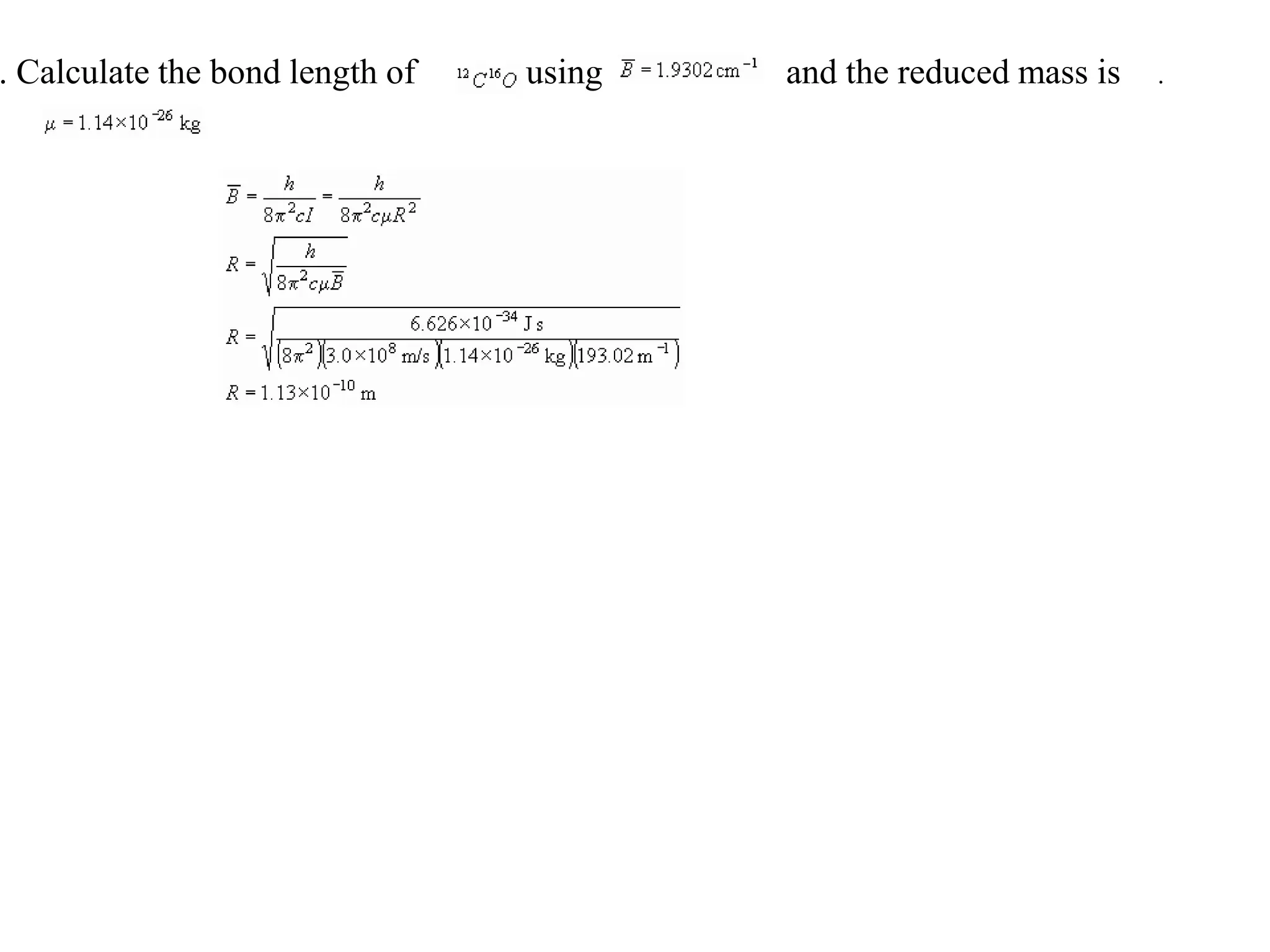
. Calculate the bond length of using and the reduced mass is .
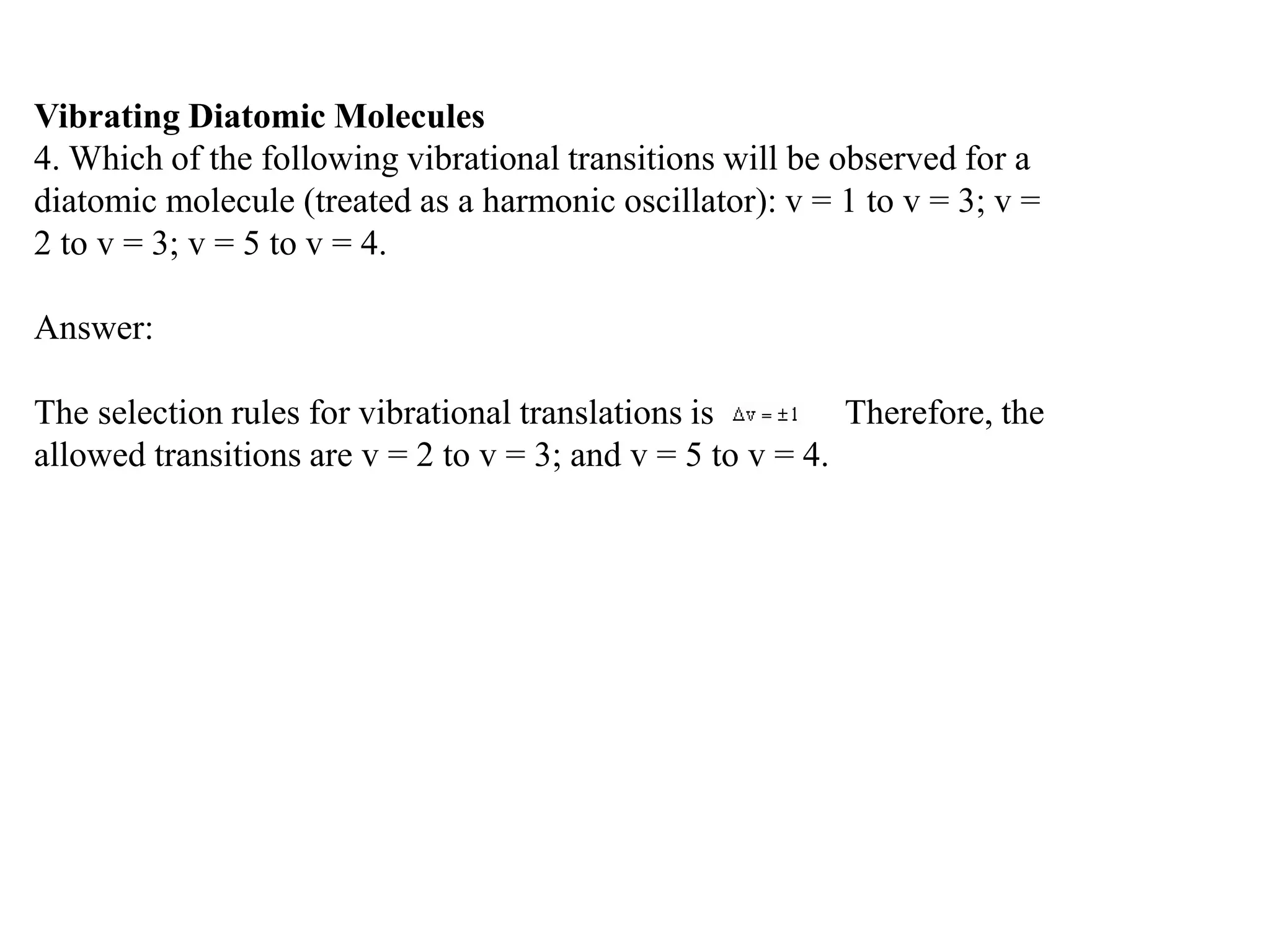
Vibrating Diatomic Molecules
4. Which of the following vibrational transitions will be observed for a
diatomic molecule (treated as a harmonic oscillator): v = 1 to v = 3; v =
2 to v = 3; v = 5 to v = 4.
Answer:
The selection rules for vibrational translations is . Therefore, the
allowed transitions are v = 2 to v = 3; and v = 5 to v = 4.
Microwave spectroscopy chapter solution.ppt

Microwave spectroscopy chapter solution.ppt

  • 1.
    ( Plot of populationof rotational energy levels versus value of J. B = 5cm-1 B = 10cm-1 max. pop. J 0 Pop  (2J + 1) e ( -BJ(J + 1)hc/kT) Q. Show that the rotational level whose quantum number is given by the expression has the maximum population. 2hcB k T 2 1 + - = Jmax
  • 2.
    At maximum populationvalue, slope = 0: Putting x = hc/kT Slope = 0 at maximum What is J value? J = 0 J = N J  (2J + 1)e –xBJ(J+1) 
  • 3.
             2 1) xB(2J e 0 2e 1) (2J xBe 1) (2J 0 0 e 1 2J dJ d slope 2 1) xBJ(J 1) xBJ(J 1) xBJ(J 1) xBJ(J                      So: 2hcB kT 2 1 2xB 1 2 1 Jmax 0 2 1) xB(2J 2           Jmax The derivative of a product of two functions is equal to the first times the derivative of the second plus the second times the derivative of the first."
  • 4.
    Show that themost populated rotational level in a diatomic molecular gas at equilibrium at temperature T is given by: b) d/dx(e−x.)= e−x (−1) = −e−x
  • 5.
    Q.Indicate whether thefollowing molecules are spherical, symmetric, or asymmetric tops: Sulphur trioxide, methane, sulphur tetrafluoride, sulphur hexafluoride, nitrogen trifluoride, ethylene, ethane, benzene, allene.
  • 9.
  • 10.
    . Calculate thebond length of using and the reduced mass is .
  • 11.
    Vibrating Diatomic Molecules 4.Which of the following vibrational transitions will be observed for a diatomic molecule (treated as a harmonic oscillator): v = 1 to v = 3; v = 2 to v = 3; v = 5 to v = 4. Answer: The selection rules for vibrational translations is . Therefore, the allowed transitions are v = 2 to v = 3; and v = 5 to v = 4.