Chapter 2: MOTION
Lesson 1 Distance & Displacement
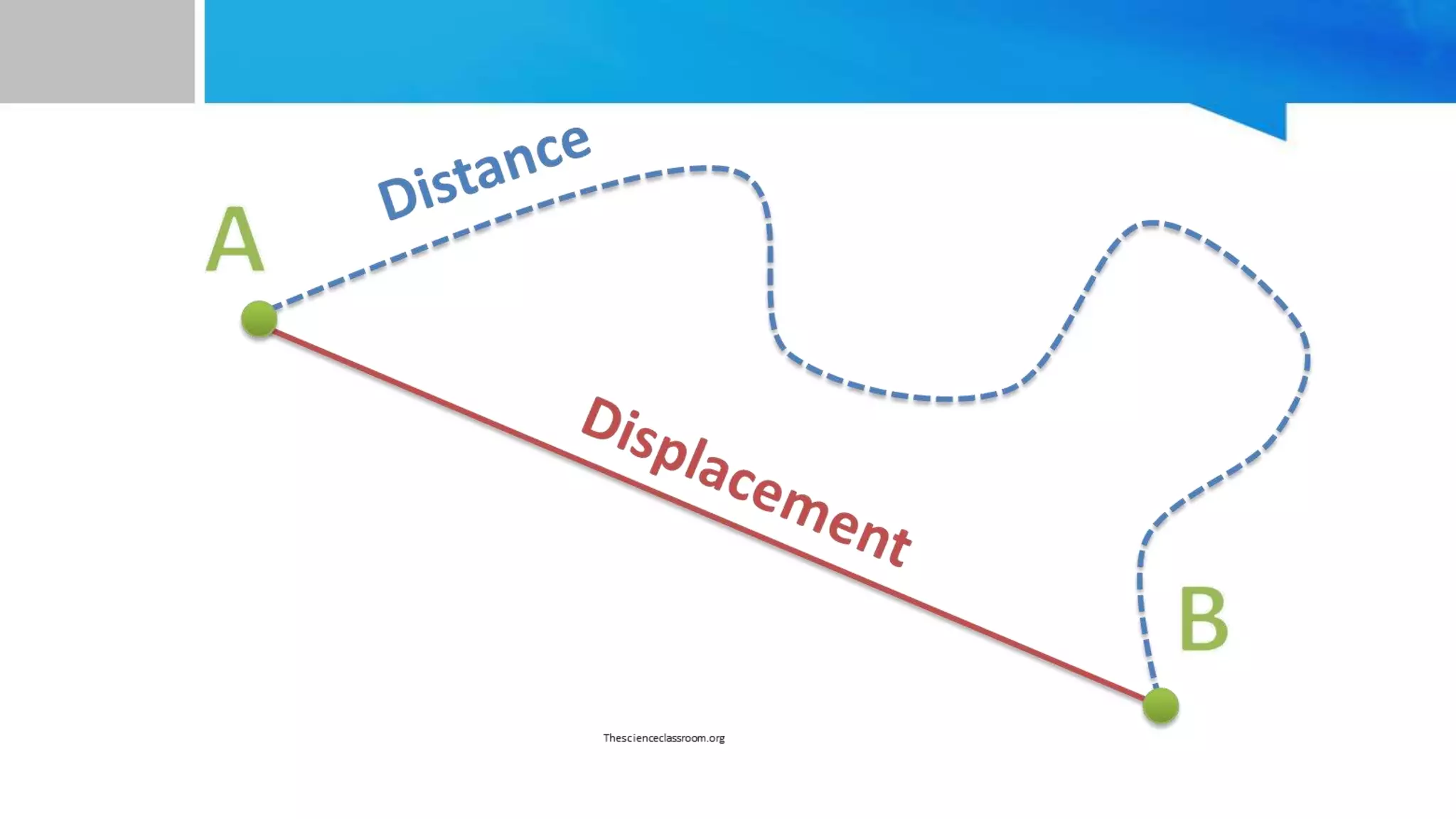
DISTANCE
• Distance is a scalar quantity that refers to "how much
ground an object has covered" during its motion.
• What is scalar? and what is its contrary?
• Scalars are quantities that are fully described by a
magnitude (or numerical value) alone.
• Vectors are quantities that are fully described by both a
magnitude and a direction.
• This will be discussed more on lesson 2.
DISPLACEMENT
• Displacement is a vector quantity that refers to "how far
out of place an object is"; it is the object's overall change
in position.
• Problem 1: An object moves from point A to point B to point C,
then back to point B and then to point C along the line shown in
the figure below.
• a) Find the distance covered by the moving object.
• b) Find the magnitude and direction of the displacement of the
object.
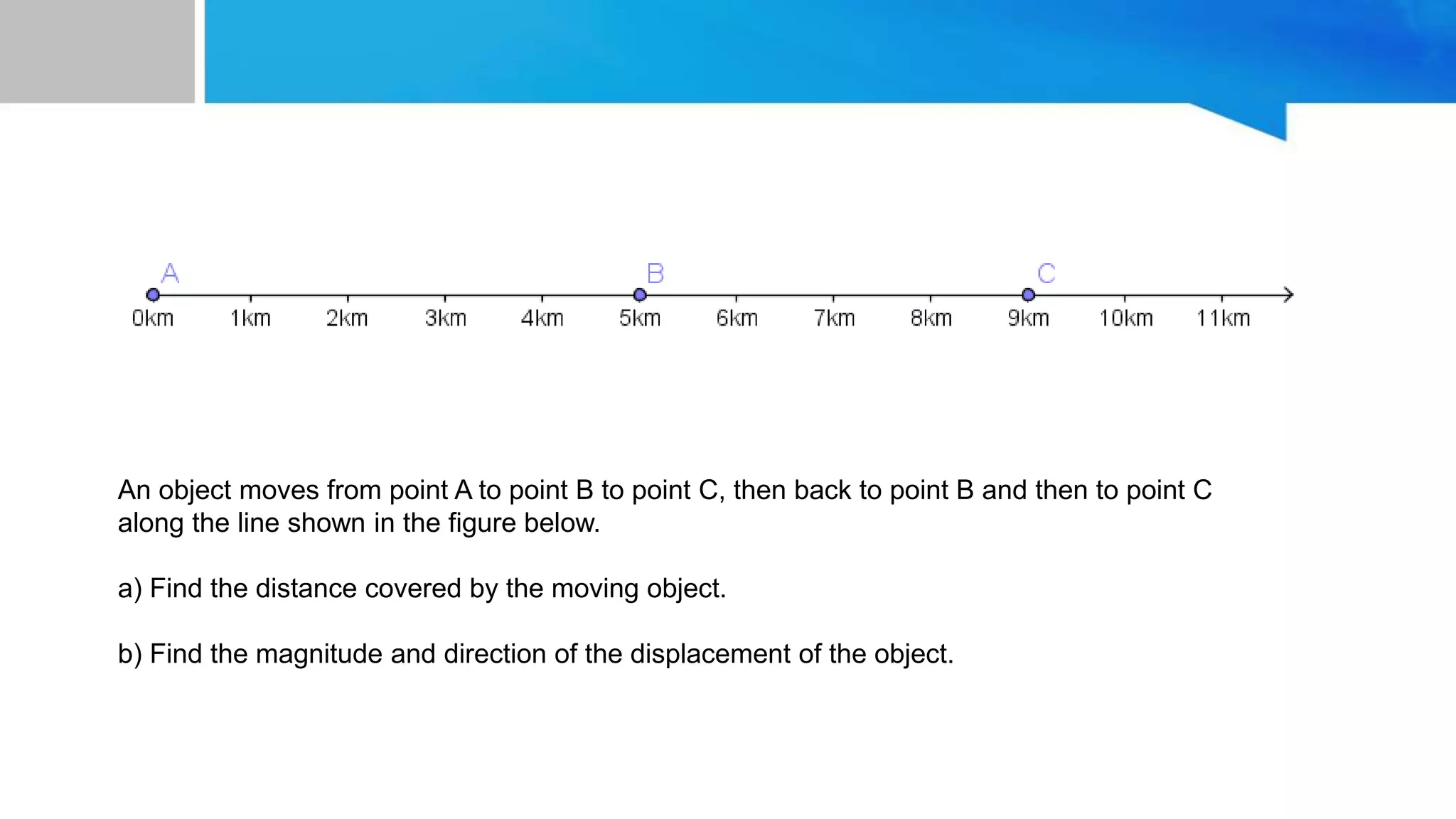
An object moves from point A to point B to point C, then back to point B and then to point C
along the line shown in the figure below.
a) Find the distance covered by the moving object.
b) Find the magnitude and direction of the displacement of the object.
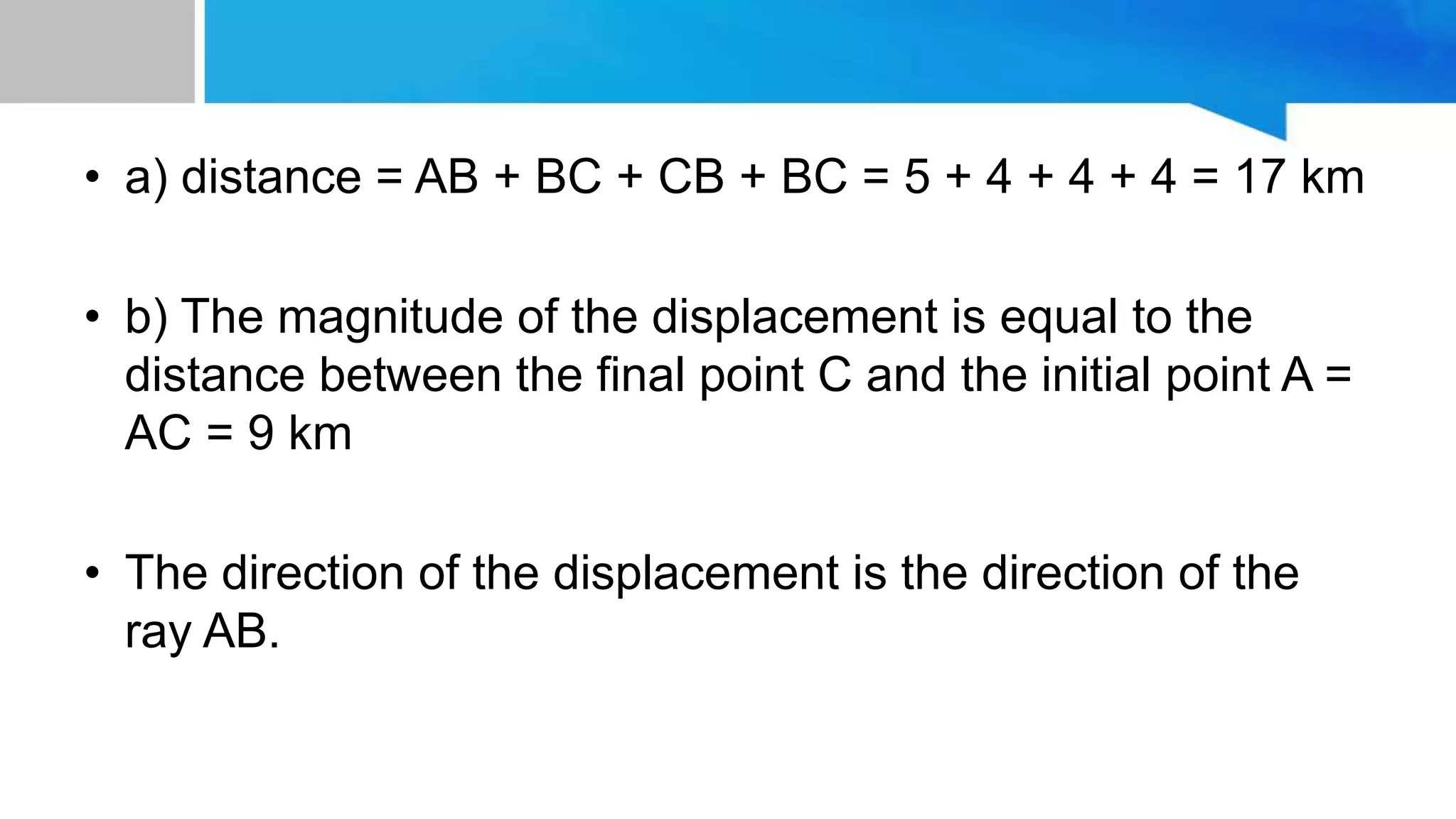
• a) distance = AB + BC + CB + BC = 5 + 4 + 4 + 4 = 17 km
• b) The magnitude of the displacement is equal to the
distance between the final point C and the initial point A =
AC = 9 km
• The direction of the displacement is the direction of the
ray AB.

Chapter2 MOTION:LESSON 1 Distance vs Displacement

  • 4.
    Chapter 2: MOTION Lesson1 Distance & Displacement
  • 5.
    DISTANCE • Distance isa scalar quantity that refers to "how much ground an object has covered" during its motion.
  • 6.
    • What isscalar? and what is its contrary? • Scalars are quantities that are fully described by a magnitude (or numerical value) alone. • Vectors are quantities that are fully described by both a magnitude and a direction. • This will be discussed more on lesson 2.
  • 7.
    DISPLACEMENT • Displacement isa vector quantity that refers to "how far out of place an object is"; it is the object's overall change in position.
  • 9.
    • Problem 1:An object moves from point A to point B to point C, then back to point B and then to point C along the line shown in the figure below. • a) Find the distance covered by the moving object. • b) Find the magnitude and direction of the displacement of the object.
  • 10.
    An object movesfrom point A to point B to point C, then back to point B and then to point C along the line shown in the figure below. a) Find the distance covered by the moving object. b) Find the magnitude and direction of the displacement of the object.
  • 12.
    • a) distance= AB + BC + CB + BC = 5 + 4 + 4 + 4 = 17 km • b) The magnitude of the displacement is equal to the distance between the final point C and the initial point A = AC = 9 km • The direction of the displacement is the direction of the ray AB.