Chapter 1: Motivation for a
Network of Wireless Sensor Nodes
2
Fundamentals of Wireless Sensor Networks: Theory and Practice
Waltenegus Dargie and Christian Poellabauer © 2010
Course Description Highlights 1
 Syllabus:
 Motivation for a Network of Wireless Sensor Nodes
 Applications
 Node Architecture
 Operating Systems
 Medium Access Control
 Network Layer Services
 Network Layer
 Power Management
 Time Synchronization
 Localization
 Security
 Sensor Network Programming
 Text book:
Fundamentals of Wireless Sensor Networks
By: Waltenegus Dargieand, Christian Poellabauer,
Wiley, 2010 (1st Edition)
3
Fundamentals of Wireless Sensor Networks: Theory and Practice
Waltenegus Dargie and Christian Poellabauer © 2010
Chapter 1: Roadmap
 Definitions and background
 Challenges and constraints
 Overview of topics covered
4
Fundamentals of Wireless Sensor Networks: Theory and Practice
Waltenegus Dargie and Christian Poellabauer © 2010
Sensing and Sensors
 Sensing: technique to gather information about physical
objects or areas
 Sensor (transducer): object performing a sensing task;
converting one form of energy in the physical world into
electrical energy
 Examples of sensors from biology: the human body
 eyes: capture optical information (light)
 ears: capture acoustic information (sound)
 nose: captures olfactory information (smell)
 skin: captures tactile information (shape, texture)
5
Fundamentals of Wireless Sensor Networks: Theory and Practice
Waltenegus Dargie and Christian Poellabauer © 2010
Sensing (Data Acquisition)
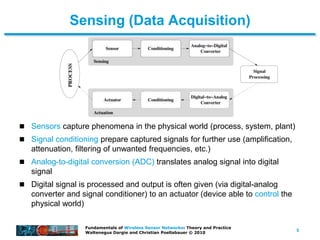
 Sensors capture phenomena in the physical world (process, system, plant)
 Signal conditioning prepare captured signals for further use (amplification,
attenuation, filtering of unwanted frequencies, etc.)
 Analog-to-digital conversion (ADC) translates analog signal into digital
signal
 Digital signal is processed and output is often given (via digital-analog
converter and signal conditioner) to an actuator (device able to control the
physical world)
6
Fundamentals of Wireless Sensor Networks: Theory and Practice
Waltenegus Dargie and Christian Poellabauer © 2010
Sensor Classifications
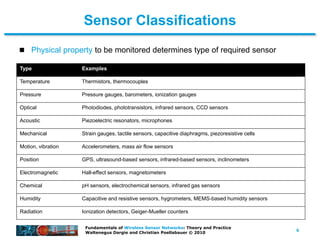
 Physical property to be monitored determines type of required sensor
Type Examples
Temperature Thermistors, thermocouples
Pressure Pressure gauges, barometers, ionization gauges
Optical Photodiodes, phototransistors, infrared sensors, CCD sensors
Acoustic Piezoelectric resonators, microphones
Mechanical Strain gauges, tactile sensors, capacitive diaphragms, piezoresistive cells
Motion, vibration Accelerometers, mass air flow sensors
Position GPS, ultrasound-based sensors, infrared-based sensors, inclinometers
Electromagnetic Hall-effect sensors, magnetometers
Chemical pH sensors, electrochemical sensors, infrared gas sensors
Humidity Capacitive and resistive sensors, hygrometers, MEMS-based humidity sensors
Radiation Ionization detectors, Geiger-Mueller counters
7
Fundamentals of Wireless Sensor Networks: Theory and Practice
Waltenegus Dargie and Christian Poellabauer © 2010
Other Classifications
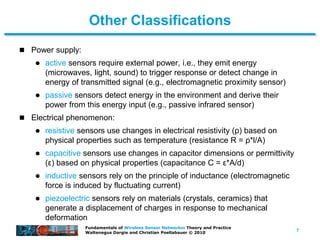
 Power supply:
 active sensors require external power, i.e., they emit energy
(microwaves, light, sound) to trigger response or detect change in
energy of transmitted signal (e.g., electromagnetic proximity sensor)
 passive sensors detect energy in the environment and derive their
power from this energy input (e.g., passive infrared sensor)
 Electrical phenomenon:
 resistive sensors use changes in electrical resistivity (ρ) based on
physical properties such as temperature (resistance R = ρ*l/A)
 capacitive sensors use changes in capacitor dimensions or permittivity
(ε) based on physical properties (capacitance C = ε*A/d)
 inductive sensors rely on the principle of inductance (electromagnetic
force is induced by fluctuating current)
 piezoelectric sensors rely on materials (crystals, ceramics) that
generate a displacement of charges in response to mechanical
deformation
8
Fundamentals of Wireless Sensor Networks: Theory and Practice
Waltenegus Dargie and Christian Poellabauer © 2010
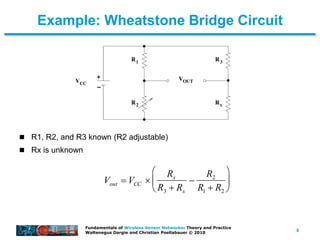
Example: Wheatstone Bridge Circuit
 R1, R2, and R3 known (R2 adjustable)
 Rx is unknown

Vout  VCC 
Rx
R3  Rx

R2
R1  R2






9
Fundamentals of Wireless Sensor Networks: Theory and Practice
Waltenegus Dargie and Christian Poellabauer © 2010
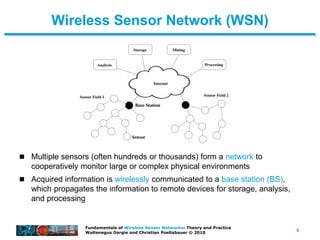
Wireless Sensor Network (WSN)
 Multiple sensors (often hundreds or thousands) form a network to
cooperatively monitor large or complex physical environments
 Acquired information is wirelessly communicated to a base station (BS),
which propagates the information to remote devices for storage, analysis,
and processing
10
Fundamentals of Wireless Sensor Networks: Theory and Practice
Waltenegus Dargie and Christian Poellabauer © 2010
History of Wireless Sensor Networks
 DARPA:
 Distributed Sensor Nets Workshop (1978)
 Distributed Sensor Networks (DSN) program (early 1980s)
 Sensor Information Technology (SensIT) program
 UCLA and Rockwell Science Center
 Wireless Integrated Network Sensors (WINS)
 Low Power Wireless Integrated Microsensor (LWIM) (1996)
 UC-Berkeley
 Smart Dust project (1999)
 concept of “motes”: extremely small sensor nodes
 Berkeley Wireless Research Center (BWRC)
 PicoRadio project (2000)
 MIT
 μAMPS (micro-Adaptive Multidomain Power-aware Sensors) (2005)
11
Fundamentals of Wireless Sensor Networks: Theory and Practice
Waltenegus Dargie and Christian Poellabauer © 2010
History of Wireless Sensor Networks
 Recent commercial efforts
 Crossbow (www.xbow.com)
 Sensoria (www.sensoria.com)
 Worldsens (worldsens.citi.insa-lyon.fr)
 Dust Networks (www.dustnetworks.com)
 Ember Corporation (www.ember.com)
12
Fundamentals of Wireless Sensor Networks: Theory and Practice
Waltenegus Dargie and Christian Poellabauer © 2010
WSN Communication
 Characteristics of typical WSN:
 low data rates (comparable to dial-up modems)
 energy-constrained sensors
 IEEE 802.11 family of standards
 most widely used WLAN protocols for wireless communications in
general
 can be found in early sensor networks or sensors networks without
stringent energy constraints
 IEEE 802.15.4 is an example for a protocol that has been designed
specifically for short-range communications in WSNs
 low data rates
 low power consumption
 widely used in academic and commercial WSN solutions
13
Fundamentals of Wireless Sensor Networks: Theory and Practice
Waltenegus Dargie and Christian Poellabauer © 2010
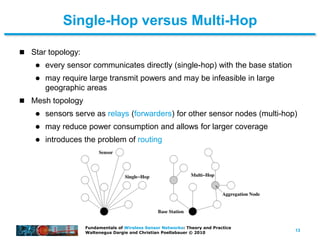
Single-Hop versus Multi-Hop
 Star topology:
 every sensor communicates directly (single-hop) with the base station
 may require large transmit powers and may be infeasible in large
geographic areas
 Mesh topology
 sensors serve as relays (forwarders) for other sensor nodes (multi-hop)
 may reduce power consumption and allows for larger coverage
 introduces the problem of routing
14
Fundamentals of Wireless Sensor Networks: Theory and Practice
Waltenegus Dargie and Christian Poellabauer © 2010
Challenges in WSNs: Energy
 Sensors typically powered through batteries
 replace battery when depleted
 recharge battery, e.g., using solar power
 discard sensor node when battery depleted
 For batteries that cannot be recharged, sensor node should be able to
operate during its entire mission time or until battery can be replaced
 Energy efficiency is affected by various aspects of sensor node/network
design
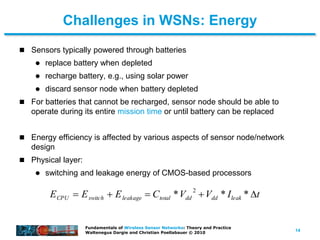
 Physical layer:
 switching and leakage energy of CMOS-based processors
ECPU  Eswitch  Eleakage  Ctotal *Vdd
2
Vdd * Ileak * t
15
Fundamentals of Wireless Sensor Networks: Theory and Practice
Waltenegus Dargie and Christian Poellabauer © 2010
Challenges in WSNs: Energy
 Medium access control layer:
 contention-based strategies lead to energy-costly collisions
 problem of idle listening
 Network layer:
 responsible for finding energy-efficient routes
 Operating system:
 small memory footprint and efficient task switching
 Security:
 fast and simple algorithms for encryption, authentication, etc.
 Middleware:
 in-network processing of sensor data can eliminate redundant data or
aggregate sensor readings
16
Fundamentals of Wireless Sensor Networks: Theory and Practice
Waltenegus Dargie and Christian Poellabauer © 2010
Challenges in WSNs: Self-Management
 Ad-hoc deployment
 many sensor networks are deployed “without design”
 sensors dropped from airplanes (battlefield assessment)
 sensors placed wherever currently needed (tracking patients in
disaster zone)
 moving sensors (robot teams exploring unknown terrain)
 sensor node must have some or all of the following abilities
 determine its location
 determine identity of neighboring nodes
 configure node parameters
 discover route(s) to base station
 initiate sensing responsibility
17
Fundamentals of Wireless Sensor Networks: Theory and Practice
Waltenegus Dargie and Christian Poellabauer © 2010
Challenges in WSNs: Self-Management
 Unattended operation
 once deployed, WSN must operate without human intervention
 device adapts to changes in topology, density, and traffic load
 device adapts in response to failures
 Other terminology
 self-organization is the ability to adapt configuration parameters
based on system and environmental state
 self-optimization is the ability to monitor and optimize the use of
the limited system resources
 self-protection is the ability recognize and protect from intrusions
and attacks
 self-healing is the ability to discover, identify, and react to
network disruptions
18
Fundamentals of Wireless Sensor Networks: Theory and Practice
Waltenegus Dargie and Christian Poellabauer © 2010
Challenges in WSNs: Wireless Networks
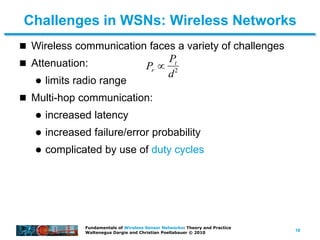
 Wireless communication faces a variety of challenges
 Attenuation:
 limits radio range
 Multi-hop communication:
 increased latency
 increased failure/error probability
 complicated by use of duty cycles

Pr 
Pt
d2
19
Fundamentals of Wireless Sensor Networks: Theory and Practice
Waltenegus Dargie and Christian Poellabauer © 2010
Challenges in WSNs: Decentralization
 Centralized management (e.g., at the base station) of the network often not
feasible to due large scale of network and energy constraints
 Therefore, decentralized (or distributed) solutions often preferred, though
they may perform worse than their centralized counterparts
 Example: routing
 Centralized:
 BS collects information from all sensor nodes
 BS establishes “optimal” routes (e.g., in terms of energy)
 BS informs all sensor nodes of routes
 can be expensive, especially when the topology changes frequently
 Decentralized:
 each sensors makes routing decisions based on limited local
information
 routes may be nonoptimal, but route establishment/management can be
much cheaper
20
Fundamentals of Wireless Sensor Networks: Theory and Practice
Waltenegus Dargie and Christian Poellabauer © 2010
Challenges in WSNs: Design Constraints
 Many hardware and software limitations affect the overall system
design
 Examples include:
 Low processing speeds (to save energy)
 Low storage capacities (to allow for small form factor and to save
energy)
 Lack of I/O components such as GPS receivers (reduce cost,
size, energy)
 Lack of software features such as multi-threading (reduce
software complexity)
21
Fundamentals of Wireless Sensor Networks: Theory and Practice
Waltenegus Dargie and Christian Poellabauer © 2010
Challenges in WSNs: Security
 Sensor networks often monitor critical infrastructure or carry
sensitive information, making them desirable targets for attacks
 Attacks may be facilitated by:
 remote and unattended operation
 wireless communication
 lack of advanced security features due to cost, form factor, or
energy
 Conventional security techniques often not feasible due to their
computational, communication, and storage requirements
 As a consequence, sensor networks require new solutions for
intrusion detection, encryption, key establishment and distribution,
node authentication, and secrecy
22
Fundamentals of Wireless Sensor Networks: Theory and Practice
Waltenegus Dargie and Christian Poellabauer © 2010
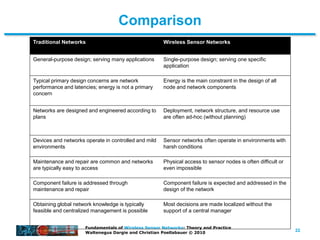
Comparison
Traditional Networks Wireless Sensor Networks
General-purpose design; serving many applications Single-purpose design; serving one specific
application
Typical primary design concerns are network
performance and latencies; energy is not a primary
concern
Energy is the main constraint in the design of all
node and network components
Networks are designed and engineered according to
plans
Deployment, network structure, and resource use
are often ad-hoc (without planning)
Devices and networks operate in controlled and mild
environments
Sensor networks often operate in environments with
harsh conditions
Maintenance and repair are common and networks
are typically easy to access
Physical access to sensor nodes is often difficult or
even impossible
Component failure is addressed through
maintenance and repair
Component failure is expected and addressed in the
design of the network
Obtaining global network knowledge is typically
feasible and centralized management is possible
Most decisions are made localized without the
support of a central manager

Chapter1.ppt

  • 1.
    Chapter 1: Motivationfor a Network of Wireless Sensor Nodes
  • 2.
    2 Fundamentals of WirelessSensor Networks: Theory and Practice Waltenegus Dargie and Christian Poellabauer © 2010 Course Description Highlights 1  Syllabus:  Motivation for a Network of Wireless Sensor Nodes  Applications  Node Architecture  Operating Systems  Medium Access Control  Network Layer Services  Network Layer  Power Management  Time Synchronization  Localization  Security  Sensor Network Programming  Text book: Fundamentals of Wireless Sensor Networks By: Waltenegus Dargieand, Christian Poellabauer, Wiley, 2010 (1st Edition)
  • 3.
    3 Fundamentals of WirelessSensor Networks: Theory and Practice Waltenegus Dargie and Christian Poellabauer © 2010 Chapter 1: Roadmap  Definitions and background  Challenges and constraints  Overview of topics covered
  • 4.
    4 Fundamentals of WirelessSensor Networks: Theory and Practice Waltenegus Dargie and Christian Poellabauer © 2010 Sensing and Sensors  Sensing: technique to gather information about physical objects or areas  Sensor (transducer): object performing a sensing task; converting one form of energy in the physical world into electrical energy  Examples of sensors from biology: the human body  eyes: capture optical information (light)  ears: capture acoustic information (sound)  nose: captures olfactory information (smell)  skin: captures tactile information (shape, texture)
  • 5.
    5 Fundamentals of WirelessSensor Networks: Theory and Practice Waltenegus Dargie and Christian Poellabauer © 2010 Sensing (Data Acquisition)  Sensors capture phenomena in the physical world (process, system, plant)  Signal conditioning prepare captured signals for further use (amplification, attenuation, filtering of unwanted frequencies, etc.)  Analog-to-digital conversion (ADC) translates analog signal into digital signal  Digital signal is processed and output is often given (via digital-analog converter and signal conditioner) to an actuator (device able to control the physical world)
  • 6.
    6 Fundamentals of WirelessSensor Networks: Theory and Practice Waltenegus Dargie and Christian Poellabauer © 2010 Sensor Classifications  Physical property to be monitored determines type of required sensor Type Examples Temperature Thermistors, thermocouples Pressure Pressure gauges, barometers, ionization gauges Optical Photodiodes, phototransistors, infrared sensors, CCD sensors Acoustic Piezoelectric resonators, microphones Mechanical Strain gauges, tactile sensors, capacitive diaphragms, piezoresistive cells Motion, vibration Accelerometers, mass air flow sensors Position GPS, ultrasound-based sensors, infrared-based sensors, inclinometers Electromagnetic Hall-effect sensors, magnetometers Chemical pH sensors, electrochemical sensors, infrared gas sensors Humidity Capacitive and resistive sensors, hygrometers, MEMS-based humidity sensors Radiation Ionization detectors, Geiger-Mueller counters
  • 7.
    7 Fundamentals of WirelessSensor Networks: Theory and Practice Waltenegus Dargie and Christian Poellabauer © 2010 Other Classifications  Power supply:  active sensors require external power, i.e., they emit energy (microwaves, light, sound) to trigger response or detect change in energy of transmitted signal (e.g., electromagnetic proximity sensor)  passive sensors detect energy in the environment and derive their power from this energy input (e.g., passive infrared sensor)  Electrical phenomenon:  resistive sensors use changes in electrical resistivity (ρ) based on physical properties such as temperature (resistance R = ρ*l/A)  capacitive sensors use changes in capacitor dimensions or permittivity (ε) based on physical properties (capacitance C = ε*A/d)  inductive sensors rely on the principle of inductance (electromagnetic force is induced by fluctuating current)  piezoelectric sensors rely on materials (crystals, ceramics) that generate a displacement of charges in response to mechanical deformation
  • 8.
    8 Fundamentals of WirelessSensor Networks: Theory and Practice Waltenegus Dargie and Christian Poellabauer © 2010 Example: Wheatstone Bridge Circuit  R1, R2, and R3 known (R2 adjustable)  Rx is unknown  Vout  VCC  Rx R3  Rx  R2 R1  R2      
  • 9.
    9 Fundamentals of WirelessSensor Networks: Theory and Practice Waltenegus Dargie and Christian Poellabauer © 2010 Wireless Sensor Network (WSN)  Multiple sensors (often hundreds or thousands) form a network to cooperatively monitor large or complex physical environments  Acquired information is wirelessly communicated to a base station (BS), which propagates the information to remote devices for storage, analysis, and processing
  • 10.
    10 Fundamentals of WirelessSensor Networks: Theory and Practice Waltenegus Dargie and Christian Poellabauer © 2010 History of Wireless Sensor Networks  DARPA:  Distributed Sensor Nets Workshop (1978)  Distributed Sensor Networks (DSN) program (early 1980s)  Sensor Information Technology (SensIT) program  UCLA and Rockwell Science Center  Wireless Integrated Network Sensors (WINS)  Low Power Wireless Integrated Microsensor (LWIM) (1996)  UC-Berkeley  Smart Dust project (1999)  concept of “motes”: extremely small sensor nodes  Berkeley Wireless Research Center (BWRC)  PicoRadio project (2000)  MIT  μAMPS (micro-Adaptive Multidomain Power-aware Sensors) (2005)
  • 11.
    11 Fundamentals of WirelessSensor Networks: Theory and Practice Waltenegus Dargie and Christian Poellabauer © 2010 History of Wireless Sensor Networks  Recent commercial efforts  Crossbow (www.xbow.com)  Sensoria (www.sensoria.com)  Worldsens (worldsens.citi.insa-lyon.fr)  Dust Networks (www.dustnetworks.com)  Ember Corporation (www.ember.com)
  • 12.
    12 Fundamentals of WirelessSensor Networks: Theory and Practice Waltenegus Dargie and Christian Poellabauer © 2010 WSN Communication  Characteristics of typical WSN:  low data rates (comparable to dial-up modems)  energy-constrained sensors  IEEE 802.11 family of standards  most widely used WLAN protocols for wireless communications in general  can be found in early sensor networks or sensors networks without stringent energy constraints  IEEE 802.15.4 is an example for a protocol that has been designed specifically for short-range communications in WSNs  low data rates  low power consumption  widely used in academic and commercial WSN solutions
  • 13.
    13 Fundamentals of WirelessSensor Networks: Theory and Practice Waltenegus Dargie and Christian Poellabauer © 2010 Single-Hop versus Multi-Hop  Star topology:  every sensor communicates directly (single-hop) with the base station  may require large transmit powers and may be infeasible in large geographic areas  Mesh topology  sensors serve as relays (forwarders) for other sensor nodes (multi-hop)  may reduce power consumption and allows for larger coverage  introduces the problem of routing
  • 14.
    14 Fundamentals of WirelessSensor Networks: Theory and Practice Waltenegus Dargie and Christian Poellabauer © 2010 Challenges in WSNs: Energy  Sensors typically powered through batteries  replace battery when depleted  recharge battery, e.g., using solar power  discard sensor node when battery depleted  For batteries that cannot be recharged, sensor node should be able to operate during its entire mission time or until battery can be replaced  Energy efficiency is affected by various aspects of sensor node/network design  Physical layer:  switching and leakage energy of CMOS-based processors ECPU  Eswitch  Eleakage  Ctotal *Vdd 2 Vdd * Ileak * t
  • 15.
    15 Fundamentals of WirelessSensor Networks: Theory and Practice Waltenegus Dargie and Christian Poellabauer © 2010 Challenges in WSNs: Energy  Medium access control layer:  contention-based strategies lead to energy-costly collisions  problem of idle listening  Network layer:  responsible for finding energy-efficient routes  Operating system:  small memory footprint and efficient task switching  Security:  fast and simple algorithms for encryption, authentication, etc.  Middleware:  in-network processing of sensor data can eliminate redundant data or aggregate sensor readings
  • 16.
    16 Fundamentals of WirelessSensor Networks: Theory and Practice Waltenegus Dargie and Christian Poellabauer © 2010 Challenges in WSNs: Self-Management  Ad-hoc deployment  many sensor networks are deployed “without design”  sensors dropped from airplanes (battlefield assessment)  sensors placed wherever currently needed (tracking patients in disaster zone)  moving sensors (robot teams exploring unknown terrain)  sensor node must have some or all of the following abilities  determine its location  determine identity of neighboring nodes  configure node parameters  discover route(s) to base station  initiate sensing responsibility
  • 17.
    17 Fundamentals of WirelessSensor Networks: Theory and Practice Waltenegus Dargie and Christian Poellabauer © 2010 Challenges in WSNs: Self-Management  Unattended operation  once deployed, WSN must operate without human intervention  device adapts to changes in topology, density, and traffic load  device adapts in response to failures  Other terminology  self-organization is the ability to adapt configuration parameters based on system and environmental state  self-optimization is the ability to monitor and optimize the use of the limited system resources  self-protection is the ability recognize and protect from intrusions and attacks  self-healing is the ability to discover, identify, and react to network disruptions
  • 18.
    18 Fundamentals of WirelessSensor Networks: Theory and Practice Waltenegus Dargie and Christian Poellabauer © 2010 Challenges in WSNs: Wireless Networks  Wireless communication faces a variety of challenges  Attenuation:  limits radio range  Multi-hop communication:  increased latency  increased failure/error probability  complicated by use of duty cycles  Pr  Pt d2
  • 19.
    19 Fundamentals of WirelessSensor Networks: Theory and Practice Waltenegus Dargie and Christian Poellabauer © 2010 Challenges in WSNs: Decentralization  Centralized management (e.g., at the base station) of the network often not feasible to due large scale of network and energy constraints  Therefore, decentralized (or distributed) solutions often preferred, though they may perform worse than their centralized counterparts  Example: routing  Centralized:  BS collects information from all sensor nodes  BS establishes “optimal” routes (e.g., in terms of energy)  BS informs all sensor nodes of routes  can be expensive, especially when the topology changes frequently  Decentralized:  each sensors makes routing decisions based on limited local information  routes may be nonoptimal, but route establishment/management can be much cheaper
  • 20.
    20 Fundamentals of WirelessSensor Networks: Theory and Practice Waltenegus Dargie and Christian Poellabauer © 2010 Challenges in WSNs: Design Constraints  Many hardware and software limitations affect the overall system design  Examples include:  Low processing speeds (to save energy)  Low storage capacities (to allow for small form factor and to save energy)  Lack of I/O components such as GPS receivers (reduce cost, size, energy)  Lack of software features such as multi-threading (reduce software complexity)
  • 21.
    21 Fundamentals of WirelessSensor Networks: Theory and Practice Waltenegus Dargie and Christian Poellabauer © 2010 Challenges in WSNs: Security  Sensor networks often monitor critical infrastructure or carry sensitive information, making them desirable targets for attacks  Attacks may be facilitated by:  remote and unattended operation  wireless communication  lack of advanced security features due to cost, form factor, or energy  Conventional security techniques often not feasible due to their computational, communication, and storage requirements  As a consequence, sensor networks require new solutions for intrusion detection, encryption, key establishment and distribution, node authentication, and secrecy
  • 22.
    22 Fundamentals of WirelessSensor Networks: Theory and Practice Waltenegus Dargie and Christian Poellabauer © 2010 Comparison Traditional Networks Wireless Sensor Networks General-purpose design; serving many applications Single-purpose design; serving one specific application Typical primary design concerns are network performance and latencies; energy is not a primary concern Energy is the main constraint in the design of all node and network components Networks are designed and engineered according to plans Deployment, network structure, and resource use are often ad-hoc (without planning) Devices and networks operate in controlled and mild environments Sensor networks often operate in environments with harsh conditions Maintenance and repair are common and networks are typically easy to access Physical access to sensor nodes is often difficult or even impossible Component failure is addressed through maintenance and repair Component failure is expected and addressed in the design of the network Obtaining global network knowledge is typically feasible and centralized management is possible Most decisions are made localized without the support of a central manager