Civics Goal 2
Principles of the Constitutiona.k.a.  The things that our government is based on today
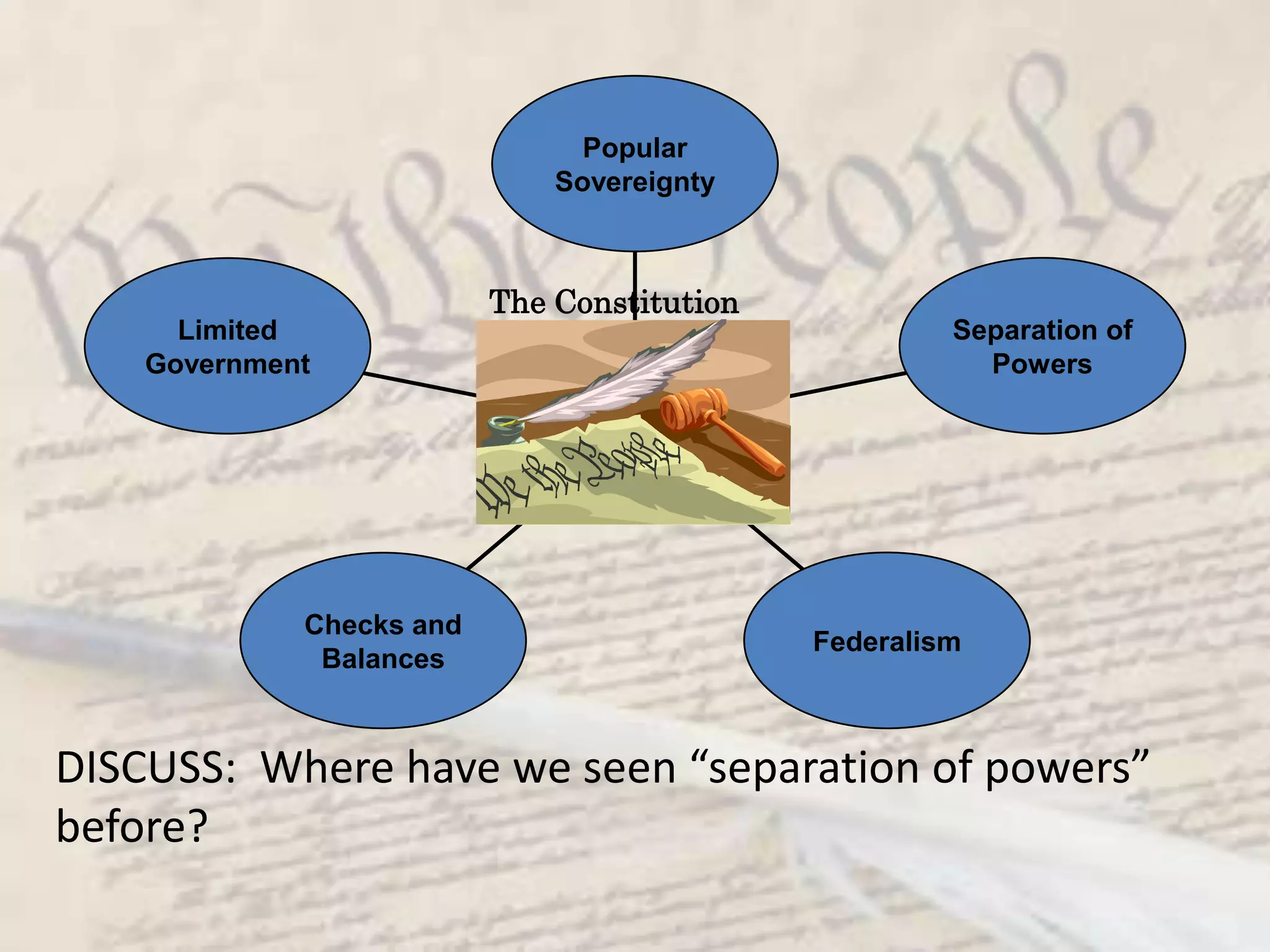
The ConstitutionDISCUSS:  Where have we seen “separation of powers” before?
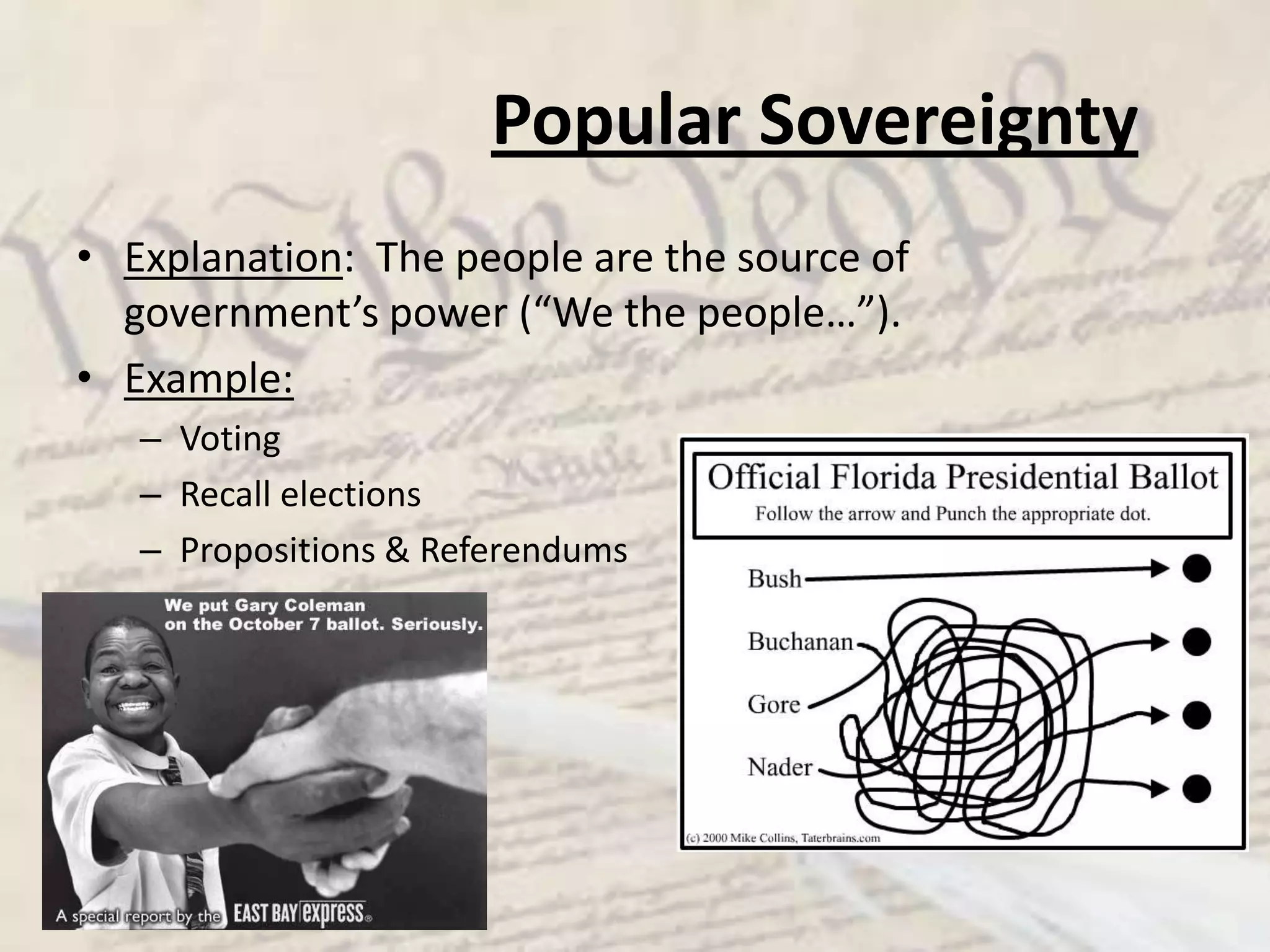
Popular SovereigntyExplanation:  The people are the source of government’s power (“We the people…”).Example:VotingRecall electionsPropositions & Referendums
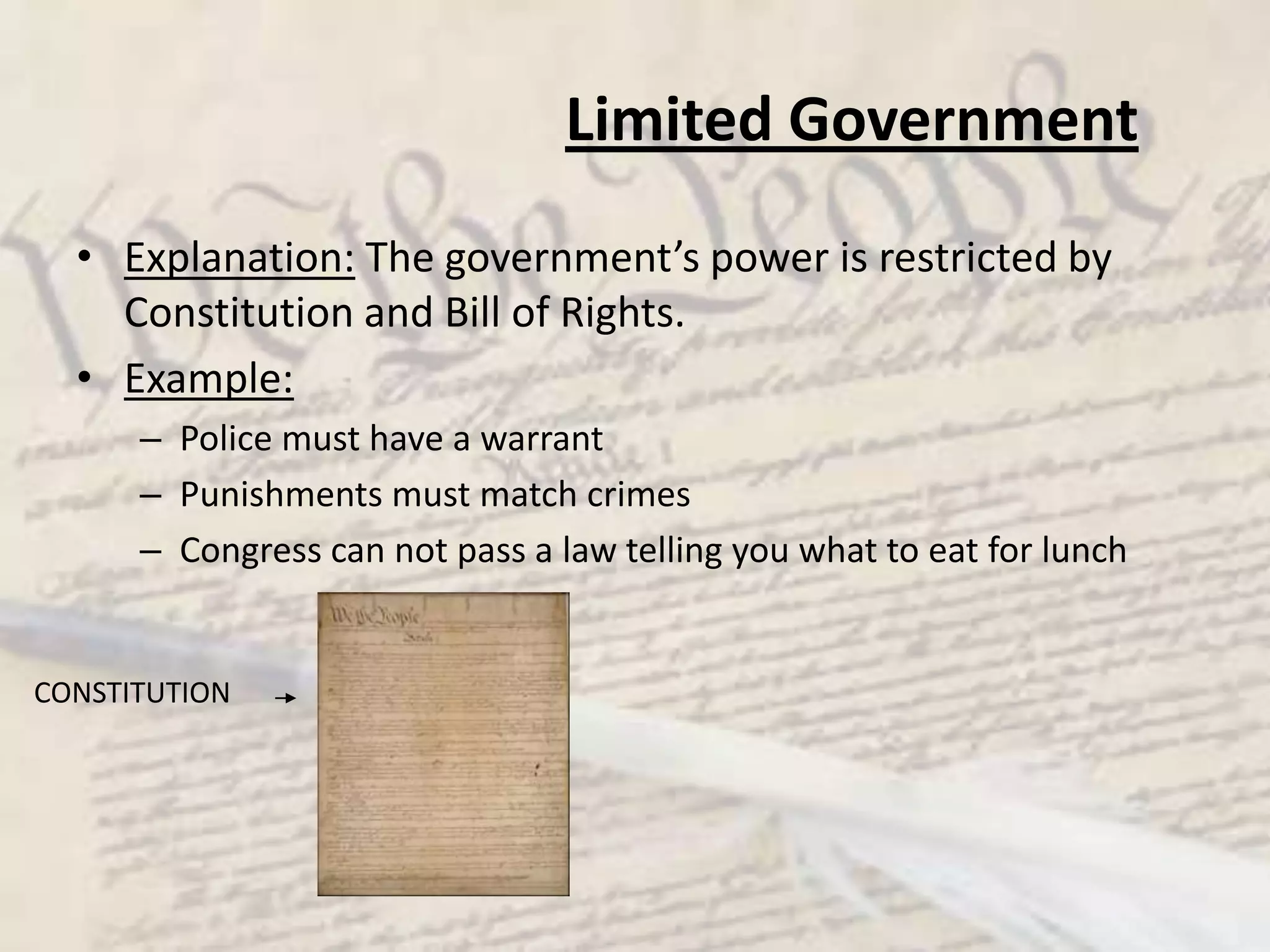
Limited GovernmentExplanation: The government’s power is restricted by Constitution and Bill of Rights.Example:Police must have a warrantPunishments must match crimesCongress can not pass a law telling you what to eat for lunchCONSTITUTION
DISCUSS:  Defend this sentence-Although England has a King, their government is based on the idea of Limited Government.Hint:  Magna Carta
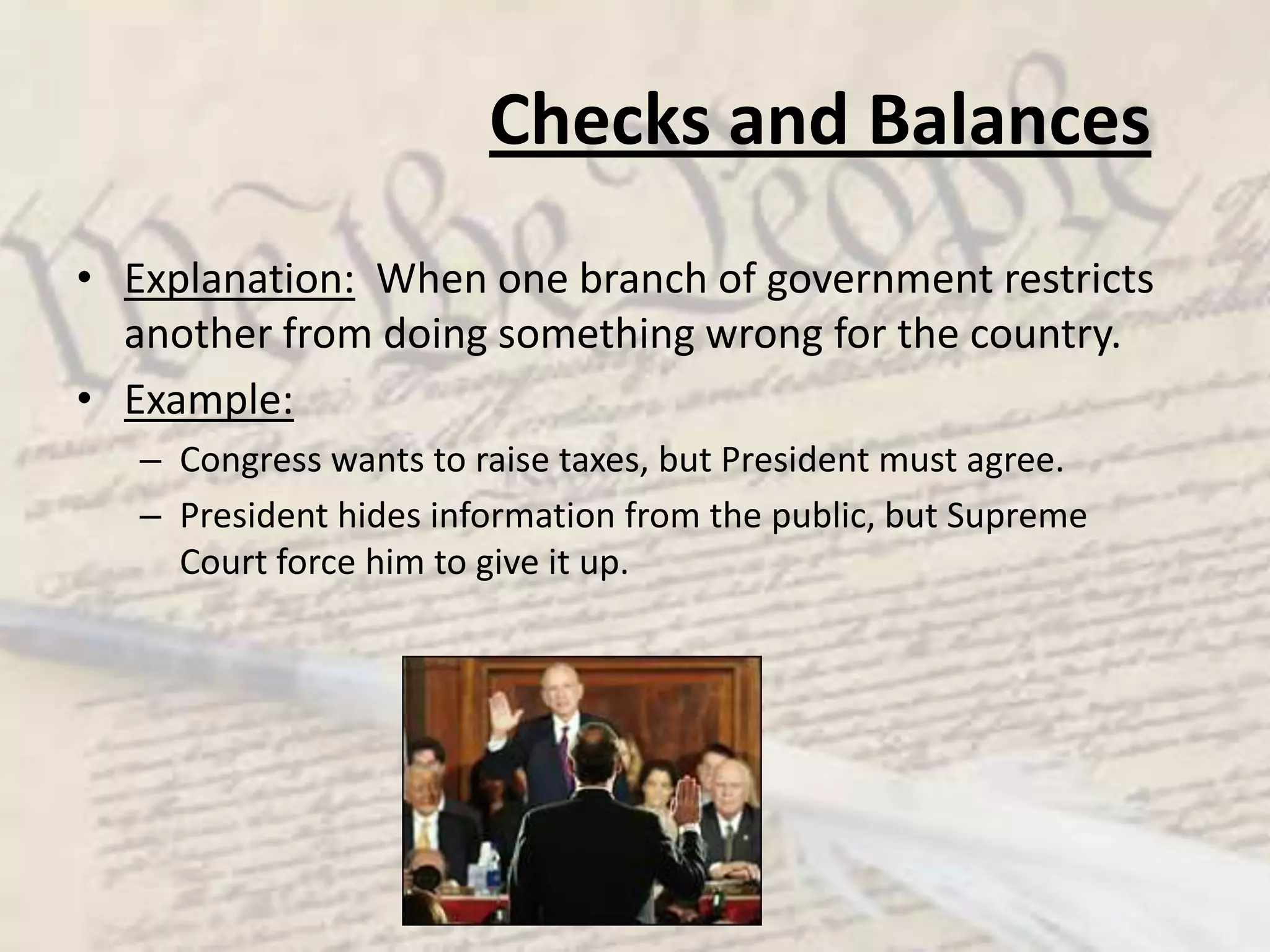
Checks and BalancesExplanation:  When one branch of government restricts another from doing something wrong for the country.Example:Congress wants to raise taxes, but President must agree.President hides information from the public, but Supreme Court force him to give it up.
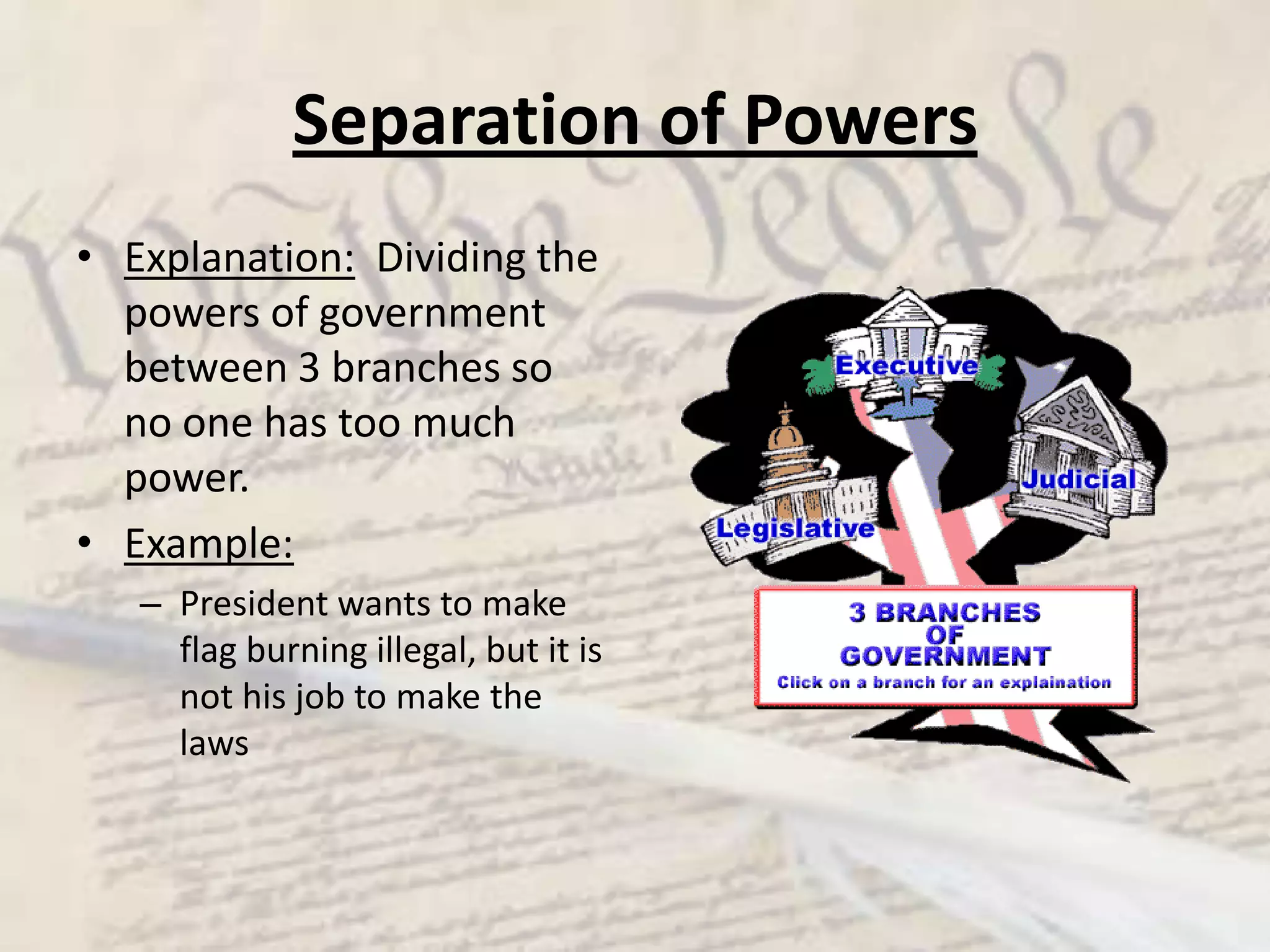
Separation of PowersExplanation:  Dividing the powers of government between 3 branches so no one has too much power.Example:President wants to make flag burning illegal, but it is not his job to make the laws
DISCUSS:  Do you think “Checks and Balances” can exist within a government that does NOT have Separation of Powers?
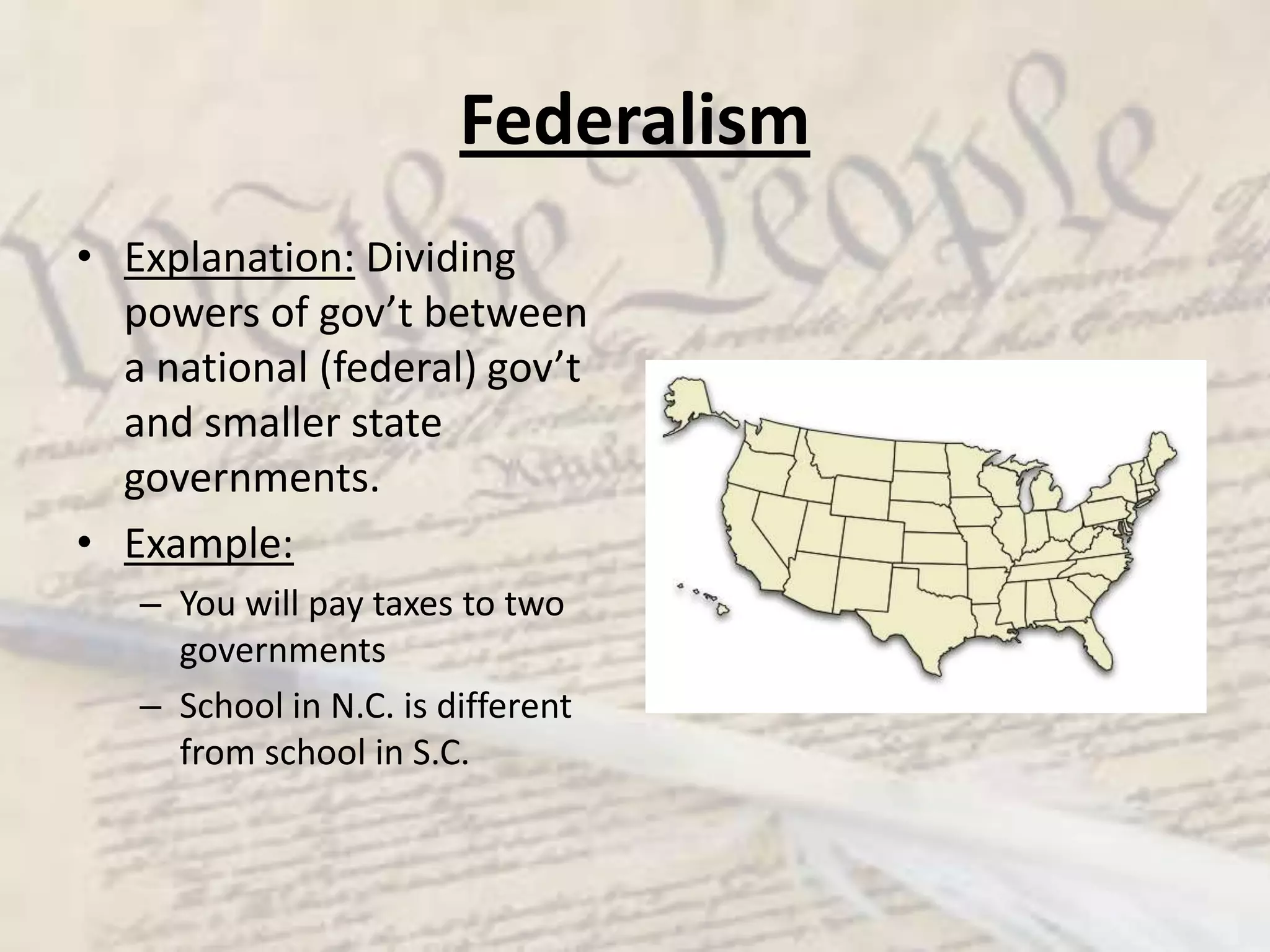
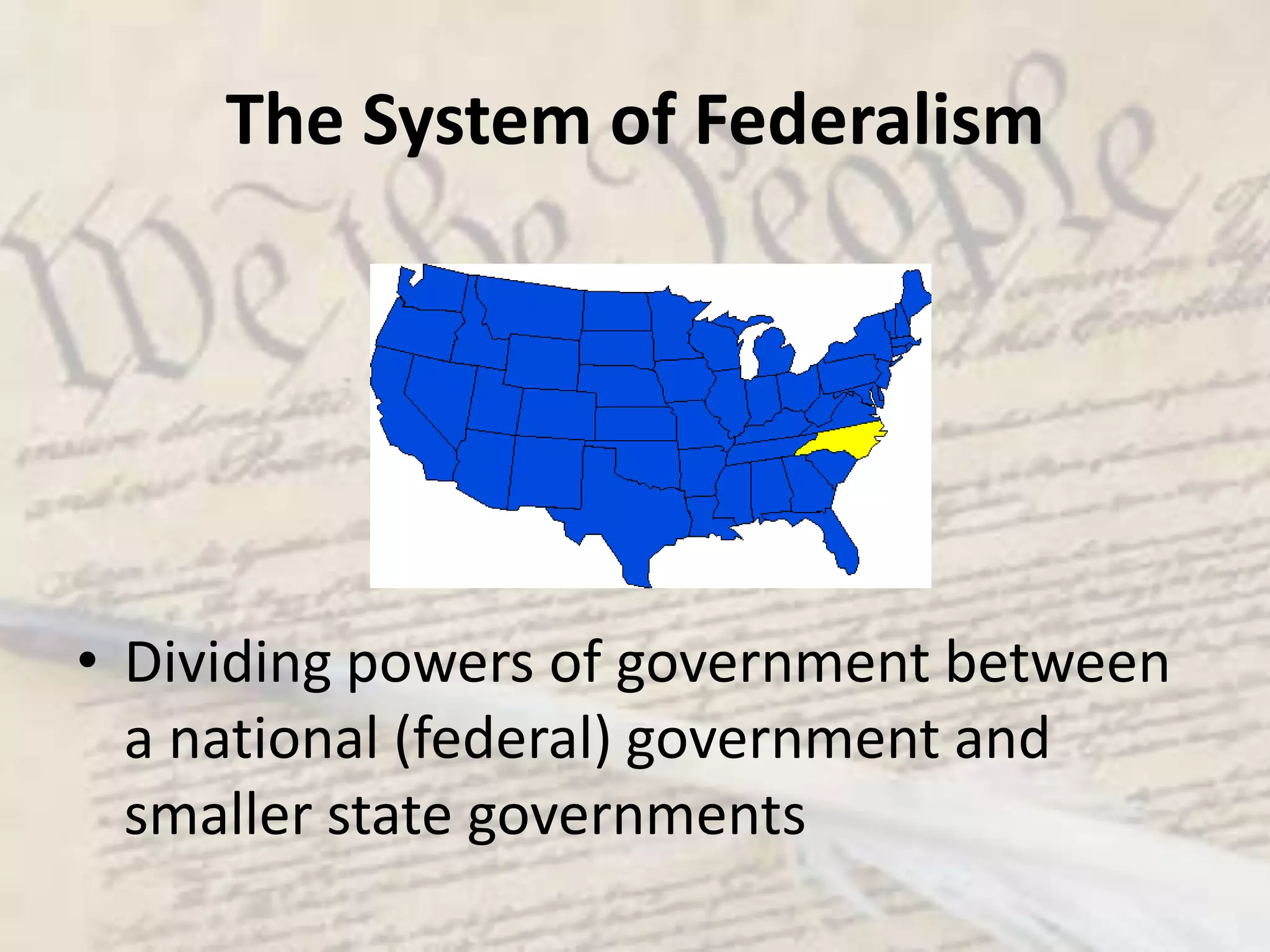
FederalismExplanation: Dividing powers of gov’t between a national (federal) gov’t and smaller state governments. Example:You will pay taxes to two governmentsSchool in N.C. is different from school in S.C.
DISCUSS:  Which of the 5 Principles might be the most important to people who vote?Popular Sovereignty
Limited Government
Separation of Powers
Checks and Balances
FederalismJudicial ReviewThe power of the Supreme court to review laws.This principle was established by the Supreme Court case Marbury vs. Madison (1803)
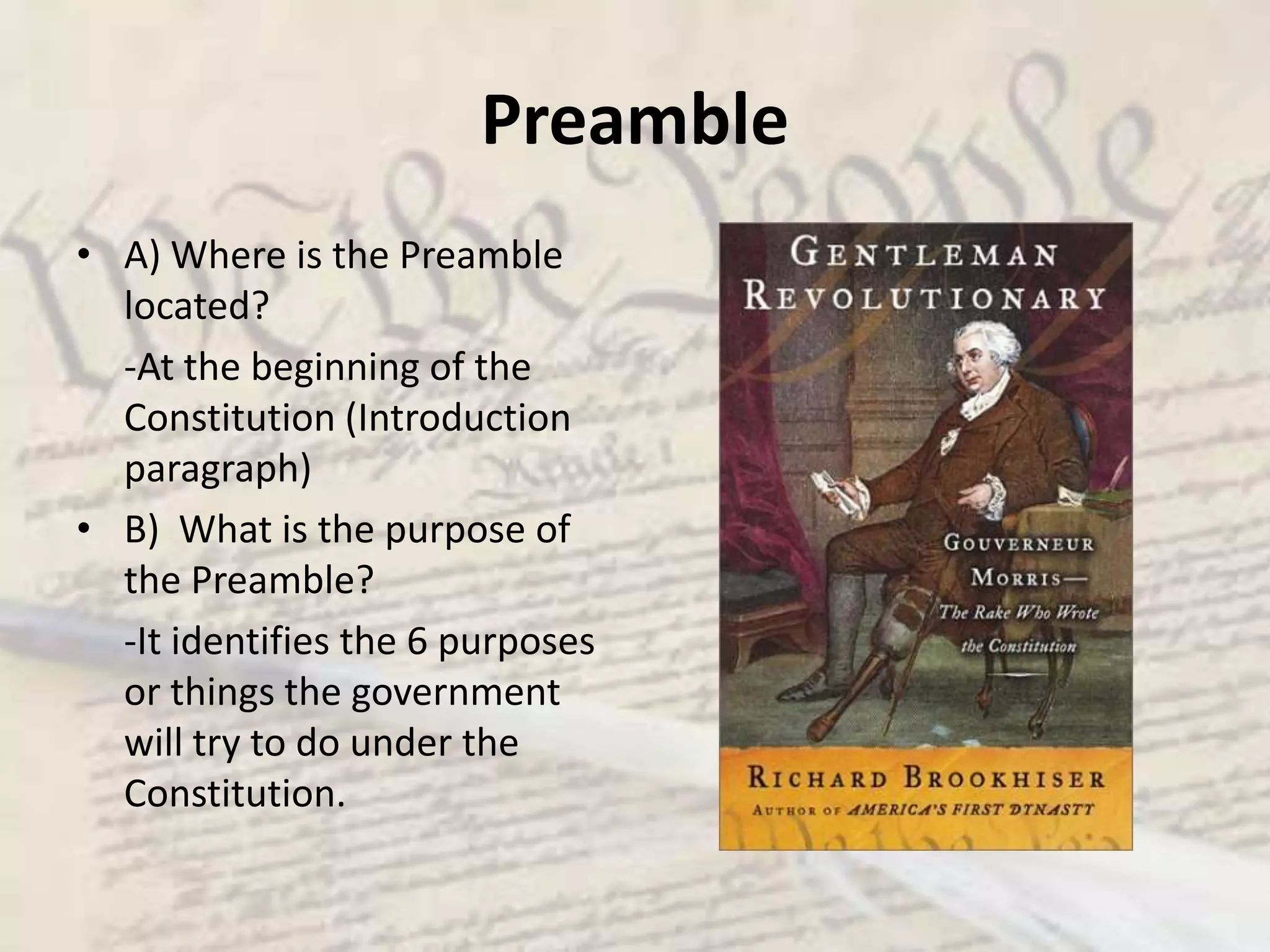
PreambleA) Where is the Preamble located?  	-At the beginning of the Constitution (Introduction paragraph)B)  What is the purpose of the Preamble?	-It identifies the 6 purposes or things the government will try to do under the Constitution.
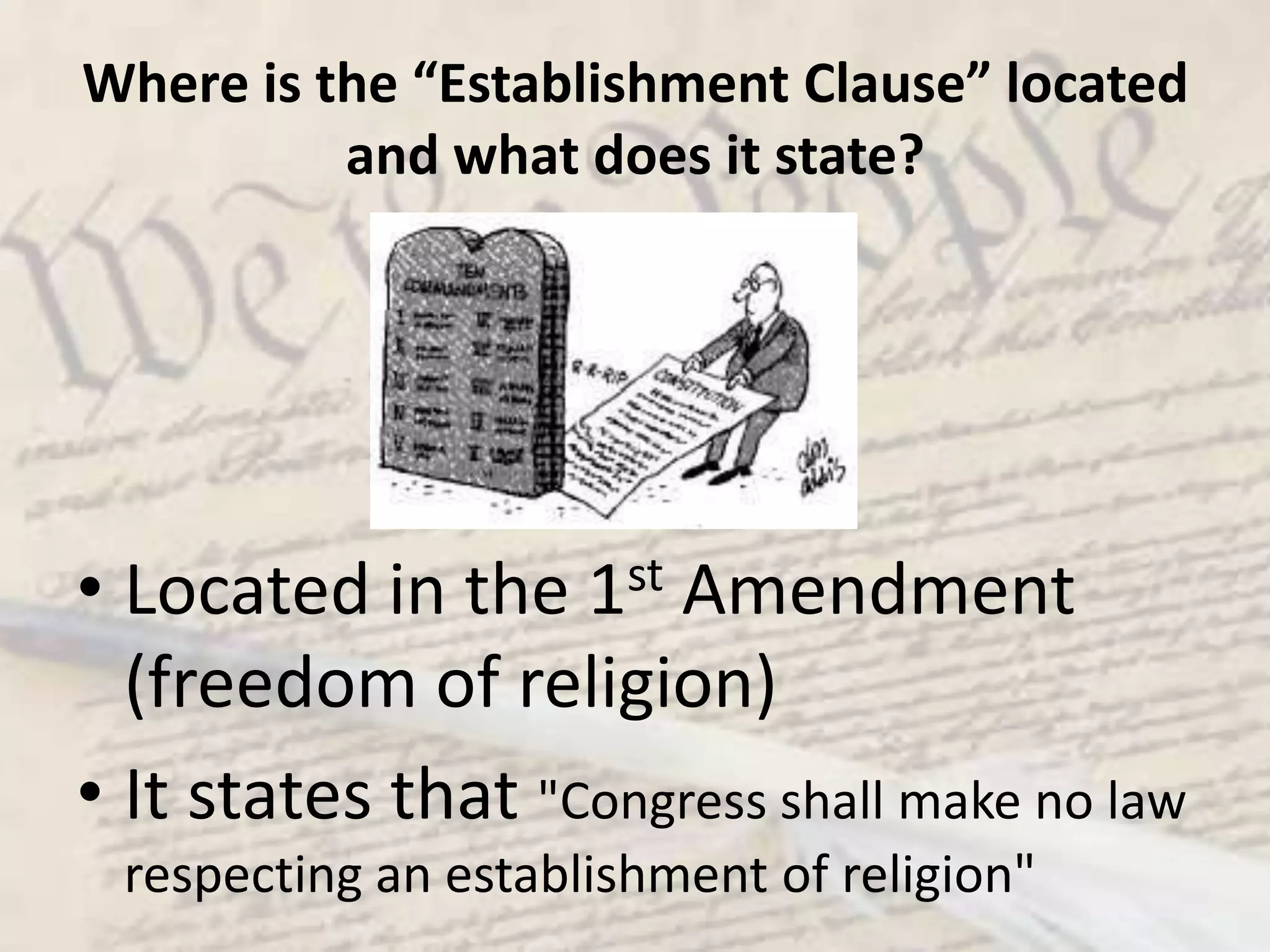
Where is the “Establishment Clause” located and what does it state?Located in the 1st Amendment (freedom of religion)It states that "Congress shall make no law respecting an establishment of religion"
Qualifications of Offices of the 3 Branches of Government
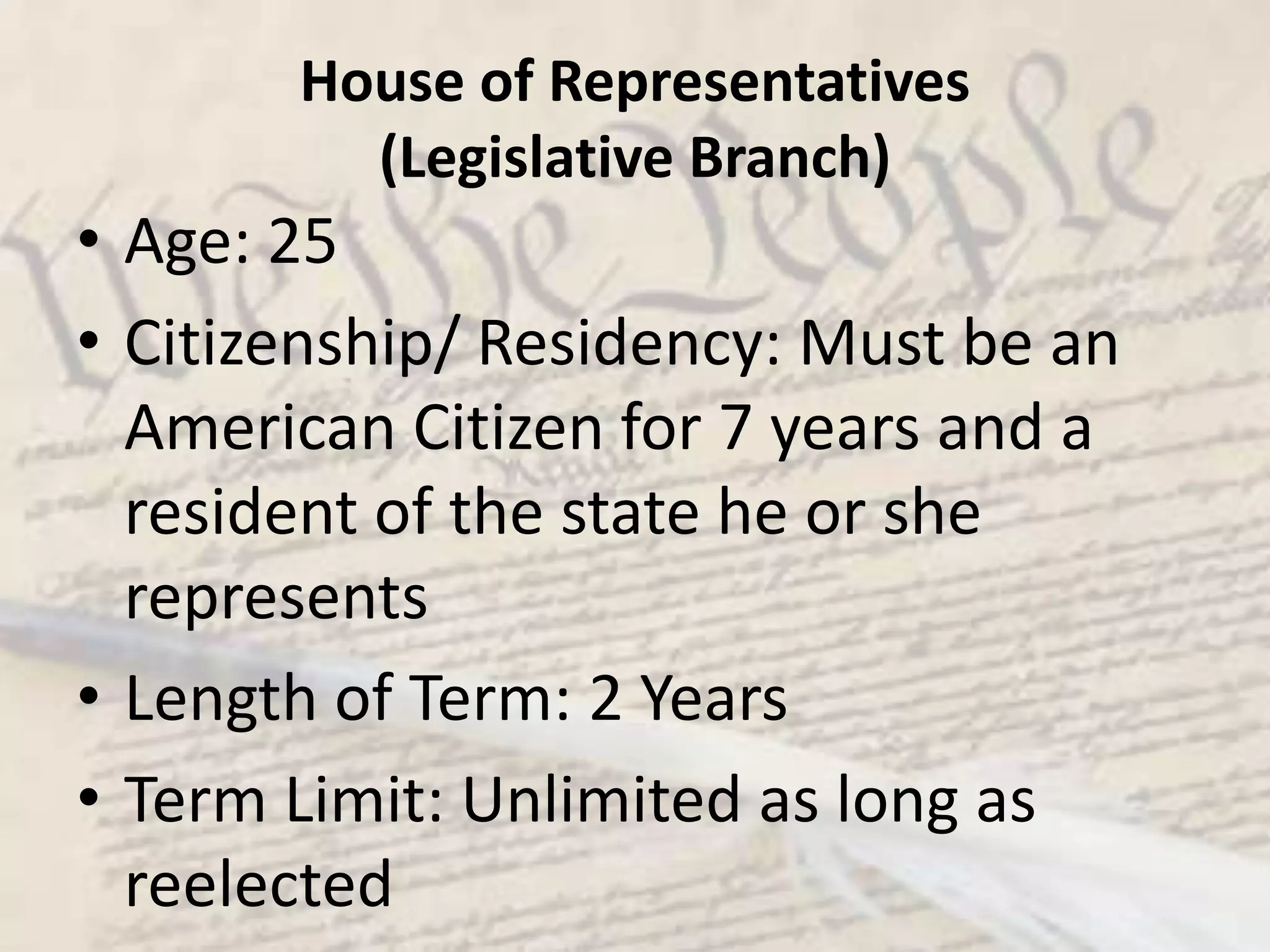
House of Representatives (Legislative Branch)Age: 25Citizenship/ Residency: Must be an American Citizen for 7 years and a resident of the state he or she representsLength of Term: 2 YearsTerm Limit: Unlimited as long as reelected
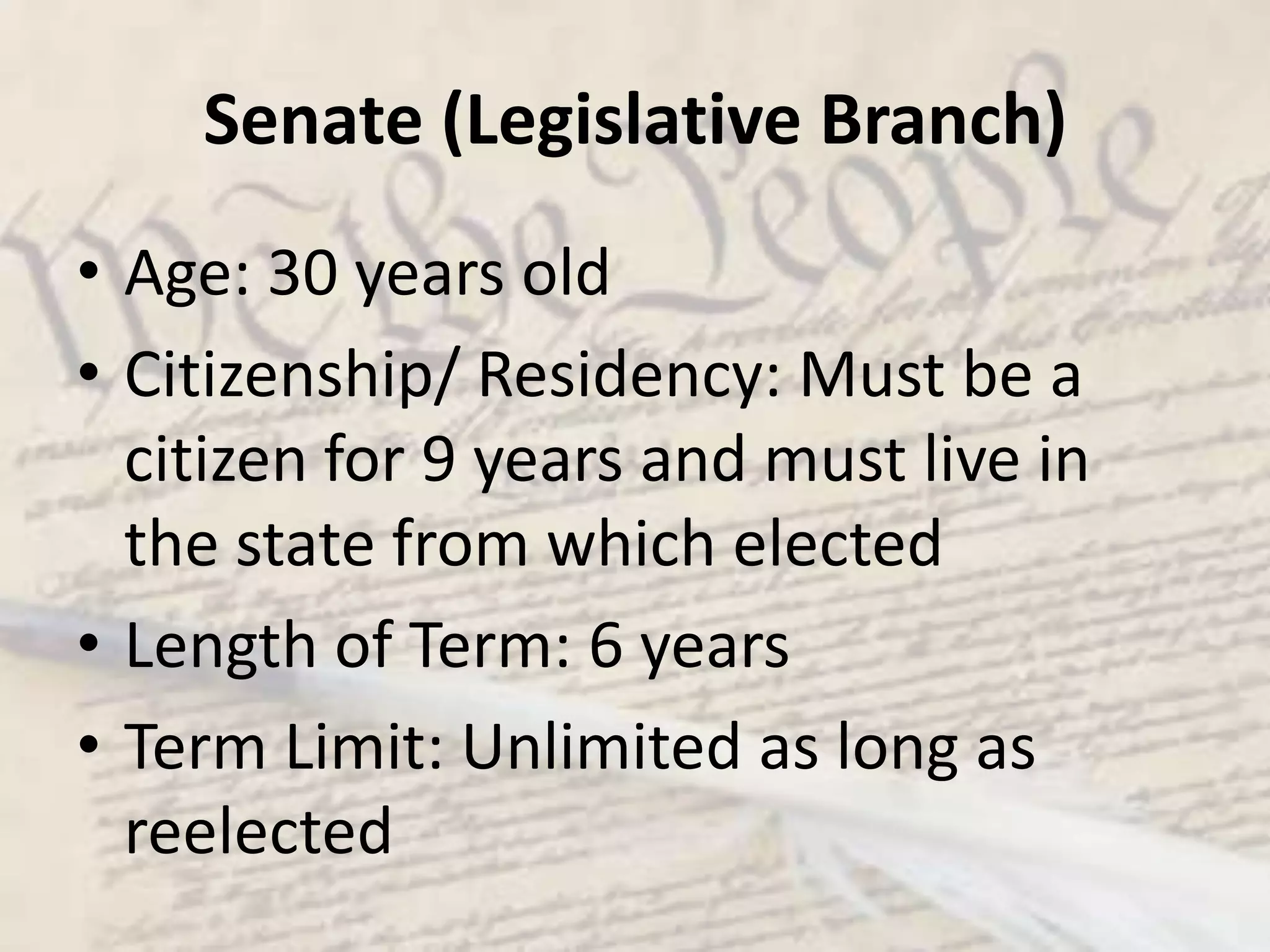
Senate (Legislative Branch)Age: 30 years oldCitizenship/ Residency: Must be a citizen for 9 years and must live in the state from which electedLength of Term: 6 yearsTerm Limit: Unlimited as long as reelected
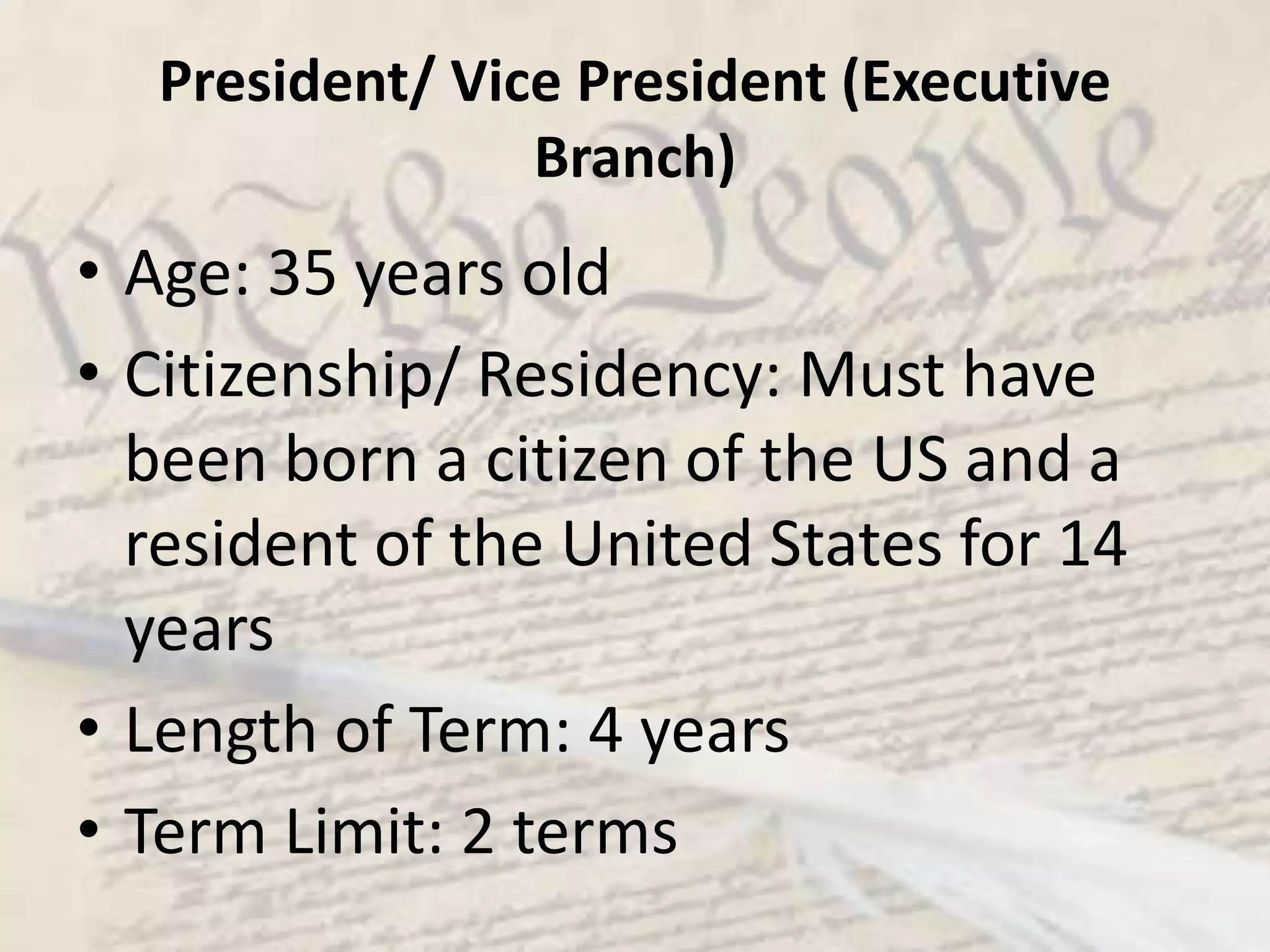
President/ Vice President (Executive Branch)Age: 35 years oldCitizenship/ Residency: Must have been born a citizen of the US and a resident of the United States for 14 yearsLength of Term: 4 yearsTerm Limit: 2 terms
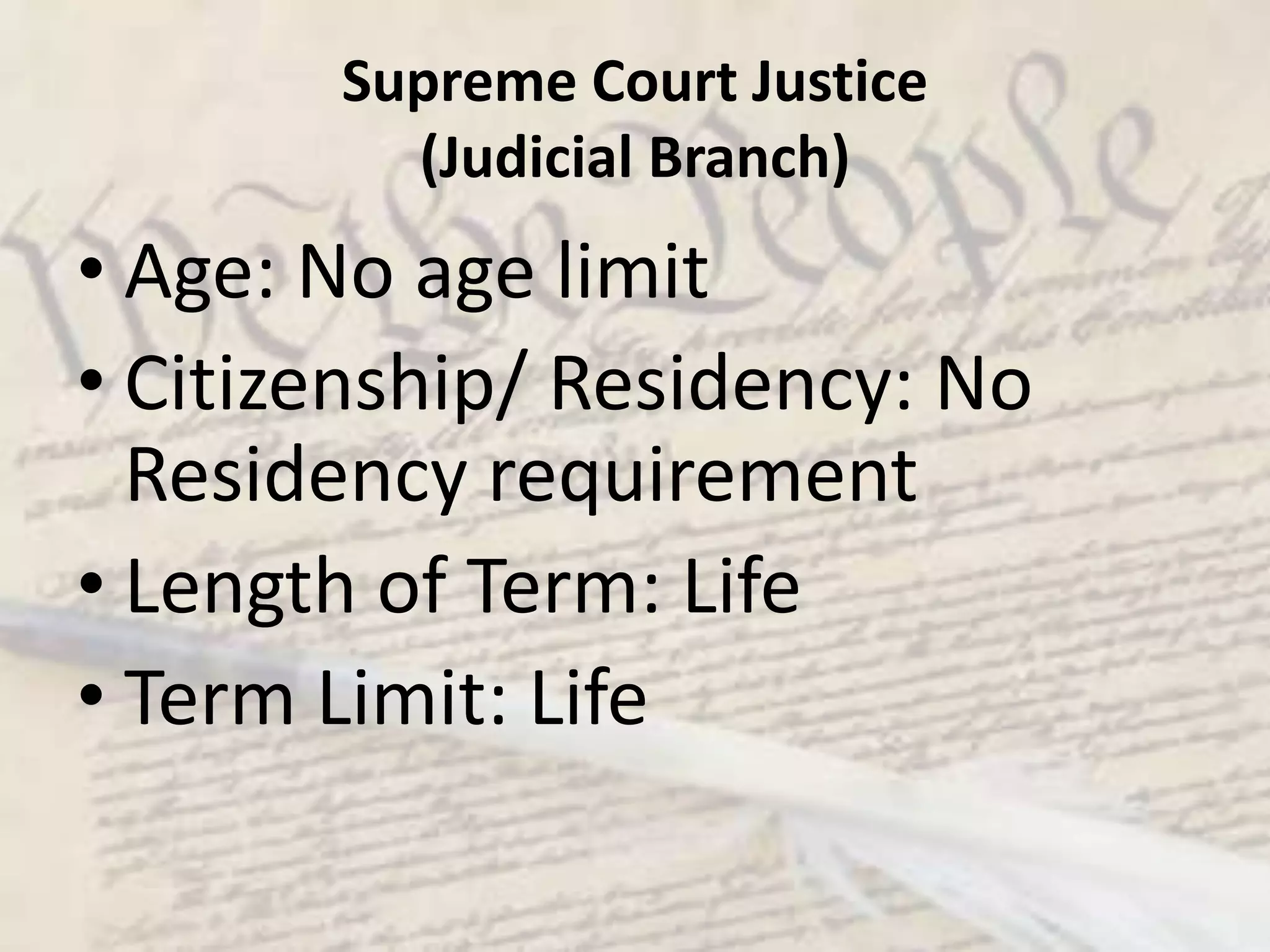
Supreme Court Justice(Judicial Branch)Age: No age limitCitizenship/ Residency: No Residency requirementLength of Term: LifeTerm Limit: Life
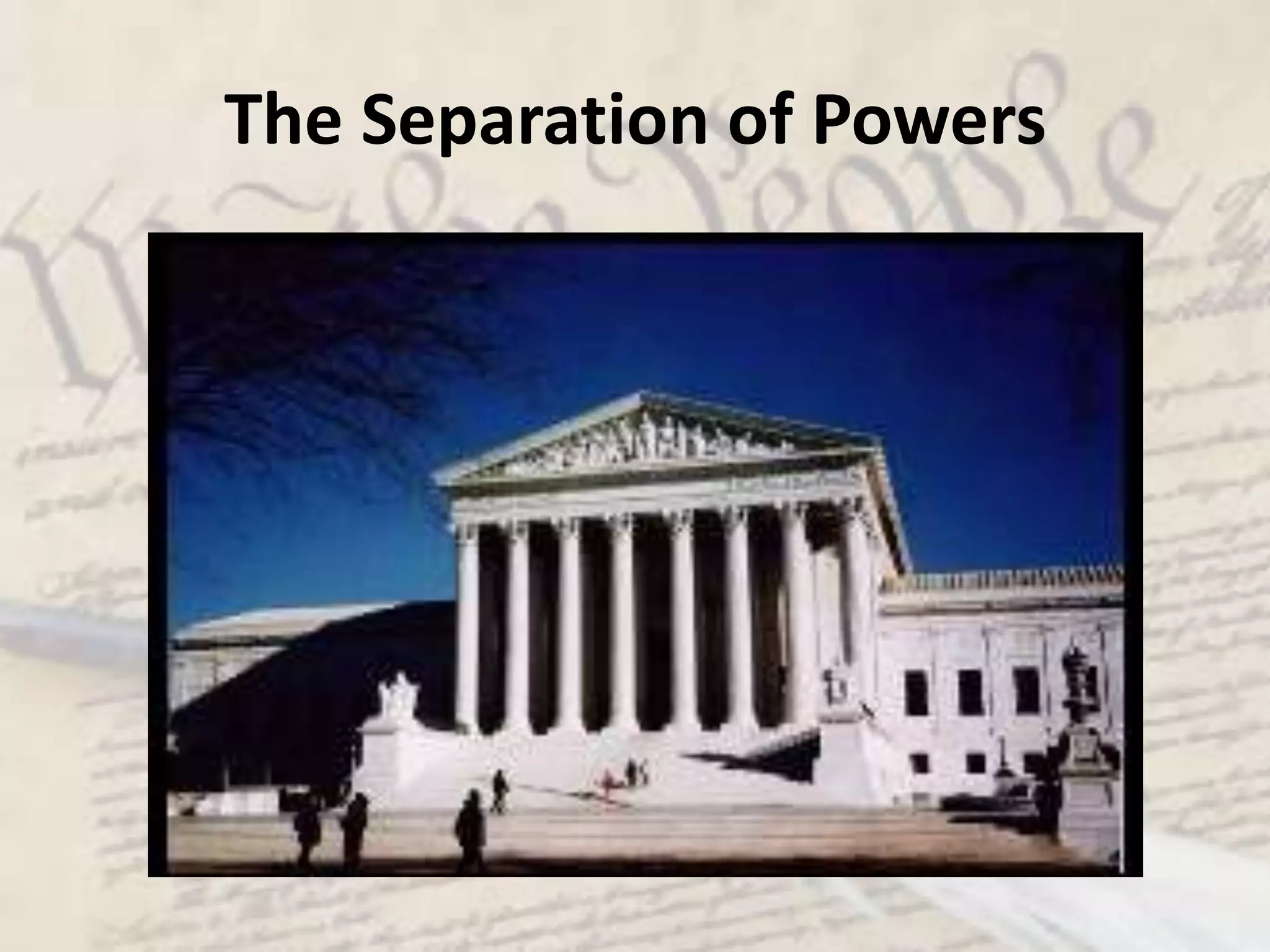
The Separation of Powers
Separation of Powers- Why?The framers of the constitution included the separation of powers  for one primary reason:  to prevent the majority from achieving absolute ruleAs part of this separation of powers, each of the three branches have Checks and Balances” on the authority of the other two branches  the power of each branch is limited or”checked” by the other two so none gain too much power
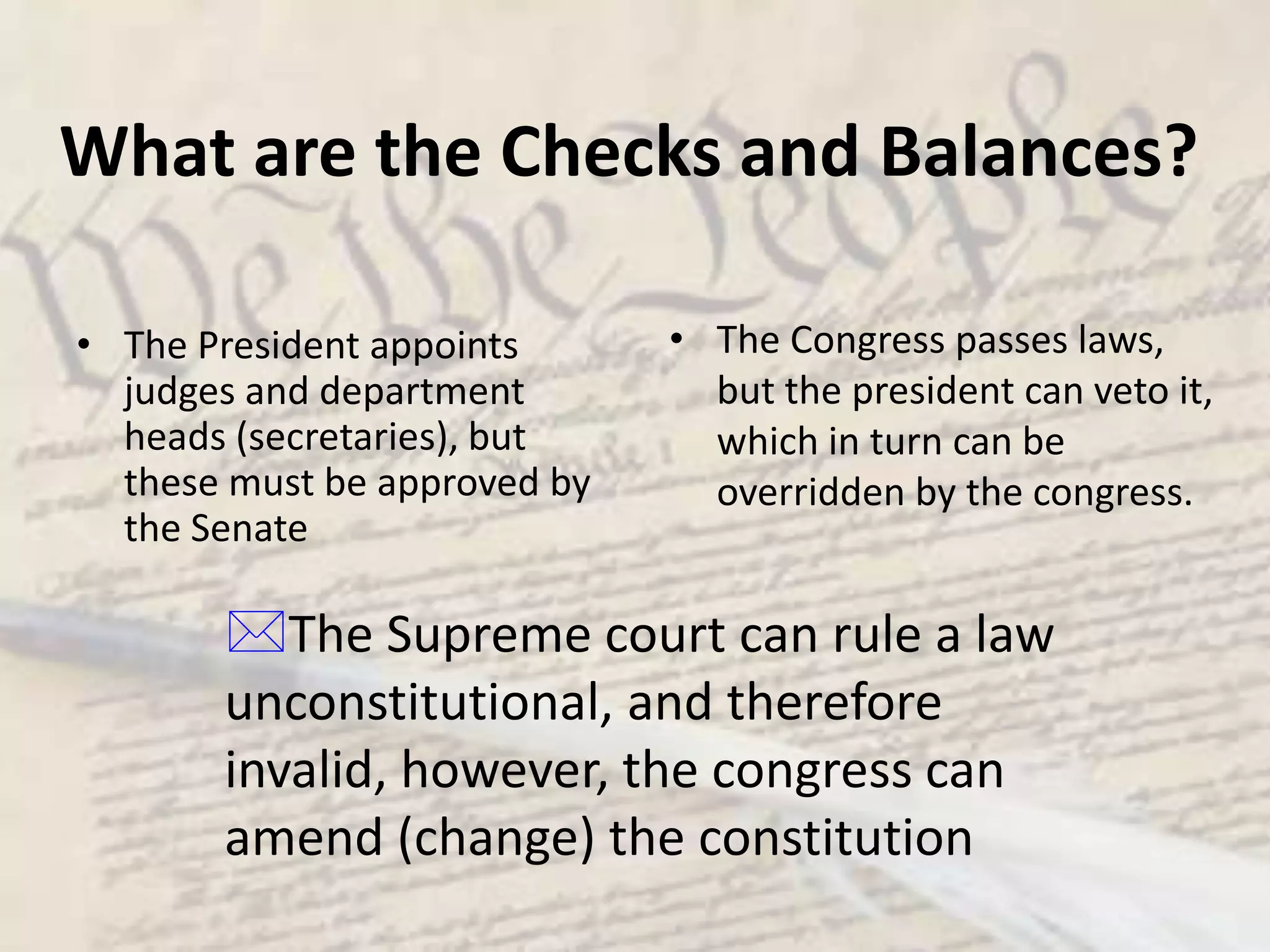
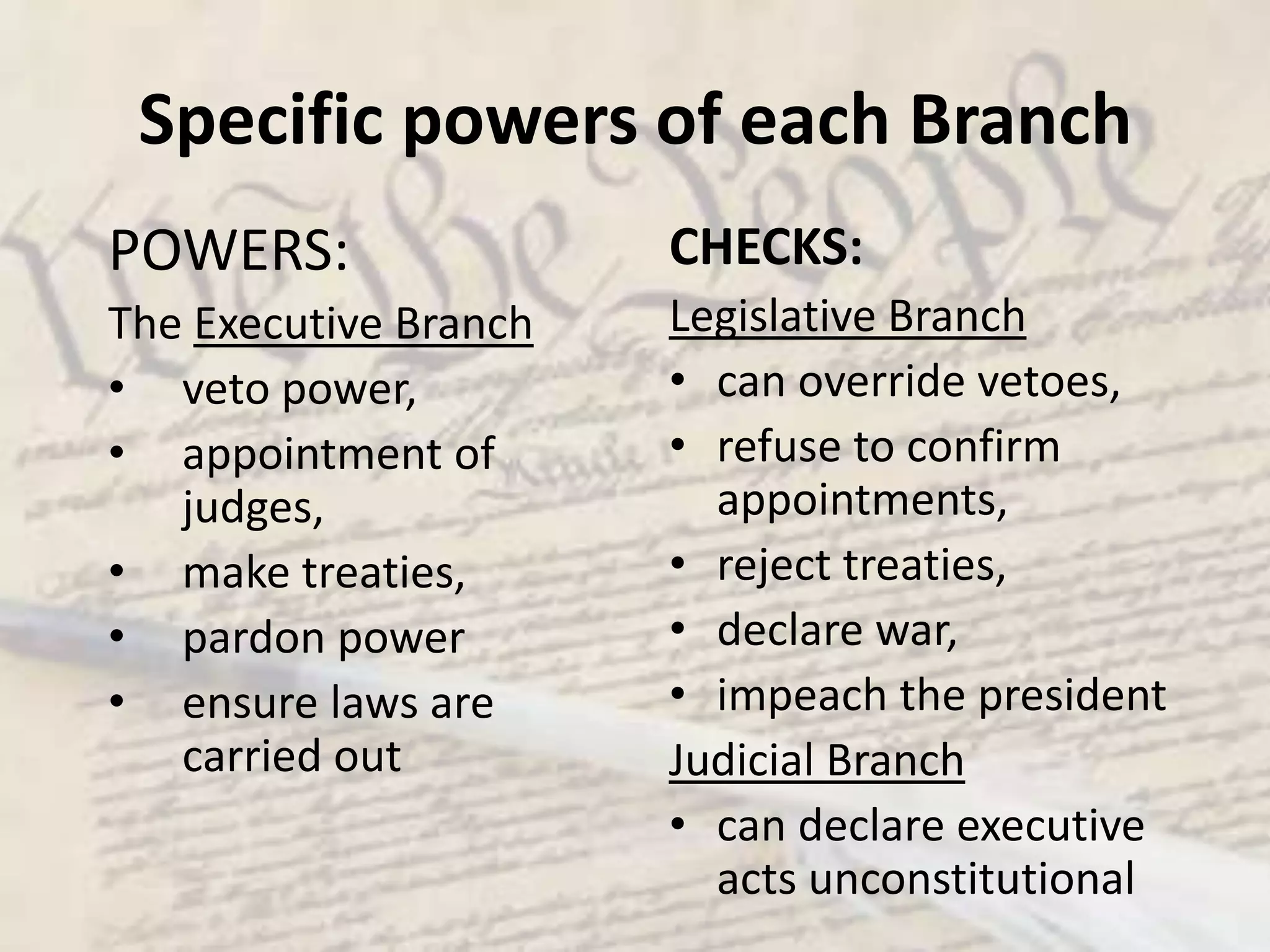
What are the Checks and Balances?The Congress passes laws, but the president can veto it, which in turn can be overridden by the congress. The President appoints judges and department heads (secretaries), but these must be approved by the SenateThe Supreme court can rule a law unconstitutional, and therefore invalid, however, the congress can amend (change) the constitutionSpecific powers of each BranchPOWERS:The Executive Branchveto power, appointment of judges,make treaties, pardon powerensure laws are carried outCHECKS:Legislative Branchcan override vetoes, refuse to confirm appointments, reject treaties, declare war, impeach the president Judicial Branch can declare executive acts unconstitutional
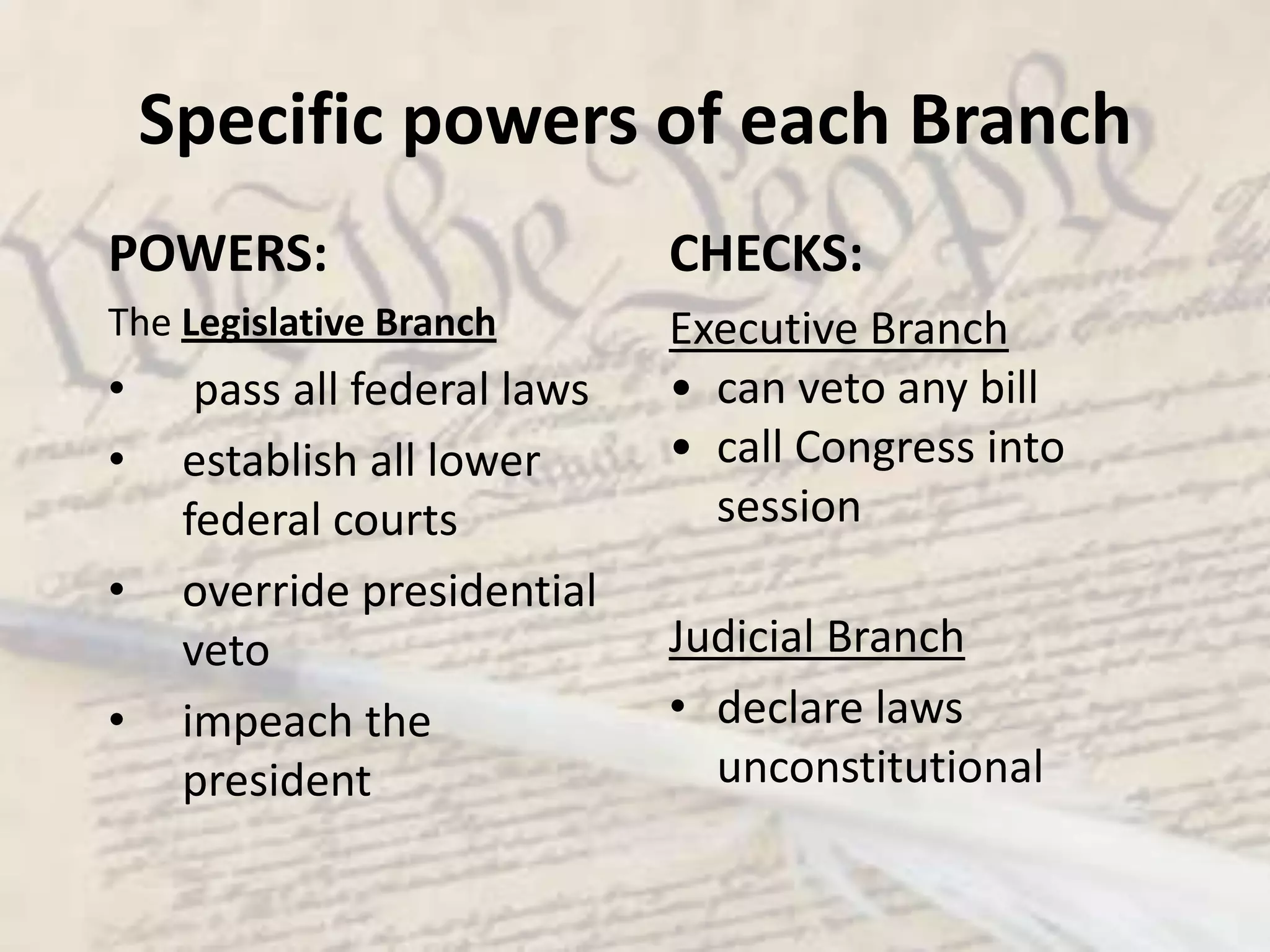
Specific powers of each BranchPOWERS:The Legislative Branch pass all federal lawsestablish all lower federal courtsoverride presidential vetoimpeach the president CHECKS:Executive Branchcan veto any bill
call Congress into sessionJudicial Branchdeclare laws unconstitutional
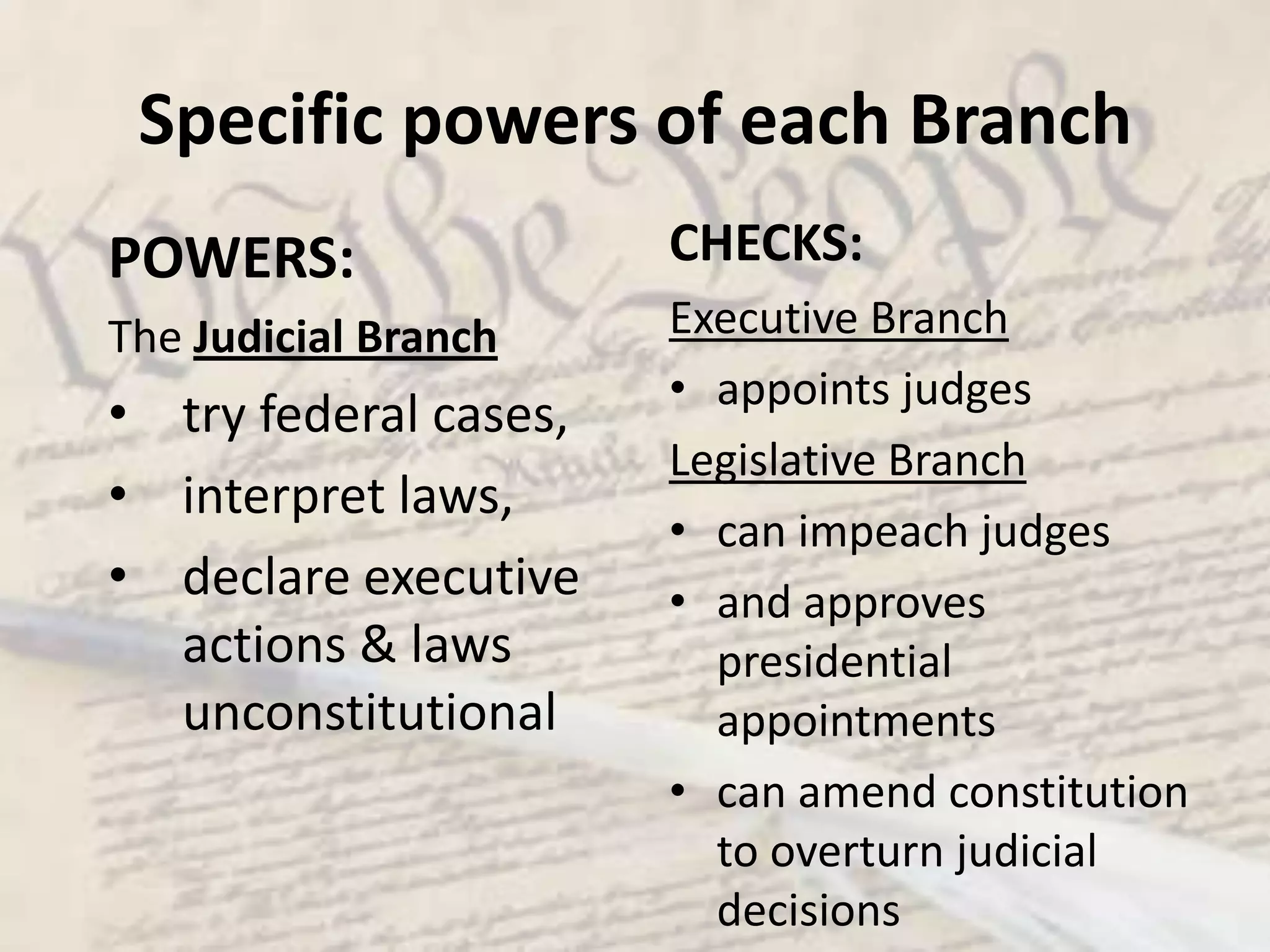
Specific powers of each BranchCHECKS:Executive Branchappoints judgesLegislative Branch can impeach judgesand approves presidential appointmentscan amend constitution to overturn judicial decisionsPOWERS:The Judicial Branchtry federal cases,interpret laws, declare executive actions & laws unconstitutional
Questions for discussionWhich branch is the most powerful ?Is one branch more powerful than the others ?  Explain. Give examplesWhy did the framers believe a separation of powers was so important ?
The System of Federalism Dividing powers of government between a national (federal) government and smaller state governments
Types of PowersExpressed Powers:  Powers actually written in the Constitutionex:  “Congress shall have the power…to raise and support Armies”Implied Powers:  Powers not actually listed in the Constitution, but are assumedex:  Congress draft citizens into the army
Elastic clausea.k.a. “necessary and proper clause”“Congress has the power to make all Laws which shall be necessary and proper for carrying into Execution the…powers vested by the Constitution.”Allows Congress to expand its powers when needed.EX:  Constitution says- “power to…repel invasions” but Congress has allowed wiretapping of suspected terrorists without warrants.
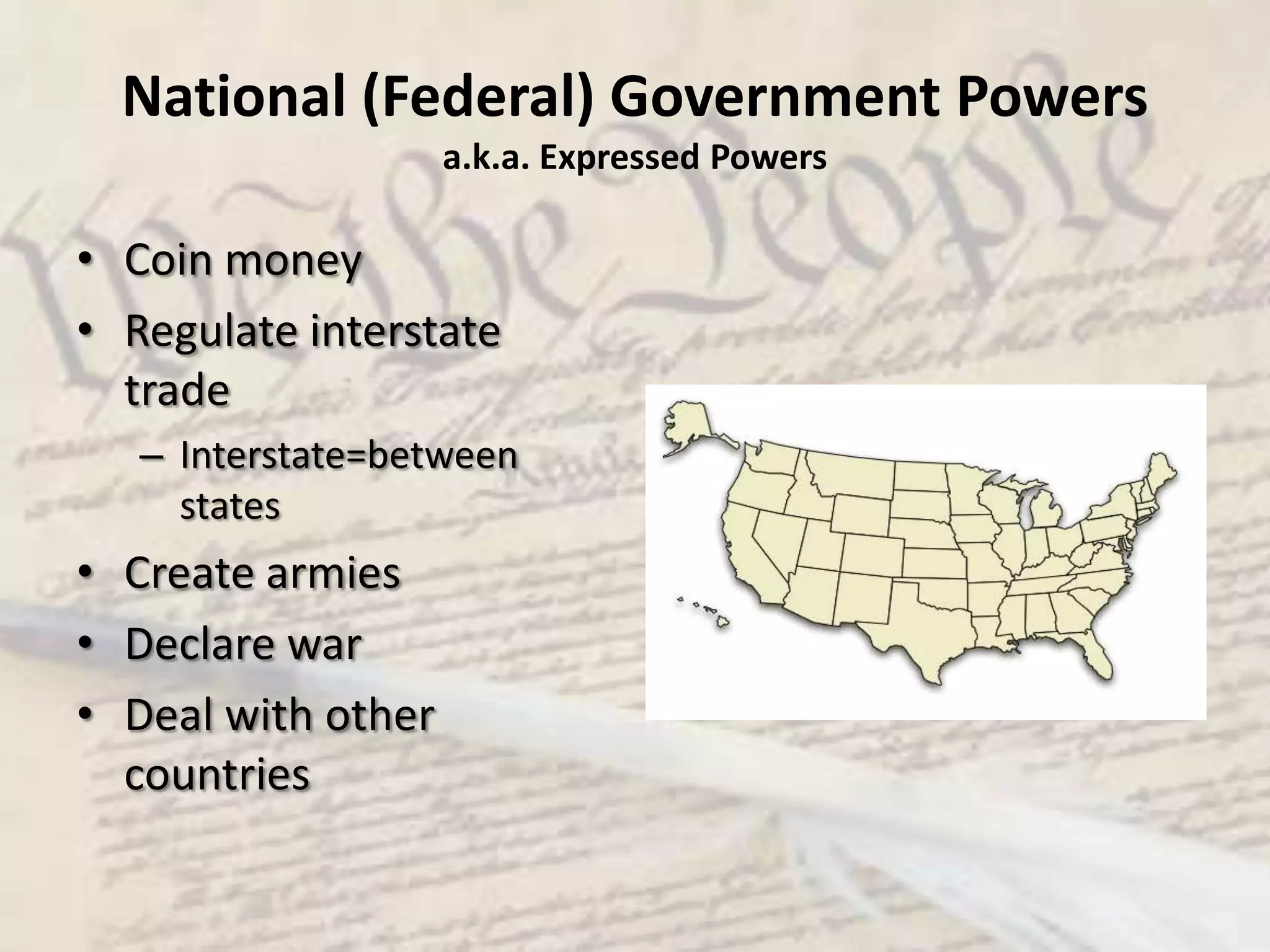
National (Federal) Government Powersa.k.a. Expressed PowersCoin moneyRegulate interstate tradeInterstate=between statesCreate armiesDeclare warDeal with other countries
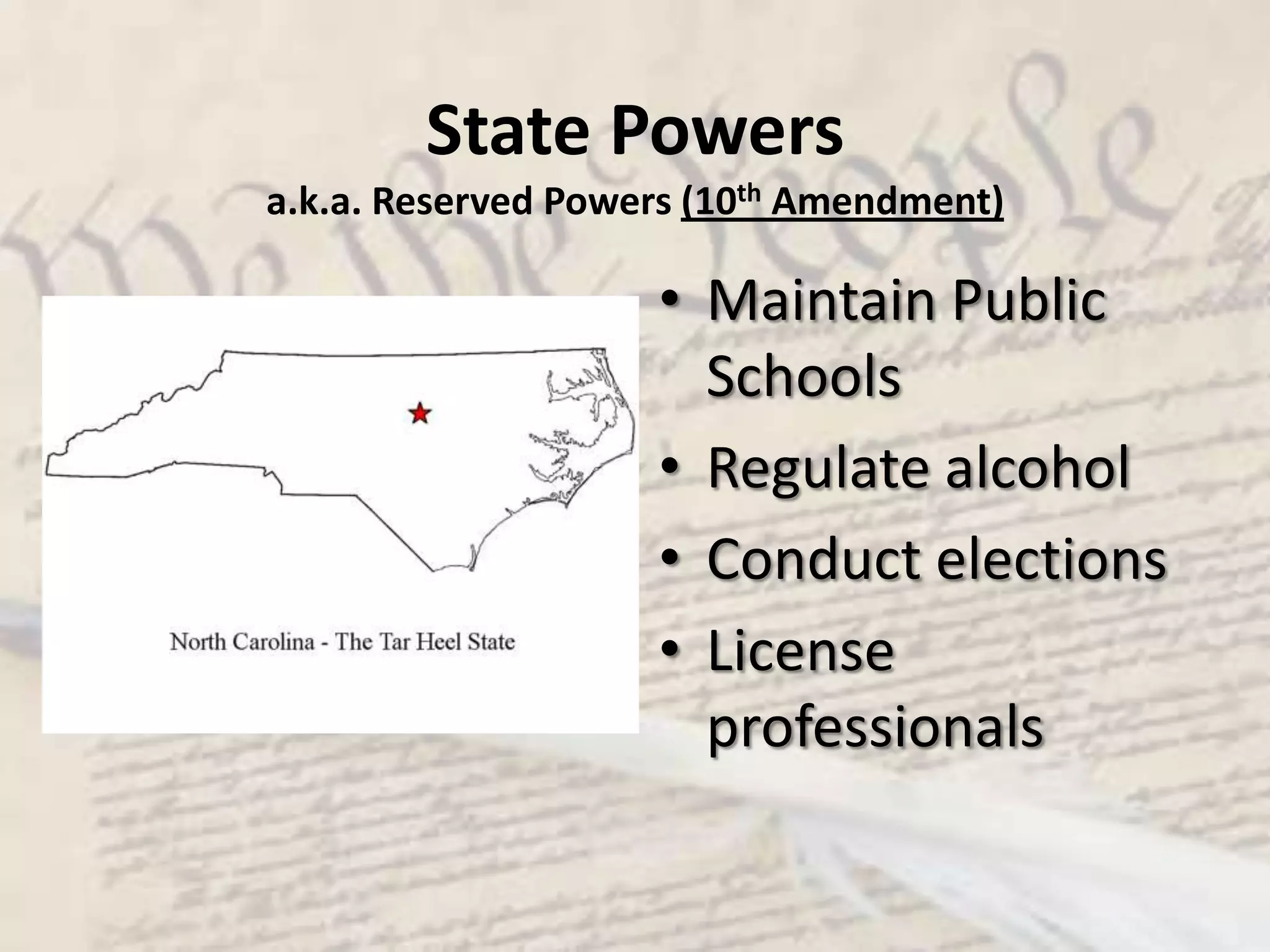
State Powersa.k.a. Reserved Powers (10th Amendment)Maintain Public SchoolsRegulate alcoholConduct electionsLicense professionals
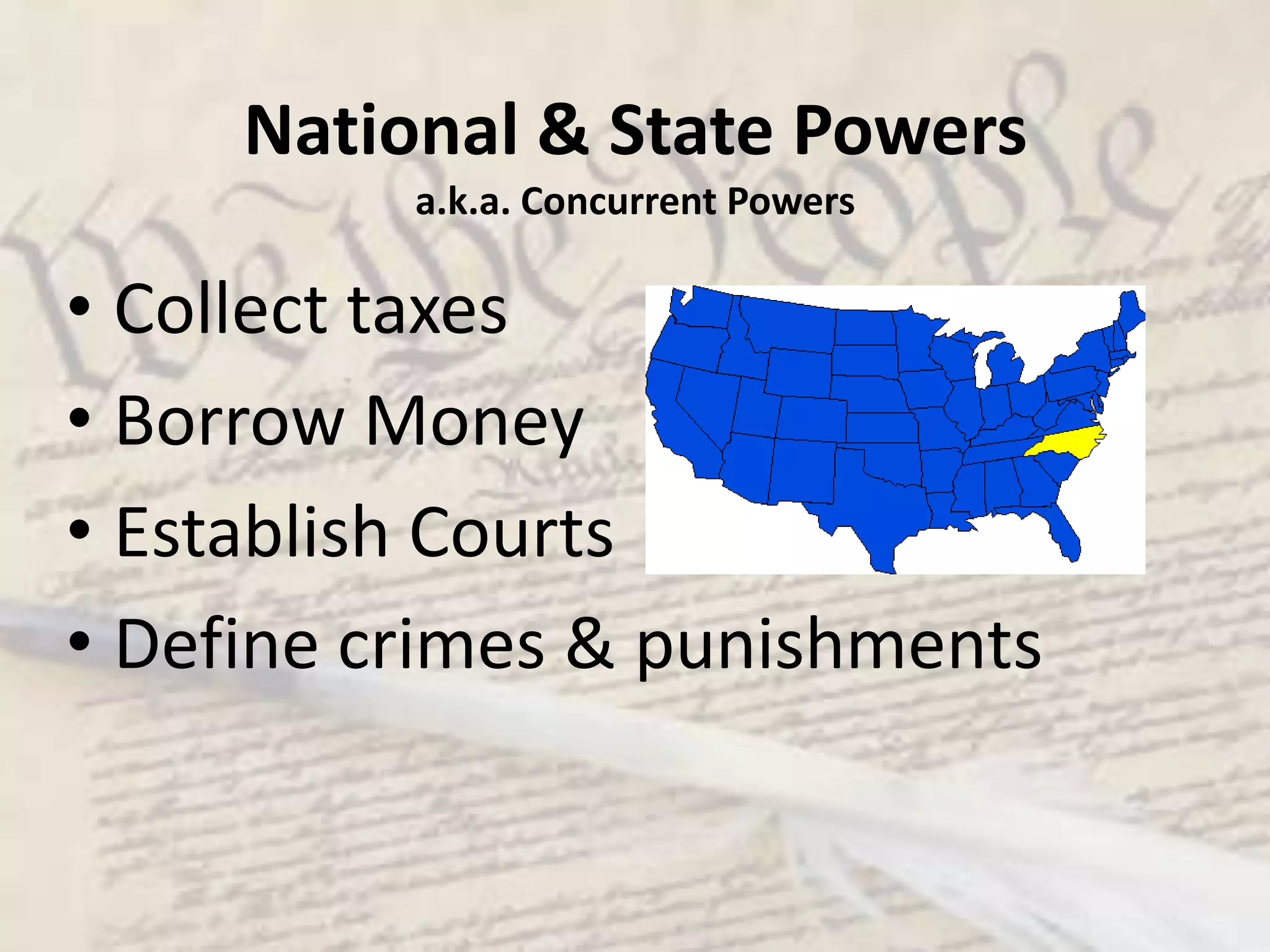
National & State Powersa.k.a. Concurrent PowersCollect taxesBorrow MoneyEstablish CourtsDefine crimes & punishments
Supremacy ClauseWhat does the Supremacy Clause state about the relationship between the federal and state governments?The Federal law (US Constitution) is above all state lawsStates cannot make laws that conflict with US laws.
36
37PigeonholeStep #2 & #5When a committee or sub-committee puts a Bill aside until it is forgotten about (dies)
38FilibusterStep #6When a senator tries to prevent a vote by talking as long as possible during the debate
39ClotureStep #6When 60 Senators vote to stop (clot) a filibuster
40Conference CommitteeStep #7When members of the HoR and Senate compromise on differences in a Bill before it goes to the President.
41VetoStep #8When the President rejects a Bill
42Pocket VetoStep #8When the President puts a Bill aside for 10 days and it does not become a law
43Override VetoStep #9If President Vetoes or Pocket Vetoes a Bill, The Senate and HoR can override the President if 2/3 of each house agrees.
44The 9 steps of how a Bill becomes a LawStep #1Bill introduced into the HoRStep #2Bill goes to committee & subcommitteeStep #3Debate and voted on in the HoR
45The 9 steps of how a Bill becomes a LawStep #4Bill introduced into the SenateStep #5Bill goes to committeeStep #6Debate and voted on in the Senate
46The 9 steps of how a Bill becomes a LawStep #7Conference CommitteeStep #8Presidential ActionSignVetoPocket VetoStep #9Override Veto
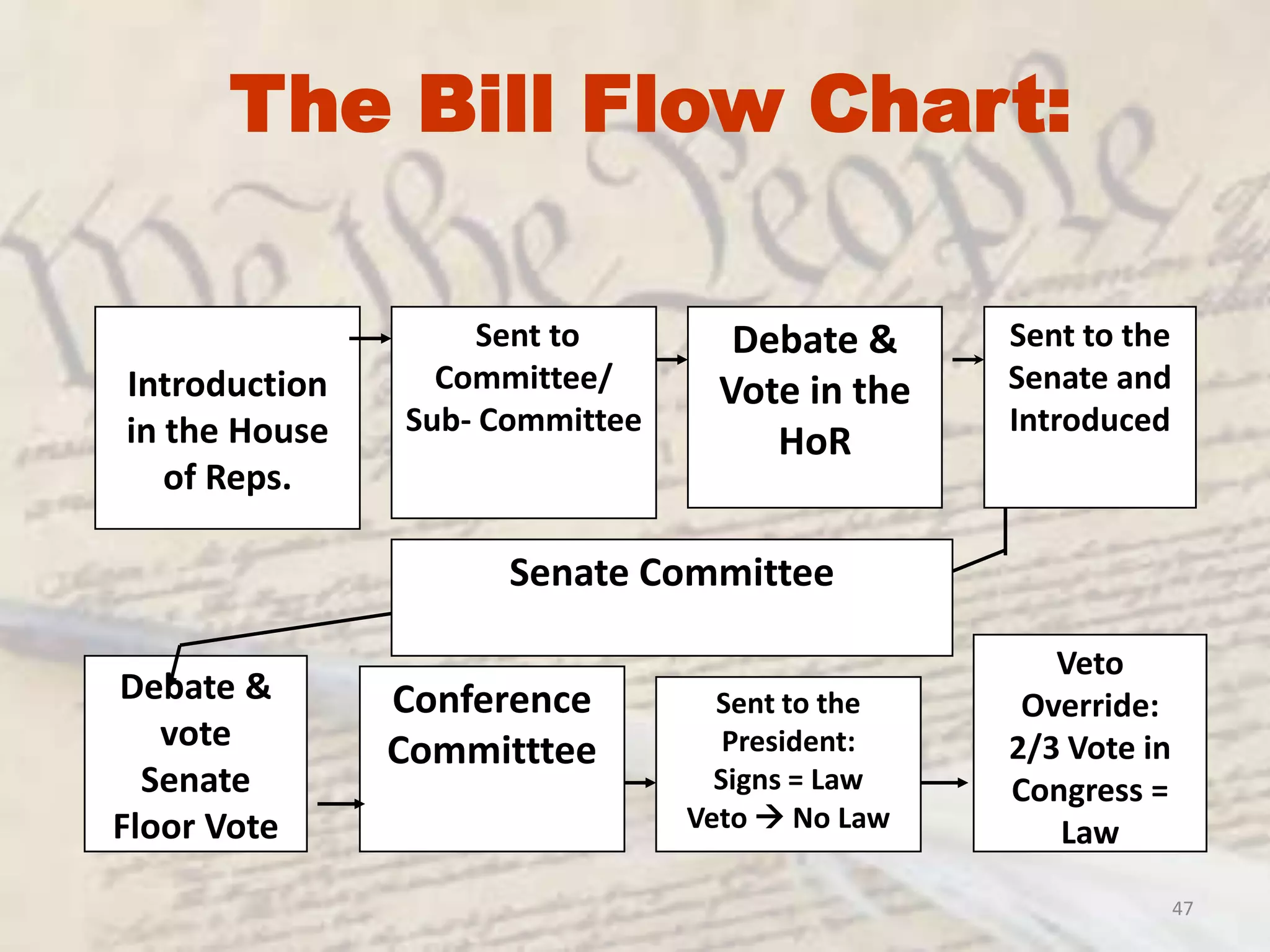
47The Bill Flow Chart:Introduction in the House of Reps. Sent to Committee/ Sub- CommitteeDebate & Vote in the HoRSent to the Senate and IntroducedSenate CommitteeVeto Override:2/3 Vote in Congress = LawDebate & vote Senate Floor VoteConference CommittteeSent to the President:Signs = LawVeto  No Law
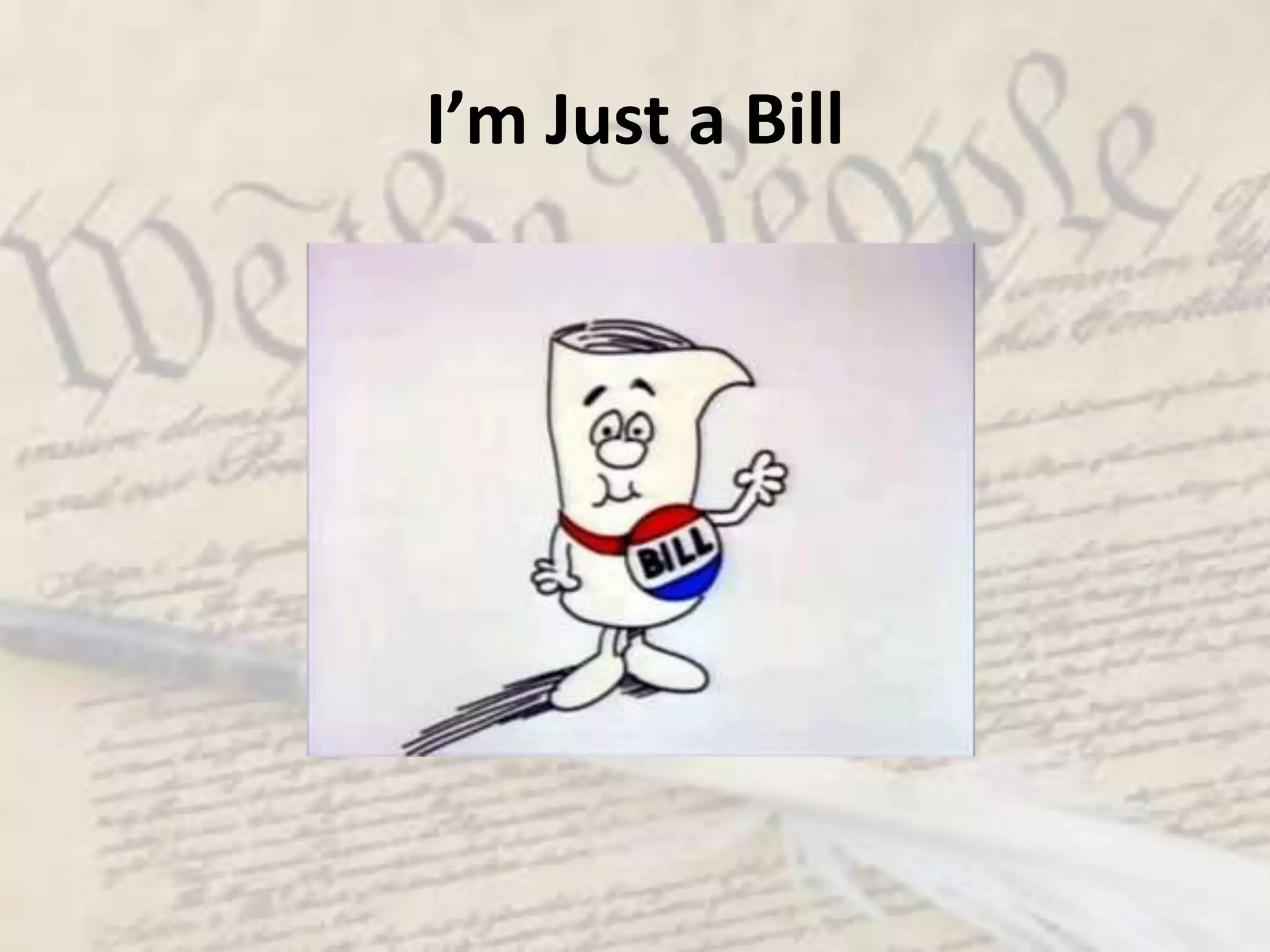
I’m Just a Bill
The Constitution and the Amendment Process (Article V)
Marbury vs. MadisonWhat is the lasting impact??The judicial branch has a duty to uphold the Constitution.  Thus, it must be able to determine when a law conflicts with the Constitution and to nullify unconstitutional laws (Judicial Review)
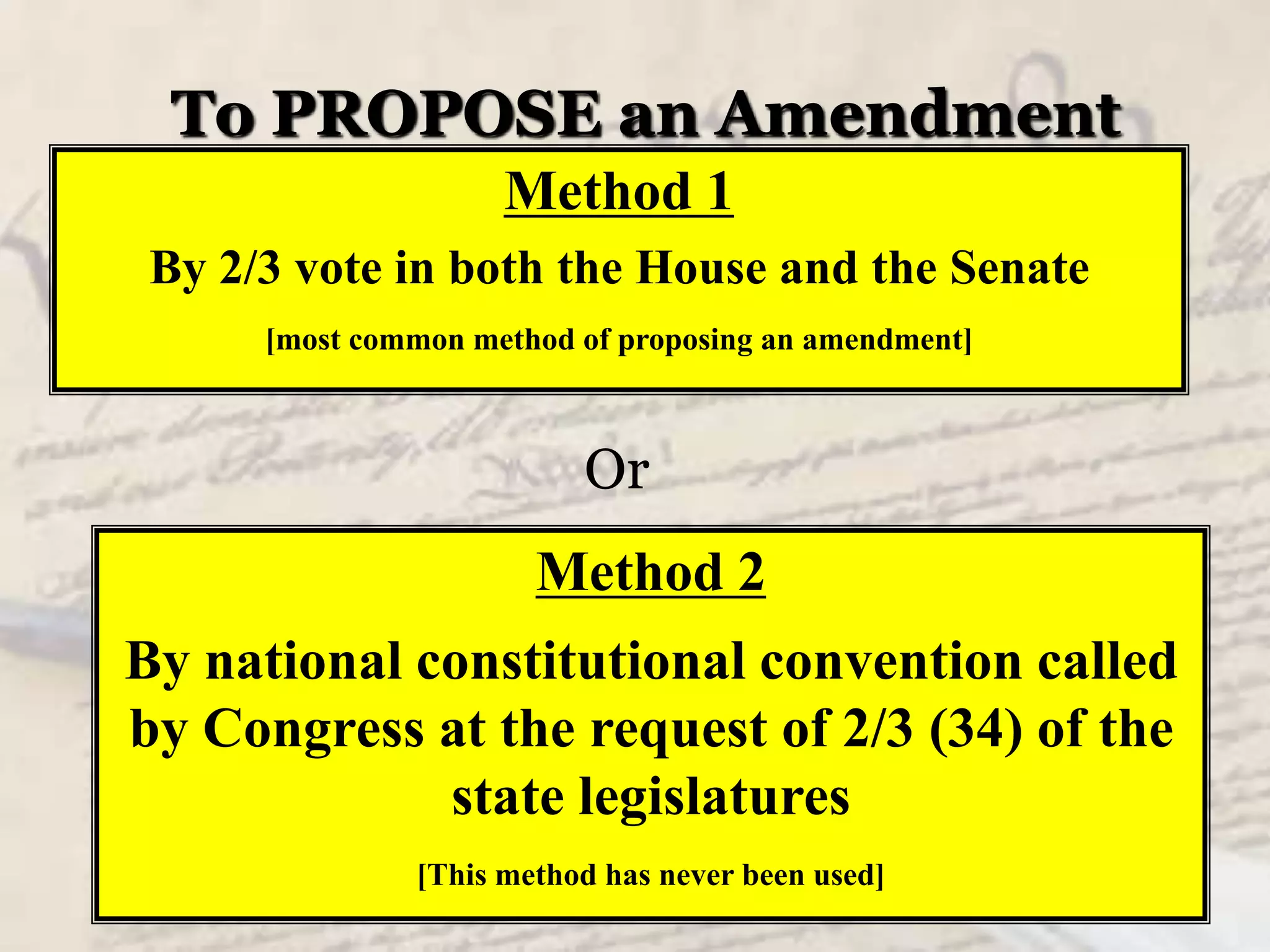
To PROPOSE an AmendmentMethod 1By 2/3 vote in both the House and the Senate[most common method of proposing an amendment]OrMethod 2By national constitutional convention called by Congress at the request of 2/3 (34) of the state legislatures[This method has never been used]
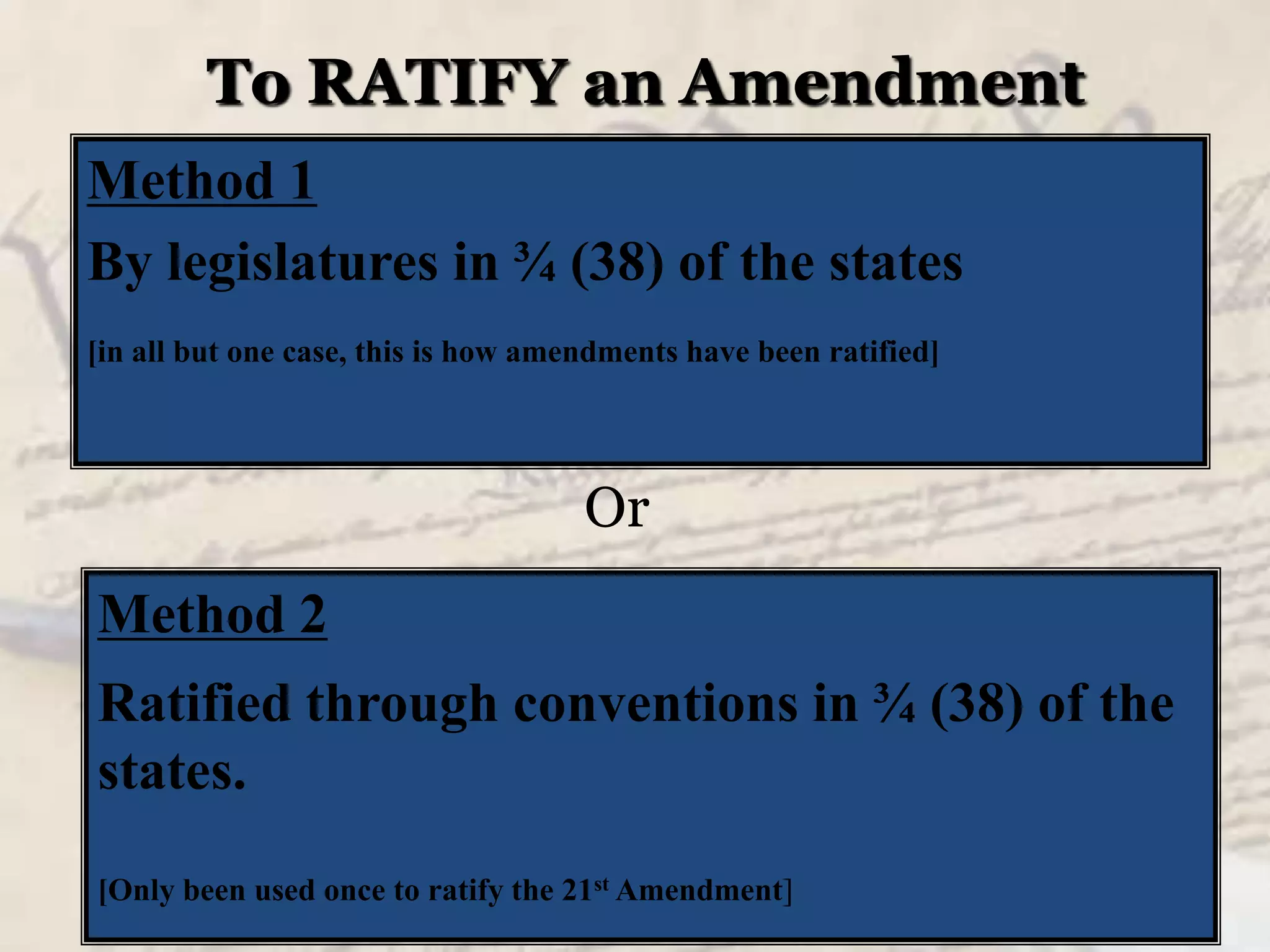
To RATIFY an AmendmentMethod 1By legislatures in ¾ (38) of the states[in all but one case, this is how amendments have been ratified]OrMethod 2Ratified through conventions in ¾ (38) of the states. [Only been used once to ratify the 21st Amendment]
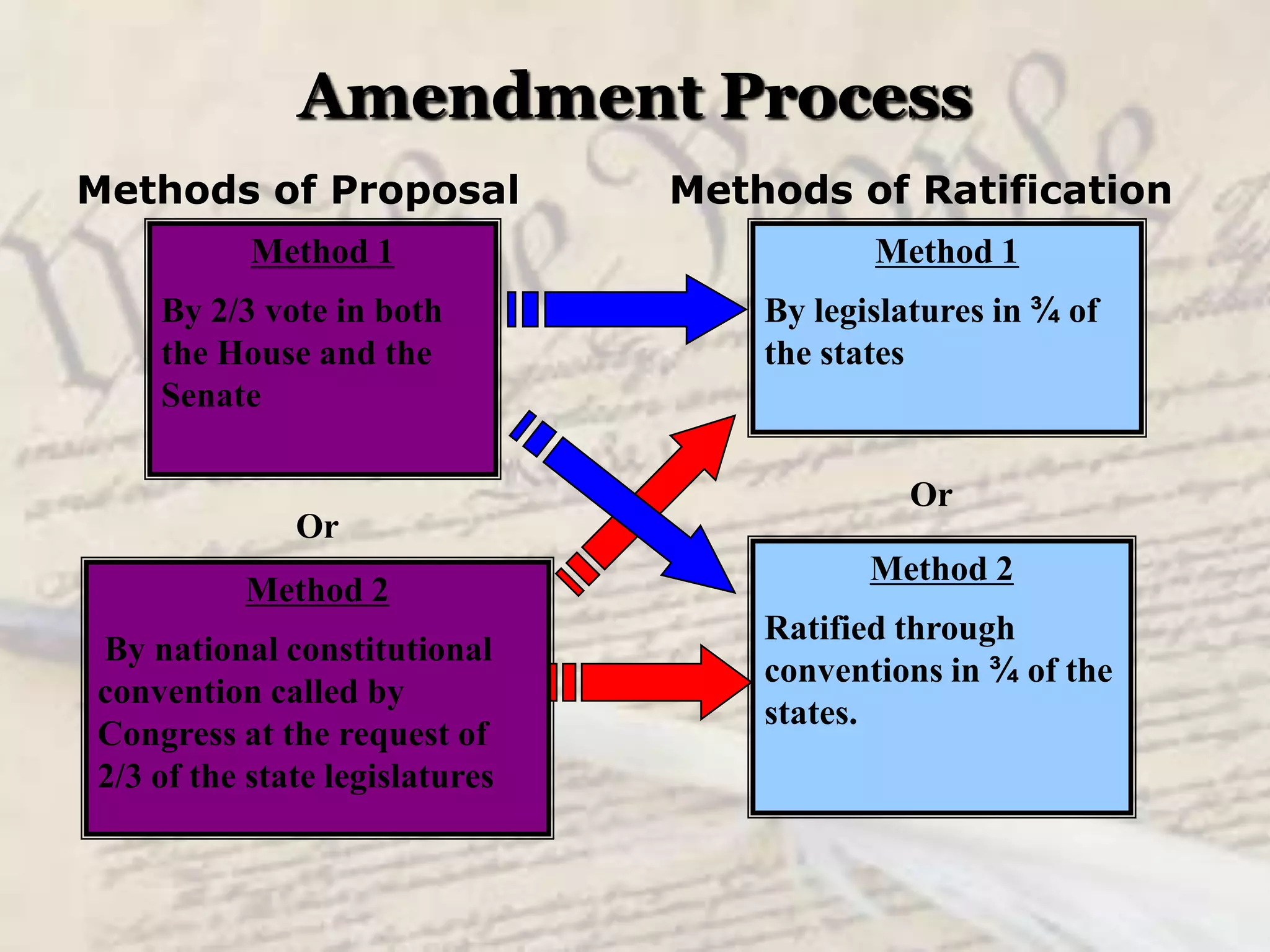
Amendment ProcessMethods of ProposalMethods of RatificationMethod 1By 2/3 vote in both the House and the SenateMethod 1By legislatures in ¾ of the statesOrOrMethod 2Ratified through conventions in ¾ of the states. Method 2By national constitutional convention called by Congress at the request of 2/3 of the state legislatures
13TH Amendment (1865)Ended slavery in the United States
14TH Amendment (1868)Equal protection under the lawBoth national and state gov’ts must  guarantee everyone their civil libertiesDefined citizenship
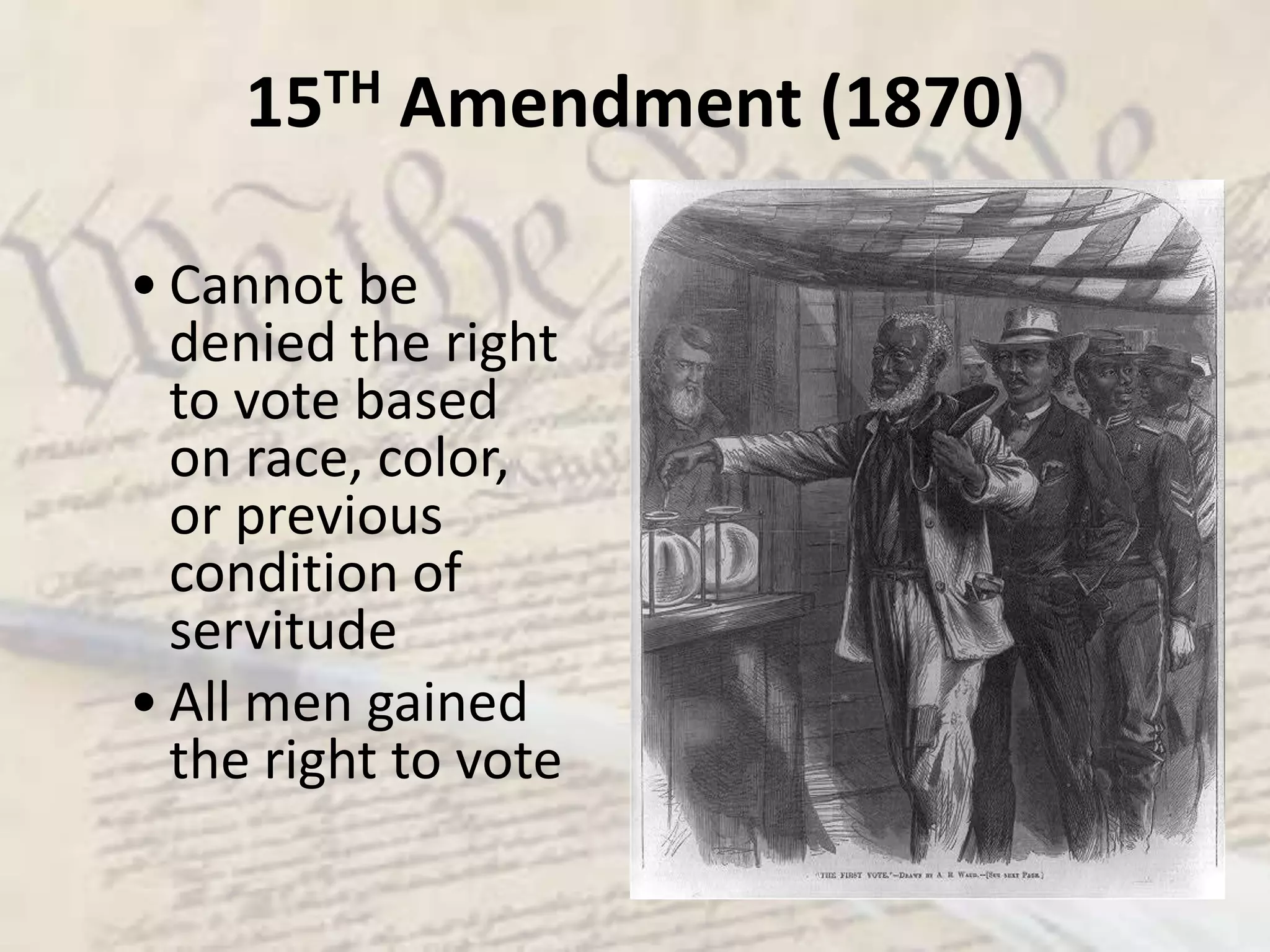
15TH Amendment (1870)Cannot be denied the right to vote based on race, color, or previous condition of servitude
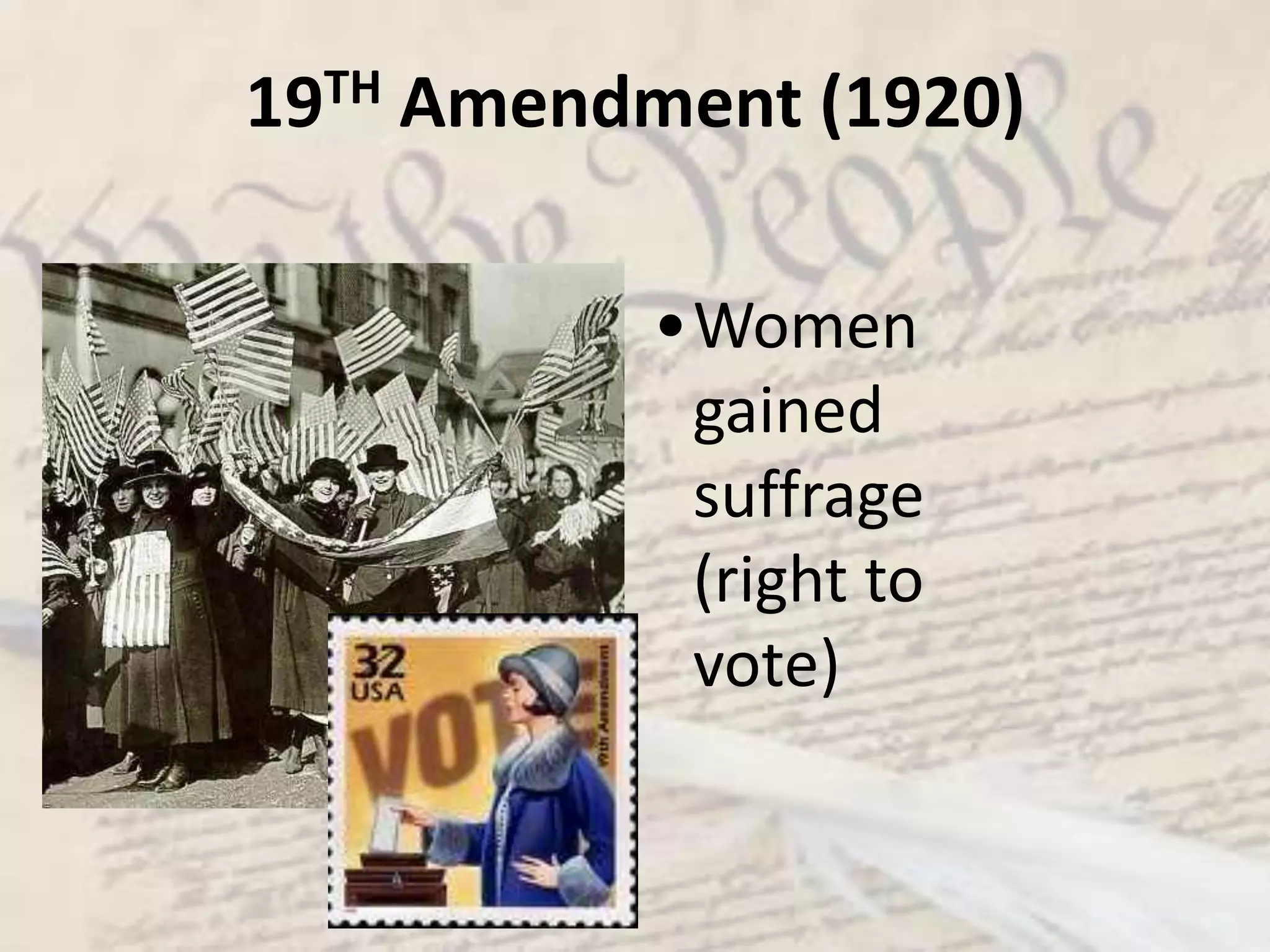
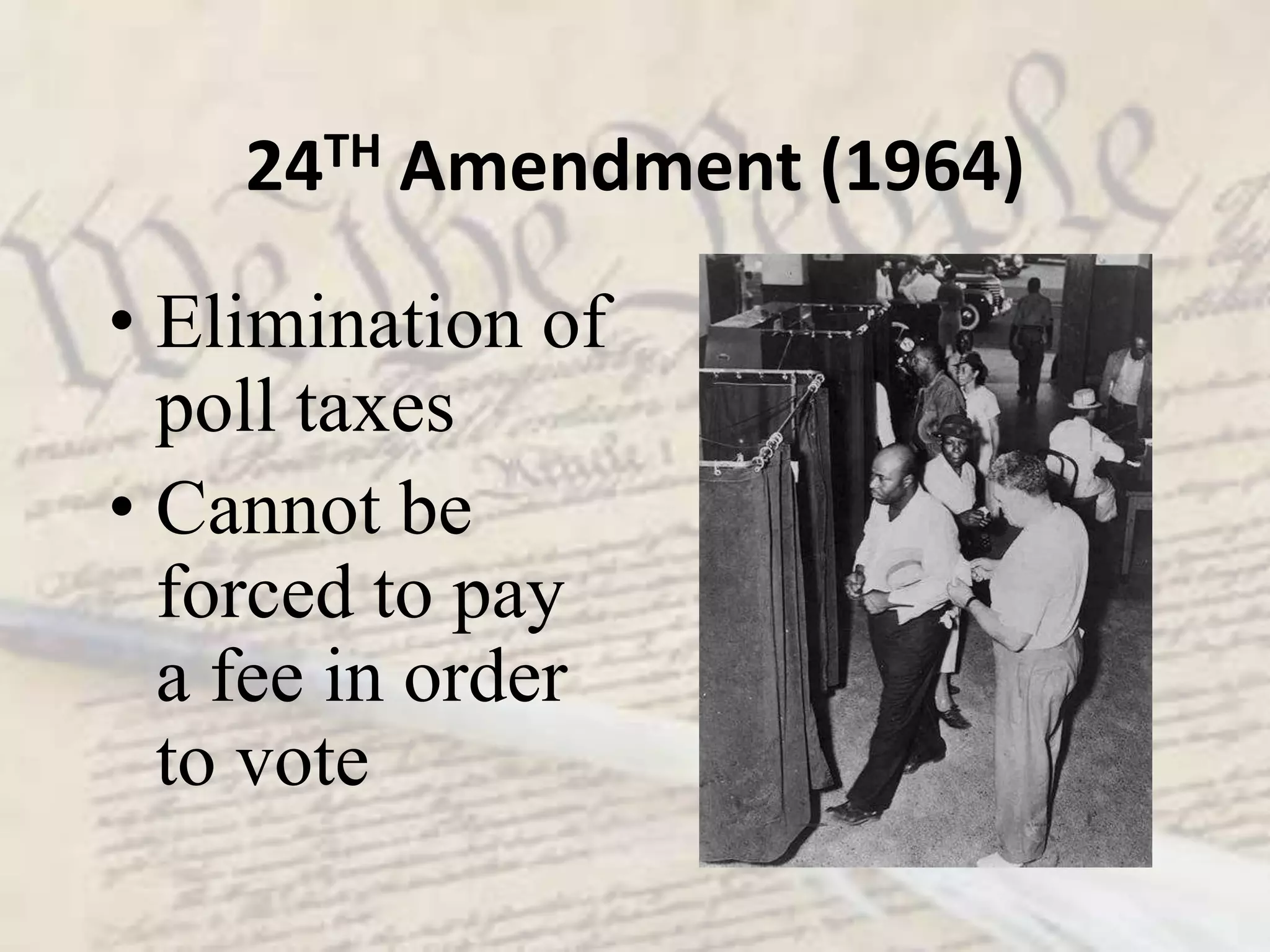
All men gained the right to vote19TH Amendment (1920)Women gained suffrage (right to vote)24TH Amendment (1964)Elimination of poll taxesCannot be forced to pay a fee in order to vote
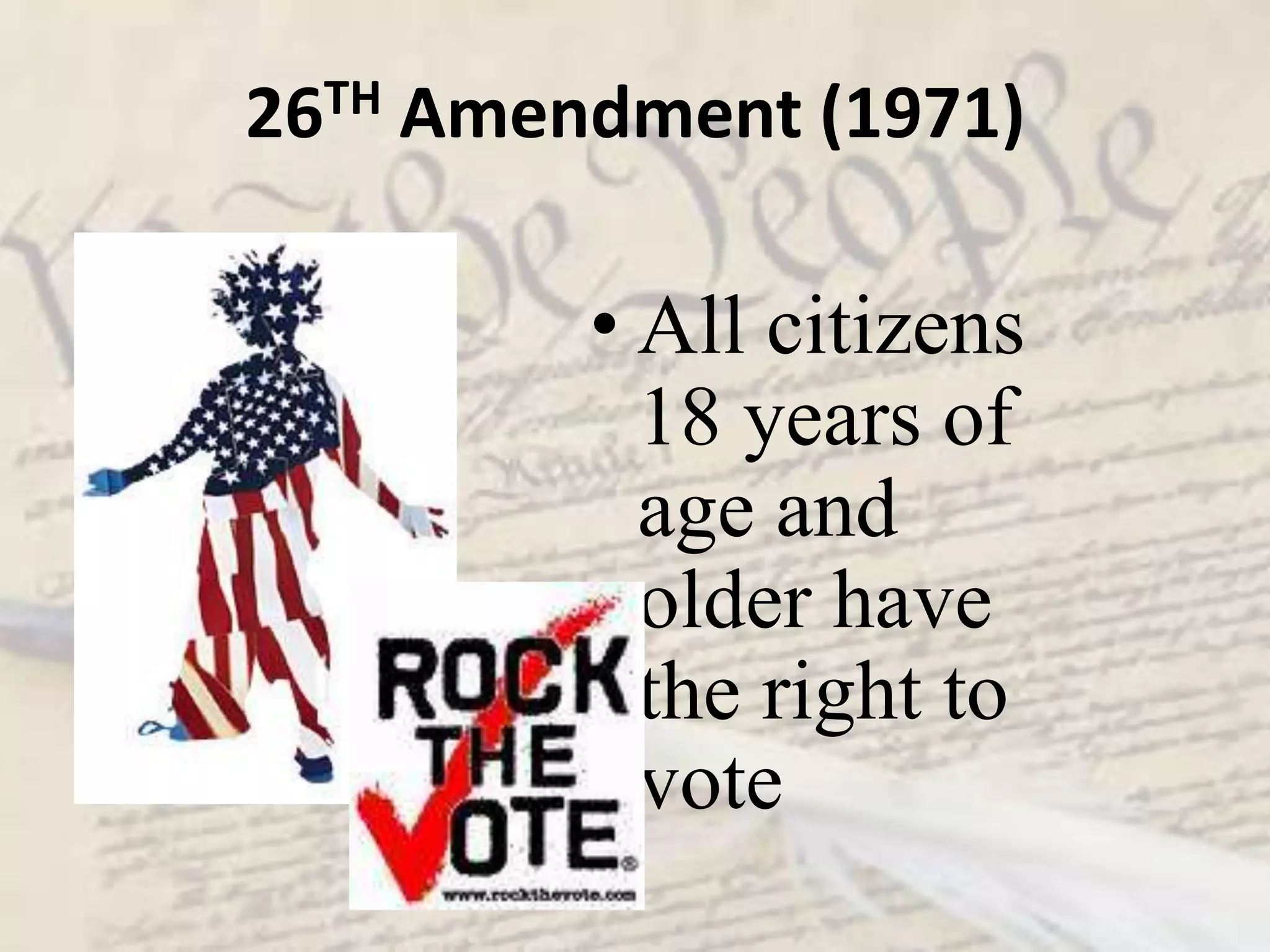
26TH Amendment (1971)All citizens 18 years of age and older have the right to vote
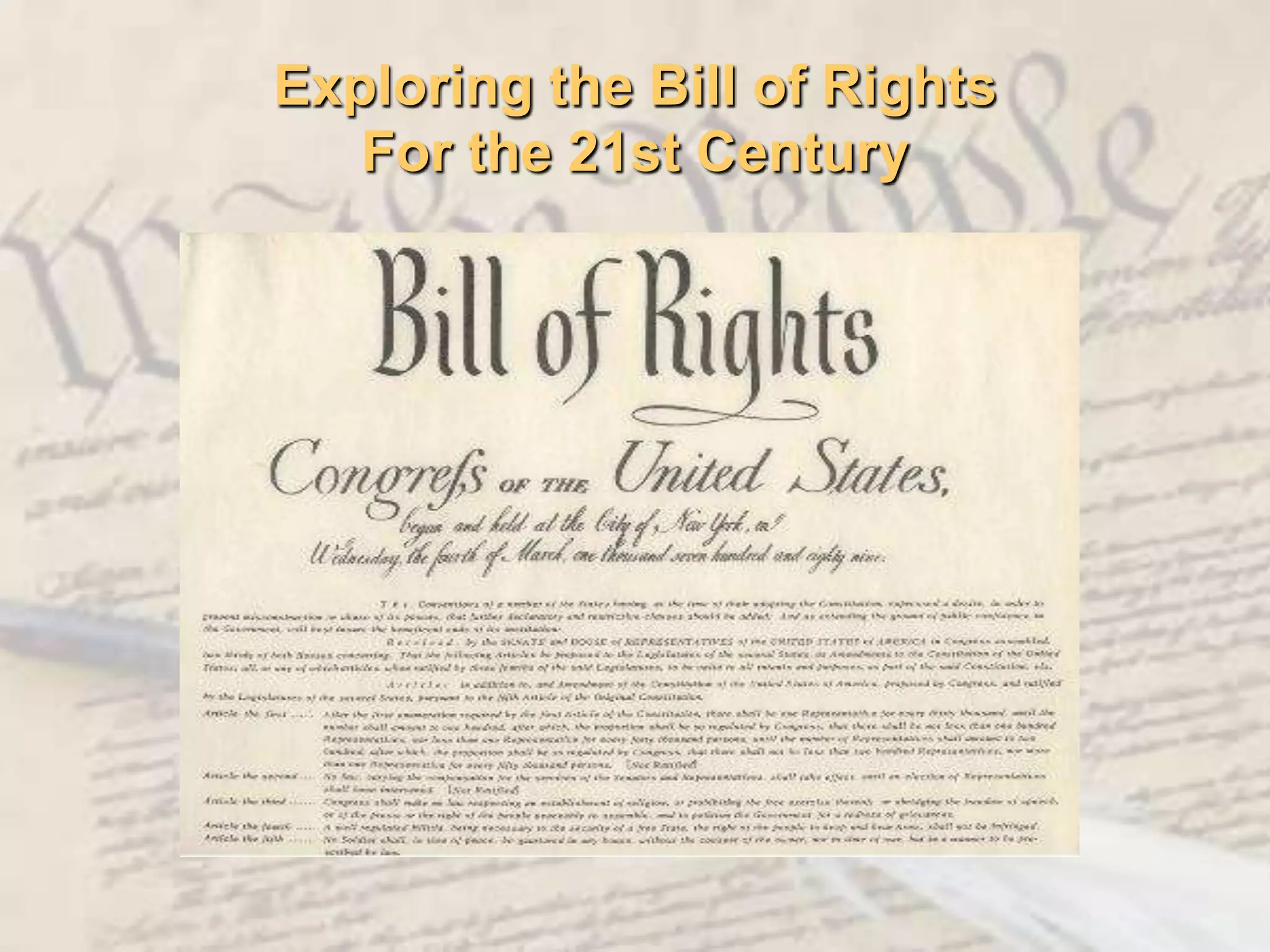
Exploring the Bill of RightsFor the 21st Century
The First  AmendmentFive Essential Freedoms and Rights
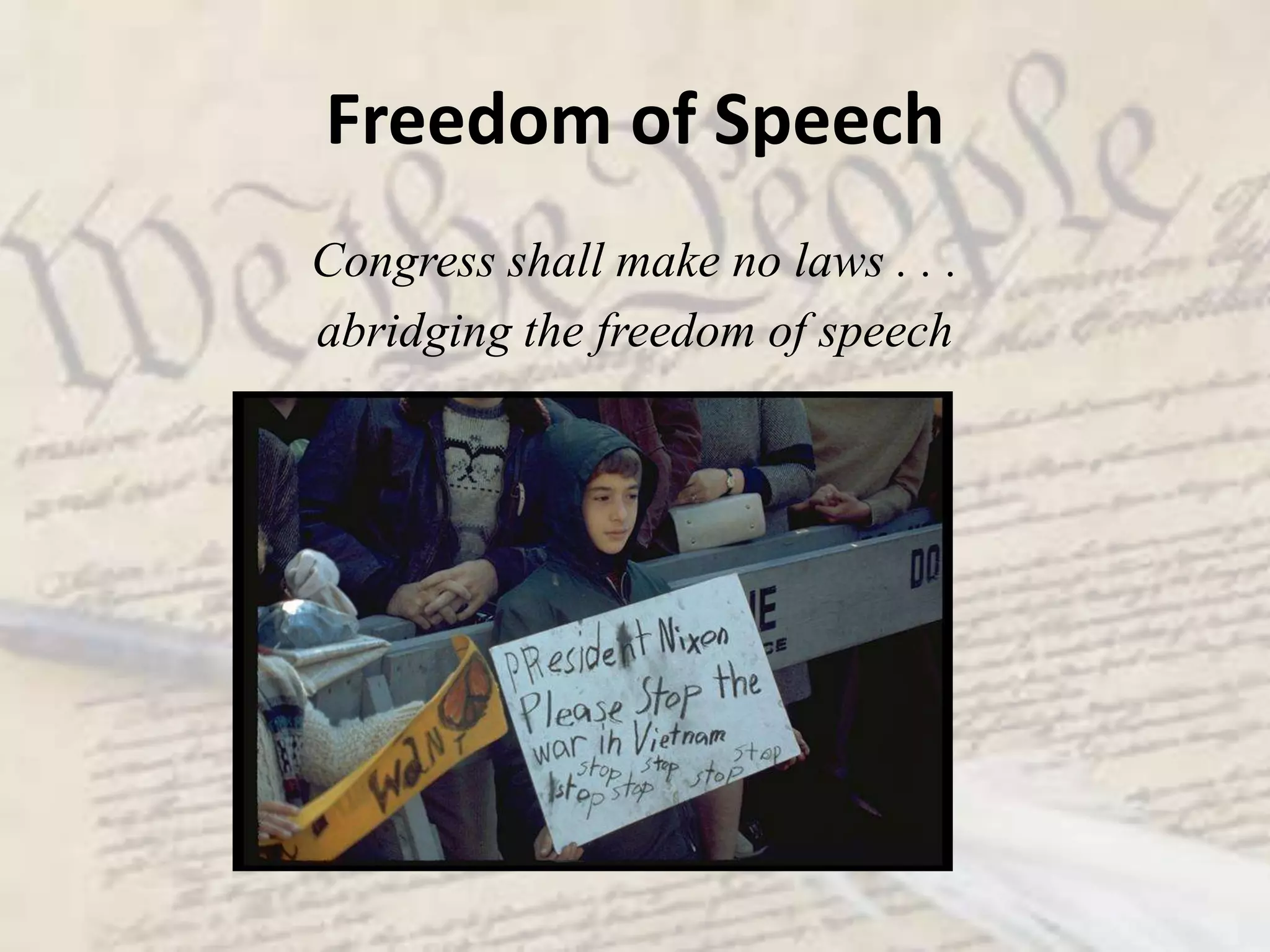
Freedom of SpeechCongress shall make no laws . . .  abridging the freedom of speech
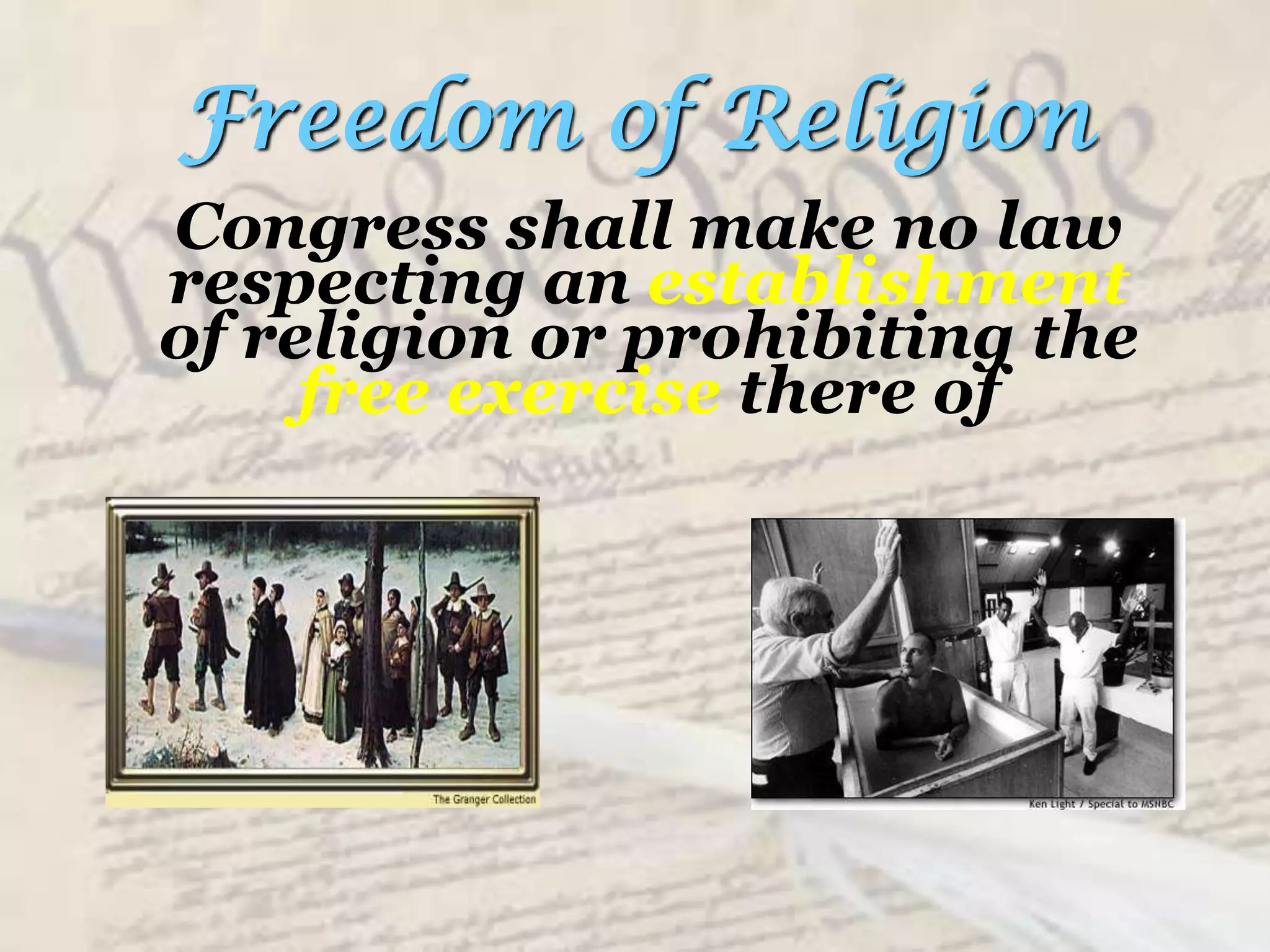
Freedom of ReligionCongress shall make no law respecting an establishment of religion or prohibiting the free exercise there of
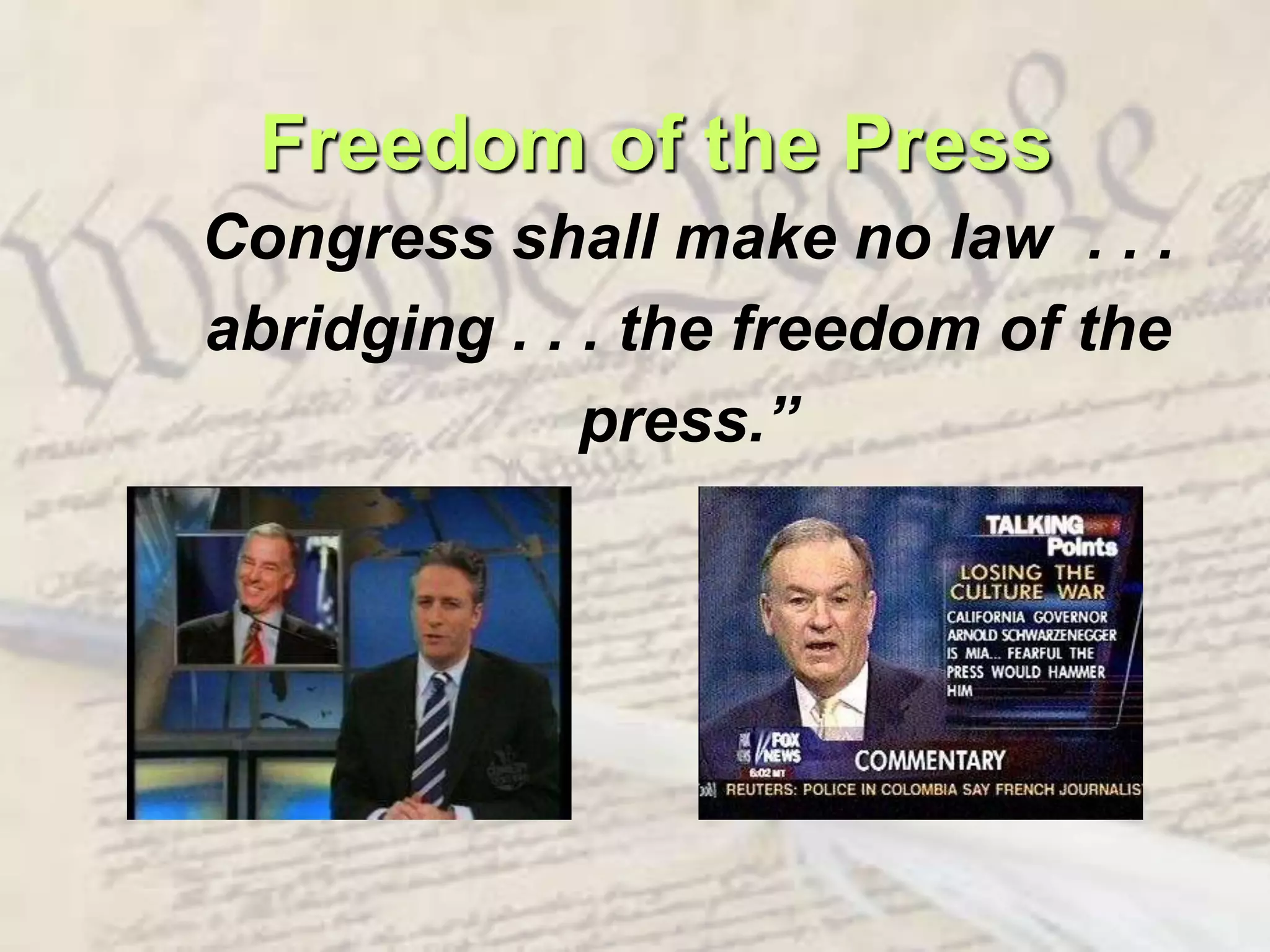
Freedom of the PressCongress shall make no law  . . .abridging . . . the freedom of thepress.”
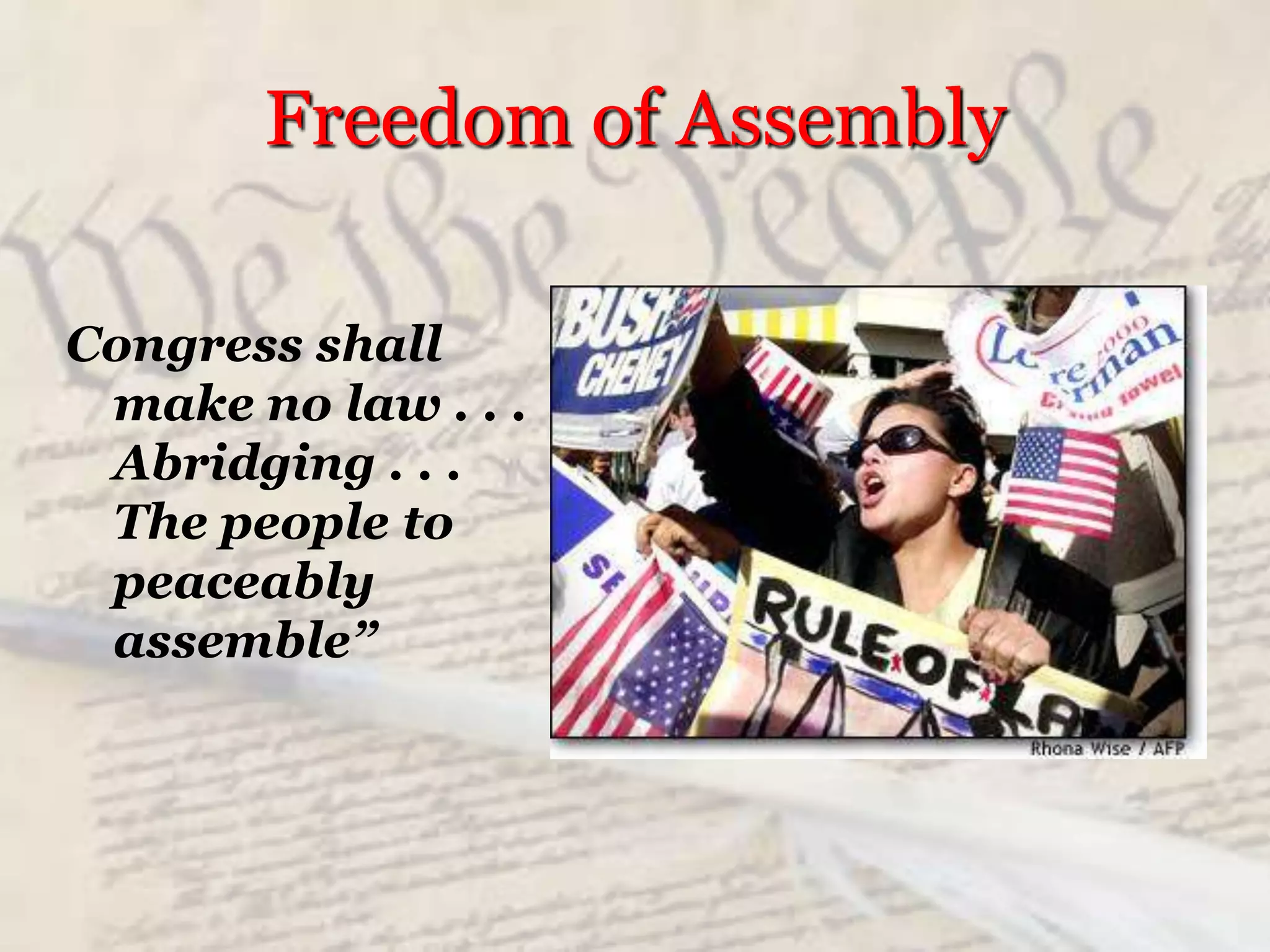
Freedom of AssemblyCongress shall make no law . . . Abridging . . . The people to peaceably assemble”
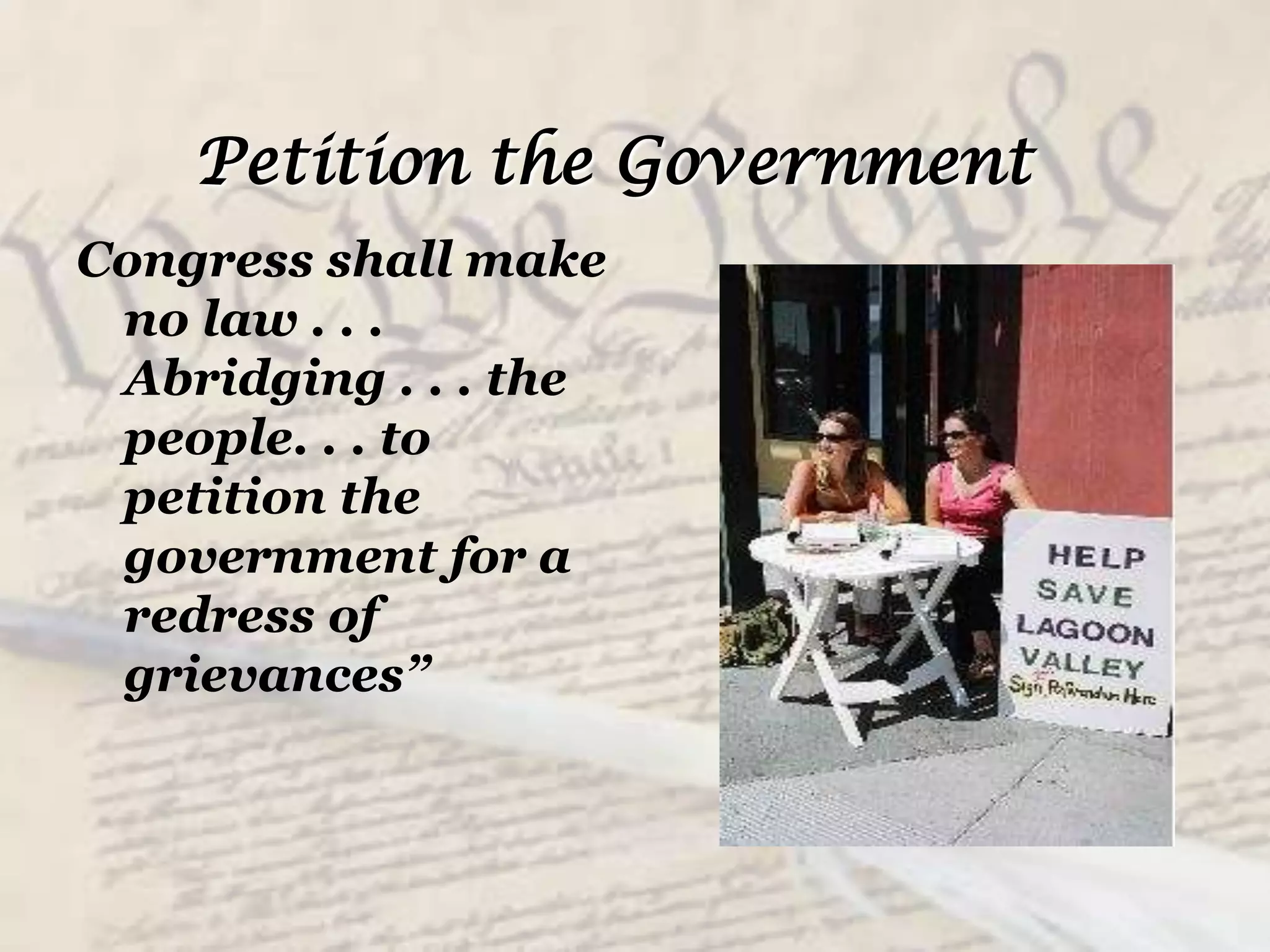
Petition the GovernmentCongress shall make no law . . . Abridging . . . the people. . . to petition the government for a redress of grievances”
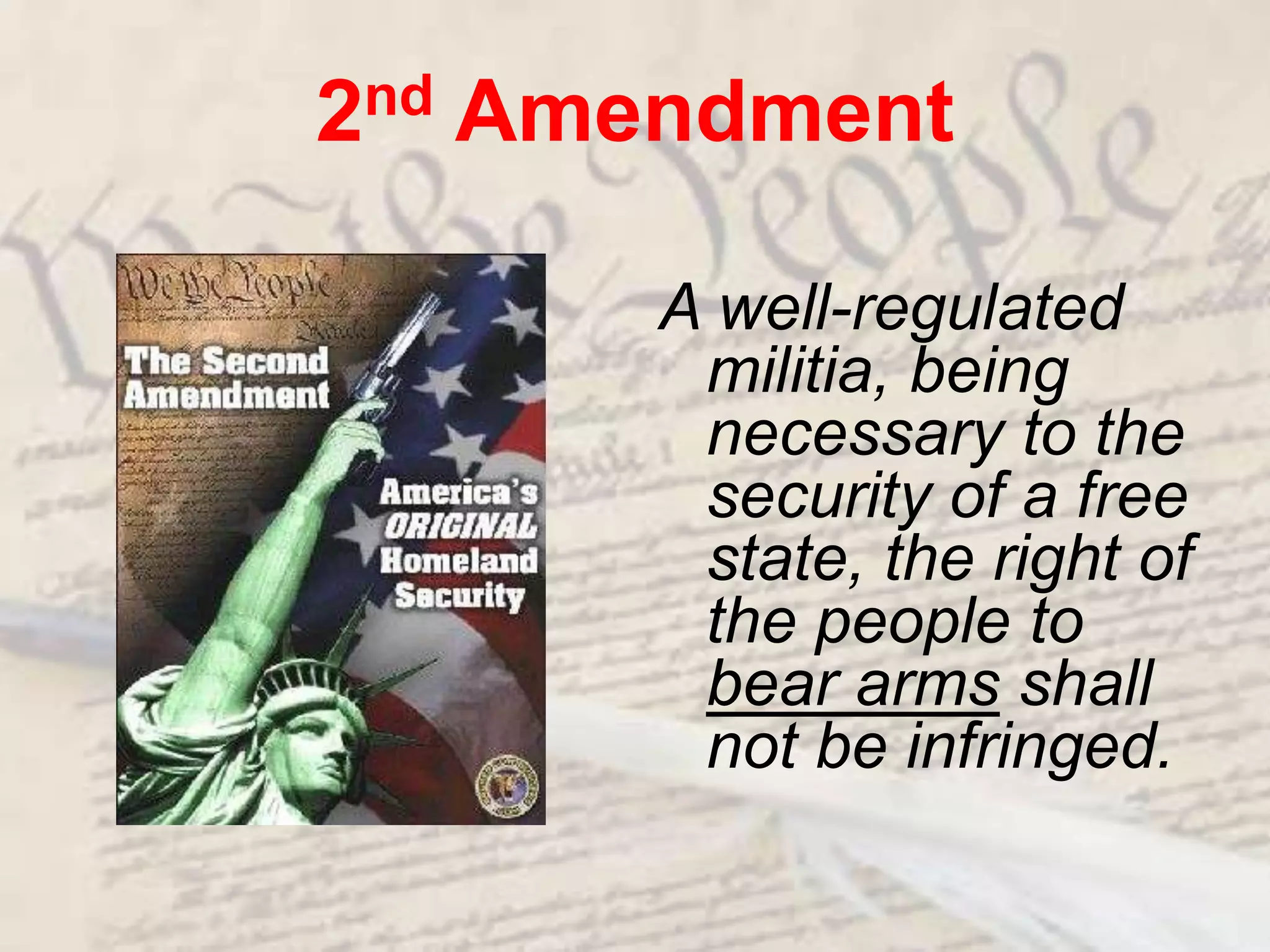
2nd AmendmentA well-regulated militia, being necessary to the security of a free state, the right of the people to bear arms shall not be infringed.
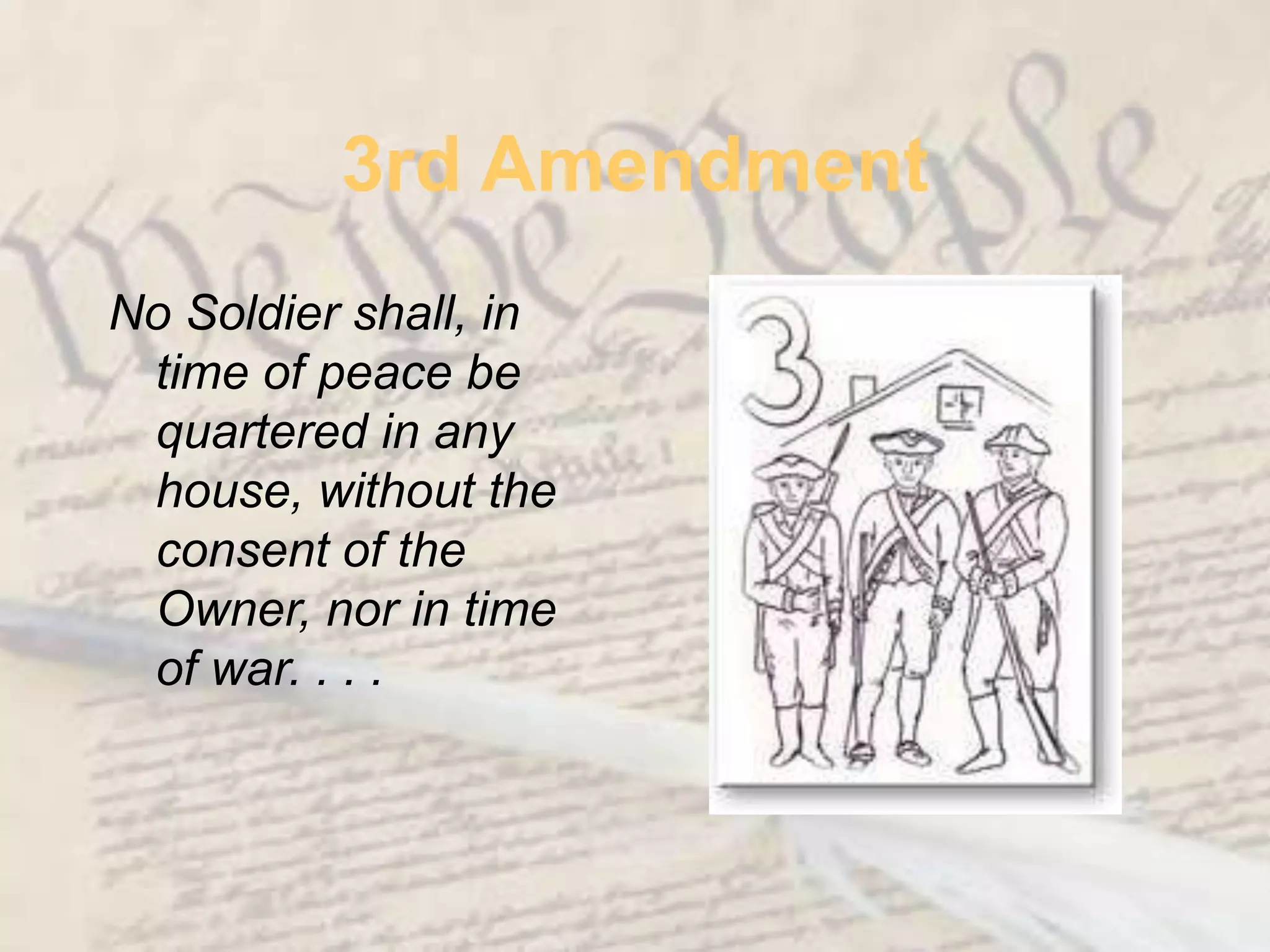
3rd AmendmentNo Soldier shall, in time of peace be quartered in any house, without the consent of the Owner, nor in time of war. . . .
4th AmendmentThe right of the people to be secure in their persons,  houses, papers, and effects, against unreasonable searches and  seizures, shall not be violated, and no Warrants shall issue, but upon probable cause, ….. particularly describing the place to be searched, and the  persons or things to be seized
5th AmendmentNo person shall be held to answer for a … crime unless on a presentment or indictment of a Grand Jury nor shall any person  be subject for the same offence to be twice put in jeopardy of  life or limb[double jeopardy]nor shall be compelled in any criminal case to  be a witness against himself [self-incrimination]
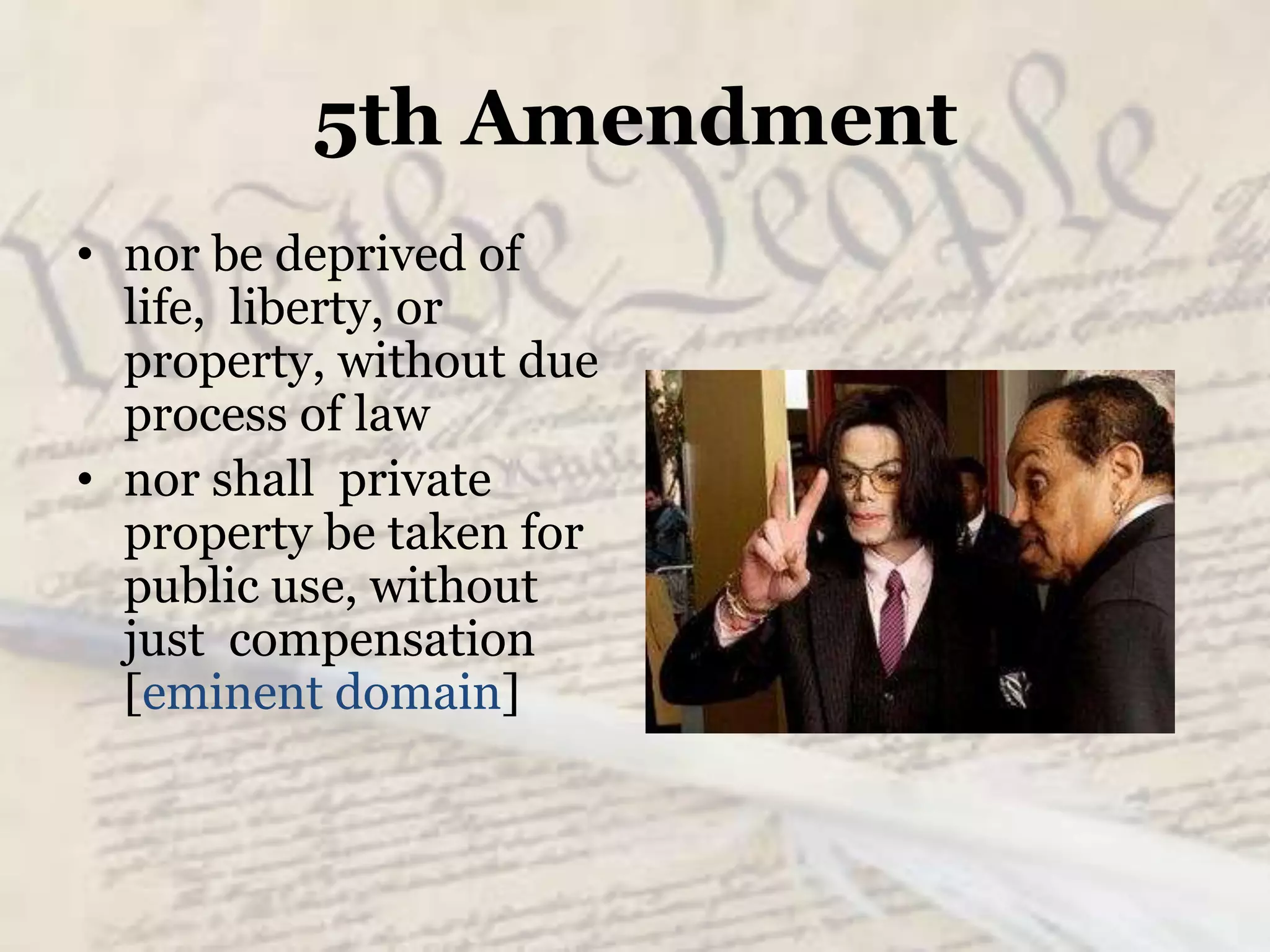
5th Amendmentnor be deprived of life,  liberty, or property, without due process of lawnor shall  private property be taken for public use, without just  compensation [eminent domain]
6th AmendmentIn all criminal prosecutions, the accused shall enjoyThe right to a speedy and public trial by an impartial juryTo be informed of the nature and cause of the accusationTo have compulsory process for obtaining witnesses in his favorTo have Assistance of Counsel for his defense
7th AmendmentIn Suits at common law, where the value in controversy  shall exceed twenty dollars, the right of trial by jury shall  be preserved….
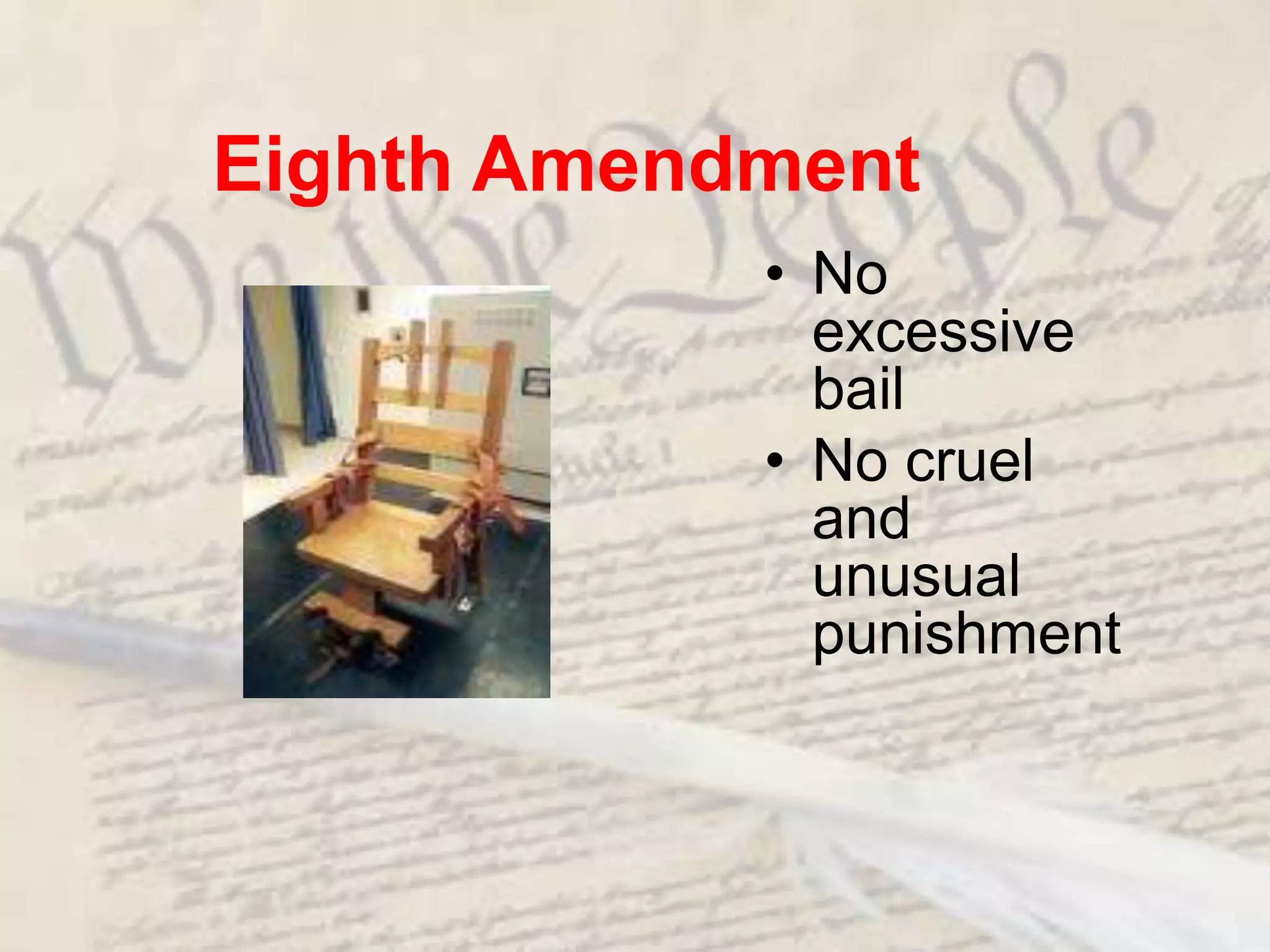
Eighth AmendmentNo excessive bailNo cruel and unusual punishment
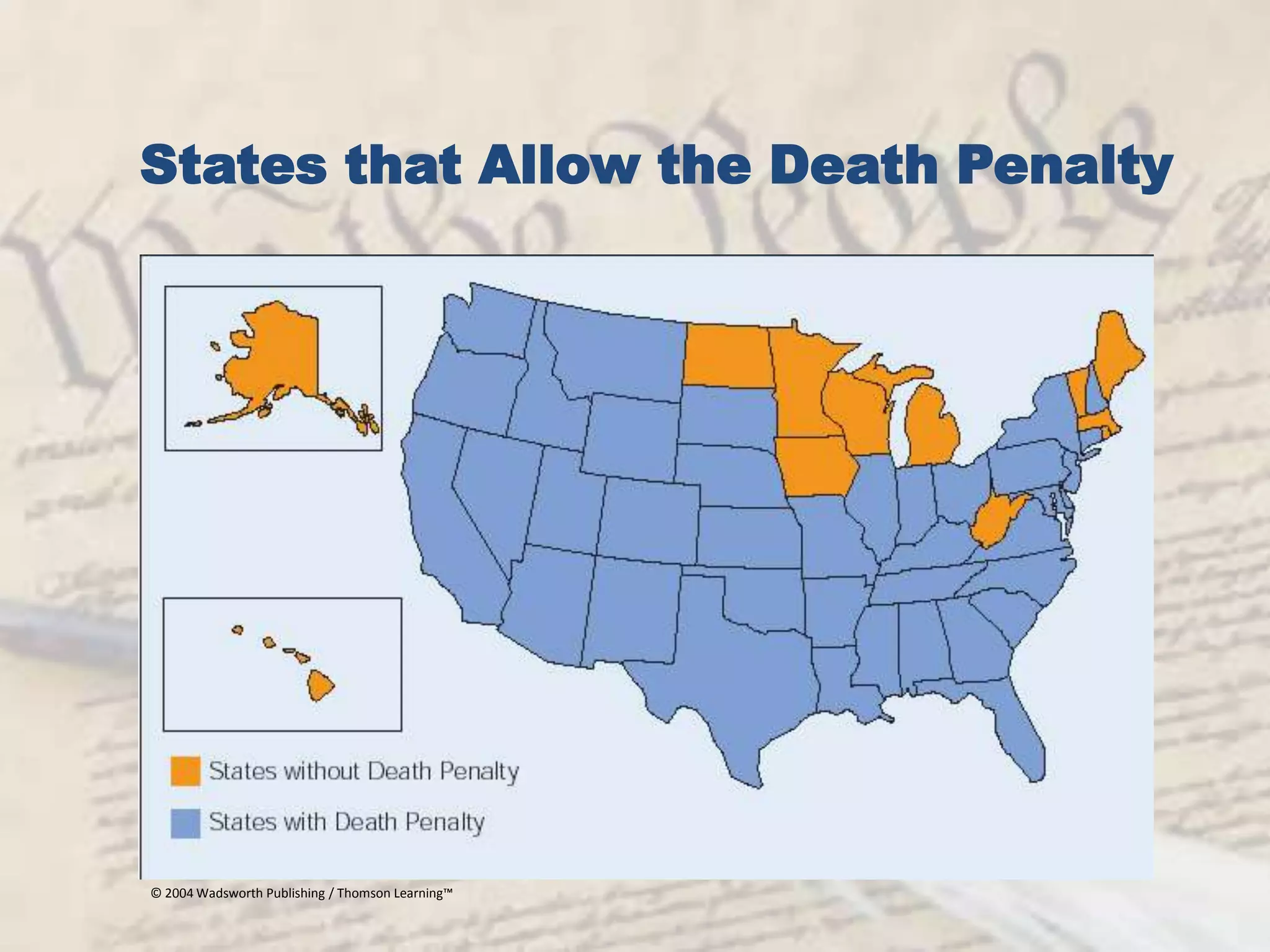
© 2004 Wadsworth Publishing / Thomson Learning™States that Allow the Death Penalty
9th AmendmentThe enumeration in the Constitution, of certain rights,  shall not be construed to deny or disparage others retained by  the people[other rights may be protected even if not included in the Bill of Rights ex: right to privacy]
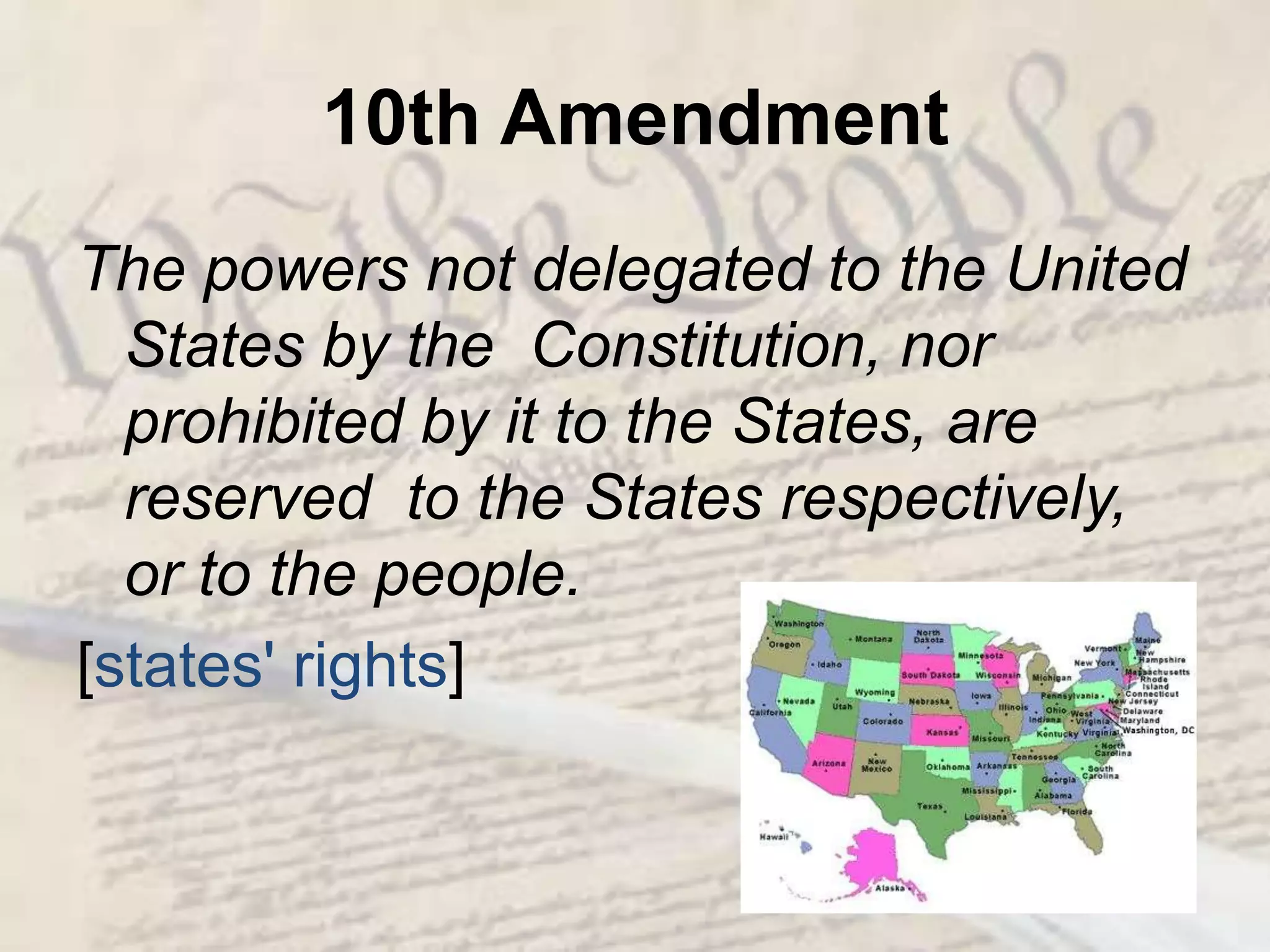
10th AmendmentThe powers not delegated to the United States by the  Constitution, nor prohibited by it to the States, are reserved  to the States respectively, or to the people.[states' rights]
The Civil War Amendments13th Amendment (1865) – neither slavery nor involuntary servitude shall exist in the United States14th Amendment (1868) – all persons born or naturalized in the United State are citizensstates cannot abridge the privileges or immunities of citizensall persons (whether or not they are citizens) are entitled to due processall persons are entitled to equal protection15th Amendment (1870) – the right to vote shall not be denied because of race, color or previous condition of servitude

Goal 2 civics

  • 1.
  • 2.
    Principles of theConstitutiona.k.a. The things that our government is based on today
  • 3.
    The ConstitutionDISCUSS: Where have we seen “separation of powers” before?
  • 4.
    Popular SovereigntyExplanation: The people are the source of government’s power (“We the people…”).Example:VotingRecall electionsPropositions & Referendums
  • 5.
    Limited GovernmentExplanation: Thegovernment’s power is restricted by Constitution and Bill of Rights.Example:Police must have a warrantPunishments must match crimesCongress can not pass a law telling you what to eat for lunchCONSTITUTION
  • 6.
    DISCUSS: Defendthis sentence-Although England has a King, their government is based on the idea of Limited Government.Hint: Magna Carta
  • 7.
    Checks and BalancesExplanation: When one branch of government restricts another from doing something wrong for the country.Example:Congress wants to raise taxes, but President must agree.President hides information from the public, but Supreme Court force him to give it up.
  • 8.
    Separation of PowersExplanation: Dividing the powers of government between 3 branches so no one has too much power.Example:President wants to make flag burning illegal, but it is not his job to make the laws
  • 9.
    DISCUSS: Doyou think “Checks and Balances” can exist within a government that does NOT have Separation of Powers?
  • 10.
    FederalismExplanation: Dividing powersof gov’t between a national (federal) gov’t and smaller state governments. Example:You will pay taxes to two governmentsSchool in N.C. is different from school in S.C.
  • 11.
    DISCUSS: Whichof the 5 Principles might be the most important to people who vote?Popular Sovereignty
  • 12.
  • 13.
  • 14.
  • 15.
    FederalismJudicial ReviewThe powerof the Supreme court to review laws.This principle was established by the Supreme Court case Marbury vs. Madison (1803)
  • 16.
    PreambleA) Where isthe Preamble located? -At the beginning of the Constitution (Introduction paragraph)B) What is the purpose of the Preamble? -It identifies the 6 purposes or things the government will try to do under the Constitution.
  • 17.
    Where is the“Establishment Clause” located and what does it state?Located in the 1st Amendment (freedom of religion)It states that "Congress shall make no law respecting an establishment of religion"
  • 19.
    Qualifications of Officesof the 3 Branches of Government
  • 20.
    House of Representatives(Legislative Branch)Age: 25Citizenship/ Residency: Must be an American Citizen for 7 years and a resident of the state he or she representsLength of Term: 2 YearsTerm Limit: Unlimited as long as reelected
  • 21.
    Senate (Legislative Branch)Age:30 years oldCitizenship/ Residency: Must be a citizen for 9 years and must live in the state from which electedLength of Term: 6 yearsTerm Limit: Unlimited as long as reelected
  • 22.
    President/ Vice President(Executive Branch)Age: 35 years oldCitizenship/ Residency: Must have been born a citizen of the US and a resident of the United States for 14 yearsLength of Term: 4 yearsTerm Limit: 2 terms
  • 23.
    Supreme Court Justice(JudicialBranch)Age: No age limitCitizenship/ Residency: No Residency requirementLength of Term: LifeTerm Limit: Life
  • 24.
  • 25.
    Separation of Powers-Why?The framers of the constitution included the separation of powers for one primary reason: to prevent the majority from achieving absolute ruleAs part of this separation of powers, each of the three branches have Checks and Balances” on the authority of the other two branches the power of each branch is limited or”checked” by the other two so none gain too much power
  • 26.
    What are theChecks and Balances?The Congress passes laws, but the president can veto it, which in turn can be overridden by the congress. The President appoints judges and department heads (secretaries), but these must be approved by the SenateThe Supreme court can rule a law unconstitutional, and therefore invalid, however, the congress can amend (change) the constitutionSpecific powers of each BranchPOWERS:The Executive Branchveto power, appointment of judges,make treaties, pardon powerensure laws are carried outCHECKS:Legislative Branchcan override vetoes, refuse to confirm appointments, reject treaties, declare war, impeach the president Judicial Branch can declare executive acts unconstitutional
  • 27.
    Specific powers ofeach BranchPOWERS:The Legislative Branch pass all federal lawsestablish all lower federal courtsoverride presidential vetoimpeach the president CHECKS:Executive Branchcan veto any bill
  • 28.
    call Congress intosessionJudicial Branchdeclare laws unconstitutional
  • 29.
    Specific powers ofeach BranchCHECKS:Executive Branchappoints judgesLegislative Branch can impeach judgesand approves presidential appointmentscan amend constitution to overturn judicial decisionsPOWERS:The Judicial Branchtry federal cases,interpret laws, declare executive actions & laws unconstitutional
  • 30.
    Questions for discussionWhichbranch is the most powerful ?Is one branch more powerful than the others ? Explain. Give examplesWhy did the framers believe a separation of powers was so important ?
  • 32.
    The System ofFederalism Dividing powers of government between a national (federal) government and smaller state governments
  • 33.
    Types of PowersExpressedPowers: Powers actually written in the Constitutionex: “Congress shall have the power…to raise and support Armies”Implied Powers: Powers not actually listed in the Constitution, but are assumedex: Congress draft citizens into the army
  • 34.
    Elastic clausea.k.a. “necessaryand proper clause”“Congress has the power to make all Laws which shall be necessary and proper for carrying into Execution the…powers vested by the Constitution.”Allows Congress to expand its powers when needed.EX: Constitution says- “power to…repel invasions” but Congress has allowed wiretapping of suspected terrorists without warrants.
  • 35.
    National (Federal) GovernmentPowersa.k.a. Expressed PowersCoin moneyRegulate interstate tradeInterstate=between statesCreate armiesDeclare warDeal with other countries
  • 36.
    State Powersa.k.a. ReservedPowers (10th Amendment)Maintain Public SchoolsRegulate alcoholConduct electionsLicense professionals
  • 37.
    National & StatePowersa.k.a. Concurrent PowersCollect taxesBorrow MoneyEstablish CourtsDefine crimes & punishments
  • 38.
    Supremacy ClauseWhat doesthe Supremacy Clause state about the relationship between the federal and state governments?The Federal law (US Constitution) is above all state lawsStates cannot make laws that conflict with US laws.
  • 39.
  • 40.
    37PigeonholeStep #2 &#5When a committee or sub-committee puts a Bill aside until it is forgotten about (dies)
  • 41.
    38FilibusterStep #6When asenator tries to prevent a vote by talking as long as possible during the debate
  • 42.
    39ClotureStep #6When 60Senators vote to stop (clot) a filibuster
  • 43.
    40Conference CommitteeStep #7Whenmembers of the HoR and Senate compromise on differences in a Bill before it goes to the President.
  • 44.
    41VetoStep #8When thePresident rejects a Bill
  • 45.
    42Pocket VetoStep #8Whenthe President puts a Bill aside for 10 days and it does not become a law
  • 46.
    43Override VetoStep #9IfPresident Vetoes or Pocket Vetoes a Bill, The Senate and HoR can override the President if 2/3 of each house agrees.
  • 47.
    44The 9 stepsof how a Bill becomes a LawStep #1Bill introduced into the HoRStep #2Bill goes to committee & subcommitteeStep #3Debate and voted on in the HoR
  • 48.
    45The 9 stepsof how a Bill becomes a LawStep #4Bill introduced into the SenateStep #5Bill goes to committeeStep #6Debate and voted on in the Senate
  • 49.
    46The 9 stepsof how a Bill becomes a LawStep #7Conference CommitteeStep #8Presidential ActionSignVetoPocket VetoStep #9Override Veto
  • 50.
    47The Bill FlowChart:Introduction in the House of Reps. Sent to Committee/ Sub- CommitteeDebate & Vote in the HoRSent to the Senate and IntroducedSenate CommitteeVeto Override:2/3 Vote in Congress = LawDebate & vote Senate Floor VoteConference CommittteeSent to the President:Signs = LawVeto  No Law
  • 51.
  • 52.
    The Constitution andthe Amendment Process (Article V)
  • 53.
    Marbury vs. MadisonWhatis the lasting impact??The judicial branch has a duty to uphold the Constitution. Thus, it must be able to determine when a law conflicts with the Constitution and to nullify unconstitutional laws (Judicial Review)
  • 54.
    To PROPOSE anAmendmentMethod 1By 2/3 vote in both the House and the Senate[most common method of proposing an amendment]OrMethod 2By national constitutional convention called by Congress at the request of 2/3 (34) of the state legislatures[This method has never been used]
  • 55.
    To RATIFY anAmendmentMethod 1By legislatures in ¾ (38) of the states[in all but one case, this is how amendments have been ratified]OrMethod 2Ratified through conventions in ¾ (38) of the states. [Only been used once to ratify the 21st Amendment]
  • 56.
    Amendment ProcessMethods ofProposalMethods of RatificationMethod 1By 2/3 vote in both the House and the SenateMethod 1By legislatures in ¾ of the statesOrOrMethod 2Ratified through conventions in ¾ of the states. Method 2By national constitutional convention called by Congress at the request of 2/3 of the state legislatures
  • 57.
    13TH Amendment (1865)Endedslavery in the United States
  • 58.
    14TH Amendment (1868)Equalprotection under the lawBoth national and state gov’ts must guarantee everyone their civil libertiesDefined citizenship
  • 59.
    15TH Amendment (1870)Cannotbe denied the right to vote based on race, color, or previous condition of servitude
  • 60.
    All men gainedthe right to vote19TH Amendment (1920)Women gained suffrage (right to vote)24TH Amendment (1964)Elimination of poll taxesCannot be forced to pay a fee in order to vote
  • 61.
    26TH Amendment (1971)Allcitizens 18 years of age and older have the right to vote
  • 62.
    Exploring the Billof RightsFor the 21st Century
  • 63.
    The First AmendmentFive Essential Freedoms and Rights
  • 64.
    Freedom of SpeechCongressshall make no laws . . . abridging the freedom of speech
  • 65.
    Freedom of ReligionCongressshall make no law respecting an establishment of religion or prohibiting the free exercise there of
  • 66.
    Freedom of thePressCongress shall make no law . . .abridging . . . the freedom of thepress.”
  • 67.
    Freedom of AssemblyCongressshall make no law . . . Abridging . . . The people to peaceably assemble”
  • 68.
    Petition the GovernmentCongressshall make no law . . . Abridging . . . the people. . . to petition the government for a redress of grievances”
  • 69.
    2nd AmendmentA well-regulatedmilitia, being necessary to the security of a free state, the right of the people to bear arms shall not be infringed.
  • 70.
    3rd AmendmentNo Soldiershall, in time of peace be quartered in any house, without the consent of the Owner, nor in time of war. . . .
  • 71.
    4th AmendmentThe rightof the people to be secure in their persons, houses, papers, and effects, against unreasonable searches and seizures, shall not be violated, and no Warrants shall issue, but upon probable cause, ….. particularly describing the place to be searched, and the persons or things to be seized
  • 72.
    5th AmendmentNo personshall be held to answer for a … crime unless on a presentment or indictment of a Grand Jury nor shall any person be subject for the same offence to be twice put in jeopardy of life or limb[double jeopardy]nor shall be compelled in any criminal case to be a witness against himself [self-incrimination]
  • 73.
    5th Amendmentnor bedeprived of life, liberty, or property, without due process of lawnor shall private property be taken for public use, without just compensation [eminent domain]
  • 74.
    6th AmendmentIn allcriminal prosecutions, the accused shall enjoyThe right to a speedy and public trial by an impartial juryTo be informed of the nature and cause of the accusationTo have compulsory process for obtaining witnesses in his favorTo have Assistance of Counsel for his defense
  • 75.
    7th AmendmentIn Suitsat common law, where the value in controversy shall exceed twenty dollars, the right of trial by jury shall be preserved….
  • 76.
    Eighth AmendmentNo excessivebailNo cruel and unusual punishment
  • 77.
    © 2004 WadsworthPublishing / Thomson Learning™States that Allow the Death Penalty
  • 78.
    9th AmendmentThe enumerationin the Constitution, of certain rights, shall not be construed to deny or disparage others retained by the people[other rights may be protected even if not included in the Bill of Rights ex: right to privacy]
  • 79.
    10th AmendmentThe powersnot delegated to the United States by the Constitution, nor prohibited by it to the States, are reserved to the States respectively, or to the people.[states' rights]
  • 80.
    The Civil WarAmendments13th Amendment (1865) – neither slavery nor involuntary servitude shall exist in the United States14th Amendment (1868) – all persons born or naturalized in the United State are citizensstates cannot abridge the privileges or immunities of citizensall persons (whether or not they are citizens) are entitled to due processall persons are entitled to equal protection15th Amendment (1870) – the right to vote shall not be denied because of race, color or previous condition of servitude
  • 81.
    The Voting Amendments19thAmendment (1920) – Equal Suffrage – the right to vote should not be denied by any account of sex
  • 82.
    24th Amendment (1964)– Voting is free for all citizens and no poll tax or literacy test is required.
  • 83.
    26th Amendment (1971)– Voting age is lowered to 18. This was a result of the soldiers dying in the Vietnam War that were unable to vote, but could die for that president.The other Important ones...18th Amendment (1919) – Prohibition of intoxicating liquors. This amendment made owning, manufacturing, and drinking alcohol illegal. This led to an increase in organized crime.
  • 84.
    21st Amendment(1933) – Repeal of 18th Amendment. This cancelled the 18th Amendment form the Constitution.
  • 85.
    22nd Amendment(1947) – Presidential Tenure. No person shall be elected to the office of the president for more than 2 terms. (Total of 8 years)
  • 86.
    25th Amendment (1965)– Presidential succession is revised to be a more descriptive system.