

Information Literacy sans frontieres


    Peter Godwin
    University of Bedfordshire
    1 July 2009
/


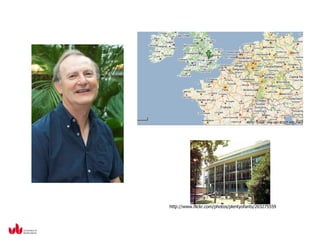
    http://www.flickr.com/photos/plentyofants/203275559
Information Literacy sans frontieres


     Information Literacy as the key for 21st
     century librarians
    The Web 2.0 connection
    Towards a mobile future?
    Conclusions
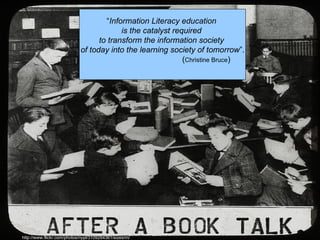
“Information Literacy education
                                         is the catalyst required
                                  to transform the information society
                            of today into the learning society of tomorrow”.
                                                            (Christine Bruce)


http://www.flickr.com/photos/nypl/3109294361/sizes/m/
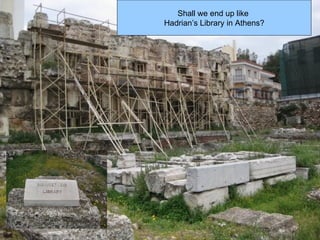
Shall we end up like
Hadrian’s Library in Athens?
http://www.flickr.com/photos/trois-tetes/9240496/sizes/m/
/


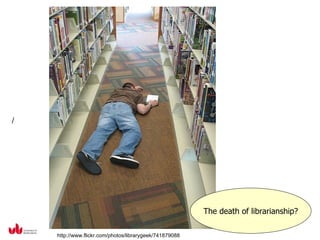
                                                         The death of librarianship?

    http://www.flickr.com/photos/librarygeek/741879088
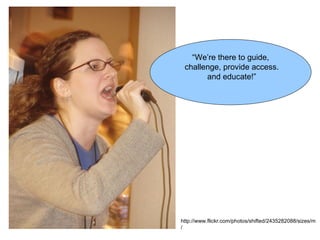
“We’re there to guide,
 challenge, provide access.
       and educate!”


http://www.flickr.com/photos/shifted/2435282088/sizes/m
/
They don’t
know
what they don’t
know!


   http://www.flickr.com/photos/b-tal/573830063/sizes/m/
JISC Higher education in a Web 2.0 world
(2009)


 "Information literacies – including searching,
   retrieving and critically evaluating information
   from a range of appropriate sources and also
   attributing it – represent a significant and
   growing deficit area.”
It’s a lifelong
                                              process


http://www.flickr.com/photos/59314524@N00/3246244830
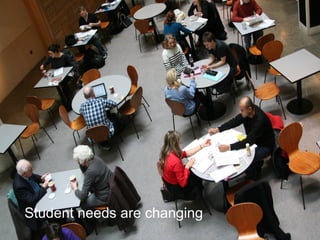
Student needs are changing
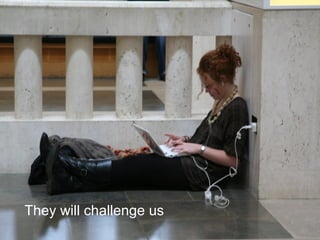
They will challenge us
At the centre of all the literacies

 Media literacy
 IT literacy Information literacy
 Language literacy             Visual literacy
         E literacy
   Information fluency
                    I-skills
 Information skills
What does it mean to be
                                      Information Literate?


http://www.flickr.com/photos/millzero/1523858246/
What is Information Literacy?

 “Information literacy is the adoption of
   appropriate information behaviour to
   identify through whatever channel or
   medium, information well fitted to
   information needs, leading to wise and
   ethical use of information in society.”

 (Sheila Webber and Bill Johnston)
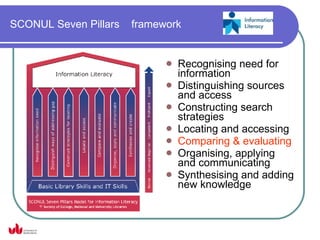
SCONUL Seven Pillars   framework


                                Recognising need for
                                 information
                                Distinguishing sources
                                 and access
                                Constructing search
                                 strategies
                                Locating and accessing
                                Comparing & evaluating
                                Organising, applying
                                 and communicating
                                Synthesising and adding
                                 new knowledge
The phenomenological view of
     Information Literacy


http://www.flickr.com/photos/71428150@N00/2349209355/sizes/m/
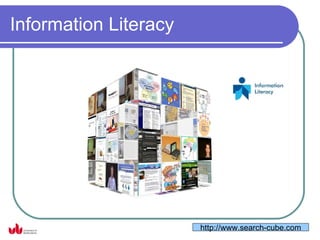
Information Literacy


                       http://www.search-cube.com
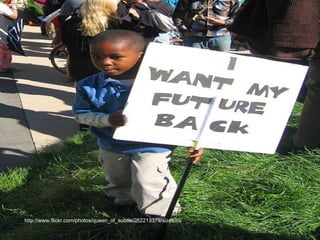
http://www.flickr.com/photos/queen_of_subtle/262213379/sizes/m/
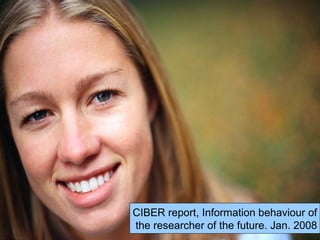
CIBER report, Information behaviour of
the researcher of the future. Jan. 2008
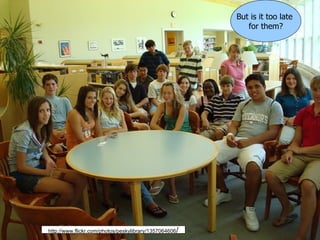
But is it too late
                                                           for them?


http://www.flickr.com/photos/peskylibrary/1357064606/
Challenges for Information Literacy

  Poor coverage in national media
  Need to use logo widely
  New promo campaigns working with
   other stakeholders
It’s more than digital literacy


    http://www.flickr.com/photos/26158685@N04/2798850223/sizes/m/
and it’s NOT telling them about
the Library !


         http://www.flickr.com/photos/mn_francis/113890389/sizes/m/
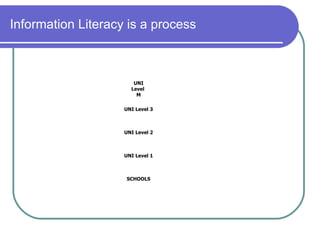
Information Literacy is a process


                       UNI
                      Level
                        M

                    UNI Level 3


                    UNI Level 2


                    UNI Level 1


                    SCHOOLS
To them we appear as custodians, representatives of a thing, not
as partners in facilitating learning!


                                               http://www.flickr.com/photos/91281489@N00/12
                                               5403481
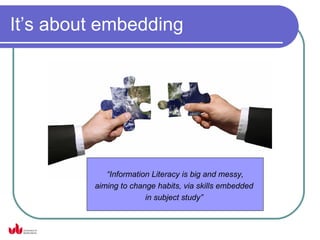
It’s about embedding


            “Information Literacy is big and messy,
         aiming to change habits, via skills embedded
                       in subject study”
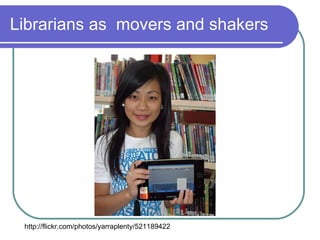
Librarians as movers and shakers


 http://flickr.com/photos/yarraplenty/521189422
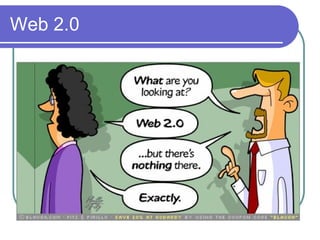
Web 2.0
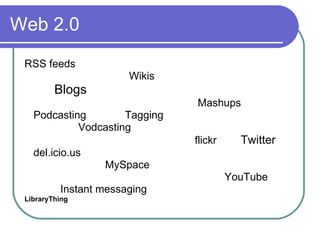
Web 2.0
 RSS feeds
                       Wikis
         Blogs
                               Mashups
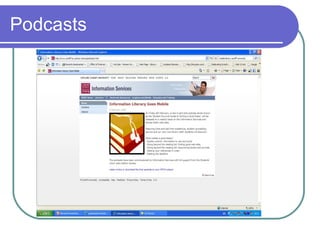
   Podcasting        Tagging
            Vodcasting
                               flickr     Twitter
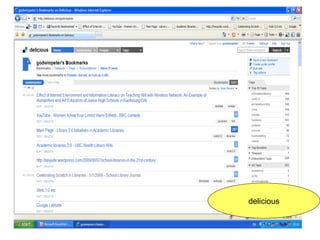
   del.icio.us
                  MySpace
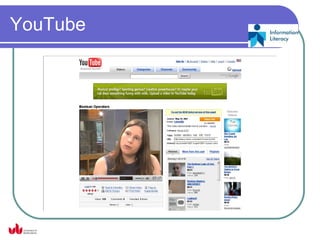
                                        YouTube
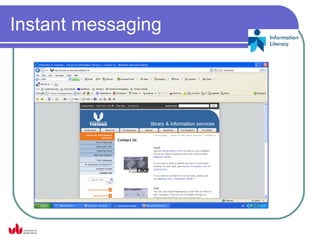
          Instant messaging
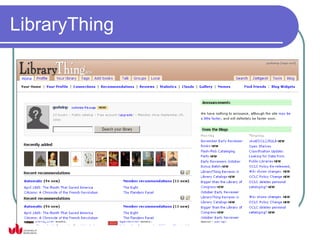
 LibraryThing
Library 2.0

  Find out your users’ changing needs
  Get rid of the culture of perfect
  Become aware of emerging technologies
   and opportunities
  Look outside the library world for
   applications, opportunities, inspiration
Recent ACRL report

 Booth, Char Informing innovation :
  tracking student interest in emerging
  Library technologies at Ohio University.
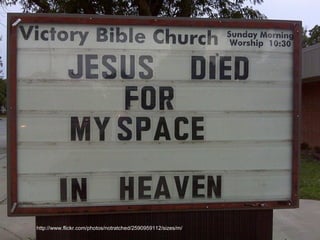
   http://www.flickr.com/photos/notratched/2590959112/sizes/m/
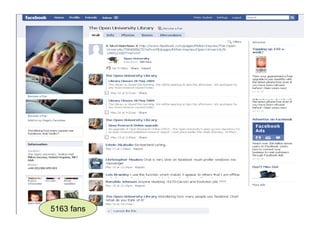
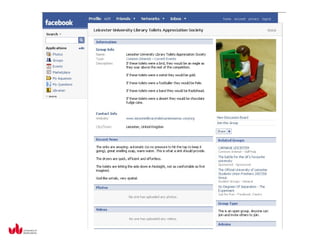
5163 fans
delicious
YouTube
Podcasts
LibraryThing
Instant messaging
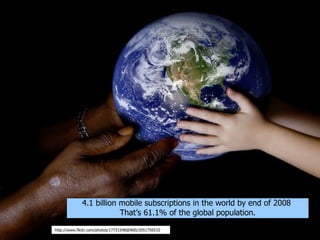
4.1 billion mobile subscriptions in the world by end of 2008
                         That’s 61.1% of the global population.

http://www.flickr.com/photos/17731548@N00/2051756510
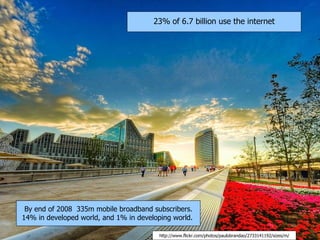
23% of 6.7 billion use the internet


 By end of 2008 335m mobile broadband subscribers.
14% in developed world, and 1% in developing world.

                                         http://www.flickr.com/photos/paulobrandao/2733141192/sizes/m/
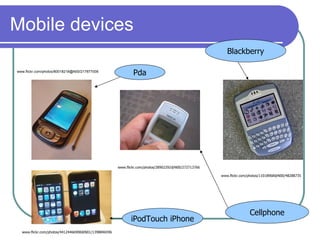
Mobile devices
                                                                                                       Blackberry

www.flickr.com/photos/80018218@N00/217877008
                                                             Pda


                                                     www.flickr.com/photos/28902292@N00/272713766

                                                                                                    www.flickr.com/photos/11018968@N00/48288735


                                                                                                                   Cellphone
                                                            iPodTouch iPhone
  www.flickr.com/photos/44124466908@N01/1398846596
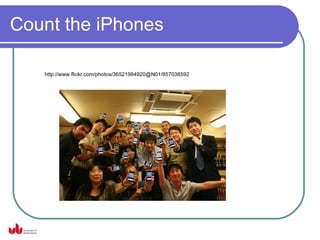
Count the iPhones

   http://www.flickr.com/photos/36521984920@N01/857038592
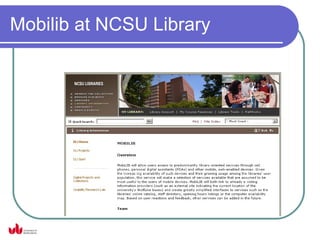
Mobilib at NCSU Library
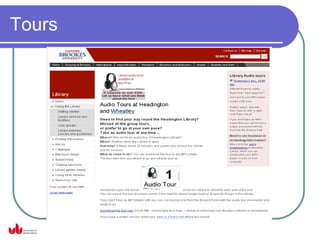
Tours
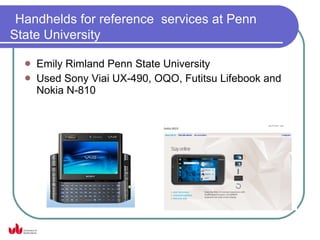
Handhelds for reference services at Penn
State University

     Emily Rimland Penn State University
     Used Sony Viai UX-490, OQO, Futitsu Lifebook and
      Nokia N-810
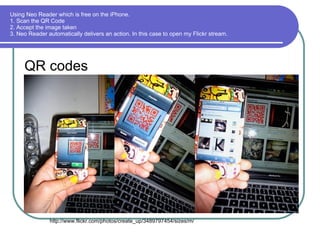
Using Neo Reader which is free on the iPhone.
1. Scan the QR Code
2. Accept the image taken
3. Neo Reader automatically delivers an action. In this case to open my Flickr stream.


     QR codes


               http://www.flickr.com/photos/create_up/3489797454/sizes/m/
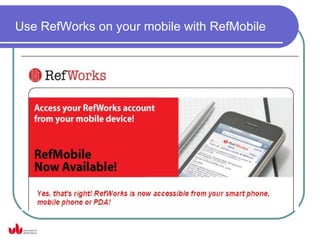
Use RefWorks on your mobile with RefMobile
Into the future

    Librarians have a dynamic part to play in
     student learning, through assisting in
     information literacy development
    We must work strategically with academic staff
     to embed these information literacy
     interventions
    We should encourage a joined-up approach to
     IL from schools through HE into lifelong
     learning.
    We have a raft of Web 2.0 tools to help with
     this.
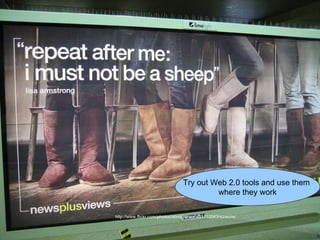
Try out Web 2.0 tools and use them
                                          where they work

http://www.flickr.com/photos/abridgeover/401110043/sizes/m/
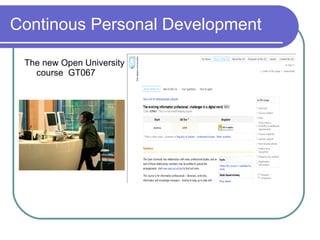
Continous Personal Development

 The new Open University CPD
   course GT067
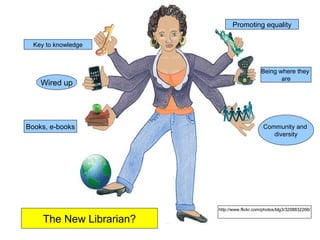
Promoting equality

  Key to knowledge


                                              Being where they
                                                     are
    Wired up


Books, e-books                                 Community and
                                                  diversity


                          http://www.flickr.com/photos/blg3/3208832266/

     The New Librarian?
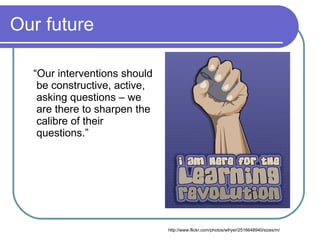
Our future

  “Our interventions should
   be constructive, active,
   asking questions – we
   are there to sharpen the
   calibre of their
   questions.”


                              http://www.flickr.com/photos/wfryer/2516648940/sizes/m/
Librarians go wild


         http://flickr.com/photos/driek/514714536/

Information Literacy sans frontieres

  • 1.
    Information Literacy sansfrontieres Peter Godwin University of Bedfordshire 1 July 2009
  • 2.
    / http://www.flickr.com/photos/plentyofants/203275559
  • 3.
    Information Literacy sansfrontieres  Information Literacy as the key for 21st century librarians  The Web 2.0 connection  Towards a mobile future?  Conclusions
  • 4.
    “Information Literacy education is the catalyst required to transform the information society of today into the learning society of tomorrow”. (Christine Bruce) http://www.flickr.com/photos/nypl/3109294361/sizes/m/
  • 5.
    Shall we endup like Hadrian’s Library in Athens?
  • 6.
  • 7.
    / The death of librarianship? http://www.flickr.com/photos/librarygeek/741879088
  • 8.
    “We’re there toguide, challenge, provide access. and educate!” http://www.flickr.com/photos/shifted/2435282088/sizes/m /
  • 9.
    They don’t know what theydon’t know! http://www.flickr.com/photos/b-tal/573830063/sizes/m/
  • 10.
    JISC Higher educationin a Web 2.0 world (2009) "Information literacies – including searching, retrieving and critically evaluating information from a range of appropriate sources and also attributing it – represent a significant and growing deficit area.”
  • 11.
    It’s a lifelong process http://www.flickr.com/photos/59314524@N00/3246244830
  • 12.
  • 13.
  • 14.
    At the centreof all the literacies Media literacy IT literacy Information literacy Language literacy Visual literacy E literacy Information fluency I-skills Information skills
  • 15.
    What does itmean to be Information Literate? http://www.flickr.com/photos/millzero/1523858246/
  • 16.
    What is InformationLiteracy? “Information literacy is the adoption of appropriate information behaviour to identify through whatever channel or medium, information well fitted to information needs, leading to wise and ethical use of information in society.” (Sheila Webber and Bill Johnston)
  • 17.
    SCONUL Seven Pillars framework  Recognising need for information  Distinguishing sources and access  Constructing search strategies  Locating and accessing  Comparing & evaluating  Organising, applying and communicating  Synthesising and adding new knowledge
  • 18.
    The phenomenological viewof Information Literacy http://www.flickr.com/photos/71428150@N00/2349209355/sizes/m/
  • 19.
    Information Literacy http://www.search-cube.com
  • 20.
  • 21.
    CIBER report, Informationbehaviour of the researcher of the future. Jan. 2008
  • 22.
    But is ittoo late for them? http://www.flickr.com/photos/peskylibrary/1357064606/
  • 23.
    Challenges for InformationLiteracy  Poor coverage in national media  Need to use logo widely  New promo campaigns working with other stakeholders
  • 24.
    It’s more thandigital literacy http://www.flickr.com/photos/26158685@N04/2798850223/sizes/m/
  • 25.
    and it’s NOTtelling them about the Library ! http://www.flickr.com/photos/mn_francis/113890389/sizes/m/
  • 26.
    Information Literacy isa process UNI Level M UNI Level 3 UNI Level 2 UNI Level 1 SCHOOLS
  • 27.
    To them weappear as custodians, representatives of a thing, not as partners in facilitating learning! http://www.flickr.com/photos/91281489@N00/12 5403481
  • 28.
    It’s about embedding “Information Literacy is big and messy, aiming to change habits, via skills embedded in subject study”
  • 29.
    Librarians as moversand shakers http://flickr.com/photos/yarraplenty/521189422
  • 31.
  • 32.
    Web 2.0 RSSfeeds Wikis Blogs Mashups Podcasting Tagging Vodcasting flickr Twitter del.icio.us MySpace YouTube Instant messaging LibraryThing
  • 33.
    Library 2.0 Find out your users’ changing needs  Get rid of the culture of perfect  Become aware of emerging technologies and opportunities  Look outside the library world for applications, opportunities, inspiration
  • 34.
    Recent ACRL report Booth, Char Informing innovation : tracking student interest in emerging Library technologies at Ohio University.
  • 35.
    http://www.flickr.com/photos/notratched/2590959112/sizes/m/
  • 36.
  • 38.
  • 39.
  • 40.
  • 42.
  • 43.
  • 44.
    4.1 billion mobilesubscriptions in the world by end of 2008 That’s 61.1% of the global population. http://www.flickr.com/photos/17731548@N00/2051756510
  • 45.
    23% of 6.7billion use the internet By end of 2008 335m mobile broadband subscribers. 14% in developed world, and 1% in developing world. http://www.flickr.com/photos/paulobrandao/2733141192/sizes/m/
  • 46.
    Mobile devices Blackberry www.flickr.com/photos/80018218@N00/217877008 Pda www.flickr.com/photos/28902292@N00/272713766 www.flickr.com/photos/11018968@N00/48288735 Cellphone iPodTouch iPhone www.flickr.com/photos/44124466908@N01/1398846596
  • 47.
    Count the iPhones http://www.flickr.com/photos/36521984920@N01/857038592
  • 48.
  • 49.
  • 50.
    Handhelds for referenceservices at Penn State University  Emily Rimland Penn State University  Used Sony Viai UX-490, OQO, Futitsu Lifebook and Nokia N-810
  • 51.
    Using Neo Readerwhich is free on the iPhone. 1. Scan the QR Code 2. Accept the image taken 3. Neo Reader automatically delivers an action. In this case to open my Flickr stream. QR codes http://www.flickr.com/photos/create_up/3489797454/sizes/m/
  • 52.
    Use RefWorks onyour mobile with RefMobile
  • 53.
    Into the future  Librarians have a dynamic part to play in student learning, through assisting in information literacy development  We must work strategically with academic staff to embed these information literacy interventions  We should encourage a joined-up approach to IL from schools through HE into lifelong learning.  We have a raft of Web 2.0 tools to help with this.
  • 54.
    Try out Web2.0 tools and use them where they work http://www.flickr.com/photos/abridgeover/401110043/sizes/m/
  • 55.
    Continous Personal Development The new Open University CPD course GT067
  • 56.
    Promoting equality Key to knowledge Being where they are Wired up Books, e-books Community and diversity http://www.flickr.com/photos/blg3/3208832266/ The New Librarian?
  • 57.
    Our future “Our interventions should be constructive, active, asking questions – we are there to sharpen the calibre of their questions.” http://www.flickr.com/photos/wfryer/2516648940/sizes/m/
  • 58.
    Librarians go wild http://flickr.com/photos/driek/514714536/