Management Information Systems
Competing with Information and
Communication Technology in the Digital Age
Lecture-2
• Definition of ICT
• Building blocks of ICT
• Identify competitive strategies of information Communication
Technologies
• Process reengineering frequently involves the strategic use of e-
business technologies
• Identify the business value of using e-business technologies
Outline of the lecture
Definition
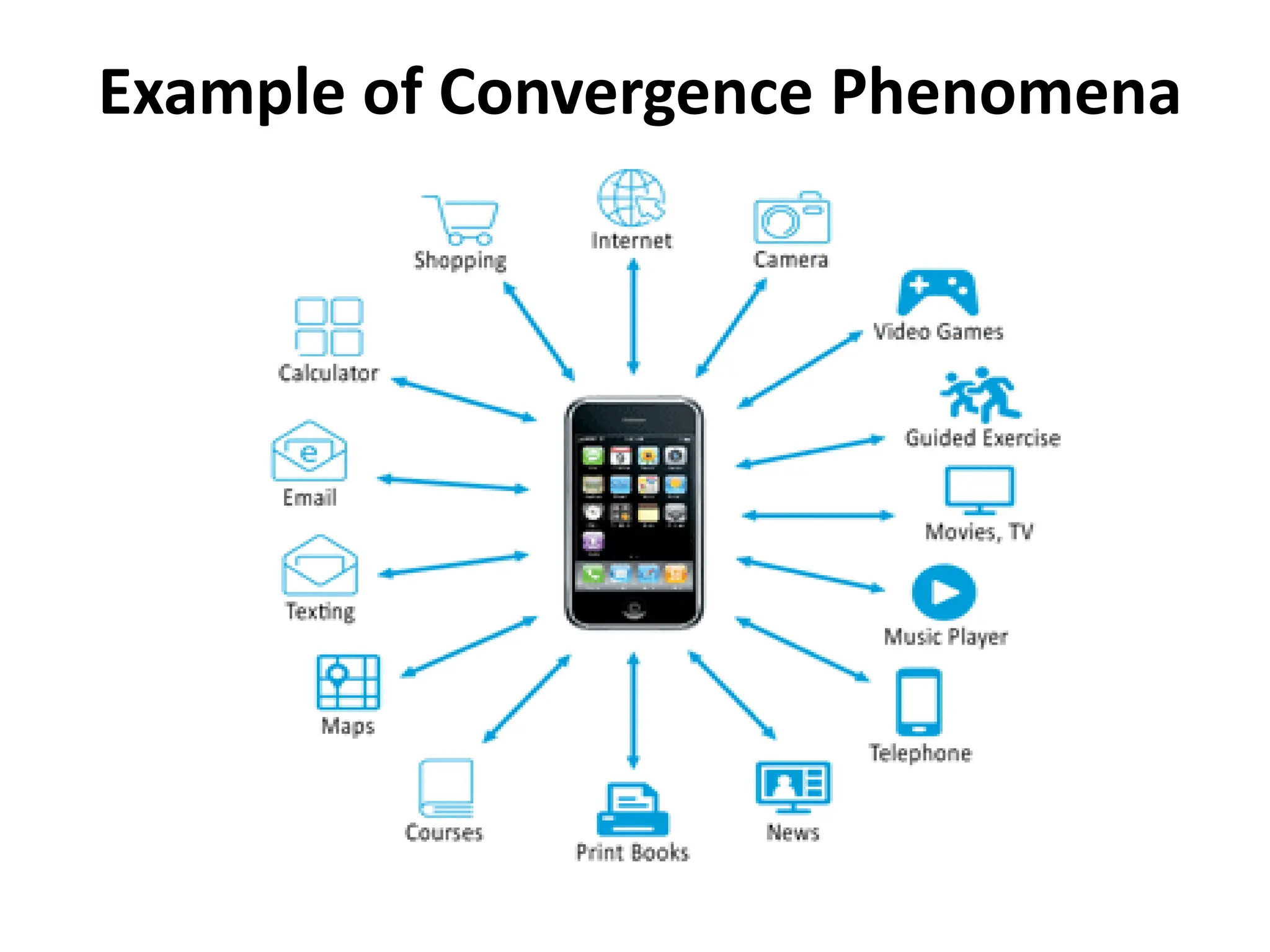
• It is a convergence phenomena to get multiple services on a
single device and unified communication link
• It is Convergence of:
• Data processing
• Computer
• Computer Networks
• Communications and
• Multimedia Digital contents
Capabilities of ICT
• ICT enable users to
 Access
 Storage
 Transmission
 Online Transactions
 Manipulate information
 Use information effectively and efficiently
Example of Convergence Phenomena
Building Blocks of ICT
• Computers/digital devices/Smart devices
• Telecommunication and/or Computers
networks
• Multimedia digital contents/web
• Human know how
 Knowledge
 Skills
 Attitude
Multimedia
• Multimedia: Information in many forms (text,
numbers, audio and motion pictures)
What is Communication?
 Communication is the act of
transferring information from one place
to another
In the case Computer Networks: it is
exchanging information from computer
to another computer through computer
network
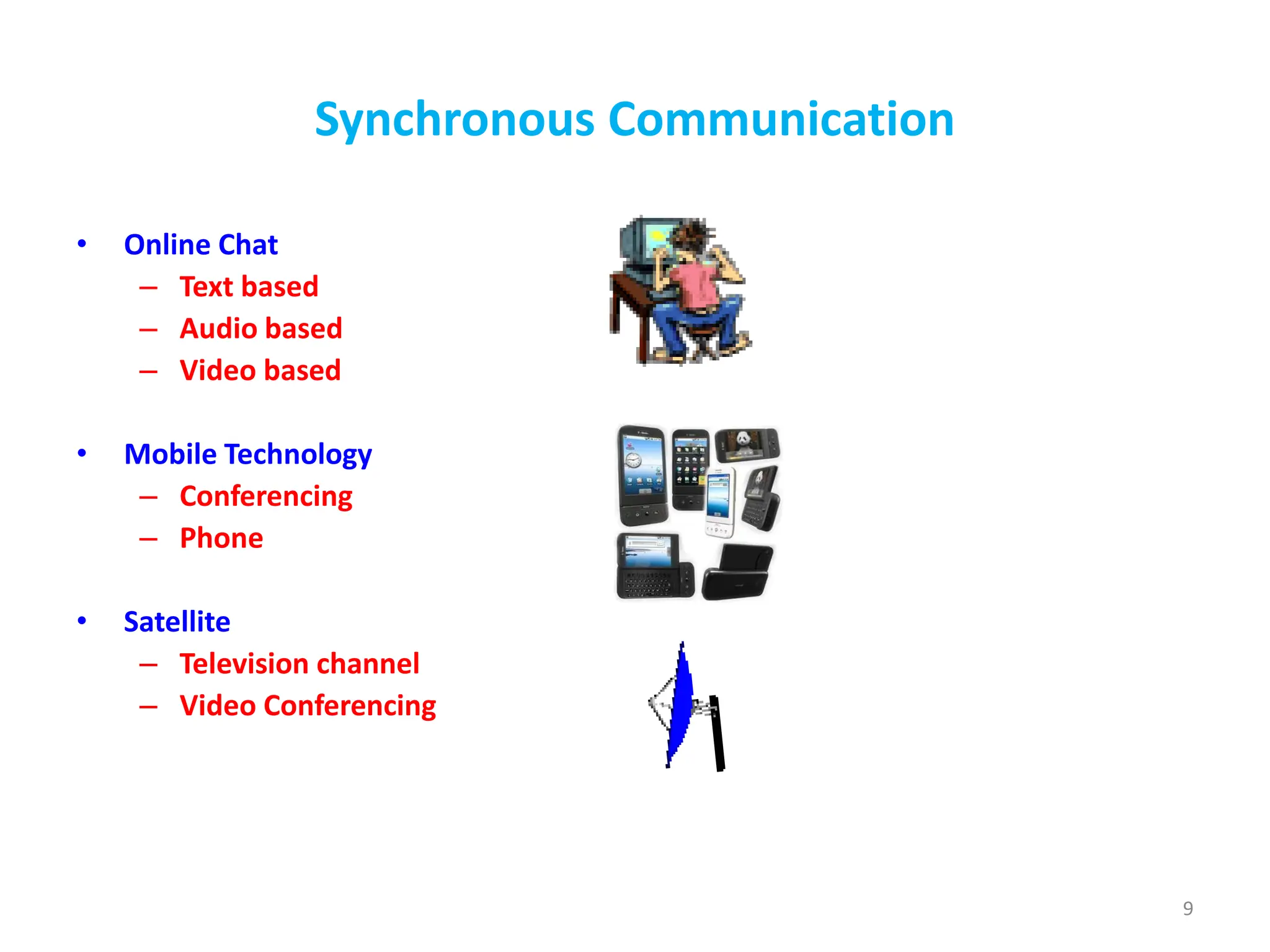
Synchronous Communication
• Online Chat
– Text based
– Audio based
– Video based
• Mobile Technology
– Conferencing
– Phone
• Satellite
– Television channel
– Video Conferencing
9
Computers
Computer is an electronic device with the capabilities of:
Can store large amounts of data
Can perform certain operations on data
Displays the result as output of the operation
Process data whenever needed
Computer Network
 A computer network is an interconnection between
among two or more computer
 Nodes
 Links
 21st century is beyond connected devices connected
intelligence through enterprise collaborations to:
 Make smart decisions making and
 effective and efficient business operations
 Strategic competitions
The Age of Networked Intelligence
• Networking of humans through technology
necessitated knowing the following concepts:
• Life long Learning
• Digital economy
• Digital Age
• ICT changes the way compete in
business world
Knowledge Economy
• Individuals and enterprises create wealth by applying
• Knowledge
• Networked human intelligence
• In modernizing the way we operate
through automation and/or augmenting
human in sectors like
 Manufacturing,
 Agriculture and
 Services
 Mining
What is Knowledge Economy
• Application of human know how
• Life long learning
• “SMART” products based machine learning
and Internet of Things (IoT)
• Economy added value will be created by brain
not only through muscle
• Mass Customized rather than mass-produced
Mass Customization
• Mass customization is a marketing and
manufacturing technique which combines the
flexibility and personalization of custom-made
products with the low unit costs associated with
mass production
• Involves sensitivity to customer preferences with
standardization of processes
• Seeks to combine:
• flexibility
• low costs and
• high quality and
• promote economics of scale
How Introducing ICT Affects
Traditional Organization Structure
Need for new structures…..
Prerequisites to Implement Information
Communication Technology
• Information Communication Technologies are
flexible tools, constrained primarily by :
• Managers’ will to use them
• Expectations about their roles, and
• Applications choices
17
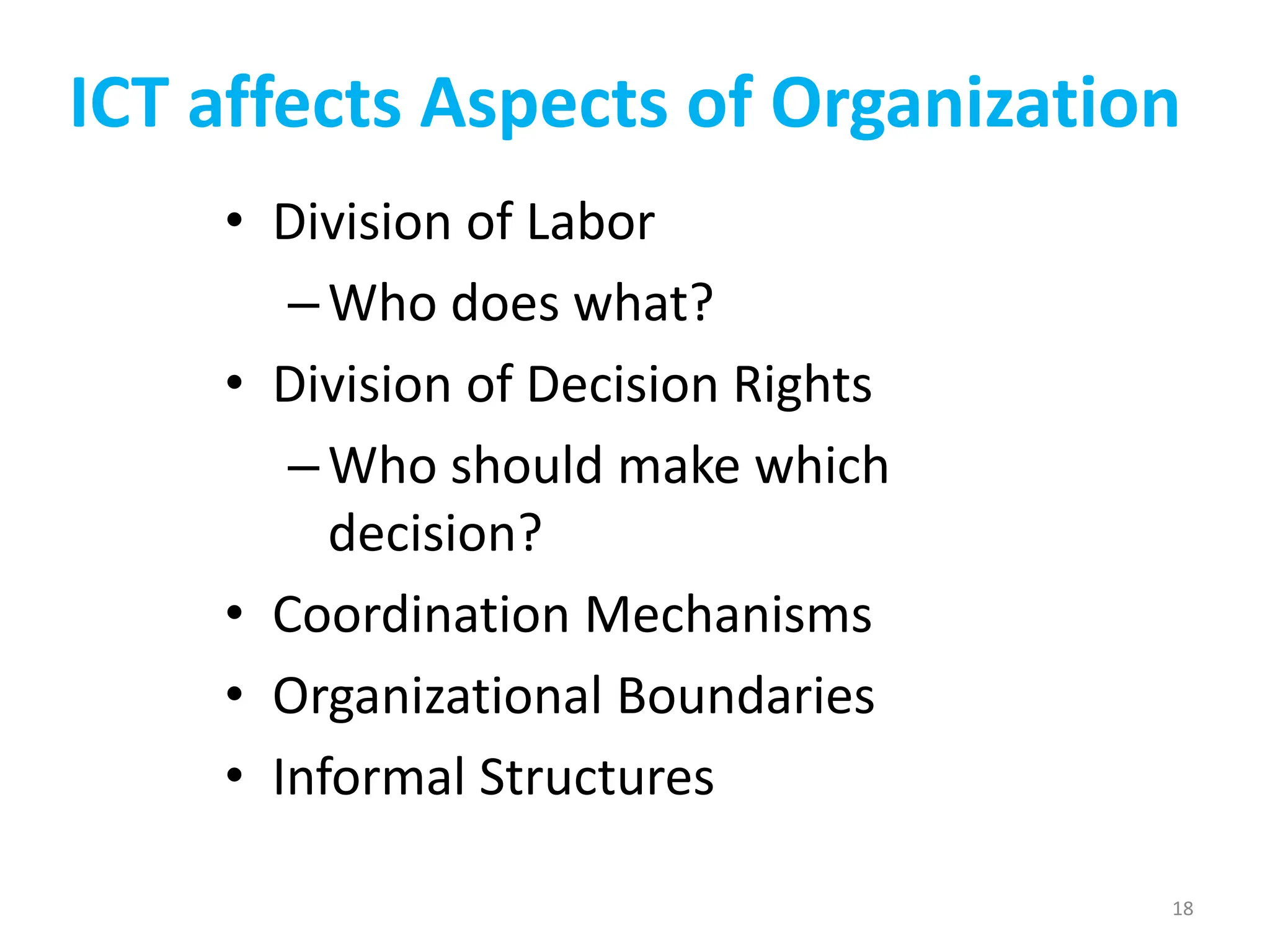
ICT affects Aspects of Organization
• Division of Labor
–Who does what?
• Division of Decision Rights
–Who should make which
decision?
• Coordination Mechanisms
• Organizational Boundaries
• Informal Structures
18
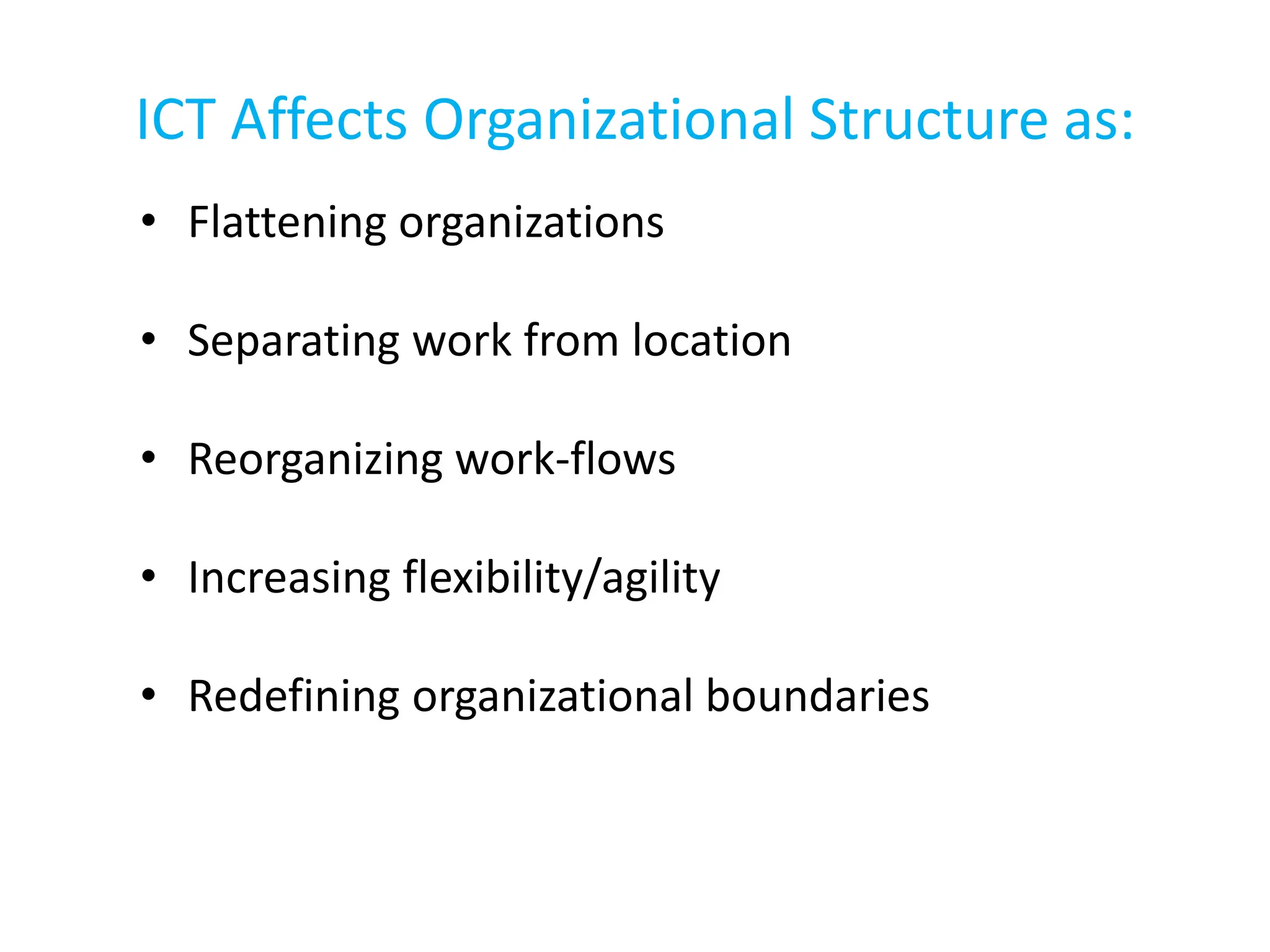
ICT Affects Organizational Structure as:
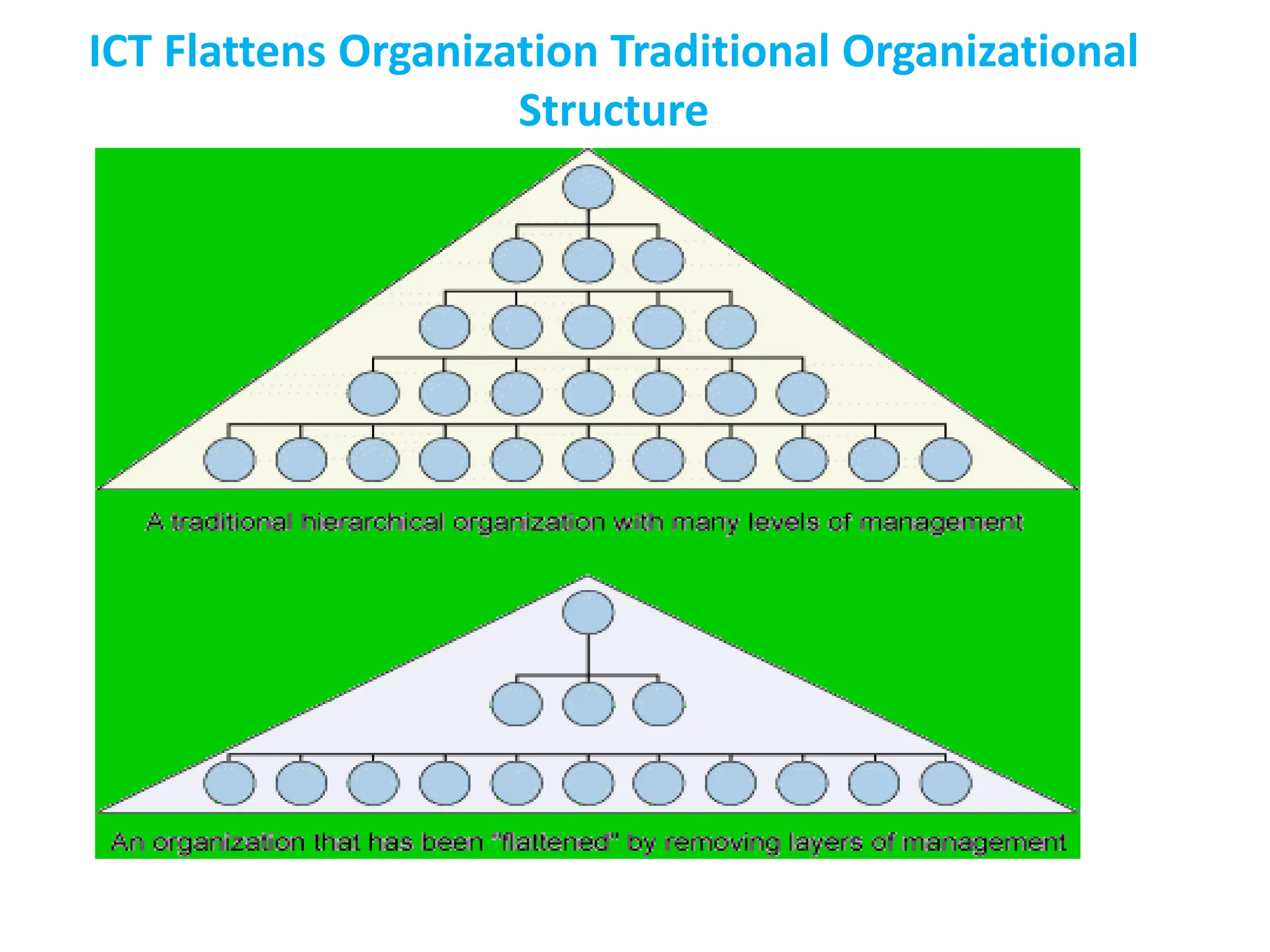
• Flattening organizations
• Separating work from location
• Reorganizing work-flows
• Increasing flexibility/agility
• Redefining organizational boundaries
ICT Flattens Organization Traditional Organizational
Structure
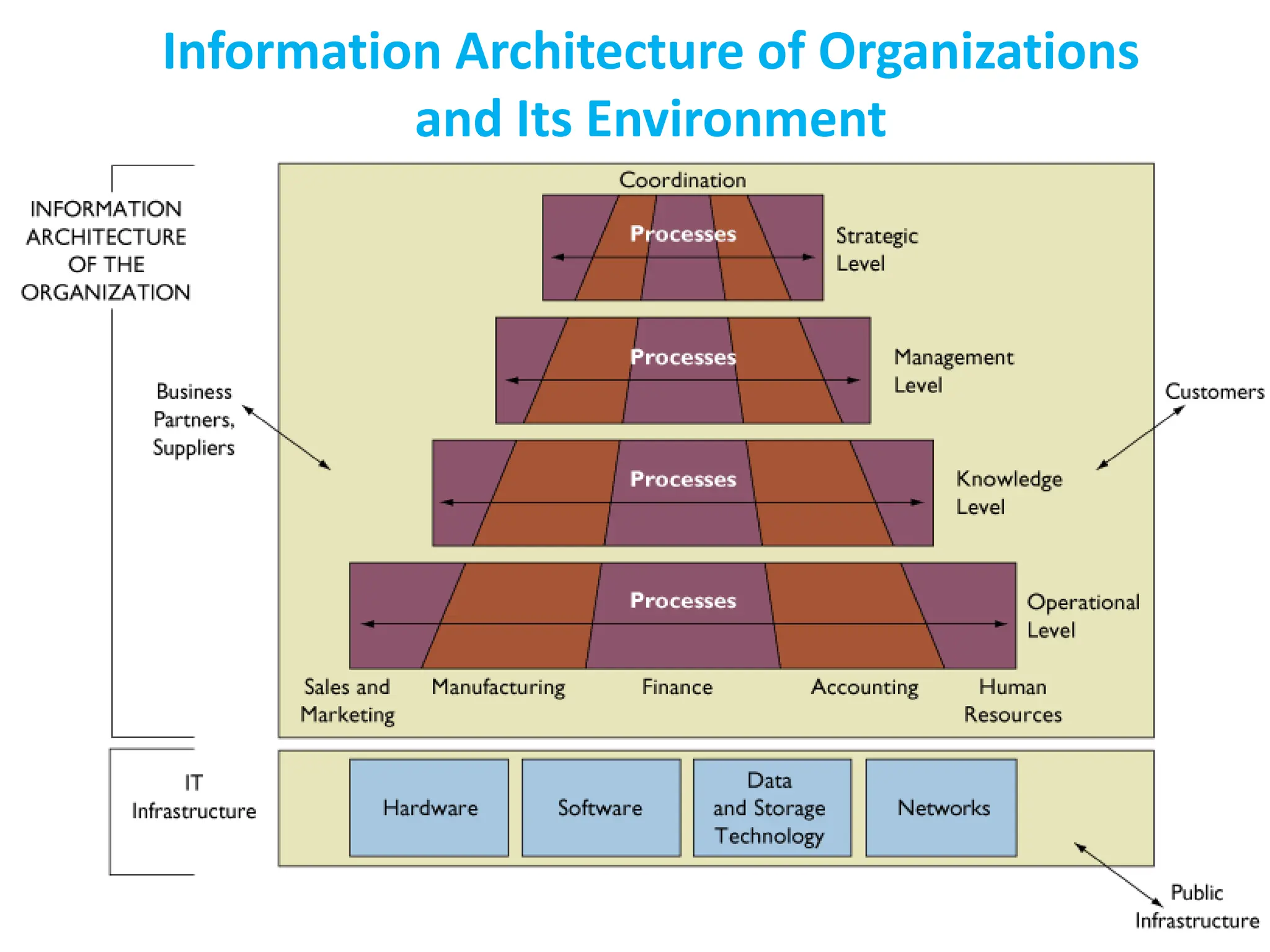
Information Architecture of Organizations
and Its Environment
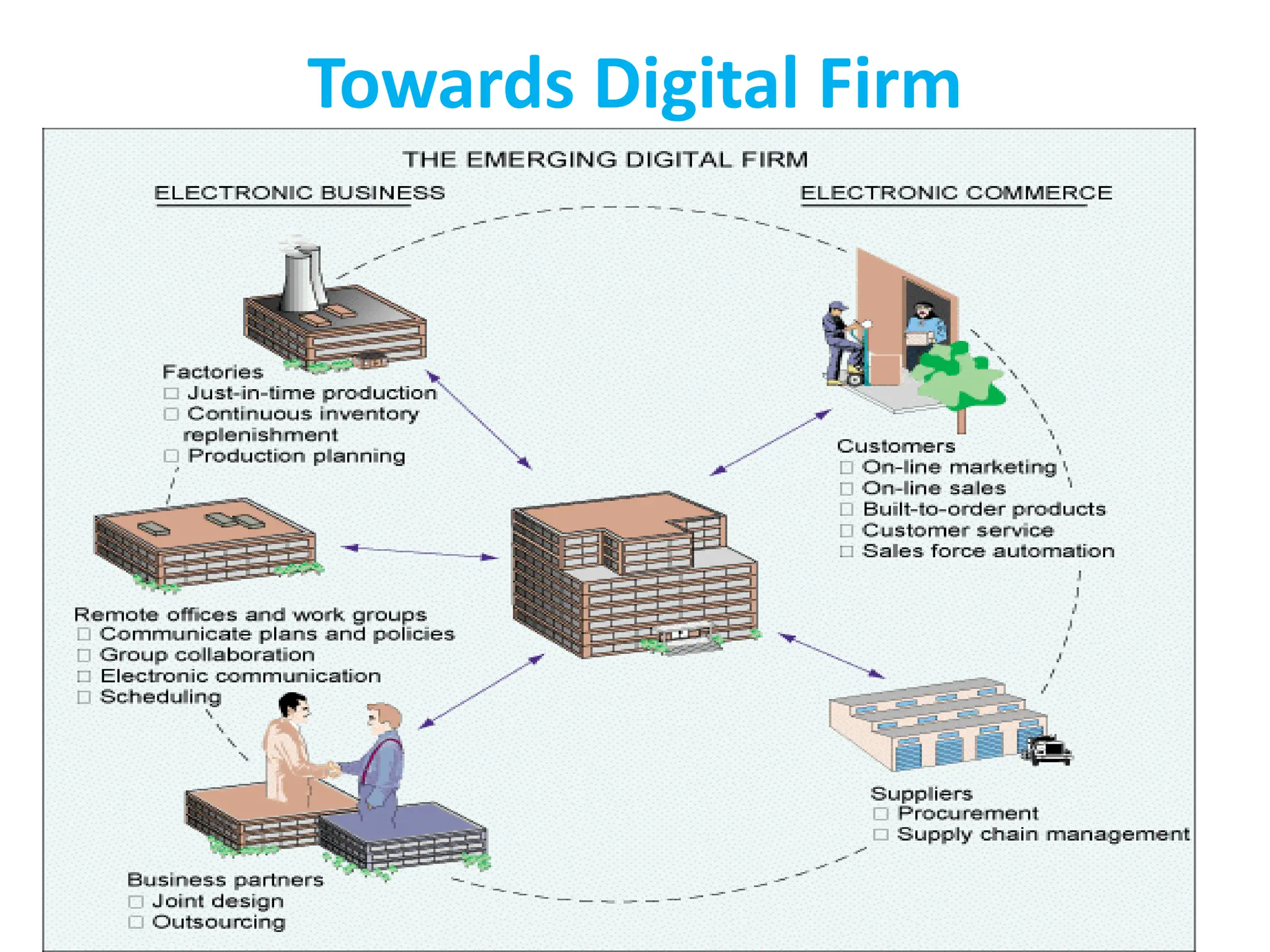
Towards Digital Firm
Strategic Use of ICT for Competitive Advantage
• Competitive Advantage is created or
maintained with the company succeeds in
performing some activity of value to
customers significantly better than its
competitors.
Strategic Use ICT for Competitive Advantage
• Make major investments in advanced ICT applications that build
barriers to entry against industry competitors or outsiders
• Include ICT components in products and services to make
substitution of competing products or services more difficult
• Leverage investment in
• ICT people
• Hardware
• Software
• Databases and
• Networks from operational uses into strategic
applications
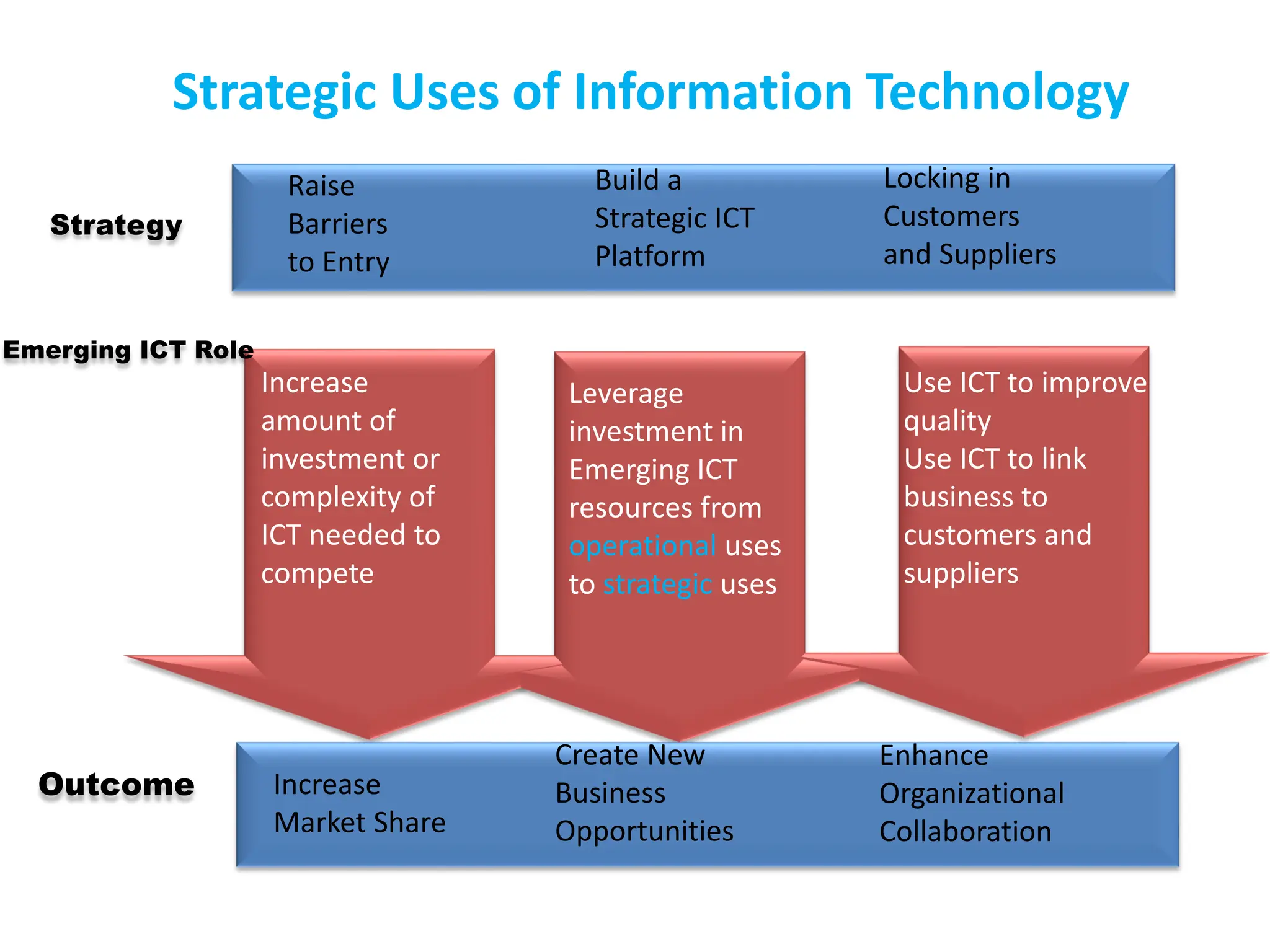
Strategic Uses of Information Technology
Raise
Barriers
to Entry
Build a
Strategic ICT
Platform
Locking in
Customers
and Suppliers
Increase
amount of
investment or
complexity of
ICT needed to
compete
Use ICT to improve
quality
Use ICT to link
business to
customers and
suppliers
Leverage
investment in
Emerging ICT
resources from
operational uses
to strategic uses
Increase
Market Share
Create New
Business
Opportunities
Enhance
Organizational
Collaboration
Strategy
Emerging ICT Role
Outcome
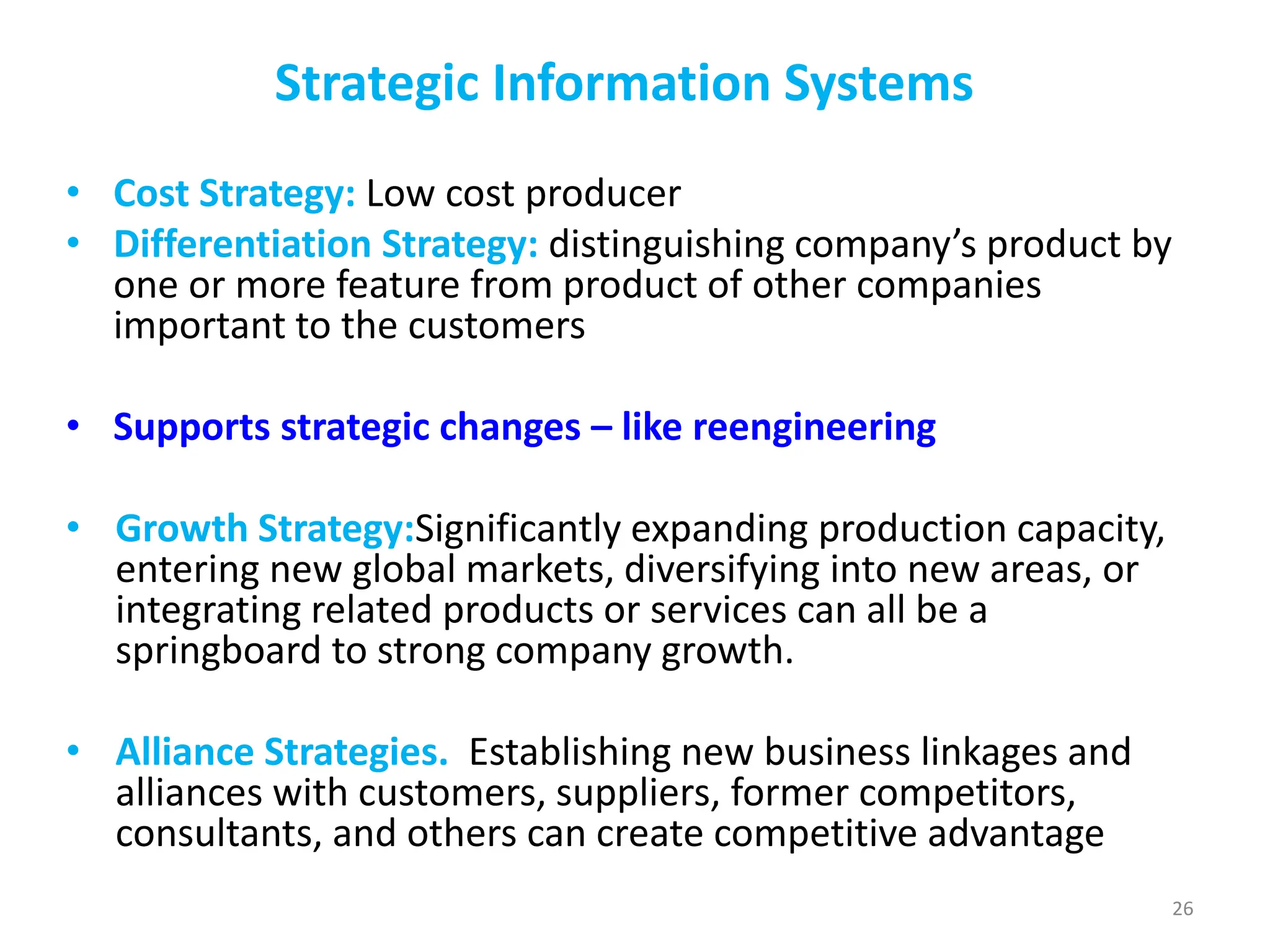
Strategic Information Systems
• Cost Strategy: Low cost producer
• Differentiation Strategy: distinguishing company’s product by
one or more feature from product of other companies
important to the customers
• Supports strategic changes – like reengineering
• Growth Strategy:Significantly expanding production capacity,
entering new global markets, diversifying into new areas, or
integrating related products or services can all be a
springboard to strong company growth.
• Alliance Strategies. Establishing new business linkages and
alliances with customers, suppliers, former competitors,
consultants, and others can create competitive advantage
26
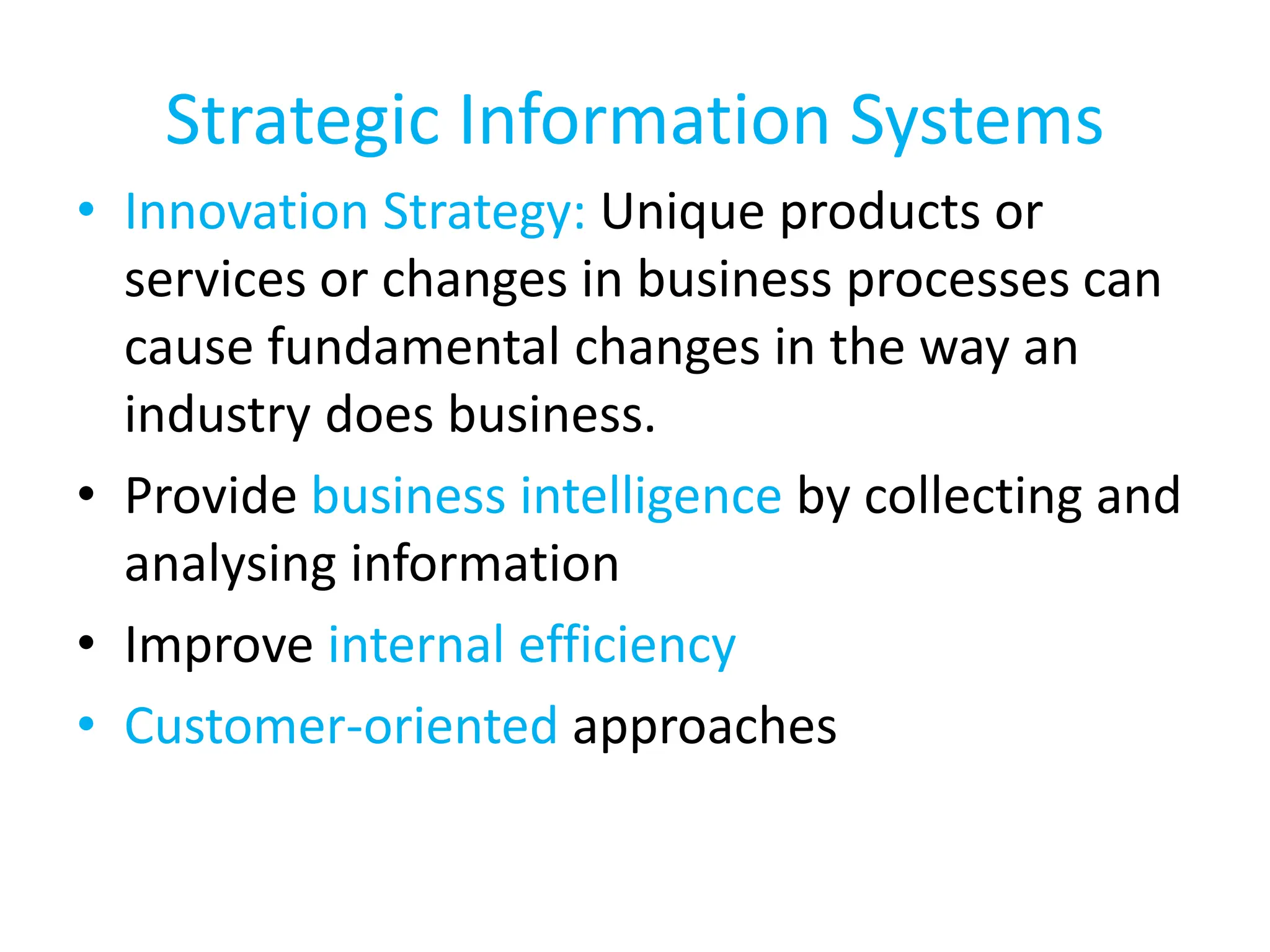
Strategic Information Systems
• Innovation Strategy: Unique products or
services or changes in business processes can
cause fundamental changes in the way an
industry does business.
• Provide business intelligence by collecting and
analysing information
• Improve internal efficiency
• Customer-oriented approaches
Internet Value Chains
• Value chains can be used to strategically position a
company’s Internet-based applications to gain
competitive advantage.
 This value chain model outlines several ways that a
company’s Internet connections with its customers
could provide business benefits and opportunities for
competitive advantage
• Example: Company-managed
•Internet newsgroups,
•Chat rooms, and
•E-commerce websites are powerful tools for
market research and product development, direct
sales, and customer feedback and support.
Internet Value Chains
 Company Internet connections with its suppliers could
be used for competitive advantage.
• Example:
• Online auctions and exchanges at suppliers’ e-
commerce websites and
• online shipping, scheduling, and status information at
an e-commerce portal that gives employees immediate
access to up-to-date information from a variety of
vendors.
• This can substantially lower costs, reduce lead times,
and improve the quality of products and services.
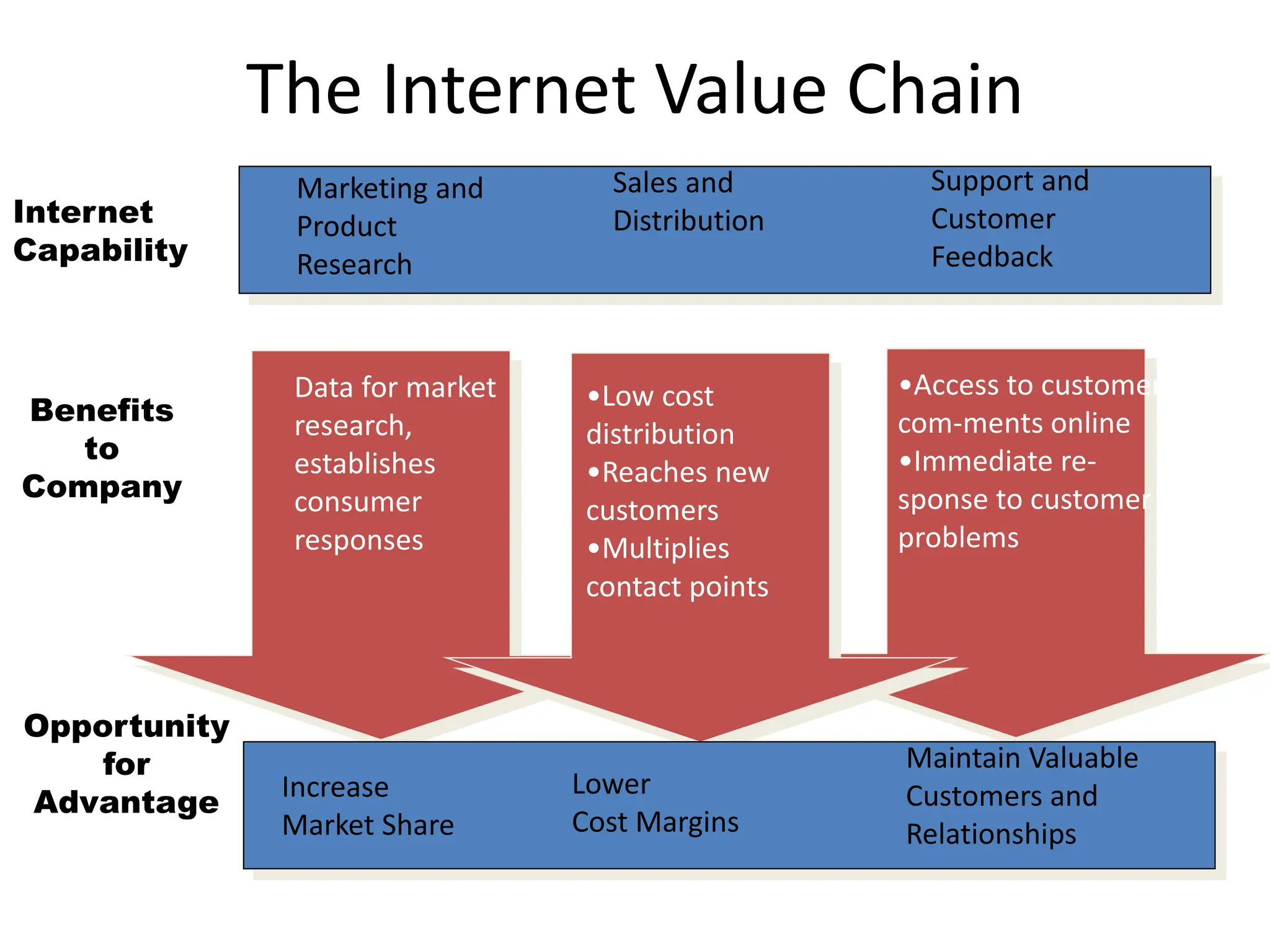
The Internet Value Chain
Marketing and
Product
Research
Sales and
Distribution
Support and
Customer
Feedback
Data for market
research,
establishes
consumer
responses
•Access to customer
com-ments online
•Immediate re-
sponse to customer
problems
•Low cost
distribution
•Reaches new
customers
•Multiplies
contact points
Increase
Market Share
Lower
Cost Margins
Maintain Valuable
Customers and
Relationships
Internet
Capability
Benefits
to
Company
Opportunity
for
Advantage
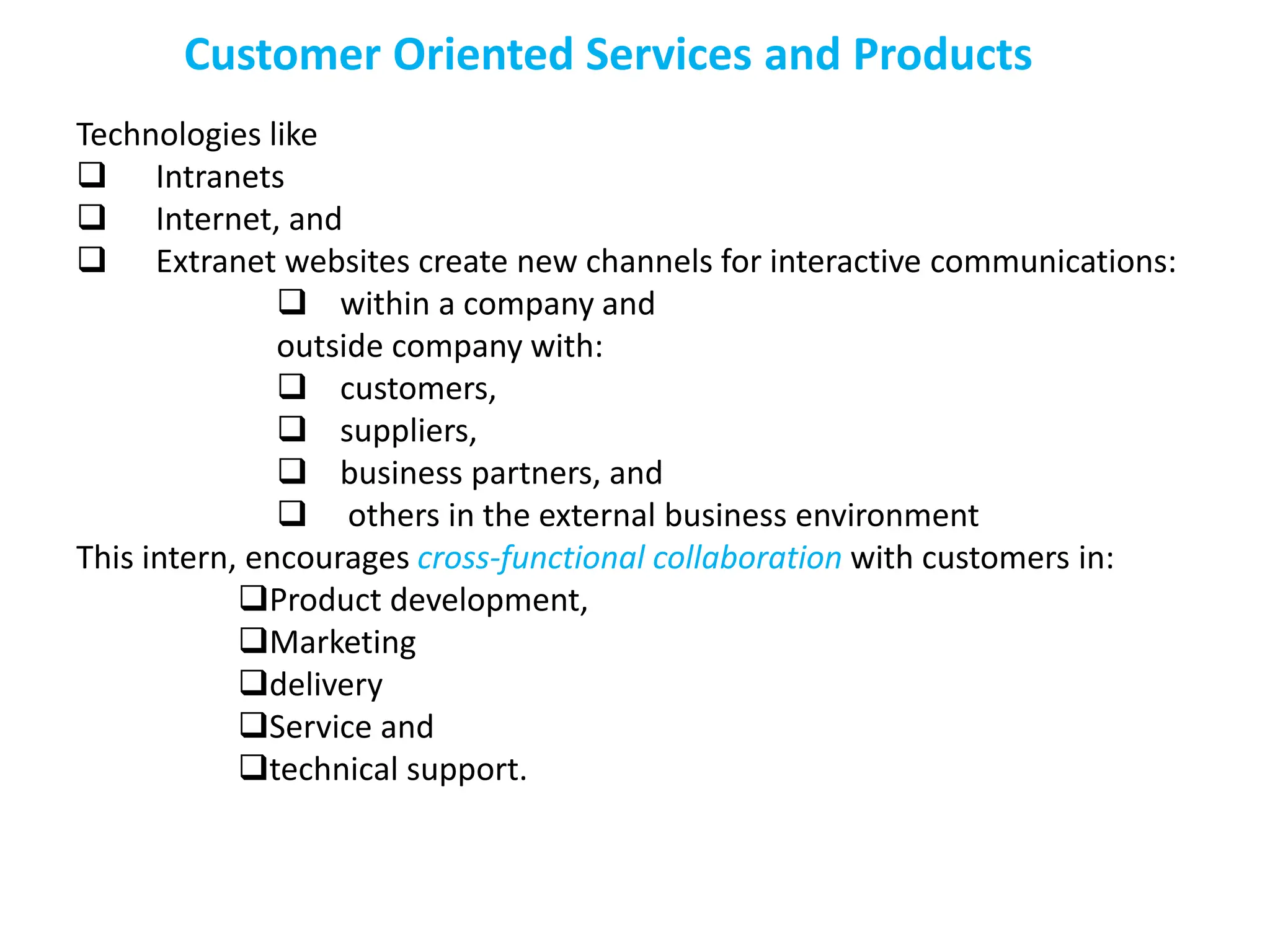
Customer Oriented Services and Products
Technologies like
 Intranets
 Internet, and
 Extranet websites create new channels for interactive communications:
 within a company and
outside company with:
 customers,
 suppliers,
 business partners, and
 others in the external business environment
This intern, encourages cross-functional collaboration with customers in:
Product development,
Marketing
delivery
Service and
technical support.
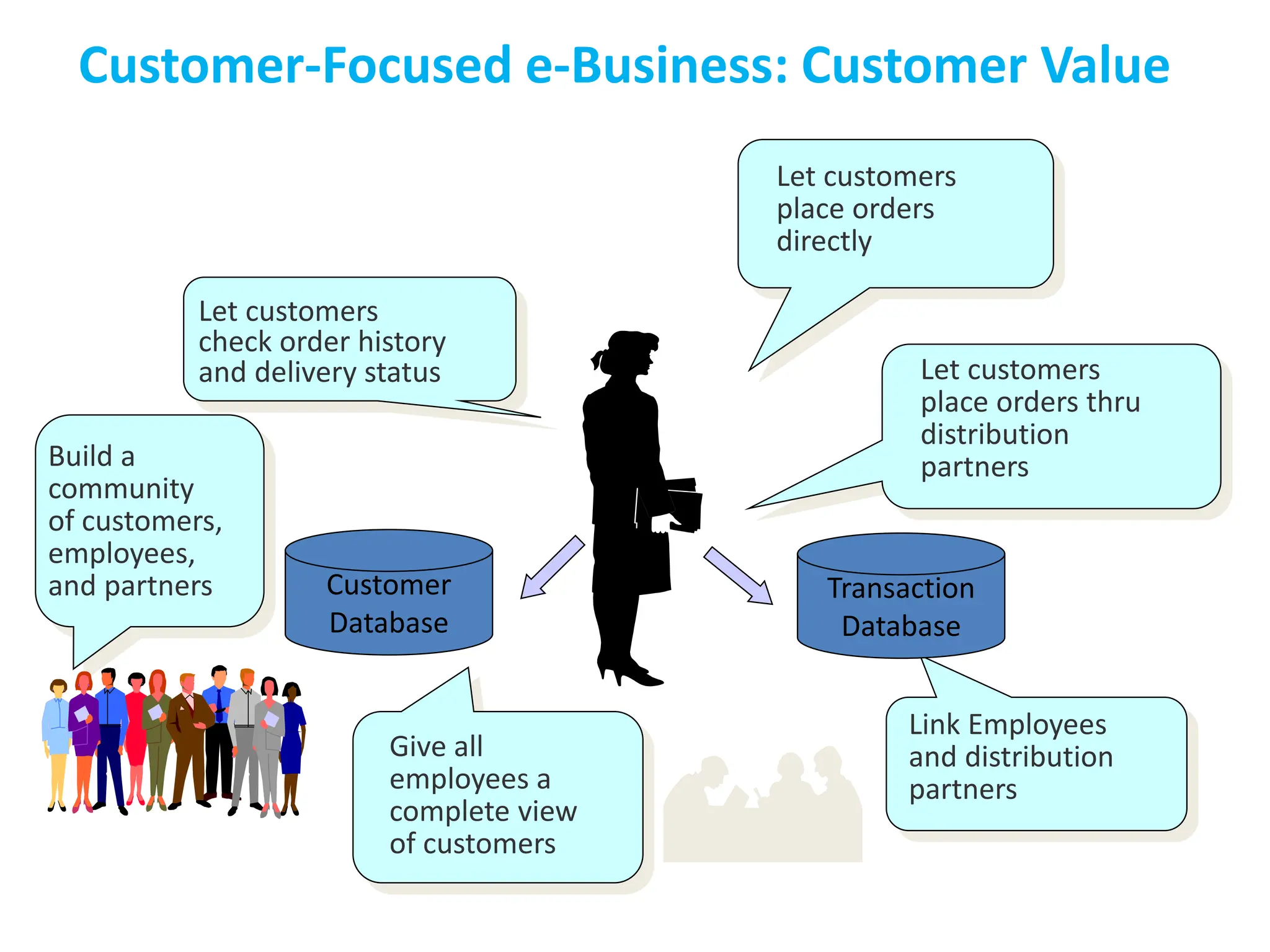
Customer-Focused e-Business: Customer Value
Let customers
place orders thru
distribution
partners
Transaction
Database
Link Employees
and distribution
partners
Let customers
check order history
and delivery status
Let customers
place orders
directly
Customer
Database
Build a
community
of customers,
employees,
and partners
Give all
employees a
complete view
of customers
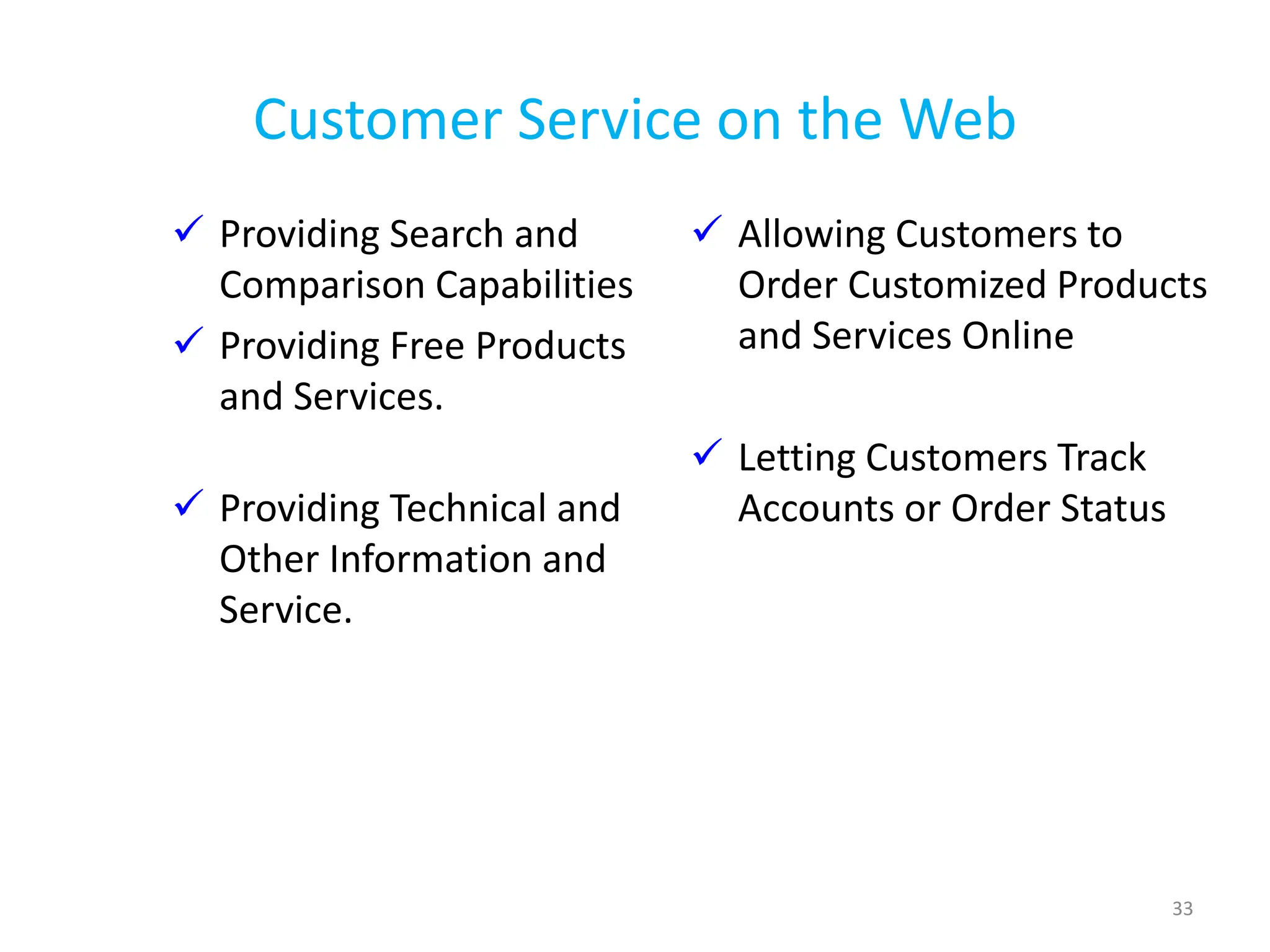
Customer Service on the Web
 Providing Search and
Comparison Capabilities
 Providing Free Products
and Services.
 Providing Technical and
Other Information and
Service.
 Allowing Customers to
Order Customized Products
and Services Online
 Letting Customers Track
Accounts or Order Status
33
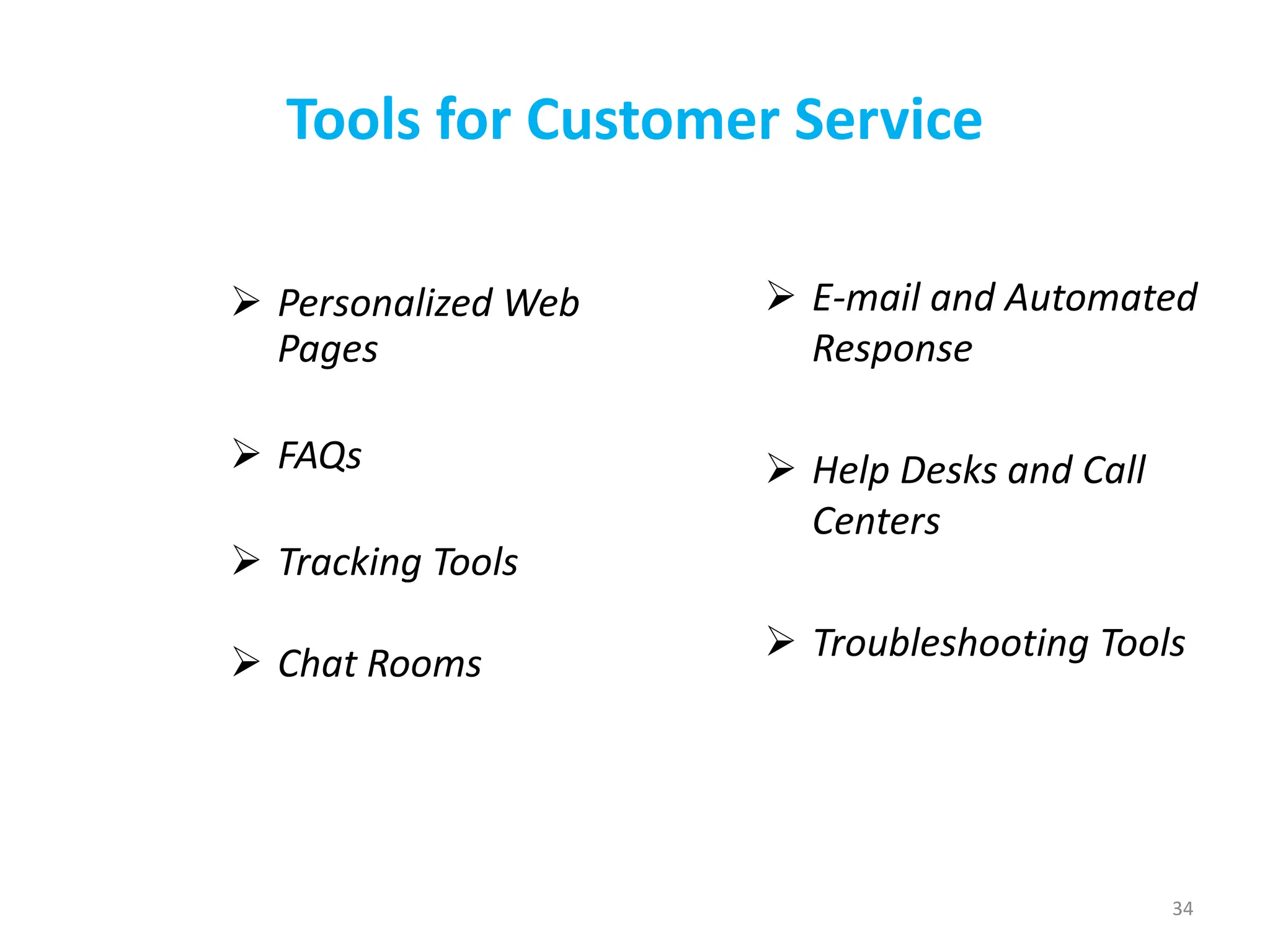
Tools for Customer Service
 Personalized Web
Pages
 FAQs
 Tracking Tools
 Chat Rooms
 E-mail and Automated
Response
 Help Desks and Call
Centers
 Troubleshooting Tools
34
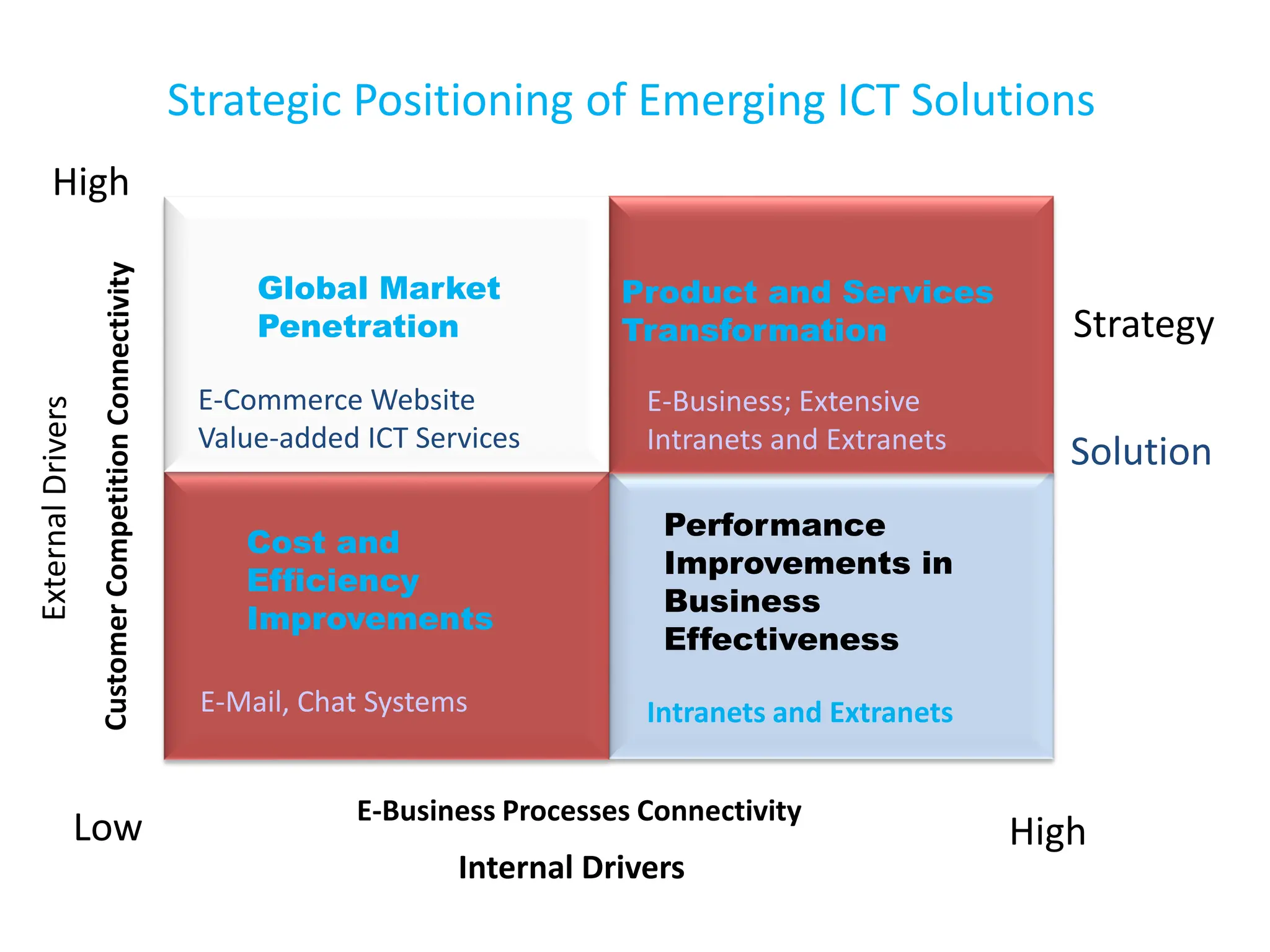
Strategic Positioning of Emerging Internet
Technologies
For Internet technologies to be used strategically
,applications must be correctly positioned.
 The strategic positioning matrix can be used to help a
company optimize the strategic impact of Internet
Technologies.
The matrix recognizes two major drivers:
Internal Drivers: The amount of connectivity,
collaboration and use of ICT within a firm.
External Drivers: The amount of connectivity,
collaboration and use of ICT by customers,
suppliers, business partners, and competitors.
Strategic Positioning of Emerging Internet
Technologies
• Cost and Efficiency Improvements.: When there is a low amount
of connectivity, collaboration and use of ICT within the company
and by customers and competitors, a firm should focus on
improving efficiency and lowering costs by using Internet
technologies to enhance communications between the company
and its customers and suppliers.
• Performance Improvement in Business Effectiveness: When
there is a high amount of internal connectivity, but external
connectivity by customers and competitors is still low, a firm
should focus on using Internet technologies like intranets and
extranets to make major improvements in business
effectiveness.
Strategic Positioning of Emerging Internet
Technologies
Global Market Penetration: When there is a high
degree of connectivity by customers and competitors
and low internal connectivity, a firm should focus on
developing Internet-based applications to optimize
interactions with customers and build market share.
Product and Service Transformation: When a company
and its customers, suppliers, and competitors are
extensively networked, Internet technologies should be
used to develop and deploy products and services that
strategically reposition it in the marketplace.
Strategic Positioning of Emerging ICT Solutions
Global Market
Penetration
E-Commerce Website
Value-added ICT Services
Product and Services
Transformation
E-Business; Extensive
Intranets and Extranets
Cost and
Efficiency
Improvements
E-Mail, Chat Systems
Performance
Improvements in
Business
Effectiveness
Intranets and Extranets
Strategy
Solution
Low
High
High
E-Business Processes Connectivity
Internal Drivers
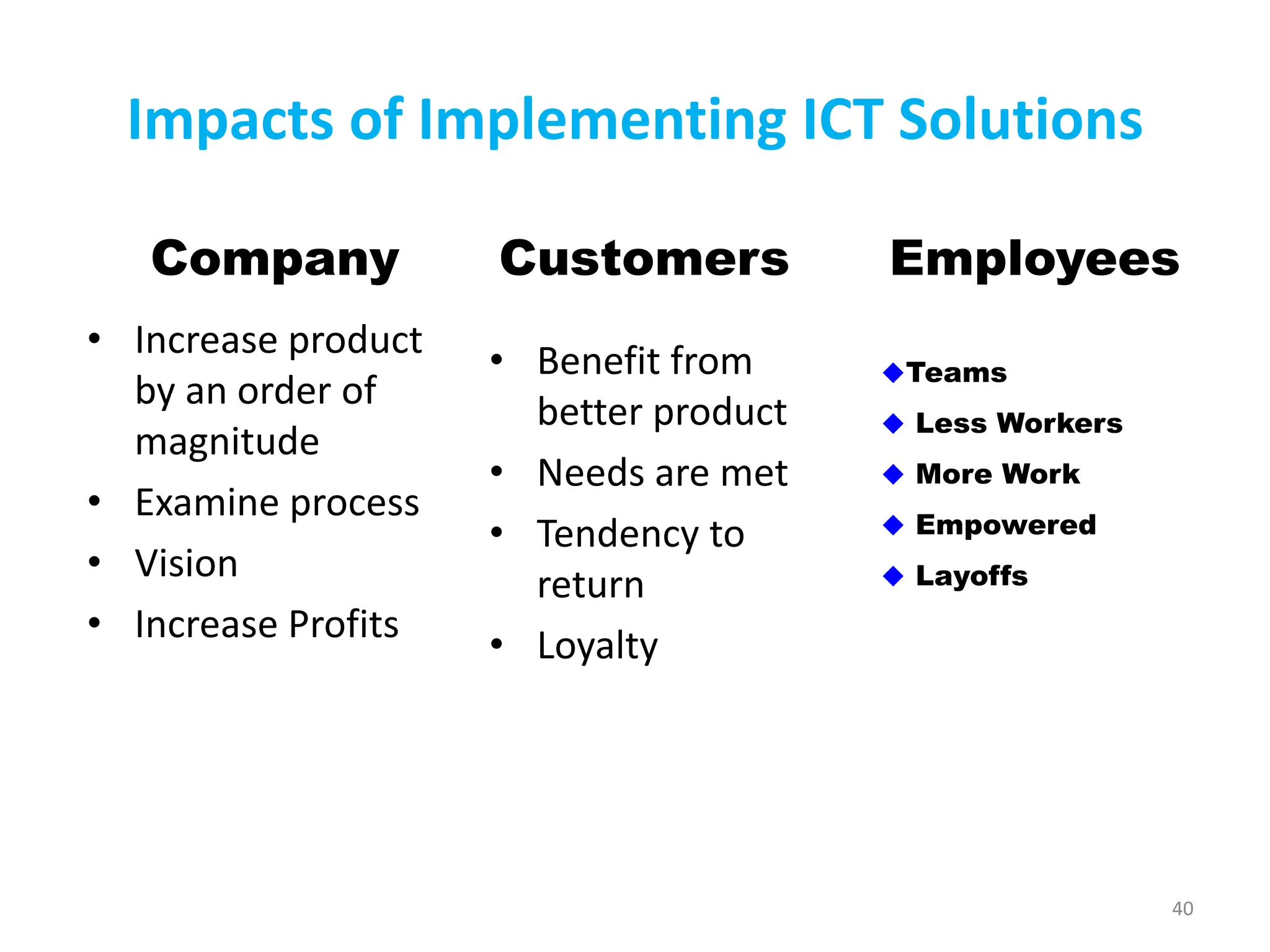
Impacts of Implementing ICT Solutions
• Increase product
by an order of
magnitude
• Examine process
• Vision
• Increase Profits
• Benefit from
better product
• Needs are met
• Tendency to
return
• Loyalty
40
Teams
 Less Workers
 More Work
 Empowered
 Layoffs
Company Customers Employees
The Need for Change Management
• Appropriate change mgt. is required to
implement ICT solutions in our organization to
deliver positive Impact
Thank You

Lecture_2_Competing_with_Information_and_Communication_Technology.pdf

  • 1.
    Management Information Systems Competingwith Information and Communication Technology in the Digital Age Lecture-2
  • 2.
    • Definition ofICT • Building blocks of ICT • Identify competitive strategies of information Communication Technologies • Process reengineering frequently involves the strategic use of e- business technologies • Identify the business value of using e-business technologies Outline of the lecture
  • 3.
    Definition • It isa convergence phenomena to get multiple services on a single device and unified communication link • It is Convergence of: • Data processing • Computer • Computer Networks • Communications and • Multimedia Digital contents
  • 4.
    Capabilities of ICT •ICT enable users to  Access  Storage  Transmission  Online Transactions  Manipulate information  Use information effectively and efficiently
  • 5.
  • 6.
    Building Blocks ofICT • Computers/digital devices/Smart devices • Telecommunication and/or Computers networks • Multimedia digital contents/web • Human know how  Knowledge  Skills  Attitude
  • 7.
    Multimedia • Multimedia: Informationin many forms (text, numbers, audio and motion pictures)
  • 8.
    What is Communication? Communication is the act of transferring information from one place to another In the case Computer Networks: it is exchanging information from computer to another computer through computer network
  • 9.
    Synchronous Communication • OnlineChat – Text based – Audio based – Video based • Mobile Technology – Conferencing – Phone • Satellite – Television channel – Video Conferencing 9
  • 10.
    Computers Computer is anelectronic device with the capabilities of: Can store large amounts of data Can perform certain operations on data Displays the result as output of the operation Process data whenever needed
  • 11.
    Computer Network  Acomputer network is an interconnection between among two or more computer  Nodes  Links  21st century is beyond connected devices connected intelligence through enterprise collaborations to:  Make smart decisions making and  effective and efficient business operations  Strategic competitions
  • 12.
    The Age ofNetworked Intelligence • Networking of humans through technology necessitated knowing the following concepts: • Life long Learning • Digital economy • Digital Age • ICT changes the way compete in business world
  • 13.
    Knowledge Economy • Individualsand enterprises create wealth by applying • Knowledge • Networked human intelligence • In modernizing the way we operate through automation and/or augmenting human in sectors like  Manufacturing,  Agriculture and  Services  Mining
  • 14.
    What is KnowledgeEconomy • Application of human know how • Life long learning • “SMART” products based machine learning and Internet of Things (IoT) • Economy added value will be created by brain not only through muscle • Mass Customized rather than mass-produced
  • 15.
    Mass Customization • Masscustomization is a marketing and manufacturing technique which combines the flexibility and personalization of custom-made products with the low unit costs associated with mass production • Involves sensitivity to customer preferences with standardization of processes • Seeks to combine: • flexibility • low costs and • high quality and • promote economics of scale
  • 16.
    How Introducing ICTAffects Traditional Organization Structure Need for new structures…..
  • 17.
    Prerequisites to ImplementInformation Communication Technology • Information Communication Technologies are flexible tools, constrained primarily by : • Managers’ will to use them • Expectations about their roles, and • Applications choices 17
  • 18.
    ICT affects Aspectsof Organization • Division of Labor –Who does what? • Division of Decision Rights –Who should make which decision? • Coordination Mechanisms • Organizational Boundaries • Informal Structures 18
  • 19.
    ICT Affects OrganizationalStructure as: • Flattening organizations • Separating work from location • Reorganizing work-flows • Increasing flexibility/agility • Redefining organizational boundaries
  • 20.
    ICT Flattens OrganizationTraditional Organizational Structure
  • 21.
    Information Architecture ofOrganizations and Its Environment
  • 22.
  • 23.
    Strategic Use ofICT for Competitive Advantage • Competitive Advantage is created or maintained with the company succeeds in performing some activity of value to customers significantly better than its competitors.
  • 24.
    Strategic Use ICTfor Competitive Advantage • Make major investments in advanced ICT applications that build barriers to entry against industry competitors or outsiders • Include ICT components in products and services to make substitution of competing products or services more difficult • Leverage investment in • ICT people • Hardware • Software • Databases and • Networks from operational uses into strategic applications
  • 25.
    Strategic Uses ofInformation Technology Raise Barriers to Entry Build a Strategic ICT Platform Locking in Customers and Suppliers Increase amount of investment or complexity of ICT needed to compete Use ICT to improve quality Use ICT to link business to customers and suppliers Leverage investment in Emerging ICT resources from operational uses to strategic uses Increase Market Share Create New Business Opportunities Enhance Organizational Collaboration Strategy Emerging ICT Role Outcome
  • 26.
    Strategic Information Systems •Cost Strategy: Low cost producer • Differentiation Strategy: distinguishing company’s product by one or more feature from product of other companies important to the customers • Supports strategic changes – like reengineering • Growth Strategy:Significantly expanding production capacity, entering new global markets, diversifying into new areas, or integrating related products or services can all be a springboard to strong company growth. • Alliance Strategies. Establishing new business linkages and alliances with customers, suppliers, former competitors, consultants, and others can create competitive advantage 26
  • 27.
    Strategic Information Systems •Innovation Strategy: Unique products or services or changes in business processes can cause fundamental changes in the way an industry does business. • Provide business intelligence by collecting and analysing information • Improve internal efficiency • Customer-oriented approaches
  • 28.
    Internet Value Chains •Value chains can be used to strategically position a company’s Internet-based applications to gain competitive advantage.  This value chain model outlines several ways that a company’s Internet connections with its customers could provide business benefits and opportunities for competitive advantage • Example: Company-managed •Internet newsgroups, •Chat rooms, and •E-commerce websites are powerful tools for market research and product development, direct sales, and customer feedback and support.
  • 29.
    Internet Value Chains Company Internet connections with its suppliers could be used for competitive advantage. • Example: • Online auctions and exchanges at suppliers’ e- commerce websites and • online shipping, scheduling, and status information at an e-commerce portal that gives employees immediate access to up-to-date information from a variety of vendors. • This can substantially lower costs, reduce lead times, and improve the quality of products and services.
  • 30.
    The Internet ValueChain Marketing and Product Research Sales and Distribution Support and Customer Feedback Data for market research, establishes consumer responses •Access to customer com-ments online •Immediate re- sponse to customer problems •Low cost distribution •Reaches new customers •Multiplies contact points Increase Market Share Lower Cost Margins Maintain Valuable Customers and Relationships Internet Capability Benefits to Company Opportunity for Advantage
  • 31.
    Customer Oriented Servicesand Products Technologies like  Intranets  Internet, and  Extranet websites create new channels for interactive communications:  within a company and outside company with:  customers,  suppliers,  business partners, and  others in the external business environment This intern, encourages cross-functional collaboration with customers in: Product development, Marketing delivery Service and technical support.
  • 32.
    Customer-Focused e-Business: CustomerValue Let customers place orders thru distribution partners Transaction Database Link Employees and distribution partners Let customers check order history and delivery status Let customers place orders directly Customer Database Build a community of customers, employees, and partners Give all employees a complete view of customers
  • 33.
    Customer Service onthe Web  Providing Search and Comparison Capabilities  Providing Free Products and Services.  Providing Technical and Other Information and Service.  Allowing Customers to Order Customized Products and Services Online  Letting Customers Track Accounts or Order Status 33
  • 34.
    Tools for CustomerService  Personalized Web Pages  FAQs  Tracking Tools  Chat Rooms  E-mail and Automated Response  Help Desks and Call Centers  Troubleshooting Tools 34
  • 35.
    Strategic Positioning ofEmerging Internet Technologies For Internet technologies to be used strategically ,applications must be correctly positioned.  The strategic positioning matrix can be used to help a company optimize the strategic impact of Internet Technologies. The matrix recognizes two major drivers: Internal Drivers: The amount of connectivity, collaboration and use of ICT within a firm. External Drivers: The amount of connectivity, collaboration and use of ICT by customers, suppliers, business partners, and competitors.
  • 36.
    Strategic Positioning ofEmerging Internet Technologies • Cost and Efficiency Improvements.: When there is a low amount of connectivity, collaboration and use of ICT within the company and by customers and competitors, a firm should focus on improving efficiency and lowering costs by using Internet technologies to enhance communications between the company and its customers and suppliers. • Performance Improvement in Business Effectiveness: When there is a high amount of internal connectivity, but external connectivity by customers and competitors is still low, a firm should focus on using Internet technologies like intranets and extranets to make major improvements in business effectiveness.
  • 37.
    Strategic Positioning ofEmerging Internet Technologies Global Market Penetration: When there is a high degree of connectivity by customers and competitors and low internal connectivity, a firm should focus on developing Internet-based applications to optimize interactions with customers and build market share. Product and Service Transformation: When a company and its customers, suppliers, and competitors are extensively networked, Internet technologies should be used to develop and deploy products and services that strategically reposition it in the marketplace.
  • 38.
    Strategic Positioning ofEmerging ICT Solutions Global Market Penetration E-Commerce Website Value-added ICT Services Product and Services Transformation E-Business; Extensive Intranets and Extranets Cost and Efficiency Improvements E-Mail, Chat Systems Performance Improvements in Business Effectiveness Intranets and Extranets Strategy Solution Low High High E-Business Processes Connectivity Internal Drivers
  • 39.
    Impacts of ImplementingICT Solutions • Increase product by an order of magnitude • Examine process • Vision • Increase Profits • Benefit from better product • Needs are met • Tendency to return • Loyalty 40 Teams  Less Workers  More Work  Empowered  Layoffs Company Customers Employees
  • 40.
    The Need forChange Management • Appropriate change mgt. is required to implement ICT solutions in our organization to deliver positive Impact
  • 41.