

Insect Development
&
Life Histories
Ch.06
Ontogeny(Biology)
- the development or developmental
history of an individual organism
- the pattern of growth from egg to
adult
Growth
Insect growth is discontinuous, at least
for the sclerotized (hard exoskeleton) cuticular
parts of the body, because the rigid cuticle
limits expansion.
Growth
Molting is the increase in size; a
periodic shedding of new cuticle of greater
surface area and shedding of old cuticle.
Growth
1. Indeterminate (continuous molting until
death) often occurs in apterygotes (wingless)
2. Determinate occurs in vast majority of
insects; often are imagines (imago; reproductively
mature); subimago is rarely reproductive (e.g.
mayflies), the female mates as a subimago then
dies without molting to an imago.
Life History Patterns and Phases
The developmental history of an
organism from egg to adult (ontogeny).
Life History Patterns and Phases
1. Embryonic Phase
The egg stage begins as soon as the
female deposit the mature egg. For practical
reasons, the age of an egg is estimated from
the time of its deposition even though the
egg existed before oviposition.
Life History Patterns and Phases
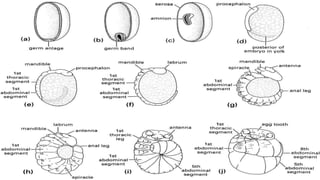
Germ Anlage- the first sign of the developing embryo
Germ Band- the germ anlage after gastrulation (creating
a multiple layer of cell)
Serosa- the embryonic cover or the thin membrane
Amnion- a membrane that closely covers the embryo
when first formed; which serves to provide a protective
environment for the developing embryo.
Procephalon- part of an insect's head that is in front of
the segment in which the mandibles are located
Life History Patterns and Phases
2. Larval or Nymphal Phase
All immature holometabolous
insects are called larvae. Immature
terrestrial insects with hemimetabolous
development are always called nymphs.
Life History Patterns and Phases
Larvae
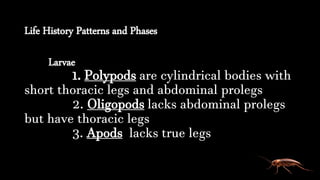
1. Polypods are cylindrical bodies with
short thoracic legs and abdominal prolegs
2. Oligopods lacks abdominal prolegs
but have thoracic legs
3. Apods lacks true legs
Life History Patterns and Phases
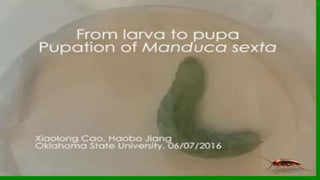
3. Metamorphosis often occur in
pterygotes; refers in particular to the change
from larva to adult of an insect.
1. Hemimetaboly a.k.a incomplete
metamorphosis; typically has only three-stage cycle:
egg, nymph, and adult.
2. Holometaboly a.k.a complete
metamorphosis; has four-stage of cycle: egg, larva,
pupa, and adult.
Life History Patterns and Phases
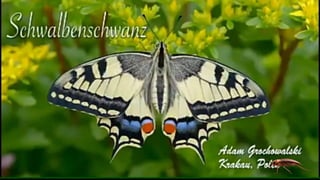
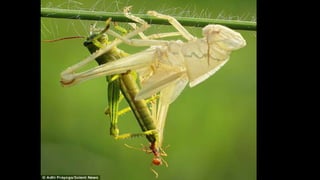
4. Imaginal or Adult Phase
The eclosion (pupal to adult ecdysis)
of an insect.
Life History Patterns and Phases
4. Imaginal or Adult Phase
Reproduction is the main function of adult life and
the length of the imaginal stadium, at least in the female,
is related to the duration of egg production.
Senescence correlates with termination of
reproduction and death may be predetermined in the
ontogeny of an insect. Females may die after egg
deposition and males die after mating.
Process and Control of Molting
Molting is the increase in size
1. Molt Increment occurs between
one instar (growth stage between two
successive molts or ecdyses).
2. Intermolt Period a.k.a. stadium
(time between one instar) or instar
duration.
Process and Control of Molting
…
Dealing with Environmental Extremes
1. Cold
- Freeze Tolerance
- Freeze Avoidance
- Chill Tolerance
- Chill Susceptibility
- Opportunistic Survival

Chapter VI – Insect Development and Life Histories

  • 1.
  • 2.
    Ontogeny(Biology) - the developmentor developmental history of an individual organism - the pattern of growth from egg to adult
  • 3.
    Growth Insect growth isdiscontinuous, at least for the sclerotized (hard exoskeleton) cuticular parts of the body, because the rigid cuticle limits expansion.
  • 4.
    Growth Molting is theincrease in size; a periodic shedding of new cuticle of greater surface area and shedding of old cuticle.
  • 5.
    Growth 1. Indeterminate (continuousmolting until death) often occurs in apterygotes (wingless) 2. Determinate occurs in vast majority of insects; often are imagines (imago; reproductively mature); subimago is rarely reproductive (e.g. mayflies), the female mates as a subimago then dies without molting to an imago.
  • 6.
    Life History Patternsand Phases The developmental history of an organism from egg to adult (ontogeny).
  • 7.
    Life History Patternsand Phases 1. Embryonic Phase The egg stage begins as soon as the female deposit the mature egg. For practical reasons, the age of an egg is estimated from the time of its deposition even though the egg existed before oviposition.
  • 8.
    Life History Patternsand Phases Germ Anlage- the first sign of the developing embryo Germ Band- the germ anlage after gastrulation (creating a multiple layer of cell) Serosa- the embryonic cover or the thin membrane Amnion- a membrane that closely covers the embryo when first formed; which serves to provide a protective environment for the developing embryo. Procephalon- part of an insect's head that is in front of the segment in which the mandibles are located
  • 11.
    Life History Patternsand Phases 2. Larval or Nymphal Phase All immature holometabolous insects are called larvae. Immature terrestrial insects with hemimetabolous development are always called nymphs.
  • 12.
    Life History Patternsand Phases Larvae 1. Polypods are cylindrical bodies with short thoracic legs and abdominal prolegs 2. Oligopods lacks abdominal prolegs but have thoracic legs 3. Apods lacks true legs
  • 15.
    Life History Patternsand Phases 3. Metamorphosis often occur in pterygotes; refers in particular to the change from larva to adult of an insect. 1. Hemimetaboly a.k.a incomplete metamorphosis; typically has only three-stage cycle: egg, nymph, and adult. 2. Holometaboly a.k.a complete metamorphosis; has four-stage of cycle: egg, larva, pupa, and adult.
  • 18.
    Life History Patternsand Phases 4. Imaginal or Adult Phase The eclosion (pupal to adult ecdysis) of an insect.
  • 20.
    Life History Patternsand Phases 4. Imaginal or Adult Phase Reproduction is the main function of adult life and the length of the imaginal stadium, at least in the female, is related to the duration of egg production. Senescence correlates with termination of reproduction and death may be predetermined in the ontogeny of an insect. Females may die after egg deposition and males die after mating.
  • 22.
    Process and Controlof Molting Molting is the increase in size 1. Molt Increment occurs between one instar (growth stage between two successive molts or ecdyses). 2. Intermolt Period a.k.a. stadium (time between one instar) or instar duration.
  • 24.
    Process and Controlof Molting …
  • 26.
    Dealing with EnvironmentalExtremes 1. Cold - Freeze Tolerance - Freeze Avoidance - Chill Tolerance - Chill Susceptibility - Opportunistic Survival