







Welcome to
Biology
Department
Lecture 1
BACTERIOLOGY
WELCOME TO
 Lecture contents
d
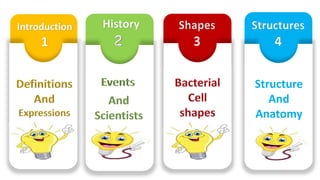
Structures
4
Structure
And
Anatomy
d
Introduction
1
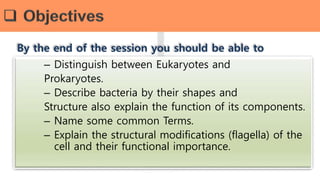
– Distinguish between Eukaryotes and
Prokaryotes.
– Describe bacteria by their shapes and
Structure also explain the function of its components.
– Name some common Terms.
– Explain the structural modifications (flagella) of the
cell and their functional importance.
By the end of the session you should be able to
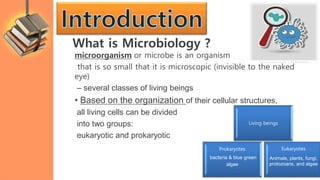
What is Microbiology ?
microorganism or microbe is an organism
that is so small that it is microscopic (invisible to the naked
eye)
– several classes of living beings
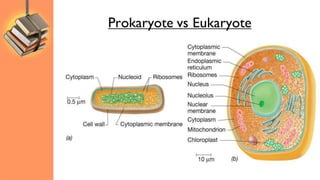
• Based on the organization of their cellular structures,
all living cells can be divided
into two groups:
eukaryotic and prokaryotic
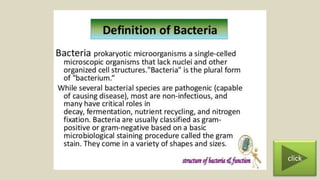
Prokaryotes
bacteria & blue green
algae
Eukaryotes
Animals, plants, fungi,
protozoans, and algae
Living beings
 Common Terms
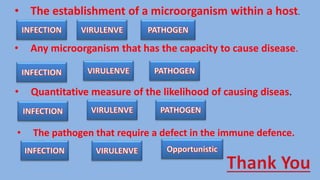
• INFECTION: the establishment of a microorganism within
a host.
• PATHOGEN: Any microorganism that has the capacity to
• cause disease.
• VIRULENCE: quantitative measure of the likelihood of
• causing disease.
• OPORTUNISTICS:
• Principle pathogens regularly cause disease
• Opportunistic pathogens require a defect in the immune
defence
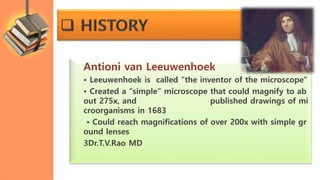
Antioni van Leeuwenhoek
• Leeuwenhoek is called "the inventor of the microscope"
• Created a “simple” microscope that could magnify to ab
out 275x, and published drawings of mi
croorganisms in 1683
• Could reach magnifications of over 200x with simple gr
ound lenses
3Dr.T.V.Rao MD
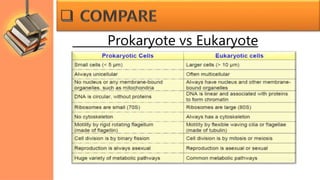
Prokaryote vs Eukaryote
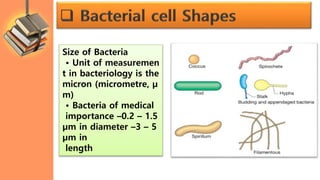
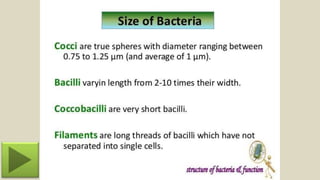
Size of Bacteria
• Unit of measuremen
t in bacteriology is the
micron (micrometre, µ
m)
• Bacteria of medical
importance –0.2 – 1.5
µm in diameter –3 – 5
µm in
length
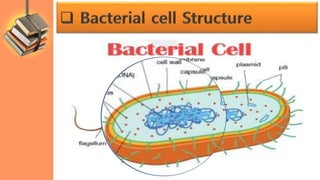
Outer layer – two components:
1. Rigid cell wall
2. Cytoplasmic (Cell/ Plasma) membrane – present beneath cell
wall
Cytoplasm – cytoplasmic inclusions, ribosomes, mesosomes, g
enetic material
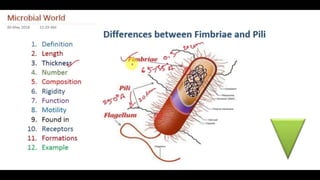
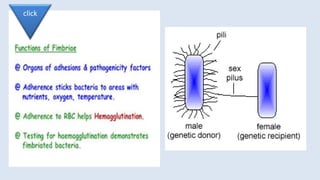
Additional structures –capsule, flagella, fimbriae (pili), spores
Anatomy of A Bacterial Cell
who examined the first microorganisms?
Who is bigger in size? (prokaryotes or Eukaryotes)?
Where can we found bacteria ?
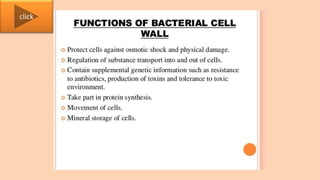
What is the Function of cell wall ?
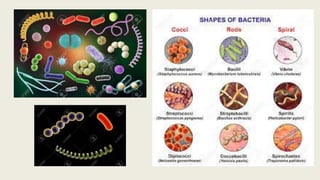
Bacterial shapes are variable describe ?
Bacterial Cell structure can be modified, how come?
clickclick
click
click
Click here
click
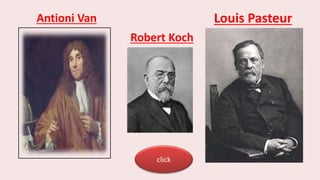
Robert Koch
Louis PasteurAntioni Van
click
click
click
click
click
click
click
click
http://www.softschools.com/quizzes/biology/ba
cteria/quiz2299.html click
• The establishment of a microorganism within a host.
• Any microorganism that has the capacity to cause disease.
• Quantitative measure of the likelihood of causing diseas.
• The pathogen that require a defect in the immune defence.
Click Here
Click here

Chapter one Dr.Rania Momtaz A. Azab

  • 1.
  • 2.
  • 3.
  • 4.
  • 5.
  • 6.
    – Distinguish betweenEukaryotes and Prokaryotes. – Describe bacteria by their shapes and Structure also explain the function of its components. – Name some common Terms. – Explain the structural modifications (flagella) of the cell and their functional importance. By the end of the session you should be able to
  • 7.
    What is Microbiology? microorganism or microbe is an organism that is so small that it is microscopic (invisible to the naked eye) – several classes of living beings • Based on the organization of their cellular structures, all living cells can be divided into two groups: eukaryotic and prokaryotic Prokaryotes bacteria & blue green algae Eukaryotes Animals, plants, fungi, protozoans, and algae Living beings
  • 8.
     Common Terms •INFECTION: the establishment of a microorganism within a host. • PATHOGEN: Any microorganism that has the capacity to • cause disease. • VIRULENCE: quantitative measure of the likelihood of • causing disease. • OPORTUNISTICS: • Principle pathogens regularly cause disease • Opportunistic pathogens require a defect in the immune defence
  • 9.
    Antioni van Leeuwenhoek •Leeuwenhoek is called "the inventor of the microscope" • Created a “simple” microscope that could magnify to ab out 275x, and published drawings of mi croorganisms in 1683 • Could reach magnifications of over 200x with simple gr ound lenses 3Dr.T.V.Rao MD
  • 10.
  • 12.
    Size of Bacteria •Unit of measuremen t in bacteriology is the micron (micrometre, µ m) • Bacteria of medical importance –0.2 – 1.5 µm in diameter –3 – 5 µm in length
  • 15.
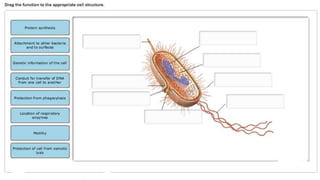
    Outer layer –two components: 1. Rigid cell wall 2. Cytoplasmic (Cell/ Plasma) membrane – present beneath cell wall Cytoplasm – cytoplasmic inclusions, ribosomes, mesosomes, g enetic material Additional structures –capsule, flagella, fimbriae (pili), spores Anatomy of A Bacterial Cell
  • 16.
    who examined thefirst microorganisms? Who is bigger in size? (prokaryotes or Eukaryotes)? Where can we found bacteria ? What is the Function of cell wall ? Bacterial shapes are variable describe ? Bacterial Cell structure can be modified, how come?
  • 17.
  • 18.
  • 19.
  • 21.
  • 23.
  • 24.
  • 25.
  • 26.
  • 29.
  • 30.
  • 32.
  • 34.
    • The establishmentof a microorganism within a host. • Any microorganism that has the capacity to cause disease. • Quantitative measure of the likelihood of causing diseas. • The pathogen that require a defect in the immune defence.
  • 35.
  • 36.