to relate your
personalexperiences
with the input
provided.
01
to demonstrate an
understanding of the
keys ideas in the
language and
communication; and
02
Learning Outcomes
3.
What is Language?
Togetherwith the creation of human life is the creation of a wonderful
and dynamic human capacity – language
Animals are said to be able to communicate with each other.
• Whales, sing.
• Wolves, howl.
• Dogs, bark.
• Birds, chirp.
The sounds that these creatures produce often reflect the state of their
emotions. While it may be true that animals communicate but only human
being are capable of producing language.
4.
Language is commonlydefined simply as “a means of communication”, but it is
defined so, there will be no difference between human communication and animal
communication. The reason is because, both animal and human do have means to
communicate.
For example: A monkey may be able to signal to its partner that is sharing food.
The monkey will produce sounds and gestures, but will not be able to organize
the sounds into a meaningful system with rules. Human beings, on the other
hand, are able to communicate their desire to share food through several ways
that are understandable to other human beings.
• They may utter word (Food!).
• Raise a question (Want some food?)
• Or give a statement (I’d like to share this food with you).
5.
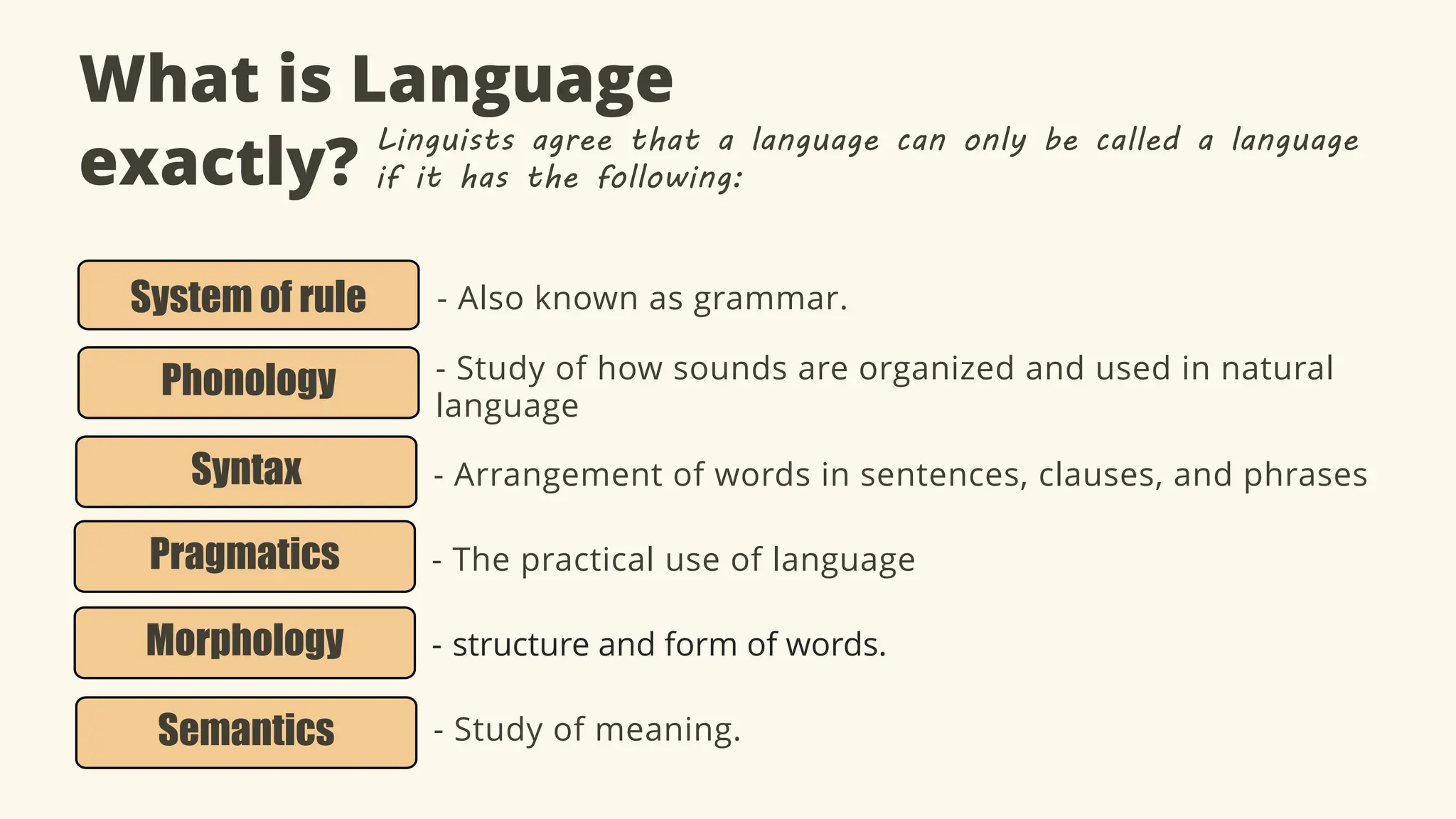
What is Language
exactly?
-Also known as grammar.
System of rule
- Study of how sounds are organized and used in natural
language
Phonology
- Arrangement of words in sentences, clauses, and phrases
Syntax
- The practical use of language
Pragmatics
- structure and form of words.
Morphology
- Study of meaning.
Semantics
Linguists agree that a language can only be called a language
if it has the following:
6.
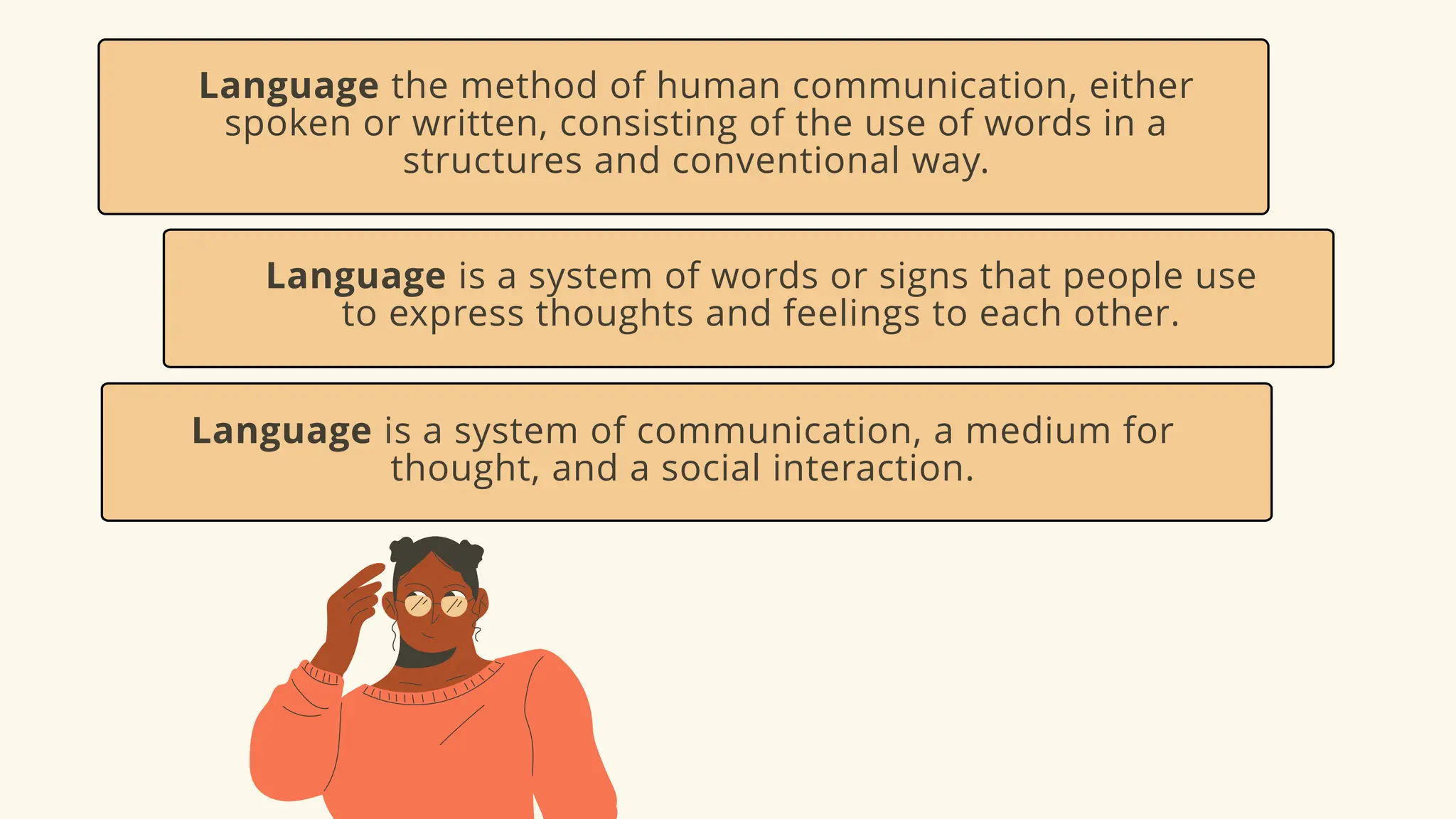
Language the methodof human communication, either
spoken or written, consisting of the use of words in a
structures and conventional way.
Language is a system of words or signs that people use
to express thoughts and feelings to each other.
Language is a system of communication, a medium for
thought, and a social interaction.
7.
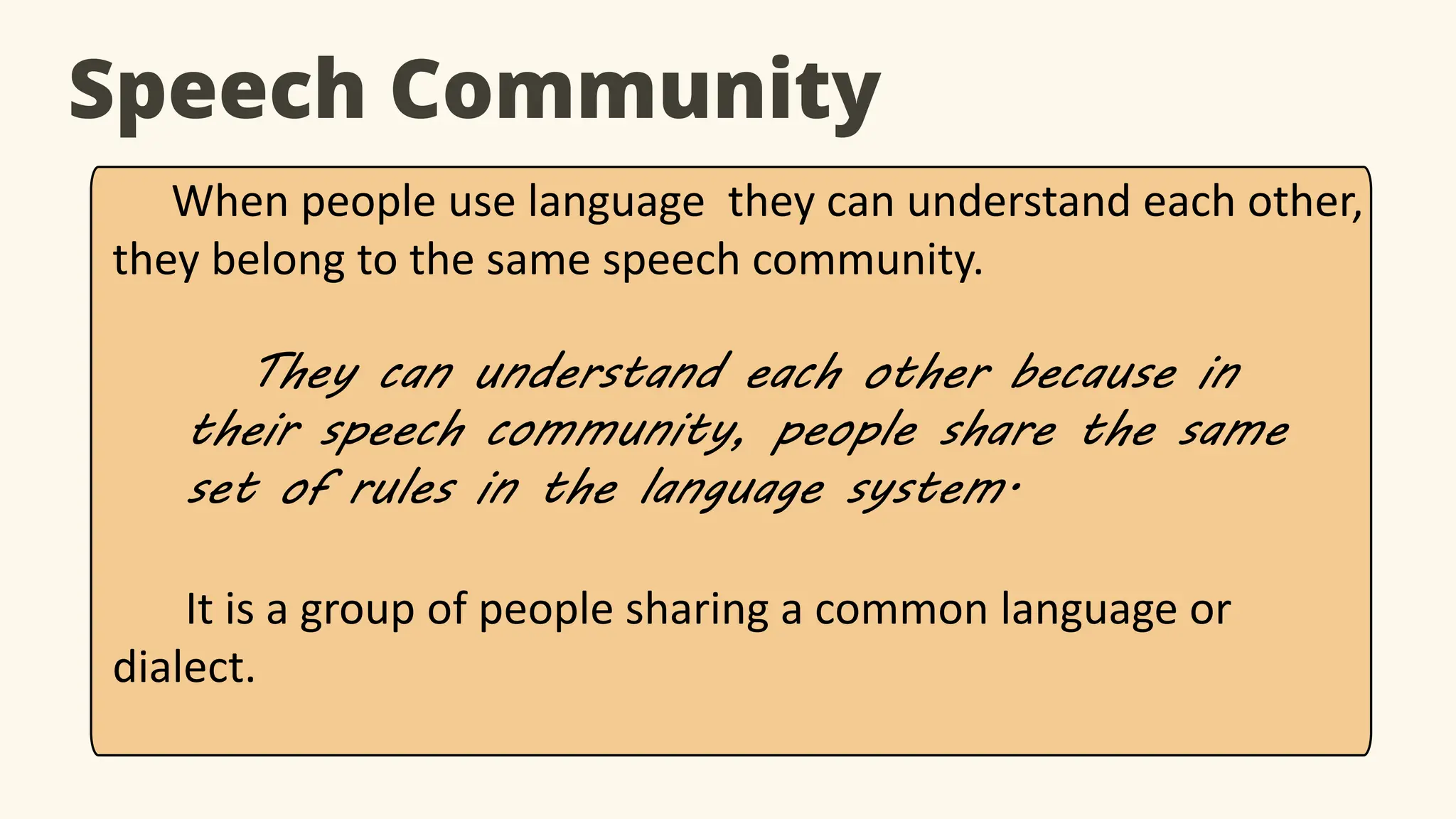
Speech Community
When peopleuse language they can understand each other,
they belong to the same speech community.
They can understand each other because in
their speech community, people share the same
set of rules in the language system.
It is a group of people sharing a common language or
dialect.
8.
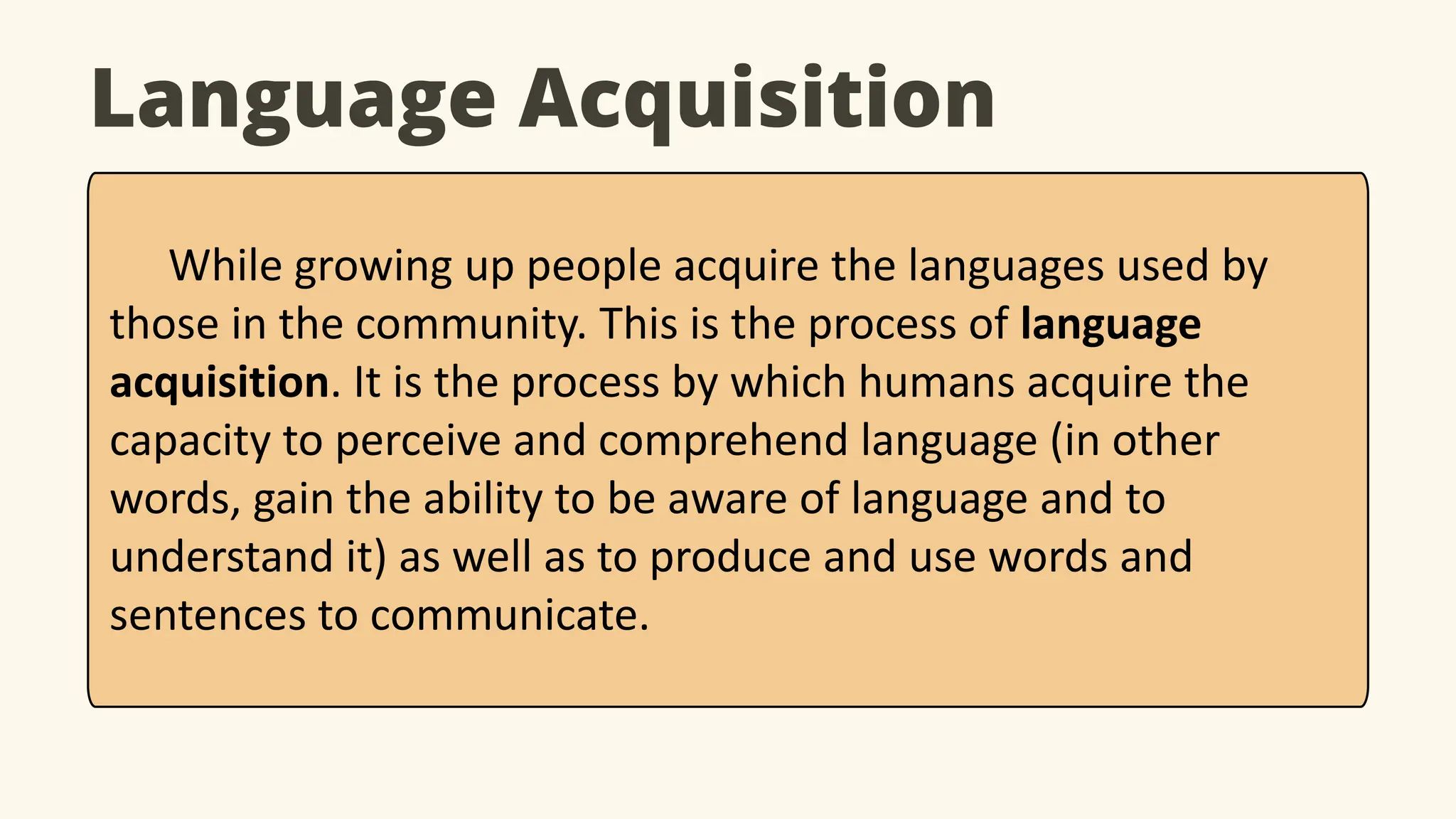
Language Acquisition
While growingup people acquire the languages used by
those in the community. This is the process of language
acquisition. It is the process by which humans acquire the
capacity to perceive and comprehend language (in other
words, gain the ability to be aware of language and to
understand it) as well as to produce and use words and
sentences to communicate.
9.
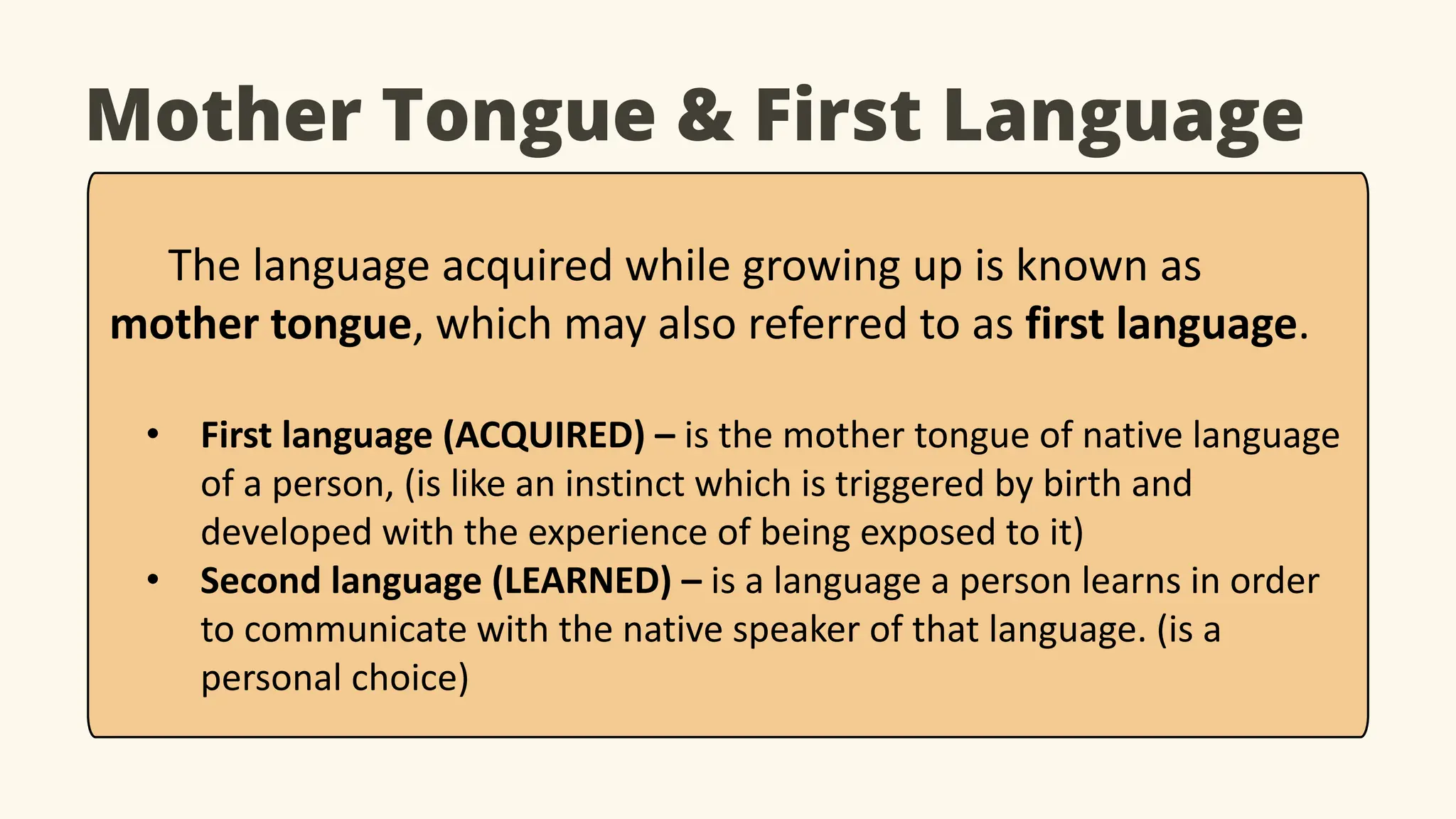
Mother Tongue &First Language
The language acquired while growing up is known as
mother tongue, which may also referred to as first language.
• First language (ACQUIRED) – is the mother tongue of native language
of a person, (is like an instinct which is triggered by birth and
developed with the experience of being exposed to it)
• Second language (LEARNED) – is a language a person learns in order
to communicate with the native speaker of that language. (is a
personal choice)
10.
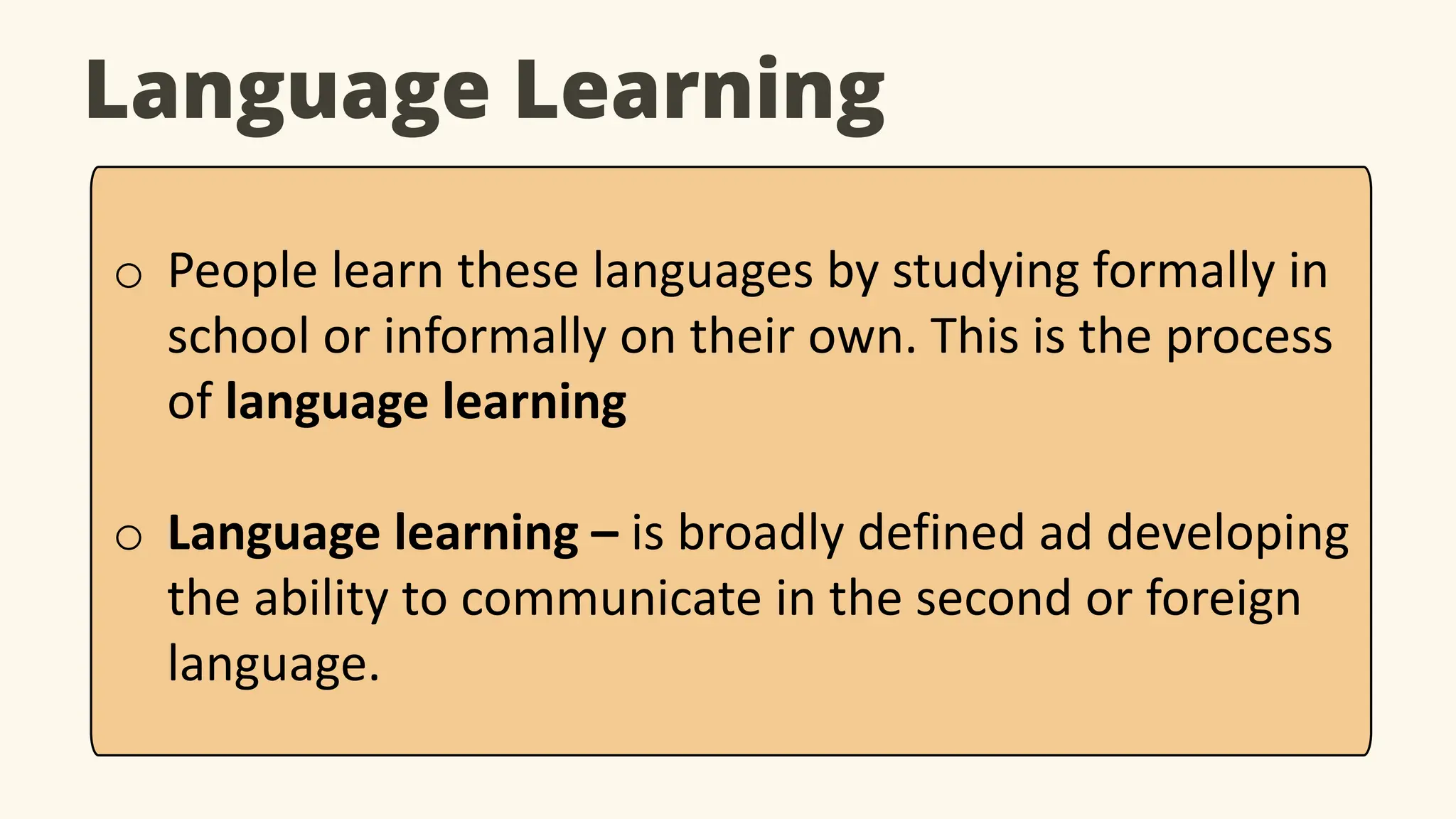
Language Learning
o Peoplelearn these languages by studying formally in
school or informally on their own. This is the process
of language learning
o Language learning – is broadly defined ad developing
the ability to communicate in the second or foreign
language.
11.
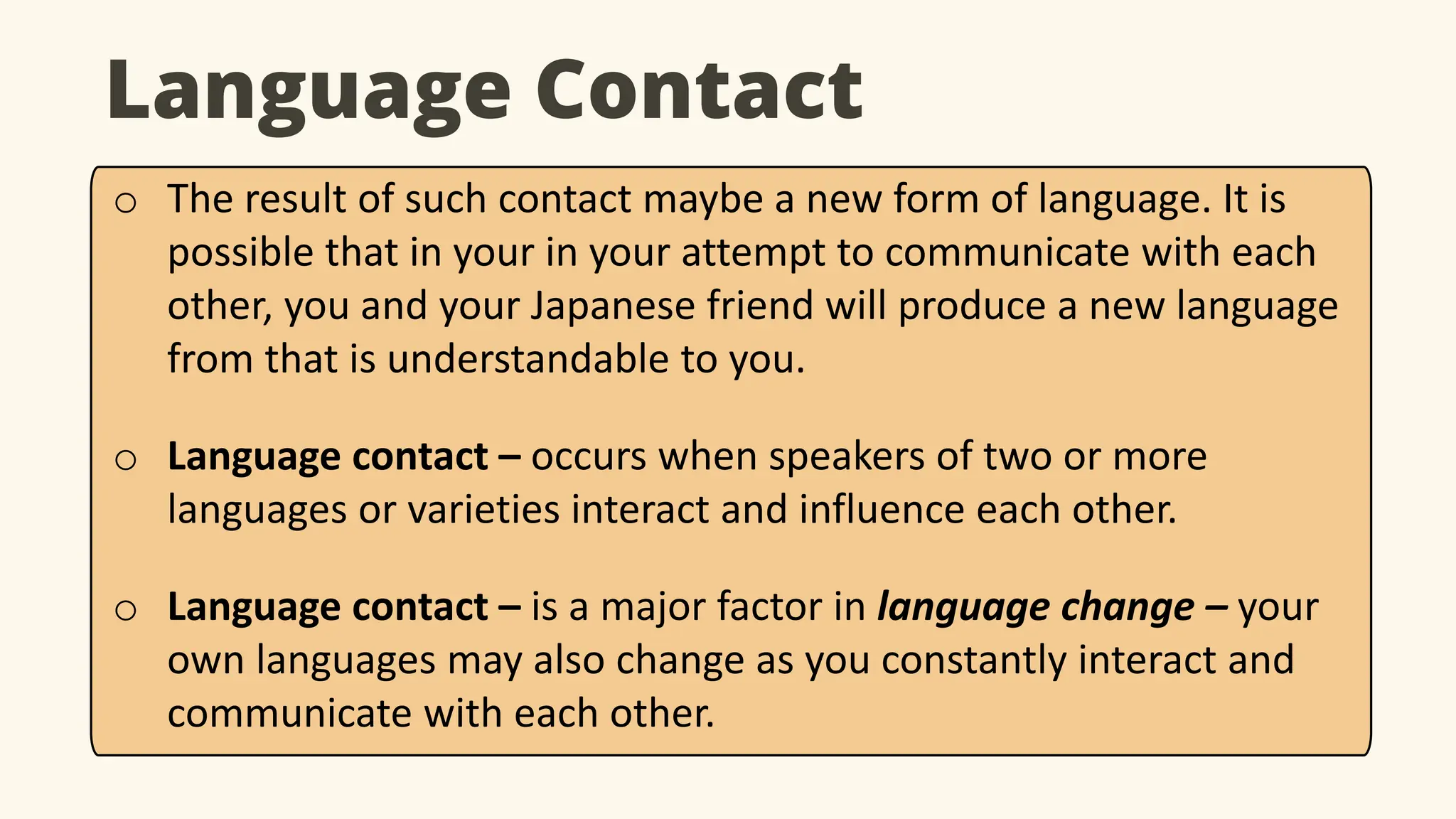
Language Contact
o Theresult of such contact maybe a new form of language. It is
possible that in your in your attempt to communicate with each
other, you and your Japanese friend will produce a new language
from that is understandable to you.
o Language contact – occurs when speakers of two or more
languages or varieties interact and influence each other.
o Language contact – is a major factor in language change – your
own languages may also change as you constantly interact and
communicate with each other.
12.
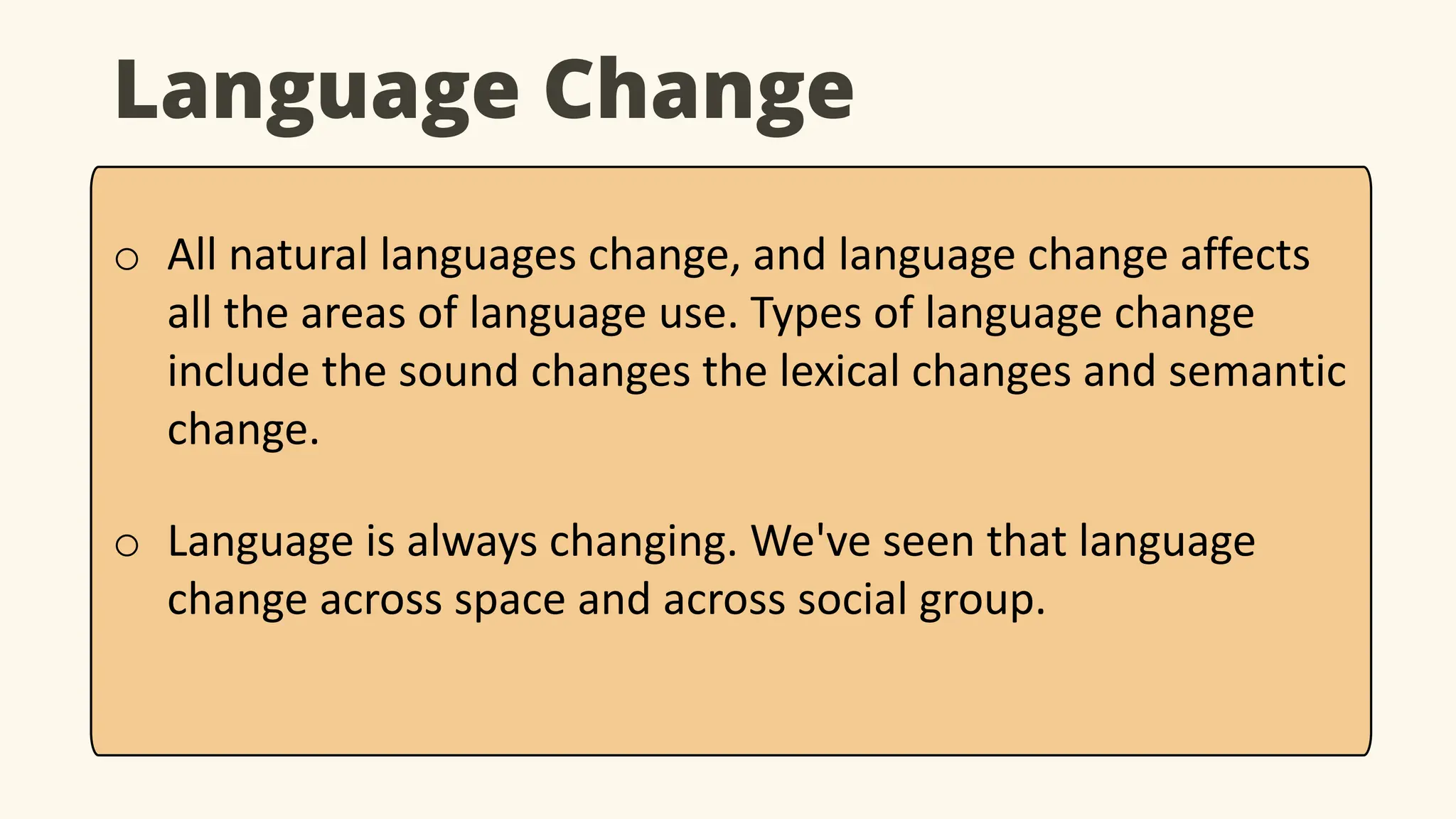
Language Change
o Allnatural languages change, and language change affects
all the areas of language use. Types of language change
include the sound changes the lexical changes and semantic
change.
o Language is always changing. We've seen that language
change across space and across social group.
13.
Language is indeeda complex human capacity. It is,
therefore, important to be aware of its features and
behavior to be able to use language more actively
and productively in communicating with others.