Chapter 8
Section 3 Notes
War in the South
• Beginning in 1778, the British turned their attention
to the SOUTHERN colonies. The British believed
that they had more support in the SOUTH. For
almost three years, the British marched through the
SOUTH without suffering a major defeat.
• In 1780, BENEDICT ARNOLD, one of Washington’s
most trusted generals, turned on the colonists and
joined the British.
• The colonists soon scored two victories in SOUTH
CAROLINA. In October 1780, they defeated the
British at the BATTLE OF KINGS MOUNTAIN. In
January 1781, they won the BATTLE OF COWPENS.
Benedict Arnold---DooDoo Head
War in South Carolina
Francis “Swamp Fox” Marion
Tombstone of Francis Marion
African Americans and the War
• The colonists were afraid to give guns to either
ENSLAVED OR FREE African Americans. In November
1775, colonial leaders discharged all African Americans
from the CONTINENTAL ARMY.
• Despite the order, about 5,000 African Americans fought
for the COLONIAL side.
• Some 1,000 African Americans also fought for the
BRITISH. The BRITISH offered enslaved persons their
freedom in return for military service.
• As a result of the war efforts of African Americans, some
NORTHERN colonies attempted to end SLAVERY in
their states. In the South, however, slavery CONTINUED
AFTER THE WAR.
Women and the War
• Women also contributed to the war effort. They
managed family farms and businesses for
husbands who were off at war. They also served
as NURSES, COOKS, and SPIES.
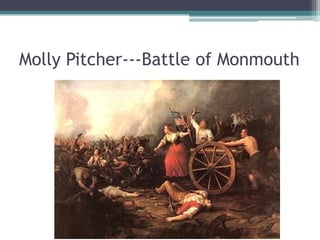
• Some women even took part in battles. MOLLY
PITCHER, for example, operated a cannon
during the BATTLE OF MONMOUTH in 1778.
Molly Pitcher---Battle of Monmouth
Molly Pitcher

Chapter 8 Section 3 Notes

  • 1.
  • 2.
    War in theSouth • Beginning in 1778, the British turned their attention to the SOUTHERN colonies. The British believed that they had more support in the SOUTH. For almost three years, the British marched through the SOUTH without suffering a major defeat. • In 1780, BENEDICT ARNOLD, one of Washington’s most trusted generals, turned on the colonists and joined the British. • The colonists soon scored two victories in SOUTH CAROLINA. In October 1780, they defeated the British at the BATTLE OF KINGS MOUNTAIN. In January 1781, they won the BATTLE OF COWPENS.
  • 3.
  • 4.
    War in SouthCarolina
  • 5.
  • 6.
  • 7.
    African Americans andthe War • The colonists were afraid to give guns to either ENSLAVED OR FREE African Americans. In November 1775, colonial leaders discharged all African Americans from the CONTINENTAL ARMY. • Despite the order, about 5,000 African Americans fought for the COLONIAL side. • Some 1,000 African Americans also fought for the BRITISH. The BRITISH offered enslaved persons their freedom in return for military service. • As a result of the war efforts of African Americans, some NORTHERN colonies attempted to end SLAVERY in their states. In the South, however, slavery CONTINUED AFTER THE WAR.
  • 8.
    Women and theWar • Women also contributed to the war effort. They managed family farms and businesses for husbands who were off at war. They also served as NURSES, COOKS, and SPIES. • Some women even took part in battles. MOLLY PITCHER, for example, operated a cannon during the BATTLE OF MONMOUTH in 1778.
  • 9.
  • 10.