An AFRICAN AMERICAN HISTORY BEHIND THE WAR RECORDS “ A FIGHT FOR FREEDOM” An Automatic PowerPoint Journey Length: 10 Minutes
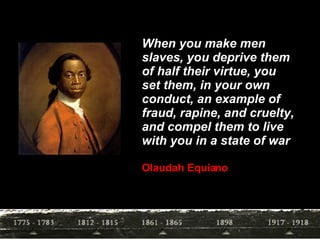
When you make men slaves, you deprive them of half their virtue, you set them, in your own conduct, an example of fraud, rapine, and cruelty, and compel them to live with you in a state of war .   Olaudah Equiano
A Reason to Fight Since their arrival on the shores of the North American Continent, Africans have been living in a perpetual  state   of   war  against  forces  that would abridge their natural rights and human freedoms.
Freedom’s War The ultimate goal of the  slave society  was not to enslave Africans, but to  transform  them into a permanent labor-class of sub-human beings. The War for Freedom was fought on the battlefield of hope, using the day-to-day weapons of  human resistance !
Freedom Fighters In the war for freedom, the  soldiers  were those who resisted and  fought back  in ways, both  covert and overt .
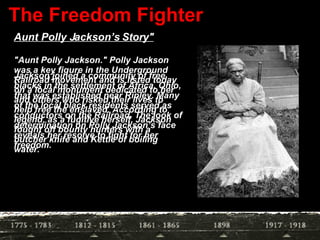
The Freedom Fighter "Aunt Polly Jackson." Polly Jackson was a key figure in the Underground Railroad movement and is listed today on a local monument dedicated to her and others who risked their lives to help free the enslaved. According to legend, as a fugitive herself, Jackson fought off bounty hunters with a butcher knife and Kettle of boiling water.  Aunt Polly Jackson’s Story" Jackson joined a community of free blacks in the settlement of Africa, Ohio, that was established near Ripley. Many of the local black residents served as conductors on the Railroad. The look of determination on Polly Jackson’s face reveals her resolve to fight for her freedom.
The Freedom Fighter Reverend John Rankin and Wife. (1793-1886) As a Presbyterian minister, Rankin started an anti-slavery society in Carlisle, Kentucky, amidst angry slave owners. He eventually moved to Ripley, Ohio, where slavery was illegal although many whites in the area remained strong pro-slavery supporters, and risked working as a conductor and station keeper on the Underground Railroad.  Rev. John Rankin’s Story Rankin lectured across the northern states for the American Anti-Slavery Society, often falling victim to mob-violence. One time, pro-slavery advocates shaved his horse’s tail and mane in an effort to embarrass and scare him. In 1829, Rankin established the historic Ripley College, enrolling the first African-American student in 1831.
Slave Rebellion http://www.pbs.org/independentlens/natturner/slave_rebellions.html#1838
Many African Americans (enslaved or free)  considered the conventional American war as their opportunity to  negotiate for   freedom  and to prove their  human value . So Why Fight for America?
Revolutionary War Timeline : 1775 – 1783 No President : Continental Congress Revolutionary War
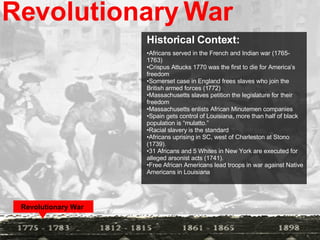
Revolutionary War Historical Context:  Africans served in the French and Indian war (1765- 1763) Crispus Attucks 1770 was the first to die for America’s freedom Somerset case in England frees slaves who join the British armed forces (1772) Massachusetts slaves petition the legislature for their freedom Massachusetts enlists African Minutemen companies Spain gets control of Louisiana, more than half of black population is “mulatto.” Racial slavery is the standard  Africans uprising in SC, west of Charleston at Stono (1739). 31 Africans and 5 Whites in New York are executed for alleged arsonist acts (1741). Free African Americans lead troops in war against Native Americans in Louisiana Revolutionary War
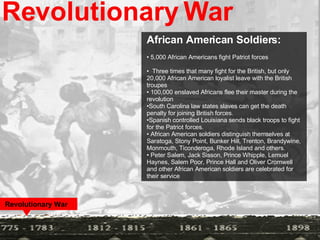
Revolutionary War African American Soldiers:  5,000 African Americans fight Patriot forces Three times that many fight for the British, but only 20,000 African American loyalist leave with the British troupes 100,000 enslaved Africans flee their master during the revolution South Carolina law states slaves can get the death penalty for joining British forces. Spanish controlled Louisiana sends black troops to fight for the Patriot forces. African American soldiers distinguish themselves at Saratoga, Stony Point, Bunker Hill, Trenton, Brandywine, Monmouth, Ticonderoga, Rhode Island and others. Peter Salem, Jack Sisson, Prince Whipple, Lemuel Haynes, Salem Poor, Prince Hall and Oliver Cromwell and other African American soldiers are celebrated for their service Revolutionary War
War of 1812 Timeline : 1812 -1815 President : James Madison War of 1812
War of 1812 Historical Context :  1800 US Census says there are 1 million African Americans (18.9%) of that 100,000 are free (10%) The Haitian Revolutions takes place Eli Whitney’s cotton gin revitalizes the cotton economy and the need for land and slaves Louisiana Purchase takes place Prohibition on the importation of slaves from Africa First Great Awakening fuels anti-slavery sentiment War of 1812
War of 1812 African American Soldiers : Andrew Jackson: Battle of New Orleans and Commodore Perry at the battles of Lake Erie Two African regiments are formed New York Accounted for between 15 and 20% percent of enlisted men on all ships and all stations in the United States Navy Fought for British and Patriotic Armies The Treaty of Ghent is signed, ending the war and consigning many of the African soldiers back into a life of slavery War of 1812
Mexican American War Timeline : 1846 – 1848 President : James K. Polk Mexican American War
Mexican American War Historical Context :   President Polk annexed Texas as a slave state, fulfilling America’s “Manifest Destiny” and moving slavery westward.  1840 Census: 2 million African Americans (16.1%) nearly 400k are free Denmark  , Nat Turner, Amistad rebellions have occurred David Walker’s Appeal is published, Henry Highland Garnet gives a speech to revolt; William Lloyd Garrison and Fredrick Douglas in one the scene The abolitionist movement is mainstream  Slave or Free is the question of the day Mexican American War
Mexican American War African American Soldiers :   Free and enslaved Africans volunteer in military  First Regiment of Volunteers, New York; the Fourth Artillery; and the Ninth, Tenth, Eleventh, and Thirteenth Infantry regiments provided many names continue the tradition Mexican American War
Mexican American War Post War:   California Gold Rush 4,000 African Americans migrate to California California becomes a state under the Missouri Compromise and the country has another fugitive slave law The Kansas/Nebraska Act of 1854 allows states to determine the status. The Dred Scott decision: “.blacks weren’t citizens and had no rights…” Mexican American War
"Once let the black man get upon his person the brass letters, U.S., let him get an eagle on his button, and a musket on his shoulder and bullets in his pockets, and there is no power on earth which can deny that he has earned the right to citizenship in the United States." Frederick Douglass
American Civil War Timeline : 1861- 1865 President : Abraham Lincoln American Civil War
American Civil War Historical Context :   John Brown raid on Harpers Ferry South Carolina  and its confederate States have seceded from the Union 1860 Census: 4 million Africans in the US—400,000 are free Lincoln Emancipates slaves in all confederate states, leaving border states alone. American Civil War
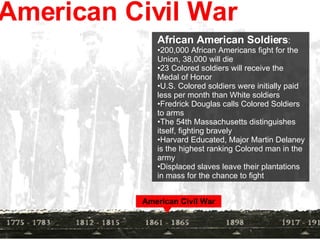
American Civil War African American Soldiers :  200,000 African Americans fight for the Union, 38,000 will die 23 Colored soldiers will receive the Medal of Honor  U.S. Colored soldiers were initially paid less per month than White soldiers  Fredrick Douglas calls Colored Soldiers to arms The 54th Massachusetts distinguishes itself, fighting bravely Harvard Educated, Major Martin Delaney is the highest ranking Colored man in the army Displaced slaves leave their plantations in mass for the chance to fight American Civil War
Indian Campaigns Timeline : 1866 -1890 President :  Andrew Johnson through Benjamin Harrison Indian Campaigns
Indian Campaigns African American Soldiers :  15,000 African Americans soldiers from the Ninth and Tenth cavalry and Twenty Fourth and Twenty Fifth infantry The Indians gave them the name Buffalo Soldiers for their bravery Henry Flipper was 10th cavalry lieutenant Indian Campaigns
Spanish-American War  Timeline : 1898 President : William McKinley Spanish-American War
Spanish-American War  African American Soldier :   U.S.S. Maine explodes killing the crew of 260 including 22 African Americans. War is declared on Spanish controlled Cuba The Buffalo Soldier regiments played an important role on the small island of Cuba. Spanish-American War
Spanish-American War  Post War:   President Roosevelt discharge 167 African American soldiers without much evidence because of the Brownsville, TX. Incident.  Lynching of African Americans are happening in record numbers Spanish-American War
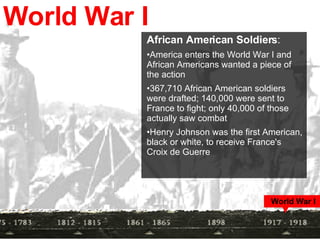
World War I Timeline : 1914 - 1918 President : Woodrow Wilson World War I
World War I African American Soldiers :  America enters the World War I and African Americans wanted a piece of the action 367,710 African American soldiers were drafted; 140,000 were sent to France to fight; only 40,000 of those actually saw combat Henry Johnson was the first American, black or white, to receive France's Croix de Guerre World War I
The Marines had made it clear during the period when George Washington was President that it barred "Negroes, Indians and mulattoes" from enlisting among its ranks. The fate of the black as a serviceman was therefore in the hands of the Army.
Among blacks, those questions took on a different point of focus in both feelings and expressions. Since the Army had provided a type of life that gave blacks a measure of social recognition and economic security, it was a common practice for many of them to take advantage of its membership in order to partially escape the restricted range of social options open to them.
The military constituted a "special class" among blacks, allowing them to escape some of their " Negroness ." Even so, the lives and experiences of blacks in the military can be viewed in many ways as a reflection of the lives and experiences of blacks in American life in general.   Black Americans in Defence of Our Nation
The National Archives  www.archives.gov
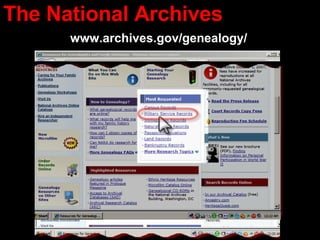
The National Archives  www.archives.gov/genealogy/
The National Archives  www.archives.gov/genealogy/military/
Ancestry.Com  U.S. Military Collection
Thank You!  Presentation Presented By: Sam Starks Mark Freeman

A Fight for Freedom

  • 1.
    An AFRICAN AMERICANHISTORY BEHIND THE WAR RECORDS “ A FIGHT FOR FREEDOM” An Automatic PowerPoint Journey Length: 10 Minutes
  • 2.
    When you makemen slaves, you deprive them of half their virtue, you set them, in your own conduct, an example of fraud, rapine, and cruelty, and compel them to live with you in a state of war . Olaudah Equiano
  • 3.
    A Reason toFight Since their arrival on the shores of the North American Continent, Africans have been living in a perpetual state of war against forces that would abridge their natural rights and human freedoms.
  • 4.
    Freedom’s War Theultimate goal of the slave society was not to enslave Africans, but to transform them into a permanent labor-class of sub-human beings. The War for Freedom was fought on the battlefield of hope, using the day-to-day weapons of human resistance !
  • 5.
    Freedom Fighters Inthe war for freedom, the soldiers were those who resisted and fought back in ways, both covert and overt .
  • 6.
    The Freedom Fighter"Aunt Polly Jackson." Polly Jackson was a key figure in the Underground Railroad movement and is listed today on a local monument dedicated to her and others who risked their lives to help free the enslaved. According to legend, as a fugitive herself, Jackson fought off bounty hunters with a butcher knife and Kettle of boiling water. Aunt Polly Jackson’s Story" Jackson joined a community of free blacks in the settlement of Africa, Ohio, that was established near Ripley. Many of the local black residents served as conductors on the Railroad. The look of determination on Polly Jackson’s face reveals her resolve to fight for her freedom.
  • 7.
    The Freedom FighterReverend John Rankin and Wife. (1793-1886) As a Presbyterian minister, Rankin started an anti-slavery society in Carlisle, Kentucky, amidst angry slave owners. He eventually moved to Ripley, Ohio, where slavery was illegal although many whites in the area remained strong pro-slavery supporters, and risked working as a conductor and station keeper on the Underground Railroad. Rev. John Rankin’s Story Rankin lectured across the northern states for the American Anti-Slavery Society, often falling victim to mob-violence. One time, pro-slavery advocates shaved his horse’s tail and mane in an effort to embarrass and scare him. In 1829, Rankin established the historic Ripley College, enrolling the first African-American student in 1831.
  • 8.
  • 9.
    Many African Americans(enslaved or free) considered the conventional American war as their opportunity to negotiate for freedom and to prove their human value . So Why Fight for America?
  • 10.
    Revolutionary War Timeline: 1775 – 1783 No President : Continental Congress Revolutionary War
  • 11.
    Revolutionary War HistoricalContext: Africans served in the French and Indian war (1765- 1763) Crispus Attucks 1770 was the first to die for America’s freedom Somerset case in England frees slaves who join the British armed forces (1772) Massachusetts slaves petition the legislature for their freedom Massachusetts enlists African Minutemen companies Spain gets control of Louisiana, more than half of black population is “mulatto.” Racial slavery is the standard Africans uprising in SC, west of Charleston at Stono (1739). 31 Africans and 5 Whites in New York are executed for alleged arsonist acts (1741). Free African Americans lead troops in war against Native Americans in Louisiana Revolutionary War
  • 12.
    Revolutionary War AfricanAmerican Soldiers: 5,000 African Americans fight Patriot forces Three times that many fight for the British, but only 20,000 African American loyalist leave with the British troupes 100,000 enslaved Africans flee their master during the revolution South Carolina law states slaves can get the death penalty for joining British forces. Spanish controlled Louisiana sends black troops to fight for the Patriot forces. African American soldiers distinguish themselves at Saratoga, Stony Point, Bunker Hill, Trenton, Brandywine, Monmouth, Ticonderoga, Rhode Island and others. Peter Salem, Jack Sisson, Prince Whipple, Lemuel Haynes, Salem Poor, Prince Hall and Oliver Cromwell and other African American soldiers are celebrated for their service Revolutionary War
  • 13.
    War of 1812Timeline : 1812 -1815 President : James Madison War of 1812
  • 14.
    War of 1812Historical Context : 1800 US Census says there are 1 million African Americans (18.9%) of that 100,000 are free (10%) The Haitian Revolutions takes place Eli Whitney’s cotton gin revitalizes the cotton economy and the need for land and slaves Louisiana Purchase takes place Prohibition on the importation of slaves from Africa First Great Awakening fuels anti-slavery sentiment War of 1812
  • 15.
    War of 1812African American Soldiers : Andrew Jackson: Battle of New Orleans and Commodore Perry at the battles of Lake Erie Two African regiments are formed New York Accounted for between 15 and 20% percent of enlisted men on all ships and all stations in the United States Navy Fought for British and Patriotic Armies The Treaty of Ghent is signed, ending the war and consigning many of the African soldiers back into a life of slavery War of 1812
  • 16.
    Mexican American WarTimeline : 1846 – 1848 President : James K. Polk Mexican American War
  • 17.
    Mexican American WarHistorical Context : President Polk annexed Texas as a slave state, fulfilling America’s “Manifest Destiny” and moving slavery westward. 1840 Census: 2 million African Americans (16.1%) nearly 400k are free Denmark , Nat Turner, Amistad rebellions have occurred David Walker’s Appeal is published, Henry Highland Garnet gives a speech to revolt; William Lloyd Garrison and Fredrick Douglas in one the scene The abolitionist movement is mainstream Slave or Free is the question of the day Mexican American War
  • 18.
    Mexican American WarAfrican American Soldiers : Free and enslaved Africans volunteer in military First Regiment of Volunteers, New York; the Fourth Artillery; and the Ninth, Tenth, Eleventh, and Thirteenth Infantry regiments provided many names continue the tradition Mexican American War
  • 19.
    Mexican American WarPost War: California Gold Rush 4,000 African Americans migrate to California California becomes a state under the Missouri Compromise and the country has another fugitive slave law The Kansas/Nebraska Act of 1854 allows states to determine the status. The Dred Scott decision: “.blacks weren’t citizens and had no rights…” Mexican American War
  • 20.
    "Once let theblack man get upon his person the brass letters, U.S., let him get an eagle on his button, and a musket on his shoulder and bullets in his pockets, and there is no power on earth which can deny that he has earned the right to citizenship in the United States." Frederick Douglass
  • 21.
    American Civil WarTimeline : 1861- 1865 President : Abraham Lincoln American Civil War
  • 22.
    American Civil WarHistorical Context : John Brown raid on Harpers Ferry South Carolina and its confederate States have seceded from the Union 1860 Census: 4 million Africans in the US—400,000 are free Lincoln Emancipates slaves in all confederate states, leaving border states alone. American Civil War
  • 23.
    American Civil WarAfrican American Soldiers : 200,000 African Americans fight for the Union, 38,000 will die 23 Colored soldiers will receive the Medal of Honor U.S. Colored soldiers were initially paid less per month than White soldiers Fredrick Douglas calls Colored Soldiers to arms The 54th Massachusetts distinguishes itself, fighting bravely Harvard Educated, Major Martin Delaney is the highest ranking Colored man in the army Displaced slaves leave their plantations in mass for the chance to fight American Civil War
  • 24.
    Indian Campaigns Timeline: 1866 -1890 President : Andrew Johnson through Benjamin Harrison Indian Campaigns
  • 25.
    Indian Campaigns AfricanAmerican Soldiers : 15,000 African Americans soldiers from the Ninth and Tenth cavalry and Twenty Fourth and Twenty Fifth infantry The Indians gave them the name Buffalo Soldiers for their bravery Henry Flipper was 10th cavalry lieutenant Indian Campaigns
  • 26.
    Spanish-American War Timeline : 1898 President : William McKinley Spanish-American War
  • 27.
    Spanish-American War African American Soldier : U.S.S. Maine explodes killing the crew of 260 including 22 African Americans. War is declared on Spanish controlled Cuba The Buffalo Soldier regiments played an important role on the small island of Cuba. Spanish-American War
  • 28.
    Spanish-American War Post War: President Roosevelt discharge 167 African American soldiers without much evidence because of the Brownsville, TX. Incident. Lynching of African Americans are happening in record numbers Spanish-American War
  • 29.
    World War ITimeline : 1914 - 1918 President : Woodrow Wilson World War I
  • 30.
    World War IAfrican American Soldiers : America enters the World War I and African Americans wanted a piece of the action 367,710 African American soldiers were drafted; 140,000 were sent to France to fight; only 40,000 of those actually saw combat Henry Johnson was the first American, black or white, to receive France's Croix de Guerre World War I
  • 31.
    The Marines hadmade it clear during the period when George Washington was President that it barred "Negroes, Indians and mulattoes" from enlisting among its ranks. The fate of the black as a serviceman was therefore in the hands of the Army.
  • 32.
    Among blacks, thosequestions took on a different point of focus in both feelings and expressions. Since the Army had provided a type of life that gave blacks a measure of social recognition and economic security, it was a common practice for many of them to take advantage of its membership in order to partially escape the restricted range of social options open to them.
  • 33.
    The military constituteda "special class" among blacks, allowing them to escape some of their " Negroness ." Even so, the lives and experiences of blacks in the military can be viewed in many ways as a reflection of the lives and experiences of blacks in American life in general. Black Americans in Defence of Our Nation
  • 34.
    The National Archives www.archives.gov
  • 35.
    The National Archives www.archives.gov/genealogy/
  • 36.
    The National Archives www.archives.gov/genealogy/military/
  • 37.
    Ancestry.Com U.S.Military Collection
  • 38.
    Thank You! Presentation Presented By: Sam Starks Mark Freeman