Structural Design and Inspection-
Principle of Virtual Work
1
By
Dr. Mahdi Damghani
2019-2020
Suggested Readings
Reference 1
2
Reference 2
Objective(s)
3
• Familiarity with the definition of work
• Familiarity with the concept of virtual work by
• Axial forces
• Transverse shear forces
• Bending
• Torsion
• Familiarisation with unit load method
Comments
4
• Please post any comments either here or on BB:
https://padlet.com/damghani_mahdi/SDI
Introduction
5
• They are based on the concept of work and are
considered within the realm of “analytical mechanics”
• Energy methods are fit for complex problems such as
indeterminate structures
• They are essential for using Finite ElementAnalysis
(FEA)
• They provide approximates solutions not exact
• The Principle of Virtual Work (PVW) is the most
fundamental tool of analytical mechanics
Complexity Demonstration
6
Work
• Displacement of force times the quantity of force in the
direction of displacement gives a scalar value called work
WF  F cos 
7
W  F a 
F1
2
W  F a
F 2
2
WF  WF1 WF 2 WF  M
Work on a particle
• Point A is virtually
displaced (imaginary
small displacement) to
point A’
• R is the resultant of
applied concurrent
forces on point A
• If particle is in
equilibrium?
R=0
WF=0
8
Principle of Virtual Work (PVW)
• If a particle is in equilibrium under the action of a
number of forces, the total work done by the forces
for a small arbitrary displacement of the particle is zero.
(Equivalent to Newton’s First Law)
• Can we say?
If a particle is not in equilibrium under the action of a
number of forces, the total work done by the forces for a
small arbitrary displacement of the particle is not zero.
R could make a 90 degree angle with
displacement
9
In other words
10
• The work done by a real force 𝑃 moving through an
arbitrary virtual displacement ≈ arbitrary test displacement ≈
arbitrary fictitious displacement 𝛿𝑢 is called the virtual work
𝛿𝑊. It is defined as; 𝛿𝑊 = 𝑃𝛿𝑢
• Note that The word arbitrary is easily understood: it simply
means that the displacements can be chosen in an
arbitrary manner without any restriction imposed on their
magnitudes or orientations. More difficult to understand are
the words virtual, test, or fictitious. All three imply that these
are not real, actual displacements. More importantly, these
fictitious displacements do not affect the forces acting on the
particle.
• Then we define PVW for both rigid bodies and deformable
bodies separately (see subsequent slides).
Note 1
11
• Note that, Δv is a small and purely imaginary
displacement and is not related in any way to the
possible displacement of the particle under the action
of the forces, F;
• Δv has been introduced purely as a device for setting
up the work-equilibrium relationship;
• The forces, F, therefore remain unchanged in
magnitude and direction during this imaginary
displacement;
• This would not be the case if the displacements were
real.
PVW for rigid bodies
• External forces (F1 ... Fr)
induce internal forces;
• Suppose the rigid body is
given virtual displacement;
• Internal and external forces
do virtual work;
• There are a lot of pairs like
A1 and A2 whose internal
forces would be equal and
opposite;
• We can regard the rigid body
as one particle.
2
1 A
A
i i
F  F
Wtotal Wi We Wi  0 Wt  We
1 2
A A
i i
W W  0
It does not undergo deformation
(change in length, area or shape)
under the action of forces.
Internal forces act and
react within the system
and external forces act
on the system
12
PVW for deformable bodies
• This principle is valid for;
• Small displacements.
• Rigid structures that cannot deform.
• Elastic or plastic deformable structures.
• Competent in solving statically indeterminate structures.
1 2
A A
i i
F  F Wtotal We Wi  0
• If a virtual displacement of Δis applied, all particles do
not necessarily displace to the amount of Δ, i.e.
internal virtual work is done in the interior of the body.
Wi  0
The distance between two
points changes under the
action of forces.
13
Work of internal axial force on
mechanical systems/structures
Isolate
Section
This truss element is working
under the action of axial load
only as a result of external
aerodynamic loading.
After imposing a virtual
displacement, the axial load
does virtual work on this truss
element.
To obtain the amount of virtual
work, we obtain the work on
the section and then
throughout the length (next
slide).
14
Work of internal axial force
A
N A  N A
• Work done by small axial force due to
small virtual axial strain for an
element of a member:
A
v v
w 
N
dA x  N x
 A
i,N
• Work done by small axial force due to
small virtual axial strain for a member:
wi,N  Nvdx
L
• Work done by small axial force due to
small virtual axial strain for a structure
having r members:
mr
m1
wi,N   Nmvmdx
reminder:

v  l
l  v  A
x  A  vx
15
Work of internal axial force for
linearly elastic material
• Based on Hook’s law (subscript v denotes virtual);
• Therefore, we have (subscript m denotes member m);
 
v

v
E
Nv
EA
1 1 L2
L1
mr
m m
i,N
N2Nv2
dx ...
2 2
 E A  E A  E A
Nm Nvm
dx 
N1Nv1
dx 
w 
m1 Lm
mr
m1
wi,N  Nmvmdx
16
Work of internal shear force
S A
• Work done by small shear force due to
small virtual shear strain for an element
of a member (β is form factor):
A
v
A
v v
w  dA x  
S
dA x  S x
 
i,S
δS
m1 L
• Work done by small shear force due to
small virtual shear strain for a member
of length L:
wi,S  Svdx
L
• Work done by small shear force due to
small virtual shear strain for a structure
having r members:
mr
wi,S  mSmvmdx
17
Work of internal shear force for
linearly elastic material
• Based on Hook’s law (subscript v denotes virtual);
• Therefore, we have (subscript m denotes member m);
 
v

v
G
Sv
GA
2 2
2
1 1
1 
L2

L1
mr
m1 m m
m
i,S
G A
G A
G A

Lm
SmSvm
dx  S1Sv1
dx   S2Sv2
dx ...
w  
18
Work of internal bending moment
R R
A v v
w  dA
y
x 
M
x

i,M
• Work done by small bending due to
small virtual axial strain for a member:
L v
 R
w 
M
dx
i,M
• Work done by small bending due to
small virtual axial strain for a structure
having r members:
mr
vm
dx
 R
Mm
m1
wi,M  
wi,M  dAvx
A
• Work done by small bending due to
small virtual axial strain for an
element of a member:
Radius of curvature due
to virtual displacement
v
v
v IE R
My y
EI
 M I
E
  
 
My
, 
v
1
R
19
Work of internal bending moment for
linearly elastic material
• We have (subscript m denotes member m);
1  Mv
Rv EI
2 2
1 1
 
L2

L1
mr
m m
m vm
i,M
E I
M2Mv2
dx ...
E I
M1Mv1
dx 
dx 
E I
M M
w 
m1 Lm
20
Work of internal torsion
• See chapter 2 of Reference 1,
chapter 15 of Reference 2 or chapter
9 of Reference 3 for details of this
• Following similar approach as
previous slides for a member of
length L we have;
L
 GJ
TTv
dx
w 
i,T
• For a structure having several
members of various length we have;
L2 2 2
L1 1 1
mr
m vm
i,T 
T2Tv2
dx...
T1Tv1
dx
dx 
G J G J G J
T T
w 
m1 Lm m m
21


 
L
We  Wv, y  Pv,x  Mv Tv  w(x)v,ydx



22

L

L L
A v
L
i  dx
 GJ
T T
EI
 GA
EA
W 
NA Nv
dx  
SASv
dx 
M AMv
dx 
Virtual work due to external force
system
• If you have various
forces acting on
your structure at
the same time;
We Wi  0
Note
• So far virtual work has been produced by actual forces
in equilibrium moving through imposed virtual
displacements;
• Base on PVW, we can alternatively assume a set of
23
virtual forces in equilibrium moving through actual
displacements;
• Application of this principle, gives a very powerful
method to analyze indeterminate structures;
Example 1
• Determine the bending moment at point B in the
simply supported beam ABC.
24
Solution
25
• We must impose a small virtual displacement which
will relate the internal moment at B to the applied
load;
• Assumed displacement should be in a way to exclude
unknown external forces such as the support
reactions, and unknown internal force systems such
as the bending moment distribution along the length
of the beam.
Solution
• Using conventional equations of equilibrium method;
RA RC
A
L
MC  0 
RA L Wb 
R 
b
W
B A
26
L
M  R a 
ab
W
Solution
• Let’s give point B a virtual displacement;
β
b
  a  b  
a

v,B
b
B
     
L
e v,B
W  Wi  MBB W
L
b
B
B

Wab
M 
L
Wa  M
Rigid
Rigid
27
Example 2
P a
• Using the principle of virtual work, derive a formula in
terms of a, b, and W for the magnitude P of the force
required for equilibrium of the structure below, i.e. ABC
(you may disregard the effects weight).
C
W
b
A
B
28
Solution
• We assume that AB andAC are rigid and therefore
internal work done by them is zero
• Apply a very small virtual displacement to our system
Just to confirm the answer,
you would get the same
result if you took moment
about B, i.e. ∑ 𝑀𝐵 = 0
Virtual movements

rC  b

rA  a
Virtualwork

U  0
P
rA W
rC  0
Pa
Wb
 0
P  bW / a
A
B
W
a
b
rCC
A
P
r

29
Example 3
• Calculate the force in
member AB of truss
structure?
30
Solution
• This structure has 1 degree of
indeterminacy, i.e. 4 reaction (support)
forces, unknowns, and 3 equations of
equilibrium
• Let’s apply an infinitesimally small virtual
displacement where we intend to get the
force
v,C v,B
31
3 4 3
tan() 
v,B

v,C
  
4

• Equating work done by external force to
that of internal force gives
v,C 30  FABv,B  FAB  40kN
Example 4
• We would like to obtain slope for the portal frame
below;
P

 
kr2
M1
kr1
M2
h
a
32
Solution
i 1 2
h

We  P


Wi  M1


1  M2

2


1 

2 

 / h 

Wi  M1 
 / h M2 
 / h

W 


M  M 
                   
1 2
i i i
h h
M k

We 
Wi  0 
P 
1
M  M  0  P 
1
M 
 M  0 


1 2 
 Ph / kr1  kr 2 
P

 
kr2
M1
kr1
2
M
h
a
33
Note
34
• The amount of virtual displacement can be any
arbitrary value;
• For convenience lets give it a unit value, for example
in the previous example lets say Δv,B=1;
• In this case the method could be called unit load
method.
Note
• If you need to obtain force in a member, you should
apply a virtual displacement at the location where force
is intended;
• If you need to obtain displacement in a member, you
should apply a virtual force at the location
displacement is intended.
35
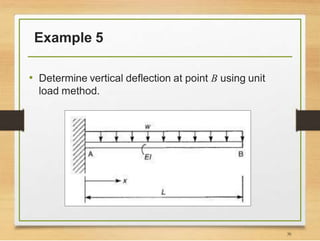
Example 5
• Determine vertical deflection at point B using unit
load method.
36
Solution
• Apply a virtual unit load in the direction of displacement to be calculated
Mv (x)  x  L
2
2 2
2 2 2
wx wL w
M (x)    wLx    L  x

L
• Work done by virtual unit load
we  1vB
• Work done by internal loads
L
v
L  x
dx 
EI
MM w
w 
0
3
i,M  2EI
• Equating external work with internal
8EI
0
L
w 3 wL4
1vB  L  x  vB 
 2EI
Virtual system
Real system
37
Example 6
• Using unit load method determine slope and deflection
at point B.
C B D A
5kN/m 8kN
2m
38
0.5m 0.5m
IAB=4x106 mm4
IBC=8x106 mm4
E=200 kN/mm2
Solution
• For deflection we apply a unit virtual load at point B in the
direction of the intended displacement;
Virtual system
Real system
Segment Interval I (mm4) M v (kN.m) M (kN.m)
AD 0<x<0.5 4x10⁶ 0 8x
DB 0.5<x<1 4x10⁶ 0 8x-2.5(x-0.5)2
BC 1<x<3 8x10⁶ x-1 8x-2.5(x-0.5)2
L2 2 2
L1 1 1
mr
i,M  E I  E I  E I
w   Mm Mvm
dx 
M1Mv1
dx 
M2Mv2
dx ...
m1 Lm m m
39
Solution
B 12mm
6
0.5
6
200810
200410
dx
3
x 1
8x  2.5x  0.52

dx  
1
6 dx  
EI 0 200410
M M 0.5
08x 1
0
8x  2.5x  0.52

L
v
1B   dx  
• For slope we apply a unit virtual moment at point B
1kN.m
L2 2 2
L1 1 1
mr
i,M  E I  E I  E I
w   Mm Mvm
dx 
M1Mv1
dx 
M2Mv2
dx ...
m1 Lm m m
40
Solution
Segment Interval I (mm4) M v (kN.m) M (kN.m)
AD 0<x<0.5 4x10⁶ 0 8x
DB 0.5<x<1 4x10⁶ 0 8x-2.5(x-0.5)2
BC 1<x<3 8x10⁶ 1 8x-2.5(x-0.5)2
6
0.5
6
200810
dx
3
1
8x  2.5x 0.52

dx  
1
6 dx  
EI 0 200410 200410
M M 0.5
08x 1
0
8x  2.5x 0.52

L
v
1B   dx  
B  0.0119 rad
41
Q1
• Use the principle of virtual work to determine the
support reactions in the beamABCD.
42
Q2
• Find the support reactions in the beamABC using the
principle of virtual work.
43
Q3
• Find the bending moment at the three-quarter-span
point in the beam. Use the principle of virtual work.
44
Q4
• Use the unit load method to calculate the deflection at
the free end of the cantilever beamABC.
45
Q5
• Calculate the deflection of the free end C of the
cantilever beamABC using the unit load method.
46
Q6
• Use the unit load method to find the magnitude and
direction of the deflection of the joint C in the truss. All
members have a cross-sectional area of 500mm2 and
a Young’s modulus of 200,000 N/mm2.
47
Q7
• Calculate the forces in the members FG, GD, and CD
of the truss using the principle of virtual work. All
horizontal and vertical members are 1m long.
48

lec3principlevirtualworkmethod-191007114659.pptx

  • 1.
    Structural Design andInspection- Principle of Virtual Work 1 By Dr. Mahdi Damghani 2019-2020
  • 2.
  • 3.
    Objective(s) 3 • Familiarity withthe definition of work • Familiarity with the concept of virtual work by • Axial forces • Transverse shear forces • Bending • Torsion • Familiarisation with unit load method
  • 4.
    Comments 4 • Please postany comments either here or on BB: https://padlet.com/damghani_mahdi/SDI
  • 5.
    Introduction 5 • They arebased on the concept of work and are considered within the realm of “analytical mechanics” • Energy methods are fit for complex problems such as indeterminate structures • They are essential for using Finite ElementAnalysis (FEA) • They provide approximates solutions not exact • The Principle of Virtual Work (PVW) is the most fundamental tool of analytical mechanics
  • 6.
  • 7.
    Work • Displacement offorce times the quantity of force in the direction of displacement gives a scalar value called work WF  F cos  7 W  F a  F1 2 W  F a F 2 2 WF  WF1 WF 2 WF  M
  • 8.
    Work on aparticle • Point A is virtually displaced (imaginary small displacement) to point A’ • R is the resultant of applied concurrent forces on point A • If particle is in equilibrium? R=0 WF=0 8
  • 9.
    Principle of VirtualWork (PVW) • If a particle is in equilibrium under the action of a number of forces, the total work done by the forces for a small arbitrary displacement of the particle is zero. (Equivalent to Newton’s First Law) • Can we say? If a particle is not in equilibrium under the action of a number of forces, the total work done by the forces for a small arbitrary displacement of the particle is not zero. R could make a 90 degree angle with displacement 9
  • 10.
    In other words 10 •The work done by a real force 𝑃 moving through an arbitrary virtual displacement ≈ arbitrary test displacement ≈ arbitrary fictitious displacement 𝛿𝑢 is called the virtual work 𝛿𝑊. It is defined as; 𝛿𝑊 = 𝑃𝛿𝑢 • Note that The word arbitrary is easily understood: it simply means that the displacements can be chosen in an arbitrary manner without any restriction imposed on their magnitudes or orientations. More difficult to understand are the words virtual, test, or fictitious. All three imply that these are not real, actual displacements. More importantly, these fictitious displacements do not affect the forces acting on the particle. • Then we define PVW for both rigid bodies and deformable bodies separately (see subsequent slides).
  • 11.
    Note 1 11 • Notethat, Δv is a small and purely imaginary displacement and is not related in any way to the possible displacement of the particle under the action of the forces, F; • Δv has been introduced purely as a device for setting up the work-equilibrium relationship; • The forces, F, therefore remain unchanged in magnitude and direction during this imaginary displacement; • This would not be the case if the displacements were real.
  • 12.
    PVW for rigidbodies • External forces (F1 ... Fr) induce internal forces; • Suppose the rigid body is given virtual displacement; • Internal and external forces do virtual work; • There are a lot of pairs like A1 and A2 whose internal forces would be equal and opposite; • We can regard the rigid body as one particle. 2 1 A A i i F  F Wtotal Wi We Wi  0 Wt  We 1 2 A A i i W W  0 It does not undergo deformation (change in length, area or shape) under the action of forces. Internal forces act and react within the system and external forces act on the system 12
  • 13.
    PVW for deformablebodies • This principle is valid for; • Small displacements. • Rigid structures that cannot deform. • Elastic or plastic deformable structures. • Competent in solving statically indeterminate structures. 1 2 A A i i F  F Wtotal We Wi  0 • If a virtual displacement of Δis applied, all particles do not necessarily displace to the amount of Δ, i.e. internal virtual work is done in the interior of the body. Wi  0 The distance between two points changes under the action of forces. 13
  • 14.
    Work of internalaxial force on mechanical systems/structures Isolate Section This truss element is working under the action of axial load only as a result of external aerodynamic loading. After imposing a virtual displacement, the axial load does virtual work on this truss element. To obtain the amount of virtual work, we obtain the work on the section and then throughout the length (next slide). 14
  • 15.
    Work of internalaxial force A N A  N A • Work done by small axial force due to small virtual axial strain for an element of a member: A v v w  N dA x  N x  A i,N • Work done by small axial force due to small virtual axial strain for a member: wi,N  Nvdx L • Work done by small axial force due to small virtual axial strain for a structure having r members: mr m1 wi,N   Nmvmdx reminder:  v  l l  v  A x  A  vx 15
  • 16.
    Work of internalaxial force for linearly elastic material • Based on Hook’s law (subscript v denotes virtual); • Therefore, we have (subscript m denotes member m);   v  v E Nv EA 1 1 L2 L1 mr m m i,N N2Nv2 dx ... 2 2  E A  E A  E A Nm Nvm dx  N1Nv1 dx  w  m1 Lm mr m1 wi,N  Nmvmdx 16
  • 17.
    Work of internalshear force S A • Work done by small shear force due to small virtual shear strain for an element of a member (β is form factor): A v A v v w  dA x   S dA x  S x   i,S δS m1 L • Work done by small shear force due to small virtual shear strain for a member of length L: wi,S  Svdx L • Work done by small shear force due to small virtual shear strain for a structure having r members: mr wi,S  mSmvmdx 17
  • 18.
    Work of internalshear force for linearly elastic material • Based on Hook’s law (subscript v denotes virtual); • Therefore, we have (subscript m denotes member m);   v  v G Sv GA 2 2 2 1 1 1  L2  L1 mr m1 m m m i,S G A G A G A  Lm SmSvm dx  S1Sv1 dx   S2Sv2 dx ... w   18
  • 19.
    Work of internalbending moment R R A v v w  dA y x  M x  i,M • Work done by small bending due to small virtual axial strain for a member: L v  R w  M dx i,M • Work done by small bending due to small virtual axial strain for a structure having r members: mr vm dx  R Mm m1 wi,M   wi,M  dAvx A • Work done by small bending due to small virtual axial strain for an element of a member: Radius of curvature due to virtual displacement v v v IE R My y EI  M I E      My ,  v 1 R 19
  • 20.
    Work of internalbending moment for linearly elastic material • We have (subscript m denotes member m); 1  Mv Rv EI 2 2 1 1   L2  L1 mr m m m vm i,M E I M2Mv2 dx ... E I M1Mv1 dx  dx  E I M M w  m1 Lm 20
  • 21.
    Work of internaltorsion • See chapter 2 of Reference 1, chapter 15 of Reference 2 or chapter 9 of Reference 3 for details of this • Following similar approach as previous slides for a member of length L we have; L  GJ TTv dx w  i,T • For a structure having several members of various length we have; L2 2 2 L1 1 1 mr m vm i,T  T2Tv2 dx... T1Tv1 dx dx  G J G J G J T T w  m1 Lm m m 21
  • 22.
        L We Wv, y  Pv,x  Mv Tv  w(x)v,ydx    22  L  L L A v L i  dx  GJ T T EI  GA EA W  NA Nv dx   SASv dx  M AMv dx  Virtual work due to external force system • If you have various forces acting on your structure at the same time; We Wi  0
  • 23.
    Note • So farvirtual work has been produced by actual forces in equilibrium moving through imposed virtual displacements; • Base on PVW, we can alternatively assume a set of 23 virtual forces in equilibrium moving through actual displacements; • Application of this principle, gives a very powerful method to analyze indeterminate structures;
  • 24.
    Example 1 • Determinethe bending moment at point B in the simply supported beam ABC. 24
  • 25.
    Solution 25 • We mustimpose a small virtual displacement which will relate the internal moment at B to the applied load; • Assumed displacement should be in a way to exclude unknown external forces such as the support reactions, and unknown internal force systems such as the bending moment distribution along the length of the beam.
  • 26.
    Solution • Using conventionalequations of equilibrium method; RA RC A L MC  0  RA L Wb  R  b W B A 26 L M  R a  ab W
  • 27.
    Solution • Let’s givepoint B a virtual displacement; β b   a  b   a  v,B b B       L e v,B W  Wi  MBB W L b B B  Wab M  L Wa  M Rigid Rigid 27
  • 28.
    Example 2 P a •Using the principle of virtual work, derive a formula in terms of a, b, and W for the magnitude P of the force required for equilibrium of the structure below, i.e. ABC (you may disregard the effects weight). C W b A B 28
  • 29.
    Solution • We assumethat AB andAC are rigid and therefore internal work done by them is zero • Apply a very small virtual displacement to our system Just to confirm the answer, you would get the same result if you took moment about B, i.e. ∑ 𝑀𝐵 = 0 Virtual movements  rC  b  rA  a Virtualwork  U  0 P rA W rC  0 Pa Wb  0 P  bW / a A B W a b rCC A P r  29
  • 30.
    Example 3 • Calculatethe force in member AB of truss structure? 30
  • 31.
    Solution • This structurehas 1 degree of indeterminacy, i.e. 4 reaction (support) forces, unknowns, and 3 equations of equilibrium • Let’s apply an infinitesimally small virtual displacement where we intend to get the force v,C v,B 31 3 4 3 tan()  v,B  v,C    4  • Equating work done by external force to that of internal force gives v,C 30  FABv,B  FAB  40kN
  • 32.
    Example 4 • Wewould like to obtain slope for the portal frame below; P    kr2 M1 kr1 M2 h a 32
  • 33.
    Solution i 1 2 h  We P   Wi  M1   1  M2  2   1   2    / h   Wi  M1   / h M2   / h  W    M  M                      1 2 i i i h h M k  We  Wi  0  P  1 M  M  0  P  1 M   M  0    1 2   Ph / kr1  kr 2  P    kr2 M1 kr1 2 M h a 33
  • 34.
    Note 34 • The amountof virtual displacement can be any arbitrary value; • For convenience lets give it a unit value, for example in the previous example lets say Δv,B=1; • In this case the method could be called unit load method.
  • 35.
    Note • If youneed to obtain force in a member, you should apply a virtual displacement at the location where force is intended; • If you need to obtain displacement in a member, you should apply a virtual force at the location displacement is intended. 35
  • 36.
    Example 5 • Determinevertical deflection at point B using unit load method. 36
  • 37.
    Solution • Apply avirtual unit load in the direction of displacement to be calculated Mv (x)  x  L 2 2 2 2 2 2 wx wL w M (x)    wLx    L  x  L • Work done by virtual unit load we  1vB • Work done by internal loads L v L  x dx  EI MM w w  0 3 i,M  2EI • Equating external work with internal 8EI 0 L w 3 wL4 1vB  L  x  vB   2EI Virtual system Real system 37
  • 38.
    Example 6 • Usingunit load method determine slope and deflection at point B. C B D A 5kN/m 8kN 2m 38 0.5m 0.5m IAB=4x106 mm4 IBC=8x106 mm4 E=200 kN/mm2
  • 39.
    Solution • For deflectionwe apply a unit virtual load at point B in the direction of the intended displacement; Virtual system Real system Segment Interval I (mm4) M v (kN.m) M (kN.m) AD 0<x<0.5 4x10⁶ 0 8x DB 0.5<x<1 4x10⁶ 0 8x-2.5(x-0.5)2 BC 1<x<3 8x10⁶ x-1 8x-2.5(x-0.5)2 L2 2 2 L1 1 1 mr i,M  E I  E I  E I w   Mm Mvm dx  M1Mv1 dx  M2Mv2 dx ... m1 Lm m m 39
  • 40.
    Solution B 12mm 6 0.5 6 200810 200410 dx 3 x 1 8x 2.5x  0.52  dx   1 6 dx   EI 0 200410 M M 0.5 08x 1 0 8x  2.5x  0.52  L v 1B   dx   • For slope we apply a unit virtual moment at point B 1kN.m L2 2 2 L1 1 1 mr i,M  E I  E I  E I w   Mm Mvm dx  M1Mv1 dx  M2Mv2 dx ... m1 Lm m m 40
  • 41.
    Solution Segment Interval I(mm4) M v (kN.m) M (kN.m) AD 0<x<0.5 4x10⁶ 0 8x DB 0.5<x<1 4x10⁶ 0 8x-2.5(x-0.5)2 BC 1<x<3 8x10⁶ 1 8x-2.5(x-0.5)2 6 0.5 6 200810 dx 3 1 8x  2.5x 0.52  dx   1 6 dx   EI 0 200410 200410 M M 0.5 08x 1 0 8x  2.5x 0.52  L v 1B   dx   B  0.0119 rad 41
  • 42.
    Q1 • Use theprinciple of virtual work to determine the support reactions in the beamABCD. 42
  • 43.
    Q2 • Find thesupport reactions in the beamABC using the principle of virtual work. 43
  • 44.
    Q3 • Find thebending moment at the three-quarter-span point in the beam. Use the principle of virtual work. 44
  • 45.
    Q4 • Use theunit load method to calculate the deflection at the free end of the cantilever beamABC. 45
  • 46.
    Q5 • Calculate thedeflection of the free end C of the cantilever beamABC using the unit load method. 46
  • 47.
    Q6 • Use theunit load method to find the magnitude and direction of the deflection of the joint C in the truss. All members have a cross-sectional area of 500mm2 and a Young’s modulus of 200,000 N/mm2. 47
  • 48.
    Q7 • Calculate theforces in the members FG, GD, and CD of the truss using the principle of virtual work. All horizontal and vertical members are 1m long. 48