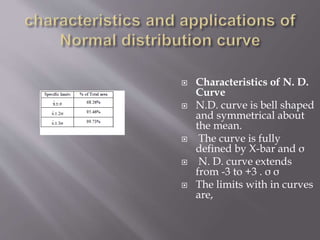
 Characteristics of N. D.
Curve
 N.D. curve is bell shaped
and symmetrical about
the mean.
 The curve is fully
defined by X-bar and σ
 N. D. curve extends
from -3 to +3 . σ σ
 The limits with in curves
are,
C505.7-Analyze the data and draw control charts
to understand SQC.
1. In process capability study
2. The area under the curve between two limits
represents the total % of production that will fall
between these limits.
 When selection 0f 3 limits, we are 95.73% sure that
the observations will lie within permissible limits.
σ
 It helps to calculate the expected proportion of
observation that will be less than or equal to
specified value . _x
 It also help to calculate the expected proportion of
observation that will be beyond the specified value
of _ x
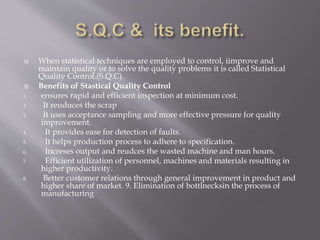
 When statistical techniques are employed to control, iimprove and
maintain quality or to solve the quality problems it is called Statistical
Quality Control.(S.Q.C).
 Benefits of Stastical Quality Control
1. ensures rapid and efficient inspection at minimum cost.
2. It reuduces the scrap
3. It uses acceptance sampling and more effective pressure for quality
improvement.
4. It provides ease for detection of faults.
5. It helps production process to adhere to specification.
6. Increses output and reudces the wasted machine and man hours.
7. Efficient utilization of personnel, machines and materials resulting in
higher productivity.
8. Better customer relations through general improvement in product and
higher share of market. 9. Elimination of bottlnecksin the process of
manufacturing
 Process capability is defined as the minimum
spread of a specific measurment variation
which will include 99.7% of the measurement
of given process.
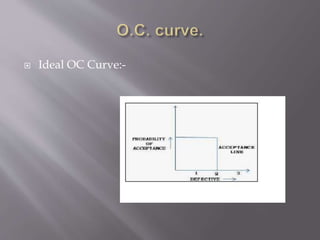
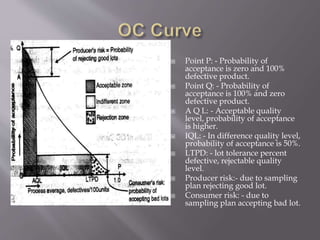
 Ideal OC Curve:-
 Point P: - Probability of
acceptance is zero and 100%
defective product.
 Point Q: - Probability of
acceptance is 100% and zero
defective product.
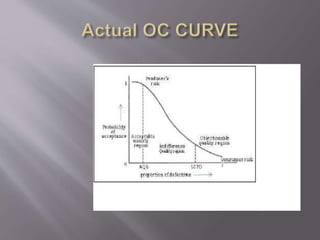
 A Q L: - Acceptable quality
level, probability of acceptance
is higher.
 IQL: - In difference quality level,
probability of acceptance is 50%.
 LTPD: - lot tolerance percent
defective, rejectable quality
level.
 Producer risk:- due to sampling
plan rejecting good lot.
 Consumer risk: - due to
sampling plan accepting bad lot.

CHAPTER 7 (2).pptx part print planning process

  • 1.
     Characteristics ofN. D. Curve  N.D. curve is bell shaped and symmetrical about the mean.  The curve is fully defined by X-bar and σ  N. D. curve extends from -3 to +3 . σ σ  The limits with in curves are,
  • 2.
    C505.7-Analyze the dataand draw control charts to understand SQC.
  • 3.
    1. In processcapability study 2. The area under the curve between two limits represents the total % of production that will fall between these limits.  When selection 0f 3 limits, we are 95.73% sure that the observations will lie within permissible limits. σ  It helps to calculate the expected proportion of observation that will be less than or equal to specified value . _x  It also help to calculate the expected proportion of observation that will be beyond the specified value of _ x
  • 4.
     When statisticaltechniques are employed to control, iimprove and maintain quality or to solve the quality problems it is called Statistical Quality Control.(S.Q.C).  Benefits of Stastical Quality Control 1. ensures rapid and efficient inspection at minimum cost. 2. It reuduces the scrap 3. It uses acceptance sampling and more effective pressure for quality improvement. 4. It provides ease for detection of faults. 5. It helps production process to adhere to specification. 6. Increses output and reudces the wasted machine and man hours. 7. Efficient utilization of personnel, machines and materials resulting in higher productivity. 8. Better customer relations through general improvement in product and higher share of market. 9. Elimination of bottlnecksin the process of manufacturing
  • 8.
     Process capabilityis defined as the minimum spread of a specific measurment variation which will include 99.7% of the measurement of given process.
  • 9.
     Ideal OCCurve:-
  • 12.
     Point P:- Probability of acceptance is zero and 100% defective product.  Point Q: - Probability of acceptance is 100% and zero defective product.  A Q L: - Acceptable quality level, probability of acceptance is higher.  IQL: - In difference quality level, probability of acceptance is 50%.  LTPD: - lot tolerance percent defective, rejectable quality level.  Producer risk:- due to sampling plan rejecting good lot.  Consumer risk: - due to sampling plan accepting bad lot.