EPS-I Process Engineering 1
Process Engineering
EPS-I Process Engineering 2
Overview
 Process Engineering
 Process Mapping
 HW 2 – 4 and Taco Bell Example
EPS-I Process Engineering 3
Engineering and Process Engineering
 Engineering often involves building a model
of an entity
 Stresses on a bridge (Civil Engineering)
 Flow of electricity in a circuit (Electrical
Engineering)
 Process Engineering involves building a
model of a process (usually multi-step,
parallel or series operations)
(Industrial/Management Engineering)
EPS-I Process Engineering 4
A Process
 A good definition of a process describes it as a
series of connected steps or actions to achieve an
outcome.
 A process has the following characteristics:
 a starting point and an end point. This is the scope
 a purpose or aim for the outcome
 rules governing the standard or quality of inputs throughout
the process
 it is usually linked to other processes
 it can be simple and short, or complex and long
From: NHS, UK
EPS-I Process Engineering 5
Examples of different processes
 From ordering a taco to receiving it.
 From first developing symptoms of a gastric
ulcer to being discharged as fit
 From the doctor saying that you need a chest
x-ray to knowing the results
EPS-I Process Engineering 6
Process Map
 A flow diagram to help create a better
understanding of the processes.
 Can model each process.
 Can eliminate or improve each process.
EPS-I Process Engineering 7
Process Mapping
 Use to graphically show the processes
involved
 Allows for examination of processes
(elimination or improvement)
 Used in manufacturing, logistics, and medical
areas
EPS-I Process Engineering 8
HW2: Fast Food Systems
 Aims
 Work as a team
 Examine an application of process engineering to
see how an example restaurant operates
 Give presentation on your results
 Select fast food restaurant.
 Visit and examine their operation.
EPS-I Process Engineering 9
HW2-4: Fast Food Systems
 How does the restaurant handle product
variety?
 Examine menu of restaurant (ignore minor items)
 Identify the food inputs for the main menu items
(again, ignore minor items)
 How does the restaurant handle speed of
delivery?
 Produce a process map
 How is customer wait time reduced?
 Where does it use Pull and/or Push approaches?
 How does it handle bulges in demand?
EPS-I Process Engineering 10
Fast Food Providers
 Customer requirements
 Low cost
 Fast
 Variety
 Consistency
 Safe, clean, convenient, pleasant surroundings
 HW2-4 will mainly examine how a fast food
restaurant meets these requirements
EPS-I Process Engineering 11
Two Main Approaches to Making Items
for Customers
 Make in advance of customer order (“Push”)
 Examples: car dealers lot, McDonalds standard
items.
 Make to Customer Order (“Pull”)
 Make after customer has ordered.
 Examples: Taco Bell, Dell computers
 What are advantages/disadvantages of each
for fast food restaurants?
EPS-I Process Engineering 12
Taco Bell
(think outside the bun)
 Products include: burritos, tacos, gorditas,
chalupas, nachos and quesadillas
 Some background: Taco Bell have re-engineered
their operations to a k-minus (kitchenless) operation,
meaning that most food preparation operations were
taken from the stores to centralized facilities.
 This has resulted in significant cost savings,
reduced space requirements and increased quality
control. They also eliminated middle-management
layers and implemented the TACO (Total
Automation of Company Operations) program to
give an integrated information system.
EPS-I Process Engineering 13
These changes have had a huge impact on the
company -- Taco Bell went from a failing regional
Mexican -American fast food chain with $500 million
in sales in 1982, to a $3 billion national company 10
years later
The K-Minus program, or kitchenless- restaurant,
established a system where the large majority of
food preparation occurs at central commissaries
rather than in the restaurant, pushing 15 hours of
work a day out of the restaurant, improving quality
control and employee morale, reducing employee
accidents and injuries, and resulting in substantial
savings on utilities.
From: http://future500.org/case_02.php
EPS-I Process Engineering 14
Main Menu Items
 Value
 Spicy Chicken Soft Taco
 Spicy Chicken Burrito
 Grande Soft Taco
 Double Decker Taco
 1/2 lb Bean Burrito Especial
 1/2 lb Beef Combo Burrito
 1/2 lb Beef and Potato Burrito
 Tacos
 Original Taco
 Taco Supreme
 Soft Taco
 Ranchero Chicken Soft Taco
 Soft Taco Supreme
 Grilled Steak Soft Taco
 Double Decker Taco
 Double Decker Taco Supreme®
 Burritos
 Bean Burrito
 7-Layer Burrito
 Chili Cheese Burrito
 Burrito Supreme®
 Fiesta Burrito
 Grilled Stuft Burrito
 Gordita
 Gordita Supreme®
 Gordita Baja®
 Gordita Nacho Cheese
 Chalupa
 Chalupa Supreme
 Chalupa Baja
 Chalupa Nacho Cheese
EPS-I Process Engineering 15
Main Ingredients
 Wraps
 Soft tortilla
 Hard taco shell
 Flatbread (Gordita)
 Chalupa
 Meats
 Chicken
 Beef
 Steak
 Other
 Beans
 Lettuce
 Onions
 Cheese
 Red sauce
 Potatoes
 Sour cream
 Tomatoes
 Rice
 Guacamole
EPS-I Process Engineering 16
Taco Bell
 How does the restaurant handle product
variety?
EPS-I Process Engineering 17
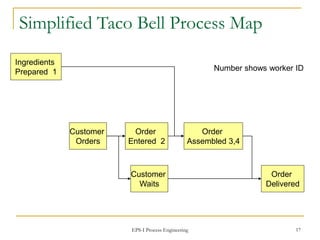
Simplified Taco Bell Process Map
Customer
Orders
Order
Entered 2
Order
Assembled 3,4
Customer
Waits
Order
Delivered
Ingredients
Prepared 1 Number shows worker ID
EPS-I Process Engineering 18
Taco Bell
 How does the restaurant handle speed of
delivery?
 How is customer wait time reduced?
 Where does it use Pull and/or Push approaches?
 How does it handle bulges in demand?
EPS-I Process Engineering 19
Taco Bell
 How does Taco-Bell meet other customer
requirements?
 Low cost
 Ingredients, central preparation of food, small site, low
wage labor
 Consistency
 Training, uniform measures
 Safe, clean, convenient, pleasant surroundings
 Well?
 How can operations be improved?

Process Engineering. ppt slides presentation

  • 1.
    EPS-I Process Engineering1 Process Engineering
  • 2.
    EPS-I Process Engineering2 Overview  Process Engineering  Process Mapping  HW 2 – 4 and Taco Bell Example
  • 3.
    EPS-I Process Engineering3 Engineering and Process Engineering  Engineering often involves building a model of an entity  Stresses on a bridge (Civil Engineering)  Flow of electricity in a circuit (Electrical Engineering)  Process Engineering involves building a model of a process (usually multi-step, parallel or series operations) (Industrial/Management Engineering)
  • 4.
    EPS-I Process Engineering4 A Process  A good definition of a process describes it as a series of connected steps or actions to achieve an outcome.  A process has the following characteristics:  a starting point and an end point. This is the scope  a purpose or aim for the outcome  rules governing the standard or quality of inputs throughout the process  it is usually linked to other processes  it can be simple and short, or complex and long From: NHS, UK
  • 5.
    EPS-I Process Engineering5 Examples of different processes  From ordering a taco to receiving it.  From first developing symptoms of a gastric ulcer to being discharged as fit  From the doctor saying that you need a chest x-ray to knowing the results
  • 6.
    EPS-I Process Engineering6 Process Map  A flow diagram to help create a better understanding of the processes.  Can model each process.  Can eliminate or improve each process.
  • 7.
    EPS-I Process Engineering7 Process Mapping  Use to graphically show the processes involved  Allows for examination of processes (elimination or improvement)  Used in manufacturing, logistics, and medical areas
  • 8.
    EPS-I Process Engineering8 HW2: Fast Food Systems  Aims  Work as a team  Examine an application of process engineering to see how an example restaurant operates  Give presentation on your results  Select fast food restaurant.  Visit and examine their operation.
  • 9.
    EPS-I Process Engineering9 HW2-4: Fast Food Systems  How does the restaurant handle product variety?  Examine menu of restaurant (ignore minor items)  Identify the food inputs for the main menu items (again, ignore minor items)  How does the restaurant handle speed of delivery?  Produce a process map  How is customer wait time reduced?  Where does it use Pull and/or Push approaches?  How does it handle bulges in demand?
  • 10.
    EPS-I Process Engineering10 Fast Food Providers  Customer requirements  Low cost  Fast  Variety  Consistency  Safe, clean, convenient, pleasant surroundings  HW2-4 will mainly examine how a fast food restaurant meets these requirements
  • 11.
    EPS-I Process Engineering11 Two Main Approaches to Making Items for Customers  Make in advance of customer order (“Push”)  Examples: car dealers lot, McDonalds standard items.  Make to Customer Order (“Pull”)  Make after customer has ordered.  Examples: Taco Bell, Dell computers  What are advantages/disadvantages of each for fast food restaurants?
  • 12.
    EPS-I Process Engineering12 Taco Bell (think outside the bun)  Products include: burritos, tacos, gorditas, chalupas, nachos and quesadillas  Some background: Taco Bell have re-engineered their operations to a k-minus (kitchenless) operation, meaning that most food preparation operations were taken from the stores to centralized facilities.  This has resulted in significant cost savings, reduced space requirements and increased quality control. They also eliminated middle-management layers and implemented the TACO (Total Automation of Company Operations) program to give an integrated information system.
  • 13.
    EPS-I Process Engineering13 These changes have had a huge impact on the company -- Taco Bell went from a failing regional Mexican -American fast food chain with $500 million in sales in 1982, to a $3 billion national company 10 years later The K-Minus program, or kitchenless- restaurant, established a system where the large majority of food preparation occurs at central commissaries rather than in the restaurant, pushing 15 hours of work a day out of the restaurant, improving quality control and employee morale, reducing employee accidents and injuries, and resulting in substantial savings on utilities. From: http://future500.org/case_02.php
  • 14.
    EPS-I Process Engineering14 Main Menu Items  Value  Spicy Chicken Soft Taco  Spicy Chicken Burrito  Grande Soft Taco  Double Decker Taco  1/2 lb Bean Burrito Especial  1/2 lb Beef Combo Burrito  1/2 lb Beef and Potato Burrito  Tacos  Original Taco  Taco Supreme  Soft Taco  Ranchero Chicken Soft Taco  Soft Taco Supreme  Grilled Steak Soft Taco  Double Decker Taco  Double Decker Taco Supreme®  Burritos  Bean Burrito  7-Layer Burrito  Chili Cheese Burrito  Burrito Supreme®  Fiesta Burrito  Grilled Stuft Burrito  Gordita  Gordita Supreme®  Gordita Baja®  Gordita Nacho Cheese  Chalupa  Chalupa Supreme  Chalupa Baja  Chalupa Nacho Cheese
  • 15.
    EPS-I Process Engineering15 Main Ingredients  Wraps  Soft tortilla  Hard taco shell  Flatbread (Gordita)  Chalupa  Meats  Chicken  Beef  Steak  Other  Beans  Lettuce  Onions  Cheese  Red sauce  Potatoes  Sour cream  Tomatoes  Rice  Guacamole
  • 16.
    EPS-I Process Engineering16 Taco Bell  How does the restaurant handle product variety?
  • 17.
    EPS-I Process Engineering17 Simplified Taco Bell Process Map Customer Orders Order Entered 2 Order Assembled 3,4 Customer Waits Order Delivered Ingredients Prepared 1 Number shows worker ID
  • 18.
    EPS-I Process Engineering18 Taco Bell  How does the restaurant handle speed of delivery?  How is customer wait time reduced?  Where does it use Pull and/or Push approaches?  How does it handle bulges in demand?
  • 19.
    EPS-I Process Engineering19 Taco Bell  How does Taco-Bell meet other customer requirements?  Low cost  Ingredients, central preparation of food, small site, low wage labor  Consistency  Training, uniform measures  Safe, clean, convenient, pleasant surroundings  Well?  How can operations be improved?