Prospecting


 Chapter 7
Important Questions Answered
   Why is prospecting important for effective selling?
   Are all sales leads good prospects? What are the
    characteristics of a qualified prospect?
   How can prospects be identified?
   How can the organisations be identified?
   How can the organisation’s promotional programme be
    used in prospecting?
   How can an effective lead qualification and management
    system aid a salesperson?
   How can a salesperson overcome a reluctance to a
    prospect?                    2
“The telemarketing aspect of my process can be
  frustrating at times because I’ll call prospects
  that won’t give me the time of day.”
                                      ~Tasha Stulz
                       Parker Marketing Research


                       7-3
Prospects - Dictionary Meaning
   An apparent probability of advancement, success, profit,
    etc.
   The outlook for the future: good business prospects.
   Anticipation; expectation; a looking forward.
   Something in view as a source of profit.
   Potential or likely customer, client, etc.
   A potential or likely candidate.


                               4
THE CONCEPT OF PROSPECTING
   A salesperson without prospects is out of business.
   A salesperson without prospects can no more close a
    sale than a surgeon without a patient can operate.
   Presenting a professional appearance, giving an
    impressive presentation and closing like a master are
    not enough to prevent failure if too little attention is
    given to prospecting.
   If your closing ratio is lower than you like, the major
    problem may be that you don't have enough good
    prospects -- not that you are a poor closer.
    You must have someone to whom to tell your story --
    someone who wants to buy and can buy.
   Prospects are everywhere - find the best
                               5
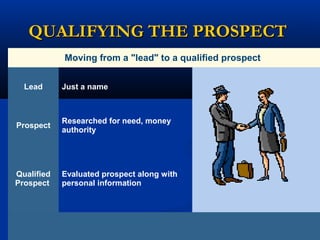
QUALIFYING THE PROSPECT
            Moving from a "lead" to a qualified prospect


  Lead      Just a name


            Researched for need, money
Prospect
            authority


Qualified   Evaluated prospect along with
Prospect    personal information


                                    6
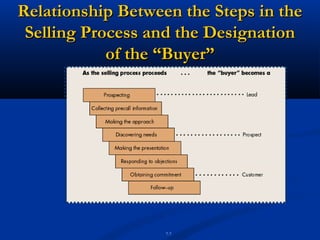
Relationship Between the Steps in the
 Selling Process and the Designation
            of the “Buyer”


                   7-7
The Importance of Prospecting
   Many experts believe it is the most important activity a
    salesperson does
   It is the process of locating potential customers for a
    product or service.
   The world is constantly changing
   More important in some fields than in others
   No salesperson can ignore leads, even in a position
    requiring less emphasis on new contacts


                               8
Class “A” Prospects
   Referral from a person the prospect respects

   Has the ability to make a buying decision

   Has the ability to pay for the product or service

   You have all the personal information you need to
    make a good presentation


                             9
Characteristics of a Good Prospect

   Starts with a Lead, which should be qualified.
   Quite some time is spent; amount of time spent
    depends upon the type of sale.


                               10
A qualified prospect is MAD
   He or she has:
       Money to buy
       Authority to buy
       Desire to buy


                           11
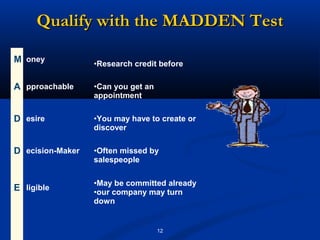
Qualify with the MADDEN Test

M oney            •Research credit before

A pproachable     •Can you get an
                  appointment

D esire           •You may have to create or
                  discover

D ecision-Maker   •Often missed by
                  salespeople

                  •May be committed already
E ligible         •our company may turn
                  down


                                    12
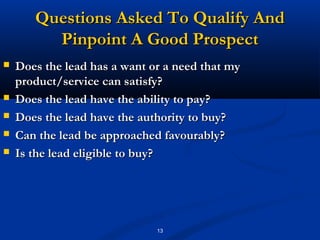
Questions Asked To Qualify And
         Pinpoint A Good Prospect
   Does the lead has a want or a need that my
    product/service can satisfy?
   Does the lead have the ability to pay?
   Does the lead have the authority to buy?
   Can the lead be approached favourably?
   Is the lead eligible to buy?


                              13
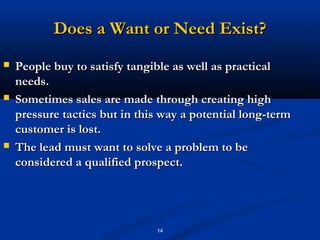
Does a Want or Need Exist?
   People buy to satisfy tangible as well as practical
    needs.
   Sometimes sales are made through creating high
    pressure tactics but in this way a potential long-term
    customer is lost.
   The lead must want to solve a problem to be
    considered a qualified prospect.


                               14
Does the Lead have the Ability to Pay?

   The ability to pay separate Lead from prospects.
   A client is not a real prospect without resources to pay
    for the product
   Ability to pay includes both cash and credit
   The client may have a desire to buy but if she/he is
    unable to pay, is not a Prospect


                               15
Does the Lead have the Authority to Buy?
   Knowing who has purchasing authority saves the
    salesperson time and effort and results in a higher
    percentage of closed sales
   It is better to simply ask that person if that person has
    the authority to buy.
   Companies also delegate their purchasing tasks to
    outside vendors – system integrators


                                16
Can the Lead be Approached
                  Favourably?
   At times they are very difficult to be approached e.g.
    Chief Executives etc that the salespeople do not
    consider them as prospects
   Possibility of getting an interview and Chances of
    making a sale


                               17
Is the Lead Eligible to Buy?
   Salespeople should be careful in contacting as if the
    company sells to wholesalers then only the wholesalers
    should be contacted.
   Salespeople should also be careful in locating the
    prospects that they should be in their exclusive sales
    territories
   Volume
   Status
   Sales territories

                              18
House accounts
   large or potential customers that are handled
    exclusively by the corporate executives should not
    be contacted by the salespersons


                           19
Other Criteria
   Leads that meet five criteria are generally considered
    excellent prospects. At times a few more are added to
    the list depending upon the company/item being sold.
    Timing of the purchase
    Long-term customer potential


                              20
Why we lose old customers
   Customer's company goes broke
   Competitor takes your customer
   Customer moves or dies

   Merger or downsizing

   Customer-salesperson relationship deteriorates

                           21
How and Where to Obtain Prospects?
   Satisfied Customers
   Endless-Chain Method
   Centre-of-Influence Method
   Networking
   Promotional Activities
       The Internet
       Inquiries from Advertising and Direct Mail
       Shows
       Seminars
   Lists and Directories
   Canvassing
                                   22
   Spotters
How and Where to Obtain Prospects?( contd.


   Telemarketing
       Limitations of Telephone Prospecting
       Tie-in With Other Tools

   Sales Letters
   Other Sources of Leads


                                  23
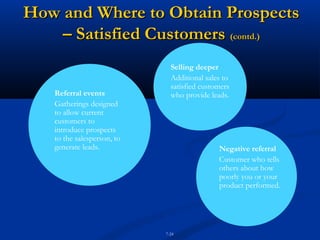
How and Where to Obtain Prospects
    – Satisfied Customers (contd.)
                              Selling deeper
                              Additional sales to
                              satisfied customers
   Referral events            who provide leads.
   Gatherings designed
   to allow current
   customers to
   introduce prospects
   to the salesperson, to
   generate leads.                           Negative referral
                                             Customer who tells
                                             others about how
                                             poorly you or your
                                             product performed.


                            7-24
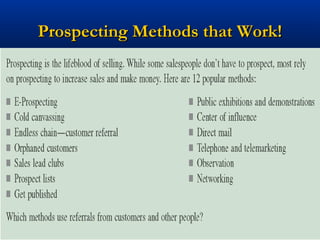
Prospecting Methods that Work!


              25
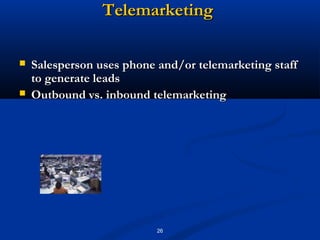
Telemarketing

   Salesperson uses phone and/or telemarketing staff
    to generate leads
   Outbound vs. inbound telemarketing


                           26
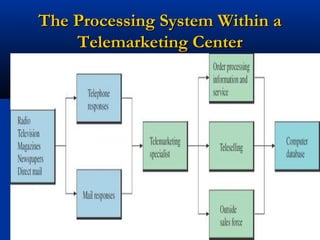
The Processing System Within a
    Telemarketing Center


              27
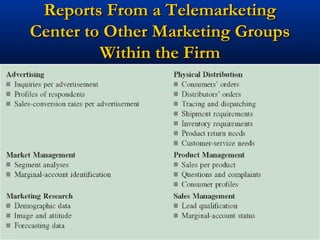
Reports From a Telemarketing
Center to Other Marketing Groups
         Within the Firm


               28
Referrals

   Have referral make the initial contact

   Learn how to ask for a referral

   Get letter of introduction

   Have referral call the prospect

   Referrals tend to be horizontal

                            29
Why people don't give referrals
   Can't think of anyone

   Object to giving referrals

   Time constraint


                            30
Centers of Influence
   Sales person cultivates well-known, influential
    people in the territory who are willing to supply
    lead information
   Buying community
   Believes in what you are selling
   Is influential with a number of people
    Is willing to give you names
   The names given to you are at least partially
    qualified prospects, more than just leads
   May never buy
                            31
Spotters

   Salesperson pays someone for lead information


                          32
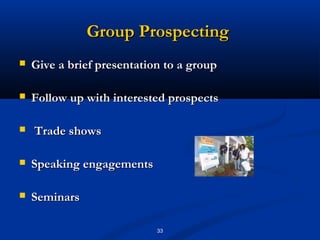
Group Prospecting
   Give a brief presentation to a group

   Follow up with interested prospects

   Trade shows

   Speaking engagements

   Seminars

                            33
Seminars

   Salespeople use seminars for prospects to generate
    leads
   Appeal to a specialized market
   Invite good prospects
   Go high-quality
   Be involved before, during, and after


                           34
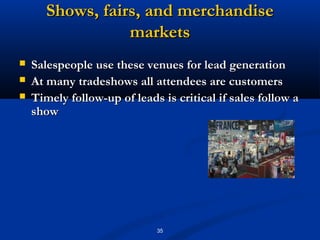
Shows, fairs, and merchandise
                  markets
   Salespeople use these venues for lead generation
   At many tradeshows all attendees are customers
   Timely follow-up of leads is critical if sales follow a
    show


                             35
Planned Cold Calling
   Salesperson tries to generate leads by calling on
    totally unfamiliar organizations
   At least one out of seven will be receptive.
   Treat cold calls as a supplement.
   Develop effective, memorable door
   Don't neglect others by too much of this.
   Preplan Cold Calls
   openers
   Limit Waiting
   Fifteen minutes
   Keep busy while waiting
   Remain Enthusiastic        36
Direct Mail or Fax
   Prospects do read well targeted direct mail
   Watch quality of purchased lists
   Create your own newsletter
   Mailing is good and Cheap
   Postcard pack
   Bounce-back card


                            37
Sales letters

   Salesperson writes personal letters to potential
    leads
   Follow up with a telephone call
   Include promotional items


                            38
Internet
   Salesperson uses websites, e-mail, listservers,
    bulletin boards, forums, roundtables, and
    newsgroups to secure leads
   Extranets
   E-selling


                            39
Ads, catalogs, and publicity
   Salespeople use these forms of promotional
    activities to generate leads


                           40
Joining Civic Groups
   Assume leadership responsibilities
   Become highly visible
   Set contact goals for each club meeting
   Keep files on each contact made
   Use "re-meet " goals to help you develop closer
    relationships
   Reach out to new members
   Use active listening
   Look for sales opportunities

                           41
Networking - active cooperation

   There are formal groups that you can join
   Sharing information makes good sense
   Salesperson uses personal relationships with those
    who are connected and cooperative to secure leads
   Suggestions:
   Call at least two people per day and go to at least one
    networking event every week
   Spend most of your initial conversation with a new contact
    talking about his or her business and learn about the
    person’s nonbusiness interests
   Follow up with your new contact on a regular basis
                                   42
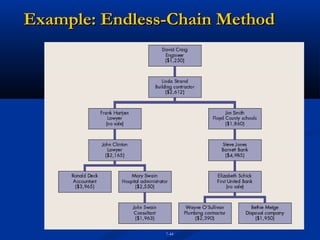
Endless chain

   Salesperson attempts to secure at least one
    additional lead from each person he or she
    interviews
   Referred lead


                            43
Example: Endless-Chain Method


                7-44
Using Directories

   Salespeople use secondary data sources, which can
    be free or fee-based
   Purchasing lists
   Sales and Marketing Management - buying power
    index
   Moody's Industrial Manual
   Poor's Register of Directors and Execs
   The Dun and Bradstreet Reference book
   The Thomas register of American Manufacturers
   Contacts Influential    45
Observation
   Prospects are everywhere
       Always be looking
       Read the news
       Trade journals


                            46
Other sources of leads
   Salesperson uses noncompeting salespeople,
    people in his or her own firm, friends, and so on, to
    secure information
   Government agencies


                            47
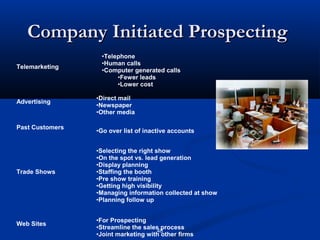
Company Initiated Prospecting
                  •Telephone
                  •Human calls
Telemarketing
                  •Computer generated calls
                       •Fewer leads
                       •Lower cost

                 •Direct mail
Advertising
                 •Newspaper
                 •Other media

Past Customers
                 •Go over list of inactive accounts


                 •Selecting the right show
                 •On the spot vs. lead generation
                 •Display planning
Trade Shows      •Staffing the booth
                 •Pre show training
                 •Getting high visibility
                 •Managing information collected at show
                 •Planning follow up


                 •For Prospecting
Web Sites
                 •Streamline the sales process
                                     48
                 •Joint marketing with other firms
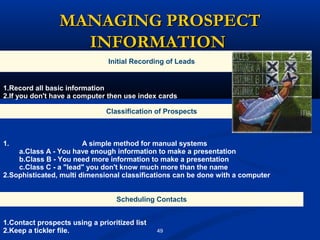
MANAGING PROSPECT
                   INFORMATION
                                Initial Recording of Leads


1.Record all basic information
2.If you don't have a computer then use index cards

                               Classification of Prospects


1.                      A simple method for manual systems
    a.Class A - You have enough information to make a presentation
    b.Class B - You need more information to make a presentation
    c.Class C - a "lead" you don't know much more than the name
2.Sophisticated, multi dimensional classifications can be done with a computer


                                  Scheduling Contacts


1.Contact prospects using a prioritized list
2.Keep a tickler file.                         49
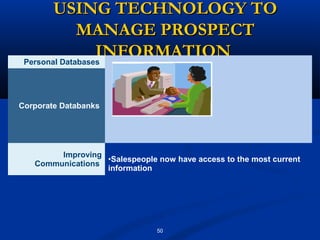
USING TECHNOLOGY TO
              MANAGE PROSPECT
                  INFORMATION
 Personal Databases


Corporate Databanks


        Improving
                  •Salespeople now have access to the most current
   Communications
                  information


                                50
Lead Qualification and Management
                   Systems
   The process developed by the salespeople for
    qualifying leads is called Lead Qualification System
   The process of analysing the relative value of each lead
    is called Lead Management System
       Prequalification
       Analyzing lead value
       Evaluating profitability of sales resulting from lead-
        generating activities


                                     51
Overcome a Reluctance to Prospect
   Salespeople usually face a natural reluctance to prospects.
    Reasons for this may be one or several out of the following
       Worrying about the worst-case scenarios
       Spending too much time preparing
       Being overly concerned with looking successful etc.
       Being fearful of
       Making group presentations
       Appearing too pushy
       Losing friends or family approval
       Using the phone for prospecting
     Feeling intimidated by people with prestige or power, o
      feeling guilt at having a career in selling
     Having a compulsive need to argue, make excuses, or
      blame others
                                    52
Helpful activities to Overcome a
            Reluctance to Prospect
   Helpful activities
   Identify and evaluate excuses not to call
   Engage in sales training and role-playing activities
   Make prospecting contacts with a supporting partner or sales
    manager
   Set specific goals for all of your prospecting activity
   Realize the economic value of most prospecting activities
   Stop negative self-evaluation from ruling your behavior
   Remember that you are calling on prospects to solve their needs
   Control your perceptions of what prospects might say about you,
    your company, or your products
   Learn and apply relaxation and stress-reducing techniques
   Recount your own prospecting successes, or those of others
                                  53
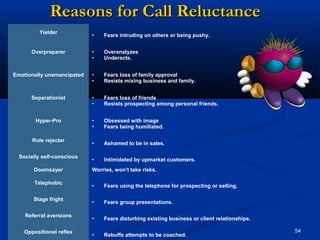
Reasons for Call Reluctance
          Yielder
                            •   Fears intruding on others or being pushy.


      Overpreparer          •   Overanalyzes
                            •   Underacts.


Emotionally unemancipated   •   Fears loss of family approval
                            •   Resists mixing business and family.


      Separationist         •   Fears loss of friends
                            •   Resists prospecting among personal friends.


        Hyper-Pro           •   Obsessed with image
                            •   Fears being humiliated.

       Role rejecter
                            •   Ashamed to be in sales.

  Socially self-conscious
                            •   Intimidated by upmarket customers.
       Doomsayer            Worries, won’t take risks.

        Telephobic
                            •   Fears using the telephone for prospecting or selling.

       Stage fright
                            •   Fears group presentations.

    Referral aversions
                            •   Fears disturbing existing business or client relationships.

    Oppositional reflex                                                                       54
                            •   Rebuffs attempts to be coached.
Summary
   Locating prospective customers is the first step in
    the sales process.
   Not all sales leads qualify as good prospects.
   Many methods can be used to locate prospects.
   The best source is a satisfied customer.
   Effective prospecting requires a strong plan that
    hinges on developing a lead qualification and
    management system and overcoming reluctance to
    prospect.


                               7-55
End of Chapter 7
Thank you

Personal Selling: Chapter 7

  • 1.
  • 2.
    Important Questions Answered  Why is prospecting important for effective selling?  Are all sales leads good prospects? What are the characteristics of a qualified prospect?  How can prospects be identified?  How can the organisations be identified?  How can the organisation’s promotional programme be used in prospecting?  How can an effective lead qualification and management system aid a salesperson?  How can a salesperson overcome a reluctance to a prospect? 2
  • 3.
    “The telemarketing aspectof my process can be frustrating at times because I’ll call prospects that won’t give me the time of day.” ~Tasha Stulz Parker Marketing Research 7-3
  • 4.
    Prospects - DictionaryMeaning  An apparent probability of advancement, success, profit, etc.  The outlook for the future: good business prospects.  Anticipation; expectation; a looking forward.  Something in view as a source of profit.  Potential or likely customer, client, etc.  A potential or likely candidate. 4
  • 5.
    THE CONCEPT OFPROSPECTING  A salesperson without prospects is out of business.  A salesperson without prospects can no more close a sale than a surgeon without a patient can operate.  Presenting a professional appearance, giving an impressive presentation and closing like a master are not enough to prevent failure if too little attention is given to prospecting.  If your closing ratio is lower than you like, the major problem may be that you don't have enough good prospects -- not that you are a poor closer.  You must have someone to whom to tell your story -- someone who wants to buy and can buy.  Prospects are everywhere - find the best 5
  • 6.
    QUALIFYING THE PROSPECT Moving from a "lead" to a qualified prospect Lead Just a name Researched for need, money Prospect authority Qualified Evaluated prospect along with Prospect personal information 6
  • 7.
    Relationship Between theSteps in the Selling Process and the Designation of the “Buyer” 7-7
  • 8.
    The Importance ofProspecting  Many experts believe it is the most important activity a salesperson does  It is the process of locating potential customers for a product or service.  The world is constantly changing  More important in some fields than in others  No salesperson can ignore leads, even in a position requiring less emphasis on new contacts 8
  • 9.
    Class “A” Prospects  Referral from a person the prospect respects  Has the ability to make a buying decision  Has the ability to pay for the product or service  You have all the personal information you need to make a good presentation 9
  • 10.
    Characteristics of aGood Prospect  Starts with a Lead, which should be qualified.  Quite some time is spent; amount of time spent depends upon the type of sale. 10
  • 11.
    A qualified prospectis MAD  He or she has:  Money to buy  Authority to buy  Desire to buy 11
  • 12.
    Qualify with theMADDEN Test M oney •Research credit before A pproachable •Can you get an appointment D esire •You may have to create or discover D ecision-Maker •Often missed by salespeople •May be committed already E ligible •our company may turn down 12
  • 13.
    Questions Asked ToQualify And Pinpoint A Good Prospect  Does the lead has a want or a need that my product/service can satisfy?  Does the lead have the ability to pay?  Does the lead have the authority to buy?  Can the lead be approached favourably?  Is the lead eligible to buy? 13
  • 14.
    Does a Wantor Need Exist?  People buy to satisfy tangible as well as practical needs.  Sometimes sales are made through creating high pressure tactics but in this way a potential long-term customer is lost.  The lead must want to solve a problem to be considered a qualified prospect. 14
  • 15.
    Does the Leadhave the Ability to Pay?  The ability to pay separate Lead from prospects.  A client is not a real prospect without resources to pay for the product  Ability to pay includes both cash and credit  The client may have a desire to buy but if she/he is unable to pay, is not a Prospect 15
  • 16.
    Does the Leadhave the Authority to Buy?  Knowing who has purchasing authority saves the salesperson time and effort and results in a higher percentage of closed sales  It is better to simply ask that person if that person has the authority to buy.  Companies also delegate their purchasing tasks to outside vendors – system integrators 16
  • 17.
    Can the Leadbe Approached Favourably?  At times they are very difficult to be approached e.g. Chief Executives etc that the salespeople do not consider them as prospects  Possibility of getting an interview and Chances of making a sale 17
  • 18.
    Is the LeadEligible to Buy?  Salespeople should be careful in contacting as if the company sells to wholesalers then only the wholesalers should be contacted.  Salespeople should also be careful in locating the prospects that they should be in their exclusive sales territories  Volume  Status  Sales territories 18
  • 19.
    House accounts  large or potential customers that are handled exclusively by the corporate executives should not be contacted by the salespersons 19
  • 20.
    Other Criteria  Leads that meet five criteria are generally considered excellent prospects. At times a few more are added to the list depending upon the company/item being sold.  Timing of the purchase  Long-term customer potential 20
  • 21.
    Why we loseold customers  Customer's company goes broke  Competitor takes your customer  Customer moves or dies  Merger or downsizing  Customer-salesperson relationship deteriorates 21
  • 22.
    How and Whereto Obtain Prospects?  Satisfied Customers  Endless-Chain Method  Centre-of-Influence Method  Networking  Promotional Activities  The Internet  Inquiries from Advertising and Direct Mail  Shows  Seminars  Lists and Directories  Canvassing 22  Spotters
  • 23.
    How and Whereto Obtain Prospects?( contd.  Telemarketing  Limitations of Telephone Prospecting  Tie-in With Other Tools  Sales Letters  Other Sources of Leads 23
  • 24.
    How and Whereto Obtain Prospects – Satisfied Customers (contd.) Selling deeper Additional sales to satisfied customers Referral events who provide leads. Gatherings designed to allow current customers to introduce prospects to the salesperson, to generate leads. Negative referral Customer who tells others about how poorly you or your product performed. 7-24
  • 25.
  • 26.
    Telemarketing  Salesperson uses phone and/or telemarketing staff to generate leads  Outbound vs. inbound telemarketing 26
  • 27.
    The Processing SystemWithin a Telemarketing Center 27
  • 28.
    Reports From aTelemarketing Center to Other Marketing Groups Within the Firm 28
  • 29.
    Referrals  Have referral make the initial contact  Learn how to ask for a referral  Get letter of introduction  Have referral call the prospect  Referrals tend to be horizontal 29
  • 30.
    Why people don'tgive referrals  Can't think of anyone  Object to giving referrals  Time constraint 30
  • 31.
    Centers of Influence  Sales person cultivates well-known, influential people in the territory who are willing to supply lead information  Buying community  Believes in what you are selling  Is influential with a number of people  Is willing to give you names  The names given to you are at least partially qualified prospects, more than just leads  May never buy 31
  • 32.
    Spotters  Salesperson pays someone for lead information 32
  • 33.
    Group Prospecting  Give a brief presentation to a group  Follow up with interested prospects  Trade shows  Speaking engagements  Seminars 33
  • 34.
    Seminars  Salespeople use seminars for prospects to generate leads  Appeal to a specialized market  Invite good prospects  Go high-quality  Be involved before, during, and after 34
  • 35.
    Shows, fairs, andmerchandise markets  Salespeople use these venues for lead generation  At many tradeshows all attendees are customers  Timely follow-up of leads is critical if sales follow a show 35
  • 36.
    Planned Cold Calling  Salesperson tries to generate leads by calling on totally unfamiliar organizations  At least one out of seven will be receptive.  Treat cold calls as a supplement.  Develop effective, memorable door  Don't neglect others by too much of this.  Preplan Cold Calls  openers  Limit Waiting  Fifteen minutes  Keep busy while waiting  Remain Enthusiastic 36
  • 37.
    Direct Mail orFax  Prospects do read well targeted direct mail  Watch quality of purchased lists  Create your own newsletter  Mailing is good and Cheap  Postcard pack  Bounce-back card 37
  • 38.
    Sales letters  Salesperson writes personal letters to potential leads  Follow up with a telephone call  Include promotional items 38
  • 39.
    Internet  Salesperson uses websites, e-mail, listservers, bulletin boards, forums, roundtables, and newsgroups to secure leads  Extranets  E-selling 39
  • 40.
    Ads, catalogs, andpublicity  Salespeople use these forms of promotional activities to generate leads 40
  • 41.
    Joining Civic Groups  Assume leadership responsibilities  Become highly visible  Set contact goals for each club meeting  Keep files on each contact made  Use "re-meet " goals to help you develop closer relationships  Reach out to new members  Use active listening  Look for sales opportunities 41
  • 42.
    Networking - activecooperation  There are formal groups that you can join  Sharing information makes good sense  Salesperson uses personal relationships with those who are connected and cooperative to secure leads  Suggestions:  Call at least two people per day and go to at least one networking event every week  Spend most of your initial conversation with a new contact talking about his or her business and learn about the person’s nonbusiness interests  Follow up with your new contact on a regular basis 42
  • 43.
    Endless chain  Salesperson attempts to secure at least one additional lead from each person he or she interviews  Referred lead 43
  • 44.
  • 45.
    Using Directories  Salespeople use secondary data sources, which can be free or fee-based  Purchasing lists  Sales and Marketing Management - buying power index  Moody's Industrial Manual  Poor's Register of Directors and Execs  The Dun and Bradstreet Reference book  The Thomas register of American Manufacturers  Contacts Influential 45
  • 46.
    Observation  Prospects are everywhere  Always be looking  Read the news  Trade journals 46
  • 47.
    Other sources ofleads  Salesperson uses noncompeting salespeople, people in his or her own firm, friends, and so on, to secure information  Government agencies 47
  • 48.
    Company Initiated Prospecting •Telephone •Human calls Telemarketing •Computer generated calls •Fewer leads •Lower cost •Direct mail Advertising •Newspaper •Other media Past Customers •Go over list of inactive accounts •Selecting the right show •On the spot vs. lead generation •Display planning Trade Shows •Staffing the booth •Pre show training •Getting high visibility •Managing information collected at show •Planning follow up •For Prospecting Web Sites •Streamline the sales process 48 •Joint marketing with other firms
  • 49.
    MANAGING PROSPECT INFORMATION Initial Recording of Leads 1.Record all basic information 2.If you don't have a computer then use index cards Classification of Prospects 1. A simple method for manual systems a.Class A - You have enough information to make a presentation b.Class B - You need more information to make a presentation c.Class C - a "lead" you don't know much more than the name 2.Sophisticated, multi dimensional classifications can be done with a computer Scheduling Contacts 1.Contact prospects using a prioritized list 2.Keep a tickler file. 49
  • 50.
    USING TECHNOLOGY TO MANAGE PROSPECT INFORMATION Personal Databases Corporate Databanks Improving •Salespeople now have access to the most current Communications information 50
  • 51.
    Lead Qualification andManagement Systems  The process developed by the salespeople for qualifying leads is called Lead Qualification System  The process of analysing the relative value of each lead is called Lead Management System  Prequalification  Analyzing lead value  Evaluating profitability of sales resulting from lead- generating activities 51
  • 52.
    Overcome a Reluctanceto Prospect  Salespeople usually face a natural reluctance to prospects. Reasons for this may be one or several out of the following  Worrying about the worst-case scenarios  Spending too much time preparing  Being overly concerned with looking successful etc.  Being fearful of  Making group presentations  Appearing too pushy  Losing friends or family approval  Using the phone for prospecting  Feeling intimidated by people with prestige or power, o feeling guilt at having a career in selling  Having a compulsive need to argue, make excuses, or blame others 52
  • 53.
    Helpful activities toOvercome a Reluctance to Prospect  Helpful activities  Identify and evaluate excuses not to call  Engage in sales training and role-playing activities  Make prospecting contacts with a supporting partner or sales manager  Set specific goals for all of your prospecting activity  Realize the economic value of most prospecting activities  Stop negative self-evaluation from ruling your behavior  Remember that you are calling on prospects to solve their needs  Control your perceptions of what prospects might say about you, your company, or your products  Learn and apply relaxation and stress-reducing techniques  Recount your own prospecting successes, or those of others 53
  • 54.
    Reasons for CallReluctance Yielder • Fears intruding on others or being pushy. Overpreparer • Overanalyzes • Underacts. Emotionally unemancipated • Fears loss of family approval • Resists mixing business and family. Separationist • Fears loss of friends • Resists prospecting among personal friends. Hyper-Pro • Obsessed with image • Fears being humiliated. Role rejecter • Ashamed to be in sales. Socially self-conscious • Intimidated by upmarket customers. Doomsayer Worries, won’t take risks. Telephobic • Fears using the telephone for prospecting or selling. Stage fright • Fears group presentations. Referral aversions • Fears disturbing existing business or client relationships. Oppositional reflex 54 • Rebuffs attempts to be coached.
  • 55.
    Summary  Locating prospective customers is the first step in the sales process.  Not all sales leads qualify as good prospects.  Many methods can be used to locate prospects.  The best source is a satisfied customer.  Effective prospecting requires a strong plan that hinges on developing a lead qualification and management system and overcoming reluctance to prospect. 7-55
  • 56.
  • 57.

Editor's Notes