What is Medical Technology ?
Medical Technology, which is a proper subset of
health technology, encompasses a wide range
of healthcare products and is used to diagnose,
monitor or treat diseases or medical conditions
affecting humans.
What is Medical Technologists ?
• Medical Technologists, also known as clinical laboratory
technologists, perform and analyze the results of complex
scientific tests on blood and body fluids.
How the Body Uses Energy - As Cell Mitochondria Convert Food into
Useable Energy?
• Food is the fuel for the body. The mitochondria are the converters; they convert
the fuel into useable energy. When food is digested, or broken down into its
smallest molecules and nutrients, and air is taken in, or inspired, the smallest
molecules and nutrients cross into the bloodstream. These molecules and
nutrients include things such as glucose (a sugar molecule derived from
carbohydrates) and oxygen.
• Use food only as a fuel. Otherwise, you will consume more fuel than is necessary
to make the machine called your body function. And you know what happens to
the excess fuel? It gets stored for later (the machine stays prepared for times of
low fuel intake) as fat.
• Just as fire burns oxygen and gives off carbon dioxide and water, mitochondria
act like furnaces when they convert glucose into adenosine triphosphate (ATP):
They “burn” (use) oxygen and give off carbon dioxide and water.
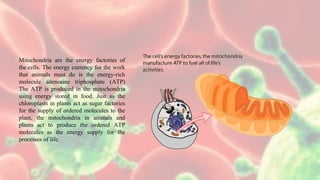
Mitochondria are the energy factories of
the cells. The energy currency for the work
that animals must do is the energy-rich
molecule adenosine triphosphate (ATP)
The ATP is produced in the mitochondria
using energy stored in food. Just as the
chloroplasts in plants act as sugar factories
for the supply of ordered molecules to the
plant, the mitochondria in animals and
plants act to produce the ordered ATP
molecules as the energy supply for the
processes of life.
BIOLOGICAL ENERGY PRODUCTION IN RELATION TO MEDICAL TECHNOLOGY
THE FOLLOWING ARE SOME OF THE TESTS PERFORMED BY MEDICAL
TECHNOLOGISTS INVOLVING BIOLOGICAL ENERGY PRODUCTION :
Citric Acid & Urine
Testing for Mitochondrial Disease Disorders (Muscle Biopsy Testing)
Blood enzyme test
Lactate and pyruvate levels
Serum creatine kinase
Genetic test
Known mutations
Rare or unknown mutations
Citric Acid & Urine
A test to see how much citric acid is in your urine is used to help evaluate your risk
for kidney stones or to help diagnose other health conditions. Low levels of citric
acid are risk factors for kidney stones, but higher levels may have a protective
effect. You can influence the amount of citric acid in your urine through your diet.
Always discuss possible dietary changes and any test results with your doctor.
Testing
A citric acid urine test is performed over a 24-hour period. The normal range of
citric acid in your urine is 320 to 1,240 mg in 24 hours. However, ranges for normal
results can vary among laboratories, so it's important to have a doctor analyze your
readings, according to MedlinePlus. There's no discomfort when you take a citric
acid urine test because it simply involves urinating normally and collecting your
urine in a special container. Because test results are influenced by your diet, you
need to eat normally when you take the test.
Mitochondrial Disease Disorders : Muscle
Biopsy Testing
• A small piece of muscle, usually the size of the end of our little finger
is removed from the upper thigh of a patient for this testing. (The
removal of this small piece of tissue does not cause permanent
damage to the patient but does leave a scar several inches long.)
• The testing completed on this muscle tells us whether or not a certain
person can produce enough energy to function normally or whether
or not he/she has a problem making too little energy. The testing is
complicated and takes many weeks to complete.
• Measures activities of specific enzymes. A special test called
polarography measures oxygen consumption in mitochondria.
Test Results
If the testing indicates that a given patient does indeed have a
mitochondrial disorder, that person is then screened every year for
many associated problems found with these diseases (such as diabetes
and thyroid disease). This helps us prevent many of the treatable
complications of these disorders.
Treatment of mitochondrial disorders is centered around vitamin,
supplement and co-factor therapy which improves mitochondrial
function, and helps reduce symptoms in many patients. Nutrition,
hydration, and energy conservation are also critically important!
Blood enzyme test
1. Lactate and pyruvate levels
If elevated, may indicate deficiency in electron transport chain;
abnormal ratios of the two may help identify the part of the chain that
is blocked.
2. Serum Creatine kinase
May be slightly elevated in mitochondrial disease but usually only high
in cases of mitochondrial DNA depletion.
Genetic test
1. Known mutations
Uses blood sample or muscle sample to screen for
known mutations, looking for common mutations
first
2. Rare or unknown mutations
Can also look for rare or unknown mutations but
may require samples from family members; this is
more expensive and time-consuming.
Prepared by:
Mercado, Princess Cate R.
Alejandrino, Ma. Lourdes F.
Aspillaga, Liezel

Chapter 6 biochemical energy production

  • 2.
    What is MedicalTechnology ? Medical Technology, which is a proper subset of health technology, encompasses a wide range of healthcare products and is used to diagnose, monitor or treat diseases or medical conditions affecting humans.
  • 3.
    What is MedicalTechnologists ? • Medical Technologists, also known as clinical laboratory technologists, perform and analyze the results of complex scientific tests on blood and body fluids.
  • 4.
    How the BodyUses Energy - As Cell Mitochondria Convert Food into Useable Energy? • Food is the fuel for the body. The mitochondria are the converters; they convert the fuel into useable energy. When food is digested, or broken down into its smallest molecules and nutrients, and air is taken in, or inspired, the smallest molecules and nutrients cross into the bloodstream. These molecules and nutrients include things such as glucose (a sugar molecule derived from carbohydrates) and oxygen. • Use food only as a fuel. Otherwise, you will consume more fuel than is necessary to make the machine called your body function. And you know what happens to the excess fuel? It gets stored for later (the machine stays prepared for times of low fuel intake) as fat. • Just as fire burns oxygen and gives off carbon dioxide and water, mitochondria act like furnaces when they convert glucose into adenosine triphosphate (ATP): They “burn” (use) oxygen and give off carbon dioxide and water.
  • 5.
    Mitochondria are theenergy factories of the cells. The energy currency for the work that animals must do is the energy-rich molecule adenosine triphosphate (ATP) The ATP is produced in the mitochondria using energy stored in food. Just as the chloroplasts in plants act as sugar factories for the supply of ordered molecules to the plant, the mitochondria in animals and plants act to produce the ordered ATP molecules as the energy supply for the processes of life.
  • 6.
    BIOLOGICAL ENERGY PRODUCTIONIN RELATION TO MEDICAL TECHNOLOGY THE FOLLOWING ARE SOME OF THE TESTS PERFORMED BY MEDICAL TECHNOLOGISTS INVOLVING BIOLOGICAL ENERGY PRODUCTION : Citric Acid & Urine Testing for Mitochondrial Disease Disorders (Muscle Biopsy Testing) Blood enzyme test Lactate and pyruvate levels Serum creatine kinase Genetic test Known mutations Rare or unknown mutations
  • 7.
    Citric Acid &Urine A test to see how much citric acid is in your urine is used to help evaluate your risk for kidney stones or to help diagnose other health conditions. Low levels of citric acid are risk factors for kidney stones, but higher levels may have a protective effect. You can influence the amount of citric acid in your urine through your diet. Always discuss possible dietary changes and any test results with your doctor. Testing A citric acid urine test is performed over a 24-hour period. The normal range of citric acid in your urine is 320 to 1,240 mg in 24 hours. However, ranges for normal results can vary among laboratories, so it's important to have a doctor analyze your readings, according to MedlinePlus. There's no discomfort when you take a citric acid urine test because it simply involves urinating normally and collecting your urine in a special container. Because test results are influenced by your diet, you need to eat normally when you take the test.
  • 8.
    Mitochondrial Disease Disorders: Muscle Biopsy Testing • A small piece of muscle, usually the size of the end of our little finger is removed from the upper thigh of a patient for this testing. (The removal of this small piece of tissue does not cause permanent damage to the patient but does leave a scar several inches long.) • The testing completed on this muscle tells us whether or not a certain person can produce enough energy to function normally or whether or not he/she has a problem making too little energy. The testing is complicated and takes many weeks to complete. • Measures activities of specific enzymes. A special test called polarography measures oxygen consumption in mitochondria.
  • 9.
    Test Results If thetesting indicates that a given patient does indeed have a mitochondrial disorder, that person is then screened every year for many associated problems found with these diseases (such as diabetes and thyroid disease). This helps us prevent many of the treatable complications of these disorders. Treatment of mitochondrial disorders is centered around vitamin, supplement and co-factor therapy which improves mitochondrial function, and helps reduce symptoms in many patients. Nutrition, hydration, and energy conservation are also critically important!
  • 10.
    Blood enzyme test 1.Lactate and pyruvate levels If elevated, may indicate deficiency in electron transport chain; abnormal ratios of the two may help identify the part of the chain that is blocked. 2. Serum Creatine kinase May be slightly elevated in mitochondrial disease but usually only high in cases of mitochondrial DNA depletion.
  • 11.
    Genetic test 1. Knownmutations Uses blood sample or muscle sample to screen for known mutations, looking for common mutations first 2. Rare or unknown mutations Can also look for rare or unknown mutations but may require samples from family members; this is more expensive and time-consuming.
  • 12.
    Prepared by: Mercado, PrincessCate R. Alejandrino, Ma. Lourdes F. Aspillaga, Liezel