LIPIDS
TO
MEDICAL TECHNOLOGY
What is Medical Technology ?
Medical Technology, which is a proper
subset of health technology, encompasses
a wide range of healthcare products and is
used to diagnose, monitor or treat
diseases or medical conditions
affecting humans.
What is Medical Technologists ?
Medical Technologists, also known as
clinical laboratory technologists,
perform and analyze the results of
complex scientific tests on blood and
body fluids.
What is Lipids used for in the human
body?
• Lipids, also known as fats, play many important roles in your body,
from providing energy to producing hormones. You wouldn't be able
to digest and absorb food properly without lipids. Of course, eating
more fat than you need can lead to weight gain, but in proper
amounts lipids are a healthy part of your diet.
LIPIDS IN RELATION TO MEDICAL TECHNOLOGY
THE FOLLOWING ARE SOME OF THE TESTS PERFORMED BY
MEDICAL TECHNOLOGISTS INVOLVING LIPIDS:
 Lipid Blood Tests
 Cushing's Syndrome
 Spirit Blue Agar Plate
 Lipiduria
Lipid Blood
Tests
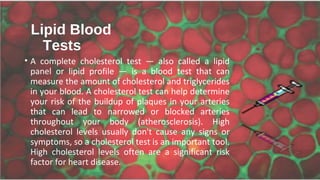
• A complete cholesterol test — also called a lipid
panel or lipid profile — is a blood test that can
measure the amount of cholesterol and triglycerides
in your blood. A cholesterol test can help determine
your risk of the buildup of plaques in your arteries
that can lead to narrowed or blocked arteries
throughout your body (atherosclerosis). High
cholesterol levels usually don't cause any signs or
symptoms, so a cholesterol test is an important tool.
High cholesterol levels often are a significant risk
factor for heart disease.
Cushing's Syndrome
• Cushing's syndrome is a disorder caused by prolonged exposure of
the body's tissues to high levels of corticosteroids (glucocorticoids).
• Corticosteroids are powerful steroid hormones produced by the
adrenal glands, located above each kidney. They regulate the
metabolism of proteins, carbohydrates, and fats. They reduce the
immune system's inflammatory responses and help to maintain blood
pressure and heart function. A vital function of corticosteroids is to
help the body respond to stress.
Exams and Tests for Cushing's
Syndrome
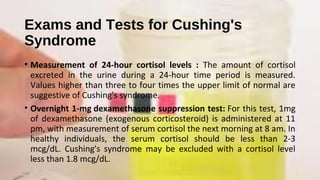
• Measurement of 24-hour cortisol levels : The amount of cortisol
excreted in the urine during a 24-hour time period is measured.
Values higher than three to four times the upper limit of normal are
suggestive of Cushing's syndrome.
• Overnight 1-mg dexamethasone suppression test: For this test, 1mg
of dexamethasone (exogenous corticosteroid) is administered at 11
pm, with measurement of serum cortisol the next morning at 8 am. In
healthy individuals, the serum cortisol should be less than 2-3
mcg/dL. Cushing's syndrome may be excluded with a cortisol level
less than 1.8 mcg/dL.
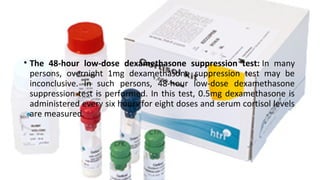
• The 48-hour low-dose dexamethasone suppression test: In  many 
persons,  overnight  1mg  dexamethasone  suppression  test  may  be 
inconclusive.  In  such  persons,  48-hour  low-dose  dexamethasone 
suppression test is performed. In this test, 0.5mg dexamethasone is 
administered every six hours for eight doses and serum cortisol levels 
are measured.
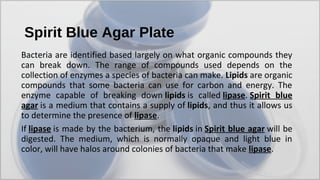
Spirit Blue Agar Plate
Bacteria are identified based largely on what organic compounds they 
can  break  down.  The  range  of  compounds  used  depends  on  the 
collection of enzymes a species of bacteria can make. Lipids are organic 
compounds  that  some  bacteria  can  use  for  carbon  and  energy.  The 
enzyme  capable  of  breaking  down lipids is  called lipase. Spirit blue
agar is a medium that contains a supply of lipids, and thus it allows us 
to determine the presence of lipase.
If lipase is made by the bacterium, the lipids in Spirit blue agar will be 
digested.  The  medium,  which  is  normally  opaque  and  light  blue  in 
color, will have halos around colonies of bacteria that make lipase.
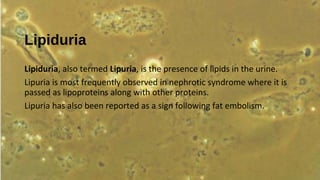
Lipiduria
Lipiduria, also termed Lipuria, is the presence of lipids in the urine.
Lipuria is most frequently observed in nephrotic syndrome where it is 
passed as lipoproteins along with other proteins.
Lipuria has also been reported as a sign following fat embolism.
Hyperlipidemia
What is hyperlipidemia?
Lipid is the scientific term for fats in the blood. At proper levels, lipids 
perform  important  functions  in  your  body,  but  can  cause  health 
problems if they are present in excess. The term hyperlipidemia means 
high  lipid  levels.  Hyperlipidemia  includes  several  conditions,  but  it 
usually  means  that  you  have  high  cholesterol  and  high  triglyceride 
levels.
• High lipid levels can speed up a process called atherosclerosis, or
hardening of the arteries. Your arteries are normally smooth and
unobstructed on the inside, but as you age, a sticky substance called
plaque forms in the walls of your arteries. Plaque is made of lipids
and other materials circulating in your blood. As more plaque builds
up, your arteries can narrow and stiffen. Eventually, enough plaque
may build up to reduce blood flow through your arteries.
• What tests will I need?
• Because hyperlipidemia usually doesn't cause symptoms, you will
need a blood test for a diagnosis. The National Cholesterol Education
Program recommends that people get this test every 5 years after
age 20. Your blood test will show your physician the levels of different
lipids in your blood. Your physician will compare your results to
established ranges. The ranges help your physician diagnose
hyperlipidemia and then decide whether you will need lifestyle
modification, medical treatment, or both as treatments.
Prepared by:
Mercado, Princess Cate R.
Alejandrino, Ma. Lourdes F.
Aspillaga, Liezel

Chapter 2 lipids

  • 1.
  • 2.
    What is MedicalTechnology ? Medical Technology, which is a proper subset of health technology, encompasses a wide range of healthcare products and is used to diagnose, monitor or treat diseases or medical conditions affecting humans.
  • 3.
    What is MedicalTechnologists ? Medical Technologists, also known as clinical laboratory technologists, perform and analyze the results of complex scientific tests on blood and body fluids.
  • 4.
    What is Lipidsused for in the human body? • Lipids, also known as fats, play many important roles in your body, from providing energy to producing hormones. You wouldn't be able to digest and absorb food properly without lipids. Of course, eating more fat than you need can lead to weight gain, but in proper amounts lipids are a healthy part of your diet.
  • 5.
    LIPIDS IN RELATIONTO MEDICAL TECHNOLOGY THE FOLLOWING ARE SOME OF THE TESTS PERFORMED BY MEDICAL TECHNOLOGISTS INVOLVING LIPIDS:  Lipid Blood Tests  Cushing's Syndrome  Spirit Blue Agar Plate  Lipiduria
  • 6.
    Lipid Blood Tests • Acomplete cholesterol test — also called a lipid panel or lipid profile — is a blood test that can measure the amount of cholesterol and triglycerides in your blood. A cholesterol test can help determine your risk of the buildup of plaques in your arteries that can lead to narrowed or blocked arteries throughout your body (atherosclerosis). High cholesterol levels usually don't cause any signs or symptoms, so a cholesterol test is an important tool. High cholesterol levels often are a significant risk factor for heart disease.
  • 7.
    Cushing's Syndrome • Cushing'ssyndrome is a disorder caused by prolonged exposure of the body's tissues to high levels of corticosteroids (glucocorticoids). • Corticosteroids are powerful steroid hormones produced by the adrenal glands, located above each kidney. They regulate the metabolism of proteins, carbohydrates, and fats. They reduce the immune system's inflammatory responses and help to maintain blood pressure and heart function. A vital function of corticosteroids is to help the body respond to stress.
  • 8.
    Exams and Testsfor Cushing's Syndrome • Measurement of 24-hour cortisol levels : The amount of cortisol excreted in the urine during a 24-hour time period is measured. Values higher than three to four times the upper limit of normal are suggestive of Cushing's syndrome. • Overnight 1-mg dexamethasone suppression test: For this test, 1mg of dexamethasone (exogenous corticosteroid) is administered at 11 pm, with measurement of serum cortisol the next morning at 8 am. In healthy individuals, the serum cortisol should be less than 2-3 mcg/dL. Cushing's syndrome may be excluded with a cortisol level less than 1.8 mcg/dL.
  • 9.
    • The 48-hourlow-dose dexamethasone suppression test: In  many  persons,  overnight  1mg  dexamethasone  suppression  test  may  be  inconclusive.  In  such  persons,  48-hour  low-dose  dexamethasone  suppression test is performed. In this test, 0.5mg dexamethasone is  administered every six hours for eight doses and serum cortisol levels  are measured.
  • 10.
    Spirit Blue AgarPlate Bacteria are identified based largely on what organic compounds they  can  break  down.  The  range  of  compounds  used  depends  on  the  collection of enzymes a species of bacteria can make. Lipids are organic  compounds  that  some  bacteria  can  use  for  carbon  and  energy.  The  enzyme  capable  of  breaking  down lipids is  called lipase. Spirit blue agar is a medium that contains a supply of lipids, and thus it allows us  to determine the presence of lipase. If lipase is made by the bacterium, the lipids in Spirit blue agar will be  digested.  The  medium,  which  is  normally  opaque  and  light  blue  in  color, will have halos around colonies of bacteria that make lipase.
  • 11.
  • 12.
    Hyperlipidemia What is hyperlipidemia? Lipid is the scientific term for fats in the blood. At proper levels, lipids  perform important  functions  in  your  body,  but  can  cause  health  problems if they are present in excess. The term hyperlipidemia means  high  lipid  levels.  Hyperlipidemia  includes  several  conditions,  but  it  usually  means  that  you  have  high  cholesterol  and  high  triglyceride  levels.
  • 13.
    • High lipidlevels can speed up a process called atherosclerosis, or hardening of the arteries. Your arteries are normally smooth and unobstructed on the inside, but as you age, a sticky substance called plaque forms in the walls of your arteries. Plaque is made of lipids and other materials circulating in your blood. As more plaque builds up, your arteries can narrow and stiffen. Eventually, enough plaque may build up to reduce blood flow through your arteries.
  • 14.
    • What testswill I need? • Because hyperlipidemia usually doesn't cause symptoms, you will need a blood test for a diagnosis. The National Cholesterol Education Program recommends that people get this test every 5 years after age 20. Your blood test will show your physician the levels of different lipids in your blood. Your physician will compare your results to established ranges. The ranges help your physician diagnose hyperlipidemia and then decide whether you will need lifestyle modification, medical treatment, or both as treatments.
  • 15.
    Prepared by: Mercado, PrincessCate R. Alejandrino, Ma. Lourdes F. Aspillaga, Liezel