Basic Nutrition and
BasicNutrition and
Nutritional Therapy
Nutritional Therapy
Foundations of
Foundations of
Nursing
Nursing
Christensen
Christensen
Kockrow
Kockrow
Mosby 5
Mosby 5th
th
edition
edition
Sharon Kinley-Schwing BSN
Pacific College 2006
2.
Prevention = nutritionone of the most important parts of health
Prevention = nutrition one of the most important parts of health
care.
care.
Nutrition is the total of all processes involved in the taking in and
Nutrition is the total of all processes involved in the taking in and
utilization of food substances for proper growth, functioning, and
utilization of food substances for proper growth, functioning, and
maintenance of health.
maintenance of health.
Nutrition plays a role directly or indirectly in all body processes, and
Nutrition plays a role directly or indirectly in all body processes, and
disease states.
disease states.
Proper nutrition may help prevent or delay onset of many diseases.
Proper nutrition may help prevent or delay onset of many diseases.
Nutrition is the most over looked part of healthy living.
Nutrition is the most over looked part of healthy living.
3.
Role of theNurse in Promotion Nutrition
Role of the Nurse in Promotion Nutrition
The nurse can promote good nutrition by:
The nurse can promote good nutrition by:
– Helping the patient understand the importance of the diet and
Helping the patient understand the importance of the diet and
encouraging dietary compliance.
encouraging dietary compliance.
– Serving meal trays to patients in a prompt and positive
Serving meal trays to patients in a prompt and positive
manner.
manner.
– Assisting some patients with the eating process.
Assisting some patients with the eating process.
– Taking and recording patient weight.
Taking and recording patient weight.
– Recording patient intake.
Recording patient intake.
– Observing clinical signs of poor nutrition and reporting them.
Observing clinical signs of poor nutrition and reporting them.
– Serving as a communication link.
Serving as a communication link.
– Nurse can apply nutrition to their personal lives, what a
Nurse can apply nutrition to their personal lives, what a
better reason to understand nutrition for your own health.
better reason to understand nutrition for your own health.
4.
NUTRITION
NUTRITION
All of theprocesses involved in consuming
All of the processes involved in consuming
and utilizing food for energy,
and utilizing food for energy,
maintenance, and growth.
maintenance, and growth.
These processes are ingestion, digestion,
These processes are ingestion, digestion,
absorption, metabolism, and excretion.
absorption, metabolism, and excretion.
5.
INGESTION
INGESTION
The taking offood into the digestive
The taking of food into the digestive
tract, generally through the mouth.
tract, generally through the mouth.
In special circumstances, ingestion
In special circumstances, ingestion
occurs directly into the stomach,
occurs directly into the stomach,
through a feeding tube.
through a feeding tube.
6.
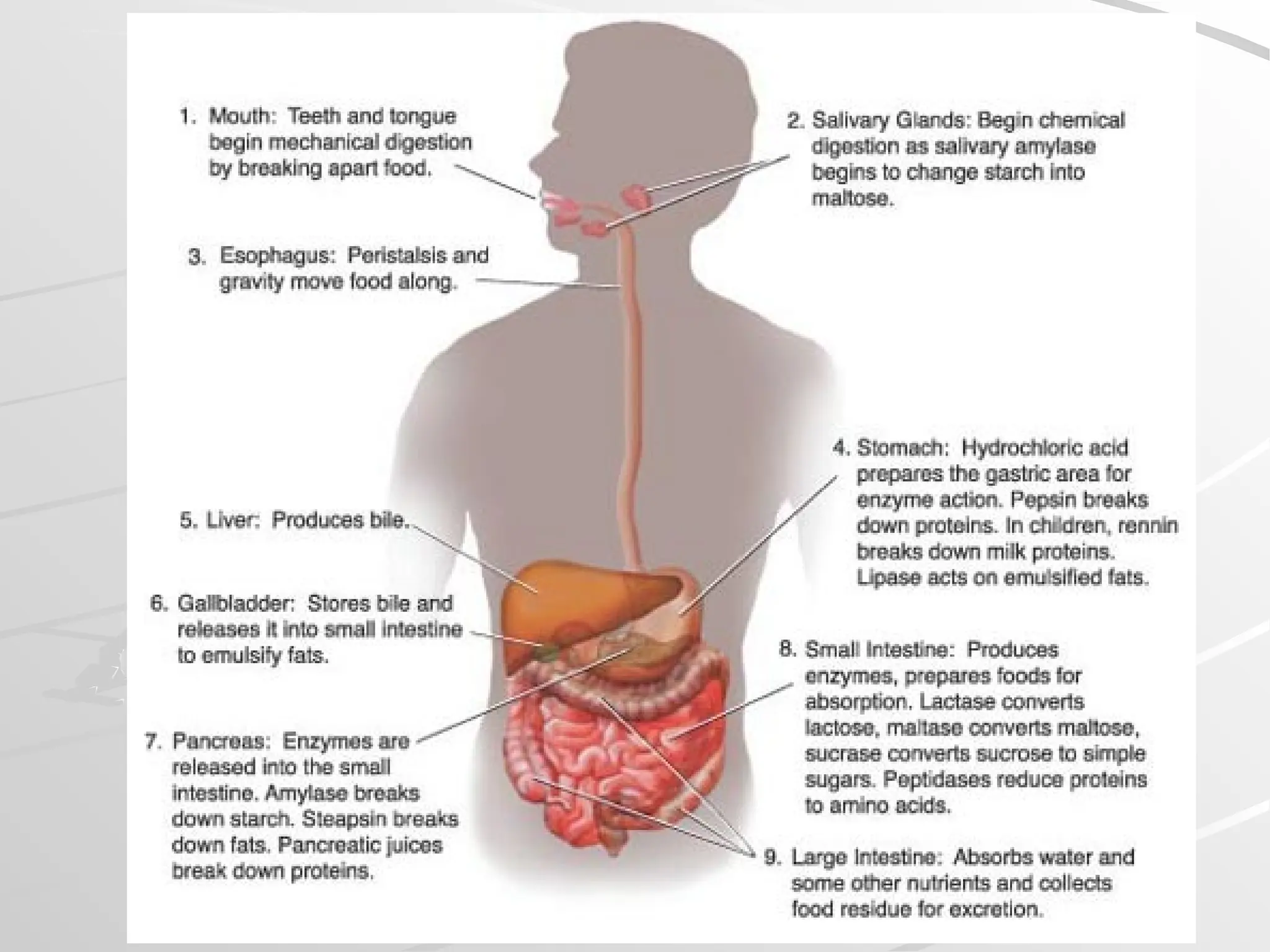
DIGESTION
DIGESTION
Mechanical and chemicalprocesses
Mechanical and chemical processes
converting nutrients to a physically
converting nutrients to a physically
absorbable state:
absorbable state:
– Mastication–chewing
Mastication–chewing
– Deglutition–swallowing
Deglutition–swallowing
– Peristalsis–rhythmic, coordinated, serial
Peristalsis–rhythmic, coordinated, serial
contractions of smooth muscles of GI tract
contractions of smooth muscles of GI tract
8.
ABSORPTION
ABSORPTION
The process wherebythe end products of
The process whereby the end products of
digestion pass through the epithelial
digestion pass through the epithelial
membranes in small and large intestines
membranes in small and large intestines
and into blood or lymph systems.
and into blood or lymph systems.
Villi–small finger-like projections that line
Villi–small finger-like projections that line
the small intestine. Most nutrients are
the small intestine. Most nutrients are
absorbed directly through the villi.
absorbed directly through the villi.
9.
METABOLISM
METABOLISM
The conversion ofnutrients into energy.
The conversion of nutrients into energy.
Anabolism–the constructive process of metabolism,
Anabolism–the constructive process of metabolism,
requires energy.
requires energy.
Catabolism–the destructive process of metabolism,
Catabolism–the destructive process of metabolism,
releases energy.
releases energy.
Basal metabolism–the energy needed to maintain
Basal metabolism–the energy needed to maintain
essential physiologic functions.
essential physiologic functions.
10.
EXCRETION
EXCRETION
The process ofeliminating or
The process of eliminating or
removing waste products from
removing waste products from
the body.
the body.
Dietary Guidelines forAmericans:
Dietary Guidelines for Americans:
These guidelines form the foundation of U.S. federal
These guidelines form the foundation of U.S. federal
nutrition policy and directly affect federal nutrition
nutrition policy and directly affect federal nutrition
programs such as food stamps, school breakfast and
programs such as food stamps, school breakfast and
lunch programs, and the Special Supplemental
lunch programs, and the Special Supplemental
Program for Women, Infants, and Children (WIC).
Program for Women, Infants, and Children (WIC).
These guidelines have been developed to address the
These guidelines have been developed to address the
importance of adequate nutrition, as well as the
importance of adequate nutrition, as well as the
prevention of over nutrition and disease.
prevention of over nutrition and disease.
Dietary Reference Intakes:
Dietary Reference Intakes:
This is a set of nutrient-based values that can be used for
This is a set of nutrient-based values that can be used for
both assessing and planning diets.
both assessing and planning diets.
They form the basis for daily values used in the
They form the basis for daily values used in the
Nutrition Facts labels on foods.
Nutrition Facts labels on foods.
The DRIs are intended to help individuals optimize
The DRIs are intended to help individuals optimize
their health, prevent disease, and avoid consuming
their health, prevent disease, and avoid consuming
too much of a nutrient.
too much of a nutrient.
13.
Essential Nutrients
Essential Nutrients
–Basic Functions:
Basic Functions:
Essential nutrients are those that our bodies cannot make in
Essential nutrients are those that our bodies cannot make in
amounts necessary for good health.
amounts necessary for good health.
The six classes of essential nutrients are carbohydrates,
The six classes of essential nutrients are carbohydrates,
fats, proteins, vitamins, minerals, and water.
fats, proteins, vitamins, minerals, and water.
Provide energy
Provide energy
– Carbohydrates and proteins: 4 kcal/g
Carbohydrates and proteins: 4 kcal/g
– Fat: 9 kcal/g
Fat: 9 kcal/g
Build and repair tissue
Build and repair tissue
– Protein, calcium, phosphorus, iron, and fat
Protein, calcium, phosphorus, iron, and fat
Regulate body processes
Regulate body processes
– Metabolism: the combination of all chemical processes
Metabolism: the combination of all chemical processes
that take place in living organisms
that take place in living organisms
14.
CARBOHYDRATES
CARBOHYDRATES
Made of theelements carbon, hydrogen,
Made of the elements carbon, hydrogen,
and oxygen (CHO)
and oxygen (CHO)
Constitute the chief source of energy for
Constitute the chief source of energy for
all body functions.
all body functions.
Requirements are 50–60% of total kcal
Requirements are 50–60% of total kcal
intake per day.
intake per day.
CARBOHYDRATE FUNCTIONS
CARBOHYDRATE FUNCTIONS
Primarysource of energy for the body.
Primary source of energy for the body.
About half-day supply stored in liver and
About half-day supply stored in liver and
muscles for use as needed.
muscles for use as needed.
Spares proteins from being used for energy.
Spares proteins from being used for energy.
Needed to oxidize fats and for synthesis of fatty
Needed to oxidize fats and for synthesis of fatty
acids and amino acids.
acids and amino acids.
17.
Carbohydrate Absorption &Storage
Carbohydrate Absorption & Storage
Digestion begins in mouth, little takes place in
Digestion begins in mouth, little takes place in
the stomach, is completed in the small
the stomach, is completed in the small
intestine.
intestine.
Leave no waste for kidneys to eliminate.
Leave no waste for kidneys to eliminate.
Absorption takes place in the villi.
Absorption takes place in the villi.
Excess converted to glycogen and stored in
Excess converted to glycogen and stored in
the liver or stored as fat.
the liver or stored as fat.
18.
DEFICIENCY AND EXCESS
DEFICIENCYAND EXCESS
Mild deficiency can cause weight loss
Mild deficiency can cause weight loss
and fatigue.
and fatigue.
Serious deficiency can cause ketosis.
Serious deficiency can cause ketosis.
Excess can cause obesity, tooth
Excess can cause obesity, tooth
decay, irritate the lining of the
decay, irritate the lining of the
stomach, or flatulence.
stomach, or flatulence.
19.
FATS
FATS
Most concentrated energysource in diet.
Most concentrated energy source in diet.
Provides 9 kcal per gram.
Provides 9 kcal per gram.
Also known as lipids.
Also known as lipids.
Composed of carbon, hydrogen, and less oxygen
Composed of carbon, hydrogen, and less oxygen
than carbohydrates.
than carbohydrates.
Recommended: no more than 25–30% of daily
Recommended: no more than 25–30% of daily
intake.
intake.
20.
Fats (Lipids)
Fats (Lipids)
Lipids:
Lipids:
Saturatedfatty acids:
Saturated fatty acids:
Unsaturated fatty acids:
Unsaturated fatty acids:
Trans Fatty Acids:
Trans Fatty Acids:
Cholesterol:
Cholesterol:
Digestion and Metabolism of fat:
Digestion and Metabolism of fat:
21.
Summary of FattyAcid Classification
Summary of Fatty Acid Classification
Saturated
Saturated
Monounsaturated:
Monounsaturated:
Polyunsaturated:
Polyunsaturated:
Trans:
Trans:
22.
Classification of LDL,Total HDL, Cholesterol
Classification of LDL, Total HDL, Cholesterol
LDL Cholesterol:
LDL Cholesterol:
Total Cholesterol:
Total Cholesterol:
HDL Cholesterol:
HDL Cholesterol:
23.
Functions of Fat
Functionsof Fat
Provides concentrated source of energy.
Provides concentrated source of energy.
Needed to absorb fat-soluble vitamins.
Needed to absorb fat-soluble vitamins.
Major component of cell membranes and myelin
Major component of cell membranes and myelin
sheaths.
sheaths.
Improves flavor, delays emptying time.
Improves flavor, delays emptying time.
Protects and helps hold organs in place.
Protects and helps hold organs in place.
Insulates the body.
Insulates the body.
24.
CLASSIFICATION
CLASSIFICATION
Triglycerides (true fats)are composed of one
Triglycerides (true fats) are composed of one
glycerol molecule attached to three fatty-
glycerol molecule attached to three fatty-
acid molecules.
acid molecules.
Phospholipids (lipoids) are composed of
Phospholipids (lipoids) are composed of
glycerol, fatty acids, and phosphorus.
glycerol, fatty acids, and phosphorus.
Cholesterol (sterol) liver produces over 1000
Cholesterol (sterol) liver produces over 1000
mg every day.
mg every day.
25.
Absorption and Storage
Absorptionand Storage
No breakdown occurs in the mouth, very little
No breakdown occurs in the mouth, very little
digestion occurs in the stomach.
digestion occurs in the stomach.
Digestion begins in the small intestine.
Digestion begins in the small intestine.
Final products of fat digestion are fatty acids and
Final products of fat digestion are fatty acids and
glycerol.
glycerol.
95% absorbed in small intestine.
95% absorbed in small intestine.
Excess fats stored as adipose tissue.
Excess fats stored as adipose tissue.
26.
Deficiency and Excess
Deficiencyand Excess
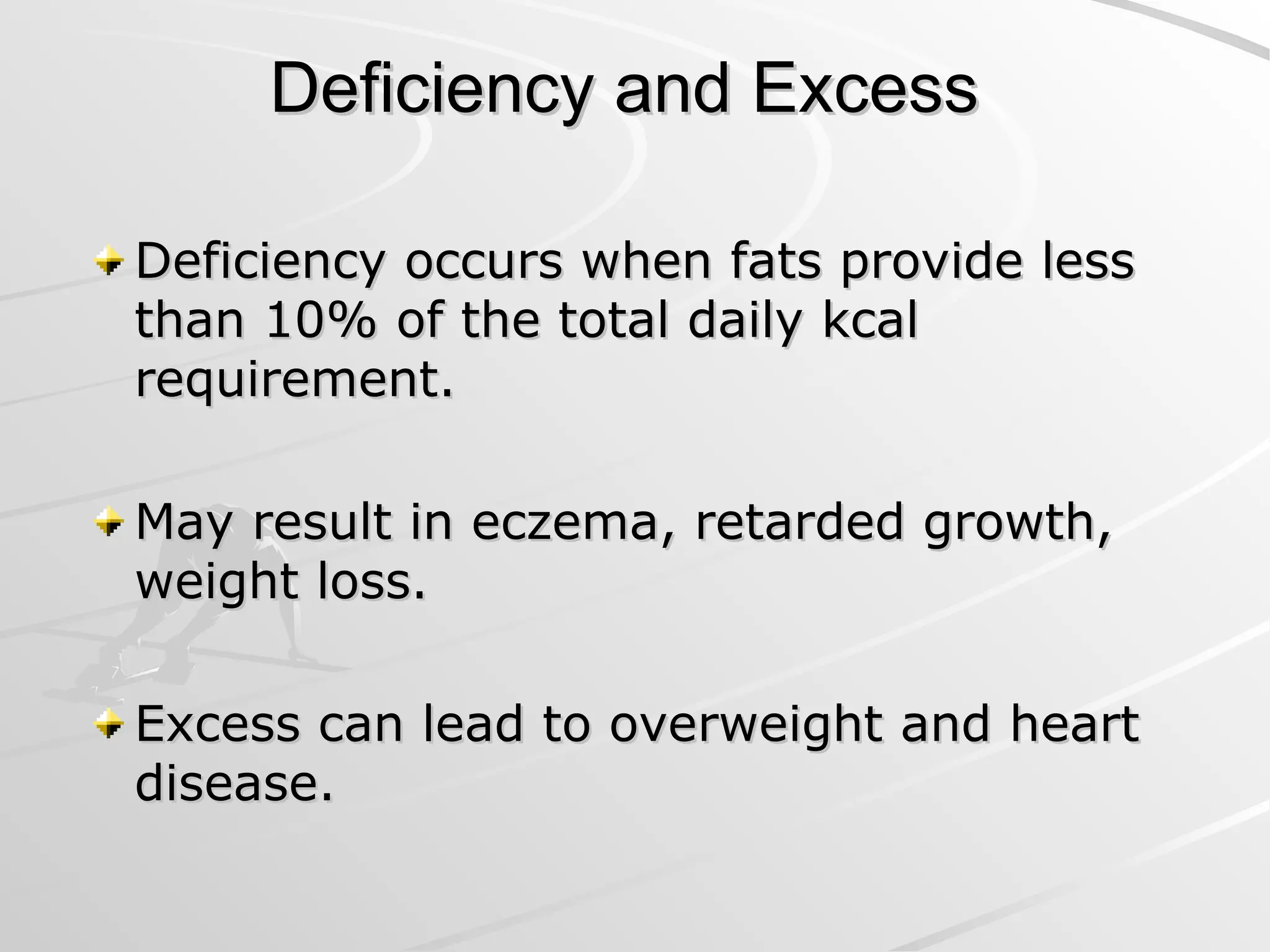
Deficiency occurs when fats provide less
Deficiency occurs when fats provide less
than 10% of the total daily kcal
than 10% of the total daily kcal
requirement.
requirement.
May result in eczema, retarded growth,
May result in eczema, retarded growth,
weight loss.
weight loss.
Excess can lead to overweight and heart
Excess can lead to overweight and heart
disease.
disease.
27.
Sources of Fat
Sourcesof Fat
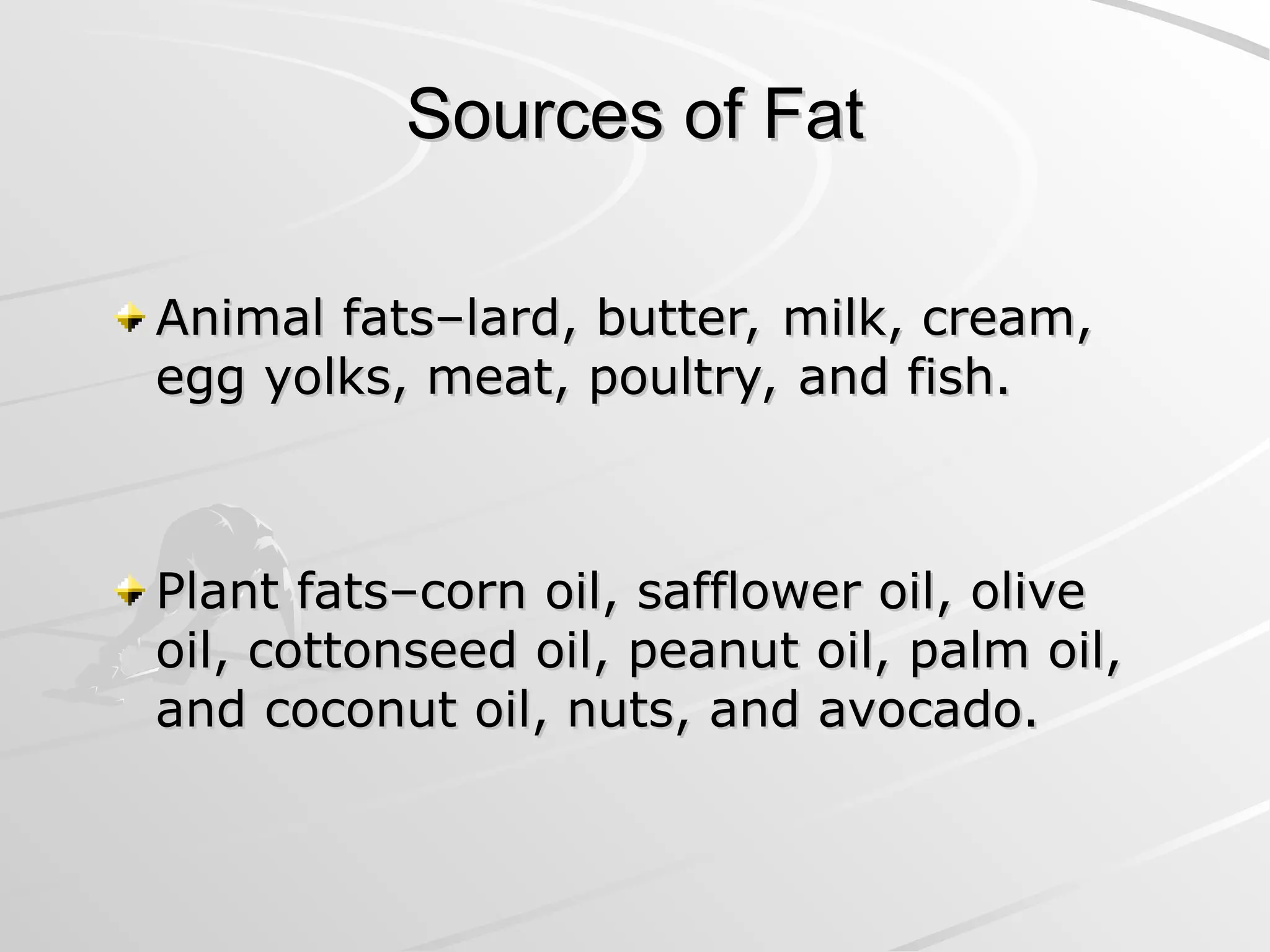
Animal fats–lard, butter, milk, cream,
Animal fats–lard, butter, milk, cream,
egg yolks, meat, poultry, and fish.
egg yolks, meat, poultry, and fish.
Plant fats–corn oil, safflower oil, olive
Plant fats–corn oil, safflower oil, olive
oil, cottonseed oil, peanut oil, palm oil,
oil, cottonseed oil, peanut oil, palm oil,
and coconut oil, nuts, and avocado.
and coconut oil, nuts, and avocado.
28.
Protein
Protein
Amino Acids:
Amino Acids:
Completeproteins:
Complete proteins:
Incomplete proteins:
Incomplete proteins:
Vegetarian diets:
Vegetarian diets:
Digestion and Metabolism of Protein:
Digestion and Metabolism of Protein:
Protein-Kilocalorie malnutrition:
Protein-Kilocalorie malnutrition:
29.
Proteins
Proteins
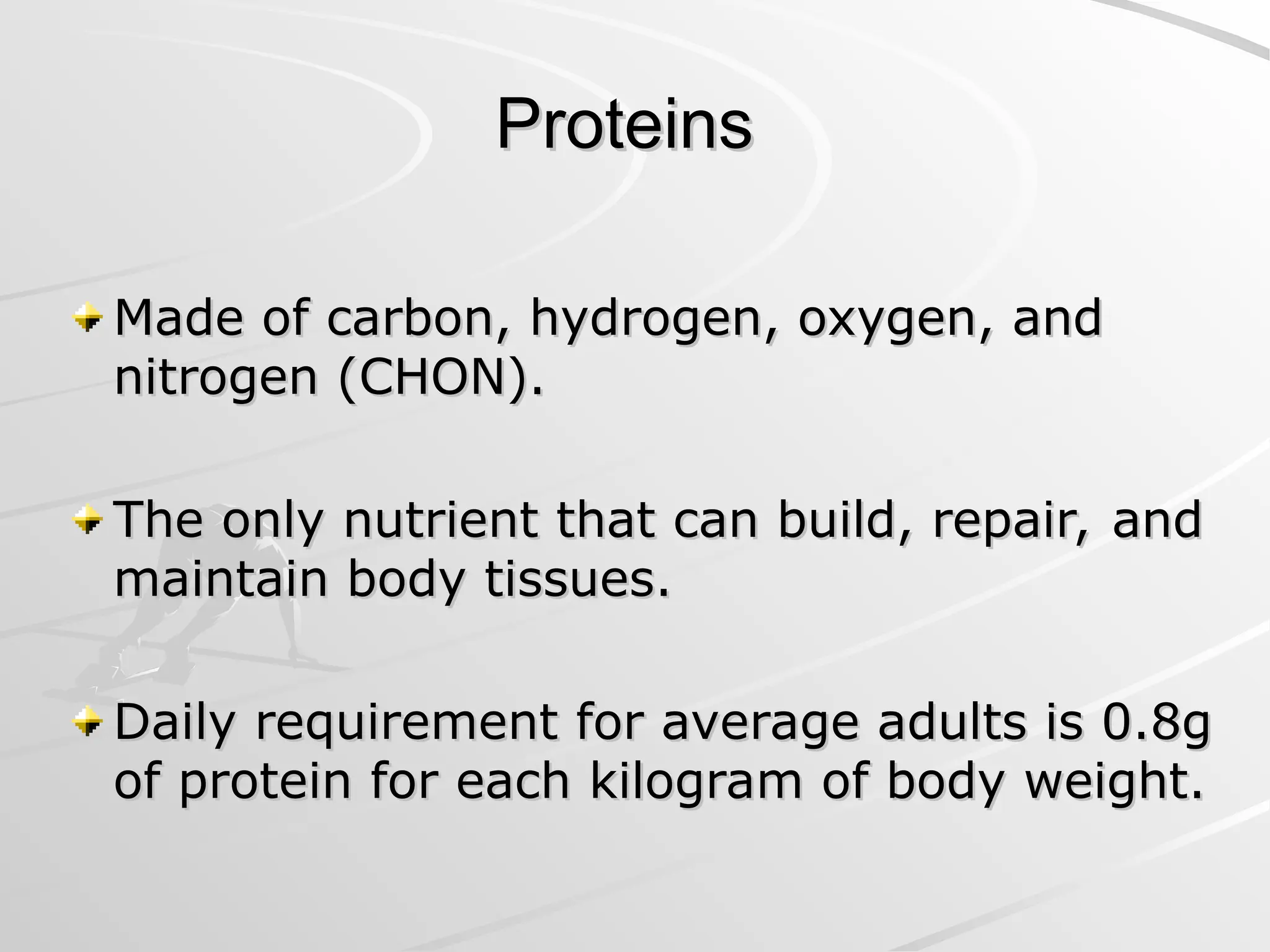
Made of carbon,hydrogen, oxygen, and
Made of carbon, hydrogen, oxygen, and
nitrogen (CHON).
nitrogen (CHON).
The only nutrient that can build, repair, and
The only nutrient that can build, repair, and
maintain body tissues.
maintain body tissues.
Daily requirement for average adults is 0.8g
Daily requirement for average adults is 0.8g
of protein for each kilogram of body weight.
of protein for each kilogram of body weight.
30.
Functions Of Proteins
FunctionsOf Proteins
Provide amino acids, needed to build, repair, and
Provide amino acids, needed to build, repair, and
maintain body tissues.
maintain body tissues.
Assist in regulating fluid balance.
Assist in regulating fluid balance.
Vital part of enzymes, hormones, blood plasma.
Vital part of enzymes, hormones, blood plasma.
Used to build antibodies.
Used to build antibodies.
Can be converted to glucose, for energy.
Can be converted to glucose, for energy.
31.
Protein Digestion andabsorption
Protein Digestion and absorption
Begins in the stomach.
Begins in the stomach.
Most digestion takes place in small intestine.
Most digestion takes place in small intestine.
End product is amino acids, absorbed into
End product is amino acids, absorbed into
the blood by the villi in the small intestine.
the blood by the villi in the small intestine.
Excess amino acids are converted to glucose,
Excess amino acids are converted to glucose,
glycogen, or fat for storage.
glycogen, or fat for storage.
32.
Sign of Deficiencyand Excess
Sign of Deficiency and Excess
Muscle wasting.
Muscle wasting.
Edema.
Edema.
Lethargy and depression.
Lethargy and depression.
Marasmus and Kwashiorkor.
Marasmus and Kwashiorkor.
Excess can contribute to heart disease, and may be
Excess can contribute to heart disease, and may be
linked to colon cancer, osteoporosis, and kidney
linked to colon cancer, osteoporosis, and kidney
damage.
damage.
33.
Vitamins and Minerals
Vitaminsand Minerals
They are needed in small amounts; toxicity may occur
They are needed in small amounts; toxicity may occur
with over consumption.
with over consumption.
They are best received from a balanced, varied diet.
They are best received from a balanced, varied diet.
Vitamins can be destroyed by heat, light, and exposure
Vitamins can be destroyed by heat, light, and exposure
to air.
to air.
Minerals cannot be destroyed because they are single
Minerals cannot be destroyed because they are single
elements rather than compounds.
elements rather than compounds.
Both vitamins and minerals can be lost when foods are
Both vitamins and minerals can be lost when foods are
cooked in water.
cooked in water.
34.
VITAMINS
VITAMINS
Organic compounds essentialto life and health.
Organic compounds essential to life and health.
Regulate body processes, needed in very small
Regulate body processes, needed in very small
amounts.
amounts.
No fuel value but required for metabolism of
No fuel value but required for metabolism of
fats, carbohydrates, proteins.
fats, carbohydrates, proteins.
Functions are unique to each vitamin.
Functions are unique to each vitamin.
35.
–Fat soluble:
Fat soluble:
A,D, E, and K.
A, D, E, and K.
Usually carried in the fatty
Usually carried in the fatty
portion of food.
portion of food.
Can be stored by the body.
Can be stored by the body.
–Water soluble:
Water soluble:
B vitamins and C.
B vitamins and C.
Not stored in the body; excesses
Not stored in the body; excesses
excreted in the urine.
excreted in the urine.
36.
Digestion of Vits
Digestionof Vits
Vitamins do not require digestion.
Vitamins do not require digestion.
Fat-soluble vitamins are absorbed into the
Fat-soluble vitamins are absorbed into the
lymphatic system, excesses are stored in
lymphatic system, excesses are stored in
the liver and adipose tissue.
the liver and adipose tissue.
Water-soluble vitamins are absorbed
Water-soluble vitamins are absorbed
directly into the circulatory system, and
directly into the circulatory system, and
excesses are excreted in urine.
excesses are excreted in urine.
37.
Deficiency/ Excess
Deficiency/ Excess
Vitamindeficiencies can occur and
Vitamin deficiencies can occur and
result in disease.
result in disease.
Vitamins consumed in excess
Vitamins consumed in excess
amounts can be toxic to the body.
amounts can be toxic to the body.
38.
Minerals
Minerals
Inorganic elements thathelp regulate body
Inorganic elements that help regulate body
processes and /or serve as structural
processes and /or serve as structural
components of the body.
components of the body.
Major minerals–more than 100 mg/day.
Major minerals–more than 100 mg/day.
Trace minerals–less than 100 mg/day.
Trace minerals–less than 100 mg/day.
Functions are unique to each individual
Functions are unique to each individual
mineral.
mineral.
39.
Classification and Sources
Classificationand Sources
Classified as major minerals or trace minerals.
Classified as major minerals or trace minerals.
Found in water and in unprocessed foods.
Found in water and in unprocessed foods.
Some foods are enriched—some vitamins are
Some foods are enriched—some vitamins are
added to them.
added to them.
Supplements may be needed during growth
Supplements may be needed during growth
periods, some clinical situations.
periods, some clinical situations.
40.
Digestion
Digestion
The amount ofa mineral absorbed by
The amount of a mineral absorbed by
the body is influenced by:
the body is influenced by:
Type of food
Type of food
Need of body
Need of body
Health of absorbing tissue
Health of absorbing tissue
41.
Deficiency and Excess
Deficiencyand Excess
Deficiency signs unique to each mineral.
Deficiency signs unique to each mineral.
Excesses can lead to toxicity.
Excesses can lead to toxicity.
Concentrated forms of minerals should
Concentrated forms of minerals should
be used only on advice of a physician.
be used only on advice of a physician.
Excesses can cause hair loss, changes
Excesses can cause hair loss, changes
in the blood, hormones, bones, muscles, and
in the blood, hormones, bones, muscles, and
nearly all tissues.
nearly all tissues.
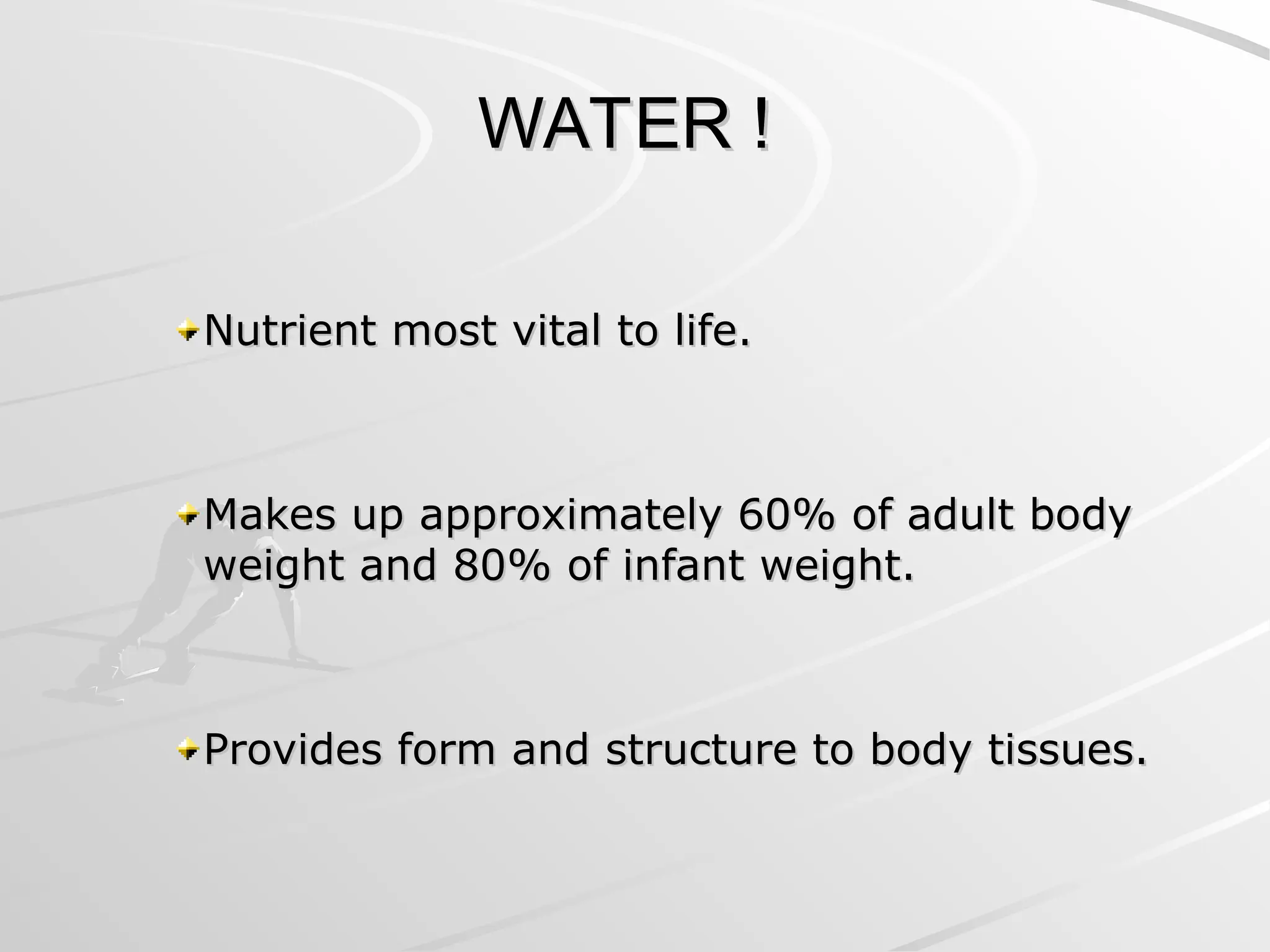
WATER !
WATER !
Nutrientmost vital to life.
Nutrient most vital to life.
Makes up approximately 60% of adult body
Makes up approximately 60% of adult body
weight and 80% of infant weight.
weight and 80% of infant weight.
Provides form and structure to body tissues.
Provides form and structure to body tissues.
50.
Acts as asolvent; necessary for most chemical
Acts as a solvent; necessary for most chemical
processes.
processes.
Transports nutrients and other substances.
Transports nutrients and other substances.
Lubricates and protects moving parts of the
Lubricates and protects moving parts of the
body.
body.
Lubricates food and aids in digestion.
Lubricates food and aids in digestion.
Regulates body temperature
Regulates body temperature
51.
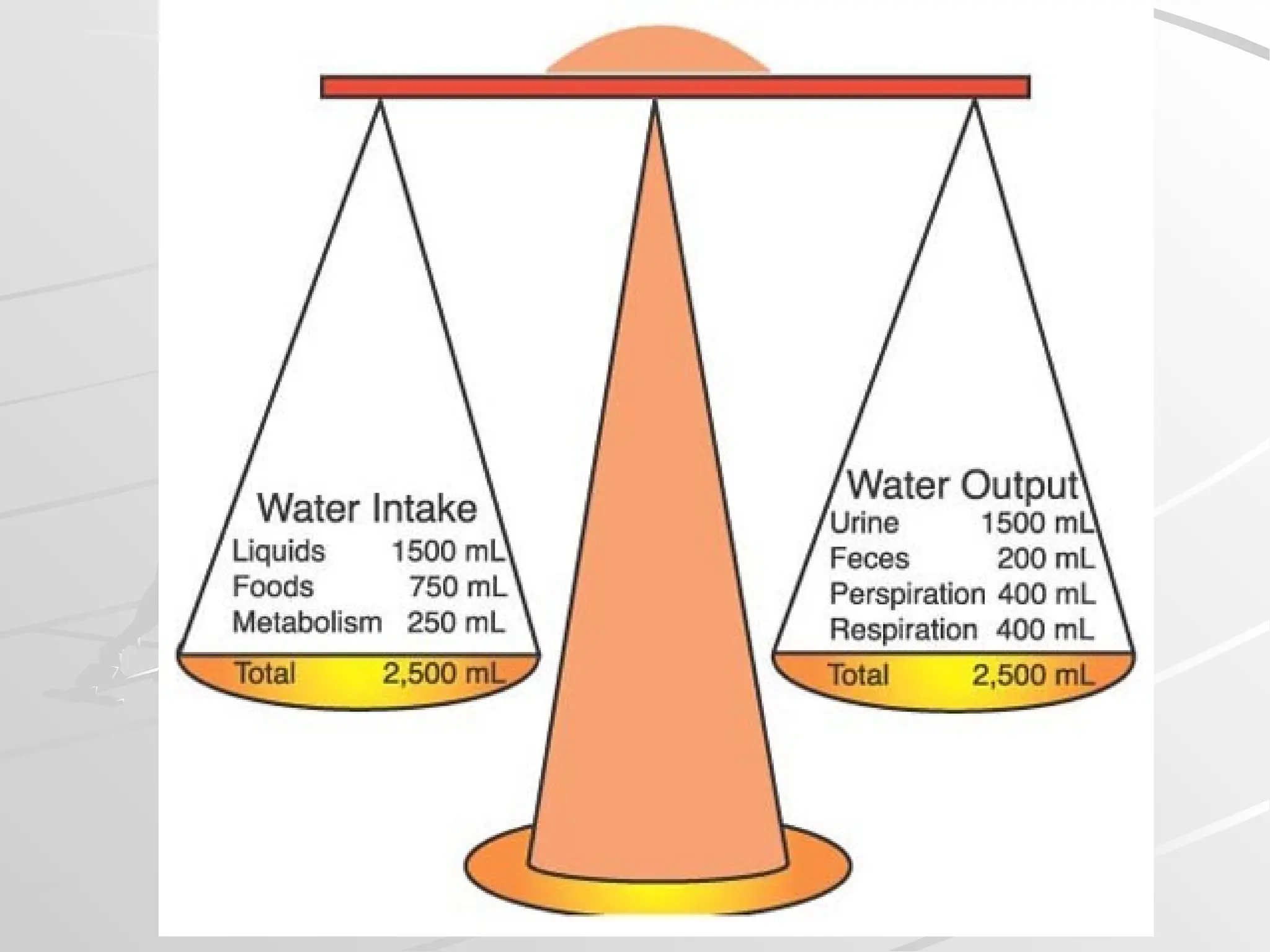
SOURCES OF WATERFOR THE BODY
SOURCES OF WATER FOR THE BODY
Liquids consumed, including water, coffee,
Liquids consumed, including water, coffee,
juice, tea, milk and soft drinks.
juice, tea, milk and soft drinks.
Foods consumed, especially vegetables and
Foods consumed, especially vegetables and
fruits.
fruits.
Metabolism, which produces water when
Metabolism, which produces water when
oxidization occurs.
oxidization occurs.
52.
WATER DIGESTION/ ABSORPTION,/STORAGE
WATERDIGESTION/ ABSORPTION,/STORAGE
Water is absorbed, not digested.
Water is absorbed, not digested.
It is not stored and is excreted daily.
It is not stored and is excreted daily.
Sensible loss–aware of loss of water.
Sensible loss–aware of loss of water.
Insensible loss–not aware of loss of water.
Insensible loss–not aware of loss of water.
Urine, feces, perspiration, and respiration are the four
Urine, feces, perspiration, and respiration are the four
ways the body loses water.
ways the body loses water.
53.
SIGNS OF
SIGNS OF
Dehydration:
Dehydration:
–Deficiency of water, can cause death.
Deficiency of water, can cause death.
– Occurs from profuse sweating, vomiting,
Occurs from profuse sweating, vomiting,
diarrhea, hemorrhage, wound drainage,
diarrhea, hemorrhage, wound drainage,
fever, and edema.
fever, and edema.
Positive water balance when more water
Positive water balance when more water
taken in than used or excreted.
taken in than used or excreted.
54.
Selected Foods withVit. C:
Selected Foods with Vit. C:
Selected Foods with Vit. D:
Selected Foods with Vit. D:
Factors that affect Calcium Absorption and
Factors that affect Calcium Absorption and
Excretion:
Excretion:
Factors that affect iron Absorption:
Factors that affect iron Absorption:
Diet Planning Guides
DietPlanning Guides
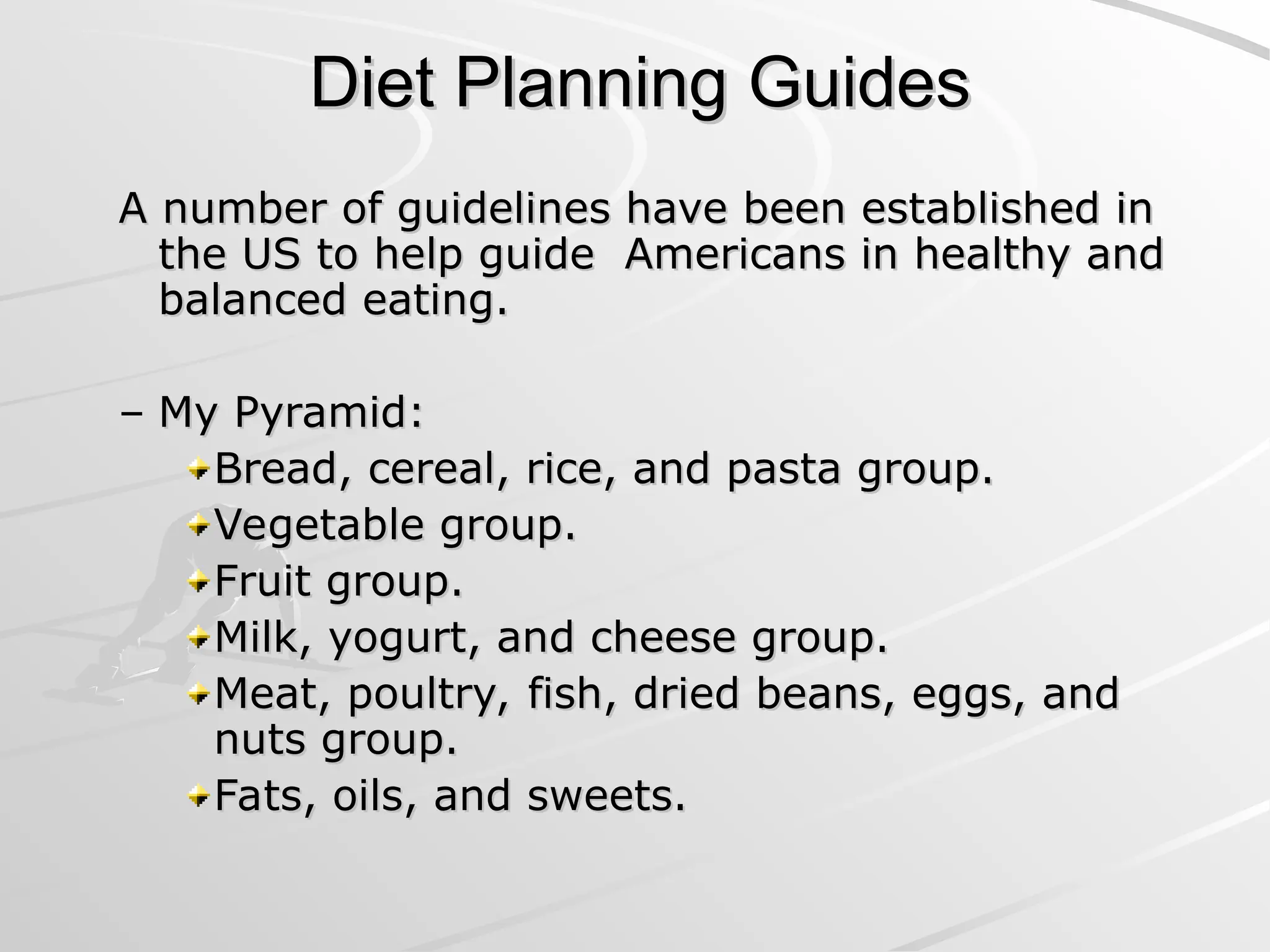
A number of guidelines have been established in
A number of guidelines have been established in
the US to help guide Americans in healthy and
the US to help guide Americans in healthy and
balanced eating.
balanced eating.
– My Pyramid:
My Pyramid:
Bread, cereal, rice, and pasta group.
Bread, cereal, rice, and pasta group.
Vegetable group.
Vegetable group.
Fruit group.
Fruit group.
Milk, yogurt, and cheese group.
Milk, yogurt, and cheese group.
Meat, poultry, fish, dried beans, eggs, and
Meat, poultry, fish, dried beans, eggs, and
nuts group.
nuts group.
Fats, oils, and sweets.
Fats, oils, and sweets.
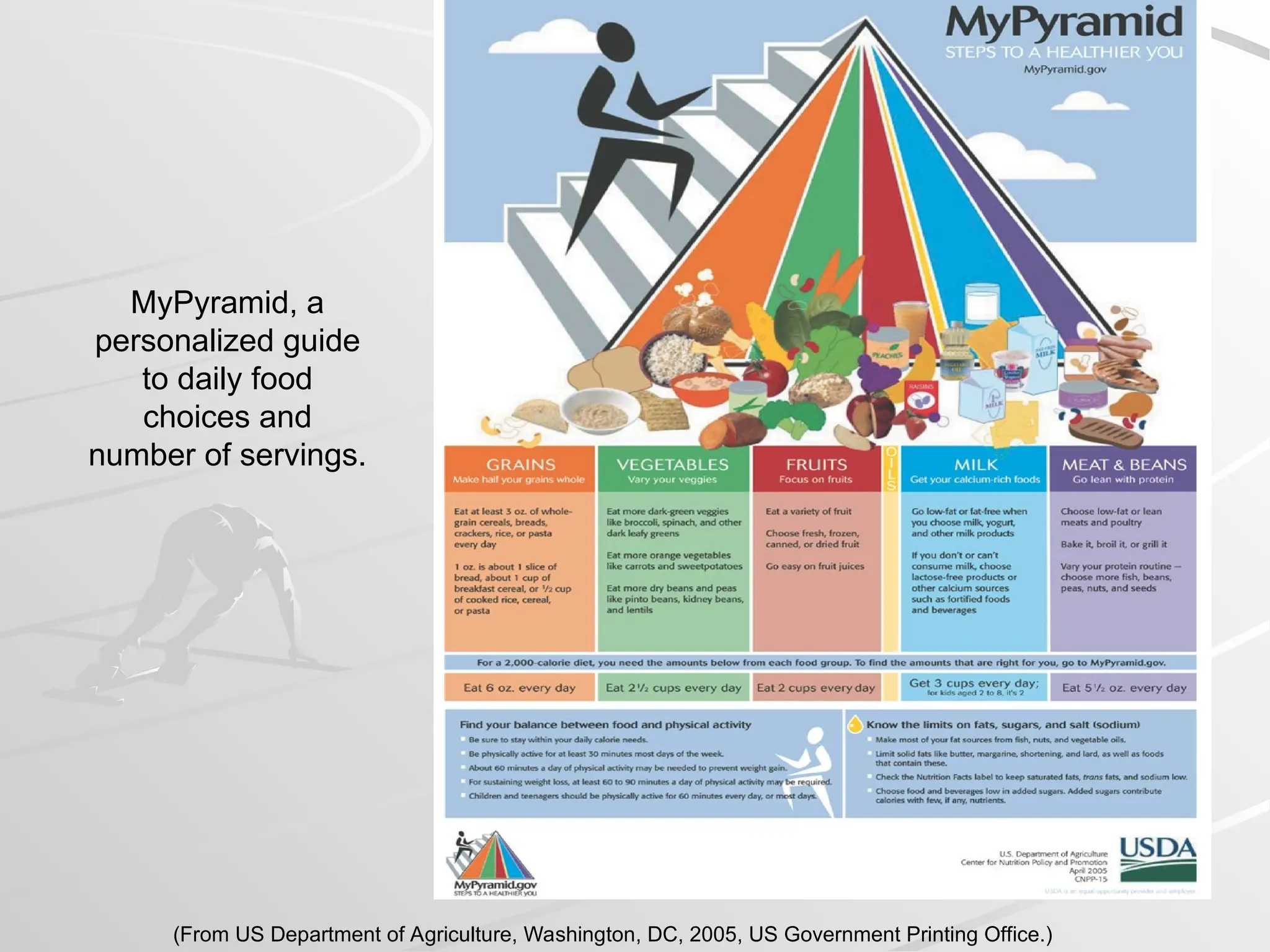
57.
MyPyramid, a
personalized guide
todaily food
choices and
number of servings.
(From US Department of Agriculture, Washington, DC, 2005, US Government Printing Office.)
58.
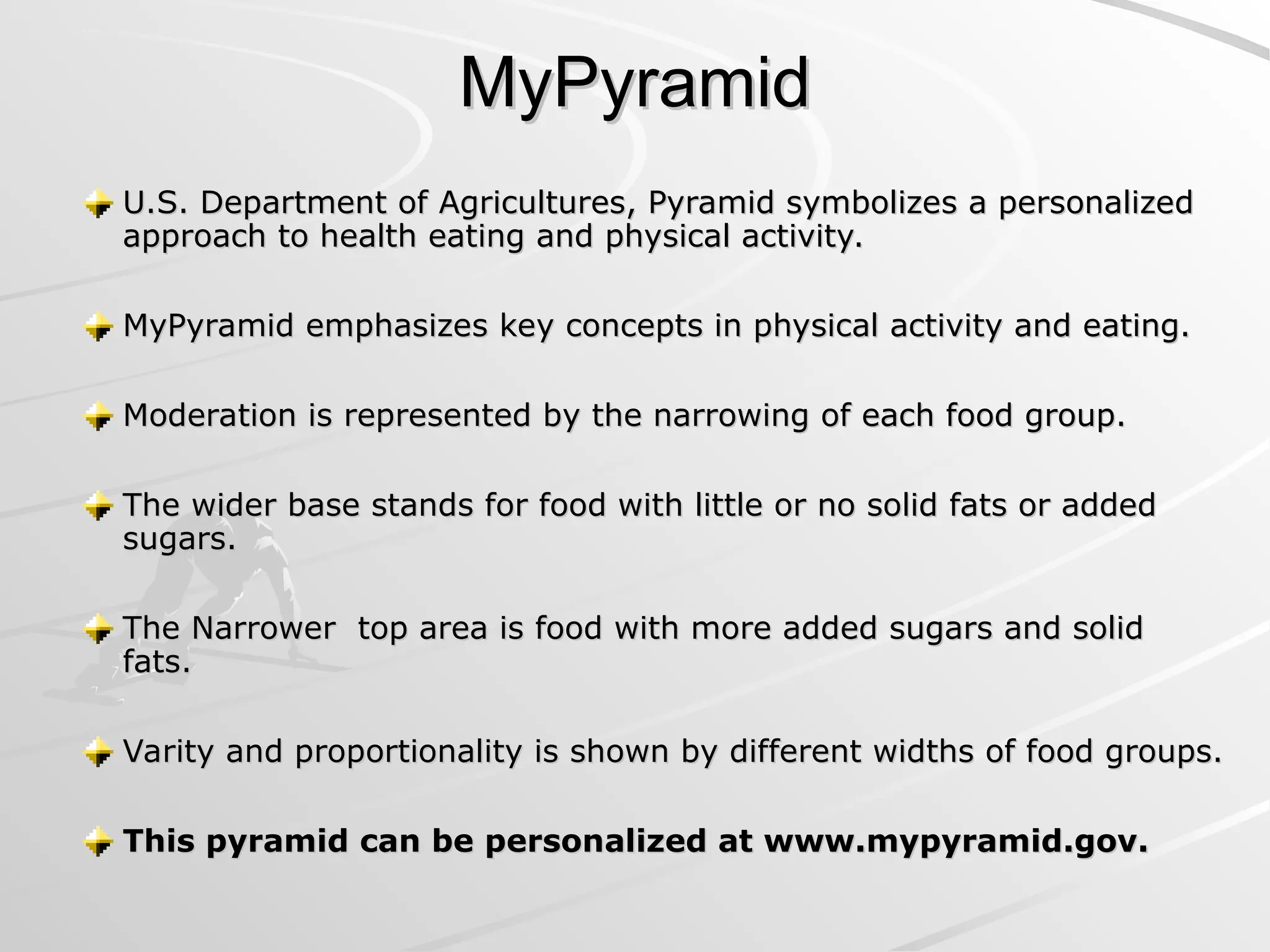
MyPyramid
MyPyramid
U.S. Department ofAgricultures, Pyramid symbolizes a personalized
U.S. Department of Agricultures, Pyramid symbolizes a personalized
approach to health eating and physical activity.
approach to health eating and physical activity.
MyPyramid emphasizes key concepts in physical activity and eating.
MyPyramid emphasizes key concepts in physical activity and eating.
Moderation is represented by the narrowing of each food group.
Moderation is represented by the narrowing of each food group.
The wider base stands for food with little or no solid fats or added
The wider base stands for food with little or no solid fats or added
sugars.
sugars.
The Narrower top area is food with more added sugars and solid
The Narrower top area is food with more added sugars and solid
fats.
fats.
Varity and proportionality is shown by different widths of food groups.
Varity and proportionality is shown by different widths of food groups.
This pyramid can be personalized at www.mypyramid.gov.
This pyramid can be personalized at www.mypyramid.gov.
Life Cycle Changes
LifeCycle Changes
Nutritional needs change as a person
Nutritional needs change as a person
grows and develops.
grows and develops.
Changes generally based on growth
Changes generally based on growth
needs, energy needs, nutrient utilization.
needs, energy needs, nutrient utilization.
Nutritional assessment should be
Nutritional assessment should be
conducted to ascertain the nutritional
conducted to ascertain the nutritional
needs of the individual.
needs of the individual.
61.
Pregnancy and Lactation
Pregnancyand Lactation
Nutrient needs during period of intensive
Nutrient needs during period of intensive
growth, such as pregnancy and infancy are
growth, such as pregnancy and infancy are
greater than any other time in life.
greater than any other time in life.
Evidence has proven that optimal nutrition
Evidence has proven that optimal nutrition
during pregnancy reduce risk of complications
during pregnancy reduce risk of complications
during pregnancy and delivery.
during pregnancy and delivery.
Health diets and avoid alcohol and caffeine
Health diets and avoid alcohol and caffeine
play an important role prior to and after
play an important role prior to and after
pregnancy.
pregnancy.
62.
Concerns in Pregnancy
Concernsin Pregnancy
Weight gain:
Weight gain:
Discomforts and complications:
Discomforts and complications:
Practices to avoid:
Practices to avoid:
Lactation:
Lactation:
The time frombirth to 1 year of age is one
The time from birth to 1 year of age is one
of the rapid growth and development.
of the rapid growth and development.
The average infant birth weight triples by
The average infant birth weight triples by
the first birthday.
the first birthday.
Nutrition is important for proper growth
Nutrition is important for proper growth
and development.
and development.
65.
Breast Milk:
Breast Milk:
Regularcow’s milk:
Regular cow’s milk:
Solid foods:
Solid foods:
Single-ingredient foods :
Single-ingredient foods :
Food high in iron:
Food high in iron:
Commercially prepared baby foods:
Commercially prepared baby foods:
Juice for infants younger than 6
Juice for infants younger than 6
months:
months:
Children having juice bottles/cups/box:
Children having juice bottles/cups/box:
66.
Childhood
Childhood
This is acritical time to instill good dietary habits.
This is a critical time to instill good dietary habits.
67.
– This isa critical time for instilling good dietary habits.
This is a critical time for instilling good dietary habits.
– At 1 year of age, appetite generally tapers off, growth slows for
At 1 year of age, appetite generally tapers off, growth slows for
now.
now.
– Children still need adequate nutrition.
Children still need adequate nutrition.
– The younger the child, the smaller the portions needed.
The younger the child, the smaller the portions needed.
– If children are offered nutritious foods in pleasant surroundings
If children are offered nutritious foods in pleasant surroundings
and in non-threatening ways.
and in non-threatening ways.
– The parents should decide which foods to serve at what time;
The parents should decide which foods to serve at what time;
the child should be able to decide what and how much to eat.
the child should be able to decide what and how much to eat.
– However this is also the time children test their independence.
However this is also the time children test their independence.
68.
Encouraging Good DietaryHabits
Encouraging Good Dietary Habits
Meals at the table at regular times.
Meals at the table at regular times.
Relaxed and enjoyable.
Relaxed and enjoyable.
Variety of foods.
Variety of foods.
Do not force children to eat or clear plates.
Do not force children to eat or clear plates.
Small servings.
Small servings.
New foods.
New foods.
Nutritious snacks.
Nutritious snacks.
Limit sweets.
Limit sweets.
Encourage physical activity.
Encourage physical activity.
Adults are to set good eating habits.
Adults are to set good eating habits.
Diets are oftenfilled with kilocalorie-rich and
Diets are often filled with kilocalorie-rich and
nutrient-poor snack foods.
nutrient-poor snack foods.
Common dietary inadequacies include iron and
Common dietary inadequacies include iron and
calcium.
calcium.
Many teenagers experiment with alcohol and
Many teenagers experiment with alcohol and
drugs, which have detrimental effects on
drugs, which have detrimental effects on
nutrition.
nutrition.
Obesity is a common problem; weight reduction
Obesity is a common problem; weight reduction
diets should be attempted only under the advice
diets should be attempted only under the advice
of a physician and with the guidance of a
of a physician and with the guidance of a
dietitian.
dietitian.
71.
Adult
Adult
With energy, activitydecreasing, weight gain
With energy, activity decreasing, weight gain
increasing: Nutritional needs start to decrease.
increasing: Nutritional needs start to decrease.
72.
Older Adult Considerations
OlderAdult Considerations
Aging may affect the eating process.
Aging may affect the eating process.
Aroma and taste of food may change.
Aroma and taste of food may change.
Changes in the digestion process.
Changes in the digestion process.
Kilocalorie needs decrease .
Kilocalorie needs decrease .
Numerous medications.
Numerous medications.
Social and mental changes.
Social and mental changes.
Chronic medical conditions.
Chronic medical conditions.
73.
Malnutrition is acommon problem among nursing
Malnutrition is a common problem among nursing
home residents and profoundly influences physical
home residents and profoundly influences physical
health and quality of life.
health and quality of life.
Residents should be offered familiar foods that taste
Residents should be offered familiar foods that taste
good.
good.
Fluids should be offered to residents at all meals and
Fluids should be offered to residents at all meals and
between meals.
between meals.
Dehydration is very common and easily corrected in
Dehydration is very common and easily corrected in
long term care facilities.
long term care facilities.
Nutritional Concerns of Adults
in Long Term Care Facilities
74.
Nurses must understandthe value of mealtime as a
Nurses must understand the value of mealtime as a
pleasant, social experience.
pleasant, social experience.
Cultural and personal preferences should be considered.
Cultural and personal preferences should be considered.
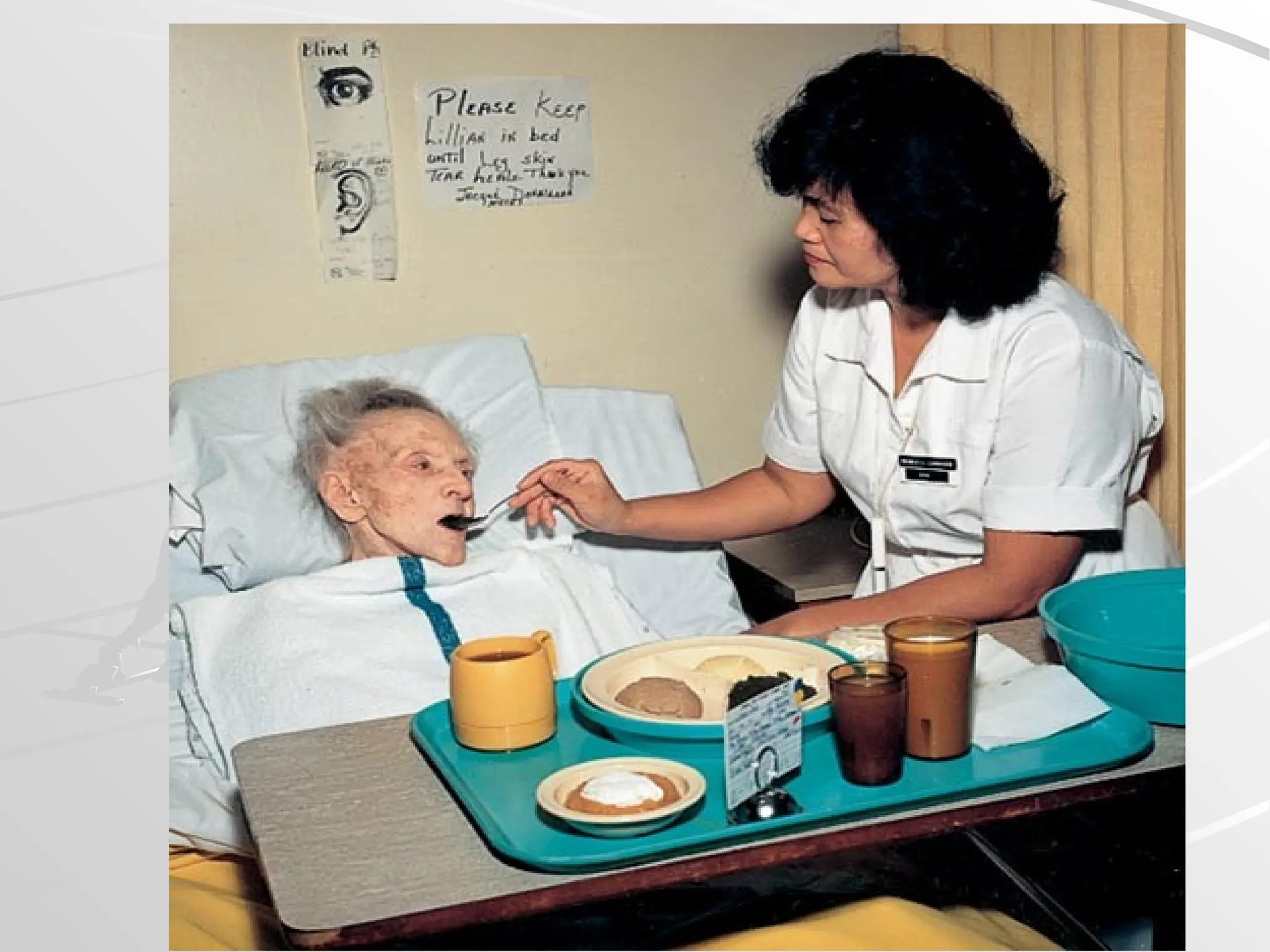
Many residents need assistance or encouragement.
Many residents need assistance or encouragement.
Lack of adequate staffing play a large role in patient
Lack of adequate staffing play a large role in patient
nutrition.
nutrition.
Many patients are on restricted diets.
Many patients are on restricted diets.
Pressure sore due to lack of mobility, and nutrition.
Pressure sore due to lack of mobility, and nutrition.
Nutrient-Drug interactions.
Nutrient-Drug interactions.
75.
Caffeine
Caffeine
Caffeine:
Caffeine:
Drug
Drug
Central nervous systemstimulant and diuretic.
Central nervous system stimulant and diuretic.
Nervousness
Nervousness
Irritability
Irritability
Anxiety
Anxiety
Insomnia
Insomnia
Heart arrhythmias
Heart arrhythmias
Palpitations
Palpitations
See Caffeine Content of Selected Beverages and Foods.
See Caffeine Content of Selected Beverages and Foods.
76.
Common Medications andTheir Effect on
Common Medications and Their Effect on
Nutrition
Nutrition
Antacids.
Antacids.
Antibiotics.
Antibiotics.
Anticoagulants.
Anticoagulants.
Aspirin.
Aspirin.
Diuretics.
Diuretics.
Laxatives.
Laxatives.
78.
Medical Nutrition Therapy
MedicalNutrition Therapy
and Therapeutic Diets
and Therapeutic Diets
These diets are specific nutrition as needed to treat an illness, injury or
These diets are specific nutrition as needed to treat an illness, injury or
condition.
condition.
79.
Purpose of DietTherapy
Purpose of Diet Therapy
The dietary prescription is written for one or
The dietary prescription is written for one or
more of the following purposes:
more of the following purposes:
Provide the client with nutrients needed for
Provide the client with nutrients needed for
maintenance or growth.
maintenance or growth.
Prepare a client for diagnostic tests.
Prepare a client for diagnostic tests.
Treat the client with a disease or condition.
Treat the client with a disease or condition.
80.
DIET THERAPY
DIET THERAPY
Thetreatment of a disease or
The treatment of a disease or
disorder with a special diet.
disorder with a special diet.
A client must not be given
A client must not be given
anything to eat or drink without
anything to eat or drink without
an order.
an order.
81.
The Vegetarian Diet
TheVegetarian Diet
Lacto-ovo vegetarians–use dairy
Lacto-ovo vegetarians–use dairy
products and eggs but no meat,
products and eggs but no meat,
poultry, or fish.
poultry, or fish.
Lacto vegetarians–use dairy products
Lacto vegetarians–use dairy products
but no meat, poultry, or eggs.
but no meat, poultry, or eggs.
Vegans–avoid all animal foods.
Vegans–avoid all animal foods.
BASIC
BASIC
NUTRITIONAL ASSESSMENT
NUTRITIONAL ASSESSMENT
Nutritionalstatus
Nutritional status
Height and weight
Height and weight
Meal and snack pattern
Meal and snack pattern
Food allergies
Food allergies
Physical activity
Physical activity
Cultural, ethnic, and family influences
Cultural, ethnic, and family influences
Use of vitamin/mineral supplements
Use of vitamin/mineral supplements
84.
NUTRITION AND HEALTH
NUTRITIONAND HEALTH
Primary nutritional disease–occurs
Primary nutritional disease–occurs
when nutrition is the cause of the
when nutrition is the cause of the
disease.
disease.
Secondary nutritional disease–
Secondary nutritional disease–
occurs as a complication of
occurs as a complication of
another disease or condition.
another disease or condition.
85.
WEIGHT MANAGEMENT
WEIGHT MANAGEMENT
Basedon relationship between
Based on relationship between
intake and use of kcal.
intake and use of kcal.
Overweight: 11%–19% above
Overweight: 11%–19% above
Obesity: 20% or more above
Obesity: 20% or more above
Underweight: 10%–15% under
Underweight: 10%–15% under
86.
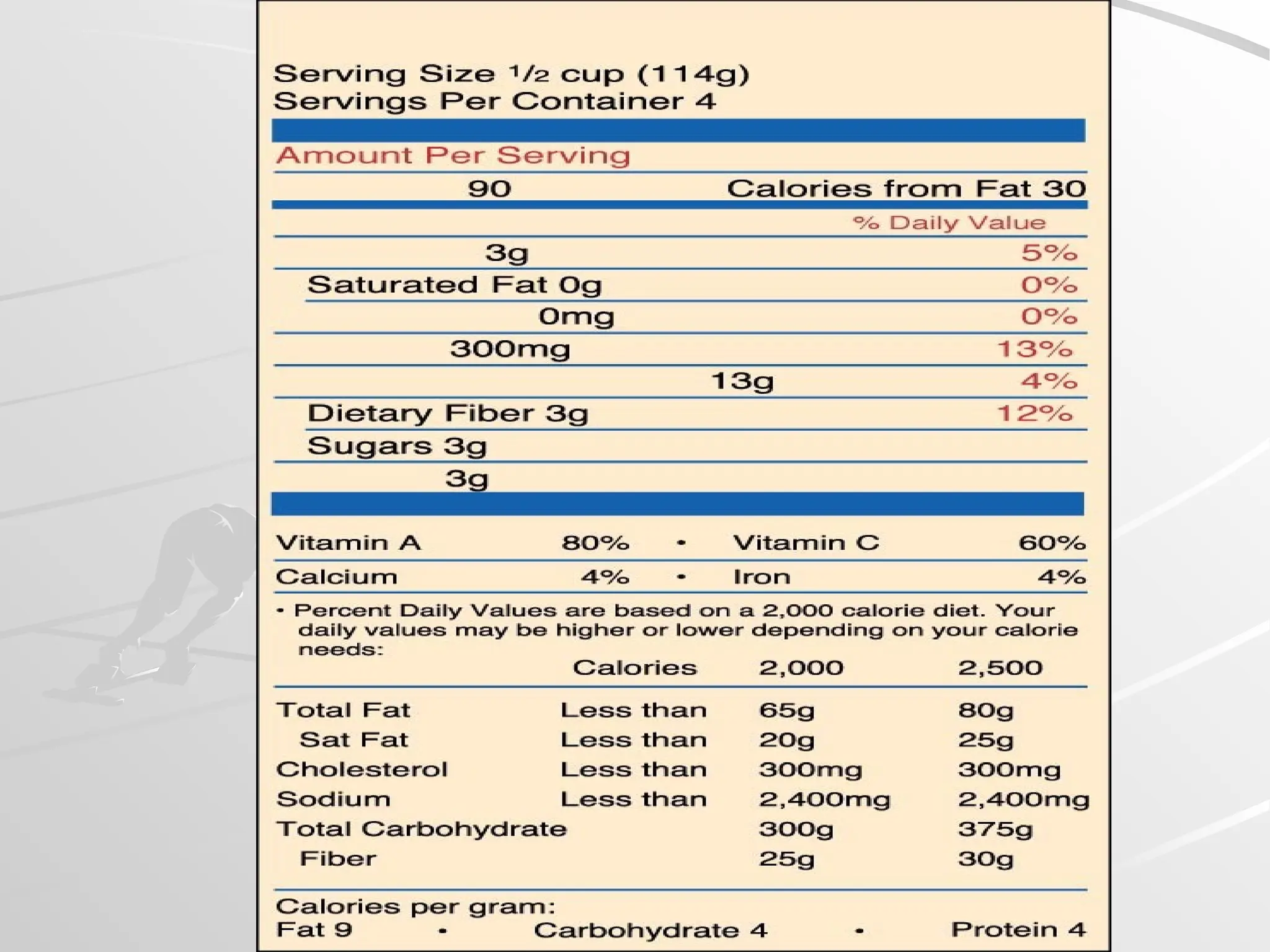
FOOD LABELING
FOOD LABELING
Requiredon virtually all retail food
Required on virtually all retail food
products.
products.
Labels must follow the approved uniform
Labels must follow the approved uniform
format and use standard serving sizes
format and use standard serving sizes
and household measurements.
and household measurements.
88.
FOOD QUALITY ANDSAFETY
FOOD QUALITY AND SAFETY
Proper storage, preparation,
Proper storage, preparation,
sanitation, and cooking are
sanitation, and cooking are
necessary to help prevent or reduce
necessary to help prevent or reduce
the risk of food-borne illnesses.
the risk of food-borne illnesses.
89.
Consistency, Texture, andFrequency
Consistency, Texture, and Frequency
Modifications
Modifications
Liquid Diets:
Liquid Diets:
Clear Liquids
Clear Liquids
Full Liquids
Full Liquids
Soft and Low-Residue Diets.
Soft and Low-Residue Diets.
High Fiber Diets.
High Fiber Diets.
Meal Frequency Modification.
Meal Frequency Modification.
90.
Kilocalorie Modifications
Kilocalorie Modifications
BasalMetabolic Rate (BMR).
Basal Metabolic Rate (BMR).
High-Kilocalorie and High Protein Diets.
High-Kilocalorie and High Protein Diets.
Anorexia.
Anorexia.
Kilocalorie-Controlled and Low-Kilocalorie Diets.
Kilocalorie-Controlled and Low-Kilocalorie Diets.
Obesity
Obesity
Measurements of Obesity
Measurements of Obesity
BMI
BMI
Body Composition
Body Composition
Waist circumference
Waist circumference
Treatment of Obesity
Treatment of Obesity
91.
Eating Disorders
Eating Disorders
AnorexiaNervosa:
Anorexia Nervosa:
Self-imposed starvation.
Self-imposed starvation.
Individuals have an intense drive for thinness,
Individuals have an intense drive for thinness,
an intense fear of gaining weight or becoming
an intense fear of gaining weight or becoming
fat, and a distorted body image.
fat, and a distorted body image.
Bulimia Nervosa:
Bulimia Nervosa:
Periods of binge eating followed by purging
Periods of binge eating followed by purging
(self-induced vomiting, emetics, laxatives,
(self-induced vomiting, emetics, laxatives,
enemas, or diuretics).
enemas, or diuretics).
Often normal weight or overweight.
Often normal weight or overweight.
Binge / Purge:
Binge / Purge:
92.
Comparison of EatingDisorders
Comparison of Eating Disorders
Diagnoses
Diagnoses
Body weight and other physical
Body weight and other physical
indicators.
indicators.
Eating behaviors.
Eating behaviors.
Compensatory behaviors (purging).
Compensatory behaviors (purging).
Psychologic indicators.
Psychologic indicators.
93.
Carbohydrate-Modified Diets
Carbohydrate-Modified Diets
DiabetesMellitus:
Diabetes Mellitus:
A disease in which the body does not produce or
A disease in which the body does not produce or
properly
properly
use insulin.
use insulin.
Insulin convert sugar, starches, and other food into
Insulin convert sugar, starches, and other food into
energy needed for daily life.
energy needed for daily life.
Two major types of diabetes:
Two major types of diabetes:
Type 1
Type 1
Type 2
Type 2
94.
Primary goals formedical nutrition therapy:
Primary goals for medical nutrition therapy:
– Improve metabolic control by achieving
Improve metabolic control by achieving
and maintaining optimal blood glucose.
and maintaining optimal blood glucose.
– Provide adequate energy for maintenance
Provide adequate energy for maintenance
of a reasonable body weight.
of a reasonable body weight.
– Prevent acute and chronic complications
Prevent acute and chronic complications
of diabetes.
of diabetes.
– Improve overall health through optimal
Improve overall health through optimal
nutrition
nutrition
95.
Carbohydrate intake shouldbe monitored and
Carbohydrate intake should be monitored and
controlled.
controlled.
Diabetic diet tools:
Diabetic diet tools:
–Exchange lists for meal planning
Exchange lists for meal planning
–Carbohydrate counting
Carbohydrate counting
Other nutritional considerations:
Other nutritional considerations:
–Hypoglycemia: consumption of inadequate
Hypoglycemia: consumption of inadequate
carbohydrates causes the blood sugar to
carbohydrates causes the blood sugar to
drop.
drop.
96.
Carbohydrate-Modified Diets
Carbohydrate-Modified Diets(continued)
(continued)
– Dumping Syndrome:
Dumping Syndrome:
It may occur after surgery in which a portion
It may occur after surgery in which a portion
or all of the stomach is removed.
or all of the stomach is removed.
– Lactose Intolerance:
Lactose Intolerance:
Intolerance occurs as a result of a lack of the
Intolerance occurs as a result of a lack of the
digestive enzyme lactase.
digestive enzyme lactase.
97.
Special Diets
Special Diets
Low-residuediet
Low-residue diet
High-fiber diet
High-fiber diet
Liberal bland diet
Liberal bland diet
Fat-controlled diet
Fat-controlled diet
Sodium-restricted diet
Sodium-restricted diet
98.
Fat Modified Diet
FatModified Diet
These diets are beneficial in reducing the risk of atherosclerosis.
These diets are beneficial in reducing the risk of atherosclerosis.
Lowering dietary fat may assist in disease treatment and control.
Lowering dietary fat may assist in disease treatment and control.
99.
Fat-Controlled Diets:
Fat-Controlled Diets:
Limitstotal fat, saturated fat, and
Limits total fat, saturated fat, and
trans-fatty acids.
trans-fatty acids.
Low-Fat Diets:
Low-Fat Diets:
All fats limited, regardless of saturation.
All fats limited, regardless of saturation.
100.
Lowering Fat/Saturated Fat/TransFatty
Lowering Fat/Saturated Fat/Trans Fatty
Acids/Cholesterol
Acids/Cholesterol
Food Groups:
Food Groups:
Choose:
Choose:
Go Easy on:
Go Easy on:
Patient Teaching
Patient Teaching
Fluidrestrictions:
Fluid restrictions:
Explain the rationale.
Explain the rationale.
Indicated if restriction is temporary or permanent.
Indicated if restriction is temporary or permanent.
Educate, discuss different sources of water.
Educate, discuss different sources of water.
Teach how to count fluids.
Teach how to count fluids.
Show the patient how much fluid is allowed.
Show the patient how much fluid is allowed.
Suggest ways to alleviate thirst without drinking.
Suggest ways to alleviate thirst without drinking.
Discuss the consequences of over consumption of fluids.
Discuss the consequences of over consumption of fluids.
Nutritional Support
Nutritional Support
Enteralnutrition–includes both the
Enteral nutrition–includes both the
ingestion of food orally and the delivery of
ingestion of food orally and the delivery of
nutrients through a GI tube.
nutrients through a GI tube.
Parenteral nutrition–the infusion of a
Parenteral nutrition–the infusion of a
solution of nutrients directly into a vein to
solution of nutrients directly into a vein to
meet the client’s daily requirements.
meet the client’s daily requirements.
106.
Tube Feedings
Tube Feedings
–Administration of nutritionally balanced liquefied
Administration of nutritionally balanced liquefied
foods or formula though a tube inserted into the
foods or formula though a tube inserted into the
stomach, duodenum, or jejunum by way of a
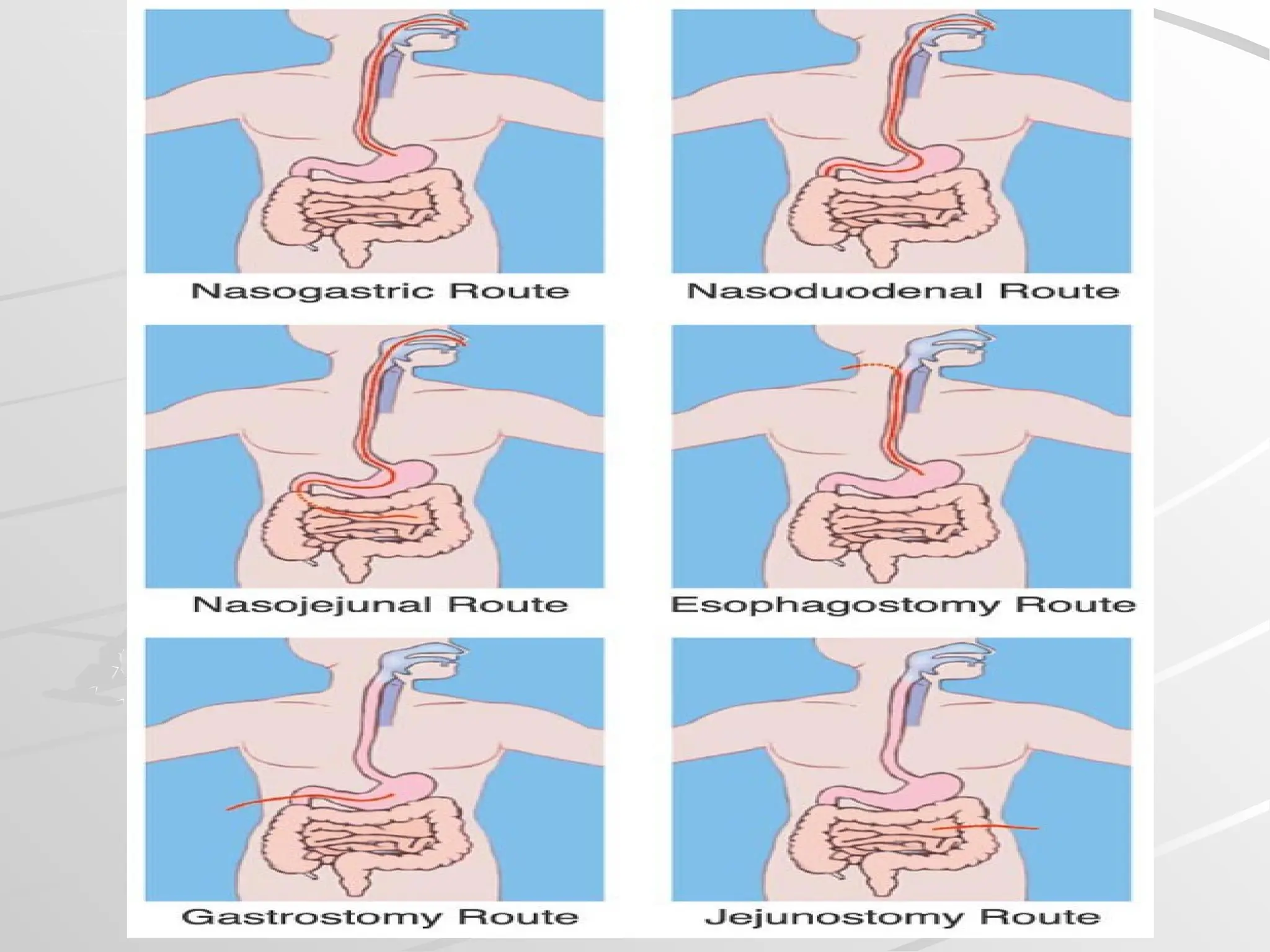
stomach, duodenum, or jejunum by way of a
nasogastric tube or a feeding ostomy.
nasogastric tube or a feeding ostomy.
– Indicated when a patient is unable to chew or
Indicated when a patient is unable to chew or
swallow, has no appetite, or refuses to eat.
swallow, has no appetite, or refuses to eat.
– Tube feeding used only when all or at least part
Tube feeding used only when all or at least part
of the GI tract is functioning.
of the GI tract is functioning.
– Feeding given continuously or intermittently.
Feeding given continuously or intermittently.
107.
Figure 21-7
Figure 21-7
Tubefeeding
sites.
(From Potter, P.A., Perry, A.G. [2005]. Fundamentals of nursing. [6th
ed.]. St. Louis: Mosby.)
109.
Nasogastric Tube Feedings
NasogastricTube Feedings
Checking for placement of a feeding tube before
Checking for placement of a feeding tube before
administering medication or tube feeding is critical
administering medication or tube feeding is critical
to safe patient care.
to safe patient care.
Tube may be accidentally placed in the lung,
Tube may be accidentally placed in the lung,
esophagus, or even the stomach when it should
esophagus, or even the stomach when it should
be in the small bowel.
be in the small bowel.
To test, use chest x-ray, test pH of aspirated fluid,
To test, use chest x-ray, test pH of aspirated fluid,
or use auscultatory method.
or use auscultatory method.
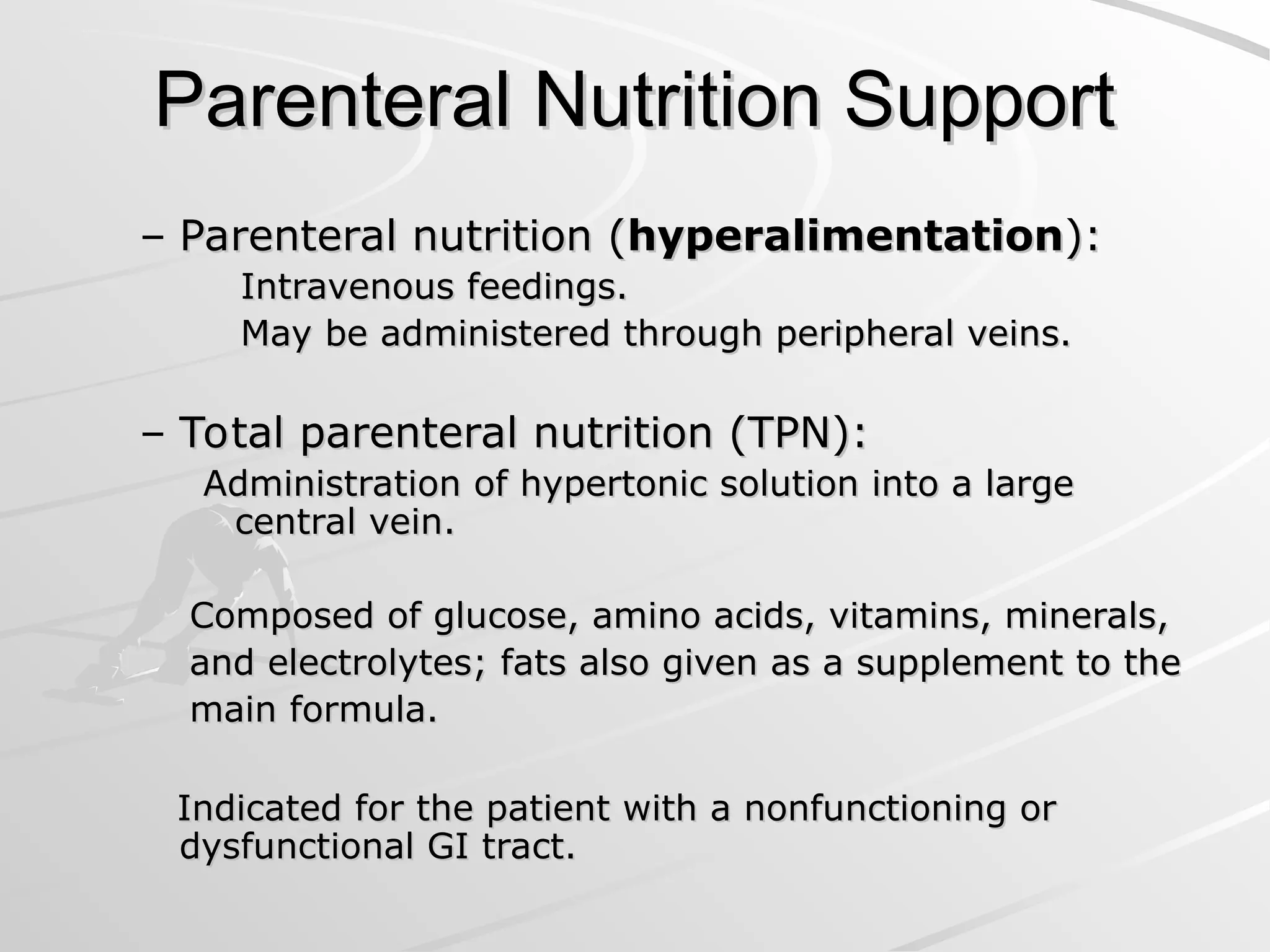
Parenteral Nutrition Support
ParenteralNutrition Support
– Parenteral nutrition (
Parenteral nutrition (hyperalimentation
hyperalimentation):
):
Intravenous feedings.
Intravenous feedings.
May be administered through peripheral veins.
May be administered through peripheral veins.
– Total parenteral nutrition (TPN):
Total parenteral nutrition (TPN):
Administration of hypertonic solution into a large
Administration of hypertonic solution into a large
central vein.
central vein.
Composed of glucose, amino acids, vitamins, minerals,
Composed of glucose, amino acids, vitamins, minerals,
and electrolytes; fats also given as a supplement to the
and electrolytes; fats also given as a supplement to the
main formula.
main formula.
Indicated for the patient with a nonfunctioning or
Indicated for the patient with a nonfunctioning or
dysfunctional GI tract.
dysfunctional GI tract.
117.
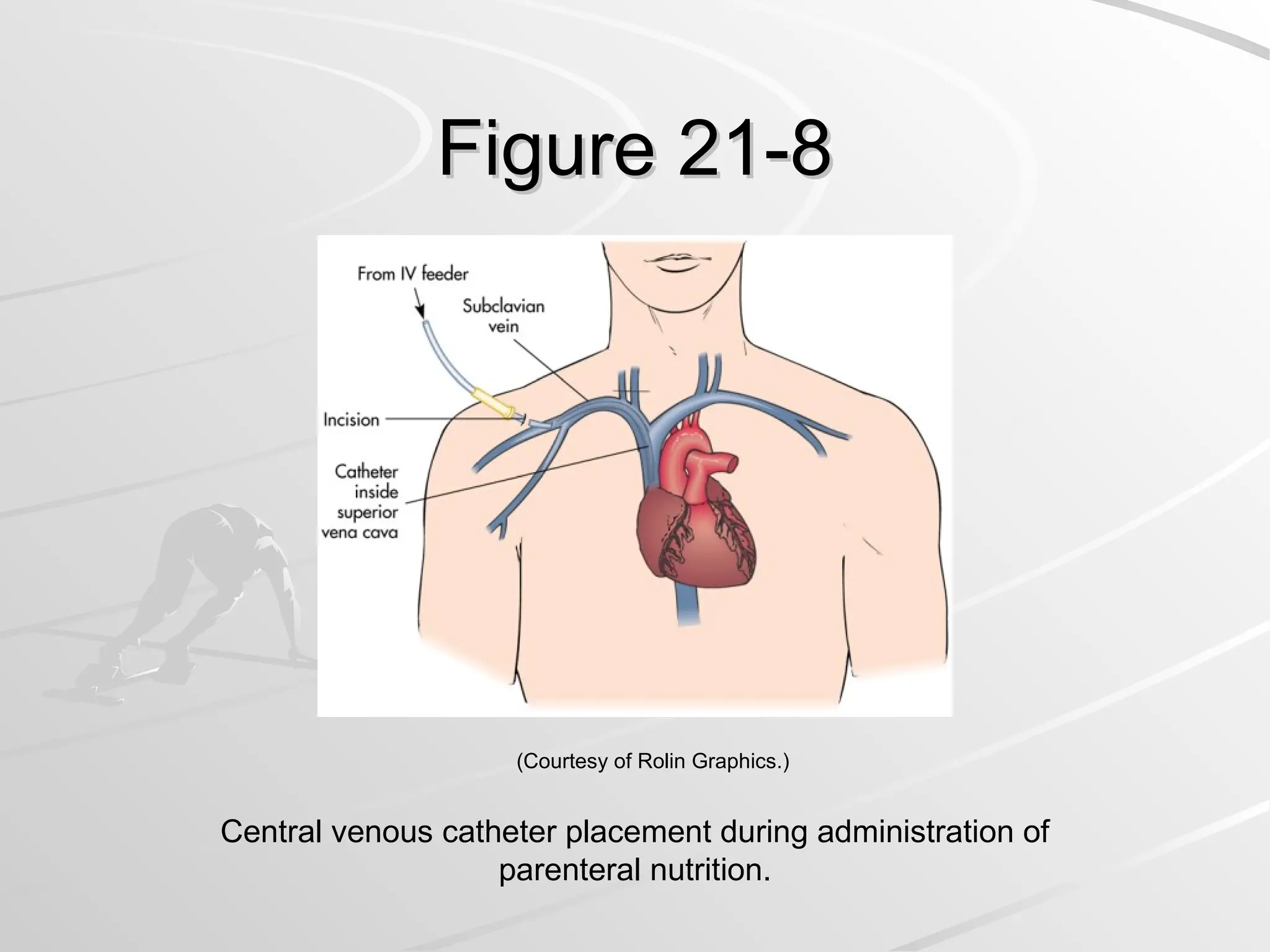
Figure 21-8
Figure 21-8
Centralvenous catheter placement during administration of
parenteral nutrition.
(Courtesy of Rolin Graphics.)
118.
Nursing Assessment
Nursing Assessment
Mustbe performed in a logical fashion
Must be performed in a logical fashion
and should include a nutritional
and should include a nutritional
history, physical examination, and the
history, physical examination, and the
results of laboratory tests.
results of laboratory tests.
119.
Nursing Diagnosis
Nursing Diagnosis
Imbalancednutrition:
Imbalanced nutrition:
– Less than body requirements
Less than body requirements
– More than body requirements
More than body requirements
Risk for imbalanced nutrition: more than
Risk for imbalanced nutrition: more than
body requirements
body requirements
Disturbed body image
Disturbed body image
Ineffective breastfeeding
Ineffective breastfeeding
Planning / Outcome
Planning/ Outcome
A plan should be formulated by the
A plan should be formulated by the
nurse and client to achieve mutually
nurse and client to achieve mutually
agreed-upon goals.
agreed-upon goals.
The plan is individualized to meet
The plan is individualized to meet
the client’s specific needs.
the client’s specific needs.
122.
Implementation
Implementation
Interventions to accomplishthe goals
Interventions to accomplish the goals
may include diet therapy, assistance
may include diet therapy, assistance
with meals, weight and intake
with meals, weight and intake
monitoring, and nutritional support.
monitoring, and nutritional support.
#13 Essential Nutrients (continued)
Basic Functions
Provide energy
Carbohydrates and proteins: 4 kcal/g
Fat: 9 kcal/g
Build and repair tissue
Protein, calcium, phosphorus, iron, and fat
Regulate body processes
Metabolism: the combination of all chemical processes that take place in living organisms
#15 Carbohydrates
Main function of carbohydrates is to provide energy.
Simple carbohydrates
Simple sugars: monosaccharides and disaccharides
Found naturally in many nutritious foods such as milk and fruit
Complex carbohydrates
Polysaccharides
Starch, glycogen, and dietary fiber
Digestion and metabolism of carbohydrates
All carbohydrates except fiber are broken down in the digestive tract into monosaccharides (simple sugar units).
They then are absorbed and eventually converted to glucose.
Glucose circulates in the bloodstream and is used by the cells for energy.
Digestion and metabolism of carbohydrate
If energy needs are met, carbohydrates will be stored as glycogen.
Once glycogen stores are full, further excesses of carbohydrates will be converted to fat and stored as adipose tissue.
Digestion and metabolism of carbohydrate
If energy needs are met, carbohydrates will be stored as glycogen.
Once glycogen stores are full, further excesses of carbohydrates will be converted to fat and stored as adipose tissue.
#20 Fats (Lipids)
These are a group of organic substances of a fatty nature that are insoluble in water and that are necessary in the body for good health.
Both fats and cholesterol are lipids.
Adipose tissue is the body’s storage form of fat; it helps insulate the body from temperature extremes and serves as a cushion to protect organs and other tissues.
Fat provides satiety; it adds flavor and aroma to foods.
Digestion and metabolism of fats
Fats must be emulsified by bile to be digested.
Once emulsified, fats can be broken down and absorbed.
Excess dietary fat will be stored as adipose tissue.
Lipoproteins facilitate the transport of lipids in the bloodstream: high-density (HDL) and low-density (LDL) lipoproteins.
#21 Saturated fatty acids
Chemical bonds are completely filled or saturated with hydrogen.
These are generally of animal origin and solid at room temperature.
They increase blood cholesterol levels and the risk of atherosclerosis.
Unsaturated fatty acids
There is one or more places on its chemical chain where hydrogen is missing.
They can be monounsaturated or polyunsaturated.
They usually have plant sources and are liquid at room temperature.
They are thought to have a blood cholesterollowering effect at moderate levels of intake.
Trans-Fatty Acids
These are unsaturated fatty acids that vary slightly in their chemical configuration from naturally occurring unsaturated fatty acids.
They are produced during hydrogenation.
They are found in foods containing partially hydrogenated vegetable oils.
They tend to increase blood cholesterol levels but not as much as saturated fats.
#22 Cholesterol
It performs specific functions in the body but provides no energy.
It is synthesized in the liver and is found in foods of animal origin.
Dietary cholesterol is highest in organ meats and egg yolks.
Intake of dietary cholesterol should average no more than 300 mg per day.
#28 Protein
Protein makes up the bulk of the body’s lean tissues and organs.
It is necessary for tissue growth and repair and wound healing.
Protein is made of smaller units called amino acids
There are 22 amino acids, but only 9 of them are considered essential amino acids.
The 9 essential amino acids must be obtained from the diet.
Complete Proteins
One that contains all nine essential amino acids in sufficient quantity and ratio for the body’s needs
Generally of animal origin; found in foods such as meat, poultry, fish, milk, cheese, and eggs
Incomplete Proteins
Lacking in one or more or the essential amino acids
Plant origin; include grains, legumes, nuts, and seeds
Vegetarian Diets
They are made up of mainly plant foods; some may include dairy products or eggs as well.
Lactovegetarin diet includes fruits, vegetables, grains, and milk and dairy products.
Lacto-ovo-vegetarian diet also includes eggs.
Protein needs can be met with a vegetarian diet; a wide variety of plant foods must be included.
Protein-Kilocalorie Malnutrition
Individuals suffering from a lack of kilocalories or protein; body breaks down its own protein stores for energy
Kwashiorkor: malnutrition caused by severe protein deficiency; may occur in the presence of adequate kilocalories
Marasmus: condition of extreme malnutrition and emaciation due to inadequate kilocalories and protein
#33 Vitamins and Minerals
They are needed in small amounts; toxicity may occur with over consumption.
They are best received from a balanced, varied diet.
Vitamins can be destroyed by heat, light, and exposure to air.
Minerals cannot be destroyed because they are single elements rather than compounds.
Both vitamins and minerals can be lost when foods are cooked in water.
Vitamins (continued)
Antioxidant vitamins
Vitamins E and C; previtamin form of A (beta-carotene)
Possible link to reduced risks of certain cancers and heart disease
Function by delaying or preventing the destruction or breakdown of cell membranes in the presence of oxygen
#42 Vitamins (continued)
Vitamin C
Adequate amounts are necessary for proper immune function.
Vitamin D
Most common dietary sources include fortified milk and milk products.
The body can also make vitamin D from exposure to sunlight.
#43 Vitamin K
It plays a role in blood clotting.
A large fluctuation in vitamin K intake may alter the effects of anticoagulation drugs.
Folate (folic acid)
Before and during pregnancy, it may play a role in reducing the risk of neural tube defects in the infant.
Vitamin B12
It is primarily found in foods of animal origin.
It requires a special intrinsic factor produced in the stomach for absorption.
Pernicious anemia may result with inadequate amounts of intrinsic factor because B12 is not absorbed.
#45 Minerals
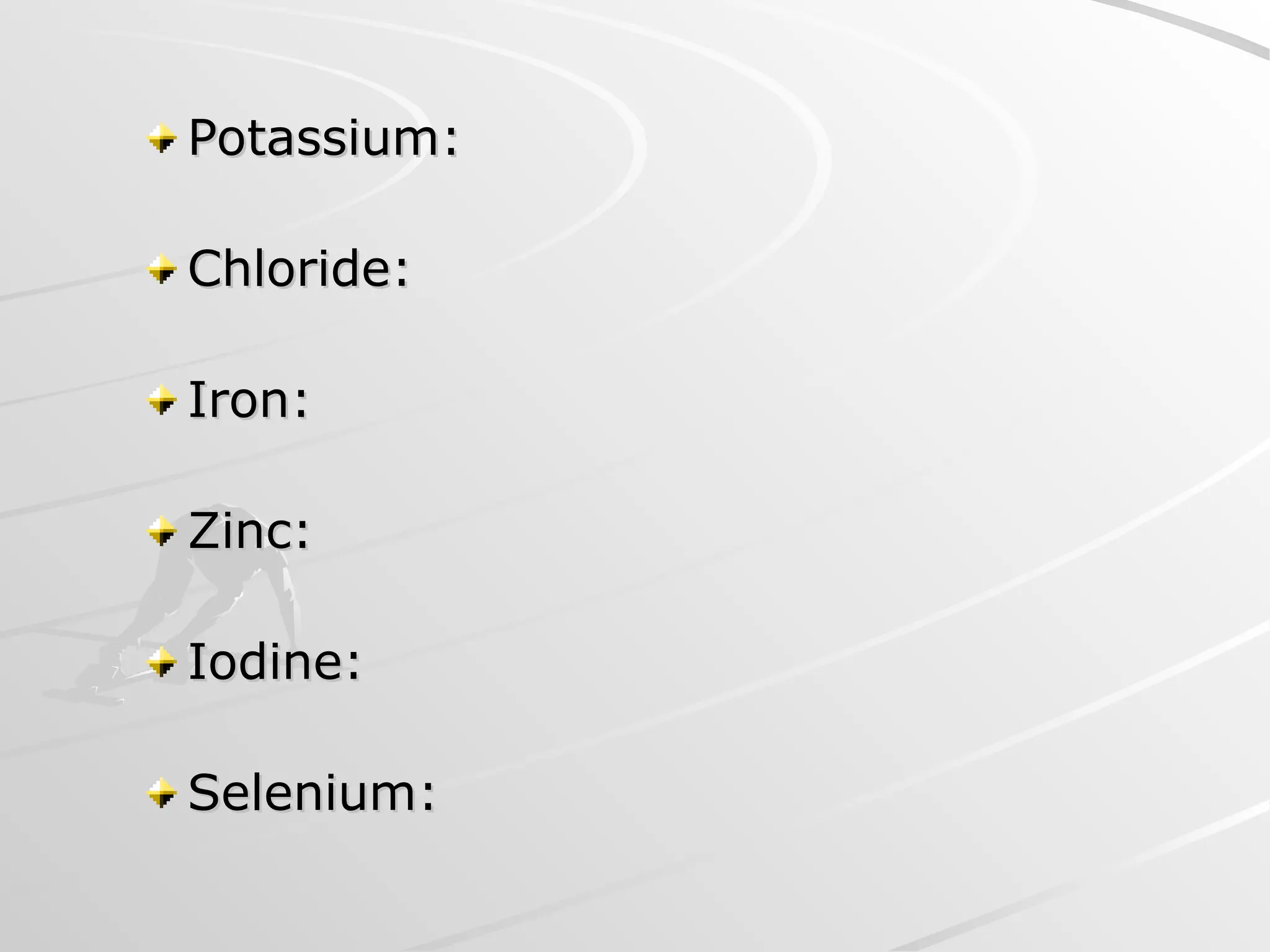
Major minerals are those needed in amounts greater than 100 mg per day: calcium, phosphorus, magnesium, sulfur, sodium, potassium, and chloride.
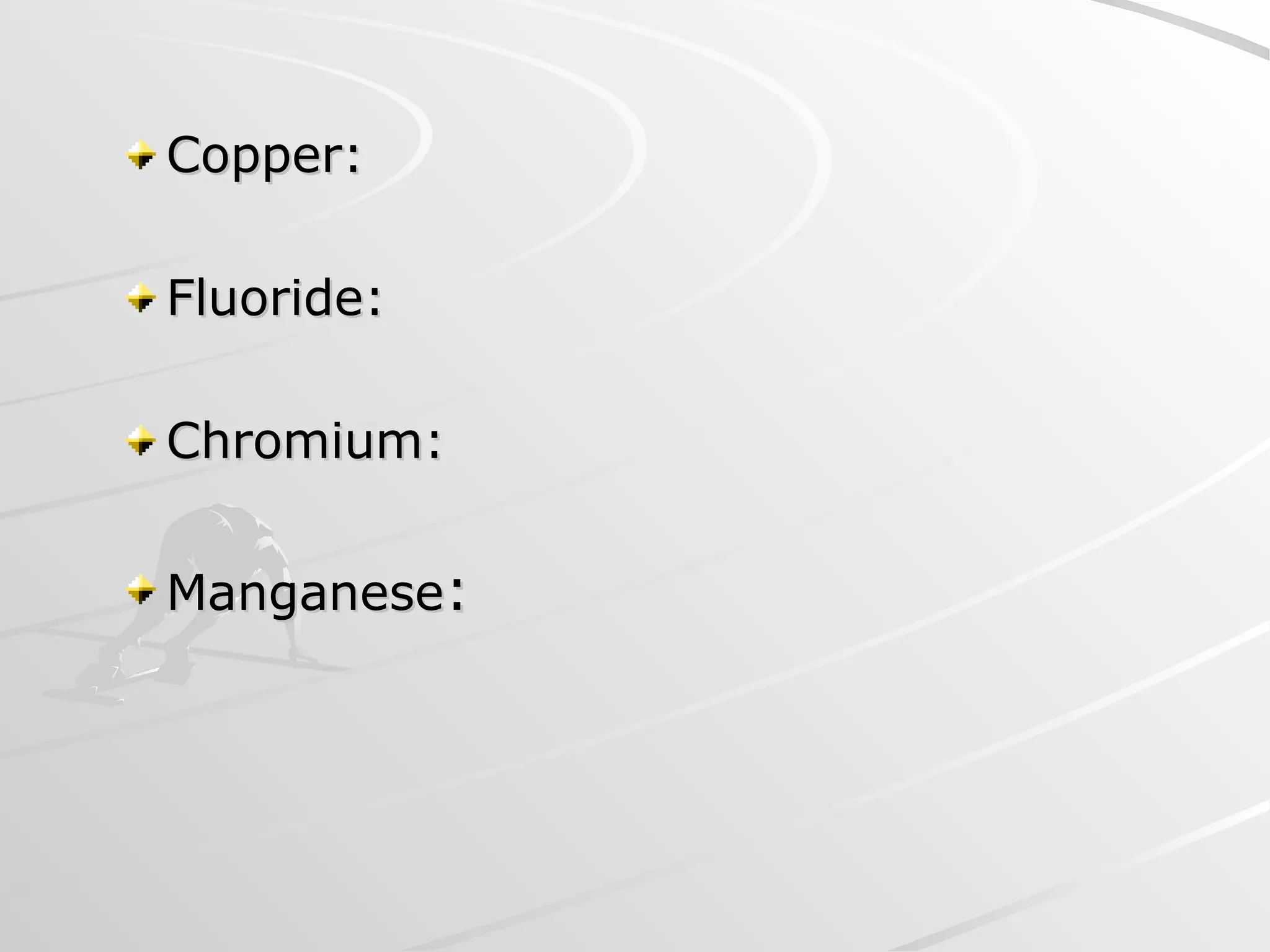
Trace minerals are needed in much smaller amounts: iron, zinc, iodine, selenium, copper, fluoride, chromium, and molybdenum.
Calcium
Protective effect against osteoporosis and hypertension
1000 to 1200 mg per day
Sodium
Functions as an electrolyte
Less than 2400 mg per day
Salt is a major dietary source
#46 Potassium
An electrolyte; may have a protective effect against hypertension
2000 mg per day
Iron
Part of hemoglobin, which is part of the red blood cell and carries oxygen to the cells
8-15 mg per day; 30 mg per day for pregnant women
#55 Dietary Guidelines for Americans
These guidelines form the foundation of U.S. federal nutrition policy and directly affect federal nutrition programs such as food stamps, school breakfast and lunch programs, and the Special Supplemental Program for Women, Infants, and Children (WIC).
These guidelines have been developed to address the importance of adequate nutrition, as well as the prevention of over nutrition and disease.
#56 MyPyramid (continued)
Symbolizes a personalized approach to healthy eating and physical activity.
Emphasizes key concepts regarding activity and eating.
Activity
Moderation
Variety
Proportionality
#62 Concerns in Pregnancy
Weight gain
Normal-weight women should gain between 25 and 35 lb.
Discomforts and complications
Pregnancy-induced hypertension (PIH)
Proper nutrition may help avert this condition; salt should not be restricted in most cases.
Gestational diabetes
Diabetes mellitus that occurs only during pregnancy; diet major part of therapy
Anemia
Iron deficiency and folacin deficiency
Adequate diet including meats, poultry, and fish; green leafy vegetables; and variety of fruits
Practices to avoid
Alcohol consumption
Caffeine consumption; less than 300 mg per day
Smoking
Lactation
Additional 500 kcal per day is recommended; increased fluid needs
Adequate nutrition vital
#65 Breast milk or iron-fortified infant formula is generally recommended for the first year.
Breastfeeding should be encouraged
Regular cow’s milk is inappropriate during the first year. Infants need high % of kilocalories from fat. Non Low fat provides inadequate fat, and difficult to digest.
Whole cow milk infants have low iron, essential fatty acids, vit E, excess sodioum potassium, protien.
After year one, only whole milk may be used.
Introducing solid foods too early may increase the risk for food allergies and choking.
Most infants are not developmentally or physiologically ready to handle solid foods before 6 months of age.
At 4 to 6 months of age, single-ingredient foods should be chosen and introduced one at a time at weekly intervals.
#71 It is important to use nutrient-dense foods and thereby
receive adequate nutrition and fewer kilocalories.
With age comes the increasing likelihood of age-related
illness;
#73 nutrient needs vary greatly from individual to
individual.
#89 Liquid diets
Clear liquid diet is a nonirritating diet consisting of liquids that are easily digested and absorbed and leave little residue in the GI tract: bouillon, broth, gelatin, tea, coffee, ginger ale
Full liquid diet is more nutritionally complete than a clear liquid diet but is still lacking in some nutrients: strained cereals and soups, ice cream, puddings, milk/milkshakes, and fruit juices
Soft and low-residue diets
Soft diet is generally low in fiber; includes foods from all five food groups and is nutritionally adequate except for fiber.
Low-residue diet is similar to the soft diet but also includes restrictions on milk, because it leaves more residue in the colon.
Mechanical soft diet eliminates foods that are difficult to chew or swallow.
Nutrition Therapy in Peptic Ulcer Disease
Eat three regular meals per day, without snacks.
Avoid known gastric acid stimulants: coffee, caffeinated soft drinks, tea, hot chili peppers, and alcohol.
Individualize the diet according to patient tolerance, eliminating any specific food or spice that causes discomfort.
Avoid cigarette smoking, aspirin, and nonsteroidal antiinflammatory drugs.
High-Fiber Diets
This is a variation of the regular diet that doubles the intake of dietary fiber.
Foods with high fiber should replace similar foods with little or no fiber.
It is used for the treatment of some GI disorders.
Meal Frequency Modification
Small, frequent meals may be used rather than three larger meals: six to eight small meals or snacks.
This decreases workload on the GI tract and cardiovascular system.
#90 High-kilocalorie and high-protein diets
During times of physiological stress, the body’s energy and protein needs are increased.
Diet should provide increased amounts of kilocalories and protein in small volumes.
The diet should still provide a balance of foods from all of the food groups.
Nutritional support in the form of tube feedings or IV feedings may be considered.
Kilocalorie-controlled and low-kilocalorie diets
Used in the treatment of obesity and in the prevention of excess weight gain
Measurements of obesity
Height and weight tables
Body mass index (BMI)
Body composition
Waist circumference
Treatment of obesity
It should involve both behavioral and psychological goals.
Diet should be low in fat and have an energy level that does not exceed expenditure.
Physical activity is an integral part of any weight management effort.
#91 Binge Eating Disorder
Frequent, recurrent episodes of binge eating; eating larger amounts of food than normal during a short period of time and feeling a lack of control over eating during binge episodes
Often obese; should consider treatment that focuses on binge eating behavior before attempting to lose weight
#93 Primary goals for medical nutrition therapy
Improve metabolic control by achieving and maintaining optimal blood glucose
Provide adequate energy for maintenance of a reasonable body weight.
Prevent acute and chronic complications of diabetes
Improve overall health through optimal nutrition
#96 Dumping Syndrome
It may occur after surgery in which a portion or all of the stomach is removed.
The stomach contents may empty too rapidly into the jejunum; the body reacts by sending water to the intestinal tract, thus reducing blood pressure.
The load in the intestinal tract increases peristalsis, leading to diarrhea.
Diet therapy involves giving small frequent meals that are higher in protein and fat and lower in carbohydrates.
The GI tract is unable to break down lactose.
Symptoms occur after the ingestion of milk products and include nausea, cramps, bloating, flatulence, and diarrhea.
Diet for lactose intolerance excludes milk and milk products; foods with milk added may need to be avoided as well.
#99 Fat controlled diets
Limits total fat, saturated fat, and trans-fatty acids.
To prevent and treat atherosclerosis, heart disease, and hyperlipidemia.
Rather than totally eliminating high-fat foods, encourages moderation.
Low-Fat Diets:
All fats limited, regardless of saturation.
Used for diseases that involve malabsorption of fat.
#102 Protein-Restricted Diet
In the presence of defects in protein metabolism or excretion, protein intake reduced or controlled; chronic renal failure and cirrhosis of the liver
Sodium-Restricted Diet
May be used to treat hypertension, water retention, edema, and congestive heart failure
Restrictions range from “no added salt” to as little as 500 mg sodium per day
Fluid-Modified Diets
Fluid is restricted to 500 to 750 ml per day plus an amount equal to daily urine output during end-stage renal disease.
Fluid restrictions may also be implemented during congestive heart failure, directly after a myocardial infarction, or in hepatic coma or ascites.
Patient may experience excessive thirst: rinse mouth with cold mouthwash, lemon in cold water, freezing fluids, cold fruits and vegetables, breath mints or hard candies, and brushing teeth.
![Figure 21-7
Figure 21-7
Tube feeding
sites.
(From Potter, P.A., Perry, A.G. [2005]. Fundamentals of nursing. [6th
ed.]. St. Louis: Mosby.)](https://image.slidesharecdn.com/white-updated-basic-nut-250310055157-2b0219f8/75/White-updated-Basic-Nut-chap-166666-ppt-107-2048.jpg)

![Skill 21-1: Step 10a(1)
Skill 21-1: Step 10a(1)
Administering nasogastric tube feedings.
(From Elkin, M.K., Perry, A.G., Potter, P.A. [2004]. Nursing interventions and clinical skills. [3rd
ed.]. St.
Louis: Mosby.)](https://image.slidesharecdn.com/white-updated-basic-nut-250310055157-2b0219f8/75/White-updated-Basic-Nut-chap-166666-ppt-111-2048.jpg)
![Skill 21-1: Step 10a(2)
Skill 21-1: Step 10a(2)
Administering nasogastric tube feedings.
(From Potter, P.A., Perry, A.G. [2005]. Fundamentals of nursing. [6th
ed.]. St. Louis: Mosby.)](https://image.slidesharecdn.com/white-updated-basic-nut-250310055157-2b0219f8/75/White-updated-Basic-Nut-chap-166666-ppt-112-2048.jpg)
![Skill 21-1: Step 10b
Skill 21-1: Step 10b
Administering nasogastric tube feedings.
(From Potter, P.A., Perry, A.G. [2005]. Fundamentals of nursing [6th
ed.]. St. Louis: Mosby.)](https://image.slidesharecdn.com/white-updated-basic-nut-250310055157-2b0219f8/75/White-updated-Basic-Nut-chap-166666-ppt-113-2048.jpg)
![Administering nasogastric tube feedings.
(From Elkin, M.K., Perry, A.G., Potter, P.A. [2004]. Nursing interventions and clinical skills. [3rd
ed.]. St.
Louis: Mosby.)](https://image.slidesharecdn.com/white-updated-basic-nut-250310055157-2b0219f8/75/White-updated-Basic-Nut-chap-166666-ppt-114-2048.jpg)
![Administering nasogastric tube feedings.
(From Elkin, M.K., Perry, A.G., Potter, P.A. [2004]. Nursing interventions and clinical skills. [3rd
ed.]. St.
Louis: Mosby.)](https://image.slidesharecdn.com/white-updated-basic-nut-250310055157-2b0219f8/75/White-updated-Basic-Nut-chap-166666-ppt-115-2048.jpg)