What is Medical Technology ?
Medical Technology, which is a proper subset of health
technology, encompasses a wide range
of healthcare products and is used to diagnose, monitor or
treat diseases or medical conditions affecting humans.
What is Medical Technologists ?
Medical Technologists, also known as clinical laboratory
technologists, perform and analyze the results of
complex scientific tests on blood and body fluids.
What is Enzymes and Vitamins used for in the
human body?
Enzymes are macromolecular biological catalysts. They are responsible 
for  thousands  of metabolic  processes that  sustain  life. 
Enzymes  are 
highly  selective catalysts,  greatly  accelerating  both  the  rate  and 
specificity of metabolic chemical reactions, from the digestion of food 
to the synthesis of DNA. 
While,  Vitamins  are  organic  compounds  which  are  needed  in  small 
quantities  to  sustain  life.  We  get  vitamins  from  food,  because  the 
human body either does not produce enough of them, or none at all.
ENZYMES AND VITAMINS
IN RELATION TO MEDICAL TECHNOLOGY
Blood Test
Lactate Dehydrogenase (LDH)
Creatine Phosphokinase (CPK)
Aspartate Transaminase (AST)
Alanine Transaminase (ALT)
Gamma-Glutamyl Transpeptidase (GGTP)
Alkaline Phosphatase (ALP)
THE FOLLOWING ARE SOME OF THE TESTS PERFORMED BY 
MEDICAL TECHNOLOGISTS  INVOLVING CARBOHYDRATES:
Lactate dehydrogenase (also called lactic acid dehydrogenase,
or LDH) is an enzyme found in almost all body tissues. It plays
an important role in cellular respiration, the process by which
glucose (sugar) from food is converted into usable energy for
our cells.
The LDH test is generally used to screen for tissue damage.
This damage may be acute (as in the case of a traumatic
injury) or chronic (due to a long-term condition such as liver
disease or certain types of anemia). It also may be used to
monitor progressive conditions, such as muscular dystrophy
and HIV.
The Procedure
A health professional will usually draw the blood from a vein. For an
infant, the blood may be obtained by puncturing the heel with a small
needle (lancet). Collecting the blood for the test will only take a few
minutes.
Results
Lactic acid dehydrogenase (LDH) is an enzyme that helps produce
energy. Results may vary widely from lab to lab.
Normal LDH levels range from 140 units per liter (U/L) to 280 U/L or
2.34 mkat/L to 4.68 mkat/L.
Creatine Phosphokinase (CPK)
Creatine phosphokinase (a.k.a., creatine kinase, CPK, or CK) is an
enzyme (a protein that helps to elicit chemical changes in your body)
found in your heart, brain, and skeletal muscles. When muscle tissue is
damaged, CPK leaks into your blood. Therefore, high levels of CPK
usually indicate some sort of stress or injury to your heart or other
muscles. To test CPK, blood is drawn from a vein in your arm.
Normal Results
Total CPK normal values:
10 - 120 micrograms per liter (mcg/L)
Normal value ranges may vary slightly among different laboratories.
Some labs use different measurements or test different samples. Talk
to your doctor about the meaning of your specific test results.
Aspartate Transaminase (AST)
An aspartate aminotransferase (AST) test is often part of an initial
screening for liver disease.
AST is found in many tissues throughout the body, including the liver,
heart, muscles, kidney, and brain. If any of these organs or tissues is
affected by disease or injury, AST is released into the bloodstream. This
means that AST isn't as specific an indicator of liver damage as ALT
(also known as alanine aminotransferase, another type of enzyme
found almost entirely in the liver).
However, when doctors look at blood levels of AST - especially in
relation to the amounts of other liver enzymes - they can get important
information about the liver and whether a disease, inflammation, drug,
or other problem is affecting it.
The Procedure
A health professional will usually draw the blood from a vein. For an
infant, the blood may be obtained by puncturing the heel with a small
needle (lancet). Collecting the blood for the test will only take a few
minutes.
Getting the Results
The blood sample will be processed by a machine. The results are
usually reported within a few hours or the next day.
If the results seem to point to liver damage or disease, further testing
may be necessary to determine what's causing the problem and how to
treat it.
Alanine Transaminase (ALT)
ALT is measured to see if the liver is damaged or diseased.
Low levels of ALT are normally found in the blood. But when
the liver is damaged or diseased, it releases ALT into the
bloodstream, which makes ALT levels go up. Most increases in
ALT levels are caused by liver damage.
How It Is Done
The health professional taking a sample of your blood
Results
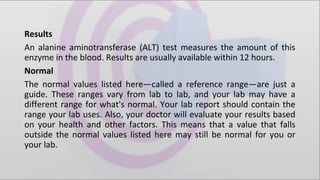
An alanine aminotransferase (ALT) test measures the amount of this
enzyme in the blood. Results are usually available within 12 hours.
Normal
The normal values listed here—called a reference range—are just a
guide. These ranges vary from lab to lab, and your lab may have a
different range for what's normal. Your lab report should contain the
range your lab uses. Also, your doctor will evaluate your results based
on your health and other factors. This means that a value that falls
outside the normal values listed here may still be normal for you or
your lab.
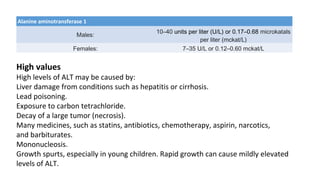
Alanine aminotransferase 1
Males:
10–40 units per liter (U/L) or 0.17–0.68 microkatals
per liter (mckat/L)
Females: 7–35 U/L or 0.12–0.60 mckat/L
High values
High levels of ALT may be caused by:
Liver damage from conditions such as hepatitis or cirrhosis.
Lead poisoning.
Exposure to carbon tetrachloride.
Decay of a large tumor (necrosis).
Many medicines, such as statins, antibiotics, chemotherapy, aspirin, narcotics,
and barbiturates.
Mononucleosis.
Growth spurts, especially in young children. Rapid growth can cause mildly elevated
levels of ALT.
Gamma-Glutamyl Transpeptidase
The gamma-glutamyl transferase (GGT) test may be used to
determine the cause of elevated alkaline phosphatase (ALP).
Both ALP and GGT are elevated in disease of the bile ducts
and in some liver diseases, but only ALP will be elevated in
bone disease. Therefore, if the GGT level is normal in a person
with a high ALP, the cause of the elevated ALP is most likely
bone disease.
How It Is Done
The health professional drawing your blood
Result
An elevated GGT level suggests that something is damaging the liver
but does not indicate specifically what. In general, the higher the level,
the greater the "insult" – or damage – to the liver. Elevated levels may
be due to liver diseases, such as hepatitis or cirrhosis, but they may
also be due to other conditions, such as congestive heart
failure, diabetes, or pancreatitis. They may also be caused by alcohol
abuse or use of drugs that are toxic to the liver.
A low or normal GGT test result indicates that it is unlikely that a
person has liver disease or has consumed any alcohol.
A high GGT level can help rule out bone disease as the cause of an
increased ALP level, but if GGT is low or normal, then an increased ALP
is more likely due to bone disease.
Alkaline Phosphatase (ALP)
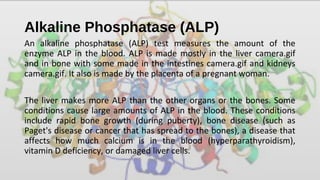
An alkaline phosphatase (ALP) test measures the amount of the
enzyme ALP in the blood. ALP is made mostly in the liver camera.gif
and in bone with some made in the intestines camera.gif and kidneys
camera.gif. It also is made by the placenta of a pregnant woman.
The liver makes more ALP than the other organs or the bones. Some
conditions cause large amounts of ALP in the blood. These conditions
include rapid bone growth (during puberty), bone disease (such as
Paget's disease or cancer that has spread to the bones), a disease that
affects how much calcium is in the blood (hyperparathyroidism),
vitamin D deficiency, or damaged liver cells.
How It Is Done
The health professional drawing your blood
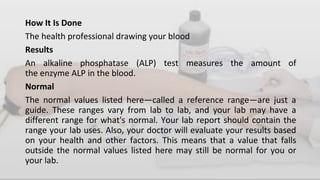
Results
An alkaline phosphatase (ALP) test measures the amount of
the enzyme ALP in the blood.
Normal
The normal values listed here—called a reference range—are just a
guide. These ranges vary from lab to lab, and your lab may have a
different range for what's normal. Your lab report should contain the
range your lab uses. Also, your doctor will evaluate your results based
on your health and other factors. This means that a value that falls
outside the normal values listed here may still be normal for you or
your lab.
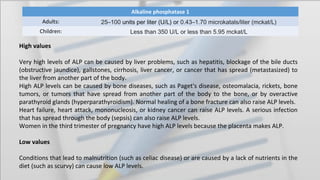
Alkaline phosphatase 1
Adults: 25–100 units per liter (U/L) or 0.43–1.70 microkatals/liter (mckat/L)
Children: Less than 350 U/L or less than 5.95 mckat/L
High values
Very high levels of ALP can be caused by liver problems, such as hepatitis, blockage of the bile ducts
(obstructive jaundice), gallstones, cirrhosis, liver cancer, or cancer that has spread (metastasized) to
the liver from another part of the body.
High ALP levels can be caused by bone diseases, such as Paget's disease, osteomalacia, rickets, bone
tumors, or tumors that have spread from another part of the body to the bone, or by overactive
parathyroid glands (hyperparathyroidism). Normal healing of a bone fracture can also raise ALP levels.
Heart failure, heart attack, mononucleosis, or kidney cancer can raise ALP levels. A serious infection
that has spread through the body (sepsis) can also raise ALP levels.
Women in the third trimester of pregnancy have high ALP levels because the placenta makes ALP.
Low values
Conditions that lead to malnutrition (such as celiac disease) or are caused by a lack of nutrients in the
diet (such as scurvy) can cause low ALP levels.
Prepared by:
Mercado, Princess Cate R.
Alejandrino, Ma. Lourdes F.
Aspillaga, Liezel

Chapter 4 enzymes and vitamins

  • 2.
    What is MedicalTechnology ? Medical Technology, which is a proper subset of health technology, encompasses a wide range of healthcare products and is used to diagnose, monitor or treat diseases or medical conditions affecting humans.
  • 3.
    What is MedicalTechnologists ? Medical Technologists, also known as clinical laboratory technologists, perform and analyze the results of complex scientific tests on blood and body fluids.
  • 4.
    What is Enzymesand Vitamins used for in the human body? Enzymes are macromolecular biological catalysts. They are responsible  for  thousands  of metabolic  processes that  sustain  life.  Enzymes  are  highly  selective catalysts,  greatly  accelerating  both  the  rate  and  specificity of metabolic chemical reactions, from the digestion of food  to the synthesis of DNA.  While,  Vitamins  are  organic  compounds  which  are  needed  in  small  quantities  to  sustain  life.  We  get  vitamins  from  food,  because  the  human body either does not produce enough of them, or none at all.
  • 5.
    ENZYMES AND VITAMINS INRELATION TO MEDICAL TECHNOLOGY Blood Test Lactate Dehydrogenase (LDH) Creatine Phosphokinase (CPK) Aspartate Transaminase (AST) Alanine Transaminase (ALT) Gamma-Glutamyl Transpeptidase (GGTP) Alkaline Phosphatase (ALP) THE FOLLOWING ARE SOME OF THE TESTS PERFORMED BY  MEDICAL TECHNOLOGISTS  INVOLVING CARBOHYDRATES:
  • 6.
    Lactate dehydrogenase (alsocalled lactic acid dehydrogenase, or LDH) is an enzyme found in almost all body tissues. It plays an important role in cellular respiration, the process by which glucose (sugar) from food is converted into usable energy for our cells. The LDH test is generally used to screen for tissue damage. This damage may be acute (as in the case of a traumatic injury) or chronic (due to a long-term condition such as liver disease or certain types of anemia). It also may be used to monitor progressive conditions, such as muscular dystrophy and HIV.
  • 7.
    The Procedure A healthprofessional will usually draw the blood from a vein. For an infant, the blood may be obtained by puncturing the heel with a small needle (lancet). Collecting the blood for the test will only take a few minutes. Results Lactic acid dehydrogenase (LDH) is an enzyme that helps produce energy. Results may vary widely from lab to lab. Normal LDH levels range from 140 units per liter (U/L) to 280 U/L or 2.34 mkat/L to 4.68 mkat/L.
  • 8.
    Creatine Phosphokinase (CPK) Creatinephosphokinase (a.k.a., creatine kinase, CPK, or CK) is an enzyme (a protein that helps to elicit chemical changes in your body) found in your heart, brain, and skeletal muscles. When muscle tissue is damaged, CPK leaks into your blood. Therefore, high levels of CPK usually indicate some sort of stress or injury to your heart or other muscles. To test CPK, blood is drawn from a vein in your arm. Normal Results Total CPK normal values: 10 - 120 micrograms per liter (mcg/L) Normal value ranges may vary slightly among different laboratories. Some labs use different measurements or test different samples. Talk to your doctor about the meaning of your specific test results.
  • 9.
    Aspartate Transaminase (AST) Anaspartate aminotransferase (AST) test is often part of an initial screening for liver disease. AST is found in many tissues throughout the body, including the liver, heart, muscles, kidney, and brain. If any of these organs or tissues is affected by disease or injury, AST is released into the bloodstream. This means that AST isn't as specific an indicator of liver damage as ALT (also known as alanine aminotransferase, another type of enzyme found almost entirely in the liver). However, when doctors look at blood levels of AST - especially in relation to the amounts of other liver enzymes - they can get important information about the liver and whether a disease, inflammation, drug, or other problem is affecting it.
  • 10.
    The Procedure A healthprofessional will usually draw the blood from a vein. For an infant, the blood may be obtained by puncturing the heel with a small needle (lancet). Collecting the blood for the test will only take a few minutes. Getting the Results The blood sample will be processed by a machine. The results are usually reported within a few hours or the next day. If the results seem to point to liver damage or disease, further testing may be necessary to determine what's causing the problem and how to treat it.
  • 11.
    Alanine Transaminase (ALT) ALTis measured to see if the liver is damaged or diseased. Low levels of ALT are normally found in the blood. But when the liver is damaged or diseased, it releases ALT into the bloodstream, which makes ALT levels go up. Most increases in ALT levels are caused by liver damage. How It Is Done The health professional taking a sample of your blood
  • 12.
    Results An alanine aminotransferase(ALT) test measures the amount of this enzyme in the blood. Results are usually available within 12 hours. Normal The normal values listed here—called a reference range—are just a guide. These ranges vary from lab to lab, and your lab may have a different range for what's normal. Your lab report should contain the range your lab uses. Also, your doctor will evaluate your results based on your health and other factors. This means that a value that falls outside the normal values listed here may still be normal for you or your lab.
  • 13.
    Alanine aminotransferase 1 Males: 10–40 unitsper liter (U/L) or 0.17–0.68 microkatals per liter (mckat/L) Females: 7–35 U/L or 0.12–0.60 mckat/L High values High levels of ALT may be caused by: Liver damage from conditions such as hepatitis or cirrhosis. Lead poisoning. Exposure to carbon tetrachloride. Decay of a large tumor (necrosis). Many medicines, such as statins, antibiotics, chemotherapy, aspirin, narcotics, and barbiturates. Mononucleosis. Growth spurts, especially in young children. Rapid growth can cause mildly elevated levels of ALT.
  • 14.
    Gamma-Glutamyl Transpeptidase The gamma-glutamyltransferase (GGT) test may be used to determine the cause of elevated alkaline phosphatase (ALP). Both ALP and GGT are elevated in disease of the bile ducts and in some liver diseases, but only ALP will be elevated in bone disease. Therefore, if the GGT level is normal in a person with a high ALP, the cause of the elevated ALP is most likely bone disease. How It Is Done The health professional drawing your blood
  • 15.
    Result An elevated GGTlevel suggests that something is damaging the liver but does not indicate specifically what. In general, the higher the level, the greater the "insult" – or damage – to the liver. Elevated levels may be due to liver diseases, such as hepatitis or cirrhosis, but they may also be due to other conditions, such as congestive heart failure, diabetes, or pancreatitis. They may also be caused by alcohol abuse or use of drugs that are toxic to the liver. A low or normal GGT test result indicates that it is unlikely that a person has liver disease or has consumed any alcohol. A high GGT level can help rule out bone disease as the cause of an increased ALP level, but if GGT is low or normal, then an increased ALP is more likely due to bone disease.
  • 16.
    Alkaline Phosphatase (ALP) Analkaline phosphatase (ALP) test measures the amount of the enzyme ALP in the blood. ALP is made mostly in the liver camera.gif and in bone with some made in the intestines camera.gif and kidneys camera.gif. It also is made by the placenta of a pregnant woman. The liver makes more ALP than the other organs or the bones. Some conditions cause large amounts of ALP in the blood. These conditions include rapid bone growth (during puberty), bone disease (such as Paget's disease or cancer that has spread to the bones), a disease that affects how much calcium is in the blood (hyperparathyroidism), vitamin D deficiency, or damaged liver cells.
  • 17.
    How It IsDone The health professional drawing your blood Results An alkaline phosphatase (ALP) test measures the amount of the enzyme ALP in the blood. Normal The normal values listed here—called a reference range—are just a guide. These ranges vary from lab to lab, and your lab may have a different range for what's normal. Your lab report should contain the range your lab uses. Also, your doctor will evaluate your results based on your health and other factors. This means that a value that falls outside the normal values listed here may still be normal for you or your lab.
  • 18.
    Alkaline phosphatase 1 Adults:25–100 units per liter (U/L) or 0.43–1.70 microkatals/liter (mckat/L) Children: Less than 350 U/L or less than 5.95 mckat/L High values Very high levels of ALP can be caused by liver problems, such as hepatitis, blockage of the bile ducts (obstructive jaundice), gallstones, cirrhosis, liver cancer, or cancer that has spread (metastasized) to the liver from another part of the body. High ALP levels can be caused by bone diseases, such as Paget's disease, osteomalacia, rickets, bone tumors, or tumors that have spread from another part of the body to the bone, or by overactive parathyroid glands (hyperparathyroidism). Normal healing of a bone fracture can also raise ALP levels. Heart failure, heart attack, mononucleosis, or kidney cancer can raise ALP levels. A serious infection that has spread through the body (sepsis) can also raise ALP levels. Women in the third trimester of pregnancy have high ALP levels because the placenta makes ALP. Low values Conditions that lead to malnutrition (such as celiac disease) or are caused by a lack of nutrients in the diet (such as scurvy) can cause low ALP levels.
  • 19.
    Prepared by: Mercado, PrincessCate R. Alejandrino, Ma. Lourdes F. Aspillaga, Liezel