Chapter 4
Data structures
Chapter about..
• Elementary data structures
• Hash tables
• Binary search trees
• Red black trees
• Augmenting data structures
Elementary data structures
• Stacks and queues
• Linked lists
• Implementing pointers and objects
• Binary trees
• Representing rooted trees
• The representation of dynamic sets by simple
data structures that use pointers.
• Complex data structures can be fashioned
using pointers.
Stacks and queues
• In a stack, the element deleted from the set is
the one most recently inserted: the stack
implements a last-in, first-out, or LIFO, policy.
• In a queue , the element deleted is always the
one that has been in the set for the longest
time: the queue implements a first-in, first-
out, or FIFO, policy.
Stacks
• INSERT operation on a stack  PUSH
• DELETE operation POP.
• top[S] that indexes the most recently inserted
element.
• The stack consists of elements S[1..top[S]], where
S[1] is the element at the bottom of the stack and
S[top[S]] is the element at the top.
• When top [S] = 0, the stack contains no elements
and is empty
• If an empty stack is popped, stack underflows,
which is normally an error.
• If top[S] exceeds n, the stack overflows.
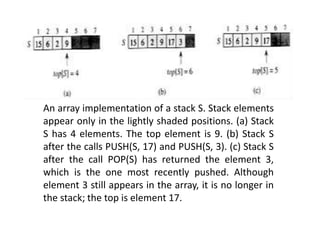
An array implementation of a stack S. Stack elements
appear only in the lightly shaded positions. (a) Stack
S has 4 elements. The top element is 9. (b) Stack S
after the calls PUSH(S, 17) and PUSH(S, 3). (c) Stack S
after the call POP(S) has returned the element 3,
which is the one most recently pushed. Although
element 3 still appears in the array, it is no longer in
the stack; the top is element 17.
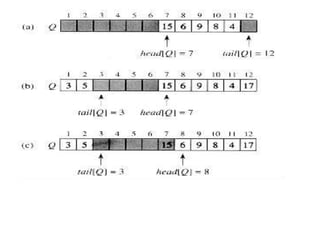
Queue
INSERT operation on a queue ENQUEUE,
DELETE operation DEQUEUE; like the stack
operation POP, DEQUEUE takes no element
argument.
The FIFO property of a queue causes it to
operate like a line of people in the registrar's
office. The queue has a head and a tail
Linked lists
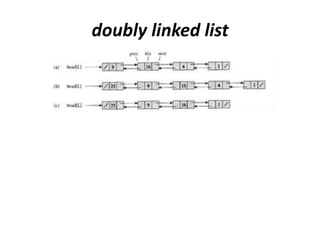
• A linked list is a data structure in which the
objects are arranged in a linear order.
• Unlike an array, though, in which the linear
order is determined by the array indices, the
order in a linked list is determined by a pointer
in each object.
• Linked lists provide a simple, flexible
representation for dynamic sets
doubly linked list
Hash Table
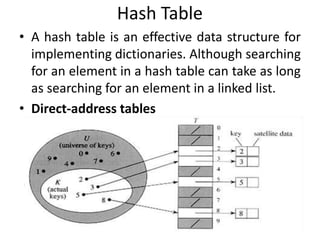
• A hash table is an effective data structure for
implementing dictionaries. Although searching
for an element in a hash table can take as long
as searching for an element in a linked list.
• Direct-address tables
• Hash tables are a common approach to the
storing/searching problem.
What is a Hash Table ?
 Each record has a special
field, called its key.
 In this example, the key is a
long integer field called
Number.
[ 0 ] [ 1 ] [ 2 ] [ 3 ] [ 4 ] [ 5 ]
. . .
[ 700]
[ 4 ]
Number 506643548
 Each record has a special
field, called its key.
 In this example, the key is a
long integer field called
Number.
 Each record has a special
field, called its key.
 In this example, the key is a
long integer field called
Number.
Collisions
 This is called a collision,
because there is already
another valid record at [2].
[ 0 ] [ 1 ] [ 2 ] [ 3 ] [ 4 ] [ 5 ] [ 700]
Number 506643548
Number 233667136
Number 281942902
Number 155778322
. . .
Number 580625685
Number 701466868
When a collision
occurs,
move forward until you
find an empty spot.
Hash functions
 uniform hashing
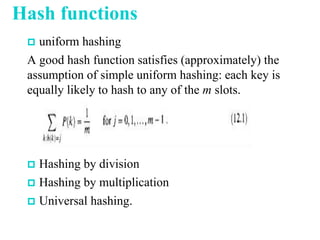
A good hash function satisfies (approximately) the
assumption of simple uniform hashing: each key is
equally likely to hash to any of the m slots.
 Hashing by division
 Hashing by multiplication
 Universal hashing.
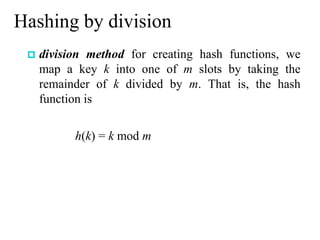
Hashing by division
 division method for creating hash functions, we
map a key k into one of m slots by taking the
remainder of k divided by m. That is, the hash
function is
h(k) = k mod m
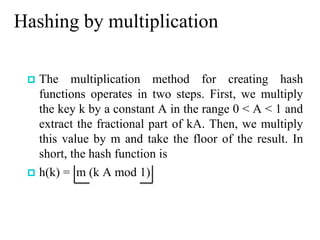
Hashing by multiplication
 The multiplication method for creating hash
functions operates in two steps. First, we multiply
the key k by a constant A in the range 0 < A < 1 and
extract the fractional part of kA. Then, we multiply
this value by m and take the floor of the result. In
short, the hash function is
 h(k) = m (k A mod 1)
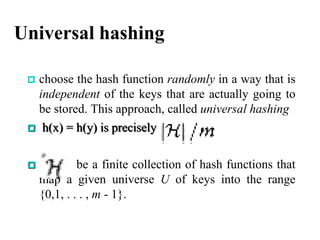
Universal hashing
 choose the hash function randomly in a way that is
independent of the keys that are actually going to
be stored. This approach, called universal hashing
 h(x) = h(y) is precisely
 be a finite collection of hash functions that
map a given universe U of keys into the range
{0,1, . . . , m - 1}.
BINARY SEARCH TREES
 Search trees are data structures that support many
dynamic-set operations, including
 SEARCH,
 MINIMUM,
 MAXIMUM,
 PREDECESSOR,
 SUCCESSOR,
 INSERT, and DELETE.
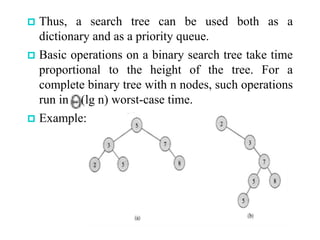
 Thus, a search tree can be used both as a
dictionary and as a priority queue.
 Basic operations on a binary search tree take time
proportional to the height of the tree. For a
complete binary tree with n nodes, such operations
run in (lg n) worst-case time.
 Example:
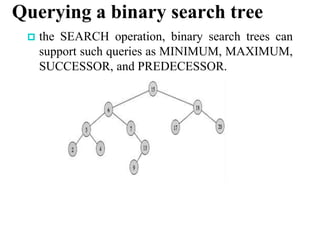
Querying a binary search tree
 the SEARCH operation, binary search trees can
support such queries as MINIMUM, MAXIMUM,
SUCCESSOR, and PREDECESSOR.
RED-BLACK TREES
 the set operations are fast if the height of the
search tree is small; but if its height is large, their
performance may be no better than with a linked
list.
 Red-black trees are one of many search-tree
schemes that are "balance" in order to guarantee
that basic dynamic-set operations take O(lg n)
time in the worst case.
Properties of red-black trees
Each node of the tree now contains the fields color,
key, left, right, and p.
If a child or the parent of a node does not exist, the
corresponding pointer field of the node contains the
value NIL.
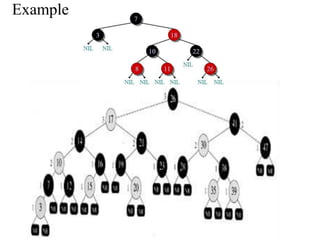
red-black properties:
1) Every node has a color either red or black.
2) Root of tree is always black.
3) There are no two adjacent red nodes (A red node
cannot have a red parent or red child).
4) Every path from root to a NULL node has same
number of black nodes
Example
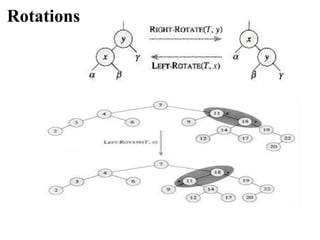
Rotations
AUGMENTING DATA STRUCTURES
It introduced the notion of Dynamic order
statistics
size[x] = size[left[x]] + size[right[x]] + 1 .

Chapter 4.pptx

  • 1.
  • 2.
    Chapter about.. • Elementarydata structures • Hash tables • Binary search trees • Red black trees • Augmenting data structures
  • 3.
    Elementary data structures •Stacks and queues • Linked lists • Implementing pointers and objects • Binary trees • Representing rooted trees • The representation of dynamic sets by simple data structures that use pointers. • Complex data structures can be fashioned using pointers.
  • 4.
    Stacks and queues •In a stack, the element deleted from the set is the one most recently inserted: the stack implements a last-in, first-out, or LIFO, policy. • In a queue , the element deleted is always the one that has been in the set for the longest time: the queue implements a first-in, first- out, or FIFO, policy.
  • 5.
    Stacks • INSERT operationon a stack  PUSH • DELETE operation POP. • top[S] that indexes the most recently inserted element. • The stack consists of elements S[1..top[S]], where S[1] is the element at the bottom of the stack and S[top[S]] is the element at the top. • When top [S] = 0, the stack contains no elements and is empty • If an empty stack is popped, stack underflows, which is normally an error. • If top[S] exceeds n, the stack overflows.
  • 6.
    An array implementationof a stack S. Stack elements appear only in the lightly shaded positions. (a) Stack S has 4 elements. The top element is 9. (b) Stack S after the calls PUSH(S, 17) and PUSH(S, 3). (c) Stack S after the call POP(S) has returned the element 3, which is the one most recently pushed. Although element 3 still appears in the array, it is no longer in the stack; the top is element 17.
  • 7.
    Queue INSERT operation ona queue ENQUEUE, DELETE operation DEQUEUE; like the stack operation POP, DEQUEUE takes no element argument. The FIFO property of a queue causes it to operate like a line of people in the registrar's office. The queue has a head and a tail
  • 9.
    Linked lists • Alinked list is a data structure in which the objects are arranged in a linear order. • Unlike an array, though, in which the linear order is determined by the array indices, the order in a linked list is determined by a pointer in each object. • Linked lists provide a simple, flexible representation for dynamic sets
  • 10.
  • 11.
    Hash Table • Ahash table is an effective data structure for implementing dictionaries. Although searching for an element in a hash table can take as long as searching for an element in a linked list. • Direct-address tables
  • 12.
    • Hash tablesare a common approach to the storing/searching problem.
  • 13.
    What is aHash Table ?  Each record has a special field, called its key.  In this example, the key is a long integer field called Number. [ 0 ] [ 1 ] [ 2 ] [ 3 ] [ 4 ] [ 5 ] . . . [ 700] [ 4 ] Number 506643548  Each record has a special field, called its key.  In this example, the key is a long integer field called Number.  Each record has a special field, called its key.  In this example, the key is a long integer field called Number.
  • 14.
    Collisions  This iscalled a collision, because there is already another valid record at [2]. [ 0 ] [ 1 ] [ 2 ] [ 3 ] [ 4 ] [ 5 ] [ 700] Number 506643548 Number 233667136 Number 281942902 Number 155778322 . . . Number 580625685 Number 701466868 When a collision occurs, move forward until you find an empty spot.
  • 15.
    Hash functions  uniformhashing A good hash function satisfies (approximately) the assumption of simple uniform hashing: each key is equally likely to hash to any of the m slots.  Hashing by division  Hashing by multiplication  Universal hashing.
  • 16.
    Hashing by division division method for creating hash functions, we map a key k into one of m slots by taking the remainder of k divided by m. That is, the hash function is h(k) = k mod m
  • 17.
    Hashing by multiplication The multiplication method for creating hash functions operates in two steps. First, we multiply the key k by a constant A in the range 0 < A < 1 and extract the fractional part of kA. Then, we multiply this value by m and take the floor of the result. In short, the hash function is  h(k) = m (k A mod 1)
  • 18.
    Universal hashing  choosethe hash function randomly in a way that is independent of the keys that are actually going to be stored. This approach, called universal hashing  h(x) = h(y) is precisely  be a finite collection of hash functions that map a given universe U of keys into the range {0,1, . . . , m - 1}.
  • 19.
    BINARY SEARCH TREES Search trees are data structures that support many dynamic-set operations, including  SEARCH,  MINIMUM,  MAXIMUM,  PREDECESSOR,  SUCCESSOR,  INSERT, and DELETE.
  • 20.
     Thus, asearch tree can be used both as a dictionary and as a priority queue.  Basic operations on a binary search tree take time proportional to the height of the tree. For a complete binary tree with n nodes, such operations run in (lg n) worst-case time.  Example:
  • 21.
    Querying a binarysearch tree  the SEARCH operation, binary search trees can support such queries as MINIMUM, MAXIMUM, SUCCESSOR, and PREDECESSOR.
  • 22.
    RED-BLACK TREES  theset operations are fast if the height of the search tree is small; but if its height is large, their performance may be no better than with a linked list.  Red-black trees are one of many search-tree schemes that are "balance" in order to guarantee that basic dynamic-set operations take O(lg n) time in the worst case.
  • 23.
    Properties of red-blacktrees Each node of the tree now contains the fields color, key, left, right, and p. If a child or the parent of a node does not exist, the corresponding pointer field of the node contains the value NIL. red-black properties: 1) Every node has a color either red or black. 2) Root of tree is always black. 3) There are no two adjacent red nodes (A red node cannot have a red parent or red child). 4) Every path from root to a NULL node has same number of black nodes
  • 24.
  • 25.
  • 26.
    AUGMENTING DATA STRUCTURES Itintroduced the notion of Dynamic order statistics size[x] = size[left[x]] + size[right[x]] + 1 .